
Chapter 9 Sequences Series and Probability Larson Precalculus
Chapter 9 Sequences, Series, and Probability Larson, Precalculus, 10 th Edition. © 2018 Cengage. All Rights Reserved. May not be scanned, copied or duplicated, or posted to a publicly accessible website, in whole or in part.
9. 7 Probability Larson, Precalculus, 10 th Edition. © 2018 Cengage. All Rights Reserved. May not be scanned, copied or duplicated, or posted to a publicly accessible website, in whole or in part.
Objectives • • Find the probabilities of events. Find the probabilities of mutually exclusive events. Find the probabilities of independent events. Find the probability of the complement of an event. Larson, Precalculus, 10 th Edition. © 2018 Cengage. All Rights Reserved. May not be scanned, copied or duplicated, or posted to a publicly accessible website, in whole or in part.
The Probability of an Event Larson, Precalculus, 10 th Edition. © 2018 Cengage. All Rights Reserved. May not be scanned, copied or duplicated, or posted to a publicly accessible website, in whole or in part.
The Probability of an Event (1 of 5) Any happening for which the result is uncertain is called an experiment. The possible results of the experiment are outcomes, the set of all possible outcomes of the experiment is the sample space of the experiment, and any sub collection of a sample space is an event. Larson, Precalculus, 10 th Edition. © 2018 Cengage. All Rights Reserved. May not be scanned, copied or duplicated, or posted to a publicly accessible website, in whole or in part.
The Probability of an Event (2 of 5) For instance, when you toss a six-sided die, the numbers 1 through 6 can represent the sample space. For this experiment, each of the outcomes is equally likely. To describe sample spaces in such a way that each outcome is equally likely, you must sometimes distinguish between or among various outcomes in ways that appear artificial. Larson, Precalculus, 10 th Edition. © 2018 Cengage. All Rights Reserved. May not be scanned, copied or duplicated, or posted to a publicly accessible website, in whole or in part.
The Probability of an Event (3 of 5) To calculate the probability of an event, count the number of outcomes in the event and in the sample space. The number of outcomes in event E is denoted by n(E), and the number of outcomes in the sample space S is denoted by n(S). The probability that event E will occur is given by The Probability of an Event If an event E has n(E) equally likely outcomes and its sample space S has n(S) equally likely outcomes, then the probability of event E is Larson, Precalculus, 10 th Edition. © 2018 Cengage. All Rights Reserved. May not be scanned, copied or duplicated, or posted to a publicly accessible website, in whole or in part.

The Probability of an Event (4 of 5) Because the number of outcomes in an event must be less than or equal to the number of outcomes in the sample space, the probability of an event must be a number between 0 and 1. That is, 0 ≤ P(E) ≤ 1 as indicated in Figure 9. 3 Larson, Precalculus, 10 th Edition. © 2018 Cengage. All Rights Reserved. May not be scanned, copied or duplicated, or posted to a publicly accessible website, in whole or in part.
The Probability of an Event (5 of 5) If P(E) = 0, then event E cannot occur, and E is called an impossible event. If P(E) = 1, event E must occur, and E is called a certain event. Larson, Precalculus, 10 th Edition. © 2018 Cengage. All Rights Reserved. May not be scanned, copied or duplicated, or posted to a publicly accessible website, in whole or in part.
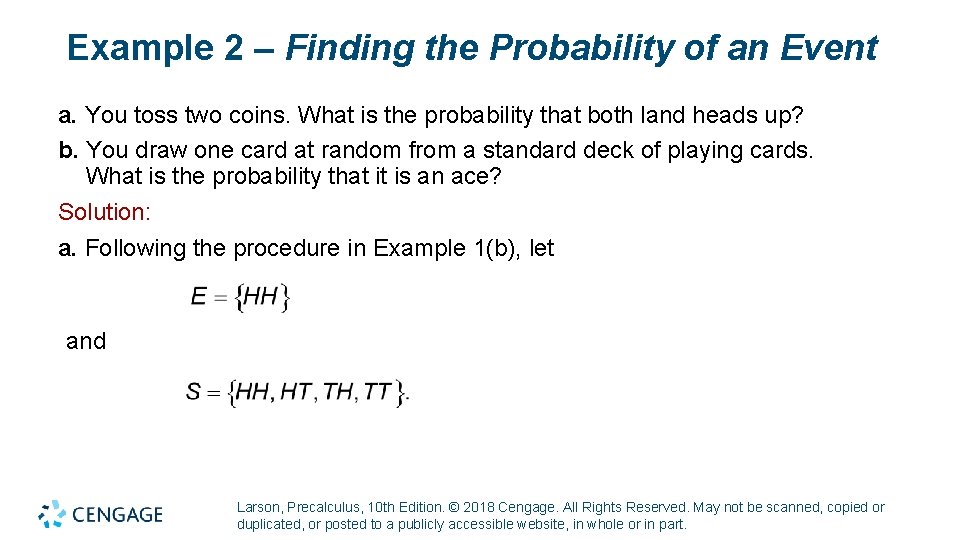
Example 2 – Finding the Probability of an Event a. You toss two coins. What is the probability that both land heads up? b. You draw one card at random from a standard deck of playing cards. What is the probability that it is an ace? Solution: a. Following the procedure in Example 1(b), let and Larson, Precalculus, 10 th Edition. © 2018 Cengage. All Rights Reserved. May not be scanned, copied or duplicated, or posted to a publicly accessible website, in whole or in part.
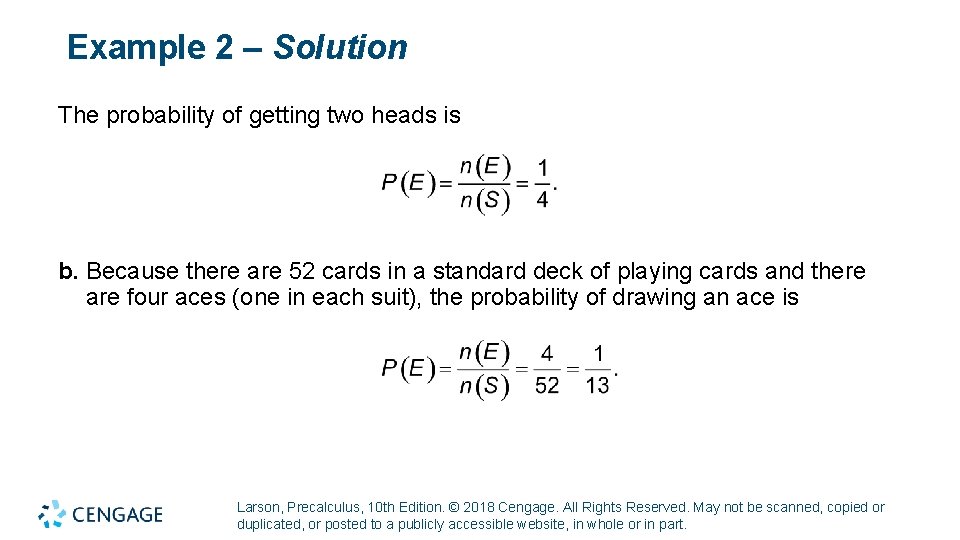
Example 2 – Solution The probability of getting two heads is b. Because there are 52 cards in a standard deck of playing cards and there are four aces (one in each suit), the probability of drawing an ace is Larson, Precalculus, 10 th Edition. © 2018 Cengage. All Rights Reserved. May not be scanned, copied or duplicated, or posted to a publicly accessible website, in whole or in part.

Mutually Exclusive Events Larson, Precalculus, 10 th Edition. © 2018 Cengage. All Rights Reserved. May not be scanned, copied or duplicated, or posted to a publicly accessible website, in whole or in part.
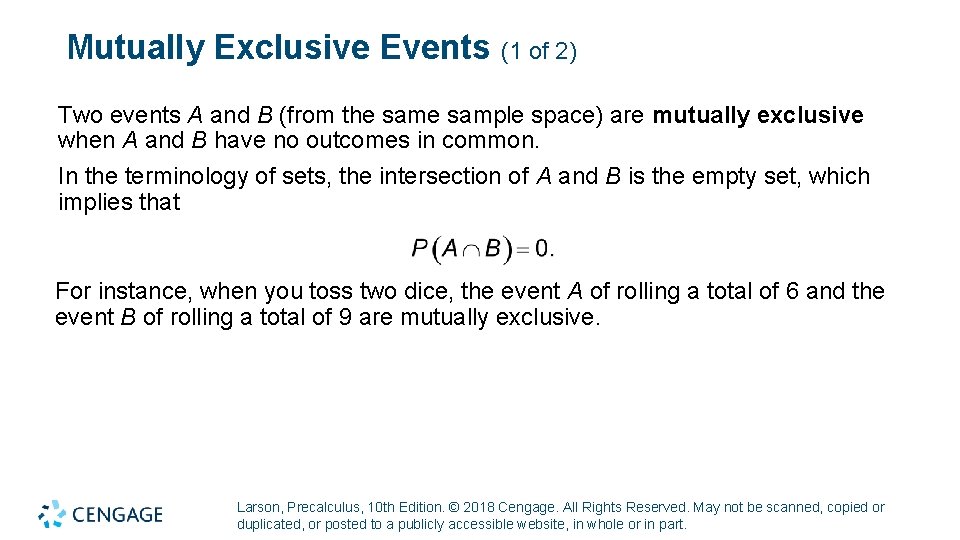
Mutually Exclusive Events (1 of 2) Two events A and B (from the sample space) are mutually exclusive when A and B have no outcomes in common. In the terminology of sets, the intersection of A and B is the empty set, which implies that For instance, when you toss two dice, the event A of rolling a total of 6 and the event B of rolling a total of 9 are mutually exclusive. Larson, Precalculus, 10 th Edition. © 2018 Cengage. All Rights Reserved. May not be scanned, copied or duplicated, or posted to a publicly accessible website, in whole or in part.
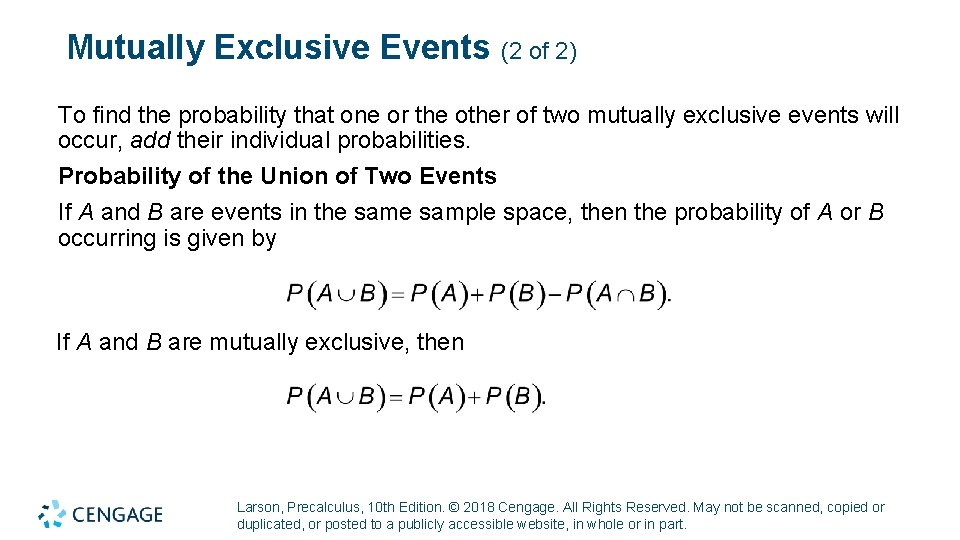
Mutually Exclusive Events (2 of 2) To find the probability that one or the other of two mutually exclusive events will occur, add their individual probabilities. Probability of the Union of Two Events If A and B are events in the sample space, then the probability of A or B occurring is given by If A and B are mutually exclusive, then Larson, Precalculus, 10 th Edition. © 2018 Cengage. All Rights Reserved. May not be scanned, copied or duplicated, or posted to a publicly accessible website, in whole or in part.
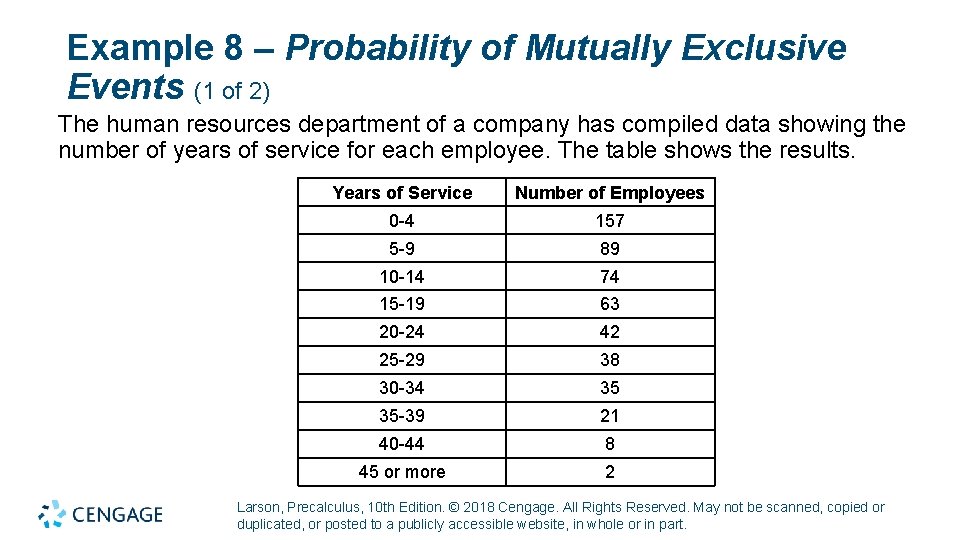
Example 8 – Probability of Mutually Exclusive Events (1 of 2) The human resources department of a company has compiled data showing the number of years of service for each employee. The table shows the results. Years of Service Number of Employees 0 -4 157 5 -9 89 10 -14 74 15 -19 63 20 -24 42 25 -29 38 30 -34 35 35 -39 21 40 -44 8 45 or more 2 Larson, Precalculus, 10 th Edition. © 2018 Cengage. All Rights Reserved. May not be scanned, copied or duplicated, or posted to a publicly accessible website, in whole or in part.
Example 8 – Probability of Mutually Exclusive Events (2 of 2) (a) What is the probability that an employee chosen at random has 4 or fewer years of service? (b) What is the probability that an employee chosen at random has 9 or fewer years of service? Solution: a. To begin, add the number of employees to find that the total is 529. Next, let event A represent choosing an employee with 0 to 4 years of service. Larson, Precalculus, 10 th Edition. © 2018 Cengage. All Rights Reserved. May not be scanned, copied or duplicated, or posted to a publicly accessible website, in whole or in part.
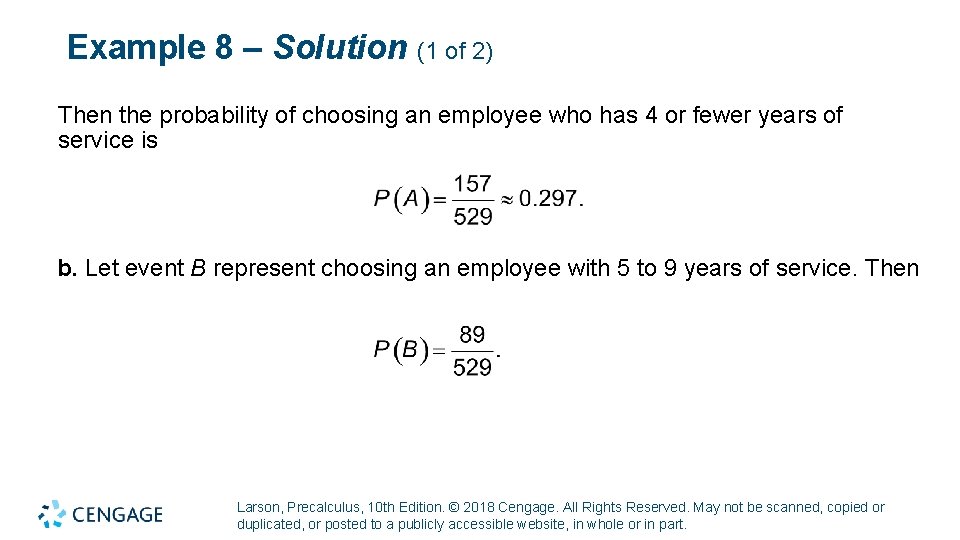
Example 8 – Solution (1 of 2) Then the probability of choosing an employee who has 4 or fewer years of service is b. Let event B represent choosing an employee with 5 to 9 years of service. Then Larson, Precalculus, 10 th Edition. © 2018 Cengage. All Rights Reserved. May not be scanned, copied or duplicated, or posted to a publicly accessible website, in whole or in part.
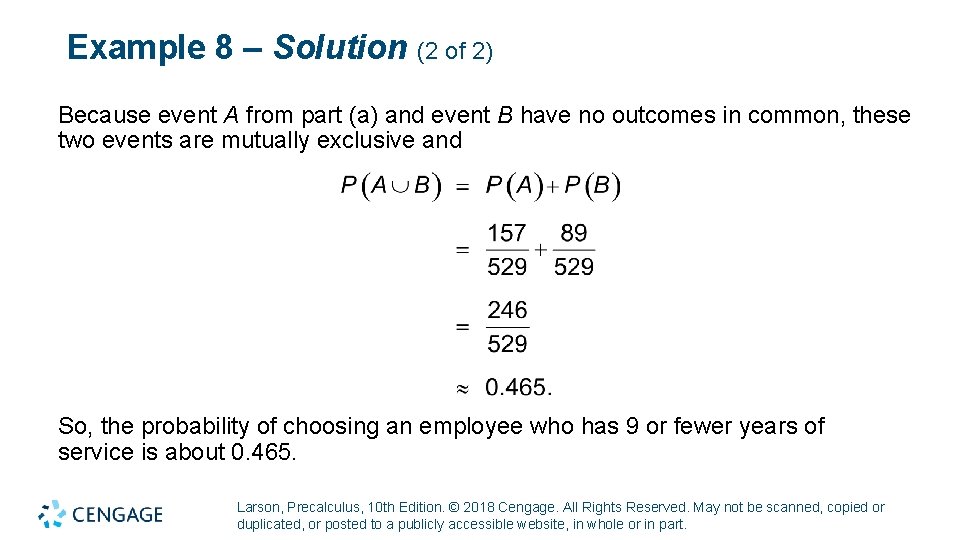
Example 8 – Solution (2 of 2) Because event A from part (a) and event B have no outcomes in common, these two events are mutually exclusive and So, the probability of choosing an employee who has 9 or fewer years of service is about 0. 465. Larson, Precalculus, 10 th Edition. © 2018 Cengage. All Rights Reserved. May not be scanned, copied or duplicated, or posted to a publicly accessible website, in whole or in part.
Independent Events Larson, Precalculus, 10 th Edition. © 2018 Cengage. All Rights Reserved. May not be scanned, copied or duplicated, or posted to a publicly accessible website, in whole or in part.
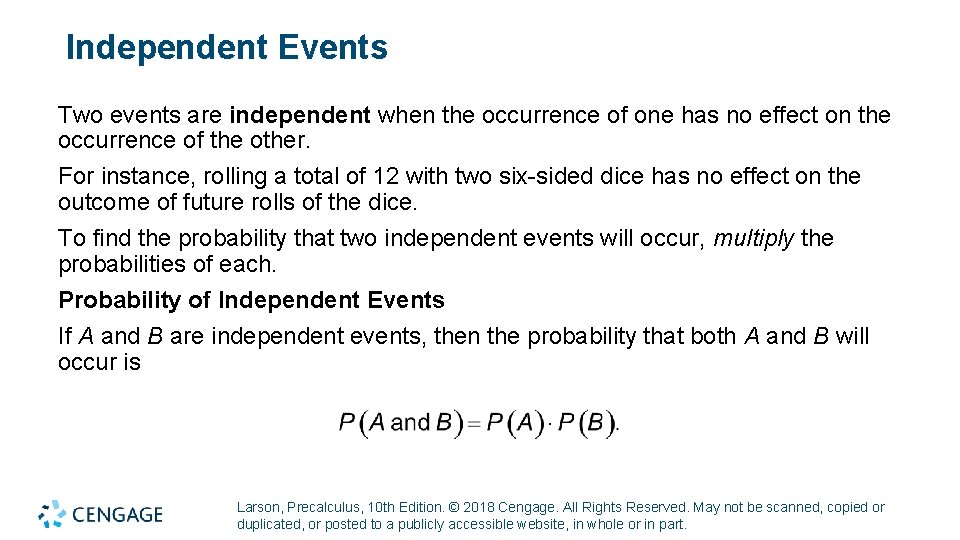
Independent Events Two events are independent when the occurrence of one has no effect on the occurrence of the other. For instance, rolling a total of 12 with two six-sided dice has no effect on the outcome of future rolls of the dice. To find the probability that two independent events will occur, multiply the probabilities of each. Probability of Independent Events If A and B are independent events, then the probability that both A and B will occur is Larson, Precalculus, 10 th Edition. © 2018 Cengage. All Rights Reserved. May not be scanned, copied or duplicated, or posted to a publicly accessible website, in whole or in part.
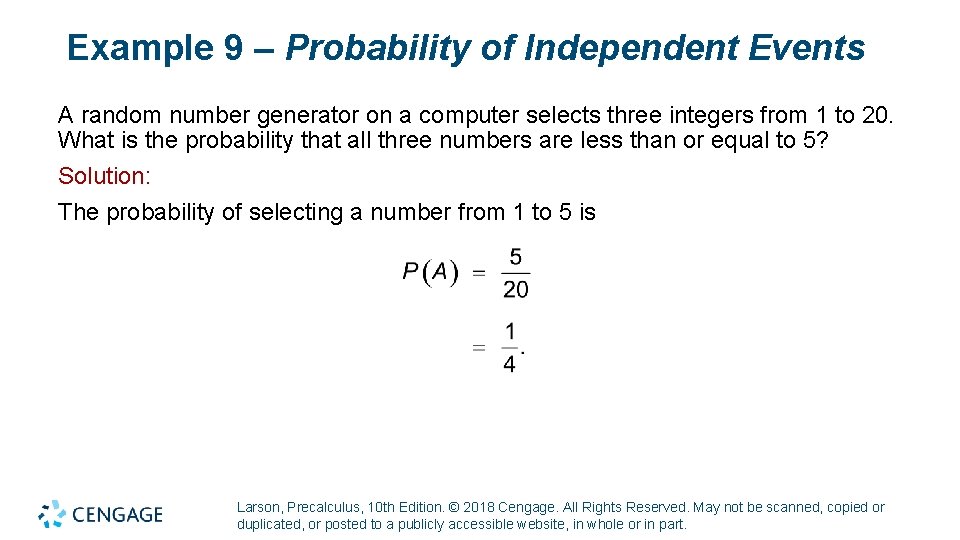
Example 9 – Probability of Independent Events A random number generator on a computer selects three integers from 1 to 20. What is the probability that all three numbers are less than or equal to 5? Solution: The probability of selecting a number from 1 to 5 is Larson, Precalculus, 10 th Edition. © 2018 Cengage. All Rights Reserved. May not be scanned, copied or duplicated, or posted to a publicly accessible website, in whole or in part.
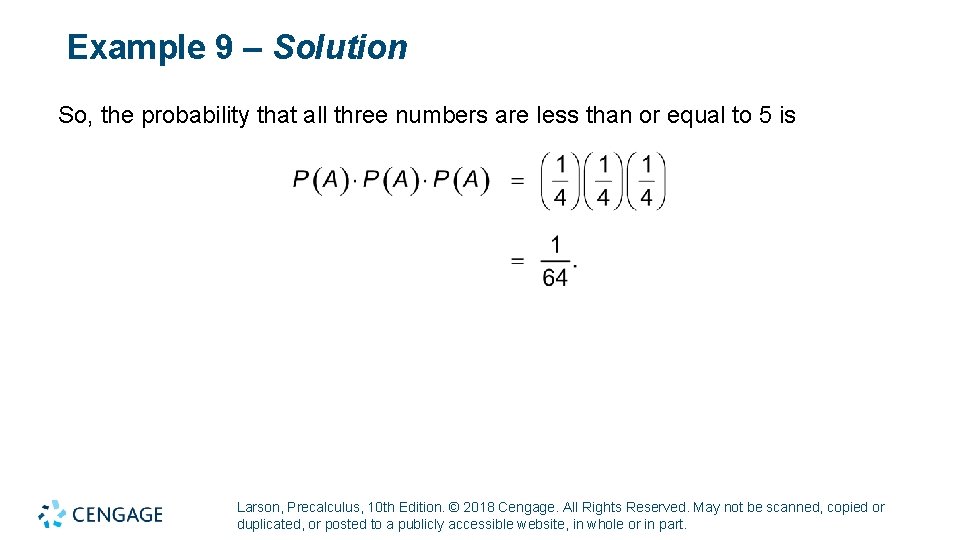
Example 9 – Solution So, the probability that all three numbers are less than or equal to 5 is Larson, Precalculus, 10 th Edition. © 2018 Cengage. All Rights Reserved. May not be scanned, copied or duplicated, or posted to a publicly accessible website, in whole or in part.
The Complement of an Event Larson, Precalculus, 10 th Edition. © 2018 Cengage. All Rights Reserved. May not be scanned, copied or duplicated, or posted to a publicly accessible website, in whole or in part.
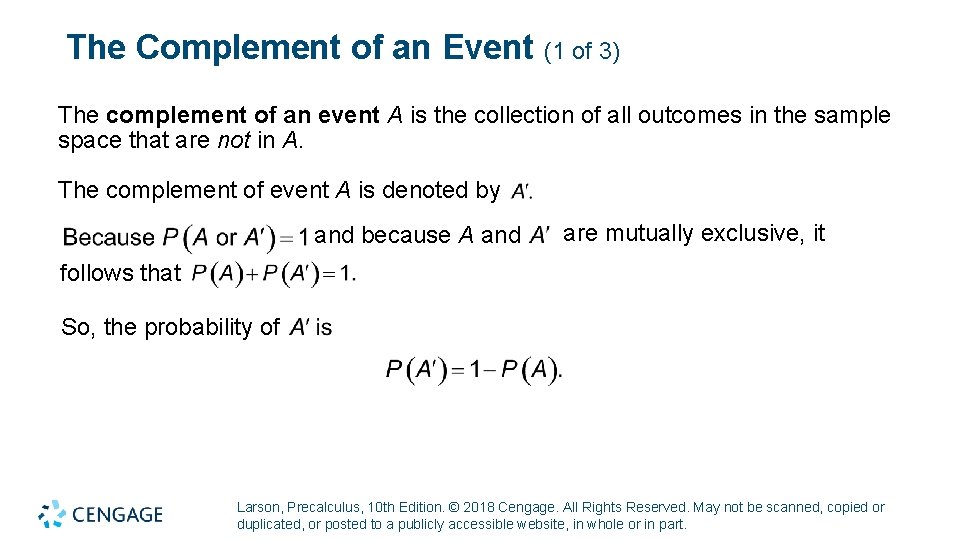
The Complement of an Event (1 of 3) The complement of an event A is the collection of all outcomes in the sample space that are not in A. The complement of event A is denoted by and because A and are mutually exclusive, it follows that So, the probability of Larson, Precalculus, 10 th Edition. © 2018 Cengage. All Rights Reserved. May not be scanned, copied or duplicated, or posted to a publicly accessible website, in whole or in part.
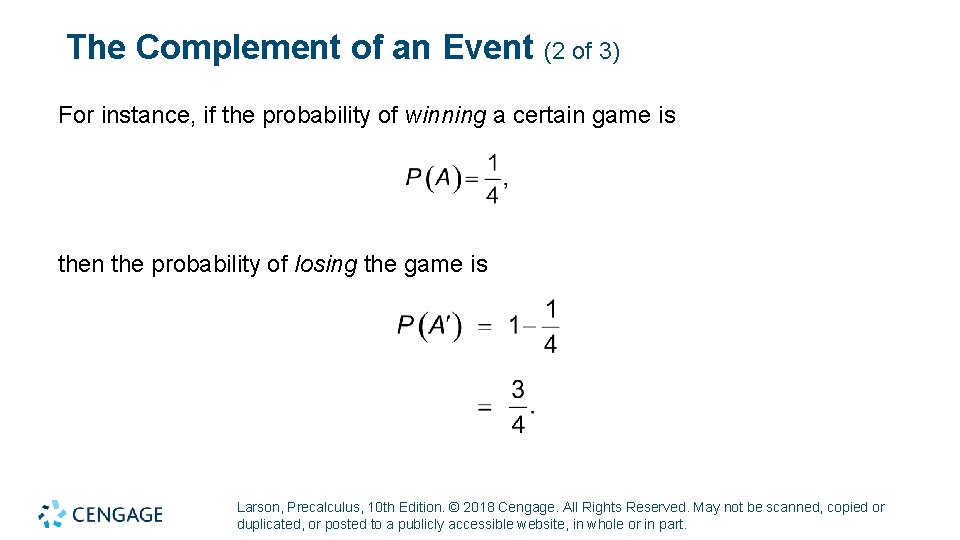
The Complement of an Event (2 of 3) For instance, if the probability of winning a certain game is then the probability of losing the game is Larson, Precalculus, 10 th Edition. © 2018 Cengage. All Rights Reserved. May not be scanned, copied or duplicated, or posted to a publicly accessible website, in whole or in part.
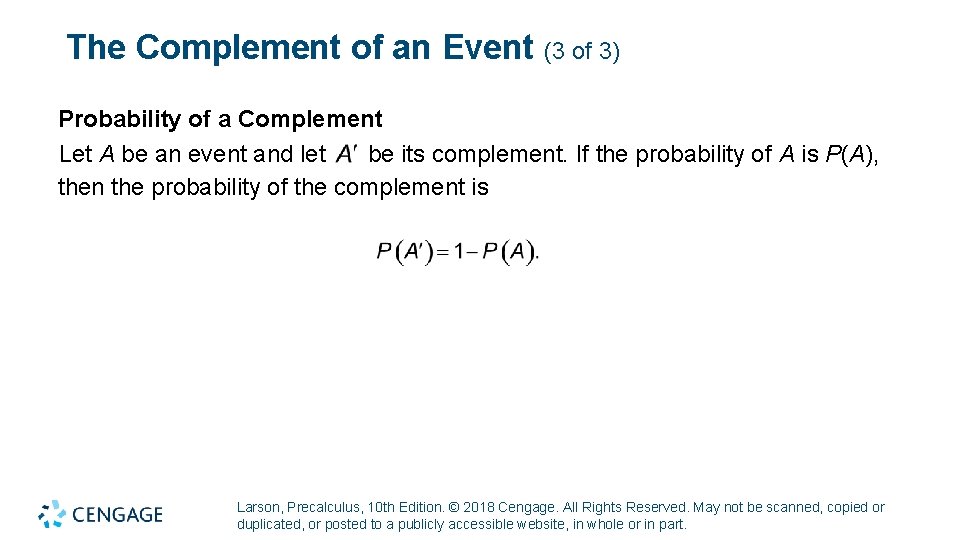
The Complement of an Event (3 of 3) Probability of a Complement Let A be an event and let be its complement. If the probability of A is P(A), then the probability of the complement is Larson, Precalculus, 10 th Edition. © 2018 Cengage. All Rights Reserved. May not be scanned, copied or duplicated, or posted to a publicly accessible website, in whole or in part.
Example 11 – Finding the Probability of a Complement A manufacturer has determined that a machine averages one faulty unit for every 1000 it produces. What is the probability that an order of 200 units will have one or more faulty units? Solution: To solve this problem as stated, you would need to find the probabilities of having exactly one faulty unit, exactly two faulty units, exactly three faulty units, and so on. However, using complements, you can find the probability that all units are perfect and then subtract this value from 1. Larson, Precalculus, 10 th Edition. © 2018 Cengage. All Rights Reserved. May not be scanned, copied or duplicated, or posted to a publicly accessible website, in whole or in part.
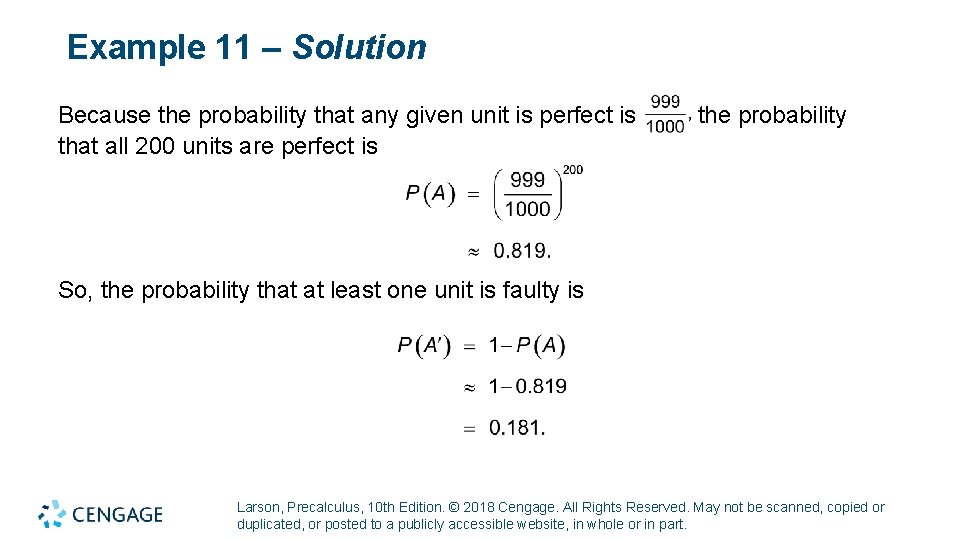
Example 11 – Solution Because the probability that any given unit is perfect is that all 200 units are perfect is the probability So, the probability that at least one unit is faulty is Larson, Precalculus, 10 th Edition. © 2018 Cengage. All Rights Reserved. May not be scanned, copied or duplicated, or posted to a publicly accessible website, in whole or in part.
- Slides: 28