
Chapter 9 Section A Working in Decibels October
Chapter 9 Section A Working in Decibels October, 1997 RF Engineering 102 v 1. 0 (c) 1997 Scott Baxter 9 -1
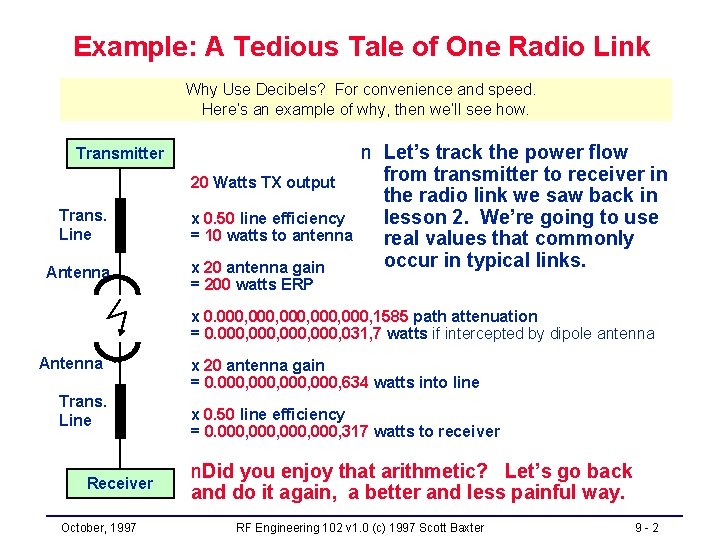
Example: A Tedious Tale of One Radio Link Why Use Decibels? For convenience and speed. Here’s an example of why, then we’ll see how. Transmitter 20 Watts TX output Trans. Line Antenna x 0. 50 line efficiency = 10 watts to antenna x 20 antenna gain = 200 watts ERP n Let’s track the power flow from transmitter to receiver in the radio link we saw back in lesson 2. We’re going to use real values that commonly occur in typical links. x 0. 000, 000, 1585 path attenuation = 0. 000, 031, 7 watts if intercepted by dipole antenna Antenna Trans. Line Receiver October, 1997 x 20 antenna gain = 0. 000, 634 watts into line x 0. 50 line efficiency = 0. 000, 317 watts to receiver n. Did you enjoy that arithmetic? Let’s go back and do it again, a better and less painful way. RF Engineering 102 v 1. 0 (c) 1997 Scott Baxter 9 -2
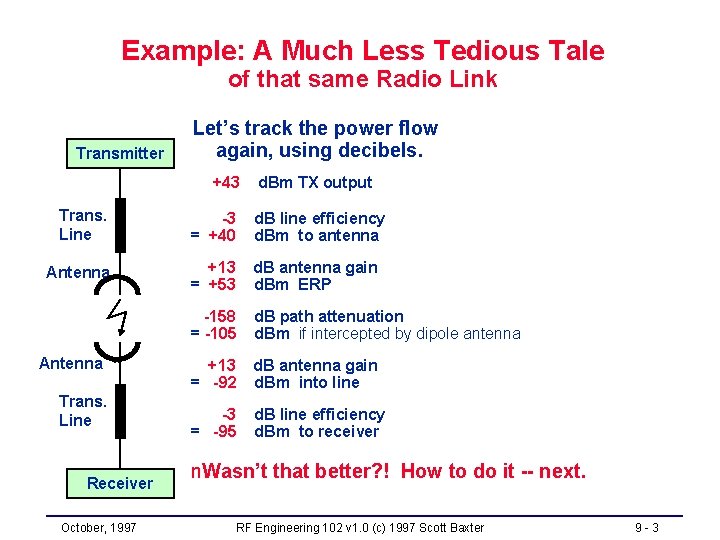
Example: A Much Less Tedious Tale of that same Radio Link Transmitter Let’s track the power flow again, using decibels. +43 d. Bm TX output Trans. Line -3 = +40 d. B line efficiency d. Bm to antenna Antenna +13 = +53 d. B antenna gain d. Bm ERP -158 = -105 d. B path attenuation d. Bm if intercepted by dipole antenna +13 = -92 d. B antenna gain d. Bm into line -3 = -95 d. B line efficiency d. Bm to receiver Antenna Trans. Line Receiver October, 1997 n. Wasn’t that better? ! How to do it -- next. RF Engineering 102 v 1. 0 (c) 1997 Scott Baxter 9 -3
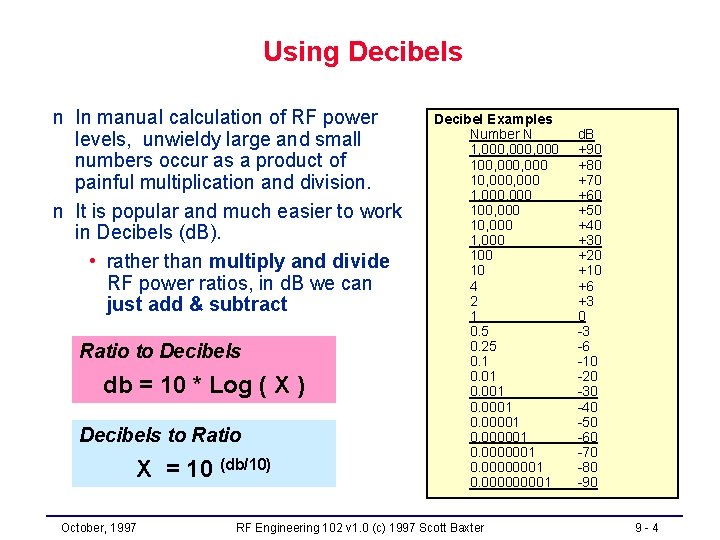
Using Decibels n In manual calculation of RF power levels, unwieldy large and small numbers occur as a product of painful multiplication and division. n It is popular and much easier to work in Decibels (d. B). • rather than multiply and divide RF power ratios, in d. B we can just add & subtract Ratio to Decibels db = 10 * Log ( X ) Decibels to Ratio X = 10 (db/10) October, 1997 Decibel Examples Number N 1, 000, 000 100, 000 10, 000 1, 000 100, 000 1, 000 10 4 2 1 0. 5 0. 25 0. 1 0. 001 0. 00001 0. 0000001 0. 000000001 RF Engineering 102 v 1. 0 (c) 1997 Scott Baxter d. B +90 +80 +70 +60 +50 +40 +30 +20 +10 +6 +3 0 -3 -6 -10 -20 -30 -40 -50 -60 -70 -80 -90 9 -4
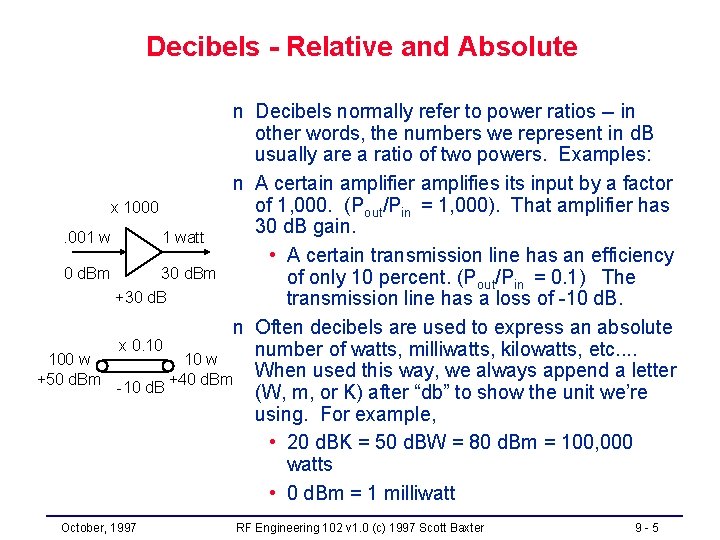
Decibels - Relative and Absolute n Decibels normally refer to power ratios -- in other words, the numbers we represent in d. B usually are a ratio of two powers. Examples: n A certain amplifier amplifies its input by a factor of 1, 000. (Pout/Pin = 1, 000). That amplifier has x 1000 30 d. B gain. . 001 w 1 watt • A certain transmission line has an efficiency 0 d. Bm 30 d. Bm of only 10 percent. (Pout/Pin = 0. 1) The +30 d. B transmission line has a loss of -10 d. B. n Often decibels are used to express an absolute x 0. 10 number of watts, milliwatts, kilowatts, etc. . 100 w 10 w +50 d. Bm +40 d. Bm When used this way, we always append a letter -10 d. B (W, m, or K) after “db” to show the unit we’re using. For example, • 20 d. BK = 50 d. BW = 80 d. Bm = 100, 000 watts • 0 d. Bm = 1 milliwatt October, 1997 RF Engineering 102 v 1. 0 (c) 1997 Scott Baxter 9 -5
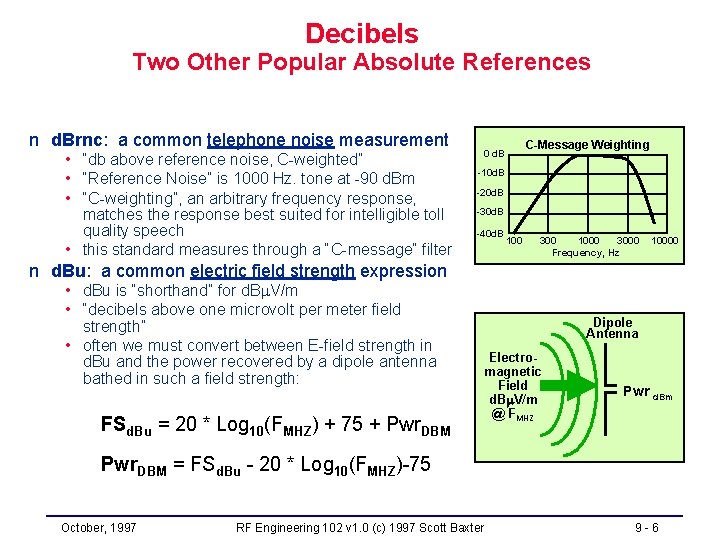
Decibels Two Other Popular Absolute References n d. Brnc: a common telephone noise measurement • “db above reference noise, C-weighted” • “Reference Noise” is 1000 Hz. tone at -90 d. Bm • “C-weighting”, an arbitrary frequency response, matches the response best suited for intelligible toll quality speech • this standard measures through a “C-message” filter C-Message Weighting 0 d. B -10 d. B -20 d. B -30 d. B -40 d. B 100 300 1000 3000 Frequency, Hz 10000 n d. Bu: a common electric field strength expression • d. Bu is “shorthand” for d. Bm. V/m • “decibels above one microvolt per meter field strength” • often we must convert between E-field strength in d. Bu and the power recovered by a dipole antenna bathed in such a field strength: FSd. Bu = 20 * Log 10(FMHZ) + 75 + Pwr. DBM Dipole Antenna Electromagnetic Field d. Bm. V/m @ FMHZ Pwr d. Bm Pwr. DBM = FSd. Bu - 20 * Log 10(FMHZ)-75 October, 1997 RF Engineering 102 v 1. 0 (c) 1997 Scott Baxter 9 -6
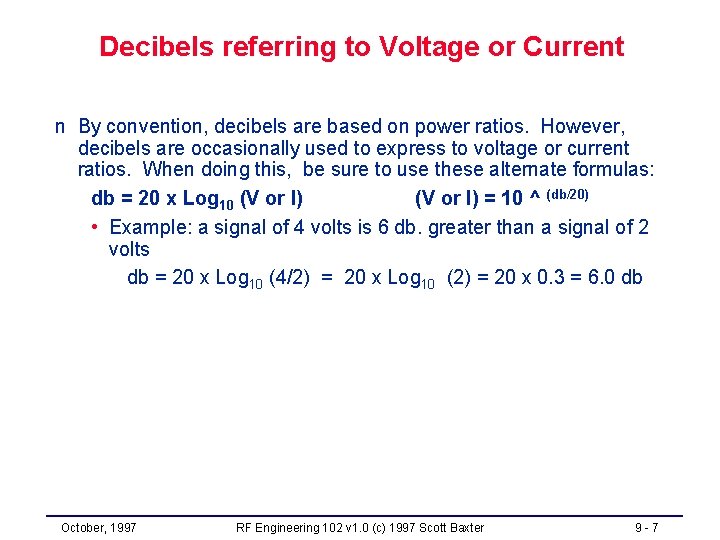
Decibels referring to Voltage or Current n By convention, decibels are based on power ratios. However, decibels are occasionally used to express to voltage or current ratios. When doing this, be sure to use these alternate formulas: db = 20 x Log 10 (V or I) = 10 ^ (db/20) • Example: a signal of 4 volts is 6 db. greater than a signal of 2 volts db = 20 x Log 10 (4/2) = 20 x Log 10 (2) = 20 x 0. 3 = 6. 0 db October, 1997 RF Engineering 102 v 1. 0 (c) 1997 Scott Baxter 9 -7
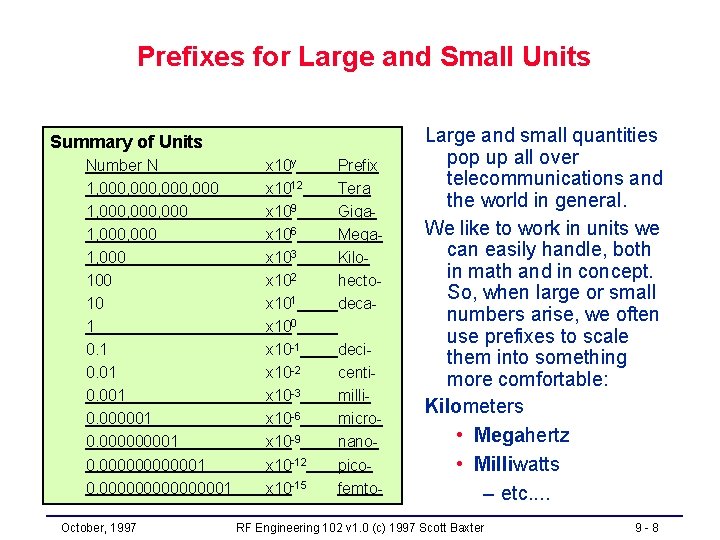
Prefixes for Large and Small Units Summary of Units Number N 1, 000, 000 1, 000 100 10 1 0. 01 0. 000001 0. 000000000001 0. 00000001 October, 1997 x 10 y x 1012 x 109 x 106 x 103 x 102 x 101 x 100 x 10 -1 x 10 -2 x 10 -3 x 10 -6 x 10 -9 x 10 -12 x 10 -15 Prefix Tera Giga. Mega. Kilohectodecadecicentimillimicronanopicofemto- Large and small quantities pop up all over telecommunications and the world in general. We like to work in units we can easily handle, both in math and in concept. So, when large or small numbers arise, we often use prefixes to scale them into something more comfortable: Kilometers • Megahertz • Milliwatts – etc. . RF Engineering 102 v 1. 0 (c) 1997 Scott Baxter 9 -8
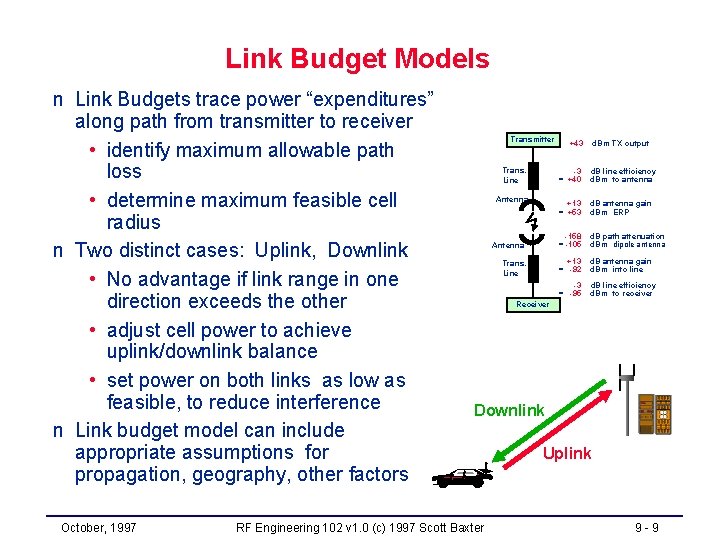
Link Budget Models n Link Budgets trace power “expenditures” along path from transmitter to receiver • identify maximum allowable path loss • determine maximum feasible cell radius n Two distinct cases: Uplink, Downlink • No advantage if link range in one direction exceeds the other • adjust cell power to achieve uplink/downlink balance • set power on both links as low as feasible, to reduce interference n Link budget model can include appropriate assumptions for propagation, geography, other factors October, 1997 Transmitter Trans. Line Antenna Trans. Line +43 d. Bm TX output -3 = +40 d. B line efficiency d. Bm to antenna +13 = +53 d. B antenna gain d. Bm ERP -158 = -105 d. B path attenuation d. Bm dipole antenna +13 = -92 d. B antenna gain d. Bm into line -3 = -95 d. B line efficiency d. Bm to receiver Receiver Downlink RF Engineering 102 v 1. 0 (c) 1997 Scott Baxter Uplink 9 -9

Cellular Link Budget Model Example October, 1997 RF Engineering 102 v 1. 0 (c) 1997 Scott Baxter 9 - 10
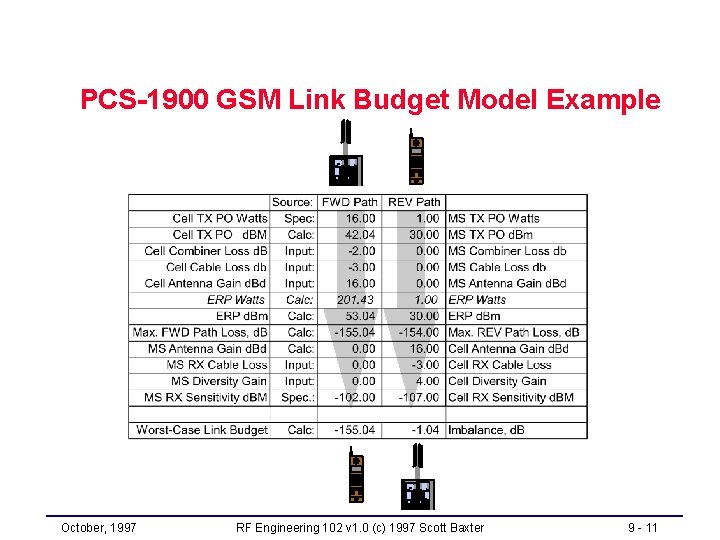
PCS-1900 GSM Link Budget Model Example TX RX TX TX RX RX TX RX October, 1997 TX TX RX RX RF Engineering 102 v 1. 0 (c) 1997 Scott Baxter 9 - 11
- Slides: 11