
Chapter 9 Section 2 Defining Heat Bellwork PreA
Chapter 9 Section 2 Defining Heat Bellwork Pre-A Physics The mass of the Earth is and its radius is 6400 km. Calculate the average density of the earth in ? Ticket at the door. Last 5 minutes Describe the kinetic energy of microscopic pa © Houghton Mifflin Harcourt Publishing Company
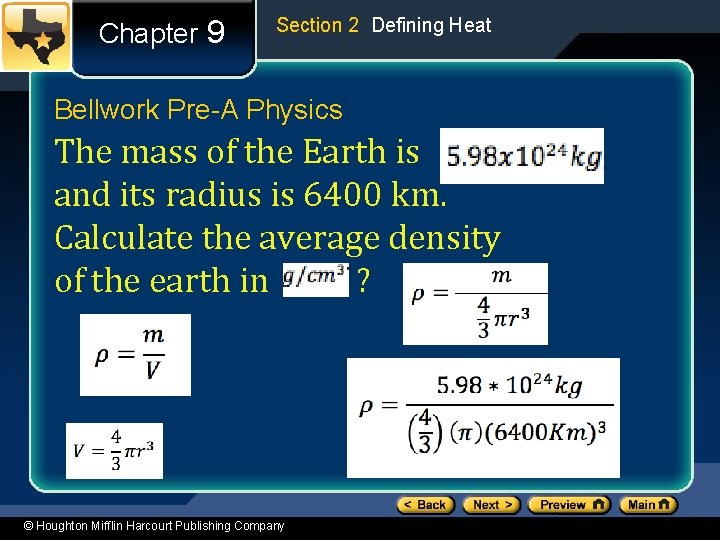
Chapter 9 Section 2 Defining Heat Bellwork Pre-A Physics The mass of the Earth is and its radius is 6400 km. Calculate the average density of the earth in ? © Houghton Mifflin Harcourt Publishing Company
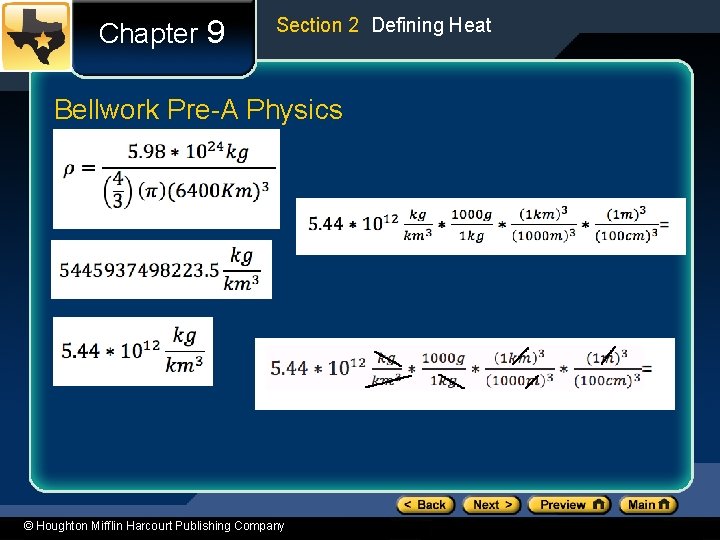
Chapter 9 Section 2 Defining Heat Bellwork Pre-A Physics © Houghton Mifflin Harcourt Publishing Company
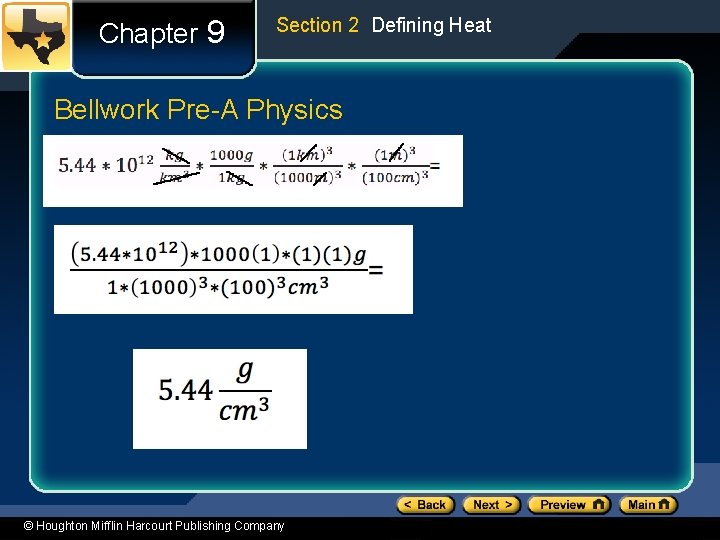
Chapter 9 Section 2 Defining Heat Bellwork Pre-A Physics © Houghton Mifflin Harcourt Publishing Company
Chapter 9 Section 2 Defining Heat Bellwork General Physics The speed of sound on air is 343 m/s, calculate the speed of sound on km/h ? Ticket at the door. Last 5 minutes Explain the difference between Heat and tem © Houghton Mifflin Harcourt Publishing Company
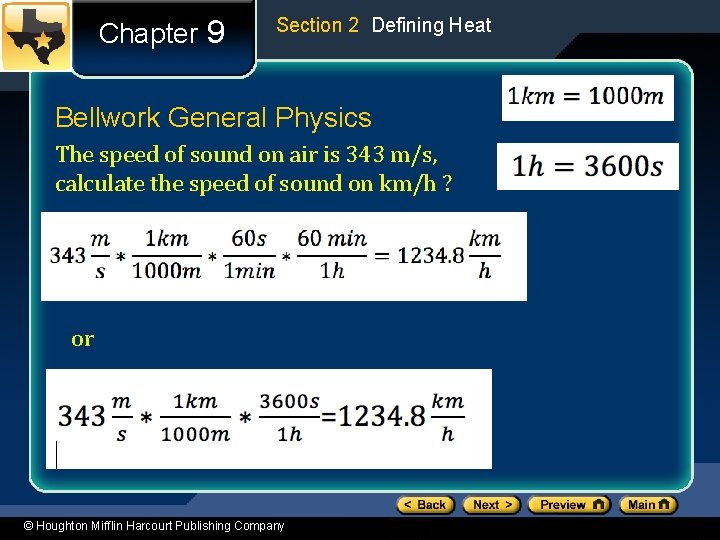
Chapter 9 Section 2 Defining Heat Bellwork General Physics The speed of sound on air is 343 m/s, calculate the speed of sound on km/h ? or © Houghton Mifflin Harcourt Publishing Company

Chapter 9 Section 2 Defining Heat Title: Heat versus Temperature Objectives: • Explain heat as the energy transferred between substances that are at different temperatures. • Relate heat and temperature. © Houghton Mifflin Harcourt Publishing Company
Chapter 9 Section 1 Temperature and Thermal Equilibrium Heat versus temperatura Click to watch the video © Houghton Mifflin Harcourt Publishing Company
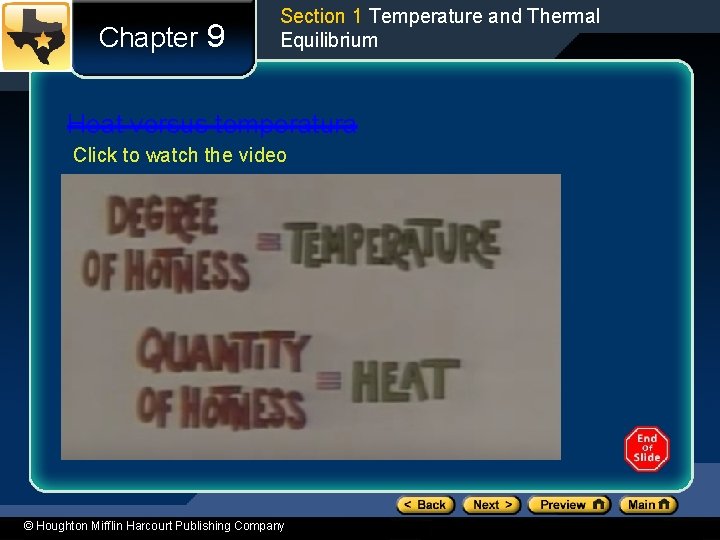
Chapter 9 Section 1 Temperature and Thermal Equilibrium Heat versus temperatura Click to watch the video © Houghton Mifflin Harcourt Publishing Company
Chapter 9 Section 2 Defining Heat and Energy • Heat is the energy transferred between objects because of a difference in their temperatures. • From a macroscopic viewpoint, energy transferred as heat tends to move from an object at higher temperature to an object at lower temperature. © Houghton Mifflin Harcourt Publishing Company
Chapter 9 Section 2 Defining Heat Temperature and Heat Click below to watch the Visual Concept © Houghton Mifflin Harcourt Publishing Company
Chapter 9 Section 2 Defining Heat and Energy, continued • Just as other forms of energy have a symbol that identifies them (PE for potential energy, KE for kinetic energy, U for internal energy, W for work), heat is indicated by the symbol Q. • Because heat, like work, is energy in transit, all heat units can be converted to joules, the SI unit for energy. © Houghton Mifflin Harcourt Publishing Company
- Slides: 12