
Chapter 9 Section 2 9 2 The Quadratic
- Slides: 16
Chapter 9 Section 2
9. 2 The Quadratic Formula Objectives 1 • Derive the quadratic formula. 2 • Solve quadratic equations by using the quadratic formula. 3 • Use the discriminant to determine the number and type of solutions. Copyright © 2012, 2008, 2004 Pearson Education, Inc.
Objective 1 Derive the quadratic formula. Copyright © 2012, 2008, 2004 Pearson Education, Inc. Slide 9. 2 - 3
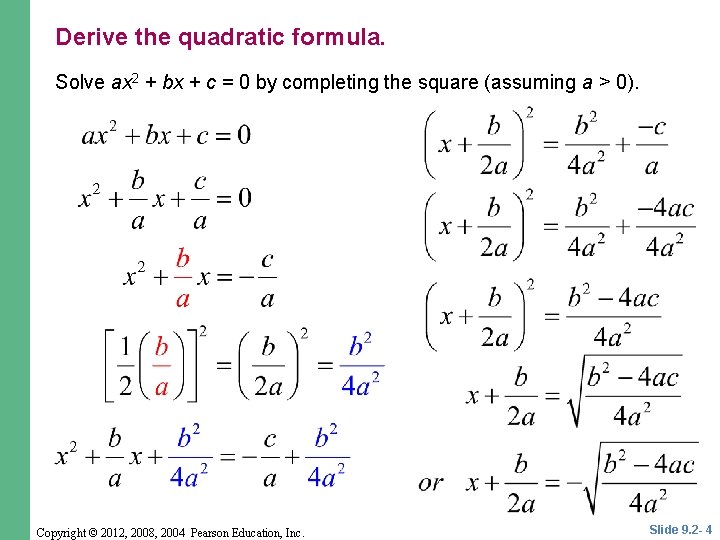
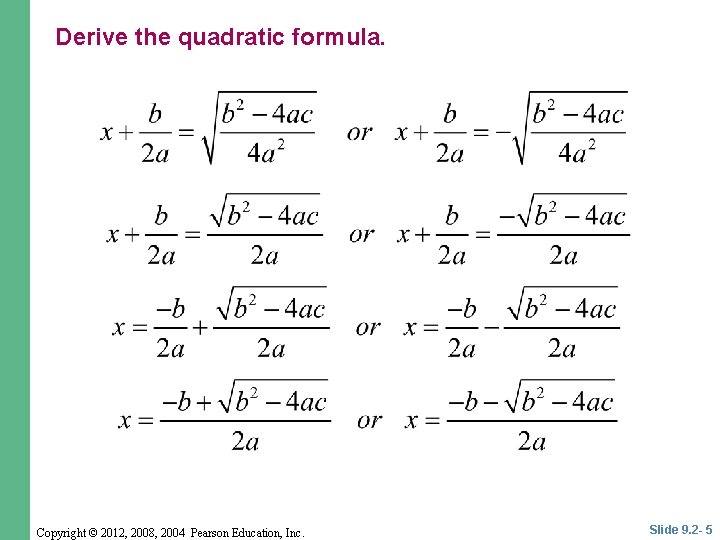
Derive the quadratic formula. Solve ax 2 + bx + c = 0 by completing the square (assuming a > 0). Copyright © 2012, 2008, 2004 Pearson Education, Inc. Slide 9. 2 - 4
Derive the quadratic formula. Copyright © 2012, 2008, 2004 Pearson Education, Inc. Slide 9. 2 - 5
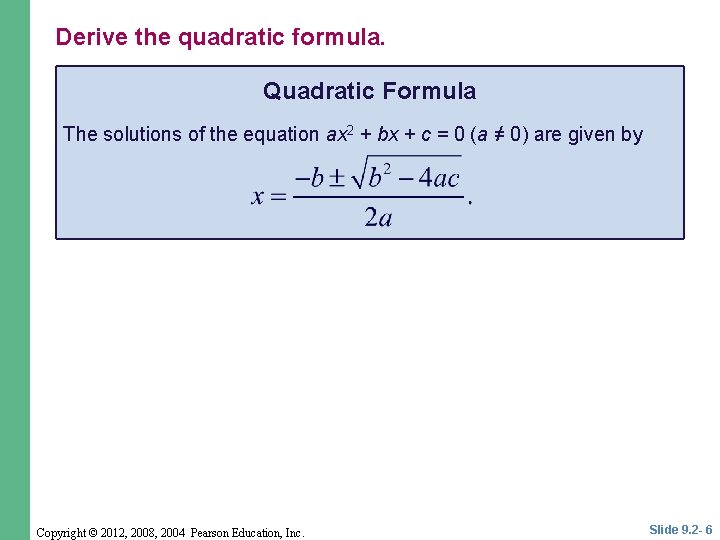
Derive the quadratic formula. Quadratic Formula The solutions of the equation ax 2 + bx + c = 0 (a ≠ 0) are given by Copyright © 2012, 2008, 2004 Pearson Education, Inc. Slide 9. 2 - 6
Objective 2 Solve quadratic equations by using the quadratic formula. Copyright © 2012, 2008, 2004 Pearson Education, Inc. Slide 9. 2 - 7
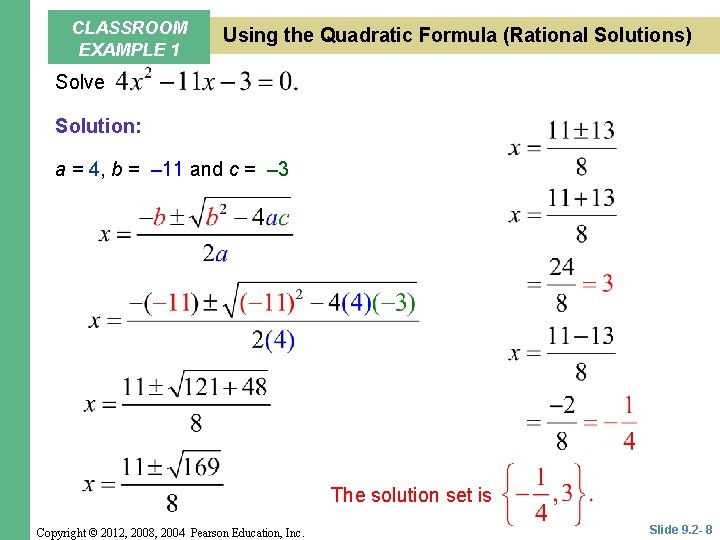
CLASSROOM EXAMPLE 1 Using the Quadratic Formula (Rational Solutions) Solve Solution: a = 4, b = – 11 and c = – 3 The solution set is Copyright © 2012, 2008, 2004 Pearson Education, Inc. Slide 9. 2 - 8
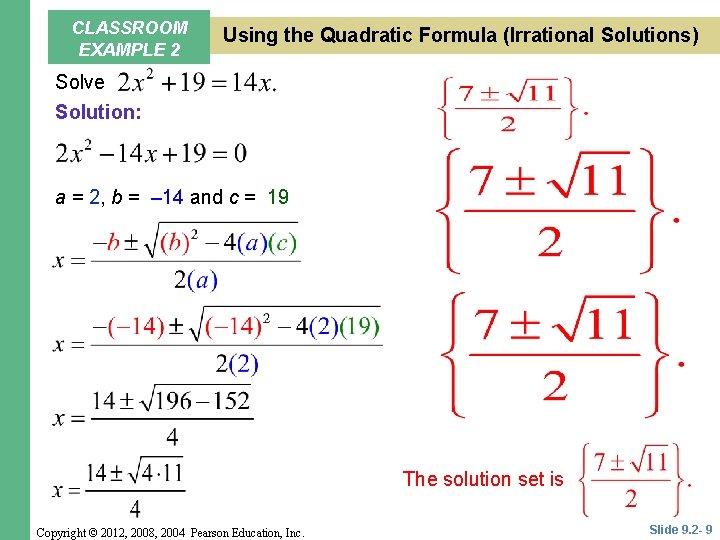
CLASSROOM EXAMPLE 2 Using the Quadratic Formula (Irrational Solutions) Solve Solution: a = 2, b = – 14 and c = 19 The solution set is Copyright © 2012, 2008, 2004 Pearson Education, Inc. Slide 9. 2 - 9
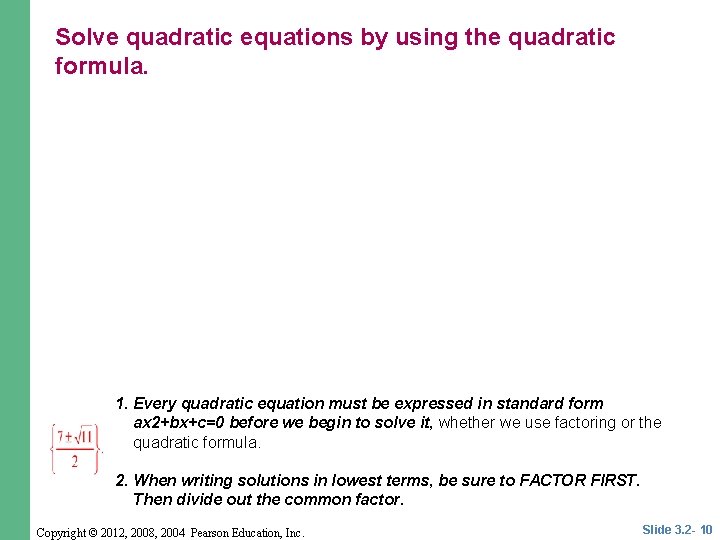
CLASSROOM Solve quadratic equations by using the quadratic EXAMPLE 1 formula. 1. Every quadratic equation must be expressed in standard form ax 2+bx+c=0 before we begin to solve it, whether we use factoring or the quadratic formula. 2. When writing solutions in lowest terms, be sure to FACTOR FIRST. Then divide out the common factor. Copyright © 2012, 2008, 2004 Pearson Education, Inc. Slide 3. 2 - 10
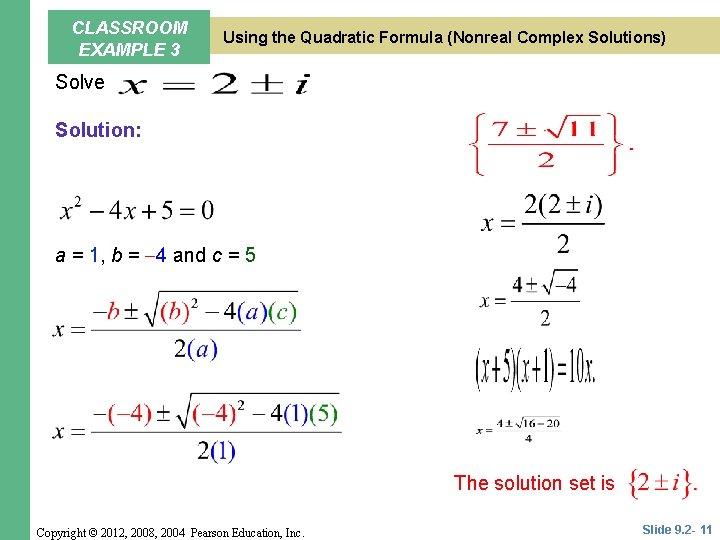
CLASSROOM EXAMPLE 3 Using the Quadratic Formula (Nonreal Complex Solutions) Solve Solution: a = 1, b = 4 and c = 5 The solution set is Copyright © 2012, 2008, 2004 Pearson Education, Inc. Slide 9. 2 - 11
Objective 3 Use the discriminant to determine the number and type of solutions. Copyright © 2012, 2008, 2004 Pearson Education, Inc. Slide 9. 2 - 12
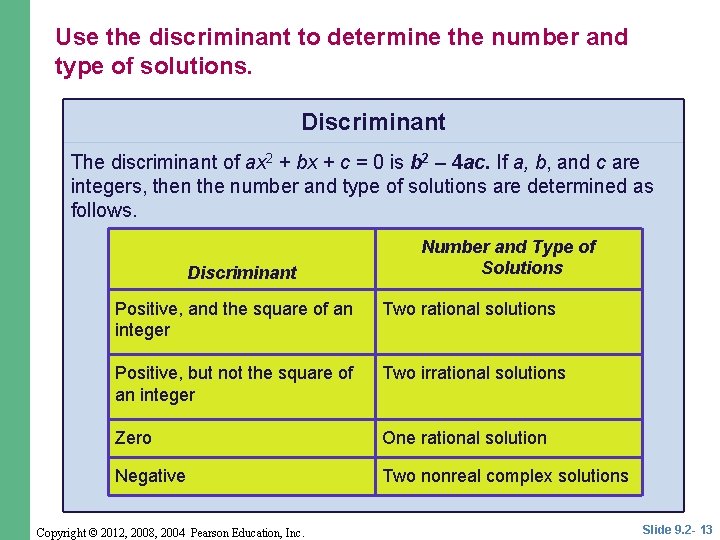
Use the discriminant to determine the number and type of solutions. Discriminant The discriminant of ax 2 + bx + c = 0 is b 2 – 4 ac. If a, b, and c are integers, then the number and type of solutions are determined as follows. Discriminant Number and Type of Solutions Positive, and the square of an integer Two rational solutions Positive, but not the square of an integer Two irrational solutions Zero One rational solution Negative Two nonreal complex solutions Copyright © 2012, 2008, 2004 Pearson Education, Inc. Slide 9. 2 - 13
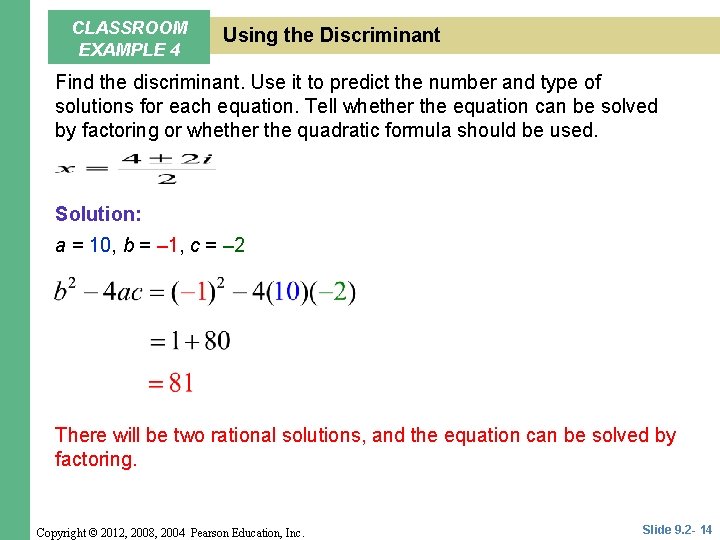
CLASSROOM EXAMPLE 4 Using the Discriminant Find the discriminant. Use it to predict the number and type of solutions for each equation. Tell whether the equation can be solved by factoring or whether the quadratic formula should be used. Solution: a = 10, b = – 1, c = – 2 There will be two rational solutions, and the equation can be solved by factoring. Copyright © 2012, 2008, 2004 Pearson Education, Inc. Slide 9. 2 - 14
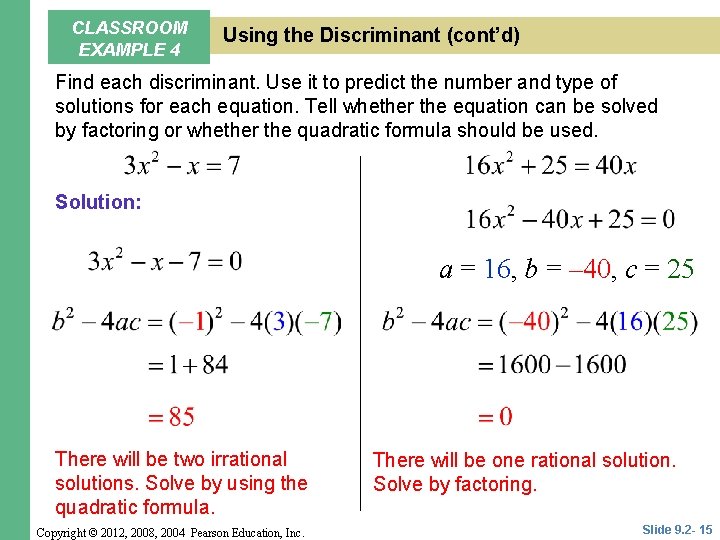
CLASSROOM EXAMPLE 4 Using the Discriminant (cont’d) Find each discriminant. Use it to predict the number and type of solutions for each equation. Tell whether the equation can be solved by factoring or whether the quadratic formula should be used. Solution: a = 16, b = – 40, c = 25 There will be two irrational solutions. Solve by using the quadratic formula. Copyright © 2012, 2008, 2004 Pearson Education, Inc. There will be one rational solution. Solve by factoring. Slide 9. 2 - 15
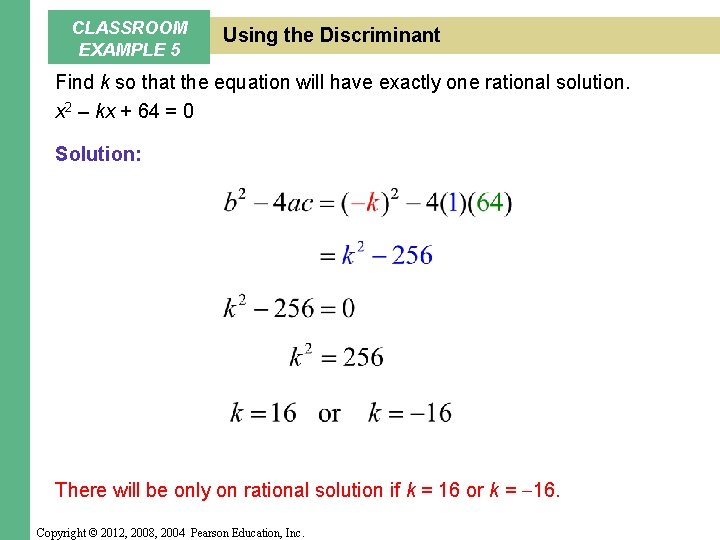
CLASSROOM EXAMPLE 5 Using the Discriminant Find k so that the equation will have exactly one rational solution. x 2 – kx + 64 = 0 Solution: There will be only on rational solution if k = 16 or k = 16. Copyright © 2012, 2008, 2004 Pearson Education, Inc.