
CHAPTER 9 SECTION 1 THE RISE OF IMPERIALISM
- Slides: 24
CHAPTER 9 SECTION 1 THE RISE OF IMPERIALISM
BIG QUESTIONS • Describe why and how Europeans were able to imperialize Africa. • What were the benefits and damages of Imperialism in Africa?
KEY TERMS • Imperialism • Direct Control • Social Darwinism • Paternalism • Congo River Basin • Assimilation • Livingstone and Stanley • Indirect Control • King Leopold II • Boers • Berlin Conference • Zulu • Colony • Union of South Africa • Protectorate • Liberia • Sphere of Influence • Ethiopia • Economic Imperialism • Menelik II
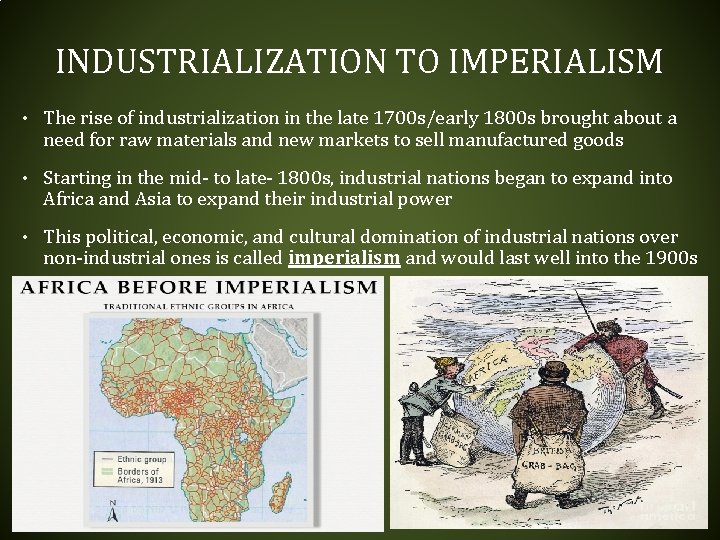
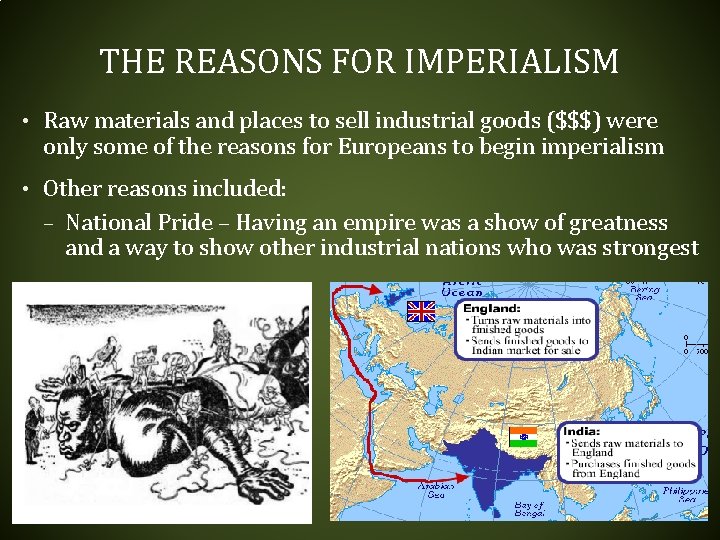
INDUSTRIALIZATION TO IMPERIALISM • The rise of industrialization in the late 1700 s/early 1800 s brought about a need for raw materials and new markets to sell manufactured goods • Starting in the mid- to late- 1800 s, industrial nations began to expand into Africa and Asia to expand their industrial power • This political, economic, and cultural domination of industrial nations over non-industrial ones is called imperialism and would last well into the 1900 s
THE REASONS FOR IMPERIALISM • Raw materials and places to sell industrial goods ($$$) were only some of the reasons for Europeans to begin imperialism • Other reasons included: – National Pride – Having an empire was a show of greatness and a way to show other industrial nations who was strongest
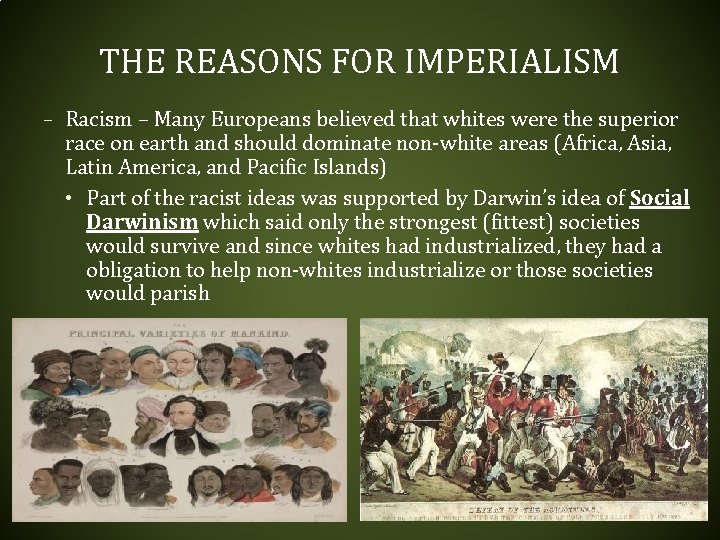
THE REASONS FOR IMPERIALISM – Racism – Many Europeans believed that whites were the superior race on earth and should dominate non-white areas (Africa, Asia, Latin America, and Pacific Islands) • Part of the racist ideas was supported by Darwin’s idea of Social Darwinism which said only the strongest (fittest) societies would survive and since whites had industrialized, they had a obligation to help non-whites industrialize or those societies would parish
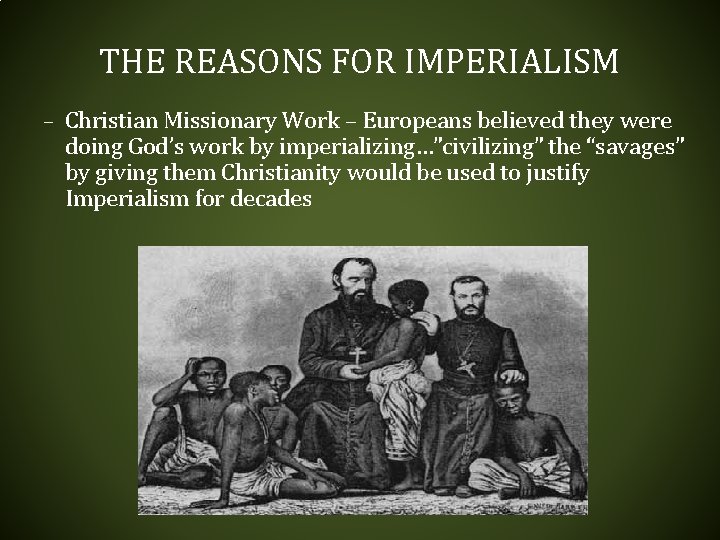
THE REASONS FOR IMPERIALISM – Christian Missionary Work – Europeans believed they were doing God’s work by imperializing…”civilizing” the “savages” by giving them Christianity would be used to justify Imperialism for decades
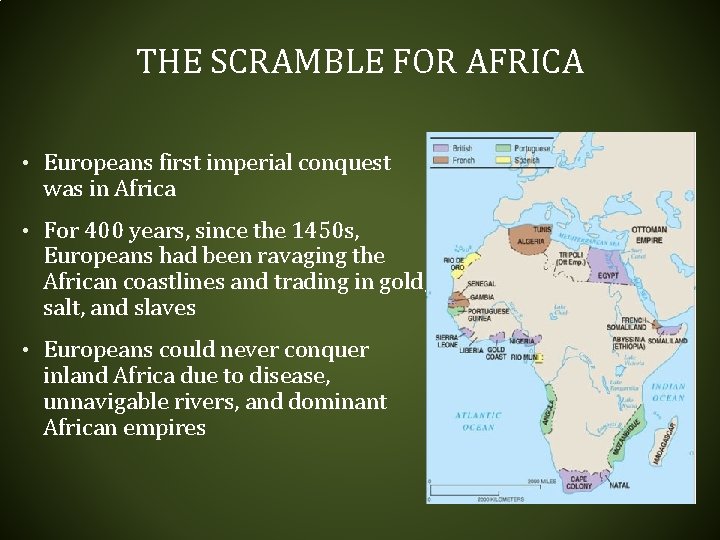
THE SCRAMBLE FOR AFRICA • Europeans first imperial conquest was in Africa • For 400 years, since the 1450 s, Europeans had been ravaging the African coastlines and trading in gold, salt, and slaves • Europeans could never conquer inland Africa due to disease, unnavigable rivers, and dominant African empires
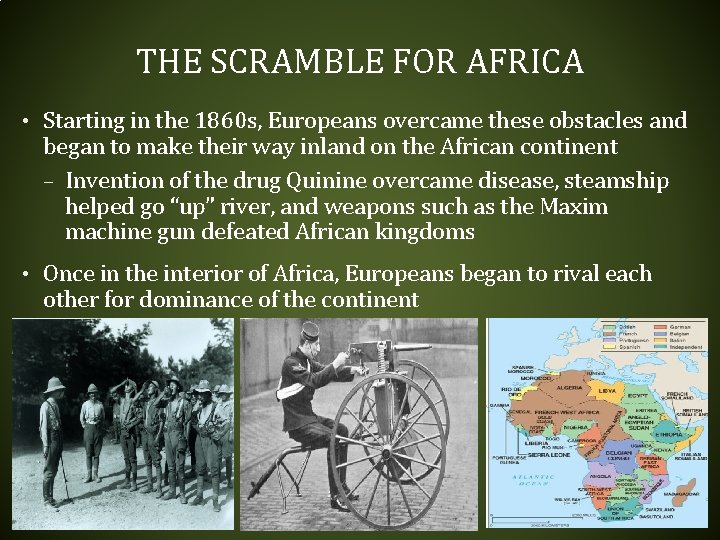
THE SCRAMBLE FOR AFRICA • Starting in the 1860 s, Europeans overcame these obstacles and began to make their way inland on the African continent – Invention of the drug Quinine overcame disease, steamship helped go “up” river, and weapons such as the Maxim machine gun defeated African kingdoms • Once in the interior of Africa, Europeans began to rival each other for dominance of the continent
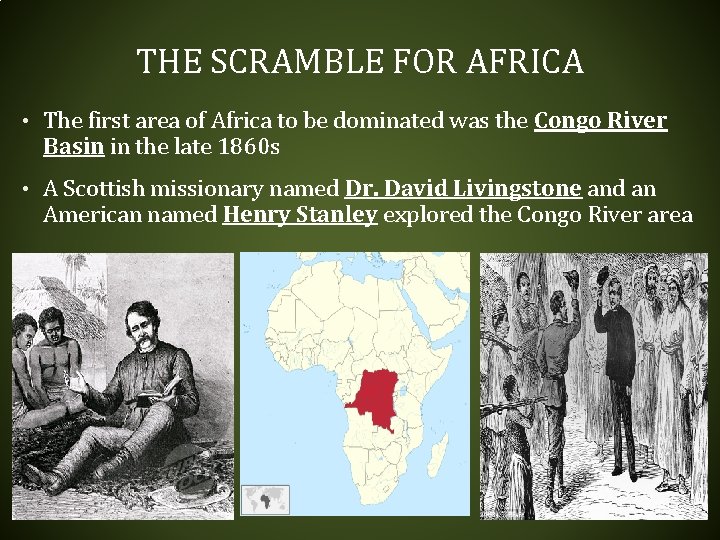
THE SCRAMBLE FOR AFRICA • The first area of Africa to be dominated was the Congo River Basin in the late 1860 s • A Scottish missionary named Dr. David Livingstone and an American named Henry Stanley explored the Congo River area
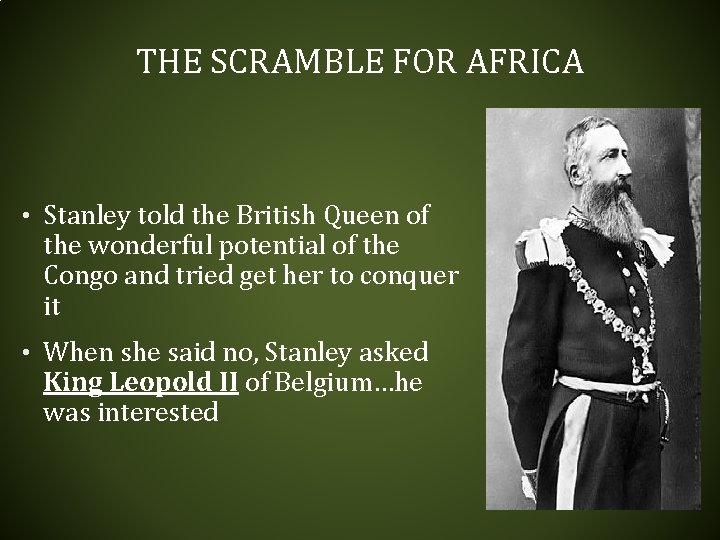
THE SCRAMBLE FOR AFRICA • Stanley told the British Queen of the wonderful potential of the Congo and tried get her to conquer it • When she said no, Stanley asked King Leopold II of Belgium…he was interested
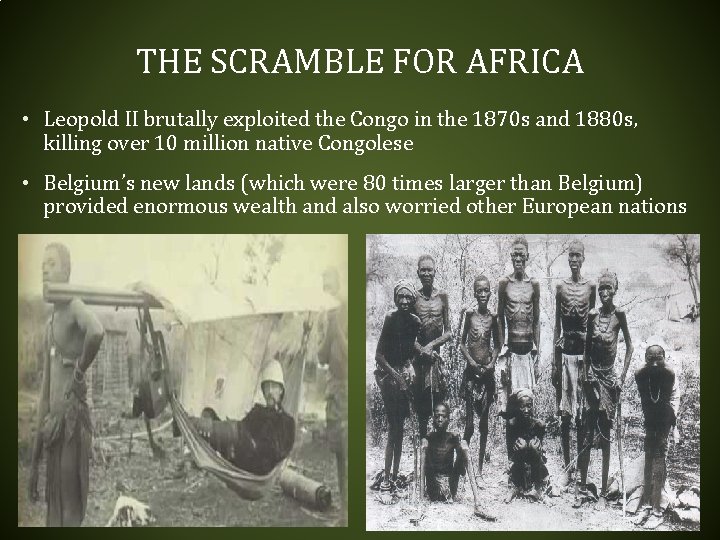
THE SCRAMBLE FOR AFRICA • Leopold II brutally exploited the Congo in the 1870 s and 1880 s, killing over 10 million native Congolese • Belgium’s new lands (which were 80 times larger than Belgium) provided enormous wealth and also worried other European nations
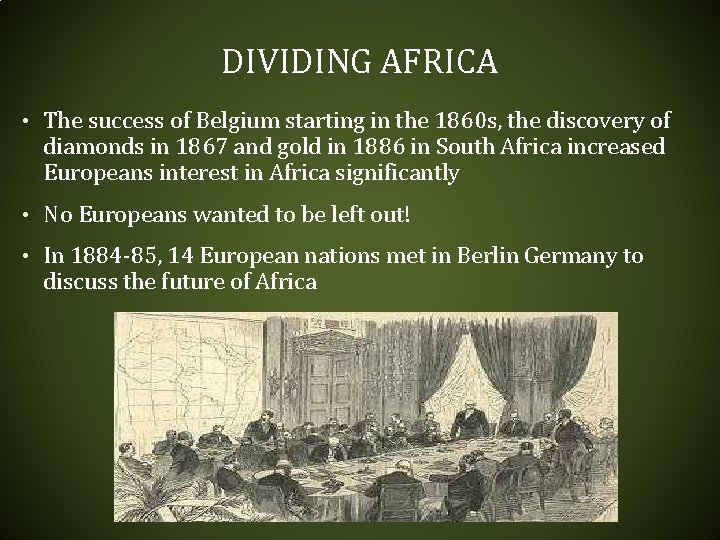
DIVIDING AFRICA • The success of Belgium starting in the 1860 s, the discovery of diamonds in 1867 and gold in 1886 in South Africa increased Europeans interest in Africa significantly • No Europeans wanted to be left out! • In 1884 -85, 14 European nations met in Berlin Germany to discuss the future of Africa
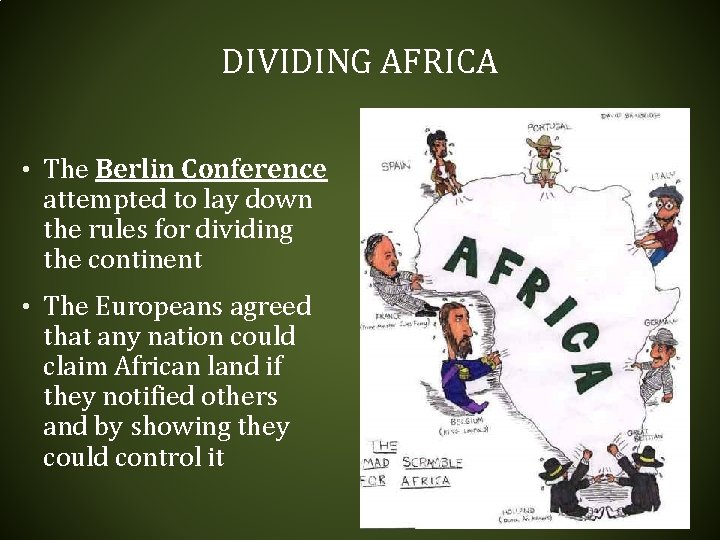
DIVIDING AFRICA • The Berlin Conference attempted to lay down the rules for dividing the continent • The Europeans agreed that any nation could claim African land if they notified others and by showing they could control it
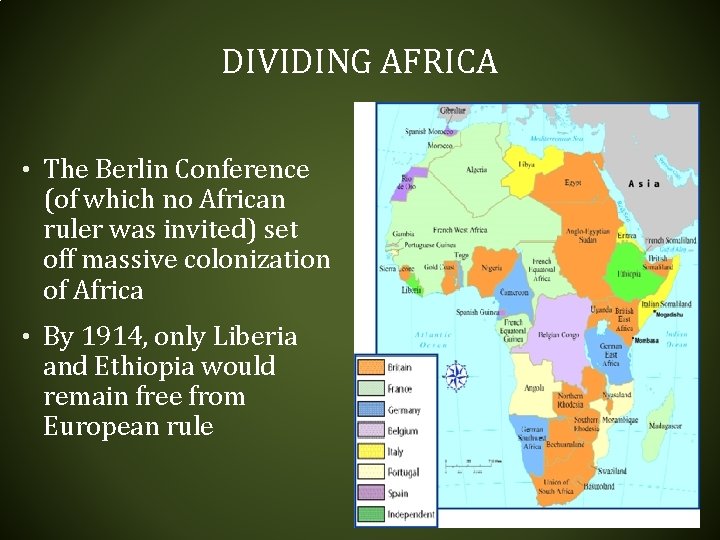
DIVIDING AFRICA • The Berlin Conference (of which no African ruler was invited) set off massive colonization of Africa • By 1914, only Liberia and Ethiopia would remain free from European rule
RULING AFRICA • The Europeans had several ways of defining their African claims 1. Colony – Ruled internally by a foreign power 2. Protectorate – Area ruled by its own people, but controlled by a foreign power 3. Sphere of Influence – Area where a foreign country has complete economic control 4. Economic Imperialism – Area controlled by a foreign business rather than a foreign country
RULING AFRICA • Regardless of what the Europeans considered their claims to be, they had two ways of controlling the lands, Direct or Indirect Control • Direct Control – Feeling that native populations couldn’t control themselves so they needed to be controled by Europeans – France, Germany, Portugal, and Belgium used this method – Directly controlled their colonies through ideas of paternalism (Using your own people to govern a foreign countries population)and assimilation (forcing a population to adopt the language and culture of the dominate government)
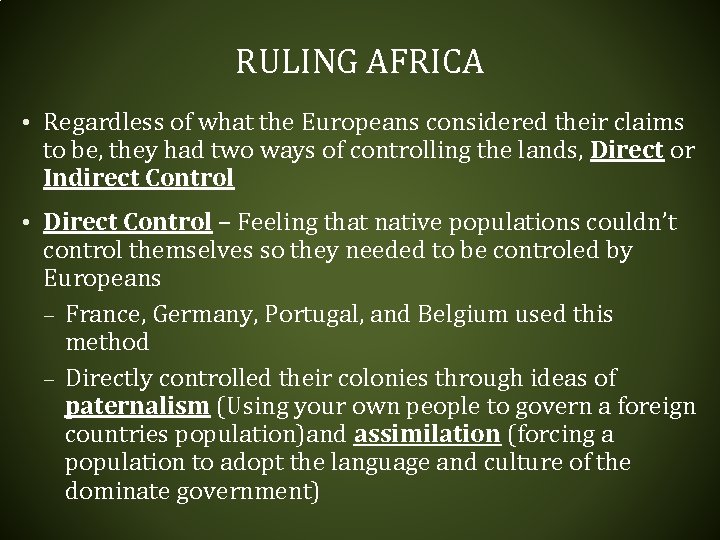
RULING AFRICA • Indirect Control – Allowing local officials power to handle daily matters – Used by Great Britain and later the United States – Local leaders were trained and watched by imperial power and could become very successful (if they played the game)
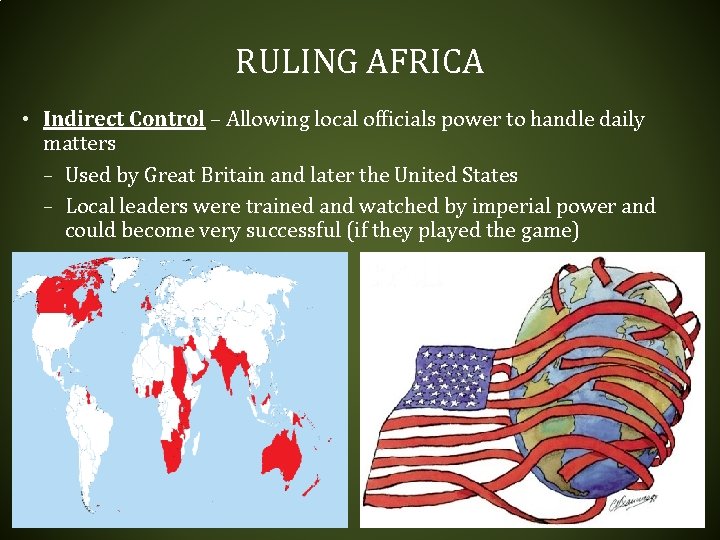
AFRICAN RESISTANCE • Not all areas of Africa were taken easily by Europeans, some not at all • Algerians fought the French for over 50 years before being imperialized • East Africans fought and killed thousands of Germans before machine guns finally subdued them
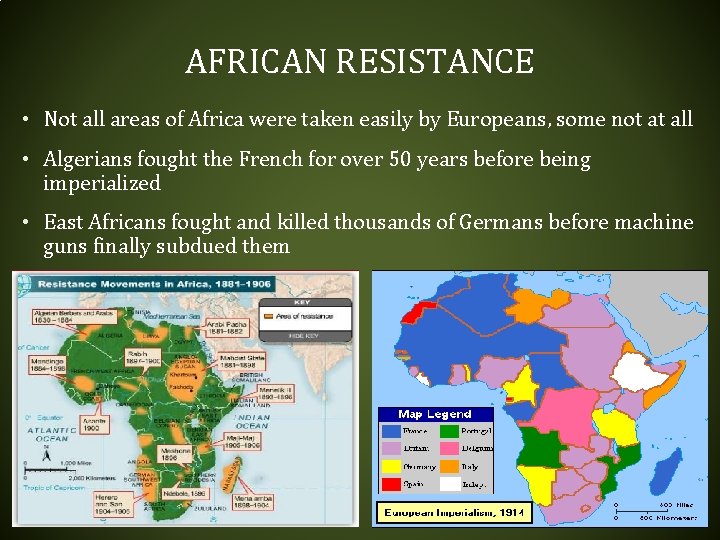
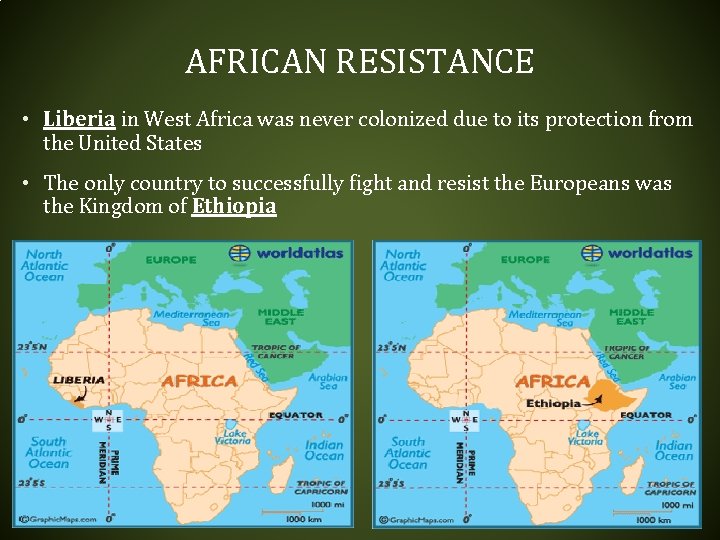
AFRICAN RESISTANCE • Liberia in West Africa was never colonized due to its protection from the United States • The only country to successfully fight and resist the Europeans was the Kingdom of Ethiopia
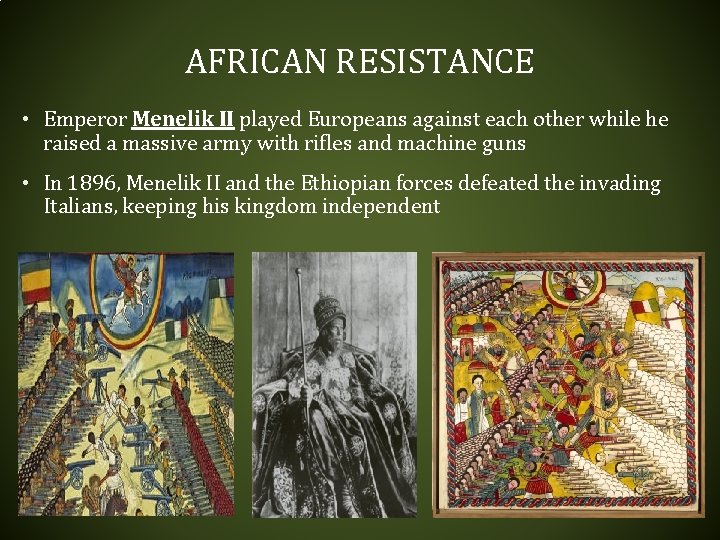
AFRICAN RESISTANCE • Emperor Menelik II played Europeans against each other while he raised a massive army with rifles and machine guns • In 1896, Menelik II and the Ethiopian forces defeated the invading Italians, keeping his kingdom independent
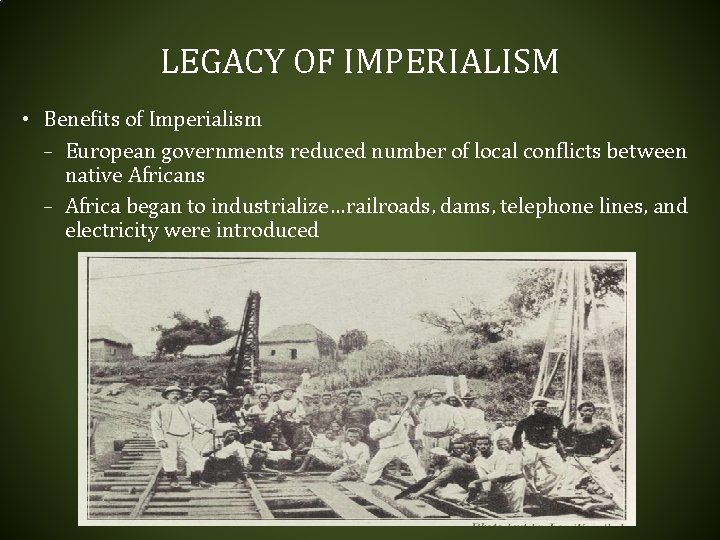
LEGACY OF IMPERIALISM • Benefits of Imperialism – European governments reduced number of local conflicts between native Africans – Africa began to industrialize…railroads, dams, telephone lines, and electricity were introduced
LEGACY OF IMPERIALISM • Damage of Imperialism – Damage was far greater than benefits!!!!!!!!!!! – Over 50 million Africans died – Africans lost control of the continent – African traditions destroyed…replaced with European language, culture, and religion – Many lost homes – Ethnic conflict created when Europeans mixed groups into colonies – All led to major continent wide civil war after imperialism ended in the 1970 s
• Describe why and how Europeans were able to imperialize Africa. • What were the benefits and damages of Imperialism in Africa? • Imperialism • Direct Control • Social Darwinism • Paternalism • Congo River Basin • Assimilation • Livingstone and • Indirect Control Stanley • King Leopold II • Berlin Conference • Colony • Protectorate • Boers • Zulu • Union of South Africa • Liberia • Sphere of Influence • Ethiopia • Economic Imperialism • Menelik II