
Chapter 9 Section 1 Introduction to Stoichiometry Definition


- Slides: 23
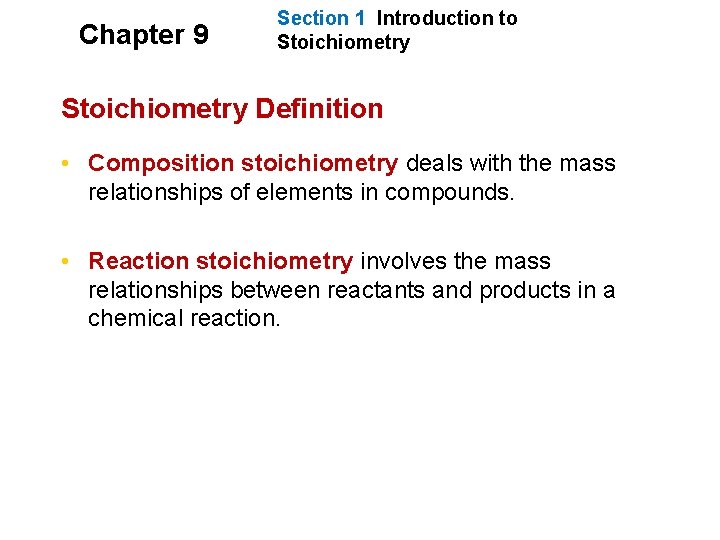
Chapter 9 Section 1 Introduction to Stoichiometry Definition • Composition stoichiometry deals with the mass relationships of elements in compounds. • Reaction stoichiometry involves the mass relationships between reactants and products in a chemical reaction.
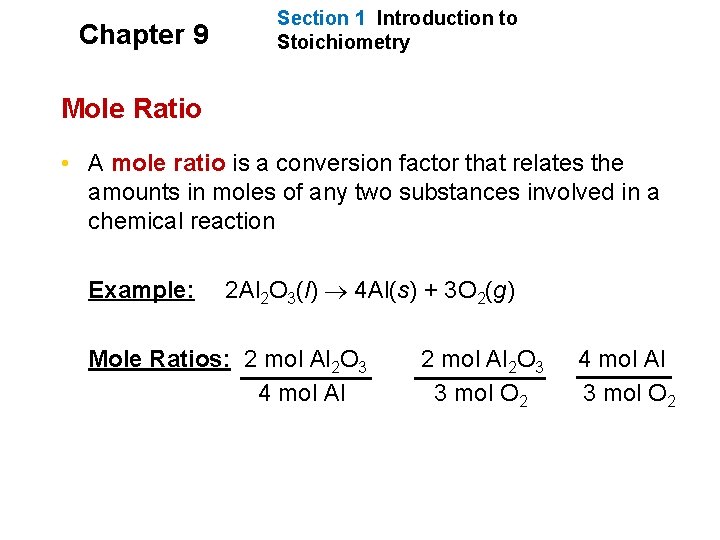
Chapter 9 Section 1 Introduction to Stoichiometry Mole Ratio • A mole ratio is a conversion factor that relates the amounts in moles of any two substances involved in a chemical reaction Example: 2 Al 2 O 3(l) 4 Al(s) + 3 O 2(g) Mole Ratios: 2 mol Al 2 O 3 4 mol Al , 2 mol Al 2 O 3 3 mol O 2 , 4 mol Al 3 mol O 2
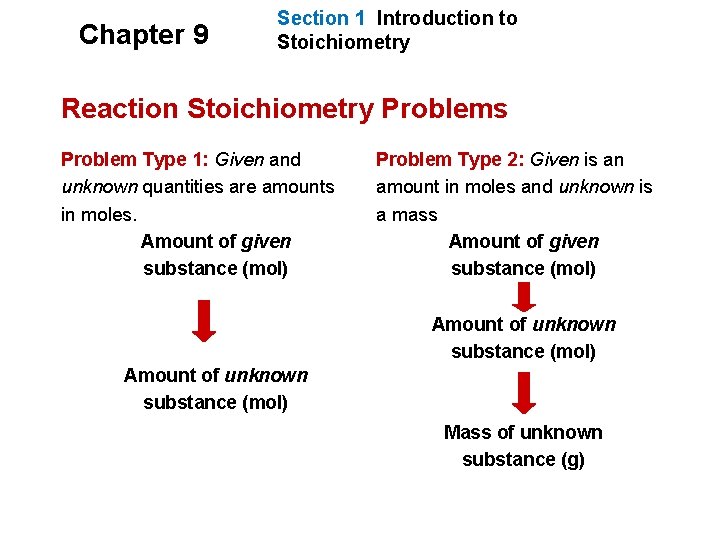
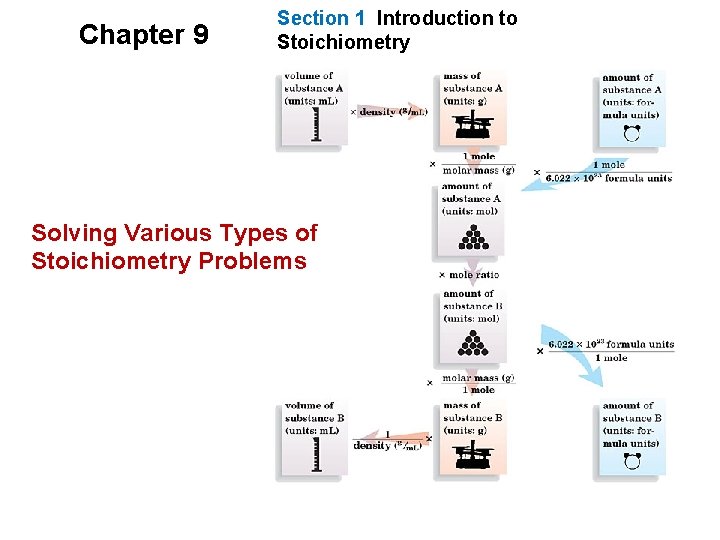
Chapter 9 Section 1 Introduction to Stoichiometry Reaction Stoichiometry Problems Problem Type 1: Given and unknown quantities are amounts in moles. Amount of given substance (mol) Problem Type 2: Given is an amount in moles and unknown is a mass Amount of given substance (mol) Amount of unknown substance (mol) Mass of unknown substance (g)
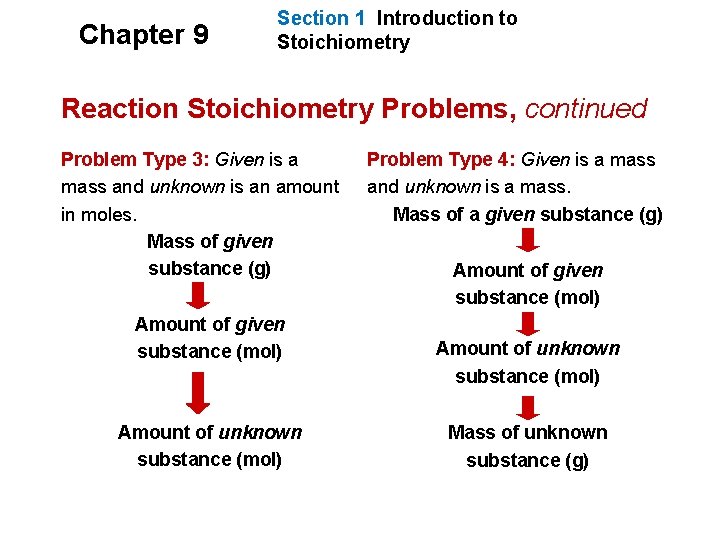
Chapter 9 Section 1 Introduction to Stoichiometry Reaction Stoichiometry Problems, continued Problem Type 3: Given is a mass and unknown is an amount in moles. Mass of given substance (g) Amount of given substance (mol) Amount of unknown substance (mol) Problem Type 4: Given is a mass and unknown is a mass. Mass of a given substance (g) Amount of given substance (mol) Amount of unknown substance (mol) Mass of unknown substance (g)
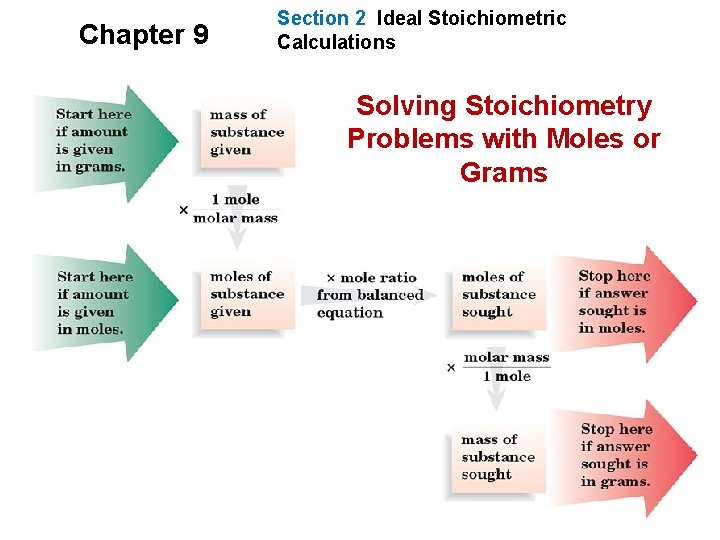
Chapter 9 Section 2 Ideal Stoichiometric Calculations Solving Stoichiometry Problems with Moles or Grams
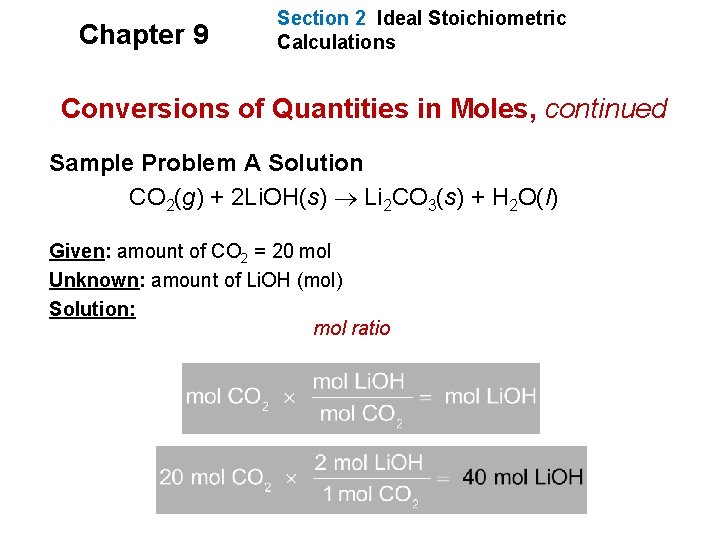
Chapter 9 Section 2 Ideal Stoichiometric Calculations Conversions of Quantities in Moles Sample Problem A In a spacecraft, the carbon dioxide exhaled by astronauts can be removed by its reaction with lithium hydroxide, Li. OH, according to the following chemical equation. CO 2(g) + 2 Li. OH(s) Li 2 CO 3(s) + H 2 O(l) How many moles of lithium hydroxide are required to react with 20 mol CO 2, the average amount exhaled by a person each day?
Chapter 9 Section 2 Ideal Stoichiometric Calculations Conversions of Quantities in Moles, continued Sample Problem A Solution CO 2(g) + 2 Li. OH(s) Li 2 CO 3(s) + H 2 O(l) Given: amount of CO 2 = 20 mol Unknown: amount of Li. OH (mol) Solution: mol ratio
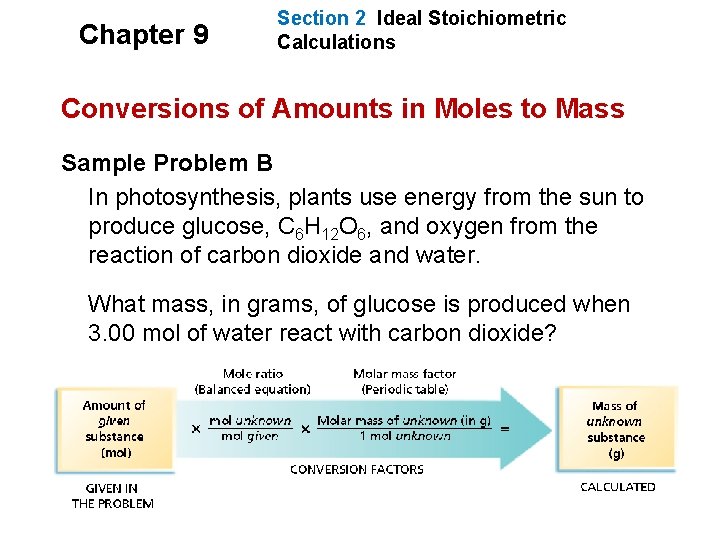
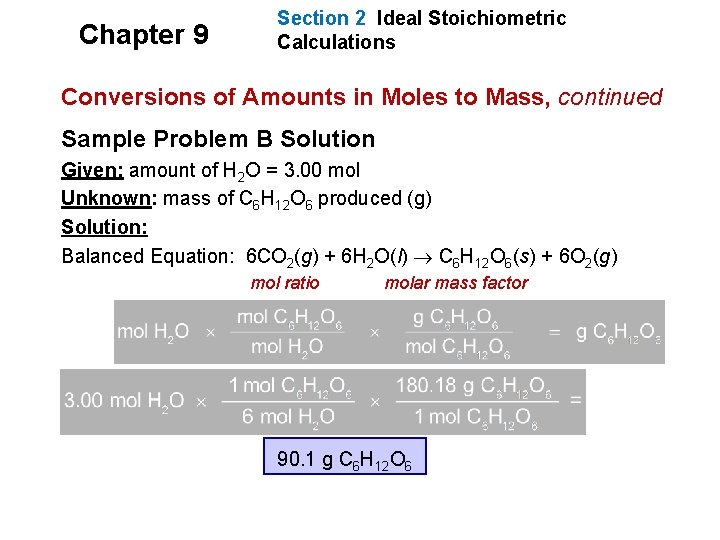
Chapter 9 Section 2 Ideal Stoichiometric Calculations Conversions of Amounts in Moles to Mass Sample Problem B In photosynthesis, plants use energy from the sun to produce glucose, C 6 H 12 O 6, and oxygen from the reaction of carbon dioxide and water. What mass, in grams, of glucose is produced when 3. 00 mol of water react with carbon dioxide?
Chapter 9 Section 2 Ideal Stoichiometric Calculations Conversions of Amounts in Moles to Mass, continued Sample Problem B Solution Given: amount of H 2 O = 3. 00 mol Unknown: mass of C 6 H 12 O 6 produced (g) Solution: Balanced Equation: 6 CO 2(g) + 6 H 2 O(l) C 6 H 12 O 6(s) + 6 O 2(g) mol ratio molar mass factor 90. 1 g C 6 H 12 O 6
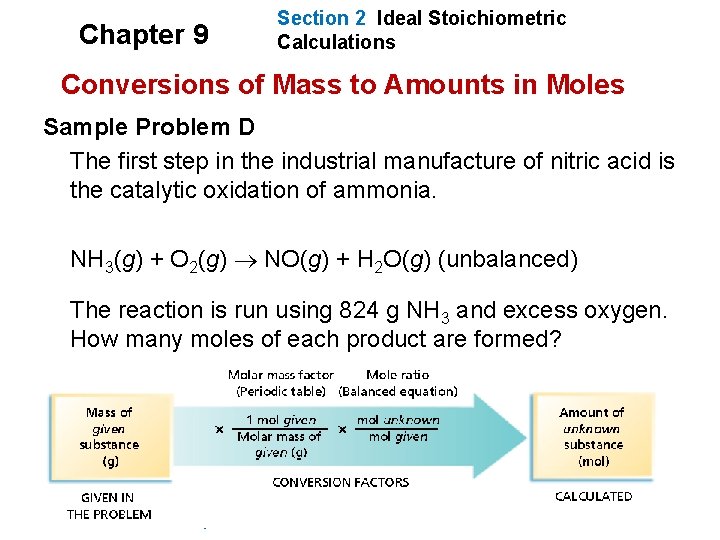
Chapter 9 Section 2 Ideal Stoichiometric Calculations Conversions of Mass to Amounts in Moles Sample Problem D The first step in the industrial manufacture of nitric acid is the catalytic oxidation of ammonia. NH 3(g) + O 2(g) NO(g) + H 2 O(g) (unbalanced) The reaction is run using 824 g NH 3 and excess oxygen. How many moles of each product are formed?
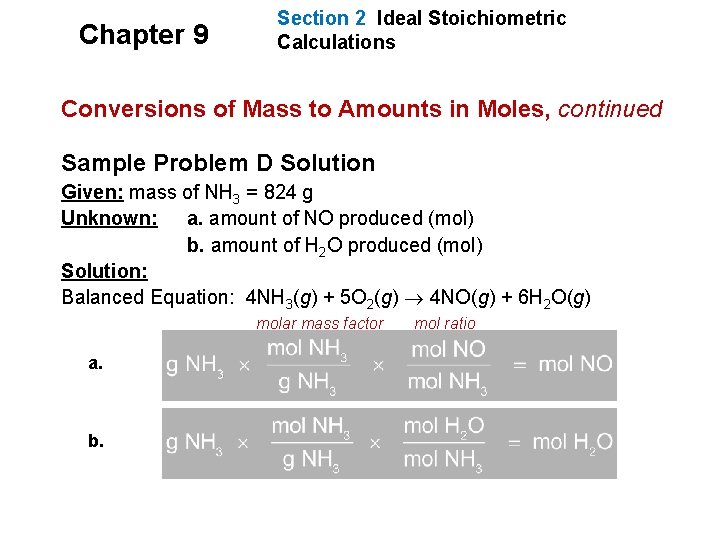
Chapter 9 Section 2 Ideal Stoichiometric Calculations Conversions of Mass to Amounts in Moles, continued Sample Problem D Solution Given: mass of NH 3 = 824 g Unknown: a. amount of NO produced (mol) b. amount of H 2 O produced (mol) Solution: Balanced Equation: 4 NH 3(g) + 5 O 2(g) 4 NO(g) + 6 H 2 O(g) molar mass factor a. b. mol ratio
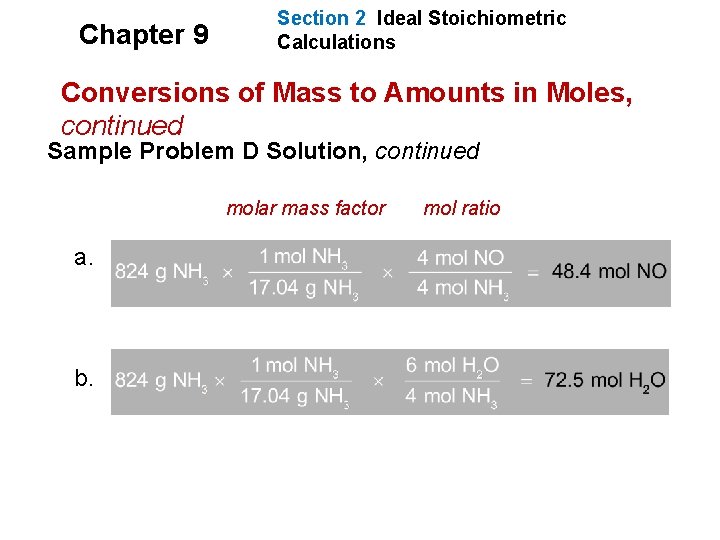
Chapter 9 Section 2 Ideal Stoichiometric Calculations Conversions of Mass to Amounts in Moles, continued Sample Problem D Solution, continued molar mass factor a. b. mol ratio
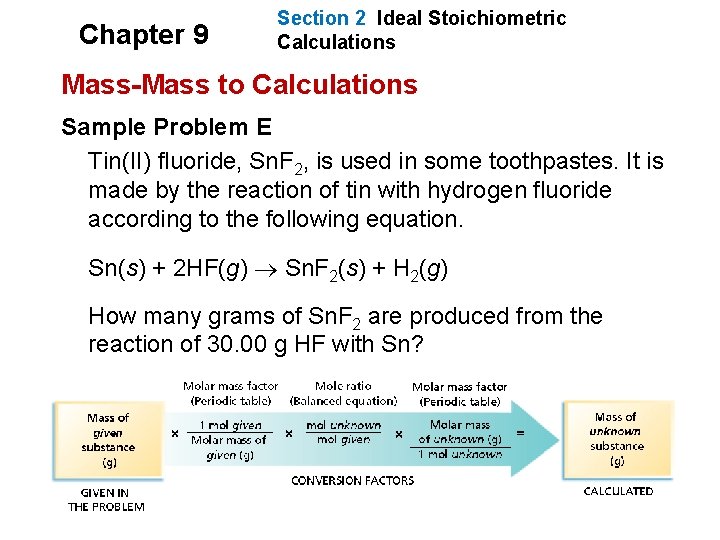
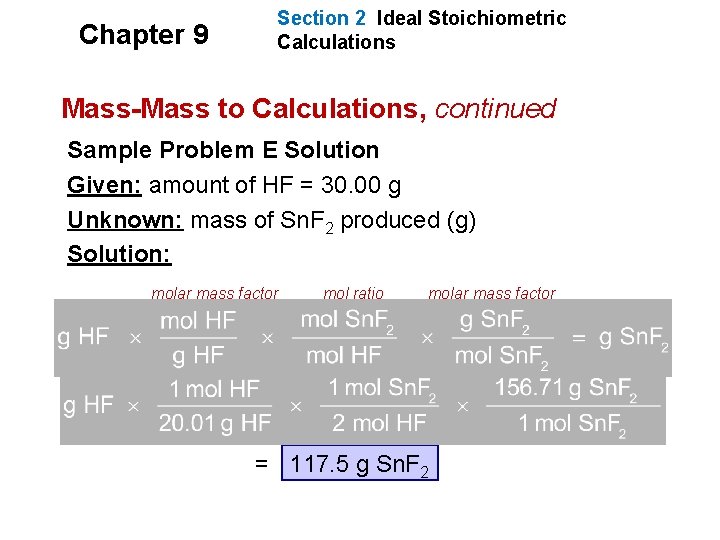
Chapter 9 Section 2 Ideal Stoichiometric Calculations Mass-Mass to Calculations Sample Problem E Tin(II) fluoride, Sn. F 2, is used in some toothpastes. It is made by the reaction of tin with hydrogen fluoride according to the following equation. Sn(s) + 2 HF(g) Sn. F 2(s) + H 2(g) How many grams of Sn. F 2 are produced from the reaction of 30. 00 g HF with Sn?
Chapter 9 Section 2 Ideal Stoichiometric Calculations Mass-Mass to Calculations, continued Sample Problem E Solution Given: amount of HF = 30. 00 g Unknown: mass of Sn. F 2 produced (g) Solution: molar mass factor mol ratio molar mass factor = 117. 5 g Sn. F 2
Chapter 9 Section 1 Introduction to Stoichiometry Solving Various Types of Stoichiometry Problems
Chapter 9 Section 3 Limiting Reactants and Percentage Yield Limiting Reactants • The limiting reactant is the reactant that limits the amount of the other reactant that can combine and the amount of product that can form in a chemical reaction. • The excess reactant is the substance that is not used up completely in a reaction.
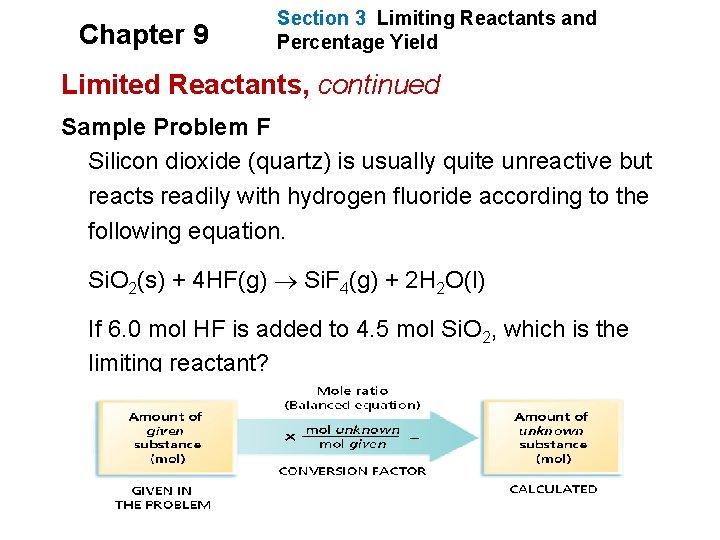
Chapter 9 Section 3 Limiting Reactants and Percentage Yield Limited Reactants, continued Sample Problem F Silicon dioxide (quartz) is usually quite unreactive but reacts readily with hydrogen fluoride according to the following equation. Si. O 2(s) + 4 HF(g) Si. F 4(g) + 2 H 2 O(l) If 6. 0 mol HF is added to 4. 5 mol Si. O 2, which is the limiting reactant?
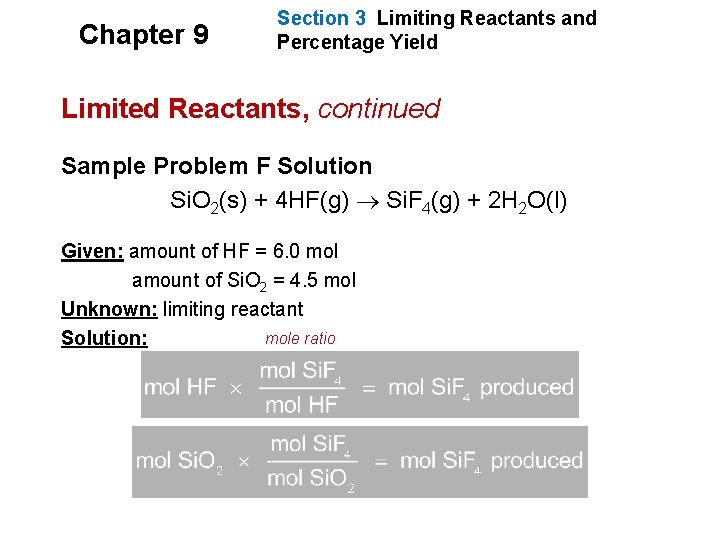
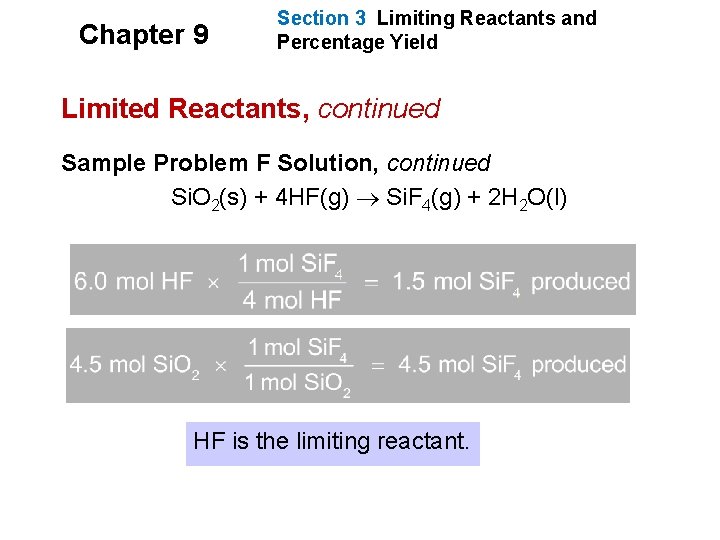
Chapter 9 Section 3 Limiting Reactants and Percentage Yield Limited Reactants, continued Sample Problem F Solution Si. O 2(s) + 4 HF(g) Si. F 4(g) + 2 H 2 O(l) Given: amount of HF = 6. 0 mol amount of Si. O 2 = 4. 5 mol Unknown: limiting reactant mole ratio Solution:
Chapter 9 Section 3 Limiting Reactants and Percentage Yield Limited Reactants, continued Sample Problem F Solution, continued Si. O 2(s) + 4 HF(g) Si. F 4(g) + 2 H 2 O(l) HF is the limiting reactant.
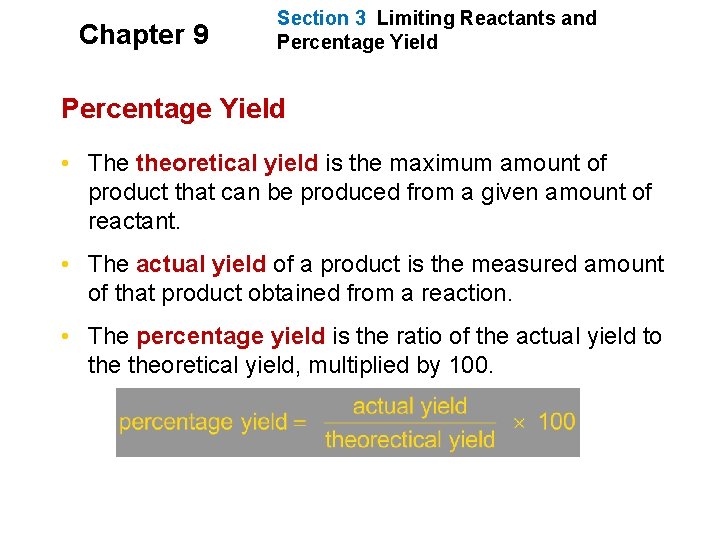
Chapter 9 Section 3 Limiting Reactants and Percentage Yield • The theoretical yield is the maximum amount of product that can be produced from a given amount of reactant. • The actual yield of a product is the measured amount of that product obtained from a reaction. • The percentage yield is the ratio of the actual yield to theoretical yield, multiplied by 100.
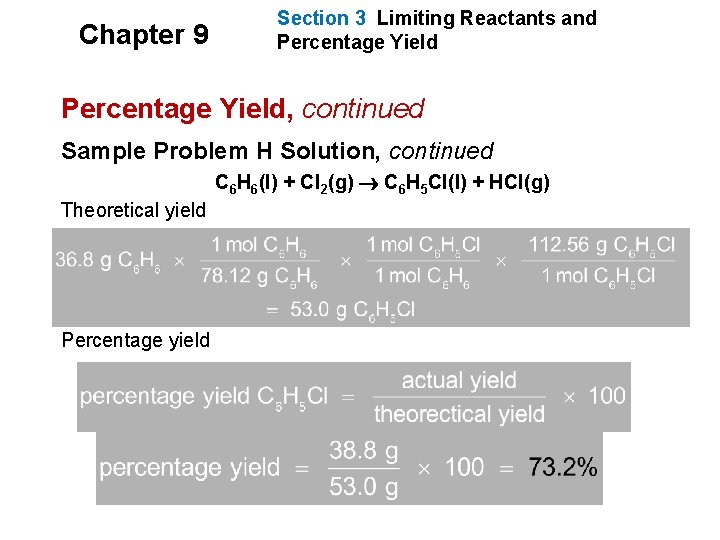
Chapter 9 Section 3 Limiting Reactants and Percentage Yield, continued Sample Problem H Chlorobenzene, C 6 H 5 Cl, is used in the production of many important chemicals, such as aspirin, dyes, and disinfectants. One industrial method of preparing chlorobenzene is to react benzene, C 6 H 6, with chlorine, as represented by the following equation. C 6 H 6 (l) + Cl 2(g) C 6 H 5 Cl(l) + HCl(g) When 36. 8 g C 6 H 6 react with an excess of Cl 2, the actual yield of C 6 H 5 Cl is 38. 8 g. What is the percentage yield of C 6 H 5 Cl?
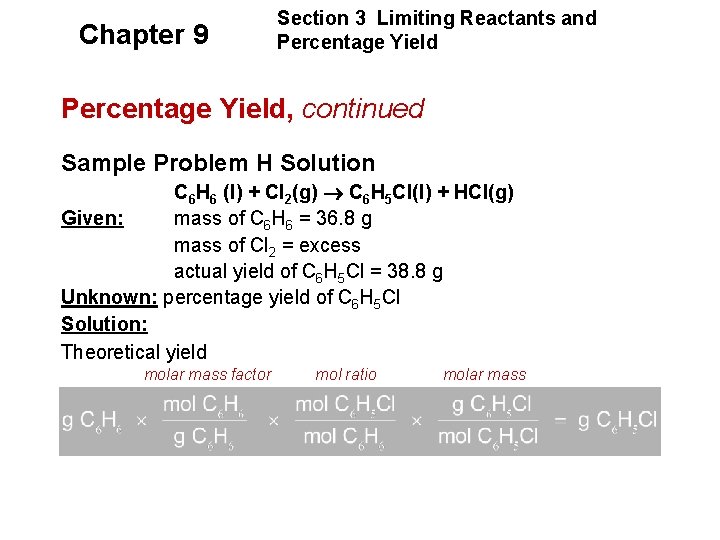
Chapter 9 Section 3 Limiting Reactants and Percentage Yield, continued Sample Problem H Solution C 6 H 6 (l) + Cl 2(g) C 6 H 5 Cl(l) + HCl(g) Given: mass of C 6 H 6 = 36. 8 g mass of Cl 2 = excess actual yield of C 6 H 5 Cl = 38. 8 g Unknown: percentage yield of C 6 H 5 Cl Solution: Theoretical yield molar mass factor mol ratio molar mass
Chapter 9 Section 3 Limiting Reactants and Percentage Yield, continued Sample Problem H Solution, continued C 6 H 6(l) + Cl 2(g) C 6 H 5 Cl(l) + HCl(g) Theoretical yield Percentage yield