
Chapter 9 Section 1 Introduction to Stoichiometry Definition



- Slides: 29
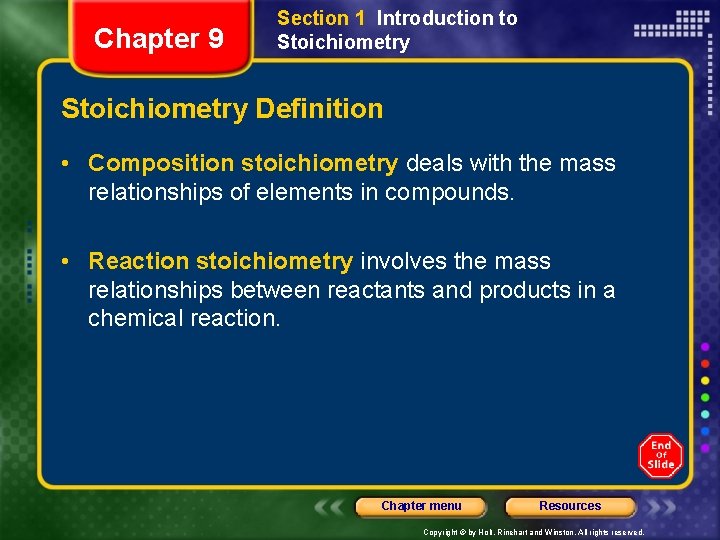
Chapter 9 Section 1 Introduction to Stoichiometry Definition • Composition stoichiometry deals with the mass relationships of elements in compounds. • Reaction stoichiometry involves the mass relationships between reactants and products in a chemical reaction. Chapter menu Resources Copyright © by Holt, Rinehart and Winston. All rights reserved.
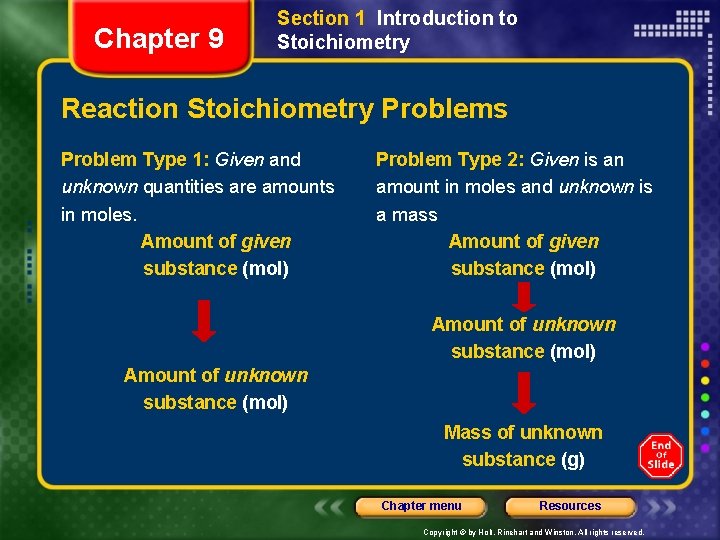
Chapter 9 Section 1 Introduction to Stoichiometry Reaction Stoichiometry Problems Problem Type 1: Given and unknown quantities are amounts in moles. Amount of given substance (mol) Problem Type 2: Given is an amount in moles and unknown is a mass Amount of given substance (mol) Amount of unknown substance (mol) Mass of unknown substance (g) Chapter menu Resources Copyright © by Holt, Rinehart and Winston. All rights reserved.
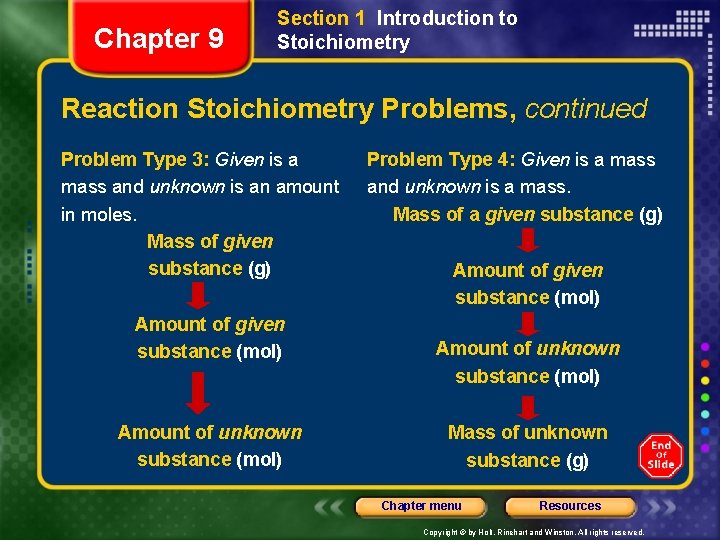
Chapter 9 Section 1 Introduction to Stoichiometry Reaction Stoichiometry Problems, continued Problem Type 3: Given is a mass and unknown is an amount in moles. Mass of given substance (g) Amount of given substance (mol) Amount of unknown substance (mol) Problem Type 4: Given is a mass and unknown is a mass. Mass of a given substance (g) Amount of given substance (mol) Amount of unknown substance (mol) Mass of unknown substance (g) Chapter menu Resources Copyright © by Holt, Rinehart and Winston. All rights reserved.
Chapter 9 Section 1 Introduction to Stoichiometry Mole Ratio • A mole ratio is a conversion factor that relates the amounts in moles of any two substances involved in a chemical reaction Example: 2 Al 2 O 3(l) 4 Al(s) + 3 O 2(g) Mole Ratios: 2 mol Al 2 O 3 4 mol Al , 2 mol Al 2 O 3 3 mol O 2 Chapter menu , 4 mol Al 3 mol O 2 Resources Copyright © by Holt, Rinehart and Winston. All rights reserved.
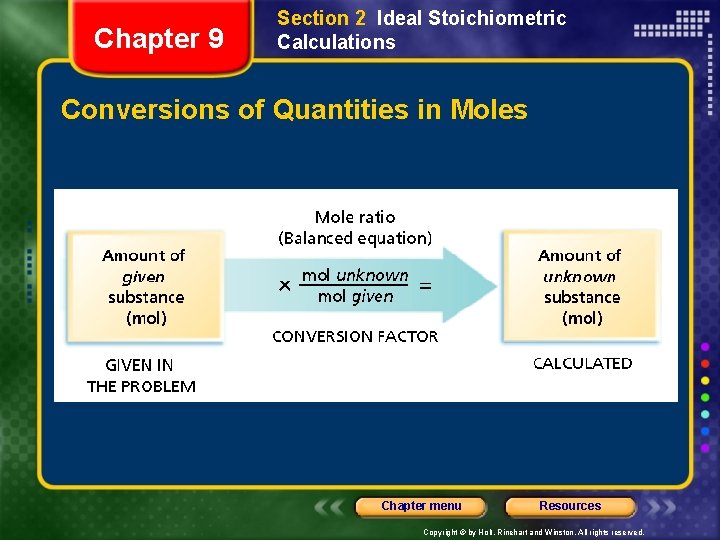
Chapter 9 Section 2 Ideal Stoichiometric Calculations Conversions of Quantities in Moles Chapter menu Resources Copyright © by Holt, Rinehart and Winston. All rights reserved.
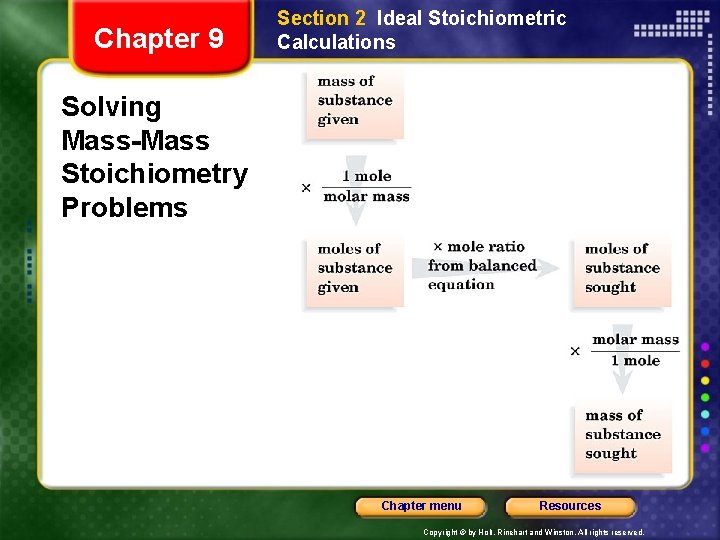
Chapter 9 Section 2 Ideal Stoichiometric Calculations Solving Mass-Mass Stoichiometry Problems Chapter menu Resources Copyright © by Holt, Rinehart and Winston. All rights reserved.
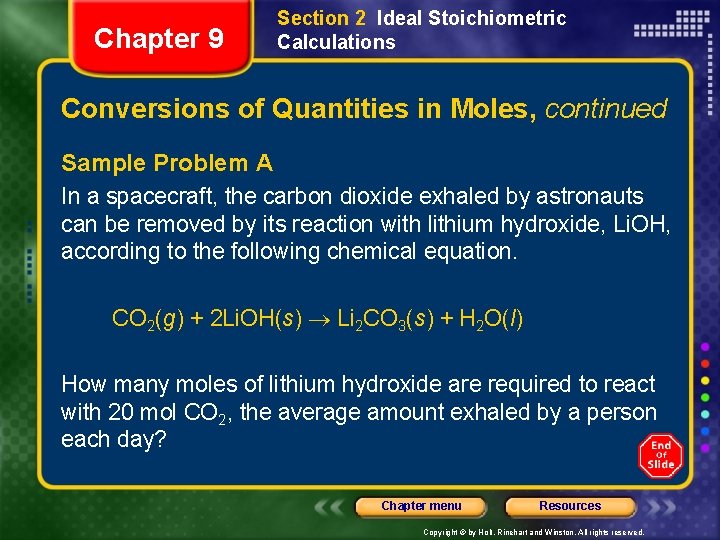
Chapter 9 Section 2 Ideal Stoichiometric Calculations Conversions of Quantities in Moles, continued Sample Problem A In a spacecraft, the carbon dioxide exhaled by astronauts can be removed by its reaction with lithium hydroxide, Li. OH, according to the following chemical equation. CO 2(g) + 2 Li. OH(s) Li 2 CO 3(s) + H 2 O(l) How many moles of lithium hydroxide are required to react with 20 mol CO 2, the average amount exhaled by a person each day? Chapter menu Resources Copyright © by Holt, Rinehart and Winston. All rights reserved.
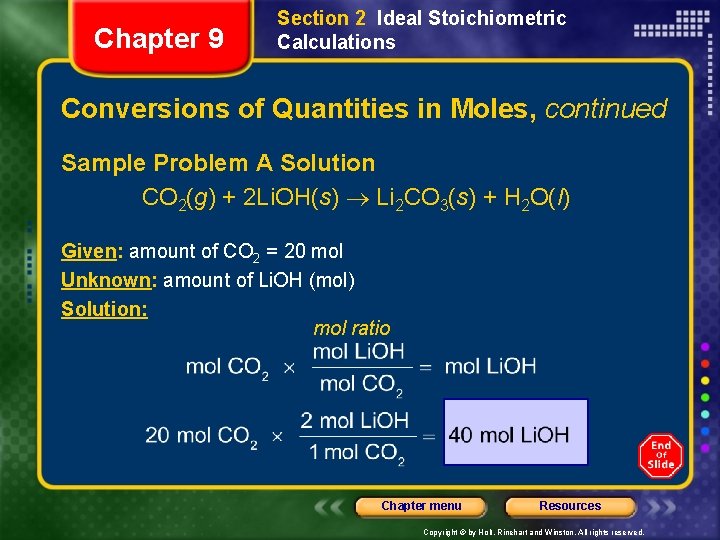
Chapter 9 Section 2 Ideal Stoichiometric Calculations Conversions of Quantities in Moles, continued Sample Problem A Solution CO 2(g) + 2 Li. OH(s) Li 2 CO 3(s) + H 2 O(l) Given: amount of CO 2 = 20 mol Unknown: amount of Li. OH (mol) Solution: mol ratio Chapter menu Resources Copyright © by Holt, Rinehart and Winston. All rights reserved.
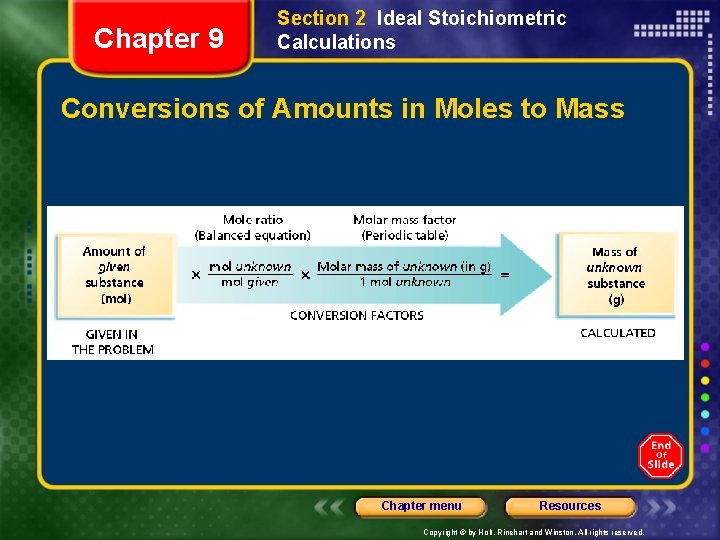
Chapter 9 Section 2 Ideal Stoichiometric Calculations Conversions of Amounts in Moles to Mass Chapter menu Resources Copyright © by Holt, Rinehart and Winston. All rights reserved.
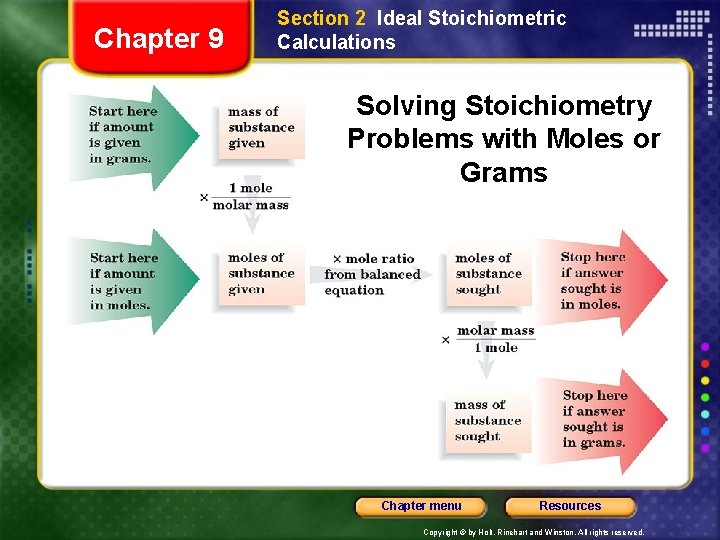
Chapter 9 Section 2 Ideal Stoichiometric Calculations Solving Stoichiometry Problems with Moles or Grams Chapter menu Resources Copyright © by Holt, Rinehart and Winston. All rights reserved.
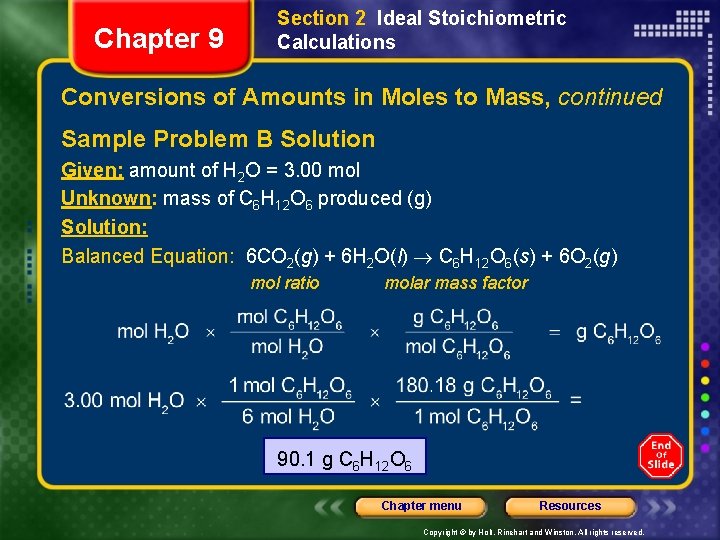
Chapter 9 Section 2 Ideal Stoichiometric Calculations Conversions of Amounts in Moles to Mass, continued Sample Problem B In photosynthesis, plants use energy from the sun to produce glucose, C 6 H 12 O 6, and oxygen from the reaction of carbon dioxide and water. What mass, in grams, of glucose is produced when 3. 00 mol of water react with carbon dioxide? Chapter menu Resources Copyright © by Holt, Rinehart and Winston. All rights reserved.
Chapter 9 Section 2 Ideal Stoichiometric Calculations Conversions of Amounts in Moles to Mass, continued Sample Problem B Solution Given: amount of H 2 O = 3. 00 mol Unknown: mass of C 6 H 12 O 6 produced (g) Solution: Balanced Equation: 6 CO 2(g) + 6 H 2 O(l) C 6 H 12 O 6(s) + 6 O 2(g) mol ratio molar mass factor 90. 1 g C 6 H 12 O 6 Chapter menu Resources Copyright © by Holt, Rinehart and Winston. All rights reserved.
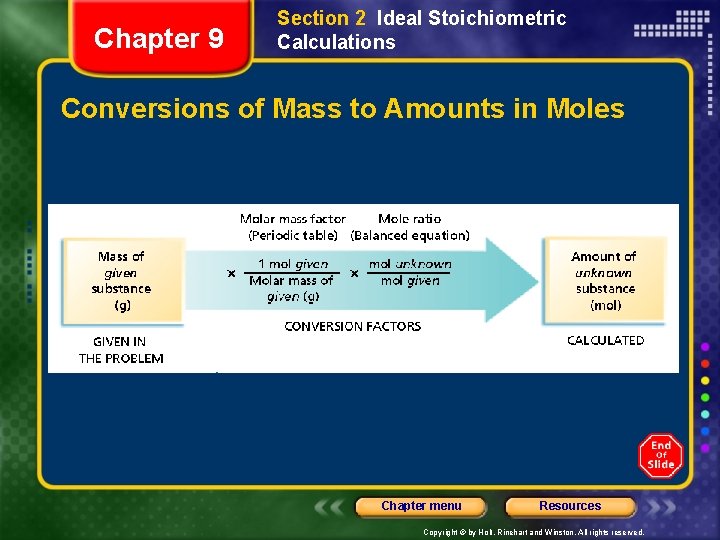
Chapter 9 Section 2 Ideal Stoichiometric Calculations Conversions of Mass to Amounts in Moles Chapter menu Resources Copyright © by Holt, Rinehart and Winston. All rights reserved.
Chapter 9 Visual Concepts Mass and Number of Moles of an Unknown Click below to watch the Visual Concept Chapter menu Resources Copyright © by Holt, Rinehart and Winston. All rights reserved.
Chapter 9 Section 2 Ideal Stoichiometric Calculations Conversions of Mass to Amounts in Moles, continued Sample Problem D The first step in the industrial manufacture of nitric acid is the catalytic oxidation of ammonia. NH 3(g) + O 2(g) NO(g) + H 2 O(g) (unbalanced) The reaction is run using 824 g NH 3 and excess oxygen. a. How many moles of NO are formed? b. How many moles of H 2 O are formed? Chapter menu Resources Copyright © by Holt, Rinehart and Winston. All rights reserved.
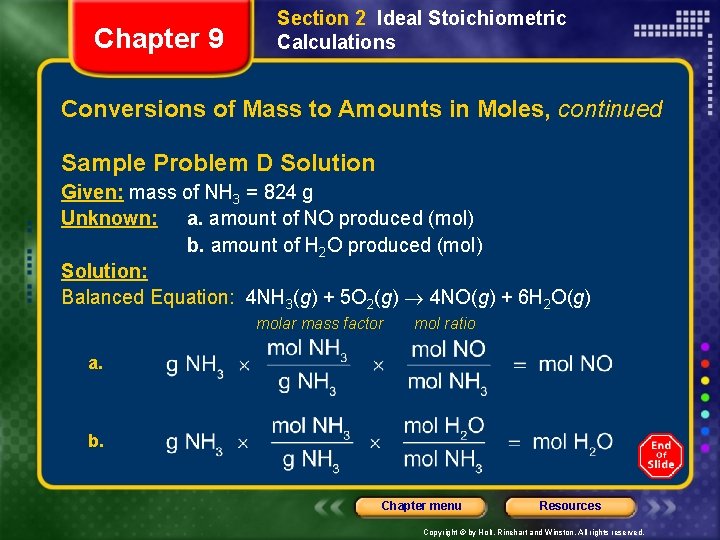
Chapter 9 Section 2 Ideal Stoichiometric Calculations Conversions of Mass to Amounts in Moles, continued Sample Problem D Solution Given: mass of NH 3 = 824 g Unknown: a. amount of NO produced (mol) b. amount of H 2 O produced (mol) Solution: Balanced Equation: 4 NH 3(g) + 5 O 2(g) 4 NO(g) + 6 H 2 O(g) molar mass factor mol ratio a. b. Chapter menu Resources Copyright © by Holt, Rinehart and Winston. All rights reserved.
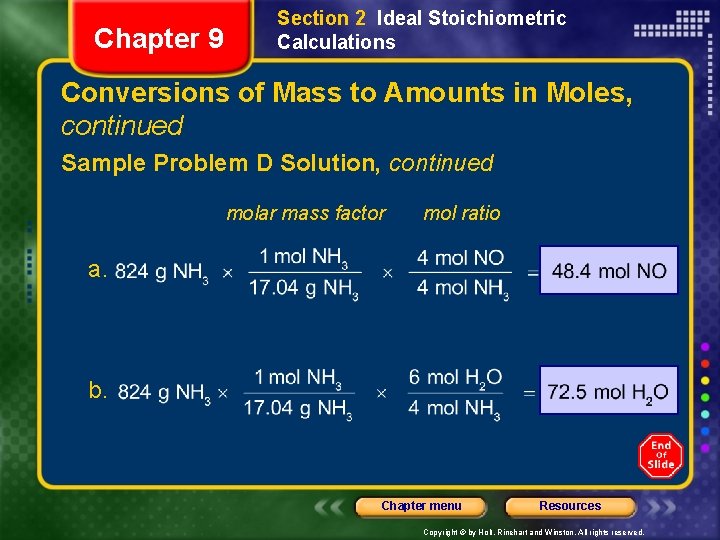
Chapter 9 Section 2 Ideal Stoichiometric Calculations Conversions of Mass to Amounts in Moles, continued Sample Problem D Solution, continued molar mass factor mol ratio a. b. Chapter menu Resources Copyright © by Holt, Rinehart and Winston. All rights reserved.
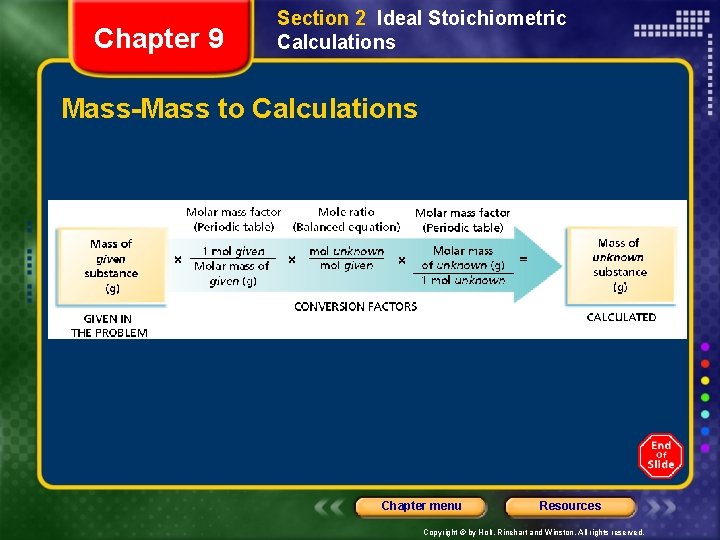
Chapter 9 Section 2 Ideal Stoichiometric Calculations Mass-Mass to Calculations Chapter menu Resources Copyright © by Holt, Rinehart and Winston. All rights reserved.
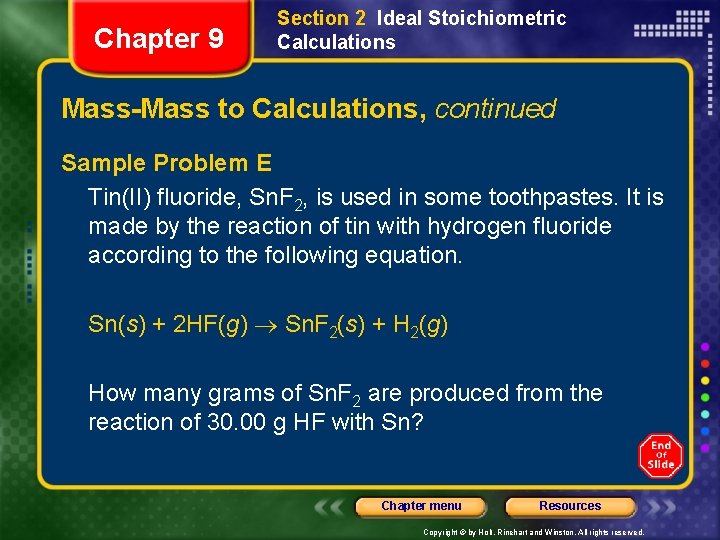
Chapter 9 Section 2 Ideal Stoichiometric Calculations Mass-Mass to Calculations, continued Sample Problem E Tin(II) fluoride, Sn. F 2, is used in some toothpastes. It is made by the reaction of tin with hydrogen fluoride according to the following equation. Sn(s) + 2 HF(g) Sn. F 2(s) + H 2(g) How many grams of Sn. F 2 are produced from the reaction of 30. 00 g HF with Sn? Chapter menu Resources Copyright © by Holt, Rinehart and Winston. All rights reserved.
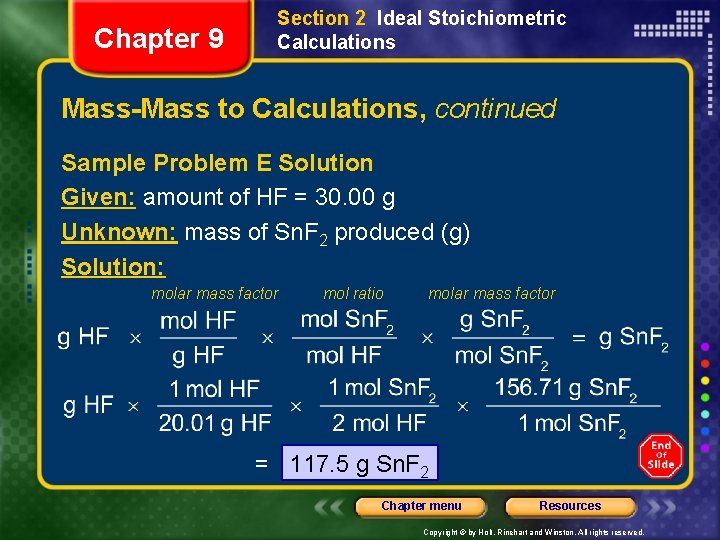
Chapter 9 Section 2 Ideal Stoichiometric Calculations Mass-Mass to Calculations, continued Sample Problem E Solution Given: amount of HF = 30. 00 g Unknown: mass of Sn. F 2 produced (g) Solution: molar mass factor mol ratio molar mass factor = 117. 5 g Sn. F 2 Chapter menu Resources Copyright © by Holt, Rinehart and Winston. All rights reserved.
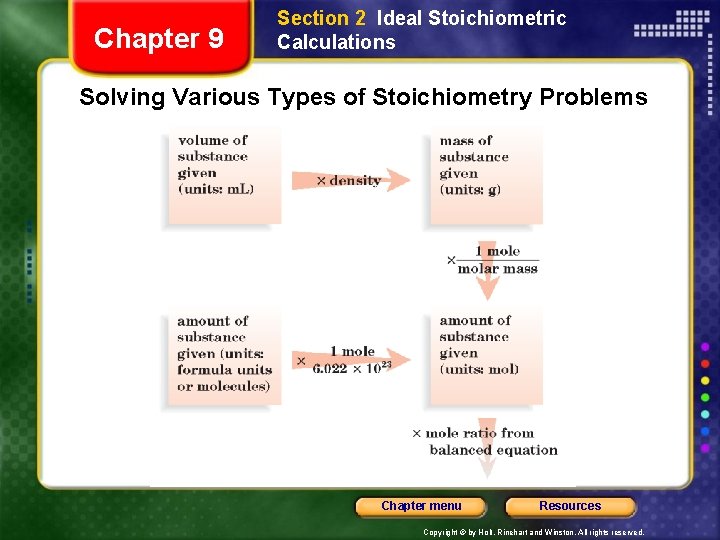
Chapter 9 Section 2 Ideal Stoichiometric Calculations Solving Various Types of Stoichiometry Problems Chapter menu Resources Copyright © by Holt, Rinehart and Winston. All rights reserved.
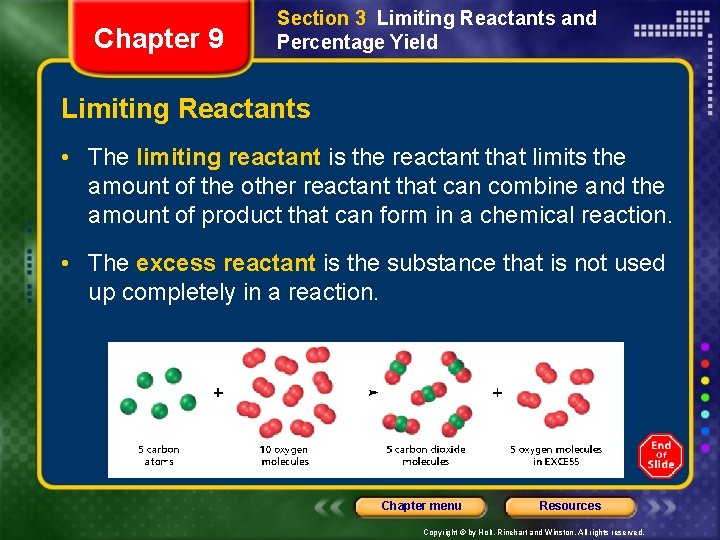
Chapter 9 Section 3 Limiting Reactants and Percentage Yield Limiting Reactants • The limiting reactant is the reactant that limits the amount of the other reactant that can combine and the amount of product that can form in a chemical reaction. • The excess reactant is the substance that is not used up completely in a reaction. Chapter menu Resources Copyright © by Holt, Rinehart and Winston. All rights reserved.
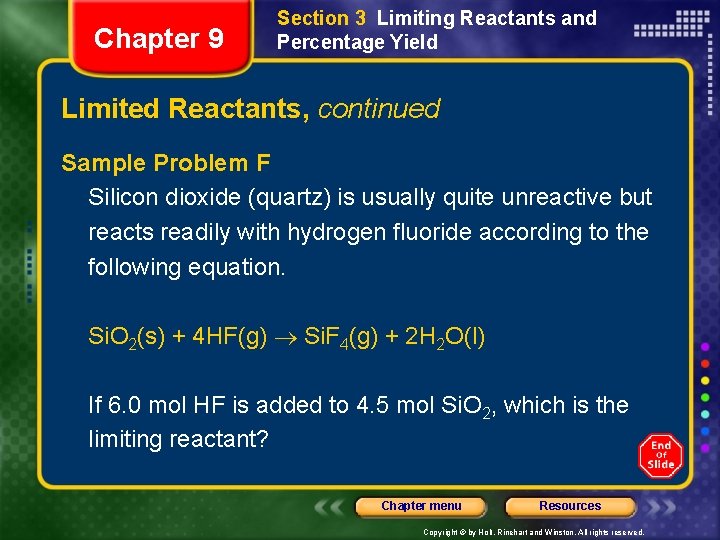
Chapter 9 Section 3 Limiting Reactants and Percentage Yield Limited Reactants, continued Sample Problem F Silicon dioxide (quartz) is usually quite unreactive but reacts readily with hydrogen fluoride according to the following equation. Si. O 2(s) + 4 HF(g) Si. F 4(g) + 2 H 2 O(l) If 6. 0 mol HF is added to 4. 5 mol Si. O 2, which is the limiting reactant? Chapter menu Resources Copyright © by Holt, Rinehart and Winston. All rights reserved.
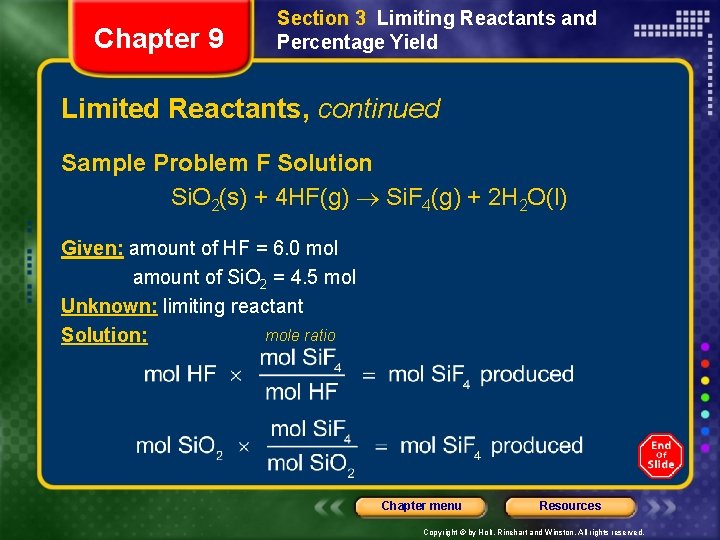
Chapter 9 Section 3 Limiting Reactants and Percentage Yield Limited Reactants, continued Sample Problem F Solution Si. O 2(s) + 4 HF(g) Si. F 4(g) + 2 H 2 O(l) Given: amount of HF = 6. 0 mol amount of Si. O 2 = 4. 5 mol Unknown: limiting reactant mole ratio Solution: Chapter menu Resources Copyright © by Holt, Rinehart and Winston. All rights reserved.
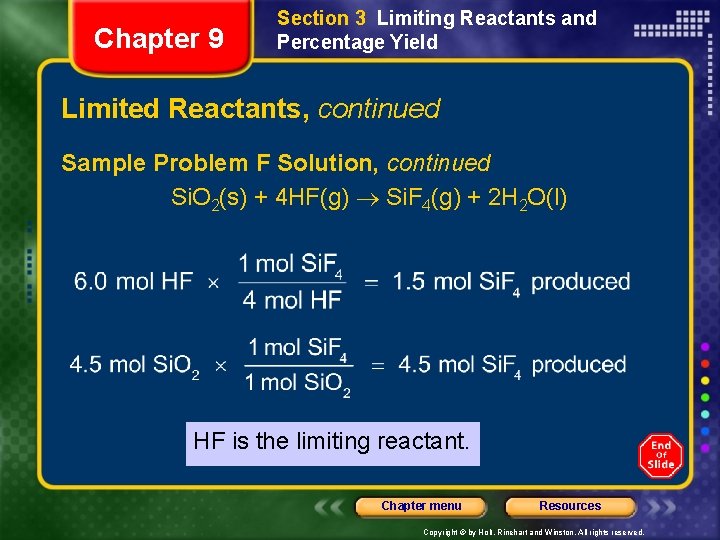
Chapter 9 Section 3 Limiting Reactants and Percentage Yield Limited Reactants, continued Sample Problem F Solution, continued Si. O 2(s) + 4 HF(g) Si. F 4(g) + 2 H 2 O(l) HF is the limiting reactant. Chapter menu Resources Copyright © by Holt, Rinehart and Winston. All rights reserved.
Chapter 9 Section 3 Limiting Reactants and Percentage Yield • The theoretical yield is the maximum amount of product that can be produced from a given amount of reactant. • The actual yield of a product is the measured amount of that product obtained from a reaction. • The percentage yield is the ratio of the actual yield to theoretical yield, multiplied by 100. Chapter menu Resources Copyright © by Holt, Rinehart and Winston. All rights reserved.
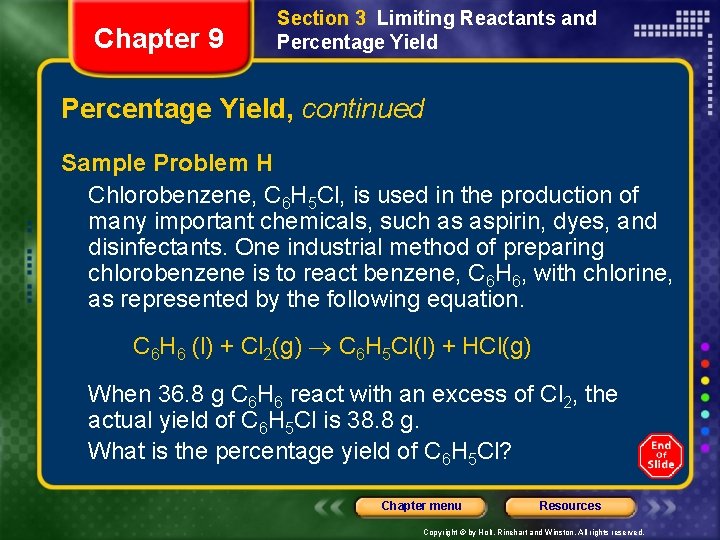
Chapter 9 Section 3 Limiting Reactants and Percentage Yield, continued Sample Problem H Chlorobenzene, C 6 H 5 Cl, is used in the production of many important chemicals, such as aspirin, dyes, and disinfectants. One industrial method of preparing chlorobenzene is to react benzene, C 6 H 6, with chlorine, as represented by the following equation. C 6 H 6 (l) + Cl 2(g) C 6 H 5 Cl(l) + HCl(g) When 36. 8 g C 6 H 6 react with an excess of Cl 2, the actual yield of C 6 H 5 Cl is 38. 8 g. What is the percentage yield of C 6 H 5 Cl? Chapter menu Resources Copyright © by Holt, Rinehart and Winston. All rights reserved.
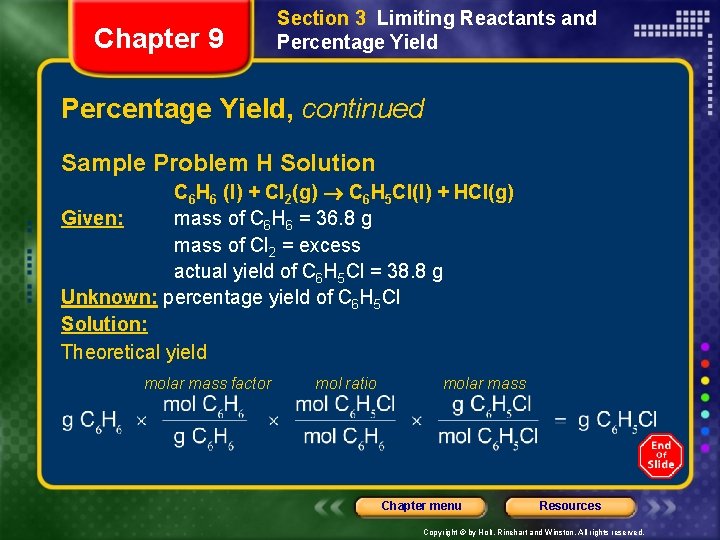
Chapter 9 Section 3 Limiting Reactants and Percentage Yield, continued Sample Problem H Solution C 6 H 6 (l) + Cl 2(g) C 6 H 5 Cl(l) + HCl(g) Given: mass of C 6 H 6 = 36. 8 g mass of Cl 2 = excess actual yield of C 6 H 5 Cl = 38. 8 g Unknown: percentage yield of C 6 H 5 Cl Solution: Theoretical yield molar mass factor mol ratio molar mass Chapter menu Resources Copyright © by Holt, Rinehart and Winston. All rights reserved.
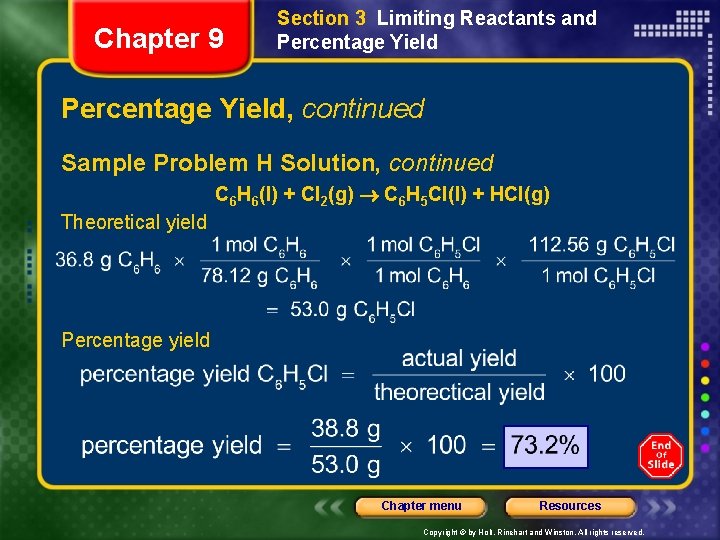
Chapter 9 Section 3 Limiting Reactants and Percentage Yield, continued Sample Problem H Solution, continued C 6 H 6(l) + Cl 2(g) C 6 H 5 Cl(l) + HCl(g) Theoretical yield Percentage yield Chapter menu Resources Copyright © by Holt, Rinehart and Winston. All rights reserved.