
Chapter 9 Searching Sorting and Algorithm Analysis Starting
![Binary Search Example • Array numlist 2 contains [0] [1] [2] [3] [4] [5]](https://slidetodoc.com/presentation_image_h2/cae544b2364ae91fd8b9db963e6a7787/image-8.jpg "Binary Search Example • Array numlist 2 contains [0] [1] [2] [3] [4] [5]")
![Selection Sort Example (pass 1) Array List contains [0] [1] [2] [3] 11 2](https://slidetodoc.com/presentation_image_h2/cae544b2364ae91fd8b9db963e6a7787/image-18.jpg "Selection Sort Example (pass 1) Array List contains [0] [1] [2] [3] 11 2")
- Slides: 29
Chapter 9: Searching, Sorting, and Algorithm Analysis Starting Out with C++ Early Objects Seventh Edition by Tony Gaddis, Judy Walters, and Godfrey Muganda Copyright © 2011 Pearson Education, Inc. Publishing as Pearson Addison-Wesley
Topics • • • 9. 1 9. 2 9. 3 9. 4 9. 5 9. 6 Introduction to Search Algorithms Searching an Array of Objects Introduction to Sorting Algorithms Sorting an Array of Objects Sorting and Searching Vectors Introduction to Analysis of Algorithms Copyright © 2011 Pearson Education, Inc. Publishing as Pearson Addison-Wesley 9 -2
9. 1 Introduction to Search Algorithms • Search: locate an item in a list (array, vector, etc. ) of information • Two algorithms (methods) considered here: – Linear search – Binary search Copyright © 2011 Pearson Education, Inc. Publishing as Pearson Addison-Wesley 9 -3
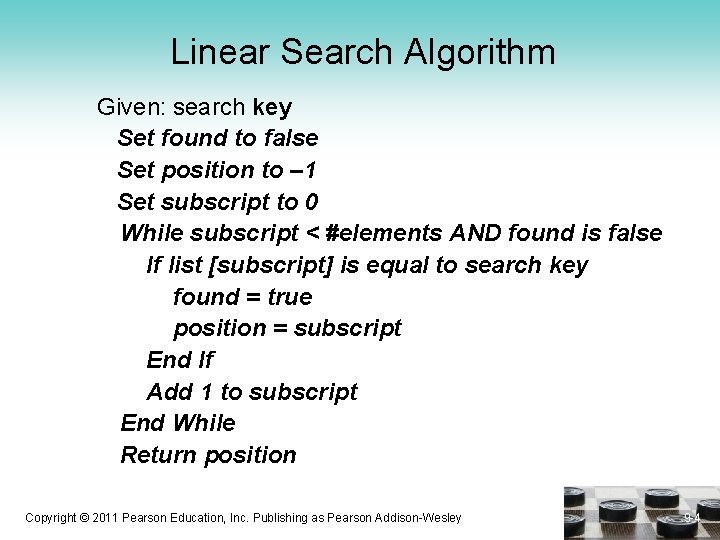
Linear Search Algorithm Given: search key Set found to false Set position to – 1 Set subscript to 0 While subscript < #elements AND found is false If list [subscript] is equal to search key found = true position = subscript End If Add 1 to subscript End While Return position Copyright © 2011 Pearson Education, Inc. Publishing as Pearson Addison-Wesley 9 -4
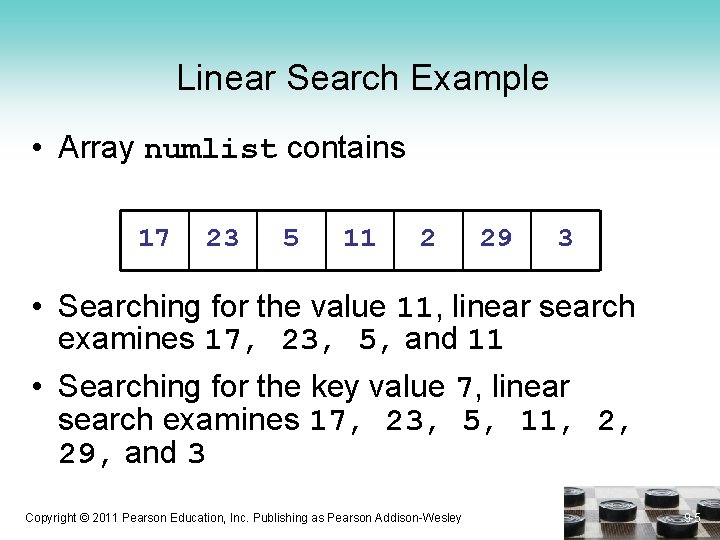
Linear Search Example • Array numlist contains 17 23 5 11 2 29 3 • Searching for the value 11, linear search examines 17, 23, 5, and 11 • Searching for the key value 7, linear search examines 17, 23, 5, 11, 2, 29, and 3 Copyright © 2011 Pearson Education, Inc. Publishing as Pearson Addison-Wesley 9 -5
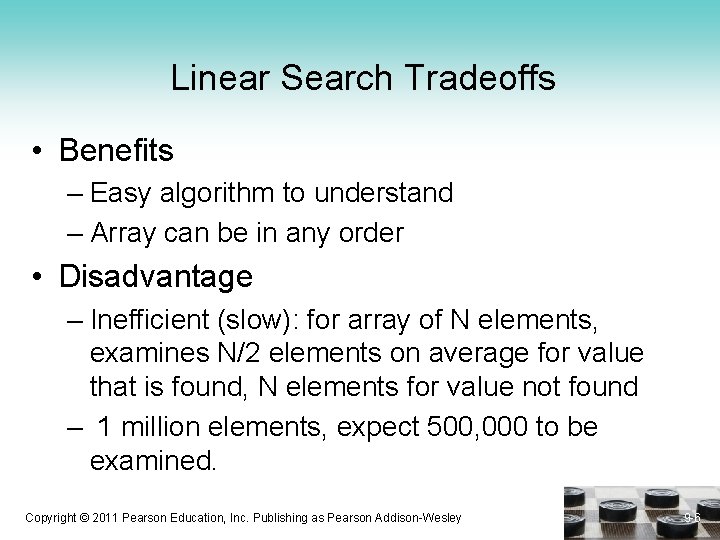
Linear Search Tradeoffs • Benefits – Easy algorithm to understand – Array can be in any order • Disadvantage – Inefficient (slow): for array of N elements, examines N/2 elements on average for value that is found, N elements for value not found – 1 million elements, expect 500, 000 to be examined. Copyright © 2011 Pearson Education, Inc. Publishing as Pearson Addison-Wesley 9 -6
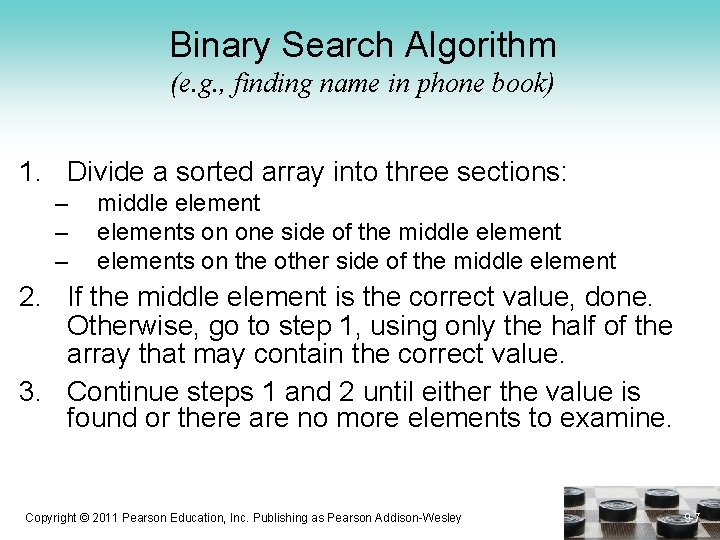
Binary Search Algorithm (e. g. , finding name in phone book) 1. Divide a sorted array into three sections: – – – middle elements on one side of the middle elements on the other side of the middle element 2. If the middle element is the correct value, done. Otherwise, go to step 1, using only the half of the array that may contain the correct value. 3. Continue steps 1 and 2 until either the value is found or there are no more elements to examine. Copyright © 2011 Pearson Education, Inc. Publishing as Pearson Addison-Wesley 9 -7
Binary Search Example • Array numlist 2 contains [0] [1] [2] [3] [4] [5] [6] 2 3 5 11 17 23 29 • Searching for the key 11, binary search examines the middle, 11 and stops • Searching for the key 7, binary search examines 11, 3, 5, and stops Copyright © 2011 Pearson Education, Inc. Publishing as Pearson Addison-Wesley 9 -8
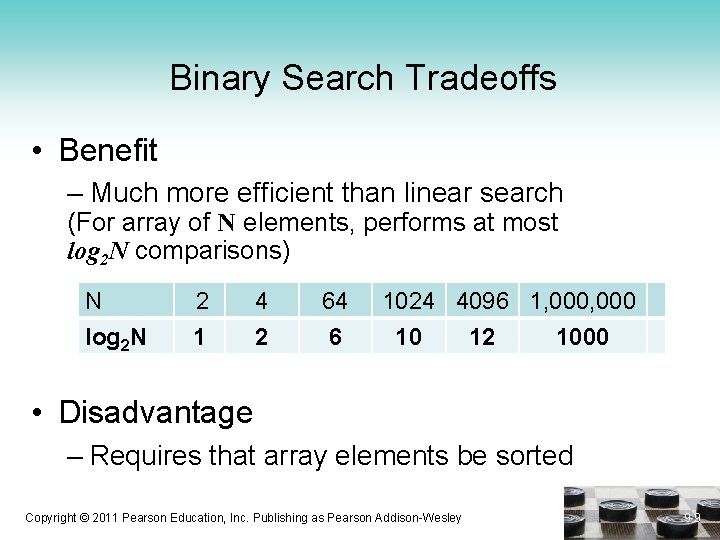
Binary Search Tradeoffs • Benefit – Much more efficient than linear search (For array of N elements, performs at most log 2 N comparisons) N log 2 N 2 1 4 2 64 6 1024 4096 1, 000 10 12 1000 • Disadvantage – Requires that array elements be sorted Copyright © 2011 Pearson Education, Inc. Publishing as Pearson Addison-Wesley 9 -9
9. 2 Searching an Array of Objects • Search algorithms are not limited to arrays of integers • When searching an array of objects or structures, the value being searched for is a member of an object or structure, not the entire object or structure • Member in object/structure: key field • Value used in search: search key Copyright © 2011 Pearson Education, Inc. Publishing as Pearson Addison-Wesley 9 -10
9. 3 Introduction to Sorting Algorithms • Sort: arrange values into an order – Ascending – smallest value first – Descending – smalles value last • Two algorithms considered here – Bubble sort – Selection sort Copyright © 2011 Pearson Education, Inc. Publishing as Pearson Addison-Wesley 9 -11
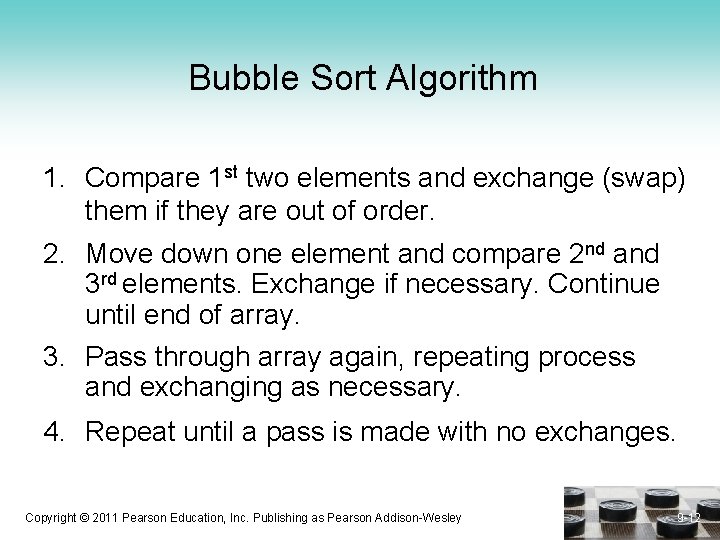
Bubble Sort Algorithm 1. Compare 1 st two elements and exchange (swap) them if they are out of order. 2. Move down one element and compare 2 nd and 3 rd elements. Exchange if necessary. Continue until end of array. 3. Pass through array again, repeating process and exchanging as necessary. 4. Repeat until a pass is made with no exchanges. Copyright © 2011 Pearson Education, Inc. Publishing as Pearson Addison-Wesley 9 -12
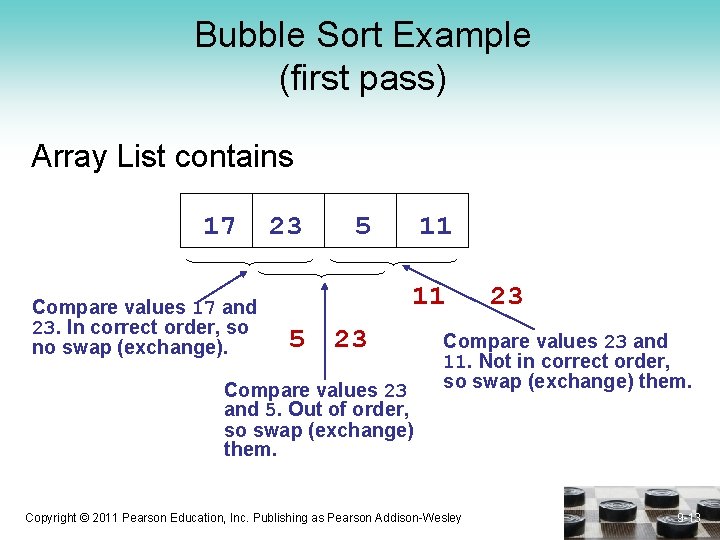
Bubble Sort Example (first pass) Array List contains 17 Compare values 17 and 23. In correct order, so no swap (exchange). 23 5 11 11 5 23 Compare values 23 and 5. Out of order, so swap (exchange) them. 23 Compare values 23 and 11. Not in correct order, so swap (exchange) them. Copyright © 2011 Pearson Education, Inc. Publishing as Pearson Addison-Wesley 9 -13
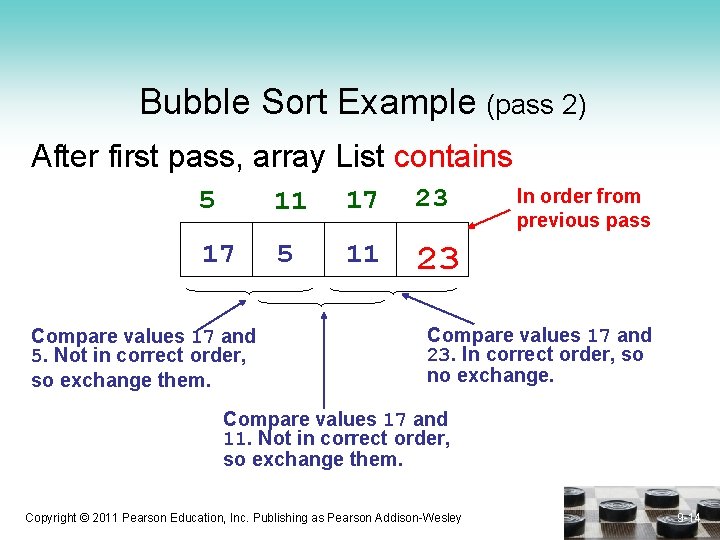
Bubble Sort Example (pass 2) After first pass, array List contains 5 11 17 23 17 5 11 23 Compare values 17 and 5. Not in correct order, so exchange them. In order from previous pass Compare values 17 and 23. In correct order, so no exchange. Compare values 17 and 11. Not in correct order, so exchange them. Copyright © 2011 Pearson Education, Inc. Publishing as Pearson Addison-Wesley 9 -14
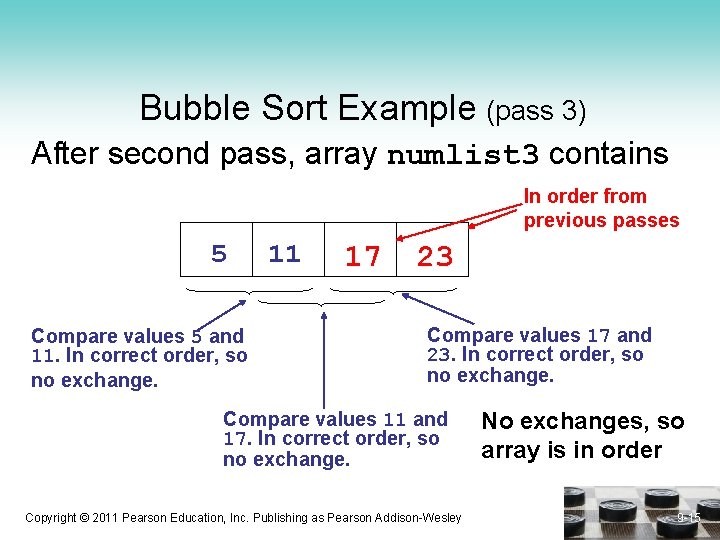
Bubble Sort Example (pass 3) After second pass, array numlist 3 contains In order from previous passes 5 Compare values 5 and 11. In correct order, so no exchange. 11 17 23 Compare values 17 and 23. In correct order, so no exchange. Compare values 11 and 17. In correct order, so no exchange. Copyright © 2011 Pearson Education, Inc. Publishing as Pearson Addison-Wesley No exchanges, so array is in order 9 -15
Bubble Sort Tradeoffs • Benefit – Easy to understand implement • Disadvantage – Inefficiency makes it slow for large arrays • MASTER IT!! Copyright © 2011 Pearson Education, Inc. Publishing as Pearson Addison-Wesley 9 -16
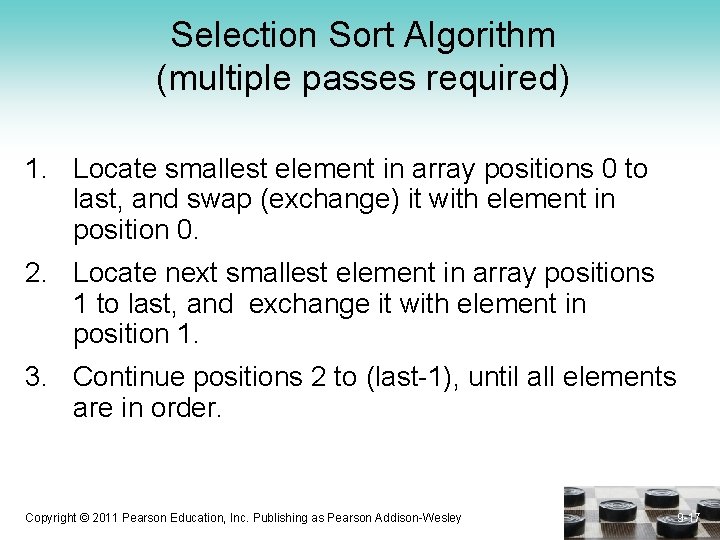
Selection Sort Algorithm (multiple passes required) 1. Locate smallest element in array positions 0 to last, and swap (exchange) it with element in position 0. 2. Locate next smallest element in array positions 1 to last, and exchange it with element in position 1. 3. Continue positions 2 to (last-1), until all elements are in order. Copyright © 2011 Pearson Education, Inc. Publishing as Pearson Addison-Wesley 9 -17
Selection Sort Example (pass 1) Array List contains [0] [1] [2] [3] 11 2 29 3 • Smallest element, 2, at position 1; • Swap List[1] and List[0]. Now in order 2 11 29 3 Copyright © 2011 Pearson Education, Inc. Publishing as Pearson Addison-Wesley 9 -18
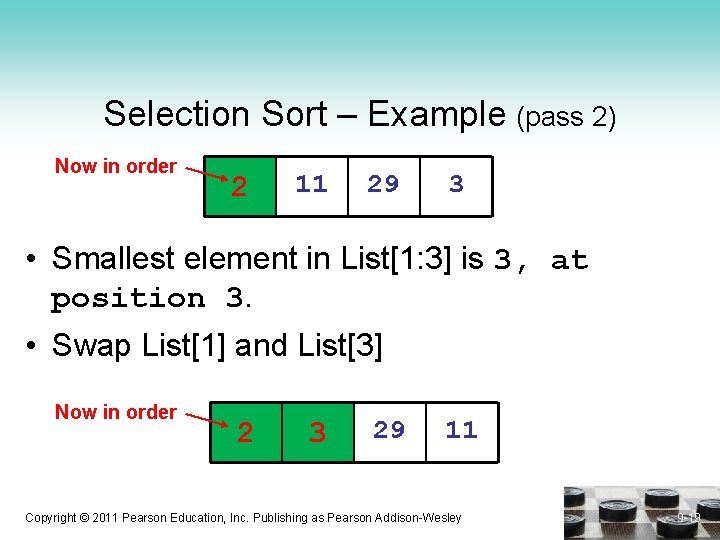
Selection Sort – Example (pass 2) Now in order 2 11 29 3 • Smallest element in List[1: 3] is 3, at position 3. • Swap List[1] and List[3] Now in order 2 3 29 11 Copyright © 2011 Pearson Education, Inc. Publishing as Pearson Addison-Wesley 9 -19
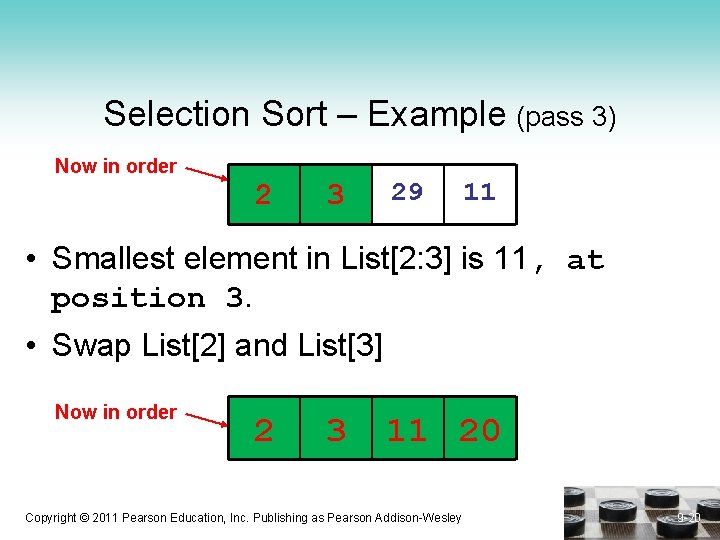
Selection Sort – Example (pass 3) Now in order 2 3 29 11 • Smallest element in List[2: 3] is 11, at position 3. • Swap List[2] and List[3] Now in order 2 3 11 20 Copyright © 2011 Pearson Education, Inc. Publishing as Pearson Addison-Wesley 9 -20
Selection Sort Tradeoffs • Benefit- more efficient than Bubble Sort, due to fewer exchanges • Disadvantage – some consider it harder than Bubble Sort to understand • This is how YOU would sort a stack of numbered cards Copyright © 2011 Pearson Education, Inc. Publishing as Pearson Addison-Wesley 9 -21
9. 4 Sorting an Array of Objects • As with searching, arrays to be sorted can contain objects or structures • The key field determines how the structures or objects will be ordered • When exchanging contents of array elements, entire structures or objects must be exchanged, not just the key fields in the structures or objects Copyright © 2011 Pearson Education, Inc. Publishing as Pearson Addison-Wesley 9 -22
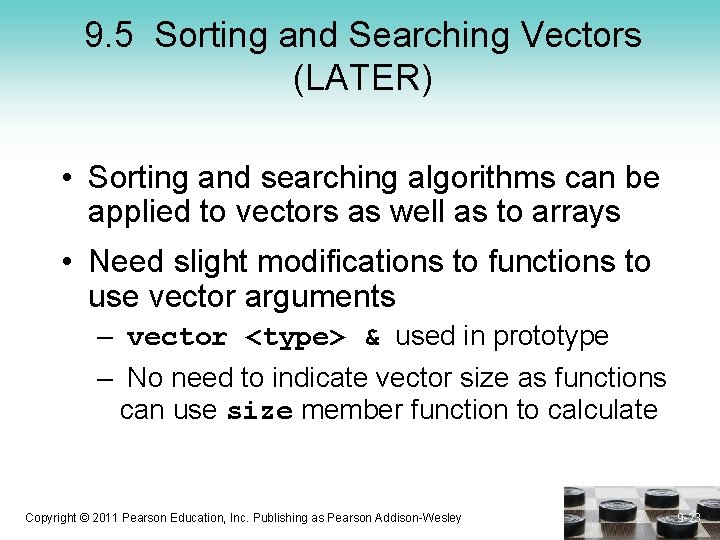
9. 5 Sorting and Searching Vectors (LATER) • Sorting and searching algorithms can be applied to vectors as well as to arrays • Need slight modifications to functions to use vector arguments – vector <type> & used in prototype – No need to indicate vector size as functions can use size member function to calculate Copyright © 2011 Pearson Education, Inc. Publishing as Pearson Addison-Wesley 9 -23
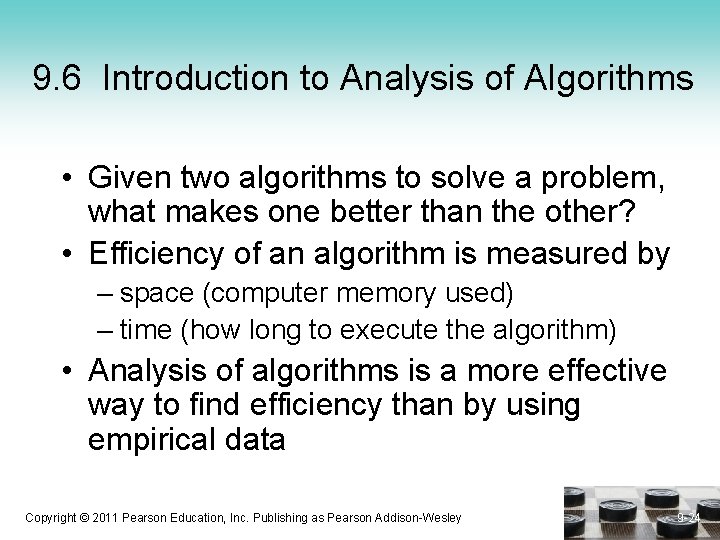
9. 6 Introduction to Analysis of Algorithms • Given two algorithms to solve a problem, what makes one better than the other? • Efficiency of an algorithm is measured by – space (computer memory used) – time (how long to execute the algorithm) • Analysis of algorithms is a more effective way to find efficiency than by using empirical data Copyright © 2011 Pearson Education, Inc. Publishing as Pearson Addison-Wesley 9 -24
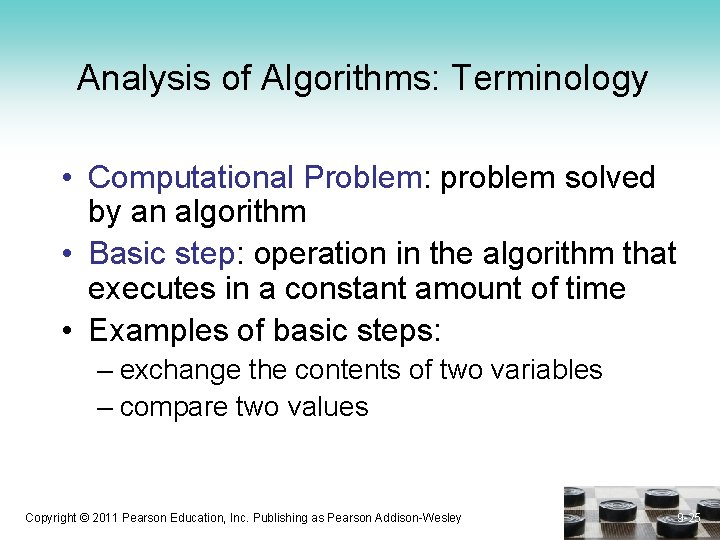
Analysis of Algorithms: Terminology • Computational Problem: problem solved by an algorithm • Basic step: operation in the algorithm that executes in a constant amount of time • Examples of basic steps: – exchange the contents of two variables – compare two values Copyright © 2011 Pearson Education, Inc. Publishing as Pearson Addison-Wesley 9 -25
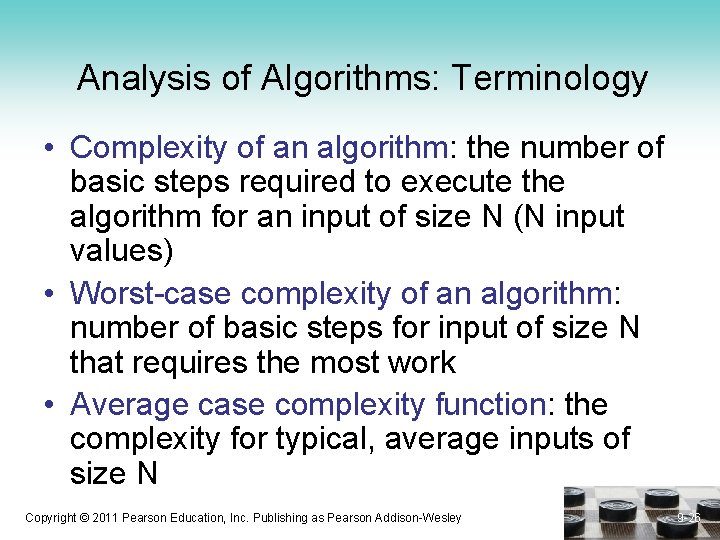
Analysis of Algorithms: Terminology • Complexity of an algorithm: the number of basic steps required to execute the algorithm for an input of size N (N input values) • Worst-case complexity of an algorithm: number of basic steps for input of size N that requires the most work • Average case complexity function: the complexity for typical, average inputs of size N Copyright © 2011 Pearson Education, Inc. Publishing as Pearson Addison-Wesley 9 -26
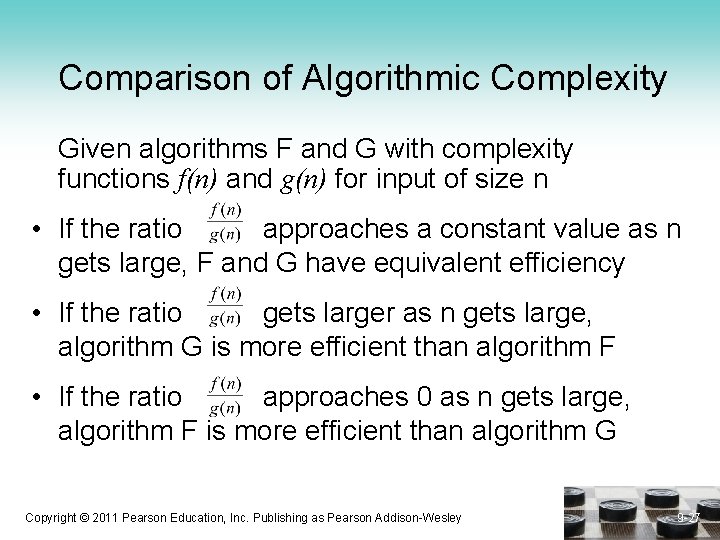
Comparison of Algorithmic Complexity Given algorithms F and G with complexity functions f(n) and g(n) for input of size n • If the ratio approaches a constant value as n gets large, F and G have equivalent efficiency • If the ratio gets larger as n gets large, algorithm G is more efficient than algorithm F • If the ratio approaches 0 as n gets large, algorithm F is more efficient than algorithm G Copyright © 2011 Pearson Education, Inc. Publishing as Pearson Addison-Wesley 9 -27
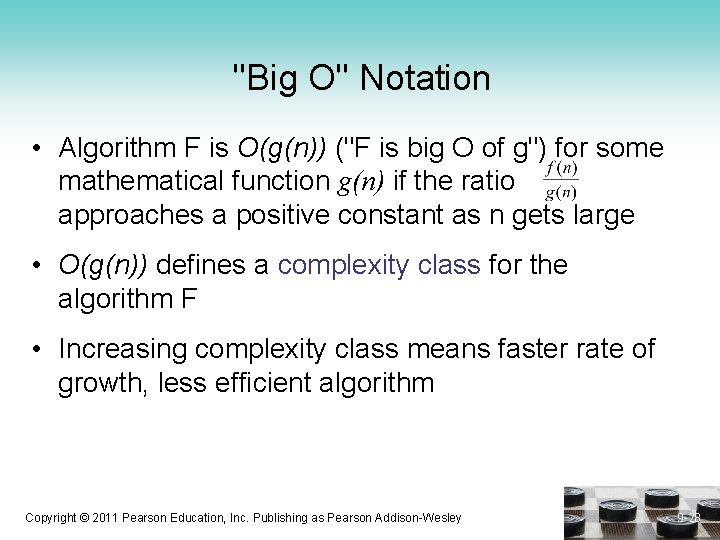
"Big O" Notation • Algorithm F is O(g(n)) ("F is big O of g") for some mathematical function g(n) if the ratio approaches a positive constant as n gets large • O(g(n)) defines a complexity class for the algorithm F • Increasing complexity class means faster rate of growth, less efficient algorithm Copyright © 2011 Pearson Education, Inc. Publishing as Pearson Addison-Wesley 9 -28
Chapter 9: Searching, Sorting, and Algorithm Analysis Starting Out with C++ Early Objects Seventh Edition by Tony Gaddis, Judy Walters, and Godfrey Muganda Copyright © 2011 Pearson Education, Inc. Publishing as Pearson Addison-Wesley