
CHAPTER 9 SCHOOLS AND DELINQUENCY LEARNING OBJECTIVES After

CHAPTER 9: SCHOOLS AND DELINQUENCY
LEARNING OBJECTIVES After reading this chapter, students should be able to: 1. Discuss the role the educational experience plays in human development over the life course 2. Be familiar with the problems facing the educational system in the United States 3. Describe the association between school failure and delinquency 4. Know about the nature and extent of school crime and its control 5. Be familiar with the legal rights of students
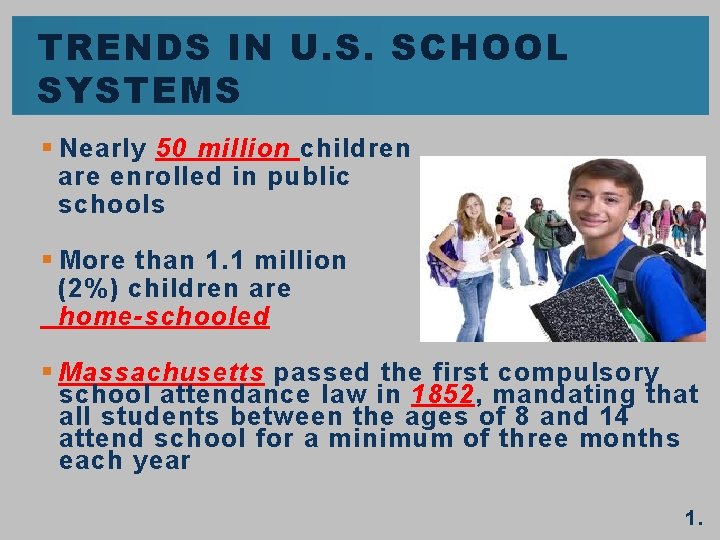
TRENDS IN U. S. SCHOOL SYSTEMS § Nearly 50 million children are enrolled in public schools § More than 1. 1 million (2%) children are home-schooled § Massachusetts passed the first compulsory school attendance law in 1852, mandating that all students between the ages of 8 and 14 attend school for a minimum of three months each year 1.
MODERN AMERICAN SCHOOLS § School plays a significant role in shaping values of youth § Today, more than 90% of school-age children attend school § School has become the primary instrument of socialization § Because young people spend a longer time in school, their adolescence is prolonged § Young people increasingly rely on school friends and become less interested in adult role models

EDUCATION TRENDS AND ISSUES § In 2010, the United States spent $11, 826 per fulltime-equivalent (FTE) student on elementary and secondary education, an amount 39 percent higher than the Organization for Economic Cooperation and Development (OECD) average of $8, 501. At the postsecondary level, U. S. expenditures per FTE student were $25, 576, almost twice as high as the OECD average of $13, 211. 2014 National Center for Education Statistics, § There has been some improvement in reading, math, and science achievement during the past decade, but improvements have been minimal § Many secondary math and science teachers did not major in the subjects they teach

EDUCATIONAL PROBLEMS Average mathematics scores of fourth- and eighth-grade students, by country: 2007 Grade four Country TIMSS scale average Hong Kong SAR Singapore Chinese Taipei Japan Kazakhstan Russian Federation England Latvia Netherlands Lithuania United States Germany Average score 500 607 599 576 568 549 544 541 537 535 530 529 525 Grade eight Country TIMSS scale average Chinese Taipei Korea, Rep. of Singapore Hong Kong SAR Japan Hungary England Russian Federation United States Lithuania Czech Republic Slovenia Average score 500 598 597 593 572 570 517 513 512 508 506 504 501
QUESTION 1. This state passed the first law providing for mandatory school attendance. a. b. c. d. Illinois Massachusetts New York Minnesota
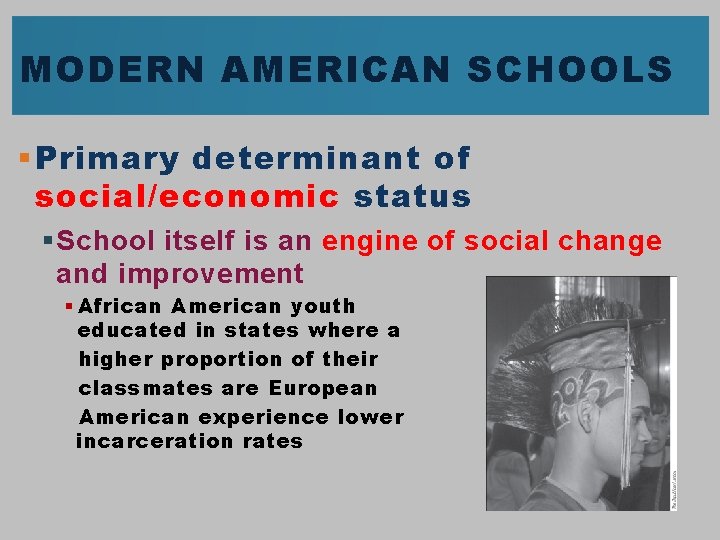
MODERN AMERICAN SCHOOLS § Primary determinant of social/economic status § School itself is an engine of social change and improvement § African American youth educated in states where a higher proportion of their classmates are European American experience lower incarceration rates

ECONOMIC DISADVANTAGE AND EDUCATIONAL ACHIEVEMENT § Economically disadvantaged children usually enter school lagging behind their more advantaged peers § They face substantial gaps in reading and math proficiency, in prosocial behaviors and behavior problems, and in readiness to learn § Many disadvantaged children fail to meet grade-level expectations on core subjects § They face higher rates of special education placement and grade repetition

DROPPING OUT § Nearly 1/3 of all high school students leave the public school system before graduating, especially minority students and students with disabilities § Effects of dropping out mixed § Some say significantly increases delinquency § Some find no link
DROPPING OUT § Reasons for dropping out: § Educational factors : § Kids who show disinterest in school are more likely to drop out - failed courses, low grade point average, absences, falling behind and getting pushed out § Social factors: § Left because they did not like school, they wanted to get a job, could not get along with teachers, had been expelled or were suspended § Poverty and family dysfunction increase chances of dropping out
RACE AND DROPPING OUT § Minority students drop out at a higher rate than European American students § According to Dorn, the relatively high dropout rate among minorities is the legacy of disciplinary policies enacted when educational administrators opposed school desegregation § Dorn believes that the dropout problem is a function of inequality of educational opportunities, rather than the failure of individual students § Payne and Welch found that administrators and teachers in urban schools were more likely to respond to misbehavior in a punitive, as opposed to a restorative, manner
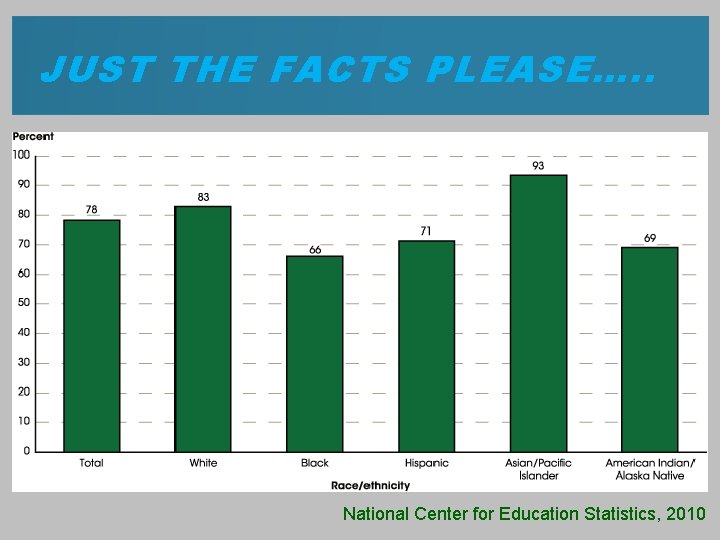
JUST THE FACTS PLEASE…. . National Center for Education Statistics, 2010
Dropping Out and Crime – Current Example Ø According to a 2009 report by California Dropout Research Project at UC Santa Barbara, dropping out of school costs the state $1. 1 billion each year. The report also reveals that compared to high school graduates, dropouts “earn lower wages, pay fewer taxes, are more likely to commit crimes, are less likely to be employed, are more likely to be on welfare, and are less healthy. ” California High School Graduation Rates show that African American youths have the lowest graduation rates (59%), with Hispanics only slightly better (60%); females of all races are the most likely to graduate. ü What causes such high dropping out rates among high school students? ü How do you explain the correlation between dropping out of school and crime?

ACADEMIC PERFORMANCE & DELINQUENCY Marvin Wolfgang’s Philadelphia cohort study § Low school achievement results in delinquency Ø Chronic underachievers most likely to be delinquent Ø No high school diploma = increased risk for delinquency (9% vs. 74%) Ø It’s a stronger predictor of delinquency than race, ethnicity, or peer influence § School failure and delinquency are related Ø Direct cause of delinquency Ø Leads to emotional/psychological problems that cause antisocial behavior Ø Share a common cause

SCHOOL FAILURE AND DELINQUENCY § Three independent views on the association between school failure and delinquency are: 1. School failure is a direct cause of delinquent behavior 2. School failure leads to emotional and psychological problems that are the actual cause of antisocial behavior 3. School failure and delinquency share a common cause
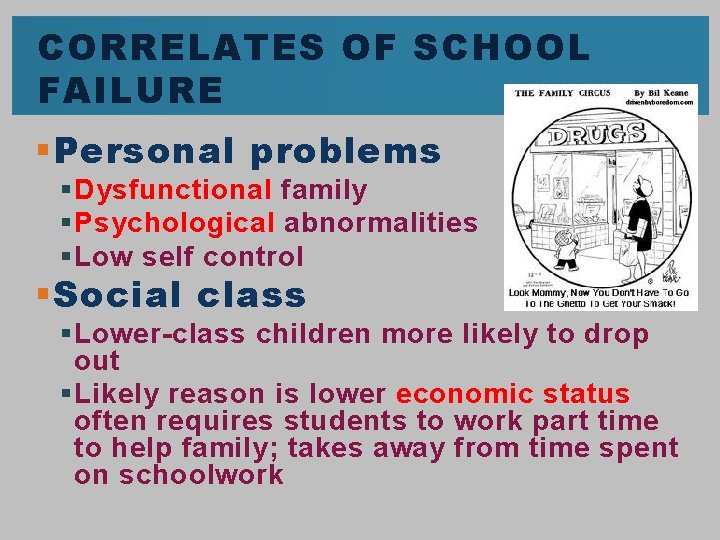
CORRELATES OF SCHOOL FAILURE § Personal problems § Dysfunctional family § Psychological abnormalities § Low self control § Social class § Lower-class children more likely to drop out § Likely reason is lower economic status often requires students to work part time to help family; takes away from time spent on schoolwork
QUESTION 2. In Marvin Wolfgang’s Philadelphia cohort study, those who were more likely to become involved in chronic delinquency: a. b. c. d. were raised in two-parent households had few disciplinary actions compared to non-offenders had diagnosed learning disabilities left school without a diploma
QUESTION 3. Only 9 percent of the chronic offenders in Wolfgang's Philadelphia cohort study graduated from high school, compared to 74 percent of non-offenders. a. True b. False
CORRELATES OF SCHOOL FAILURE § Tracking § Involves dividing students into groups according to ability § Keeps certain students from having any hope of achieving academic success, thereby causing lack of motivation, which can lead to delinquent behavior § Alienation § Youths who don’t like/care about school are more likely to be delinquent

DELINQUENCY IN SCHOOL § General victimization Ø Significant portion of juvenile crime occurs during school day and on school grounds § Teacher victimization Ø Students not only ones being victimized § Bullying Ø Repeated negative acts committed by one or more youth against another Ø See Focus on Delinquency p. 236 § School Shootings Ø Highly publicized events Ø Profile of school shooters developed Ø Many shooters had history of abuse, bullying, and perceived lack of support (U. S. Secret Service)
QUESTION 4. There are three independent views on the association between school failure and delinquency which of the following statements does not reflect one of these three views? a. b. c. d. school failure is unrelated to delinquency school failure is a direct cause of delinquent behavior school failure leads to emotional and psychological problems that are the actual cause of antisocial behavior school failure and delinquency share a common cause: social and personal problems
QUESTION 4. Academic tracking refers to: a. school monitoring student performance to identify students that need help b. recording where students end up five years after graduation c. dividing students into groups according to ability and achievement level d. identifying patterns of delinquency and victimization inside schools
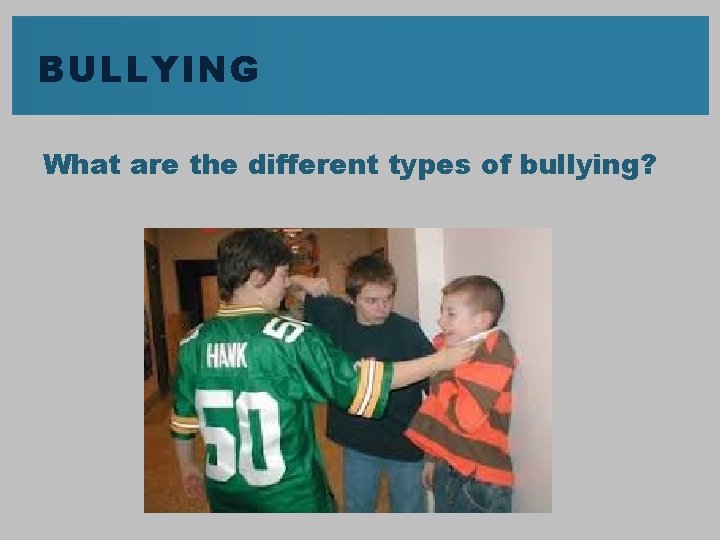
BULLYING What are the different types of bullying?
BULLYING § Bullying is the use of one’s strength or status to intimidate, injure or humiliate another person of lesser strength or status § Types of bullying include: Ø Physical bullying: Hitting, kicking, spitting, pushing, or taking personal belongings. Ø Verbal bullying: Taunting, malicious teasing, name calling, or making threats. Ø Emotional bullying: Spreading rumors, manipulating social relationships, or engaging in social exclusion, extortion, or intimidation. Ø Sexual bullying: Harassment and actual abuse. Ø Cyber bullying: the Internet, cell phones or other devices are used to send or post text or images intended to hurt or embarrass another person.
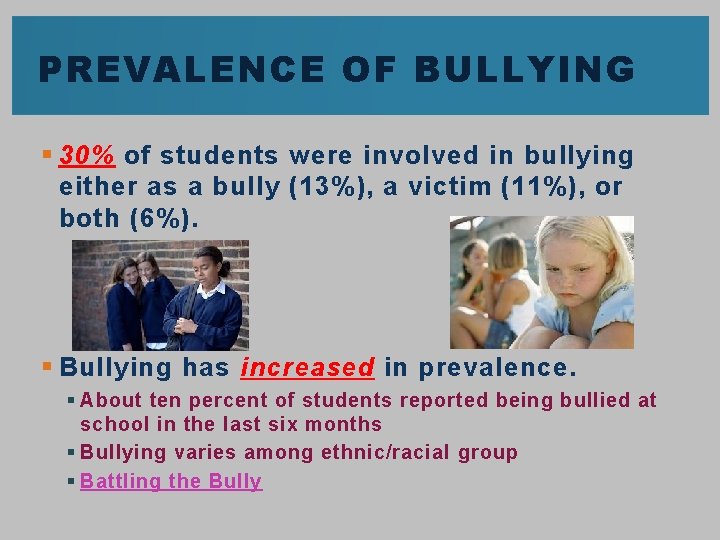
PREVALENCE OF BULLYING § 30% of students were involved in bullying either as a bully (13%), a victim (11%), or both (6%). § Bullying has increased in prevalence. § About ten percent of students reported being bullied at school in the last six months § Bullying varies among ethnic/racial group § Battling the Bully
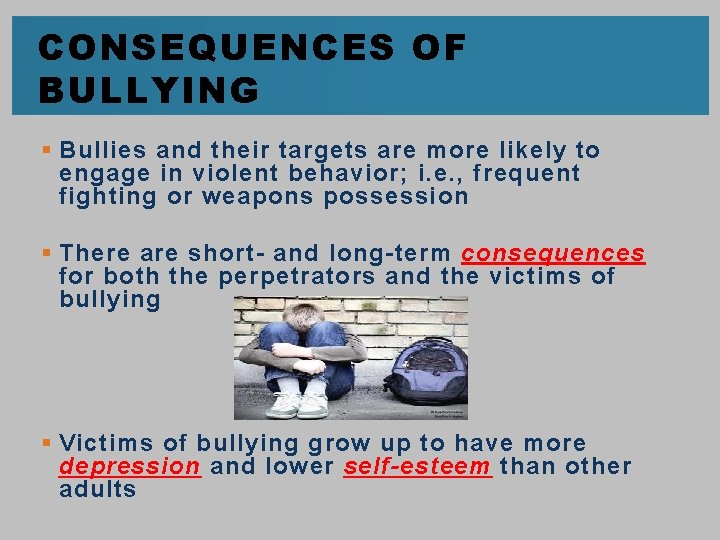
CONSEQUENCES OF BULLYING § Bullies and their targets are more likely to engage in violent behavior; i. e. , frequent fighting or weapons possession § There are short- and long-term consequences for both the perpetrators and the victims of bullying § Victims of bullying grow up to have more depression and lower self-esteem than other adults
CONSEQUENCES OF BULLYING § Bullying may be a critical risk factor in the development of future problems with violence and delinquency § Children who are bullies are more likely to Ø feel lonely Ø have trouble making friends, and Ø do not get along well with classmates § Sometimes they are insecure, embarrass easily, and are fearful of attending school
CONSEQUENCES OF BULLYING § Bullies usually have multiple problems : Ø Abuse animals Ø Vandalize property Ø School drop outs Ø Fights Ø Abuse drugs and alcohol § According to Matt De. Lisi, many of the most serious adult criminals got their start as bullies at school
QUESTION 5. According to the text, over 50 percent of students are bullied in school. a. True b. False
QUESTION 6. Which of the following statements about bullying is false? a. Studies of bullying suggest that there are shortand long-term consequences for both the perpetrators and the victims of bullying b. Studies suggest that chronically victimized students may, as adults, be at increased risk for depression, poor self-esteem, and other mental health problems c. Studies suggest that bullying may be a critical risk factor in the development of future problems with violence and delinquency d. Studies suggest that victims of bullying in early grades are less likely to be bullied later
PREVENTION OF BULLYING § School programs may reduce bullying § Dan Olweus reduced school bullying in schools in Norway through the Olweus Bullying Prevention Program Ø Involves school-wide, classroom and individual interventions Ø Rules and sanctions are reinforced through classroom discussion Ø Parent involvement Ø Mental Health interventions
Grandma Bullied – Current Example http: //youtu. be/s. Bh. Axof. UAZY Ø In 2012, Karen Klein caught national and international attention. Ms. Klein, a school bus monitor, was taunted, insulted, and threatened of violence in the Rochester, N. Y. , suburb of Greece. Perhaps most shocking, her tormentors were a group of four 13 -year-old boys. A 10 -minute You. Tube video posted showed the students calling her "fat, " "ugly" and a "troll, " and jabbing her with their fingers as she wept. The children continued to abuse her verbally after she removed her sunglasses to show she had been crying. ü Based on your experience, how prevalent is violence on school buses? ü Who should be responsible for the safety of students, drivers, and school monitors on school buses? ü Do you think a punitive or restorative approach should be taken to the bullies? Why?
VIOLENCE AT SCHOOL § School violence is a worldwide problem § Juveniles are 75 times more likely to be murdered away from school than at school § Most victims of school killings are male and are killed with firearms § Most school crime is non-fatal
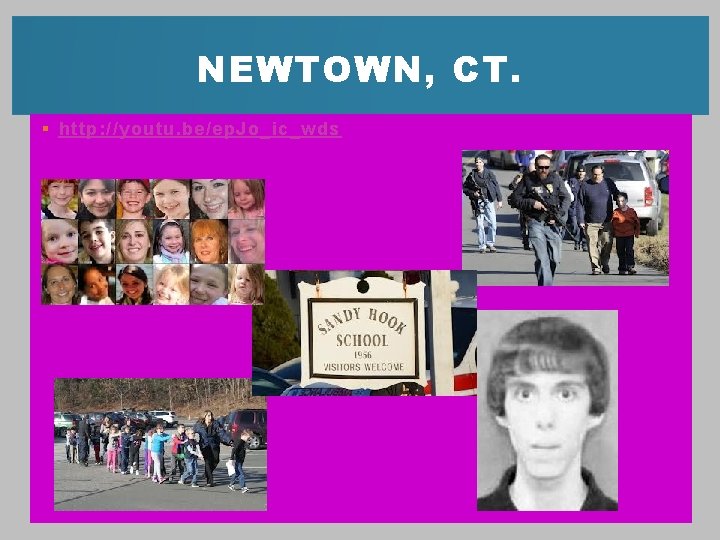
SCHOOL SHOOTINGS § Highly publicized events § Many shooters had history of abuse, bullying, and real or perceived lack of support from peers, parents, and teachers § Nature and Extent of Shootings: § Most shootings occurred around the start of the school day, the lunch period, or the end of the school day § Shooters were also likely to have expressed some form of suicidal behavior prior to the shooting
SCHOOL SHOOTINGS § Who is the School Shooter? § Shooters developed a plan of attack well in advance § Experience mental anguish § Come from a wide variety of backgrounds § Have a history of feeling extremely depressed or desperate § The most frequent motivation was revenge § Most shooters had experience with guns and/or other weapons
NEWTOWN, CT. § http: //youtu. be/ep. Jo_ic_wds
CRIME TYPE….
REDUCING SCHOOL CRIME § School security efforts § Locked or monitored doors/gates, limited or controlled access to campus, metal detectors, security cameras, and limited access to social networking websites § Employing law enforcement § Some have undercover officers § Some assign School Resource Officers to work on campus § Improving school climate § Critics argue that security measures reduce morale § The most effective methods of reducing disorder and crime in schools includes the encouragement of order and organization and an emphasis on studentbonding
ROLE OF SCHOOL IN DELINQUENCY PREVENTION § Advocates called for reforming the system to make it more responsive to needs of students § No Child Left Behind Act of 2001 increased accountability for schools § School-based prevention efforts: § Cognitive § Affective § Behavioral § Environmental § Therapeutic
LEGAL RIGHTS IN SCHOOL § Right to Personal Privacy § New Jersey vs. T. L. O. (1984): § School officials can legally search students when there are reasonable grounds to believe a student has violated the law § Drug Testing § The Supreme Court allows school authorities to conduct random drug tests on the grounds that they are less intrusive than a search of a student’s body § The Court extended the right to test for drugs without probable cause to all students as long as the drug-testing policies were “reasonable” (Board of Education of Independent School District No. 92 of Pottawatomie County el al. v. Earls et al. )
LEGAL RIGHTS IN SCHOOL § Academic Privacy § The Family Educational Rights and Privacy Act (1974) § Restricts disclosure of information from a student ’s education records without parental consent § In 1994, Congress allowed educational system to disclose education records under four circumstances: ① State law authorizes the disclosure ② The disclosure is to a juvenile justice agency ③ The disclosure relates to the justice system’s ability to provide preadjudication services to a student ④ State or local officials certify in writing that the institution or individual receiving the information has agreed not to disclose it to a third party other than another juvenile justice system agency
LEGAL RIGHTS IN SCHOOL § Two main categories of free speech: ① Passive speech: § Unless it can be shown that the forbidden conduct will interfere with the discipline required to operate the school, the prohibition cannot be sustained (Tinker v. Des Monies Independent Community School District, 1969) ② Active Speech: § The Court extended the right of school officials to censor active speech when it ruled the principal of Hazelwood School District could censor articles in a student publication (Hazelwood School District v. Kuhlmeier, 1988)
LEGAL RIGHTS IN SCHOOL § Off-campus: The Supreme Court (2002) ruled that school officials can control student speech at off-campus events § Speech in Cyberspace: § The Court noted that as long as the online content created by a student is his or her own, uses his/her own resources and is not disruptive to the learning environment, the student cannot be disciplined § School prayer: § Prayers led by “elected” students undermine the protection of minority viewpoints – schoolsanctioned prayer is therefore severely limited at public school events (Santa Fe Independent School District, Petitioner v. Jane Doe, 2000). However, space for after-school religious groups must be provided (Good News Club v. Milford Central School, 2001).
LEGAL RIGHTS IN SCHOOL § School Discipline § Corporal punishment allowed in 20 states § Under in loco parentis: § Discipline is one of the parental duties given to the school system § In the 1977 case Ingraham v. Wright § Court held that neither the 8 th nor the 14 th Amendment was violated by a teacher’s use of corporal punishment to discipline students § According to the American Civil Liberties Union and Human Rights Watch, almost a quarter of a million US public school children are subjected to corporal punishment each school year § Suspensions/expulsions require due process hearing (Goss v. Lopez, 1976)
QUESTION 7. In the 1984 United States Supreme Court case New Jersey v. T. L. O. the court ruled that students were protected against unreasonable searches and seizures, but that school personnel are not bound by the same restrictions as police officers. a. True b. False
QUESTION 8. Which of the following Acts restricts the disclosure of personal student information without parental consent? a. b. c. d. Taft Hartley Act Bartley-Fox Act Gramm-Newman Act Family Educational Rights and Privacy Act
QUESTION 9. What legal doctrine gives the schools the right to assume some of the duties of parents, including discipline? a. b. c. d. in loco parentis in prayentis mantis educatum primus investiture
SUMMARY ü Know the role of education in human development ü Be familiar with issues facing the U. S. educational system ü Understands the hazards facing dropouts ü Describe the school failure/delinquency association ü List personal/social factors linked to school failure ü Discuss factors contributing to school delinquency ü Know nature/extent of school shootings ü Be familiar with efforts to reduce school crime ü Understand types of school-based delinquency efforts ü Be familiar with legal rights of students
- Slides: 49