
Chapter 9 Robbins and Judge Foundations of Group

Chapter 9 Robbins and Judge Foundations of Group Behavior 9 -1
GROUP AND TYPES OF GROUPS � � A group is defined as two or more individuals, interacting and interdependent, who have come together to achieve particular objectives. Groups can be either formal or informal. � Formal groups—those defined by the organization’s structure � Informal groups—alliances that are neither formally structured nor organizationally determined � There is no single reason why people join groups 9 -2
DEFINING GROUP � Social identity theory proposes that people have emotional reactions to the failure or success of their group because their self-esteem gets tied into the performance of the group. � Several characteristics make a social identity important to a person � Similarity � Distinctiveness � Status � Uncertainty reduction 9 -3
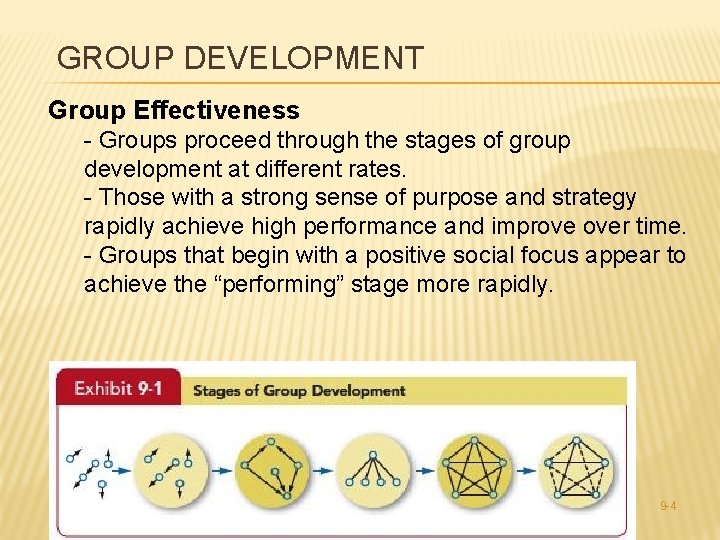
GROUP DEVELOPMENT Group Effectiveness - Groups proceed through the stages of group development at different rates. - Those with a strong sense of purpose and strategy rapidly achieve high performance and improve over time. - Groups that begin with a positive social focus appear to achieve the “performing” stage more rapidly. 9 -4

PUNCTUATED EQUILIBRIUM MODEL 9 -5
GROUP PROPERTIES: ROLE � Role Identity � Role Perception � Role Expectations � Role Conflict 9 -6
NORMS � Types � Performance Norms � Appearance Norms � Social Arrangement Norms � Resource Allocation Norms 9 -7
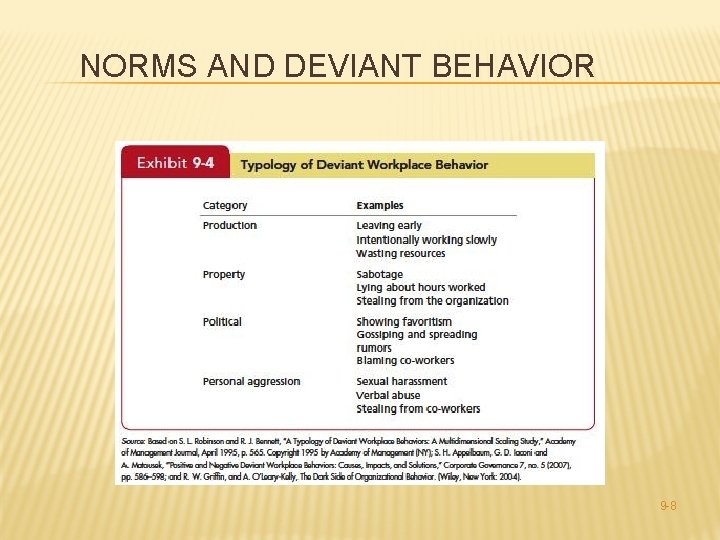
NORMS AND DEVIANT BEHAVIOR 9 -8
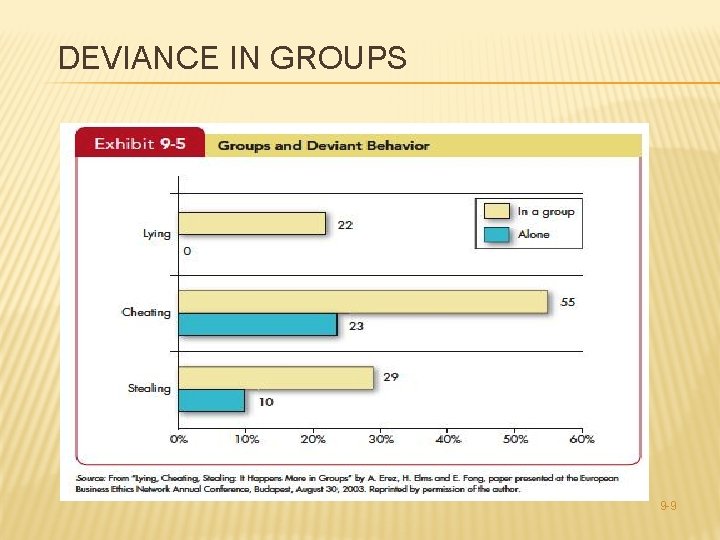
DEVIANCE IN GROUPS 9 -9
GROUP PROPERTIES: STATUS � Status characteristics theory – differences in status characteristics create status hierarchies within groups. �Status derived from one of three sources: �The power a person wields over others; �A person’s ability to contribute to group’s goals; �Individual’s personal characteristics. 9 -10
STATUS AND BEHAVIOR � Status � and Norms High status individuals in groups are accorded different consideration � Status and group interaction is influenced both positively and negatively � Cultural differences in status perception influences differently 9 -11
GROUP PROPERTIES: GROUP SIZE � � The size of a group affects the group’s overall behavior. Social loafing- the tendency for individuals to expend less effort when working collectively than alone. Smaller groups are faster at completing tasks than larger ones. Large groups in problem solving do better. � Large groups are good at gaining input. � Smaller groups are better doing something with input. 9 -12

GROUP PROPERTIES: COHESIVENESS 9 -13
GROUP PROPERTY: DIVERSITY � Diversity is the extent to which members of a group are similar to, or different from one another. � Diversity appears to increase group conflict, especially in the early stages of a group’s tenure, which often lower group morale and raises dropout rates. 1 -14

SUMMARY AND IMPLICATIONS FOR MANAGERS Role perception and an employee’s performance evaluation are positively related. � The degree of congruence between the employee’s and the boss’s perception of the employee’s job influences the degree to which the boss will judge that employee effective. � An employee whose role perception fulfills the boss’s role expectations will receive a higher performance evaluation. � 9 -15
SUMMARY AND IMPLICATIONS FOR MANAGERS � Norms control behavior by establishing standards of right and wrong. � The norms of a given group can help explain members’ behaviors for managers. � When norms support high output, managers can expect markedly higher individual performance than when they aim to restrict output. � Norms that support antisocial behavior increase the likelihood that individuals will engage in deviant workplace activities. 9 -16
SUMMARY AND IMPLICATIONS FOR MANAGERS � Status inequities create frustration and can adversely influence productivity and willingness to remain with an organization. � Incongruence is likely to reduce motivation and motivate a search for ways to bring about fairness. � Because lower-status people tend to participate less in group discussions, groups with high status differences are likely to inhibit input from lower-status members and reduce their potential. 9 -17
SUMMARY AND IMPLICATIONS FOR MANAGERS � The impact of size on a group’s performance depends on the type of task. � Larger groups are more effective at fact-finding activities, smaller groups at action-taking tasks. � Our knowledge of social loafing suggests that managers using larger groups should also provide measures of individual performance. � Cohesiveness can influence a group’s level of productivity or not, depending on the group’s performance-related norms. 9 -18
- Slides: 18