
Chapter 9 Road to Revolution DIFFICULTIES WITH MEXICO
- Slides: 89
Chapter 9 Road to Revolution DIFFICULTIES WITH MEXICO
VOCABULARY CH 9 LESSON 1 Content Vocabulary � land speculator � decree � duty � Academic Vocabulary � scheme � significant �
STUDENTS WILL KNOW � causes of the Fredonian Rebellion. � what the Law of April 6, 1830, stated. � how the people of Texas reacted to new laws. � causes of the early conflicts between Mexico and Texas in the 1830 s. � TEKS 3 A 11 B
QUESTIONS TO CONSIDER � Summarizing How did political change in Mexico create tensions between Texas settlers and the Mexican government? � Making Connections How did the Fredonian Rebellion lead to the Mier y Terán Report? � Drawing Conclusions Why would Mexico welcome European settlers to Texas but not American settlers?
CENTRALISTS BRING CHANGES � During most of the 1820 s, the Federalists held power in Mexico. � they largely left settlers in Texas alone. � In 1829, the Centralists gained control of the Mexican government. � They ended the relative freedom Texans had enjoyed. The Centralists issued regulations to bring the states and provinces of Mexico, including Texas, more closely under the authority of the national government.
� Anglo Americans in Texas protests , creating additional tensions between the settlers and the government of Mexico. � tensions had existed even before the Centralists came to power. � The first conflict between the settlers and the Mexican government came in 1826, and it involved the Nacogdoches land grant.
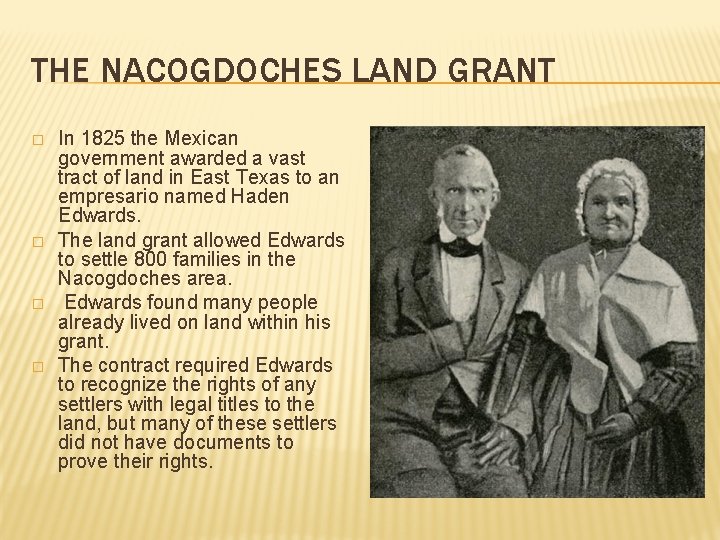
THE NACOGDOCHES LAND GRANT � � In 1825 the Mexican government awarded a vast tract of land in East Texas to an empresario named Haden Edwards. The land grant allowed Edwards to settle 800 families in the Nacogdoches area. Edwards found many people already lived on land within his grant. The contract required Edwards to recognize the rights of any settlers with legal titles to the land, but many of these settlers did not have documents to prove their rights.
� Edwards announced that all settlers had to show him clear titles to the land. If they could not, they would have to leave the land or buy it from him. This angered many of the early settlers, especially those who had no proof of clear title and felt threatened with losing their land.
� Troubles in the colony continued, and settlers complained to officials. While Edwards was away from his colony, he left his brother Benjamin in charge. His brother annoyed Mexican officials with a number of angry letters. Finally, government officials decided to cancel Edwards’s land grant, which angered the empresario.
� Troubles in the colony continued, and settlers complained to officials. While Edwards was away from his colony, he left his brother Benjamin in charge. His brother annoyed Mexican officials with a number of angry letters. Finally, government officials decided to cancel Edwards’s land grant, which angered the empresario.
THE FREDONIAN REBELLION AND AFTERMATH � Late in 1826, Supporters of Edwards took a bold action and rebelled against Mexican authority. Their short-lived revolt only further increased tensions between Texans and the Mexican government.
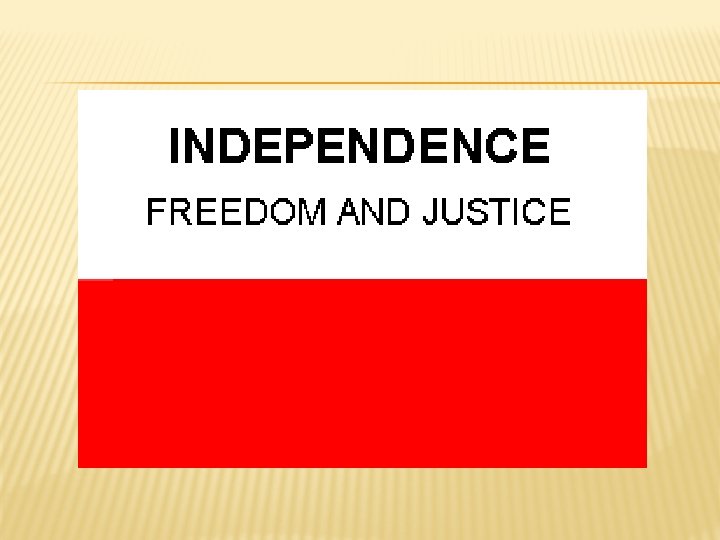
THE REPUBLIC OF FREDONIA � Benjamin Edwards, Haden’s brother, decided to take bold action. Enlisting the support of Richard Fields, a Cherokee chief, Benjamin and a small band of followers proclaimed the creation of a new independent state. They called it the Republic of Fredonia and signed a Declaration of Independence on December 21, 1826. They raised a red and white flag bearing the words “Independence, Liberty, Justice” and prepared to defend themselves in a building called the Old Stone Fort.
� The Edwards brothers asked for help from Austin’s colony and from the United States, but they received no assistance. Stephen F. Austin even helped the Mexican government put down the revolt. When Mexican troops from San Antonio approached Nacogdoches in January 1827, the Fredonian Rebellion collapsed. Some of the Fredonians were captured, but most fled across the Sabine River into the United States.
THE MIER Y TERÁN REPORT � The Fredonian Rebellion was a minor incident, and the rebels had little support among Anglo Americans. � The Fredonian revolt worried Mexican officials. They thought the revolt was part of an American scheme to acquire Texas. � The United States had offered to buy Texas in 1827 and 1829.
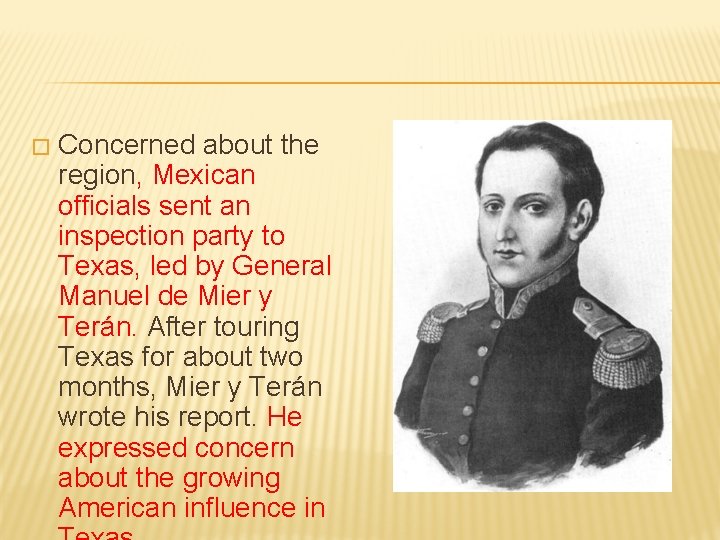
� Concerned about the region, Mexican officials sent an inspection party to Texas, led by General Manuel de Mier y Terán. After touring Texas for about two months, Mier y Terán wrote his report. He expressed concern about the growing American influence in
� Mier y Terán made it clear that prompt action was essential. He recommended several steps. He urged the government to place more troops around the settlements, work to attract more Mexican and European settlers, and develop more trade between Texas and Mexico.
THE SLAVERY ISSUE � While Mexican officials considered Mier y Terán's report, Anglo Americans worried that the government would abolish, or end, slavery. Texans had long argued against such an action, with Austin and Erasmo Seguín taking major roles in convincing the government of Mexico to allow slavery.
� Those efforts seemed to be undone in 1829. That year the president of Mexico issued a decree, or order, abolishing slavery. The order was never actually enforced in Texas. Even so, it worried Anglo American slaveholders, who believed that it was only a matter of time before slavery became illegal.
THE LAW OF APRIL 6, 1830 � On April 6, 1830 the government of Mexico issued a law based on many of Mier y Terán’s recommendations. What became known as the Law of April 6, 1830, had a significant impact on Texas.
PROVISIONS OF THE LAW � The government used the law to encourage the immigration of Mexican and European families to Texas with generous land grants and financial assistance. A key part of the law was Article II, which stopped immigration from the United States into Texas. It also suspended most empresario contracts that had not been fulfilled. This part of the law read as follows:
PRIMARY SOURCE � “[I]t is prohibited that emigrants from nations bordering on this Republic shall settle in the states or territories adjacent to their own nation. Consequently, all contracts not already completed and not in harmony with this law are suspended. ” � —Texas Gazette, July 3, 1830
� The Law of April 6, 1830, also set up new forts. Soldiers in the forts would prevent smuggling, the introduction of additional enslaved people, and illegal land speculation. � Mexico discouraged trade between foreign nations and Texas by placing taxes called duties on goods made in foreign nations. The government took this step to try to increase trade between Texas and Mexico.
REACTION IN TEXAS � Anglo settlers in Texas were alarmed by the Law of April 6, 1830. The success of many settlers depended upon the continued growth of trade with the United States. Many also had friends and relatives who wanted to come to Texas. The ban on bringing in enslaved people revived fears that slavery would be outlawed in Texas.
� The Law of April 6, 1830, was an early turning point in relations between the colonists and the Mexican government. Each side began to distrust the other. Stephen F. Austin tried to negotiate with Mexican leaders. He soon realized that serious damage had already been done to relations between Texans and the Mexican government.
� Summarizing How did political change in Mexico create tensions between Texas settlers and the Mexican government? � Making Connections How did the Fredonian Rebellion lead to the Mier y Terán Report? � Drawing Conclusions Why would Mexico welcome European settlers to Texas but not American settlers?
Ch 9 Lesson 2 FIRST CONFLICTS
VOCABULARY 9 -2 Content Vocabulary � commerce � import � skirmish � resolution � delegate � Academic Vocabulary � enforce � decline �
STUDENTS WILL KNOW � causes of the early conflicts between Mexico and Texas in the 1830 s. � the resolutions that were written at Turtle Bayou. � the results of the Convention of 1832. � the results of the Convention of 1833. � TEKS 3 A 3 B 9 A
QUESTIONS TO CONSIDER � Identifying Points of View Why did the Turtle Bayou Resolutions support the Federalists of Mexico? � Summarizing Why did a group of Texans adopt the Turtle Bayou Resolutions? � Identifying Points of View What were Santa Anna’s political views on the rights of Texans as compared to those of Bustamante? � Identifying What role did Sam Houston play at the Convention of 1833?
TROUBLE AT ANAHUAC � Taxes led to the next clash between Texans and Mexico. At the port of Anahuac, a tax collector and a unit of Mexican soldiers were assigned to control the commerce coming in and out of Mexico. � They were based at a garrison, located at the mouth of the Trinity River.
� The garrison was commanded by Colonel John (Juan) Davis Bradburn. A native of Virginia, Bradburn joined the fight for Mexican independence and, as a reward, was made a colonel in the Mexican army.
� Soon after arriving, Bradburn quarreled with the colonists living at Anahuac. They accused him of refusing to hand over enslaved people who had tried to escape to freedom. They also accused his troops, a few of whom were former convicts, of stealing supplies. Perhaps the colonists’ greatest objection, though, was that Bradburn tried to enforce the duty on goods imported by ship into Texas.
� On Bradburn’s orders, a tax collector at Anahuac attempted to collect duties on goods as far away as the Brazos River. � At that time, a small number of Mexican troops were stationed at the mouth of the Brazos River, but there was no tax collector.
� To process the necessary papers to pay these duties, ship captains on the Brazos were expected to dock and travel long distances overland to Anahuac. This angered the ship captains, and some of them took their ships upriver without stopping at the mouth of the Brazos for clearance. This resulted in the exchange of gunfire between Texans and Mexican troops
ARRESTS LEAD TO CLASHES � In May of 1832, the situation reached a crisis point. Bradburn arrested two lawyers, William B. Travis and Patrick C. Jack, and put them in prison. He believed the two had been spreading false rumors that an armed force from Louisiana was heading to Anahuac. Bradburn claimed they had interfered with his efforts to enforce the laws.
� Two different groups of angry settlers, totaling about 200 people, marched to Anahuac. Frank W. Johnson and William H. Jack, Patrick’s brother, led one group from San Felipe. John Austin, a friend and possibly a distant relation of Stephen F. Austin, led the other party from Brazoria.
� A small skirmish, or fight, occurred between the Texans and the Mexican troops. The Texans captured some of Bradburn’s soldiers, hoping to exchange them for Travis and Jack. Bradburn agreed to the exchange if the Texans retreated. The Texans released the soldiers, but some of the Texans refused to withdraw. As a result, Bradburn did not release Travis and Jack and called in additional forces.
� After another skirmish, the Texans made camp at nearby Turtle Bayou. They realized they needed more firepower, so John Austin led a group back to Brazoria to obtain a cannon.
THE TURTLE BAYOU RESOLUTIONS � While this conflict was taking place in Texas, General Antonio López de Santa Anna, a Federalist, was leading a revolt against Centralist president Anastacio Bustamante was unpopular with Texans, who believed his Centralist rule went against the Mexican Constitution of 1824. Santa Anna, on the other hand, had promised to follow the constitution, which most Texans supported.
� News reached Turtle Bayou that Santa Anna had won a battle in Mexico against Centralist forces. The news heartened the Texans at Turtle Bayou. On June 13, 1832, they met and adopted the Turtle Bayou Resolutions.
� In these resolutions, or formal statements, they declared their loyalty to Mexico, but not to the Mexican government. The Texans stated their support for Santa Anna and Mexico’s Federalists.
� At the same time, Bradburn asked other commanders for help. Colonel José de las Piedras, who controlled the Mexican garrison at Nacogdoches, arrived at Anahuac. Piedras believed that the Texans outnumbered his soldiers, so he gave in to their demands. He removed Bradburn from command released Travis and Jack. Bradburn resigned and fled from Texas, and Piedras returned to Nacogdoches.
� A Federalist officer took charge at Anahuac. He declared support for Santa Anna, closed the fort, and moved his troops to Mexico to join the fight against the Centralists.
� Identifying Points of View Why did the Turtle Bayou Resolutions support the Federalists of Mexico? The Texans favored the Federalist position because their position allowed more freedom in Texas and Mexico and opposed the Centralist position which meant more control from the central government
� Summarizing Why did a group of Texans adopt the Turtle Bayou Resolutions? � The Texans wanted to state their support for Santa Anna, Mexico’s Federalist and the Mexican Constitution of 1824
� Identifying Points of View What were Santa Anna’s political views on the rights of Texans as compared to those of Bustamante? � Santa Anna was a Federalist who promised to follow the Constitution of 1824, which most Texans supported. Bustamante was a centralist who wanted greater control over Texas
TEXANS SEEK CHANGE � As the situation in Anahuac calmed, violence flared at Velasco, near the mouth of the Brazos River, on June 26, 1832. John Austin and his group had obtained the cannon at Brazoria and loaded it onto a ship. However, the Mexican commander, Colonel Domingo de Ugartechea, would not let them pass at Velasco. Soon the Texans and Mexicans were fighting.
� The Battle of Velasco was brief but bloody. Several men on both sides died, and a dozen or so on each side were wounded. When the Mexican soldiers ran out of ammunition, Ugartechea surrendered. Austin’s group then sailed on to Anahuac with the cannon, only to discover that Travis and Jack had already been freed.
� Troops supporting Santa Anna were winning battles elsewhere. In the late summer of 1832, Bustamante resigned as president of Mexico, and the next year Santa Anna took power. Most Texans were pleased. They believed he would treat Texas well, since he had declared himself a Federalist.
CONVENTION OF 1832 � In the fall of 1832, fifty-five delegates from Anglo American settlements met at a convention in San Felipe. They met from October 1 through October 6, with Stephen F. Austin leading the convention as president. They agreed to send several requests to the government of Mexico and chose William H. Wharton and Rafael Manchola to present their proposals.
� The proposals of the Convention of 1832 were mainly ideas long favored by Texans. They wanted to resume immigration from the United States and for Texas to be exempt from import duties for three years. In a new move, the convention asked that Texas be made a separate state of Mexico. � None of these proposals was ever presented, . Some leaders thought that the fact that almost all the delegates were Anglo Americans weakened their position.
CONVENTION OF 1833 � In April 1833, Anglo Americans called a second convention at San Felipe. Most of the delegates at this convention had not attended the previous one. Among the new delegates was Sam Houston, representing Nacogdoches.
� The Convention of 1833 adopted resolutions like the ones adopted the year before. However, this meeting went further than asking to make Texas a separate state. It actually drew up a constitution for the proposed state. Sam Houston served as chairman of the committee that wrote the draft of the constitution.
� Stephen F. Austin, Dr. James B. Miller, and Erasmo Seguín were chosen to present the resolutions in Mexico City. Dr. Miller, however, remained in Texas to treat many people suffering from a serious illness. Seguín declined the assignment. As a result, Austin made the trip to Mexico City alone.
� Identifying What role did Sam Houston play at the Convention of 1833? � He led the committee that wrote the draft state constitution
Lesson 9 -3 TENSIONS GROW, 1833– 1835
VOCABULARY 9 -3 Content Vocabulary � epidemic � repeal � dictator � Academic Vocabulary � temporary � uniform �
� why Stephen F. Austin was in prison. � how Santa Anna became president of Mexico. � the changes that Santa Anna made in his positions after becoming president. � when Texans started thinking about independence from Mexico. � TEKS 3 A 3 B 9 C 21 A
QUESTIONS TO CONSIDER � Explaining What led to the arrest of Stephen F. Austin? � Identifying Cause and Effect What led to the call for the Consultation? � Sequencing List the following events in the correct sequence: Tenorio surrenders; Travis marches to Anahuac; General Cós rejects apology; Briscoe is arrested. � Identifying Points of View Describe the points of view of the two opposing groups at the time of the Consultation.
AUSTIN’S MISSION TO MEXICO � In April of 1833, Stephen F. Austin went to Mexico City to deliver the Conventions resolutions to the Mexican government. Austin played an important leadership role. Even colonists who did not like Austin admitted to his great influence with state and federal officials in Mexico.
� When Austin reached the Mexican capital three months later, � Santa Anna was away from the city. � the new government of Mexico was not yet well organized. � , a cholera epidemic raged in the city, thousands of people were dying from the deadly disease.
� Austin becomes discouraged by the lack of progress � Austin wrote a letter to authorities in San Antonio on October 2. � He suggested that they join with other officials across Texas to form a temporary state government.
AUSTIN ARRESTED � By November 1833, the situation in Mexico City seemed more hopeful. � Santa Anna, finally back in the city, agreed to some of the reforms Texans wanted. � He was willing to repeal, the law restricting immigration from the United States. � Santa Anna would not accept separate statehood for Texas.
� Austin left the capital for home on December 10. � In January of 1834, he reached Saltillo, the capital of the Mexican state of Coahuila y Tejas. � a copy of his October 2 letter had been sent to officials in Mexico and been read by Mexico’s vice president. � The vice president believed Austin’s suggestion that a new state government be formed was an act of rebellion and ordered Austin arrested.
� Unaware of the order, Austin appeared at the office of the commanding general in Saltillo for a meeting. � He was promptly arrested and sent back to Mexico City, where he remained in prison for a year. While in prison, Austin wrote several letters to his family and friends in Texas describing his experience:
� “My confinement has been very rigid but I am in good health and have borne it with tolerable patience. I had no books the first month, and it was solitary enough—after that I prevailed on the sergeant to go to D. Victor Blanco who sent them—he and Padre Muldoon have been firm and unwavering in their friendship to me in all this business. ” � —Stephen F. Austin, from a letter written during his Mexican imprisonment
� Local officials at various Texas towns began to press for Austin’s freedom. Ramón Músquiz, a political leader in San Antonio and a trusted friend of Austin, wrote to Mexican officials requesting that Austin be released. Lawyers Peter W. Grayson and Spencer H. Jack traveled to Mexico City to help.
� On Christmas Day 1834, Mexican authorities agreed to release Austin, but he could not return to Texas. � he had to stay in Mexico City and wait for the final decision on his case.
� Austin was finally freed on July 11, 1835. He traveled to the port city of Veracruz and left for Texas by ship. � When Austin arrived in Texas on September 1, 1835, he had been away for nearly two and a half years.
� Until this point, Austin believed that good relations with the Mexican government would help all Texas colonies succeed. When tensions arose between Texas and Mexico, he was always quick to calm the situation. While looking out for the interests of Texans, Austin used a cautious approach. However, his patience was at an end, and soon Austin would change his approach toward the Mexican government.
TEXAS DURING AUSTIN’S ABSENCE � During the time Austin spent in Mexico, changes occurred in Texas and around the region. � The cholera epidemic of 1833 that had struck Mexico also appeared in Matamoros and Monclova in Mexico, and in San Antonio and the Brazoria area in Texas. � In the autumn of 1833, heavy rains and many cases of malaria, a disease carried by mosquitoes, added to the suffering.
� Although Texans continued to be concerned about Austin’s imprisonment during 1834, they were hopeful about their own situation. Conditions in Texas were getting better. The cholera epidemic ended, and the weather improved.
� � � The reforms Santa Anna had promised for Texas also began. recognizing English as an official language for legal and business transactions, allowing immigration from the United States, improving the court and postal systems. Religious tolerance was also granted. That meant that Anglo American settlers were no longer required to become Roman Catholics. In addition, Texas was divided into three departments, and thus was able to send three representatives, instead of one, to the state legislature of Coahuila y Tejas.
TROUBLE ERUPTS AGAIN � The relatively calm period ended in early 1835 when trouble broke out once again around Anahuac. The people of the town were angry that Mexican officials had begun forcing them to pay duties on imports. � Local merchants, led by store owner Andrew Briscoe, claimed that the taxes were not being collected in other ports. Briscoe said that unless enforcement of the law was uniform, it was unfair.
� He then provoked the commander of Anahuac’s garrison, Captain Antonio Tenorio, with a trick. He loaded a ship as though he were trying to move goods without paying the duties. However, the cargo was nothing but bricks. Briscoe was arrested.
� Briscoe’s arrest angered many Texans. In late June, William B. Travis led a group from San Felipe to Anahuac to pressure Tenorio into surrendering. Tenorio freed Briscoe, and he and his soldiers left Texas. � Travis’s actions upset some Texans. They feared that it would cause trouble for Austin, who was still in Mexico City. Several towns adopted resolutions assuring the Mexican government of their loyalty.
� Leaders at San Felipe wrote a letter of apology to General Martín Perfecto de Cós, Santa Anna’s brother-in-law and commander of the Mexican forces in Coahuila.
GENERAL CÓS RESPONDS � General Cós was upset by the fiery words and aggressive acts of the Texans. He demanded that Texas officials arrest those involved in the disturbances, including William B. Travis. Cós also wanted those arrested to be turned over to the military for trial. That demand came on Santa Anna’s orders. Santa Anna, it seemed, was no longer a Federalist. He wanted power centralized—in his hands.
� Cós also ordered the arrest of Lorenzo de Zavala, a respected Mexican political leader. De Zavala had helped to write the Mexican Constitution of 1824. Committed to Federalist ideas, he had been critical of recent actions by Santa Anna in Mexico. Concerned about his safety, he had moved to Texas. Cós announced that he would be taking a large force to Texas to arrest those he considered disloyal.
A CALL FOR A CONSULTATION � Cós’s actions caused great concern in Texas. Texans believed that crimes should be tried in civilian court, not a military court. � On August 15, 1835, the town leaders of Columbia issued a call for a convention so the people could discuss the situation. This meeting came to be known as the Consultation,
� Texans were divided on the idea of the Consultation. One group, called the Peace Party, worried that the meeting would lead to trouble. � Another group, called the War Party, favored holding the meeting. Many in this group were settlers who had been disappointed when the Mexican government stopped issuing land contracts.
� Some War Party leaders were ready for even more dramatic action. William H. Wharton and William B. Travis favored an immediate declaration of independence from Mexico, even if it meant war. � The invitation to the Consultation stated that the delegates should work for a peaceful solution if it could be secured on agreeable terms. the invitation also urged the delegates to “prepare for war—if war is inevitable. ”
� Shortly after the call for the Consultation, Stephen F. Austin returned from his two years in Mexico. Leaders of the Peace Party hoped that he would oppose the Consultation. Delegates had not yet been chosen. They hoped that if he opposed it, the great respect he commanded would convince others to abandon the meeting.
� At a meeting in Brazoria in early September, Austin spoke in favor of the Consultation. Austin was now convinced that Santa Anna was becoming a dictator, Austin worried about Santa Anna’s decision to send large numbers of troops to Texas. After long consideration, Austin believed the time had come to act. He urged the people to unite:
� “War is our only recourse. There is no other remedy. We must defend our rights, ourselves, and our country by force of arms. ” � —Stephen F. Austin
� Explaining What led to the arrest of Stephen F. Austin? � Austin wrote a letter encouraging leaders in San Antonio to form a their own government. It was seen as an act of rebellion by Mexican authorities � Identifying Cause and Effect What led to the call for the Consultation? � General Cos was angered by some Texans and ordered their arrest. Texans were concerned that their freedoms were being threatened and called for the consultation to decide what to do.
� Sequencing List the following events in the correct sequence: Tenorio surrenders; Travis marches to Anahuac; General Cós rejects apology; Briscoe is arrested. � Briscoe is arrested; Travis marches to Anahuac; Tenorio surrenders; General Cós rejects apology; . �
� Identifying Points of View Describe the points of view of the two opposing groups at the time of the Consultation. � The Peace Party feared the Consultation might cause trouble � The War Party favored the Consultation; Some of its leaders wanted a Declaration of Independence from Mexico even if it meant war.