
Chapter 9 Quantum Statistics A quote to make
- Slides: 26
Chapter 9: Quantum Statistics
A quote to make us think: “Ludwig Boltzmann, who spent much of his life studying statistical mechanics, died in 1906 by his own hand. His student, Paul Ehrenfest, carrying on Boltzmann’s work, died similarly in 1933. Now it is our turn to study statistical mechanics. Perhaps it will be wise to approach the subject cautiously. ” David L. Goldstein (on the first page of his book States of Matter, Mineola, New York: Dover, 1985)
The [Fermi-Dirac] solution. . . is probably the correct one for gas molecules, since it is known to be the correct one for electrons in an atom, and one would expect molecules to resemble electrons more closely than light quanta. P. A. M. Dirac, 1926 3
With a heavy heart I have become converted to the idea that Fermi … , not Einstein. Bose, is the correct statistics [for electrons]. W. Pauli to E. Schrödinger, Nov. 1926 4
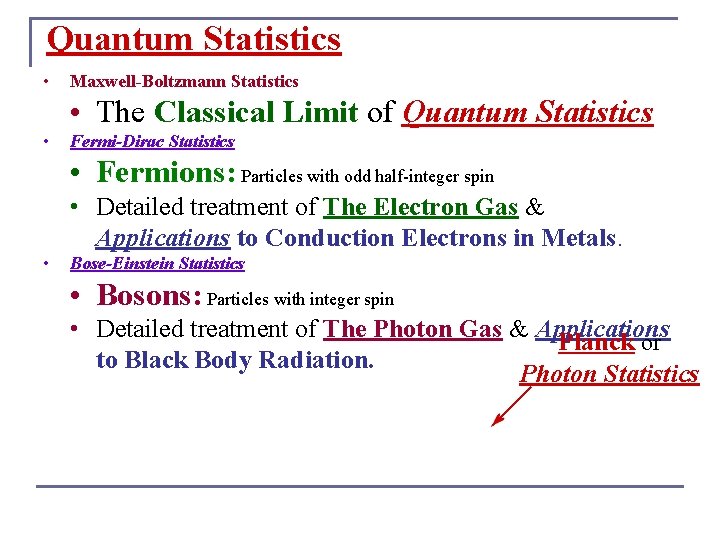
Quantum Statistics • Maxwell-Boltzmann Statistics • The Classical Limit of Quantum Statistics • Fermi-Dirac Statistics • Fermions: Particles with odd half-integer spin • Detailed treatment of The Electron Gas & Applications to Conduction Electrons in Metals. • Bose-Einstein Statistics • Bosons: Particles with integer spin • Detailed treatment of The Photon Gas & Applications Planck or to Black Body Radiation. Photon Statistics
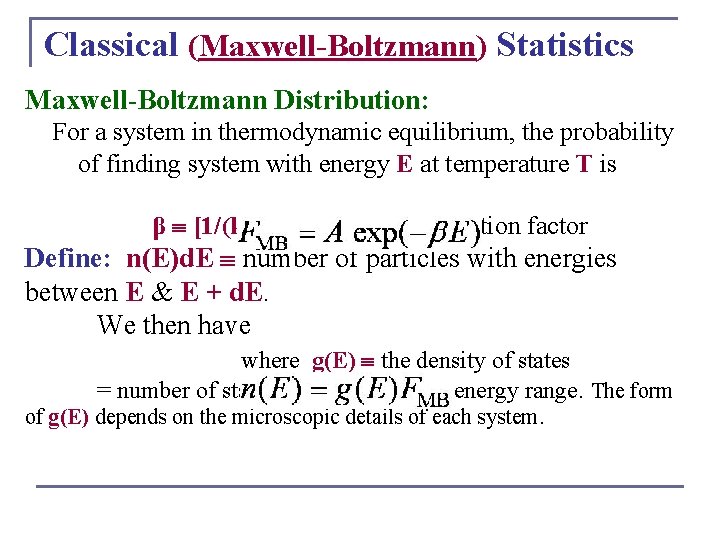
Classical (Maxwell-Boltzmann) Statistics Maxwell-Boltzmann Distribution: For a system in thermodynamic equilibrium, the probability of finding system with energy E at temperature T is β [1/(k. BT)], A = normalization factor Define: n(E)d. E number of particles with energies between E & E + d. E. We then have where g(E) the density of states = number of states available per unit energy range. The form of g(E) depends on the microscopic details of each system.
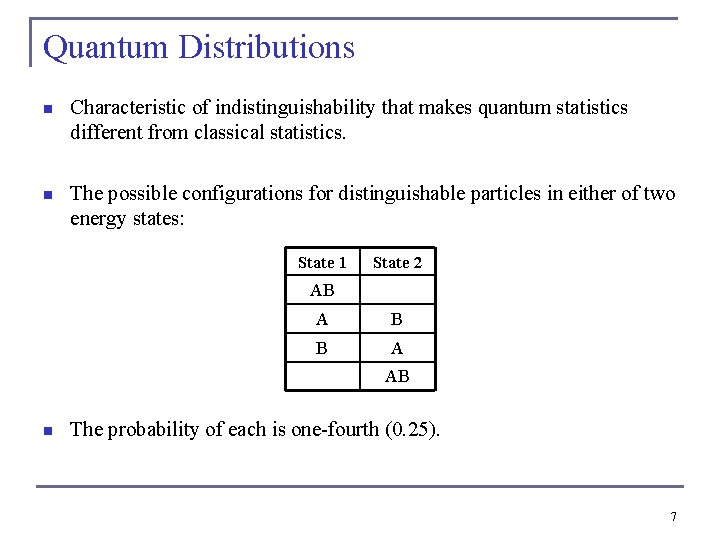
Quantum Distributions n Characteristic of indistinguishability that makes quantum statistics different from classical statistics. n The possible configurations for distinguishable particles in either of two energy states: State 1 State 2 AB A B B A AB n The probability of each is one-fourth (0. 25). 7
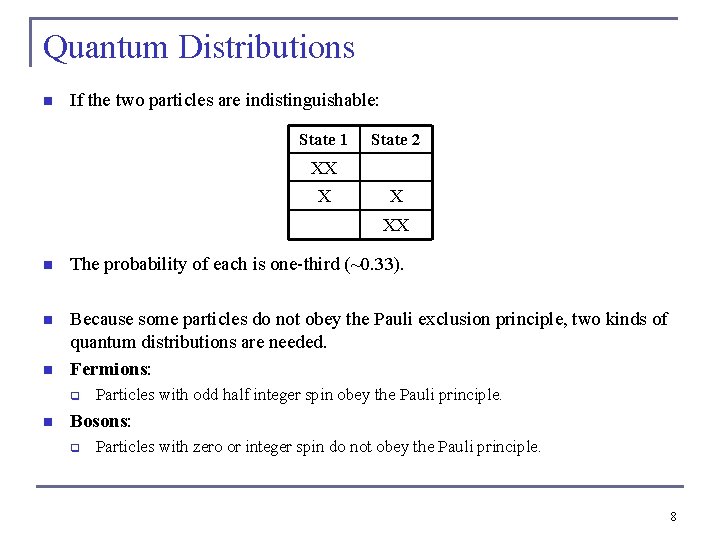
Quantum Distributions n If the two particles are indistinguishable: State 1 State 2 XX X X XX n The probability of each is one-third (~0. 33). n Because some particles do not obey the Pauli exclusion principle, two kinds of quantum distributions are needed. Fermions: n q n Particles with odd half integer spin obey the Pauli principle. Bosons: q Particles with zero or integer spin do not obey the Pauli principle. 8
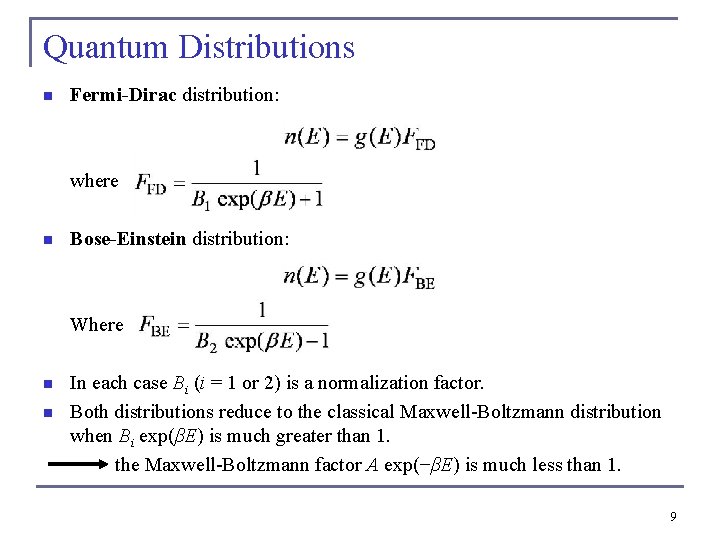
Quantum Distributions n Fermi-Dirac distribution: where n Bose-Einstein distribution: Where n n In each case Bi (i = 1 or 2) is a normalization factor. Both distributions reduce to the classical Maxwell-Boltzmann distribution when Bi exp(βE) is much greater than 1. the Maxwell-Boltzmann factor A exp(−βE) is much less than 1. 9
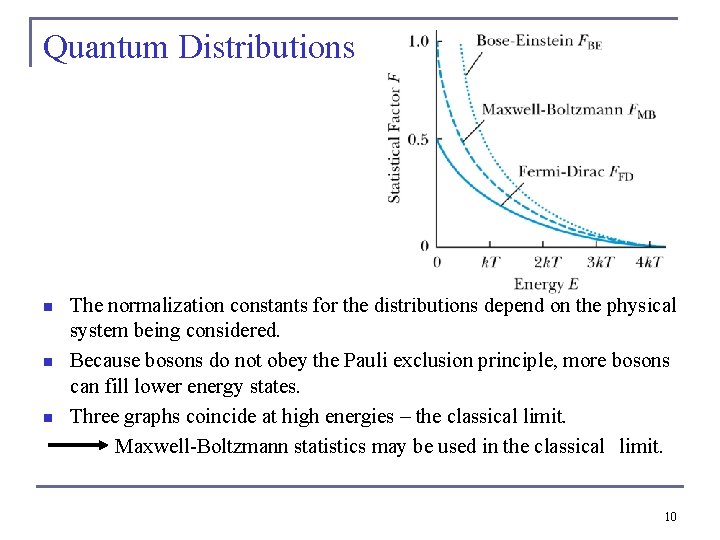
Quantum Distributions n n n The normalization constants for the distributions depend on the physical system being considered. Because bosons do not obey the Pauli exclusion principle, more bosons can fill lower energy states. Three graphs coincide at high energies – the classical limit. Maxwell-Boltzmann statistics may be used in the classical limit. 10
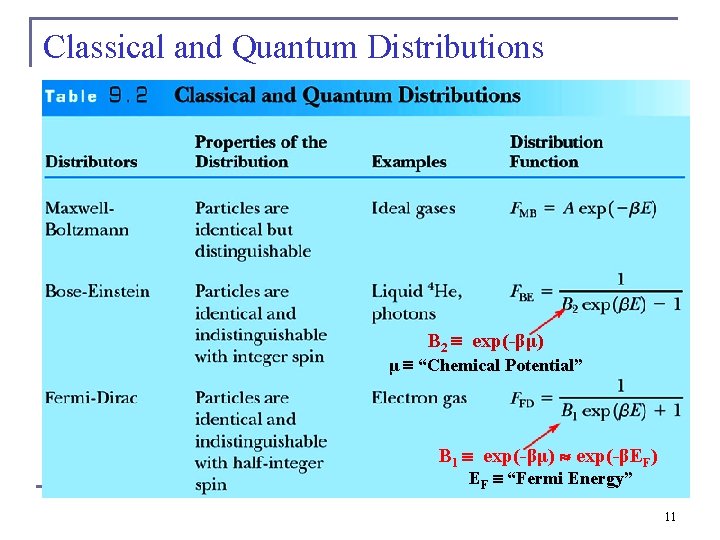
Classical and Quantum Distributions B 2 exp(-βμ) μ “Chemical Potential” B 1 exp(-βμ) exp(-βEF) EF “Fermi Energy” 11
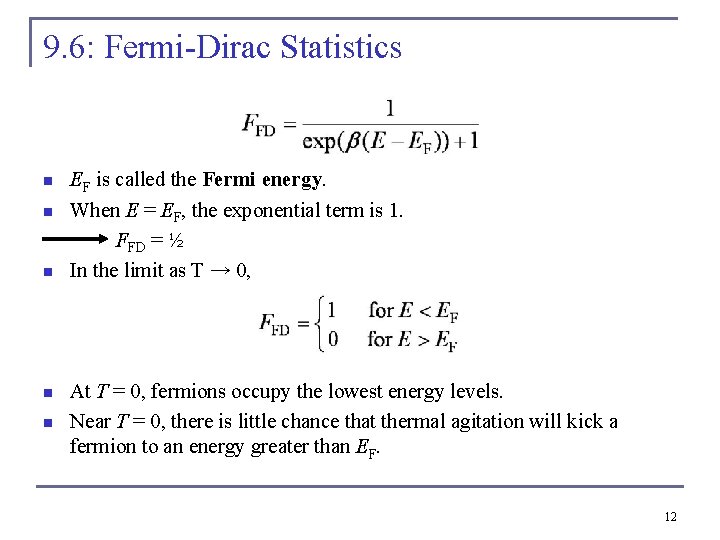
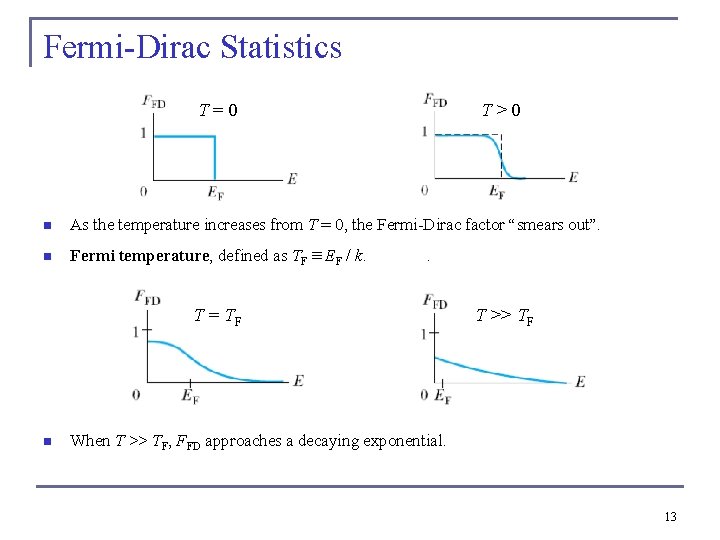
9. 6: Fermi-Dirac Statistics n n n EF is called the Fermi energy. When E = EF, the exponential term is 1. FFD = ½ In the limit as T → 0, At T = 0, fermions occupy the lowest energy levels. Near T = 0, there is little chance that thermal agitation will kick a fermion to an energy greater than EF. 12
Fermi-Dirac Statistics T=0 T>0 n As the temperature increases from T = 0, the Fermi-Dirac factor “smears out”. n Fermi temperature, defined as TF ≡ EF / k. . T = TF n T >> TF When T >> TF, FFD approaches a decaying exponential. 13
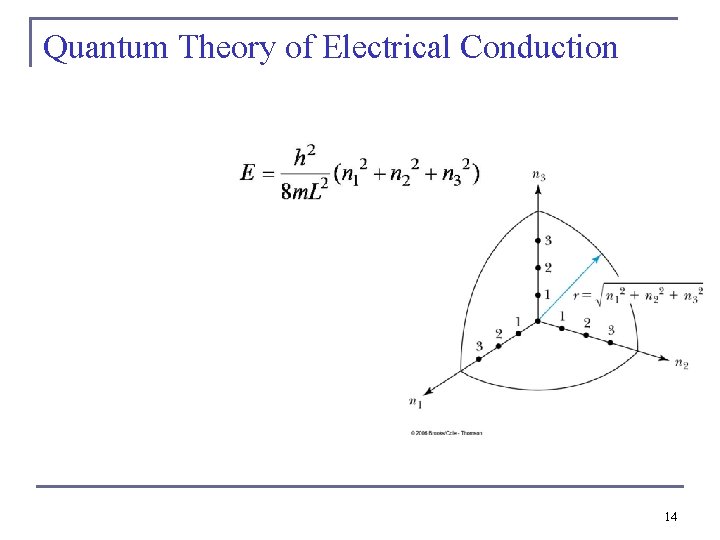
Quantum Theory of Electrical Conduction 14
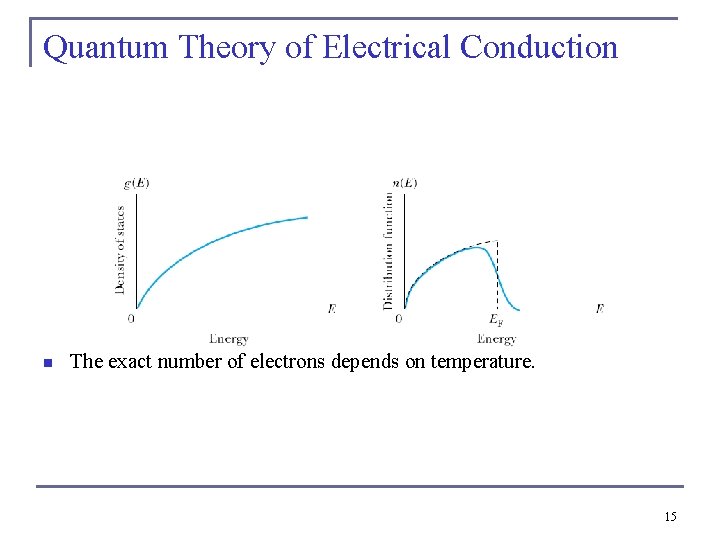
Quantum Theory of Electrical Conduction n The exact number of electrons depends on temperature. 15
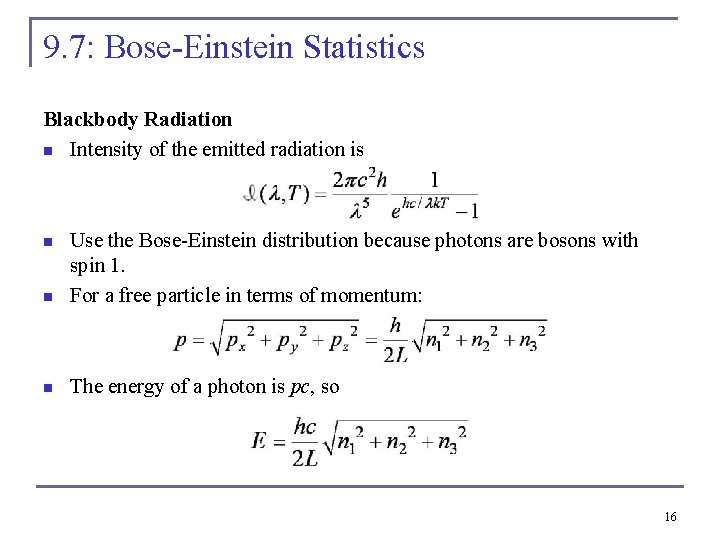
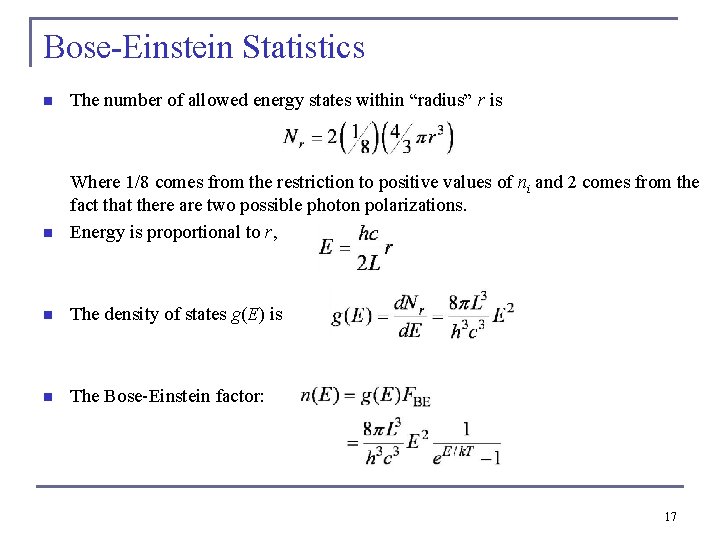
9. 7: Bose-Einstein Statistics Blackbody Radiation n Intensity of the emitted radiation is n Use the Bose-Einstein distribution because photons are bosons with spin 1. For a free particle in terms of momentum: n The energy of a photon is pc, so n 16
Bose-Einstein Statistics n The number of allowed energy states within “radius” r is n Where 1/8 comes from the restriction to positive values of ni and 2 comes from the fact that there are two possible photon polarizations. Energy is proportional to r, n The density of states g(E) is n The Bose-Einstein factor: 17
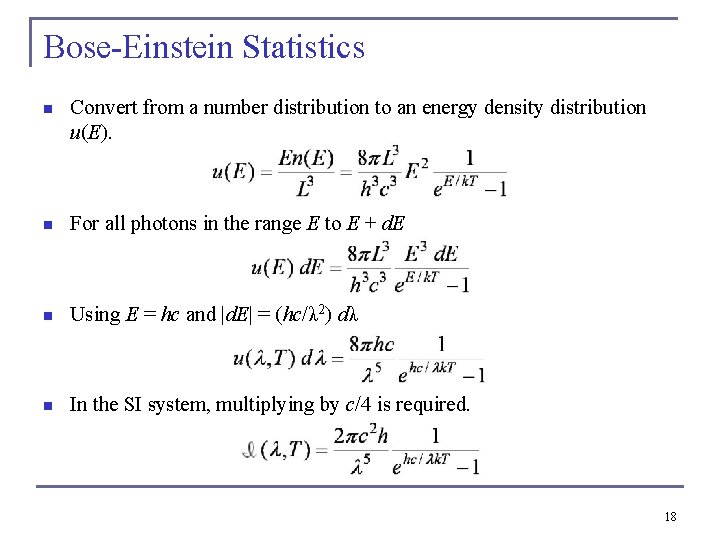
Bose-Einstein Statistics n Convert from a number distribution to an energy density distribution u(E). n For all photons in the range E to E + d. E n Using E = hc and |d. E| = (hc/λ 2) dλ n In the SI system, multiplying by c/4 is required. 18
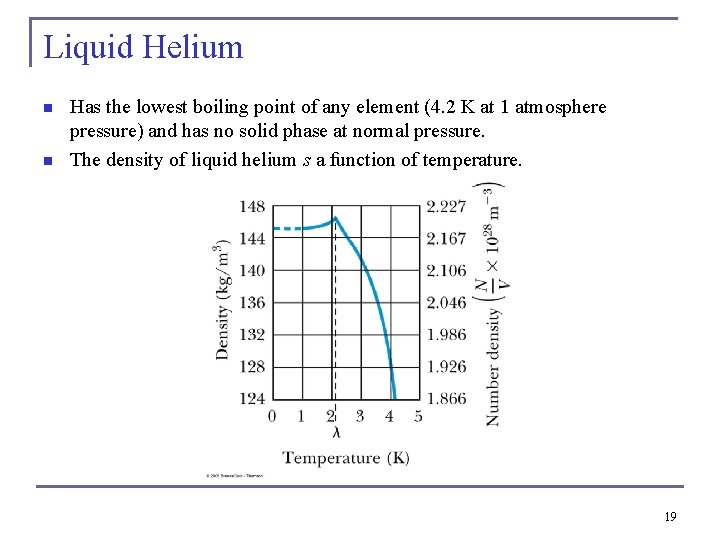
Liquid Helium n n Has the lowest boiling point of any element (4. 2 K at 1 atmosphere pressure) and has no solid phase at normal pressure. The density of liquid helium s a function of temperature. 19
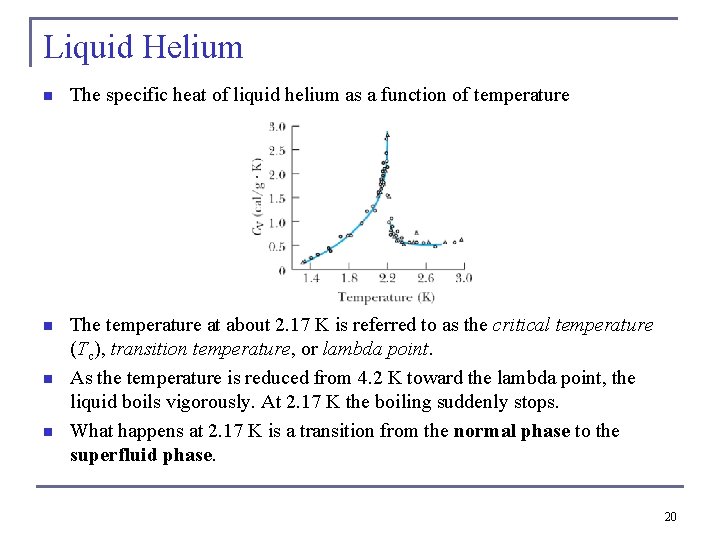
Liquid Helium n The specific heat of liquid helium as a function of temperature n The temperature at about 2. 17 K is referred to as the critical temperature (Tc), transition temperature, or lambda point. As the temperature is reduced from 4. 2 K toward the lambda point, the liquid boils vigorously. At 2. 17 K the boiling suddenly stops. What happens at 2. 17 K is a transition from the normal phase to the superfluid phase. n n 20
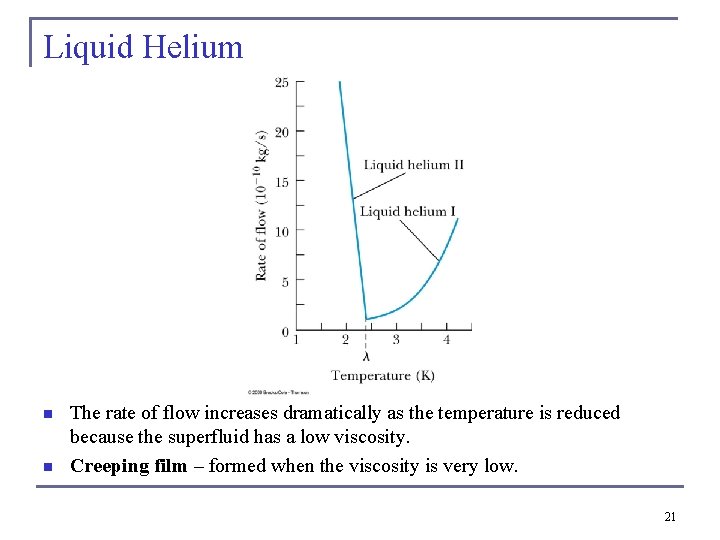
Liquid Helium n n The rate of flow increases dramatically as the temperature is reduced because the superfluid has a low viscosity. Creeping film – formed when the viscosity is very low. 21
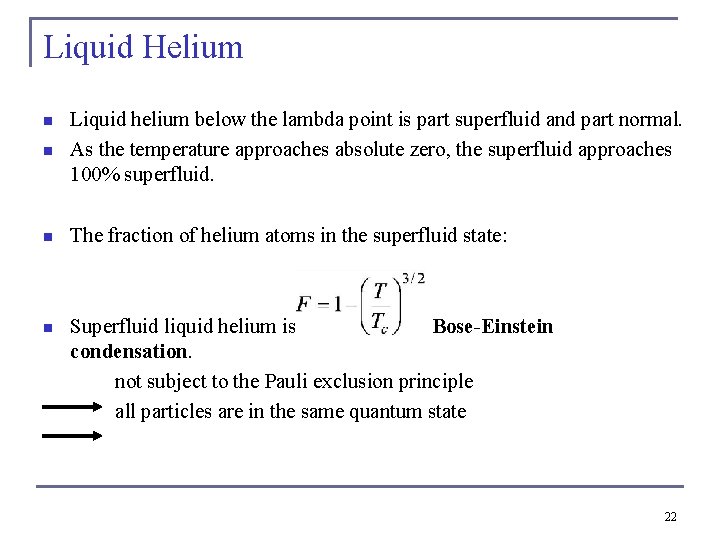
Liquid Helium n Liquid helium below the lambda point is part superfluid and part normal. As the temperature approaches absolute zero, the superfluid approaches 100% superfluid. n The fraction of helium atoms in the superfluid state: n Superfluid liquid helium is referred to as a Bose-Einstein condensation. not subject to the Pauli exclusion principle all particles are in the same quantum state n 22
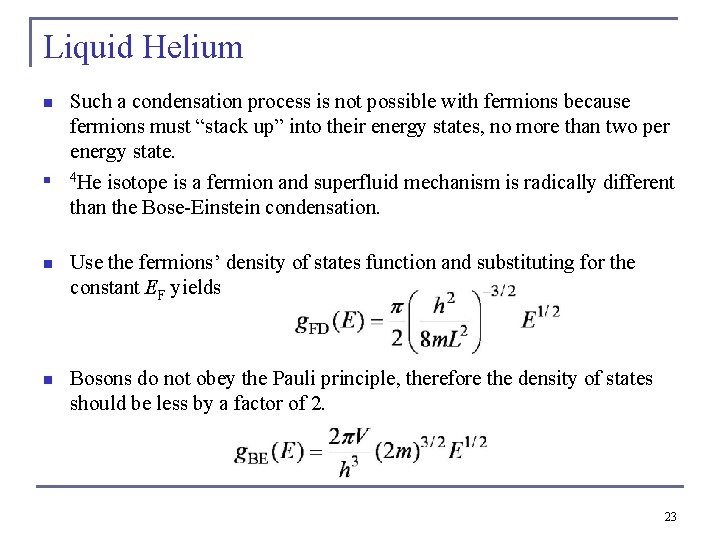
Liquid Helium n n Such a condensation process is not possible with fermions because fermions must “stack up” into their energy states, no more than two per energy state. 4 He isotope is a fermion and superfluid mechanism is radically different than the Bose-Einstein condensation. n Use the fermions’ density of states function and substituting for the constant EF yields n Bosons do not obey the Pauli principle, therefore the density of states should be less by a factor of 2. 23
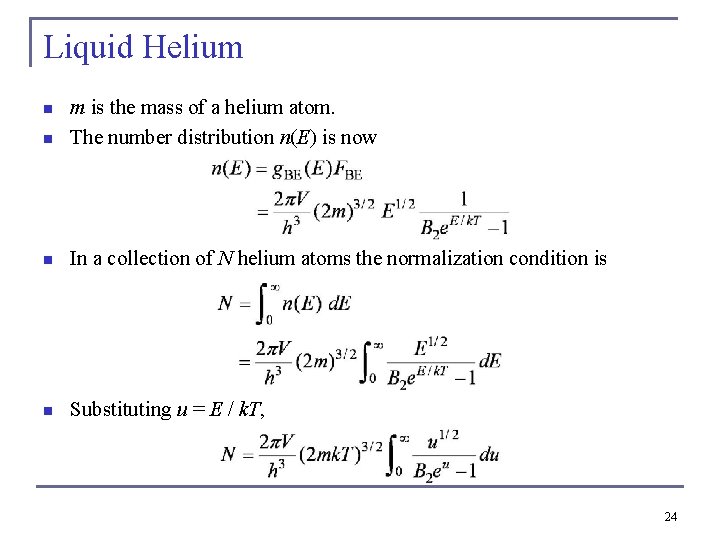
Liquid Helium n m is the mass of a helium atom. The number distribution n(E) is now n In a collection of N helium atoms the normalization condition is n Substituting u = E / k. T, n 24
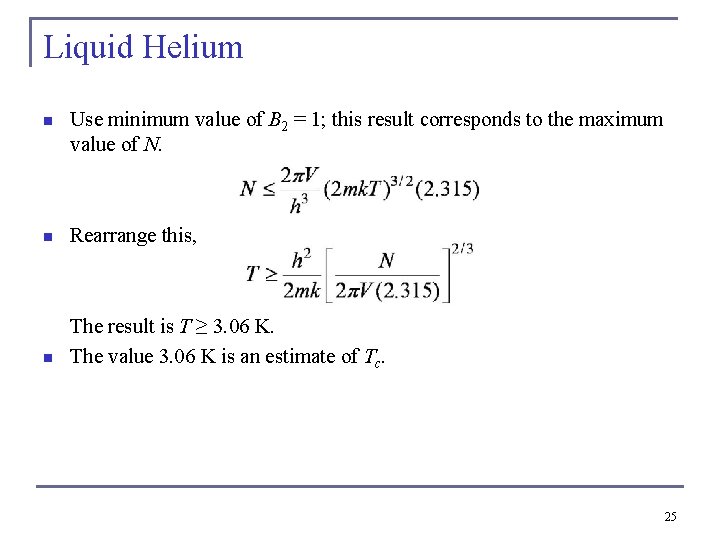
Liquid Helium n Use minimum value of B 2 = 1; this result corresponds to the maximum value of N. n Rearrange this, n The result is T ≥ 3. 06 K. The value 3. 06 K is an estimate of Tc. 25
Bose-Einstein Condensation in Gases n By the strong Coulomb interaction among gas particles it was difficult to obtain the low temperatures and high densities needed to produce the condensate. Finally success was achieved in 1995. n First, they used laser cooling to cool their gas of 87 Rb atoms to about 1 m. K. Then they used a magnetic trap to cool the gas to about 20 n. K. In their magnetic trap they drove away atoms with higher speeds and further from the center. What remained was an extremely cold, dense cloud at about 170 n. K. 26