
Chapter 9 Psychological Development Copyright Bacon 2007 CopyrightAllynand
Chapter 9 Psychological Development Copyright Bacon 2007 Copyright©©Allyn&and Bacon 2006
Developmental Psychology Developmental psychology – The study of how people change over time due to biological and environmental influences Copyright©©Allynand & Bacon Copyright Bacon 2007 2006
How Do Psychologists Explain Development? Development is a process of growth and change brought about by an interaction of heredity and the environment Copyright©©Allynand & Bacon Copyright Bacon 2007 2006
The Nature-Nurture Interaction Nature-nurture issue – Long-standing discussion over relative influence of heredity (nature) and environment (nurture) Copyright©©Allynand & Bacon Copyright Bacon 2007 2006
The Nature-Nurture Interaction Twin studies – Twins are compared in the search for genetic and environmental effects fraternal vs. identical Copyright©©Allynand & Bacon Copyright Bacon 2007 2006
Limits of twin studies 1. Environment treats similar people similarly 2. Confirmation bias on similarities Copyright©©Allynand & Bacon Copyright Bacon 2007 2006
The Nature-Nurture Interaction Adoption studies – -Similarities to biological family suggest nature -Similarities to adopted family suggest nurture Copyright©©Allynand & Bacon Copyright Bacon 2007 2006
Psychological Traits in Your Genes While psychological traits are formed by interaction of heredity and the environment, many traits have a strong genetic influence (e. g. general intelligence, alcoholism, Alzheimer’s, schizophrenia, depression and panic disorder) Copyright©©Allynand & Bacon Copyright Bacon 2007 2006
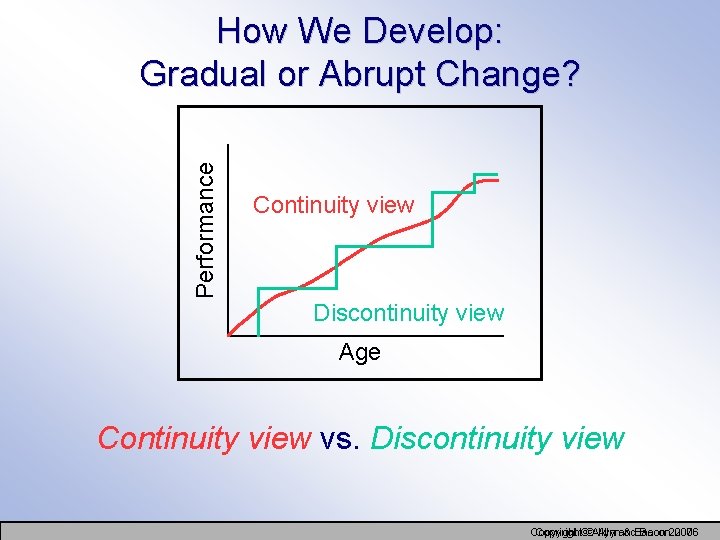
Performance How We Develop: Gradual or Abrupt Change? Continuity view Discontinuity view Age Continuity view vs. Discontinuity view Copyright©©Allynand & Bacon Copyright Bacon 2007 2006
Gradual versus Abrupt Change Developmental stages – Periods of life marked by significant transitions in physical or psychological functioning Copyright©©Allynand & Bacon Copyright Bacon 2007 2006
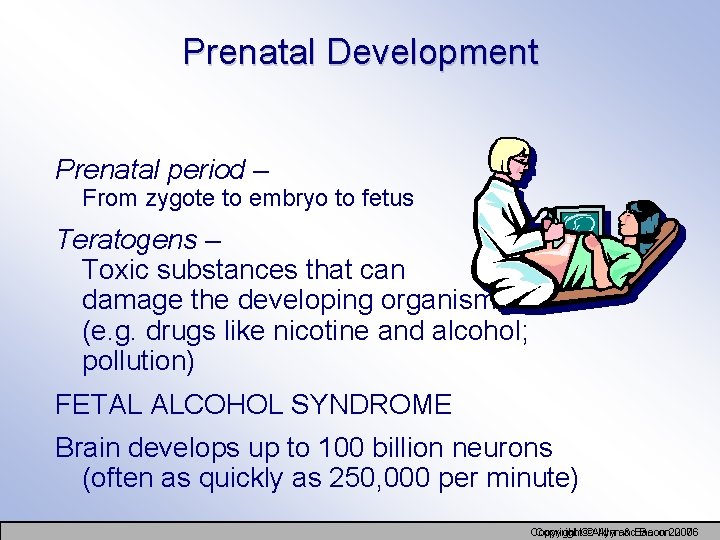
Prenatal Development Prenatal period – From zygote to embryo to fetus Teratogens – Toxic substances that can damage the developing organism (e. g. drugs like nicotine and alcohol; pollution) FETAL ALCOHOL SYNDROME Brain develops up to 100 billion neurons (often as quickly as 250, 000 per minute) Copyright©©Allynand & Bacon Copyright Bacon 2007 2006
Neonatal Period (from birth to one month) Sensory abilities Turns toward sensation Prefers salty and sweet flavors Weak vision Prefer female voices Motor abilities Postural reflex Grasping reflex Babinski reflex Startle reflex Moro reflex Copyright©©Allynand & Bacon Copyright Bacon 2007 2006
Infancy (from one month to about 18 months) Branching of dendrites synaptic pruning: connections not reinforced are lost Babies learn through classical conditioning turning toward sugar water Copyright©©Allynand & Bacon Copyright Bacon 2007 2006
Infancy (from one month to about 18 months) Maturation – The unfolding of genetically programmed processes of growth and development over time Copyright©©Allynand & Bacon Copyright Bacon 2007 2006

Maturation Timetable for Locomotion Birth Copyright©©Allynand & Bacon Copyright Bacon 2007 2006
Maturation Timetable for Locomotion Birth 1 mo. Responds to sound Becomes quiet when picked up Vocalizes occasionally Copyright©©Allynand & Bacon Copyright Bacon 2007 2006
Maturation Timetable for Locomotion Birth 1 mo. 2 mo. Smiles socially Recognizes mother Rolls from side to back Lifts head and holds it erect and steady Copyright©©Allynand & Bacon Copyright Bacon 2007 2006
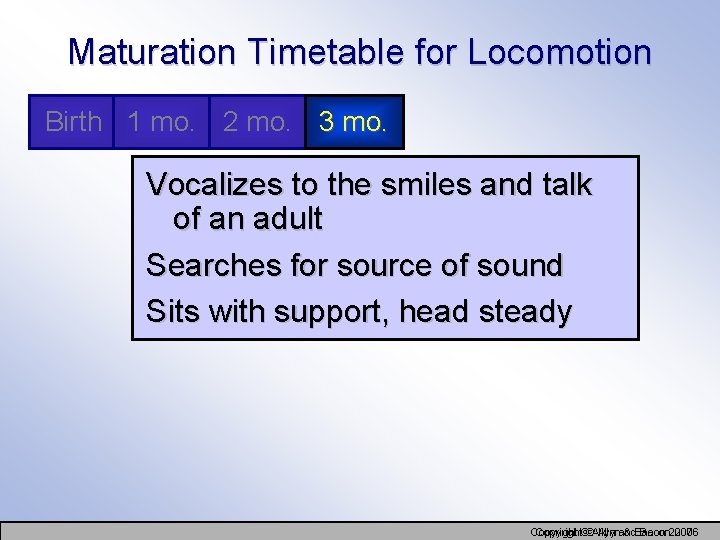
Maturation Timetable for Locomotion Birth 1 mo. 2 mo. 3 mo. Vocalizes to the smiles and talk of an adult Searches for source of sound Sits with support, head steady Copyright©©Allynand & Bacon Copyright Bacon 2007 2006
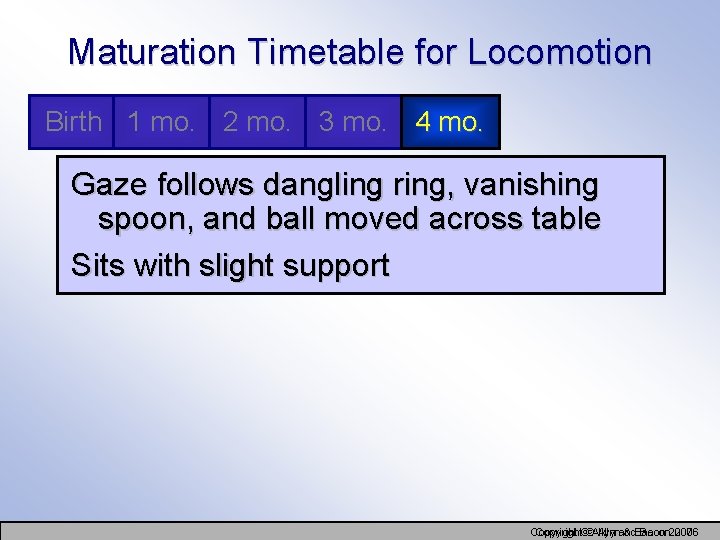
Maturation Timetable for Locomotion Birth 1 mo. 2 mo. 3 mo. 4 mo. Gaze follows dangling ring, vanishing spoon, and ball moved across table Sits with slight support Copyright©©Allynand & Bacon Copyright Bacon 2007 2006
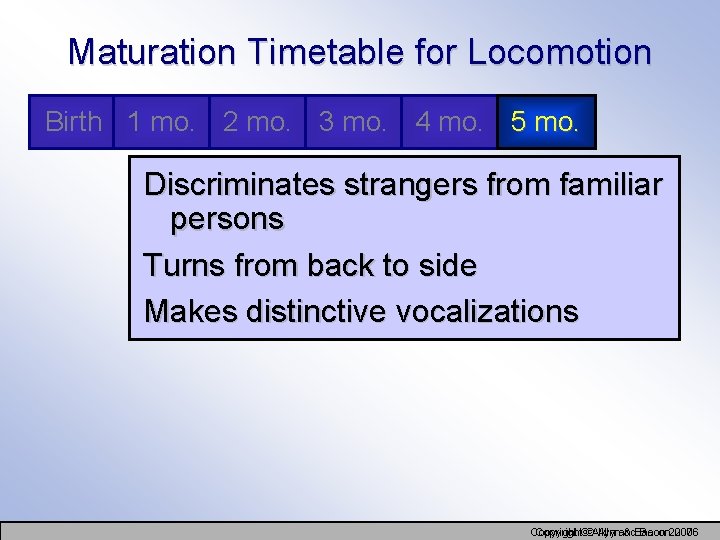
Maturation Timetable for Locomotion Birth 1 mo. 2 mo. 3 mo. 4 mo. 5 mo. Discriminates strangers from familiar persons Turns from back to side Makes distinctive vocalizations Copyright©©Allynand & Bacon Copyright Bacon 2007 2006
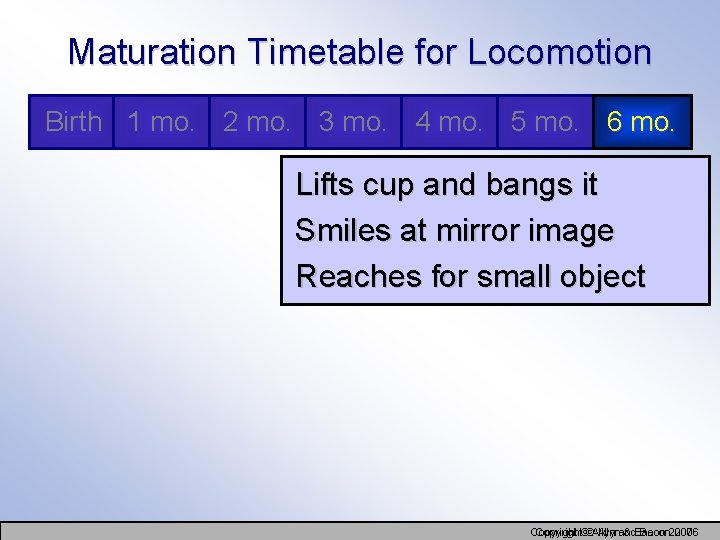
Maturation Timetable for Locomotion Birth 1 mo. 2 mo. 3 mo. 4 mo. 5 mo. 6 mo. Lifts cup and bangs it Smiles at mirror image Reaches for small object Copyright©©Allynand & Bacon Copyright Bacon 2007 2006
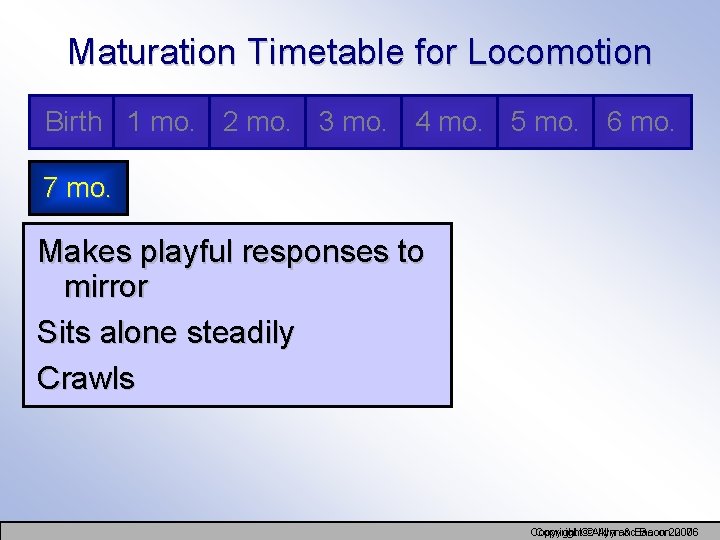
Maturation Timetable for Locomotion Birth 1 mo. 2 mo. 3 mo. 4 mo. 5 mo. 6 mo. 7 mo. Makes playful responses to mirror Sits alone steadily Crawls Copyright©©Allynand & Bacon Copyright Bacon 2007 2006
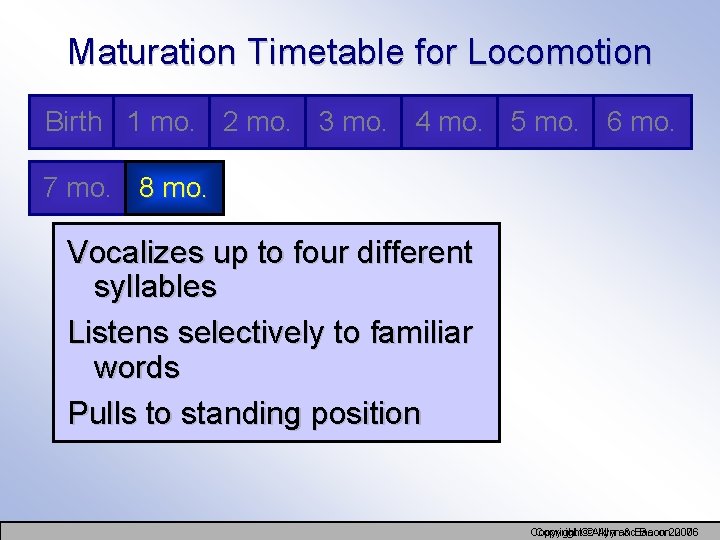
Maturation Timetable for Locomotion Birth 1 mo. 2 mo. 3 mo. 4 mo. 5 mo. 6 mo. 7 mo. 8 mo. Vocalizes up to four different syllables Listens selectively to familiar words Pulls to standing position Copyright©©Allynand & Bacon Copyright Bacon 2007 2006
Maturation Timetable for Locomotion Birth 1 mo. 2 mo. 3 mo. 4 mo. 5 mo. 6 mo. 7 mo. 8 mo. 9 mo. Copyright©©Allynand & Bacon Copyright Bacon 2007 2006
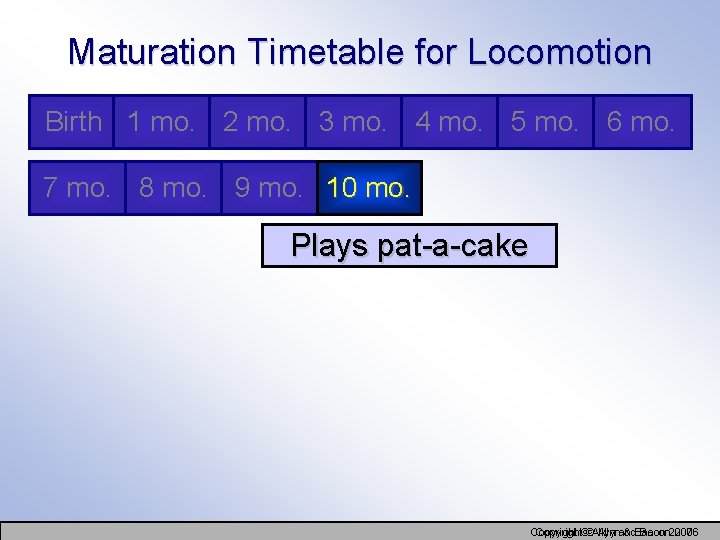
Maturation Timetable for Locomotion Birth 1 mo. 2 mo. 3 mo. 4 mo. 5 mo. 6 mo. 7 mo. 8 mo. 9 mo. 10 mo. Plays pat-a-cake Copyright©©Allynand & Bacon Copyright Bacon 2007 2006
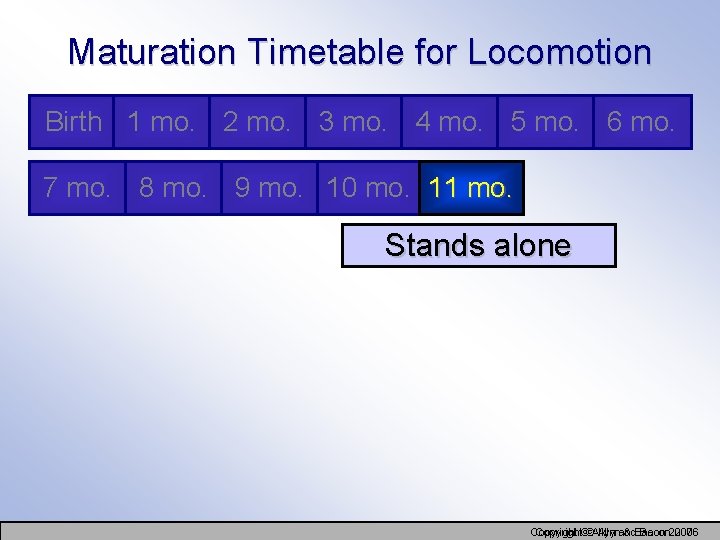
Maturation Timetable for Locomotion Birth 1 mo. 2 mo. 3 mo. 4 mo. 5 mo. 6 mo. 7 mo. 8 mo. 9 mo. 10 mo. 11 mo. Stands alone Copyright©©Allynand & Bacon Copyright Bacon 2007 2006
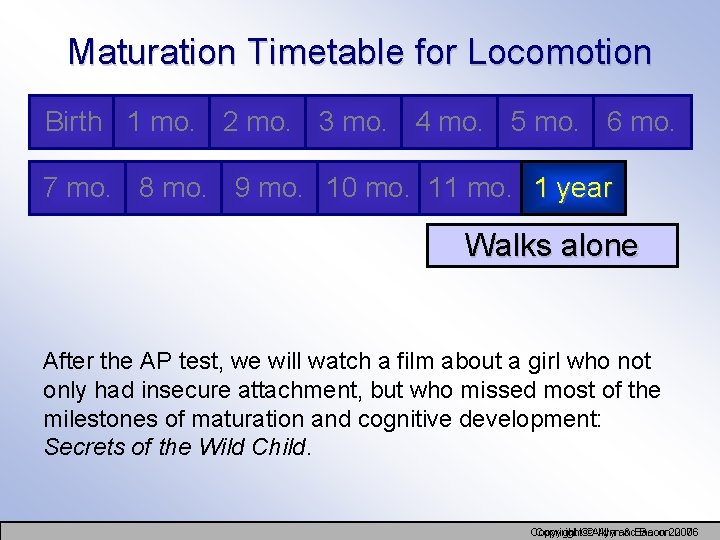
Maturation Timetable for Locomotion Birth 1 mo. 2 mo. 3 mo. 4 mo. 5 mo. 6 mo. 7 mo. 8 mo. 9 mo. 10 mo. 11 mo. 1 year Walks alone After the AP test, we will watch a film about a girl who not only had insecure attachment, but who missed most of the milestones of maturation and cognitive development: Secrets of the Wild Child. Copyright©©Allynand & Bacon Copyright Bacon 2007 2006
What Are the Developmental Tasks of Infancy and Childhood? Infants and children face important developmental tasks in cognition and social relationships – tasks that lay a foundation for further growth in adolescence and adulthood Copyright©©Allynand & Bacon Copyright Bacon 2007 2006
Cognitive Development Cognitive development – The process by which thinking changes over time (e. g. naming explosion @ 18 months) Schemas – a conceptual framework that provides expectations about the world Piaget: Mental structures that guide a developing child’s thoughts Copyright©©Allynand & Bacon Copyright Bacon 2007 2006
Cognitive Development Assimilation – modifies new info to fit it into existing schemas (SS: same schema—filing something in an existing file folder) Accommodation – restructures existing schemas so that new info is better understood (creating and labelling a NEW file folder: bromance) Copyright©©Allynand & Bacon Copyright Bacon 2007 2006
Assimilation or Accommodation? 1. 2. 3. 4. 5. 6. A child sees a zebra for the first time and calls it a horse. You have been homophobic your whole life, but when your child comes out of the closet, you become tolerant. You call four-legged animals dogs. You see a giraffe, call it a dog, and are corrected. From then on, four-legged animals with long legs are called giraffes. A child sees three trucks drive by, two 18 -wheelers, and a smaller truck. He says, "Look, a daddy truck, a mommy truck and a baby truck. " You are served apple pie with melted cheese. You try it, and decide you will always order melted cheese on apple pie. Copyright©©Allynand & Bacon Copyright Bacon 2007 2006
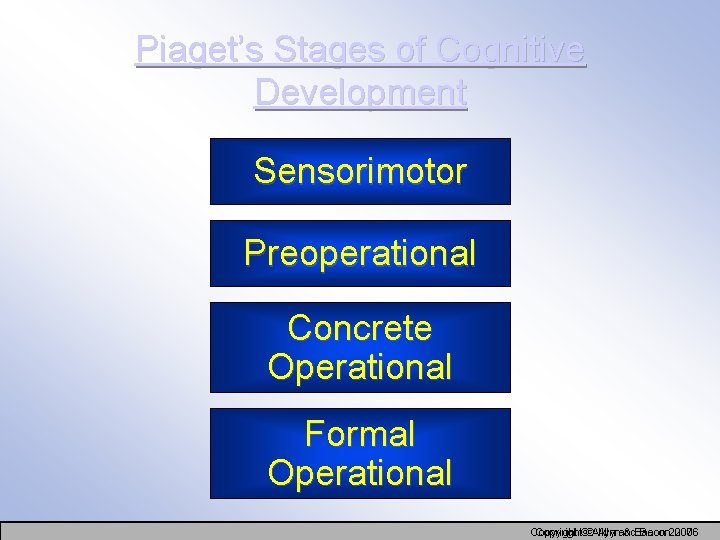
Piaget’s Stages of Cognitive Development Sensorimotor Preoperational Concrete Operational Formal Operational Copyright©©Allynand & Bacon Copyright Bacon 2007 2006
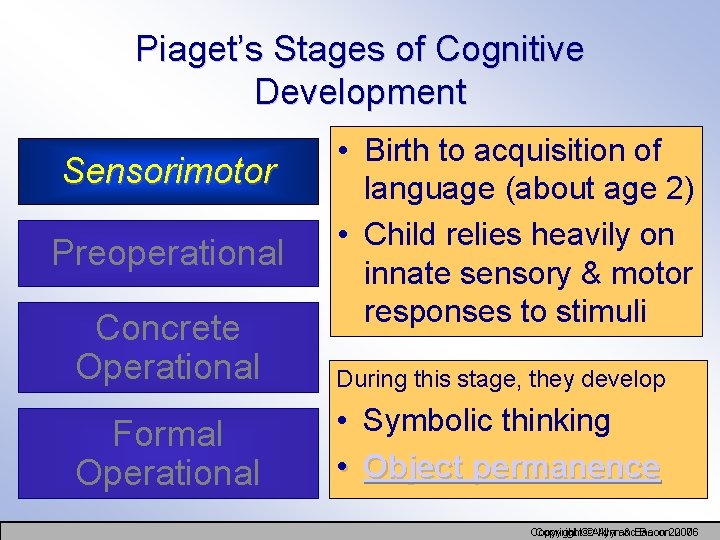
Piaget’s Stages of Cognitive Development Sensorimotor Preoperational • Birth to acquisition of language (about age 2) • Child relies heavily on innate sensory & motor responses to stimuli Concrete Operational During this stage, they develop Formal Operational • Symbolic thinking • Object permanence Copyright©©Allynand & Bacon Copyright Bacon 2007 2006
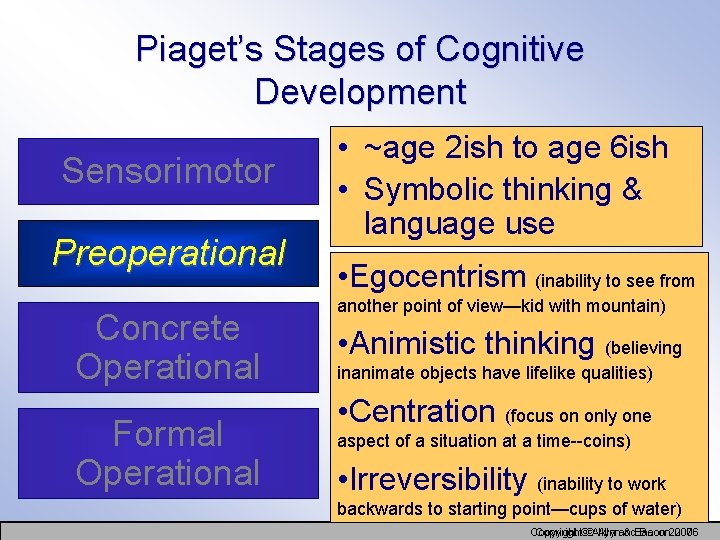
Piaget’s Stages of Cognitive Development Sensorimotor Preoperational Concrete Operational Formal Operational • ~age 2 ish to age 6 ish • Symbolic thinking & language use • Egocentrism (inability to see from another point of view—kid with mountain) • Animistic thinking (believing inanimate objects have lifelike qualities) • Centration (focus on only one aspect of a situation at a time--coins) • Irreversibility (inability to work backwards to starting point—cups of water) Copyright©©Allynand & Bacon Copyright Bacon 2007 2006
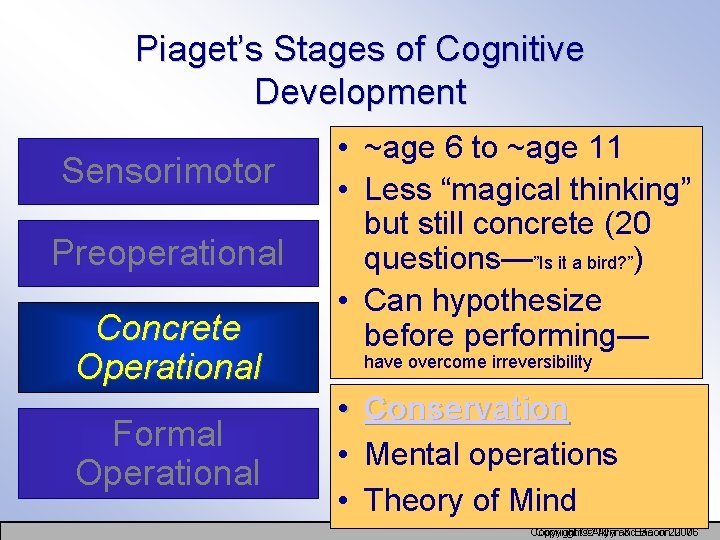
Piaget’s Stages of Cognitive Development Sensorimotor Preoperational Concrete Operational Formal Operational • ~age 6 to ~age 11 • Less “magical thinking” but still concrete (20 questions—”Is it a bird? ”) • Can hypothesize before performing— have overcome irreversibility • • • Conservation Mental operations Theory of Mind Copyright©©Allynand & Bacon Copyright Bacon 2007 2006
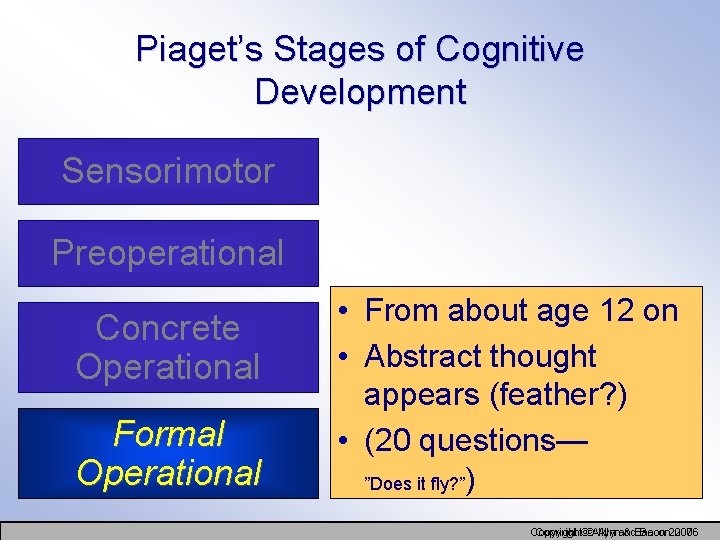
Piaget’s Stages of Cognitive Development Sensorimotor Preoperational Concrete Operational Formal Operational • From about age 12 on • Abstract thought appears (feather? ) • (20 questions— ”Does it fly? ”) Copyright©©Allynand & Bacon Copyright Bacon 2007 2006
Theory of Mind Awareness that others differ from oneself Copyright©©Allynand & Bacon Copyright Bacon 2007 2006
Piaget applied to learning Vygotsky’s zone of proximal development – The space between what a child can do with help and what the child can do without help (scaffolding) Copyright©©Allynand & Bacon Copyright Bacon 2007 2006
Infancy (from one month to about 18 months) Synchronicity: coordination of mother/child movement Contact comfort: Harlow’s Attachment Theory; Harlow explains his experiment -lack of contact comfort can lead to failure to thrive --Critical Period: Optimal period early in life when certain stimuli/experiences produce normal development. Animals go one step further--imprinting Copyright©©Allynand & Bacon Copyright Bacon 2007 2006
Attachment theory: an infant must develop a relationship with at least one caregiver for development to occur normally Styles are assessed by Ainsworth’s “strange situation” experiment • • • See handout to match attachment styles Take the “self-quiz” on page 372 Still face experiment Attachment styles are similar through generations…but the cycle can be broken Copyright©©Allynand & Bacon Copyright Bacon 2007 2006
Social and Emotional Development Temperament – One’s characteristic manner of behavior -e. g. highly reactive; easy/difficult/slow to warm up (see next chapter) Socialization – The process of shaping behavior, values, and attitudes to conform to those society regards as desirable Copyright©©Allynand & Bacon Copyright Bacon 2007 2006
Social and Emotional Development Most approaches to child rearing fall into one of the following four styles: 1. Authoritarian parents: highly demanding, coercive, criticizing, rely on punishment (Tiger Mother) 2. Authoritative parents: reasonable demands, explain and enforce rules; listen to child 3. Permissive parents: make few demands; let child make decisions before the child is ready (often out of concern for child’s self-esteem) 4. Uninvolved parents: permissive, but lack expectations; are indifferent to child’s POV Copyright©©Allynand & Bacon Copyright Bacon 2007 2006
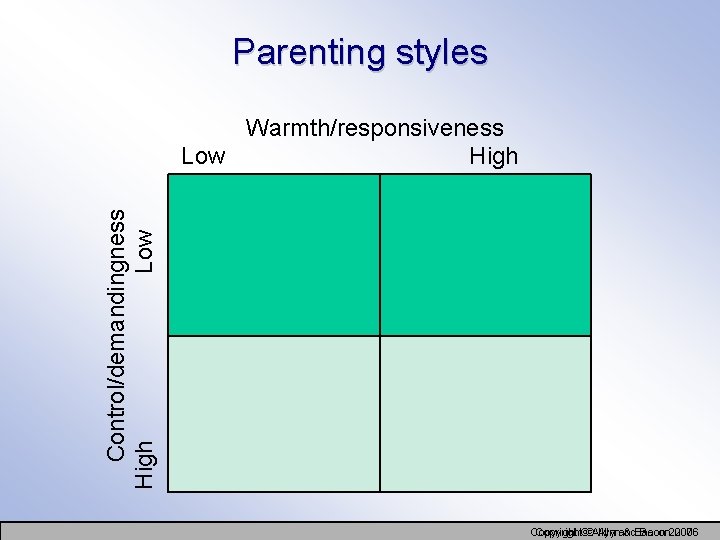
Parenting styles Control/demandingness High Low Warmth/responsiveness Low High Copyright©©Allynand & Bacon Copyright Bacon 2007 2006
Break Let’s take the parental authority questionnaire (48 -4) Teens of authoritarian parents were twice as likely as children of authoritative parents to be heavy drinkers. Teens of permissive parents were three times more likely. (Source: BYU study in Journal of Studies on Alcohol and Drugs) Teens of uninvolved parents scored worst on tests of psychosocial development, school achievement, internalized distress, and problem behavior. Copyright©©Allynand & Bacon Copyright Bacon 2007 2006
Gender Development GENDER ROLES: Heavily influenced by culture. Vary greatly depending on social environment. SOCIAL LEARNING THEORY: Has strong impact on gender identity. We learn by imitating others and then finding reward or punishment (“Big boys don’t cry. ”) Copyright©©Allynand & Bacon Copyright Bacon 2007 2006
Gender Development Cont. GENDER TYPING: The acquisition of a traditional masculine or feminine role. Beyond just imitating others, gender typing can occur because some children are simply more attuned to traditional roles. TRANSGENDER: Umbrella term describing those whose gender identity or expression differs from that associated with their birth sex. Copyright©©Allynand & Bacon Copyright Bacon 2007 2006
Kohlberg’s Stages of Moral Reasoning I. Preconventional morality: self is most important; based on direct consequences Stage 1: Pleasure/pain orientation -reward v. punishment -might makes right Stage 2: Cost/benefit orientation; reciprocity “Instrumental exchange” People are valued for their utility, and vengeance is accepted Copyright©©Allynand & Bacon Copyright Bacon 2007 2006
Kohlberg’s Stages of Moral Reasoning II. Conventional morality: society is most important; role conformity Stage 3: “Good child” orientation -social approval; pleasing people Stage 4: Law-and-order; “good citizen” Obey -what if everyone did that? the -respect for authority and the social order; law duty, consistency and precedent Copyright©©Allynand & Bacon Copyright Bacon 2007 2006
Kohlberg’s Stages of Moral Reasoning III. Postconventional morality: principle is most important; a sense of justice Stage 5: Individual rights; “the philosopher” -laws are social contracts, not edicts; “we all have the right to life, liberty…”; democratic government lives here Stage 6: Universal principle; “the prophet” -adherence to abstractions; beyond the law; principles of conscience Change the law Ignore the law Copyright©©Allynand & Bacon Copyright Bacon 2007 2006
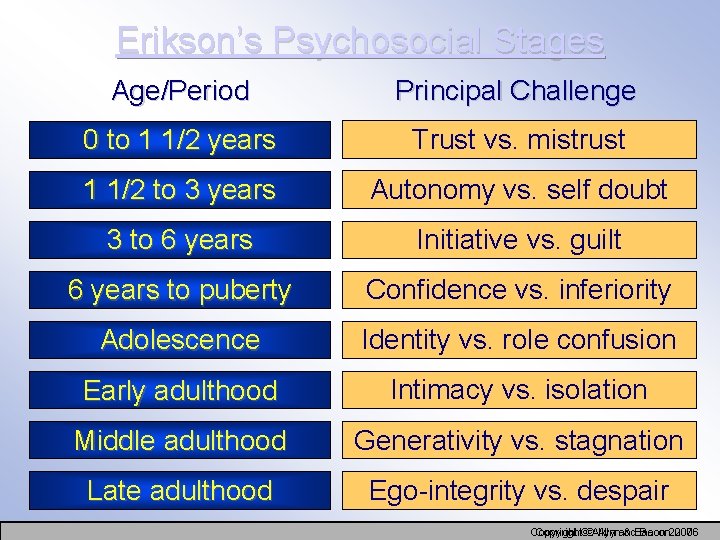
Erikson’s Psychosocial Stages Age/Period Principal Challenge 0 to 1 1/2 years Trust vs. mistrust 1 1/2 to 3 years Autonomy vs. self doubt 3 to 6 years Initiative vs. guilt 6 years to puberty Confidence vs. inferiority Adolescence Identity vs. role confusion Early adulthood Intimacy vs. isolation Middle adulthood Generativity vs. stagnation Late adulthood Ego-integrity vs. despair Copyright©©Allynand & Bacon Copyright Bacon 2007 2006
How do we know we’ve moved to a different stage? Erikson and Pixar Rite of passage -- A social ritual that marks a transition between developmental stages. What agreed-upon rites of passage do we have in our culture? SOCIAL CLOCK: Culturally preferred timing of social events such as marriage, parenthood, and retirement. Differs greatly from culture to culture, era to era. Copyright©©Allynand & Bacon Copyright Bacon 2007 2006
The Developmental Challenges of Adulthood Generativity – A process of making a commitment beyond oneself to family, work, society, or future generations (sounds like the top two rungs of Maslow’s hierarchy, yes? ) Copyright©©Allynand & Bacon Copyright Bacon 2007 2006
Let’s take a survey (9 -18) …to find out how well you resolved the conflicts in Erikson’s first five stages Copyright©©Allynand & Bacon Copyright Bacon 2007 2006
What Developmental Challenges Do Adults Face? Nature and nurture continue to produce changes throughout life, but in adulthood these changes include both growth and decline Copyright©©Allynand & Bacon Copyright Bacon 2007 2006
Kubler-Ross’s five stages of grief Denial Anger Bargaining Depression Acceptance Giraffes grieve too Copyright©©Allynand & Bacon Copyright Bacon 2007 2006

End of Chapter 9 Copyright Bacon 2007 Copyright©©Allyn&and Bacon 2006
- Slides: 56