
Chapter 9 Project Management Russell and Taylor Operations
- Slides: 61
Chapter 9 Project Management Russell and Taylor Operations and Supply Chain Management, 8 th Edition
Lecture Outline • • Project Planning – Slide 5 Project Scheduling – Slide 18 Project Control – Slide 21 CPM/PERT – Slide 22 Probabilistic Activity Times – Slide 34 Microsoft Project – Slide 46 Project Crashing and Time-Cost Trade-off – Slide 56 © 2014 John Wiley & Sons, Inc. - Russell and Taylor 8 e 9 -2
Learning Objectives • Discuss the project planning process, including planning tools, evaluation methods, and key concepts • Discuss the benefits of and strategies for dealing with diverse project groups • Explain the basics of project scheduling and the use of Gantt charts • Define enterprise project management and discuss the key elements in project control © 2014 John Wiley & Sons, Inc. - Russell and Taylor 8 e 9 -3
Learning Objectives • Define enterprise project management and discuss the key elements in project control • Develop and analyze both deterministic AND probabilistic project networks • Use Microsoft Project for network analysis • Determine and explain project crashing and time-cost tradeoffs © 2014 John Wiley & Sons, Inc. - Russell and Taylor 8 e 9 -4
Project Planning • A Project … • • • Has a unique purpose IS not repetitive Is accomplished in a finite time by TEAMS Is a one-time operational activity or effort Has definite starting and stopping points Produces a unique product customized to meet customer requirements © 2014 John Wiley & Sons, Inc. - Russell and Taylor 8 e 9 -5
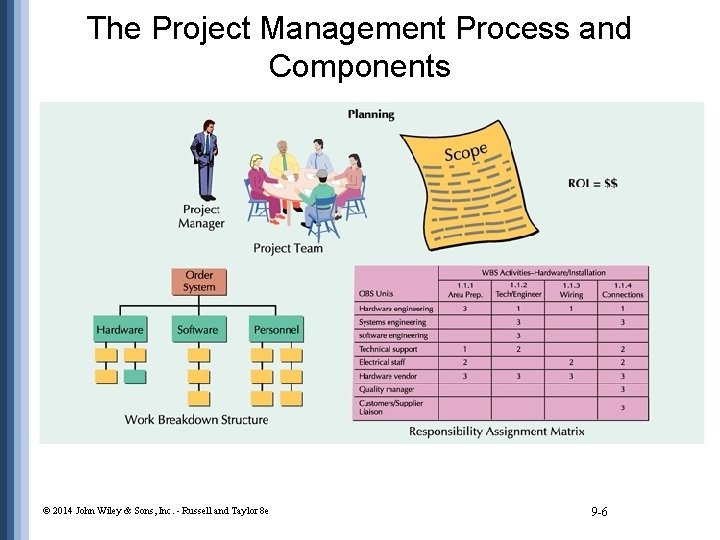
The Project Management Process and Components © 2014 John Wiley & Sons, Inc. - Russell and Taylor 8 e 9 -6
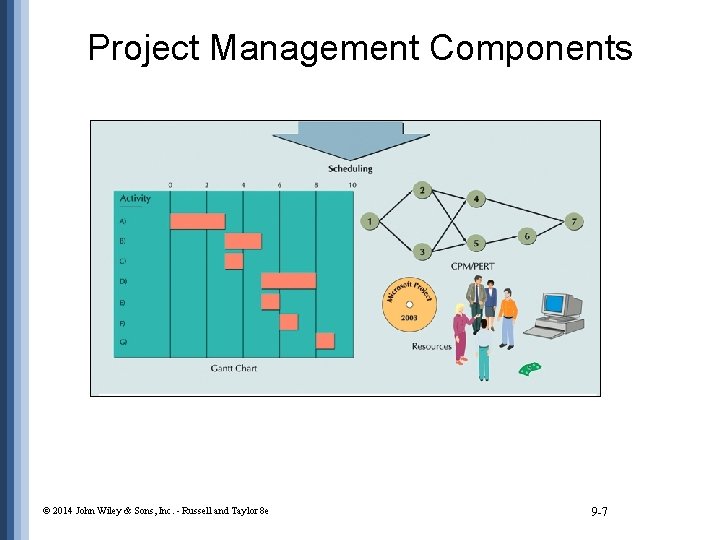
Project Management Components © 2014 John Wiley & Sons, Inc. - Russell and Taylor 8 e 9 -7
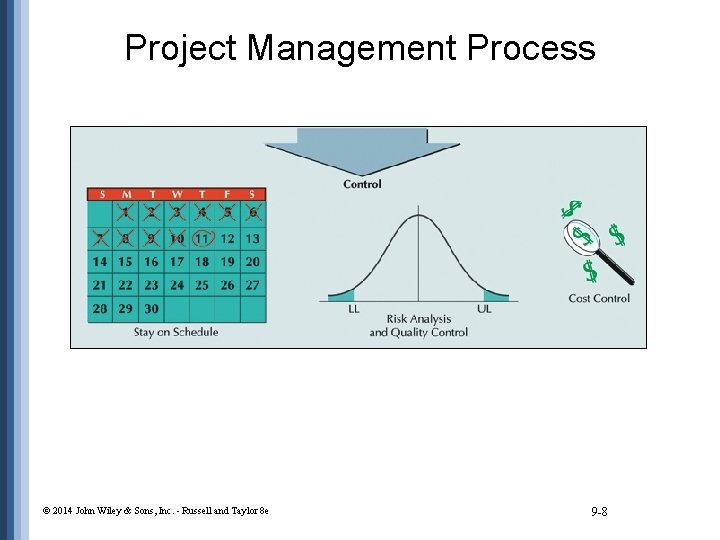
Project Management Process © 2014 John Wiley & Sons, Inc. - Russell and Taylor 8 e 9 -8
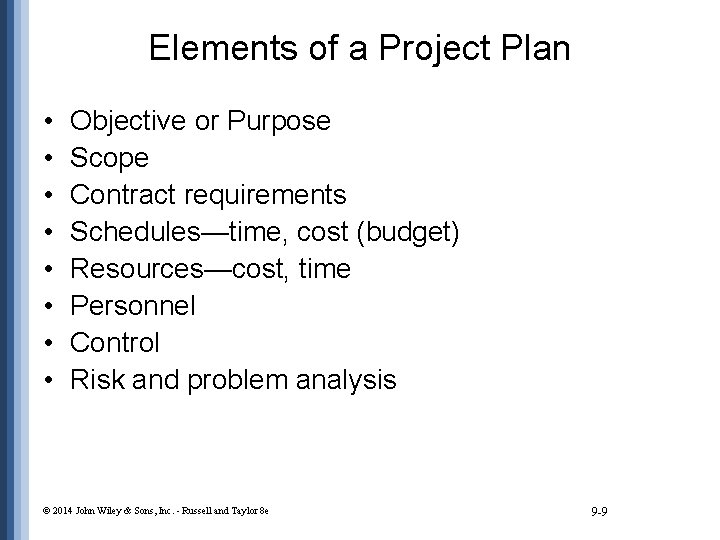
Elements of a Project Plan • • Objective or Purpose Scope Contract requirements Schedules—time, cost (budget) Resources—cost, time Personnel Control Risk and problem analysis © 2014 John Wiley & Sons, Inc. - Russell and Taylor 8 e 9 -9
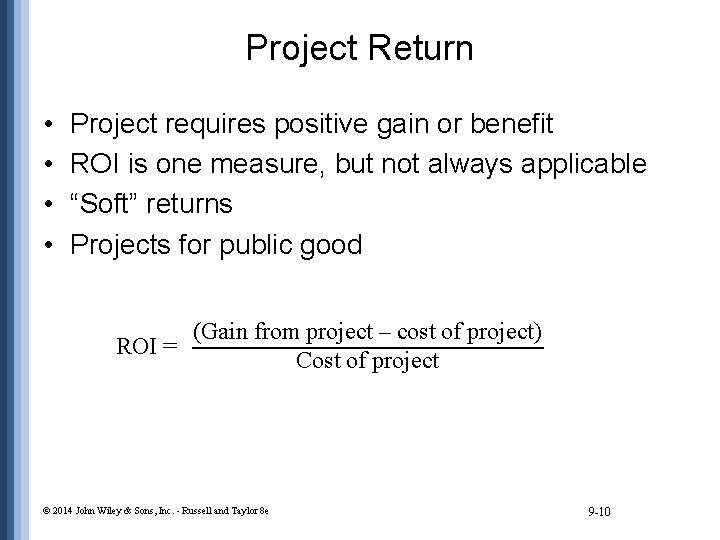
Project Return • • Project requires positive gain or benefit ROI is one measure, but not always applicable “Soft” returns Projects for public good (Gain from project – cost of project) ROI = Cost of project © 2014 John Wiley & Sons, Inc. - Russell and Taylor 8 e 9 -10
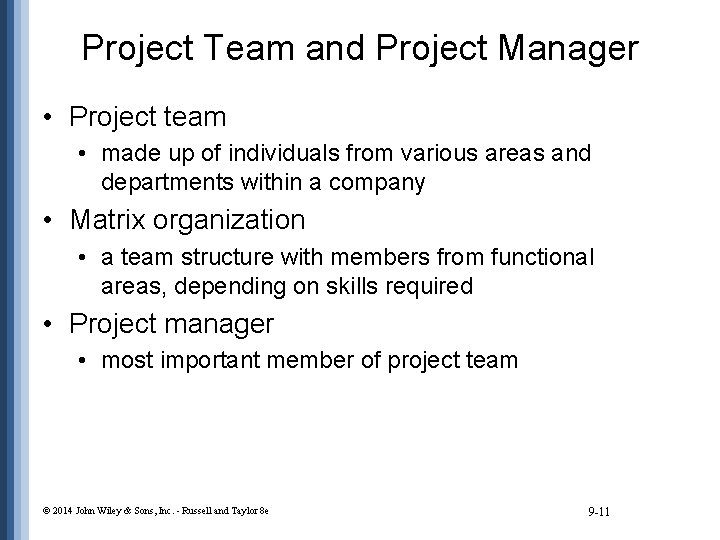
Project Team and Project Manager • Project team • made up of individuals from various areas and departments within a company • Matrix organization • a team structure with members from functional areas, depending on skills required • Project manager • most important member of project team © 2014 John Wiley & Sons, Inc. - Russell and Taylor 8 e 9 -11
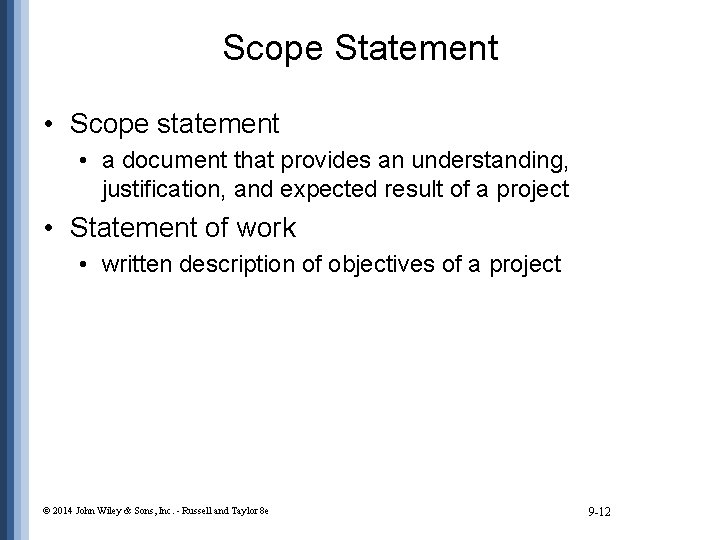
Scope Statement • Scope statement • a document that provides an understanding, justification, and expected result of a project • Statement of work • written description of objectives of a project © 2014 John Wiley & Sons, Inc. - Russell and Taylor 8 e 9 -12
Requirements Document • A detailed description of customer requirements that will be accommodated by this project © 2014 John Wiley & Sons, Inc. - Russell and Taylor 8 e 9 -13
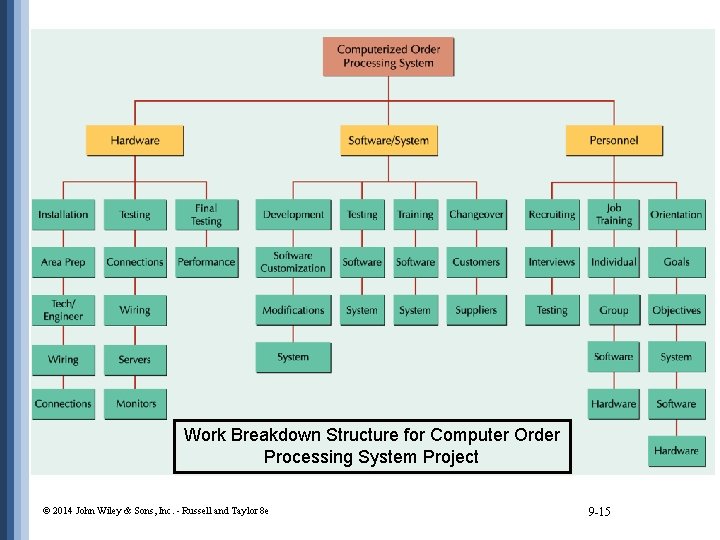
Work Breakdown Structure • Organizes the work in a project • Breaks project into components, subcomponents, work packages • Start at the top and work down • Brainstorm project scope • A graphic delineation of SCOPE © 2014 John Wiley & Sons, Inc. - Russell and Taylor 8 e 9 -14
Work Breakdown Structure for Computer Order Processing System Project © 2014 John Wiley & Sons, Inc. - Russell and Taylor 8 e 9 -15
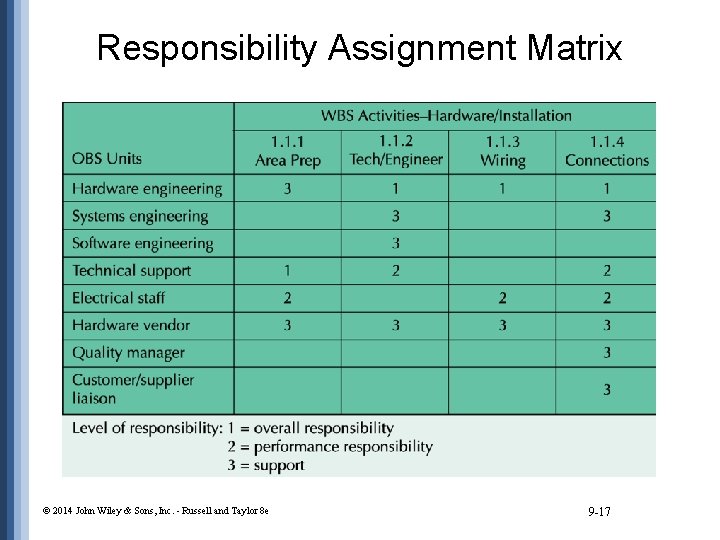
Responsibility Assignment Matrix • Organizational Breakdown Structure (OBS) • a chart that shows which organizational units are responsible for which work items • Responsibility Assignment Matrix (RAM) • shows who is responsible for the work in a project © 2014 John Wiley & Sons, Inc. - Russell and Taylor 8 e 9 -16
Responsibility Assignment Matrix © 2014 John Wiley & Sons, Inc. - Russell and Taylor 8 e 9 -17
Global Cultural and Diversity Issues in Project Management • Global project teams are formed from different genders, cultures, ethnicities, etc. • Diversity among team members can add an extra dimension to project planning • Cultural research and communication are important elements in the planning process © 2014 John Wiley & Sons, Inc. - Russell and Taylor 8 e 9 -18
Project Scheduling • Steps – – Define activities Sequence activities Estimate time Develop schedule © 2014 John Wiley & Sons, Inc. - Russell and Taylor 8 e • Techniques – Gantt chart – CPM/PERT • Software – Microsoft Project 9 -19
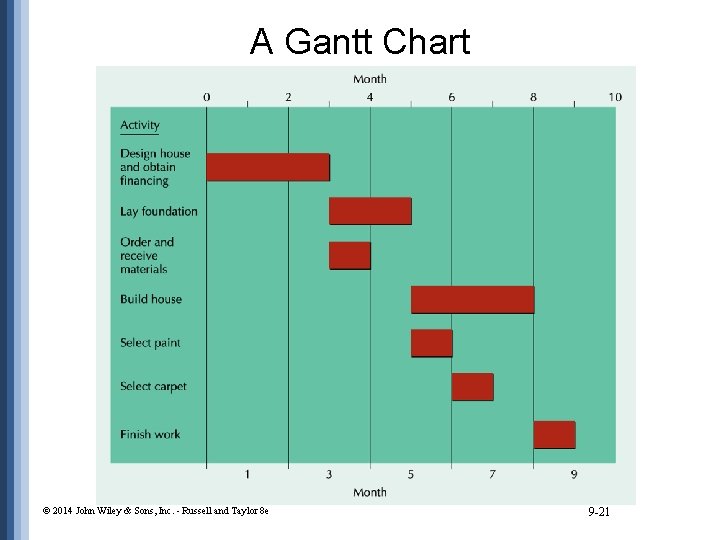
Gantt Chart—the most important Graphics Tool • Graph or bar chart • TIME is the independent variable exhibited on the S-axis • Horizontal bars represent the time for each task • Bars also indicate status of tasks • Provides visual display of project schedule • Shows precedence – sequence of tasks • Shows slack – amount of time an activity can be delayed without delaying the project © 2014 John Wiley & Sons, Inc. - Russell and Taylor 8 e 9 -20
A Gantt Chart © 2014 John Wiley & Sons, Inc. - Russell and Taylor 8 e 9 -21
Project Control • • • Time management Cost management Quality management Performance management Communication Enterprise project management © 2014 John Wiley & Sons, Inc. - Russell and Taylor 8 e 9 -22
CPM/PERT—methods for project scheduling • Critical Path Method (CPM) • Du. Pont & Remington-Rand (1955) • Deterministic task times • Activity-on-node network construction • Project Evaluation and Review Technique (PERT) • US Navy and Booz, Allen & Hamilton (1952) • Probabilistic task time estimates • Activity-on-arrow network construction © 2014 John Wiley & Sons, Inc. - Russell and Taylor 8 e 9 -23
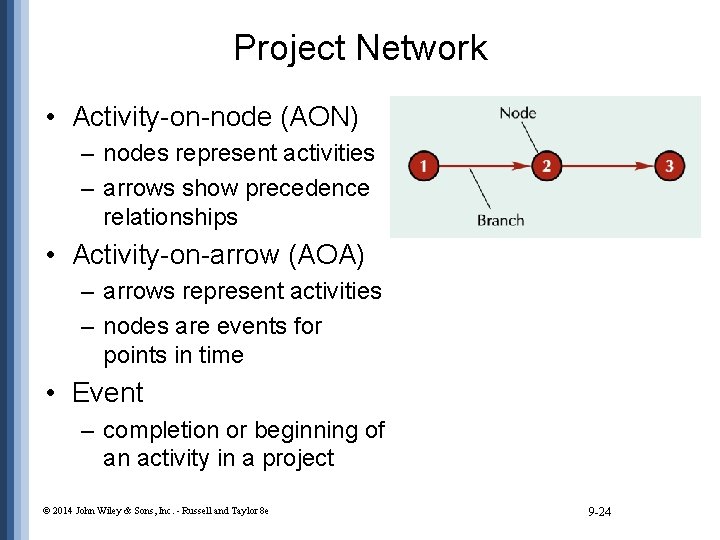
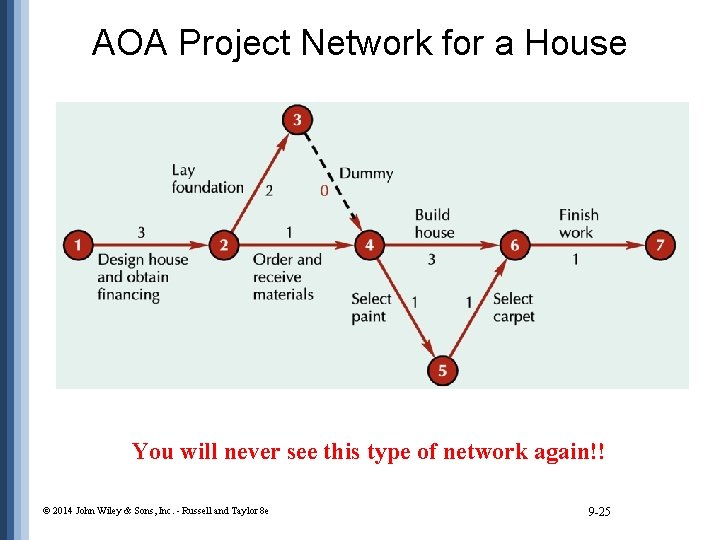
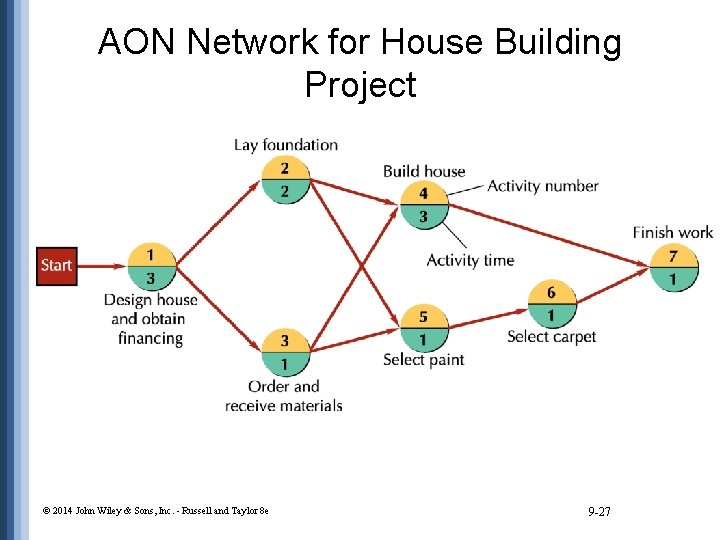
Project Network • Activity-on-node (AON) – nodes represent activities – arrows show precedence relationships • Activity-on-arrow (AOA) – arrows represent activities – nodes are events for points in time • Event – completion or beginning of an activity in a project © 2014 John Wiley & Sons, Inc. - Russell and Taylor 8 e 9 -24
AOA Project Network for a House You will never see this type of network again!! © 2014 John Wiley & Sons, Inc. - Russell and Taylor 8 e 9 -25
AON Network for House Building Project © 2014 John Wiley & Sons, Inc. - Russell and Taylor 8 e 9 -27
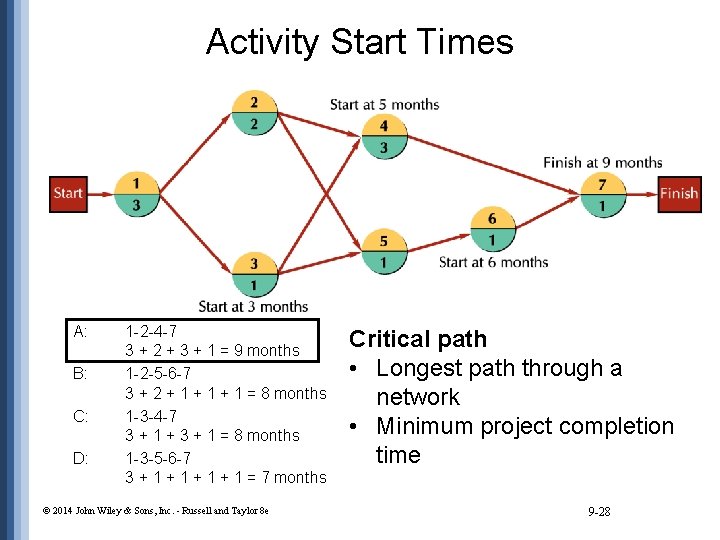
Activity Start Times A: B: C: D: 1 -2 -4 -7 3 + 2 + 3 + 1 = 9 months 1 -2 -5 -6 -7 3 + 2 + 1 + 1 = 8 months 1 -3 -4 -7 3 + 1 + 3 + 1 = 8 months 1 -3 -5 -6 -7 3 + 1 + 1 = 7 months © 2014 John Wiley & Sons, Inc. - Russell and Taylor 8 e Critical path • Longest path through a network • Minimum project completion time 9 -28
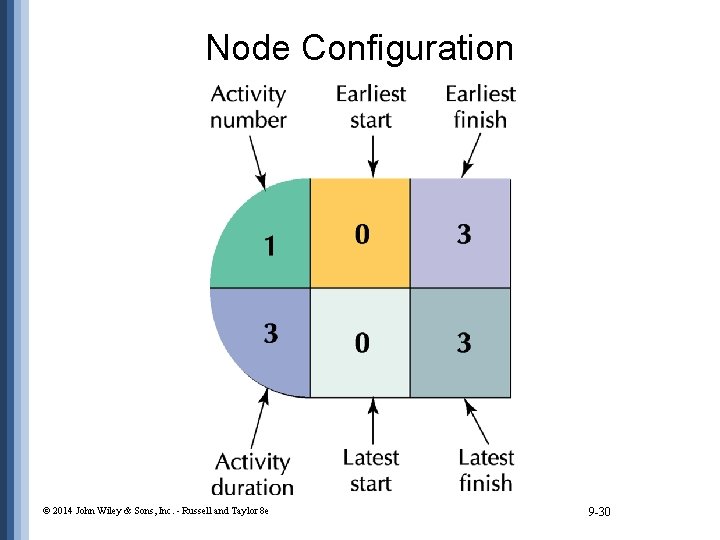
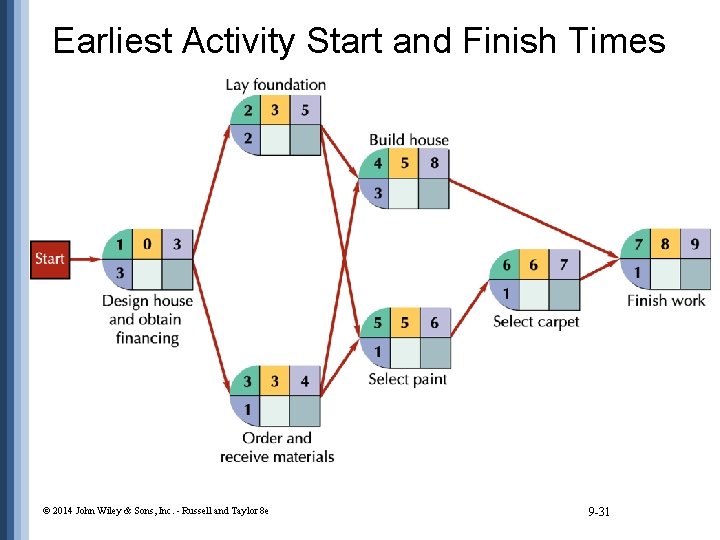
Activity Scheduling • Forward pass • starts at beginning of CPM/PERT network to determine earliest activity times • Earliest start time (ES) • earliest time an activity can start • ES = maximum EF of immediate predecessors • Earliest finish time (EF) • earliest time an activity can finish • earliest start time plus activity time • EF= ES + t © 2014 John Wiley & Sons, Inc. - Russell and Taylor 8 e 9 -29
Node Configuration © 2014 John Wiley & Sons, Inc. - Russell and Taylor 8 e 9 -30
Earliest Activity Start and Finish Times © 2014 John Wiley & Sons, Inc. - Russell and Taylor 8 e 9 -31
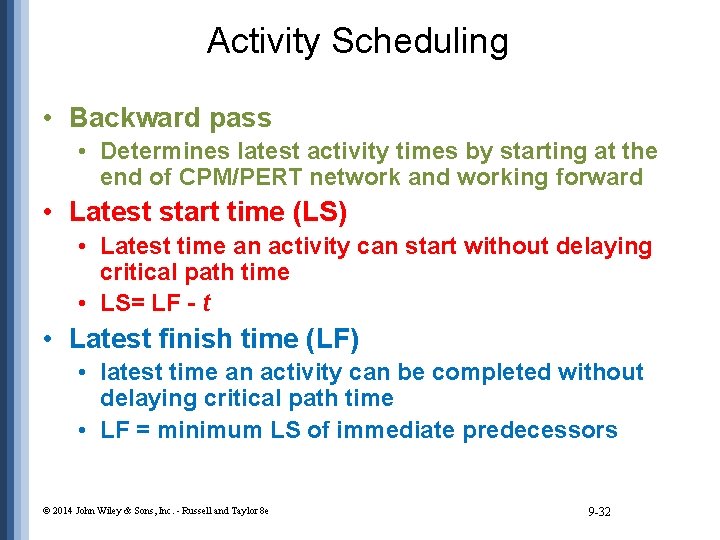
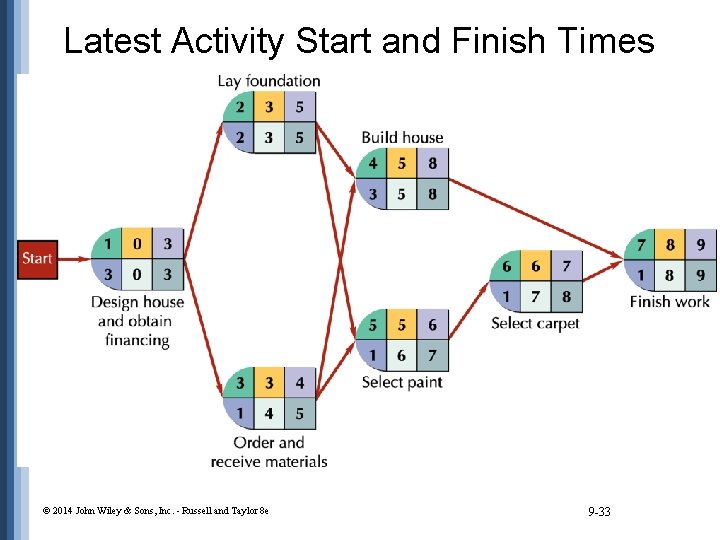
Activity Scheduling • Backward pass • Determines latest activity times by starting at the end of CPM/PERT network and working forward • Latest start time (LS) • Latest time an activity can start without delaying critical path time • LS= LF - t • Latest finish time (LF) • latest time an activity can be completed without delaying critical path time • LF = minimum LS of immediate predecessors © 2014 John Wiley & Sons, Inc. - Russell and Taylor 8 e 9 -32
Latest Activity Start and Finish Times © 2014 John Wiley & Sons, Inc. - Russell and Taylor 8 e 9 -33
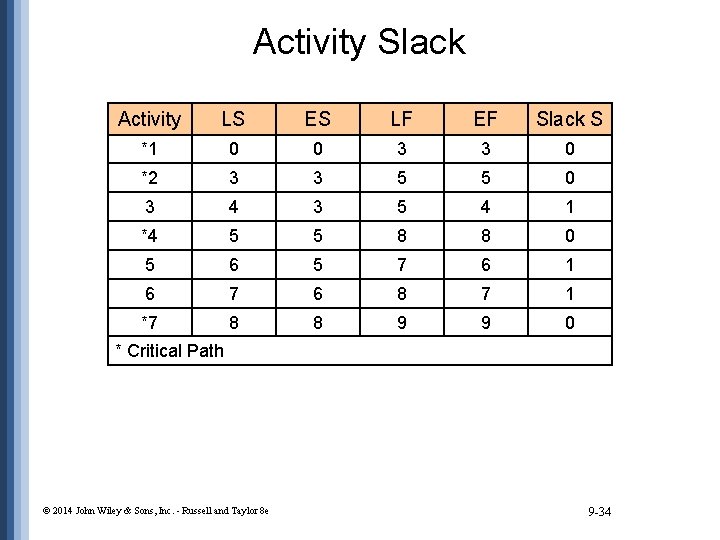
Activity Slack Activity LS ES LF EF Slack S *1 0 0 3 3 0 *2 3 3 5 5 0 3 4 3 5 4 1 *4 5 5 8 8 0 5 6 5 7 6 1 6 7 6 8 7 1 *7 8 8 9 9 0 * Critical Path © 2014 John Wiley & Sons, Inc. - Russell and Taylor 8 e 9 -34
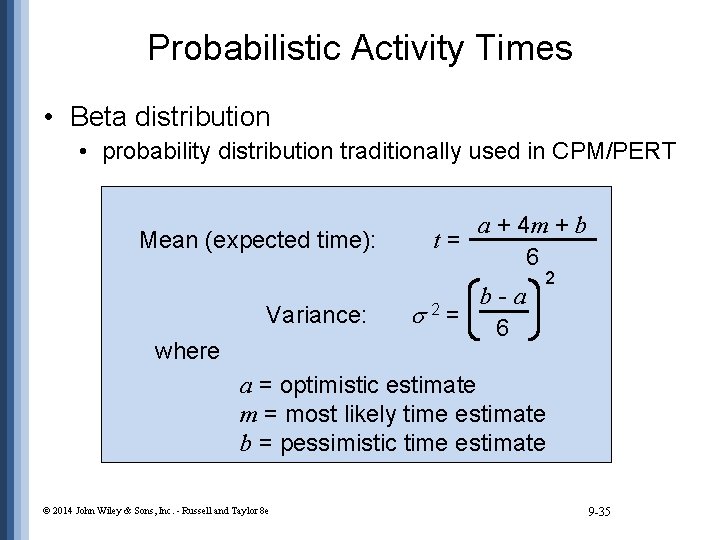
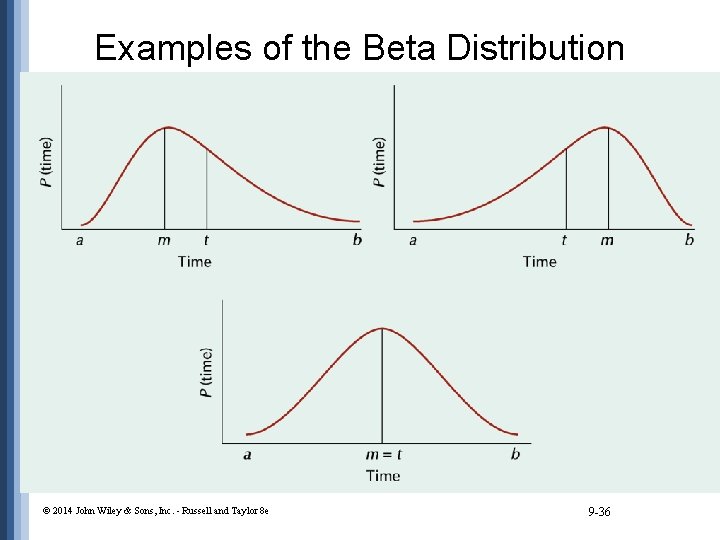
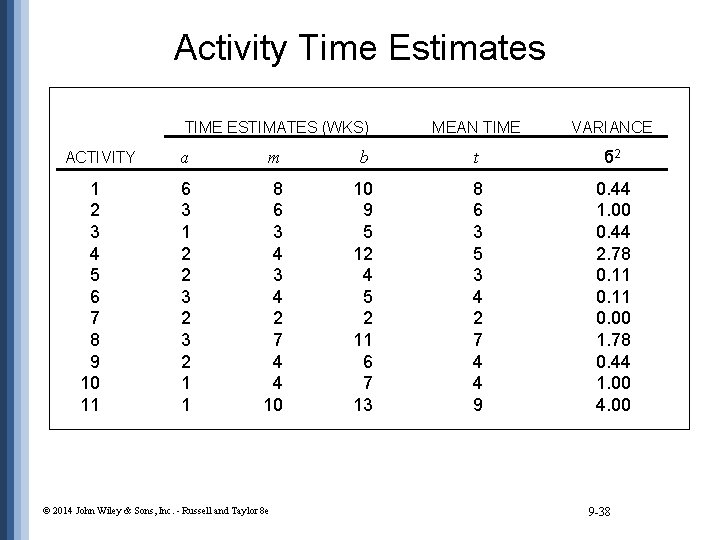
Probabilistic Activity Times • Beta distribution • probability distribution traditionally used in CPM/PERT Mean (expected time): Variance: where a + 4 m + b t= 6 b-a = 6 2 2 a = optimistic estimate m = most likely time estimate b = pessimistic time estimate © 2014 John Wiley & Sons, Inc. - Russell and Taylor 8 e 9 -35
Examples of the Beta Distribution © 2014 John Wiley & Sons, Inc. - Russell and Taylor 8 e 9 -36
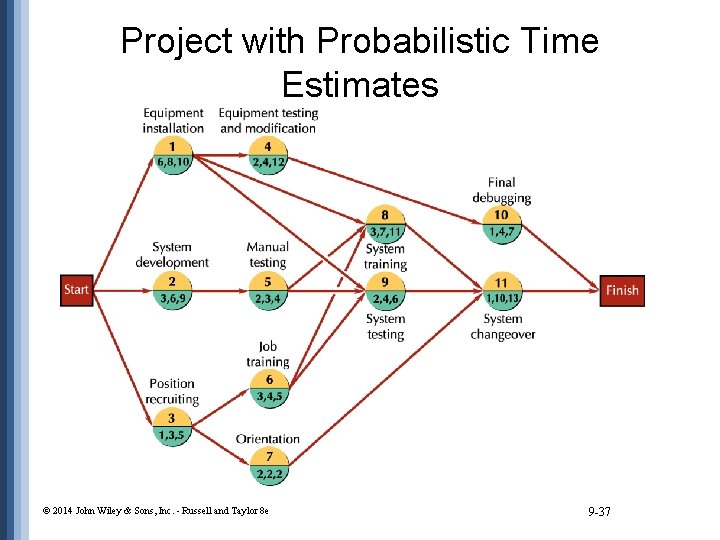
Project with Probabilistic Time Estimates © 2014 John Wiley & Sons, Inc. - Russell and Taylor 8 e 9 -37
Activity Time Estimates TIME ESTIMATES (WKS) ACTIVITY 1 2 3 4 5 6 7 8 9 10 11 MEAN TIME VARIANCE a m b t б 2 6 3 1 2 2 3 2 1 1 8 6 3 4 2 7 4 4 10 10 9 5 12 4 5 2 11 6 7 13 8 6 3 5 3 4 2 7 4 4 9 0. 44 1. 00 0. 44 2. 78 0. 11 0. 00 1. 78 0. 44 1. 00 4. 00 © 2014 John Wiley & Sons, Inc. - Russell and Taylor 8 e 9 -38
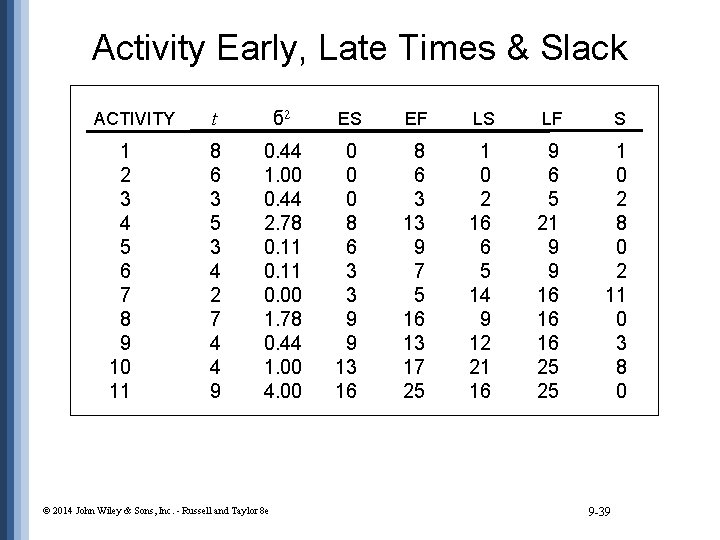
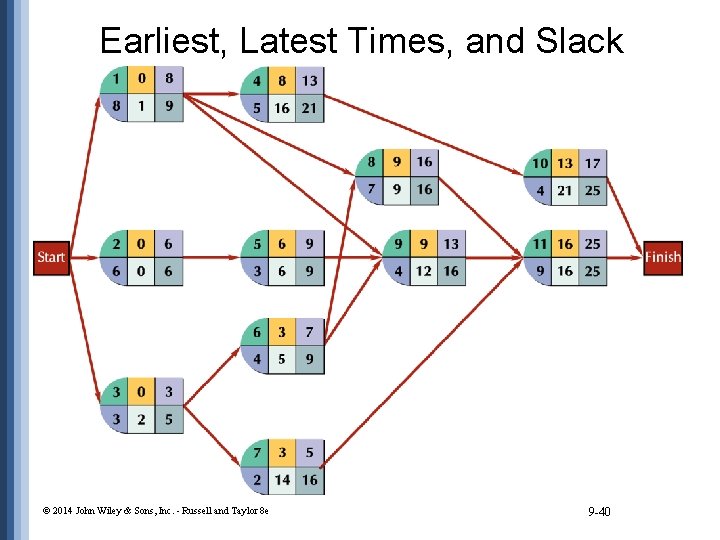
Activity Early, Late Times & Slack ACTIVITY 1 2 3 4 5 6 7 8 9 10 11 t б ES EF LS LF S 8 6 3 5 3 4 2 7 4 4 9 0. 44 1. 00 0. 44 2. 78 0. 11 0. 00 1. 78 0. 44 1. 00 4. 00 0 8 6 3 3 9 9 13 16 8 6 3 13 9 7 5 16 13 17 25 1 0 2 16 6 5 14 9 12 21 16 9 6 5 21 9 9 16 16 16 25 25 1 0 2 8 0 2 11 0 3 8 0 © 2014 John Wiley & Sons, Inc. - Russell and Taylor 8 e 9 -39
Earliest, Latest Times, and Slack © 2014 John Wiley & Sons, Inc. - Russell and Taylor 8 e 9 -40
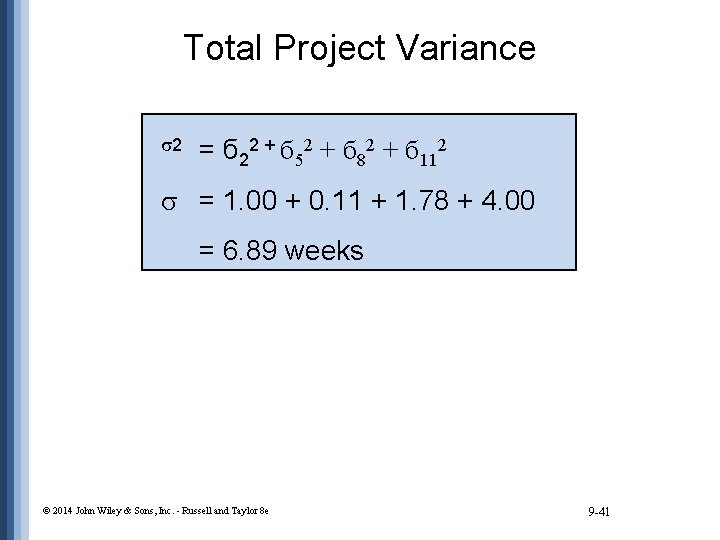
Total Project Variance 2 = б 22 + б 52 + б 82 + б 112 = 1. 00 + 0. 11 + 1. 78 + 4. 00 = 6. 89 weeks © 2014 John Wiley & Sons, Inc. - Russell and Taylor 8 e 9 -41
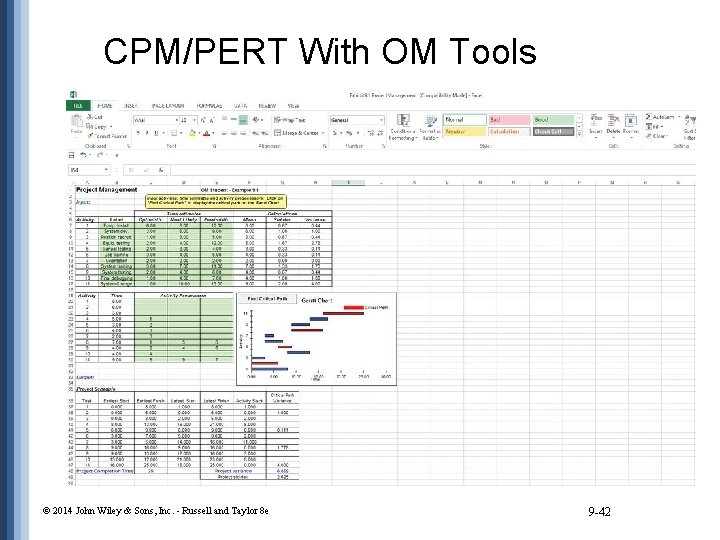
CPM/PERT With OM Tools © 2014 John Wiley & Sons, Inc. - Russell and Taylor 8 e 9 -42
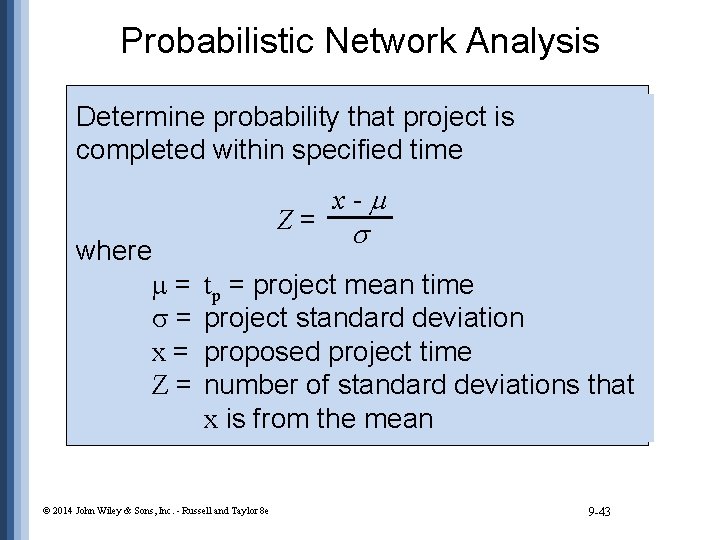
Probabilistic Network Analysis Determine probability that project is completed within specified time where = = x= Z= Z= x- tp = project mean time project standard deviation proposed project time number of standard deviations that x is from the mean © 2014 John Wiley & Sons, Inc. - Russell and Taylor 8 e 9 -43
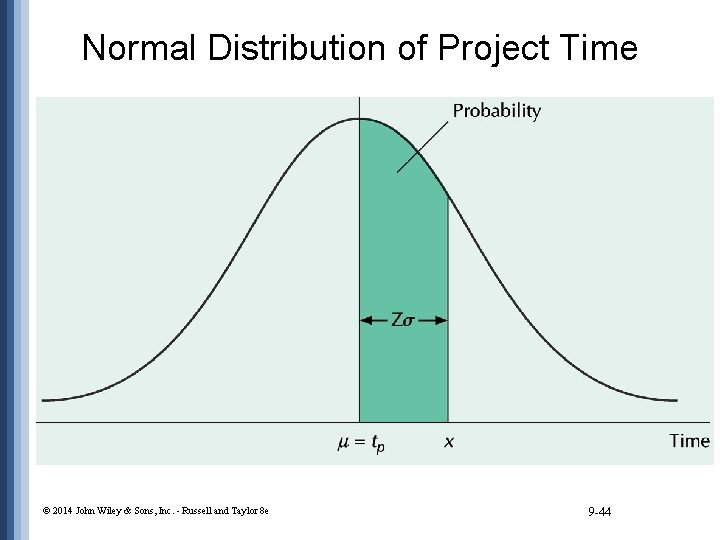
Normal Distribution of Project Time © 2014 John Wiley & Sons, Inc. - Russell and Taylor 8 e 9 -44
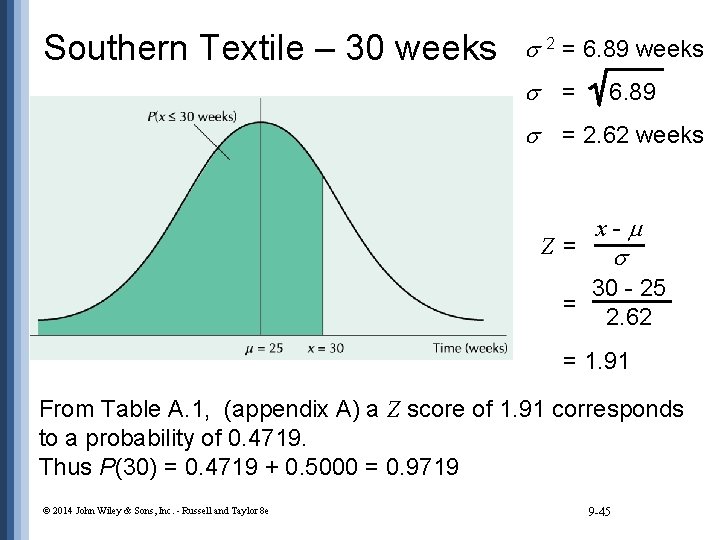
Southern Textile – 30 weeks 2 = 6. 89 weeks = 6. 89 = 2. 62 weeks Z= = x- 30 - 25 2. 62 = 1. 91 From Table A. 1, (appendix A) a Z score of 1. 91 corresponds to a probability of 0. 4719. Thus P(30) = 0. 4719 + 0. 5000 = 0. 9719 © 2014 John Wiley & Sons, Inc. - Russell and Taylor 8 e 9 -45
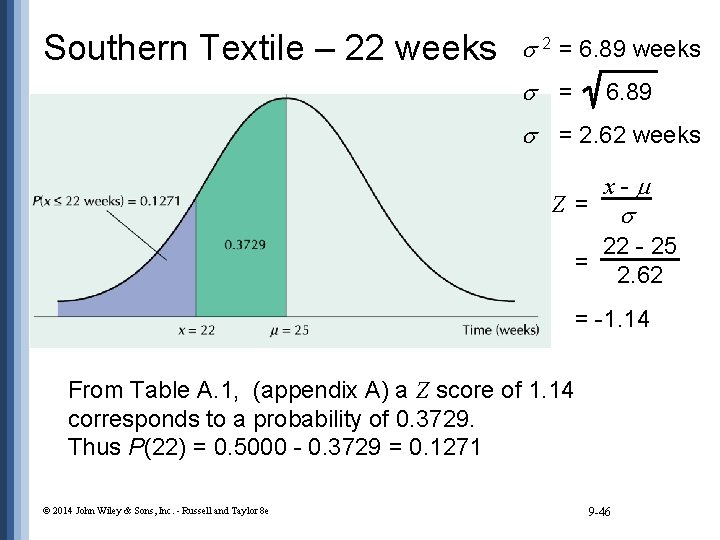
Southern Textile – 22 weeks 2 = 6. 89 weeks = 6. 89 = 2. 62 weeks Z= x- 22 - 25 = 2. 62 = -1. 14 From Table A. 1, (appendix A) a Z score of 1. 14 corresponds to a probability of 0. 3729. Thus P(22) = 0. 5000 - 0. 3729 = 0. 1271 © 2014 John Wiley & Sons, Inc. - Russell and Taylor 8 e 9 -46
Microsoft Project • Popular software package for project management and CPM/PERT analysis • Relatively easy to use • House-building example © 2014 John Wiley & Sons, Inc. - Russell and Taylor 8 e 9 -47
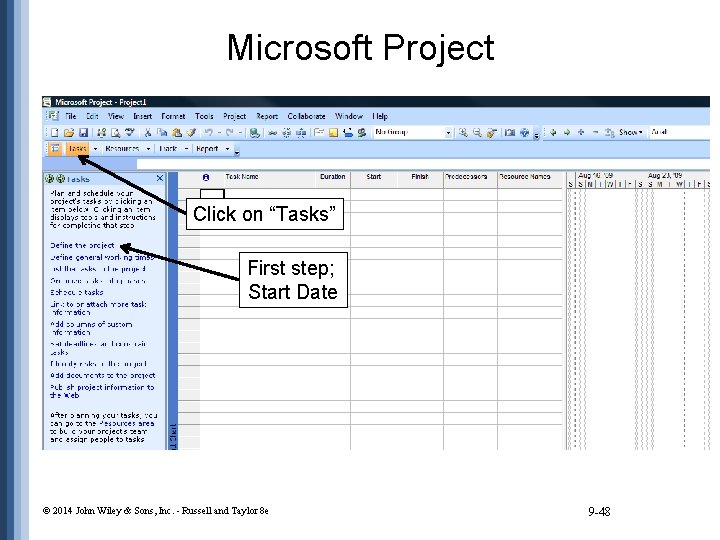
Microsoft Project Click on “Tasks” First step; Start Date © 2014 John Wiley & Sons, Inc. - Russell and Taylor 8 e 9 -48
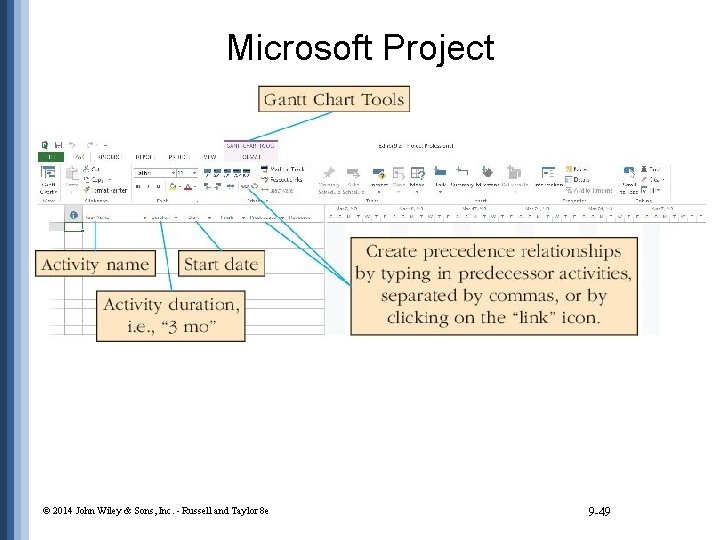
Microsoft Project © 2014 John Wiley & Sons, Inc. - Russell and Taylor 8 e 9 -49
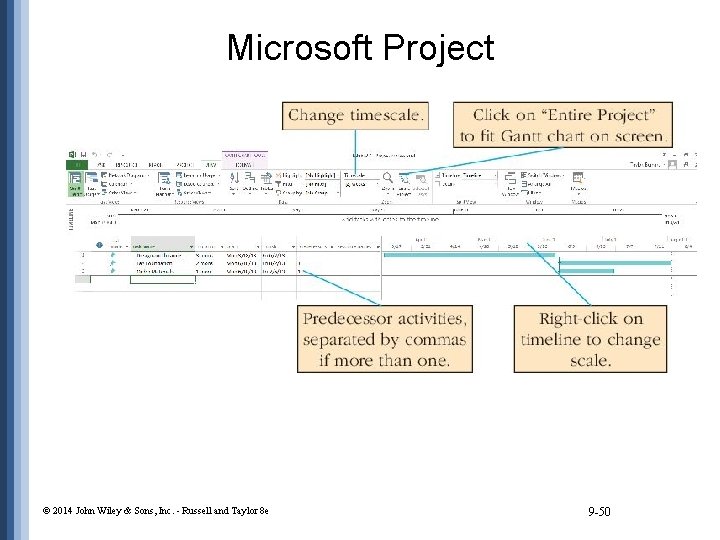
Microsoft Project © 2014 John Wiley & Sons, Inc. - Russell and Taylor 8 e 9 -50
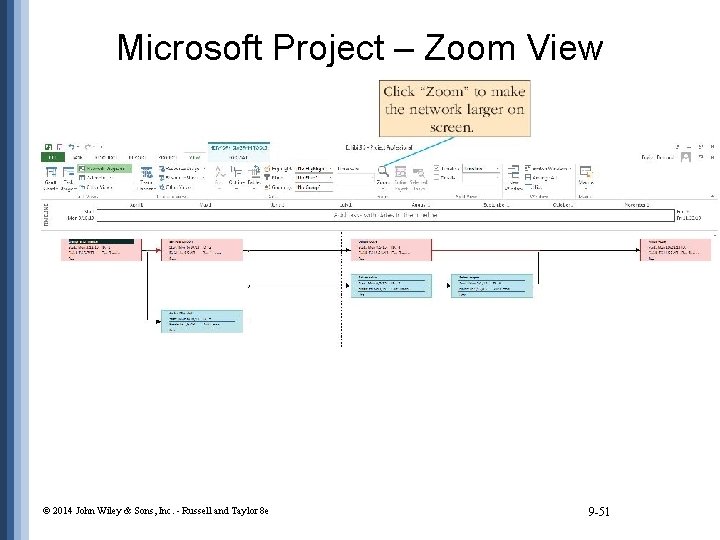
Microsoft Project – Zoom View © 2014 John Wiley & Sons, Inc. - Russell and Taylor 8 e 9 -51
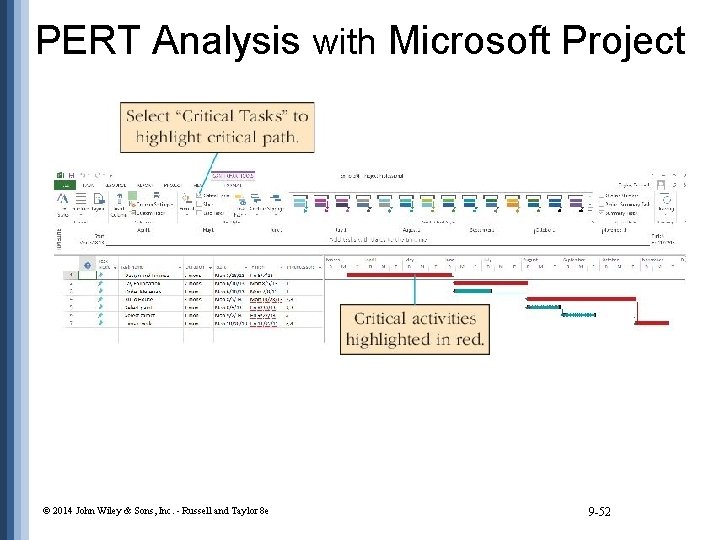
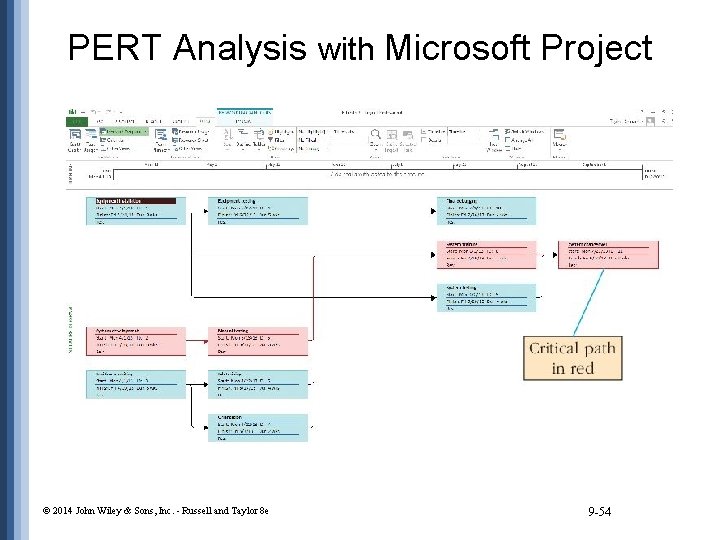
PERT Analysis with Microsoft Project © 2014 John Wiley & Sons, Inc. - Russell and Taylor 8 e 9 -52
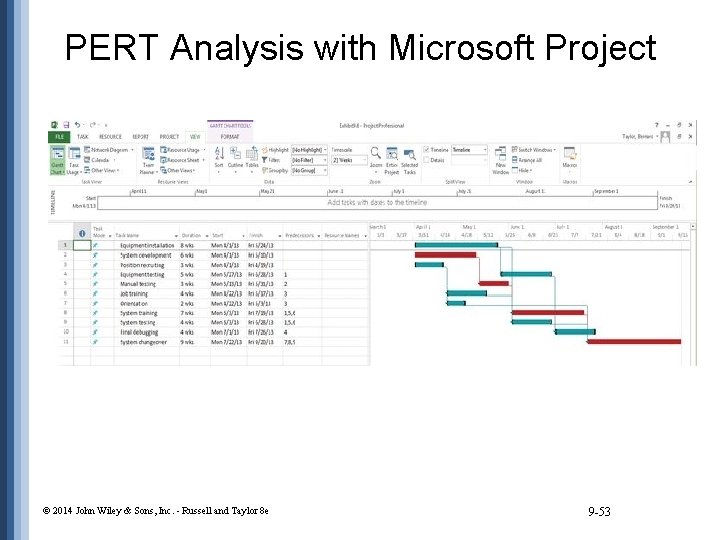
PERT Analysis with Microsoft Project © 2014 John Wiley & Sons, Inc. - Russell and Taylor 8 e 9 -53
PERT Analysis with Microsoft Project © 2014 John Wiley & Sons, Inc. - Russell and Taylor 8 e 9 -54
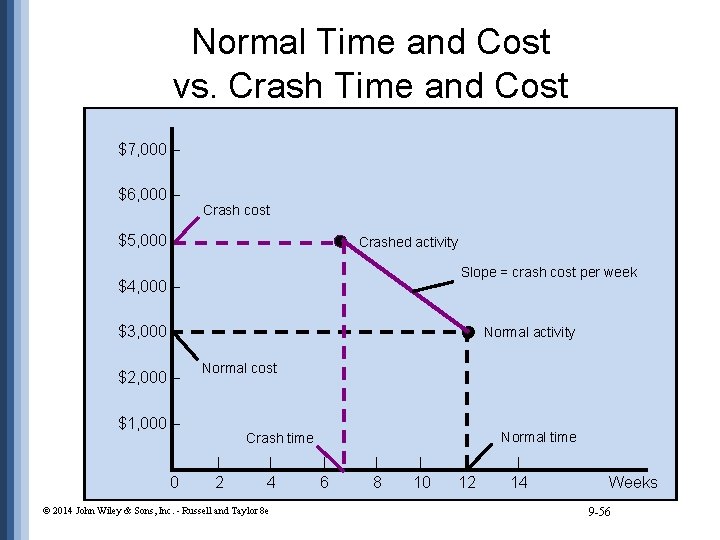
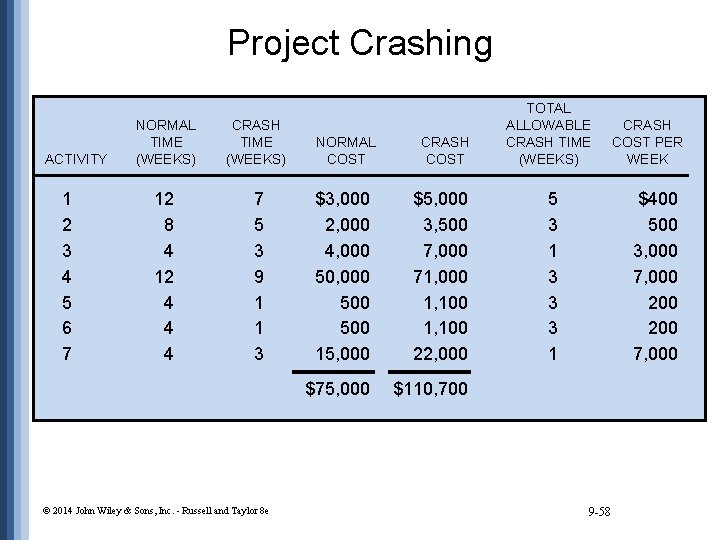
Project Crashing • reducing project time by expending additional resources • Crash time • an amount of time an activity is reduced • Crash cost • cost of reducing activity time • Goal • reduce project duration at minimum cost © 2014 John Wiley & Sons, Inc. - Russell and Taylor 8 e 9 -55
Normal Time and Cost vs. Crash Time and Cost $7, 000 – $6, 000 – Crash cost $5, 000 – Crashed activity Slope = crash cost per week $4, 000 – $3, 000 – $2, 000 – Normal activity Normal cost $1, 000 – – 0 Normal time Crash time | 2 | 4 © 2014 John Wiley & Sons, Inc. - Russell and Taylor 8 e | 6 | 8 | 10 | 12 | 14 Weeks 9 -56
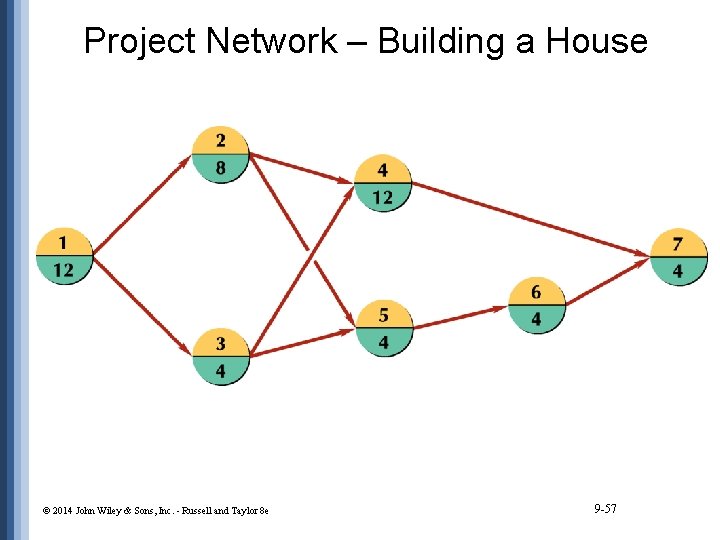
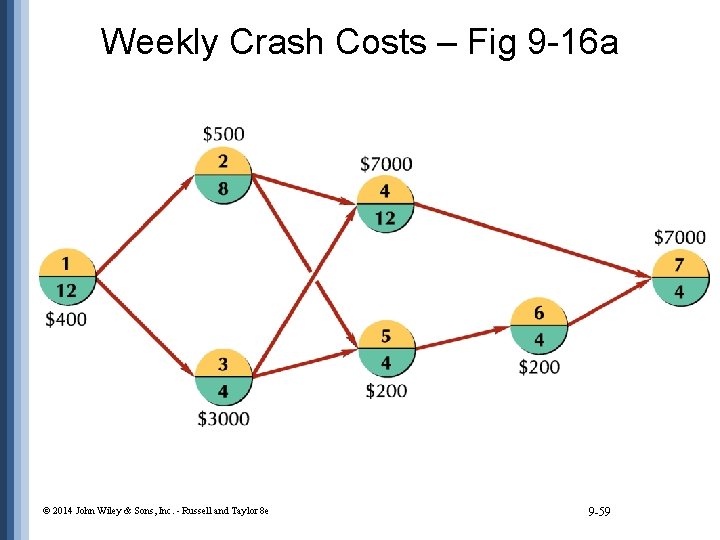
Project Network – Building a House © 2014 John Wiley & Sons, Inc. - Russell and Taylor 8 e 9 -57
Project Crashing ACTIVITY 1 2 3 4 5 6 7 NORMAL TIME (WEEKS) CRASH TIME (WEEKS) NORMAL COST 12 8 4 12 4 4 4 7 5 3 9 1 1 3 $3, 000 2, 000 4, 000 500 500 15, 000 $5, 000 3, 500 7, 000 71, 000 1, 100 22, 000 $75, 000 $110, 700 © 2014 John Wiley & Sons, Inc. - Russell and Taylor 8 e CRASH COST TOTAL ALLOWABLE CRASH TIME (WEEKS) 5 3 1 3 3 3 1 CRASH COST PER WEEK $400 500 3, 000 7, 000 200 7, 000 9 -58
Weekly Crash Costs – Fig 9 -16 a © 2014 John Wiley & Sons, Inc. - Russell and Taylor 8 e 9 -59
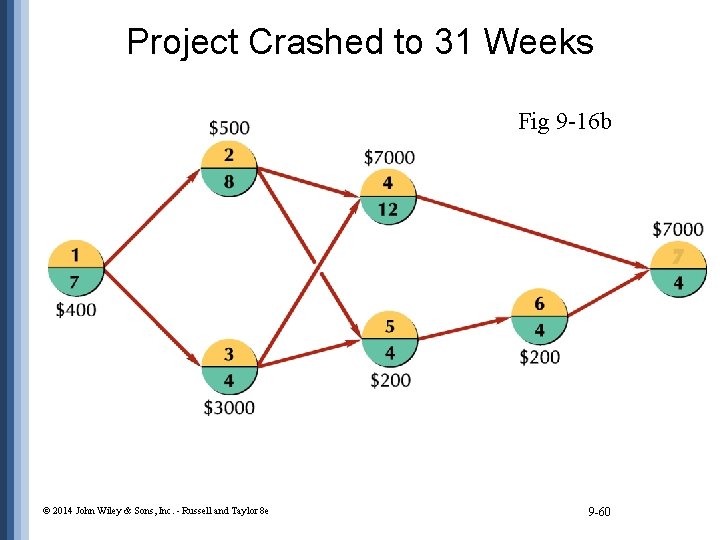
Project Crashed to 31 Weeks Fig 9 -16 b © 2014 John Wiley & Sons, Inc. - Russell and Taylor 8 e 9 -60
Time-Cost Relationship • Crashing costs increase as project duration decreases • Indirect costs increase as project duration increases • Reduce project length as long as crashing costs are less than indirect costs and you will be saving money as well as reducing project duration • You can crash the even further but it will cost more • Crashing should be done before execution in the planning phase © 2014 John Wiley & Sons, Inc. - Russell and Taylor 8 e 9 -61
Copyright 2014 John Wiley & Sons, Inc. All rights reserved. Reproduction or translation of this work beyond that permitted in section 117 of the 1976 United States Copyright Act without express permission of the copyright owner is unlawful. Request for further information should be addressed to the Permission Department, John Wiley & Sons, Inc. The purchaser may make back-up copies for his/her own use only and not for distribution or resale. The Publisher assumes no responsibility for errors, omissions, or damages caused by the use of these programs or from the use of the information herein. © 2014 John Wiley & Sons, Inc. - Russell and Taylor 8 e 6 -63