
CHAPTER 9 PROFESSIONAL SELLING Important Topics of This
- Slides: 22
CHAPTER 9 PROFESSIONAL SELLING
Important Topics of This Chapter Profile of a professional salesperson. Understanding buyer behavior in business selling. The Importance of planning in business selling. Different approaches may be used in business selling. Selling styles and sales tasks in the business-tobusiness market. The professional selling process Contemporary trends in business selling
Characteristics of Top Business Sales Performers Goal-Setting Efficiency Readiness to Learn Helping People Integrity Vision Passion Communication Skills Commitment
Personal Selling in Business Marketing Sales Engineer: Sells to OEMs, users or distributors. The executive salesperson: Sells computers, insurance and other services to executives. Business supplies salesperson: Sells raw and processed materials to OEMs. Detailed salesperson: Sells to nonusers. Inside sales person: Telephone salesperson. Missionary salesperson: Factory reps.
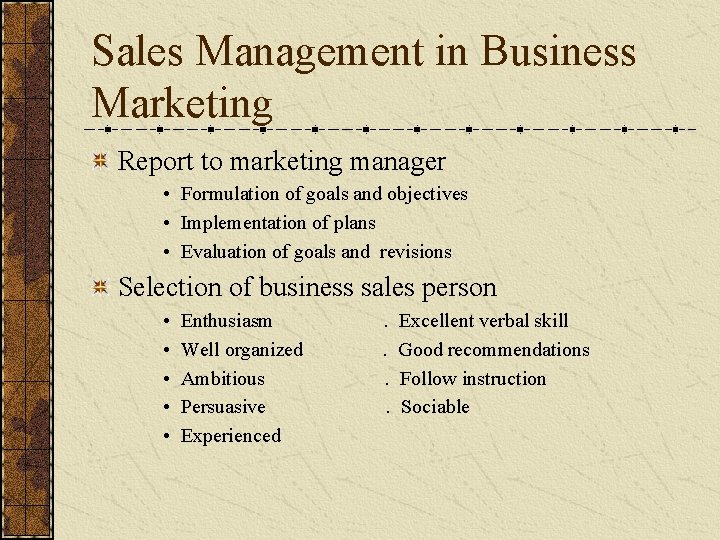
Sales Management in Business Marketing Report to marketing manager • Formulation of goals and objectives • Implementation of plans • Evaluation of goals and revisions Selection of business sales person • • • Enthusiasm Well organized Ambitious Persuasive Experienced . . Excellent verbal skill Good recommendations Follow instruction Sociable
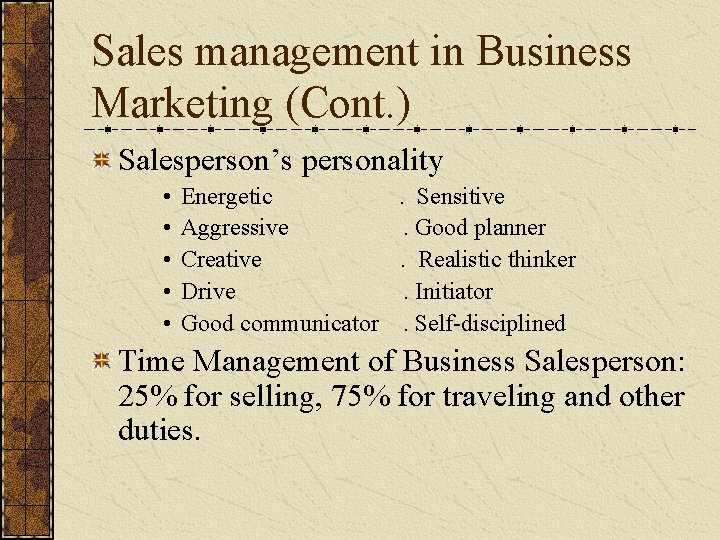
Sales management in Business Marketing (Cont. ) Salesperson’s personality • • • Energetic. Sensitive Aggressive. Good planner Creative. Realistic thinker Drive. Initiator Good communicator. Self-disciplined Time Management of Business Salesperson: 25% for selling, 75% for traveling and other duties.
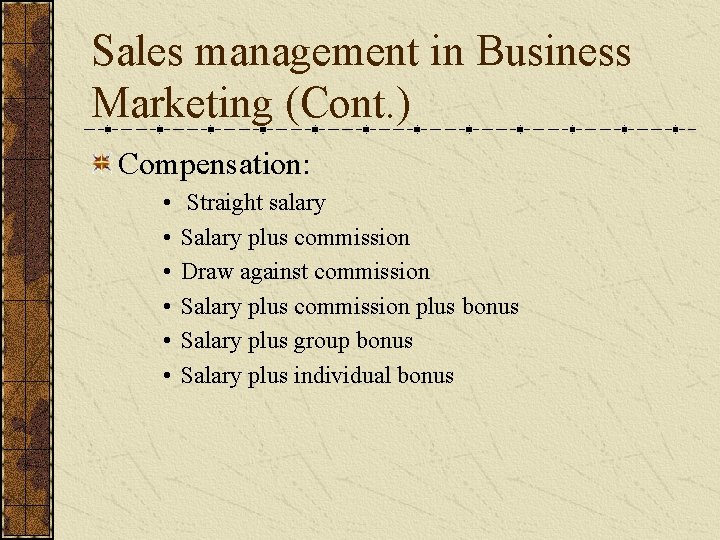
Sales management in Business Marketing (Cont. ) Compensation: • • • Straight salary Salary plus commission Draw against commission Salary plus commission plus bonus Salary plus group bonus Salary plus individual bonus
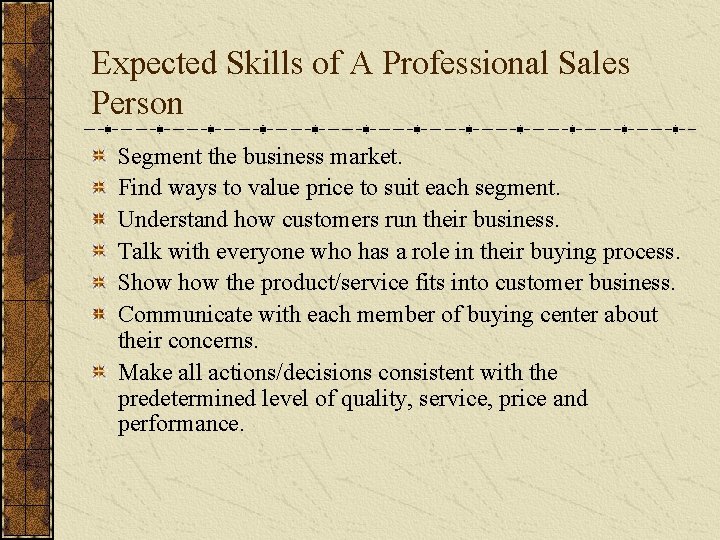
Expected Skills of A Professional Sales Person Segment the business market. Find ways to value price to suit each segment. Understand how customers run their business. Talk with everyone who has a role in their buying process. Show the product/service fits into customer business. Communicate with each member of buying center about their concerns. Make all actions/decisions consistent with the predetermined level of quality, service, price and performance.
Business Salesperson’s Activities Selling: 30% of the time. Maintenance of Distributor Relationship: Role playing. Conflict resolution. Planning: Sales calls, contacts and prospecting new accounts. Decision making: 80/20 principle. Managing Communication: 70% of the time.
Understanding Buyer Behavior Understanding the Needs: Increasing sales and profits. Maintaining the quality. Increasing the efficiency. Methods Used to Uncover Important Buyer Needs: Ask questions: • Questions often can bring out needs that the prospect would not reveal or does not know exist. Observe: • Successful salespeople are particularly sensitive to customer expressions and body language. Listen: • Salespeople must remember that telling is not selling. The instant a salesperson asks a question and waits quietly for an answer, the prospect’s entire attention is focused on the salesperson. Thus, a basic rule of selling is, never to say something if you can ask it.
Planning a Sales Call Planning is valuable to focus thinking and prepare the salesperson for what is expected. Typical planning process involves: Setting objective Preparing an opener Preparing qualifying questions Listing main features and advantages of product/service Listing main benefits of product/service Listing support to substantiate benefits Listing expected buyer’s objections and salesperson’s responses Planning the close
Approaches for Effective Buying. Selling Process AIDA Buying Decision Model: Decide to pay attention. Decide there is a problem. Decide product/service, company and salesperson. Decide to buy. Problem Solving Model: Gain the interview. Establish the problem. Solve the problem. Close the sale.
Selling Styles and Tasks Creative Selling: Influencing demand. Service Selling: Assists customers.
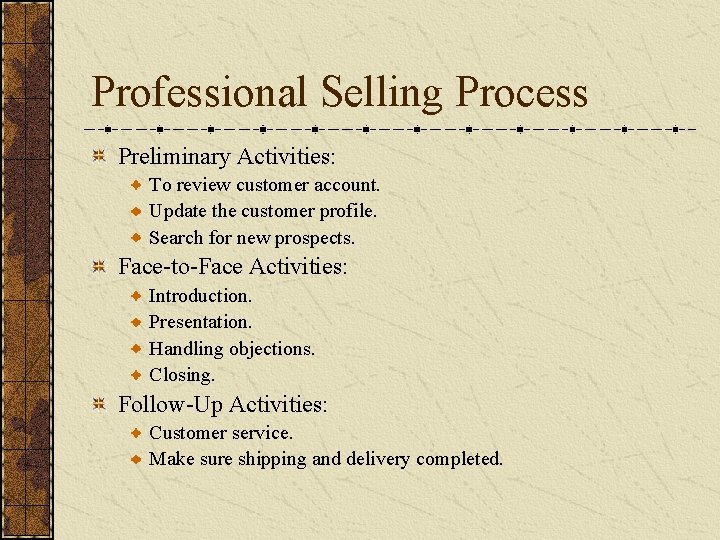
Professional Selling Process Preliminary Activities: To review customer account. Update the customer profile. Search for new prospects. Face-to-Face Activities: Introduction. Presentation. Handling objections. Closing. Follow-Up Activities: Customer service. Make sure shipping and delivery completed.
Salespeople Expect— and Even Like—Objections Handling objections correctly will lead to your close. Well-handled objection is a positive buying signal. Ask for the order Ask for the trial Ask for action
Handling Sincere Objections Find out what the objection means—ask questions and listen. What does “it costs too much” really mean? Restate objection as you understand it. Get in step—agree that it is a wise concern. Never say, “You’re wrong. ” Answer objection by – Offsetting with other benefits – “Boomerang method”—converting objections into a benefit – Converting objection into question so it becomes a request for further information
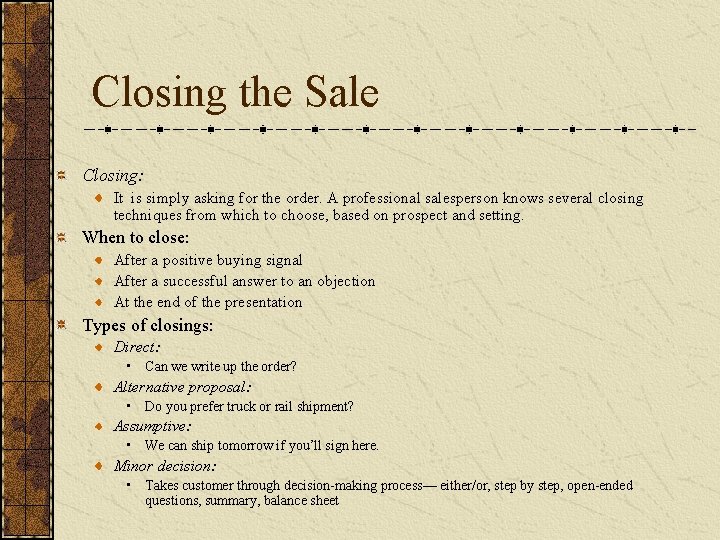
Closing the Sale Closing: It is simply asking for the order. A professional salesperson knows several closing techniques from which to choose, based on prospect and setting. When to close: After a positive buying signal After a successful answer to an objection At the end of the presentation Types of closings: Direct: • Can we write up the order? Alternative proposal: • Do you prefer truck or rail shipment? Assumptive: • We can ship tomorrow if you’ll sign here. Minor decision: • Takes customer through decision-making process— either/or, step by step, open-ended questions, summary, balance sheet
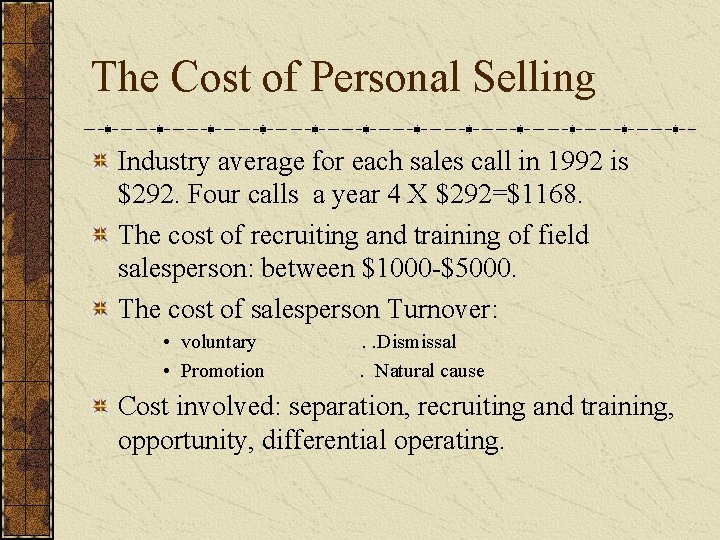
The Cost of Personal Selling Industry average for each sales call in 1992 is $292. Four calls a year 4 X $292=$1168. The cost of recruiting and training of field salesperson: between $1000 -$5000. The cost of salesperson Turnover: • voluntary • Promotion . . Dismissal. Natural cause Cost involved: separation, recruiting and training, opportunity, differential operating.
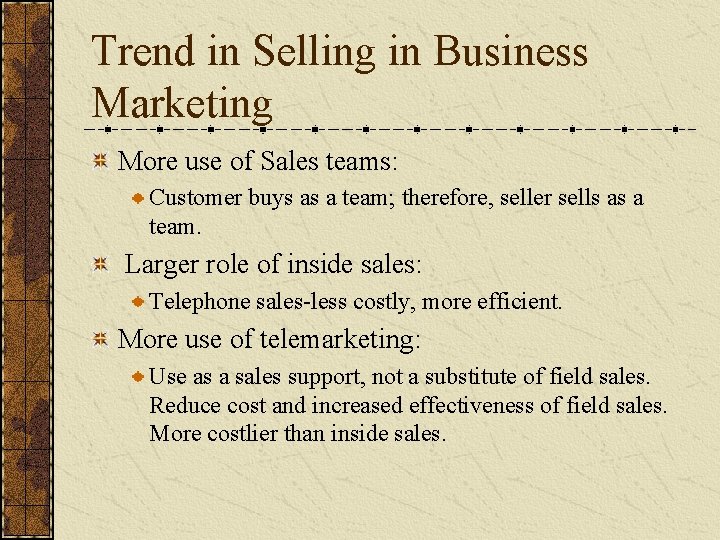
Trend in Selling in Business Marketing More use of Sales teams: Customer buys as a team; therefore, seller sells as a team. Larger role of inside sales: Telephone sales-less costly, more efficient. More use of telemarketing: Use as a sales support, not a substitute of field sales. Reduce cost and increased effectiveness of field sales. More costlier than inside sales.
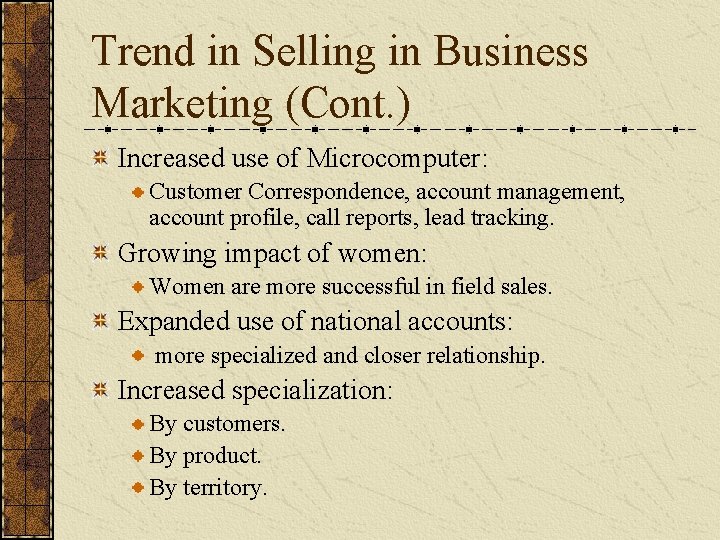
Trend in Selling in Business Marketing (Cont. ) Increased use of Microcomputer: Customer Correspondence, account management, account profile, call reports, lead tracking. Growing impact of women: Women are more successful in field sales. Expanded use of national accounts: more specialized and closer relationship. Increased specialization: By customers. By product. By territory.
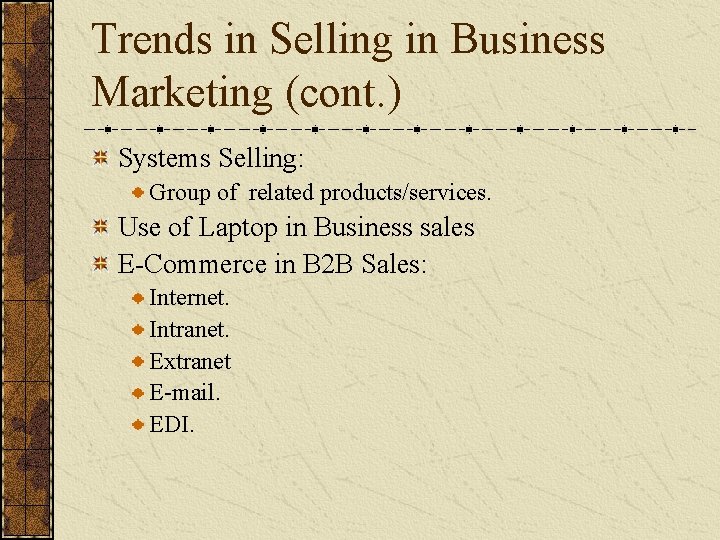
Trends in Selling in Business Marketing (cont. ) Systems Selling: Group of related products/services. Use of Laptop in Business sales E-Commerce in B 2 B Sales: Internet. Intranet. Extranet E-mail. EDI.
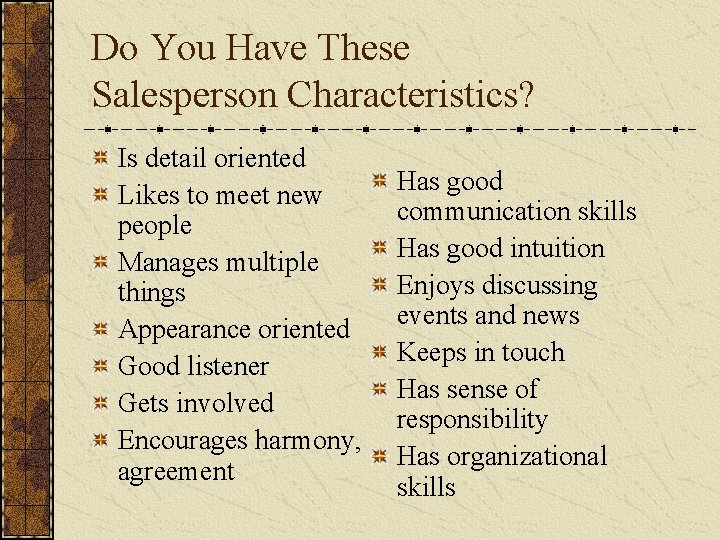
Do You Have These Salesperson Characteristics? Is detail oriented Likes to meet new people Manages multiple things Appearance oriented Good listener Gets involved Encourages harmony, agreement Has good communication skills Has good intuition Enjoys discussing events and news Keeps in touch Has sense of responsibility Has organizational skills