
CHAPTER 9 Producing Data Experiments ESSENTIAL STATISTICS Second

- Slides: 10
CHAPTER 9: Producing Data Experiments ESSENTIAL STATISTICS Second Edition David S. Moore, William I. Notz, and Michael A. Fligner Lecture Presentation
Chapter 9 Concepts ¡Observation vs. Experiment ¡Subjects, Factors, Treatments ¡Randomized Comparative Experiments ¡Matched Pairs Designs 2
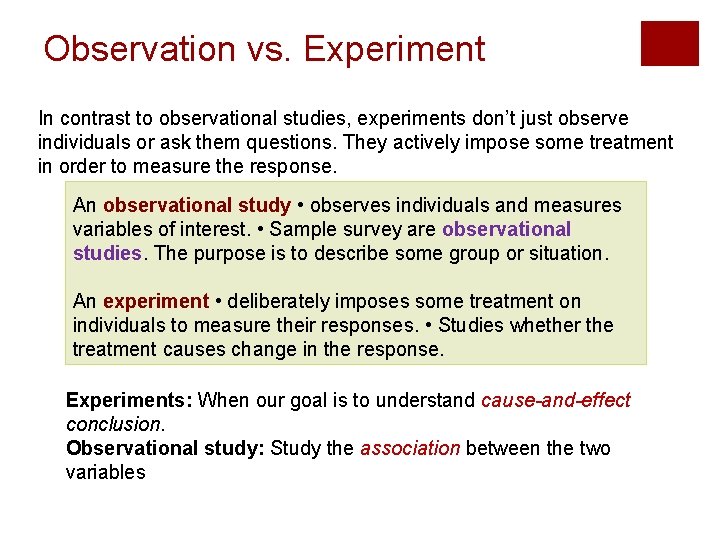
Observation vs. Experiment In contrast to observational studies, experiments don’t just observe individuals or ask them questions. They actively impose some treatment in order to measure the response. An observational study • observes individuals and measures variables of interest. • Sample survey are observational studies. The purpose is to describe some group or situation. An experiment • deliberately imposes some treatment on individuals to measure their responses. • Studies whether the treatment causes change in the response. Experiments: When our goal is to understand cause-and-effect conclusion. Observational study: Study the association between the two variables
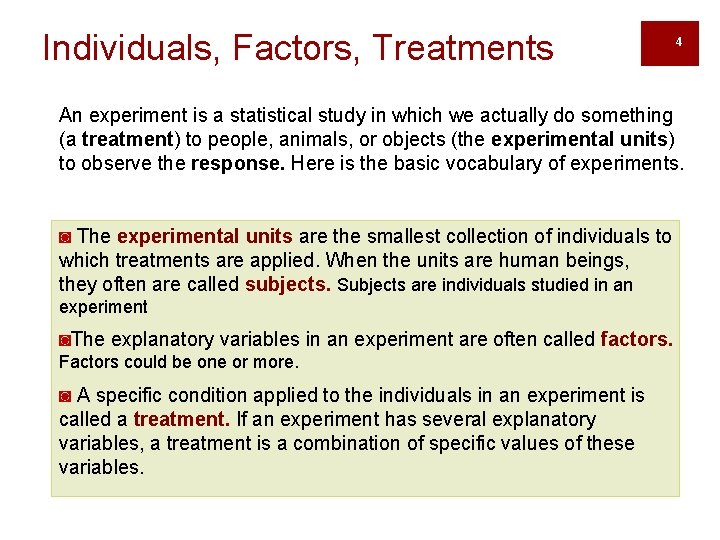
Individuals, Factors, Treatments 4 An experiment is a statistical study in which we actually do something (a treatment) to people, animals, or objects (the experimental units) to observe the response. Here is the basic vocabulary of experiments. ◙ The experimental units are the smallest collection of individuals to which treatments are applied. When the units are human beings, they often are called subjects. Subjects are individuals studied in an experiment ◙The explanatory variables in an experiment are often called factors. Factors could be one or more. ◙ A specific condition applied to the individuals in an experiment is called a treatment. If an experiment has several explanatory variables, a treatment is a combination of specific values of these variables.
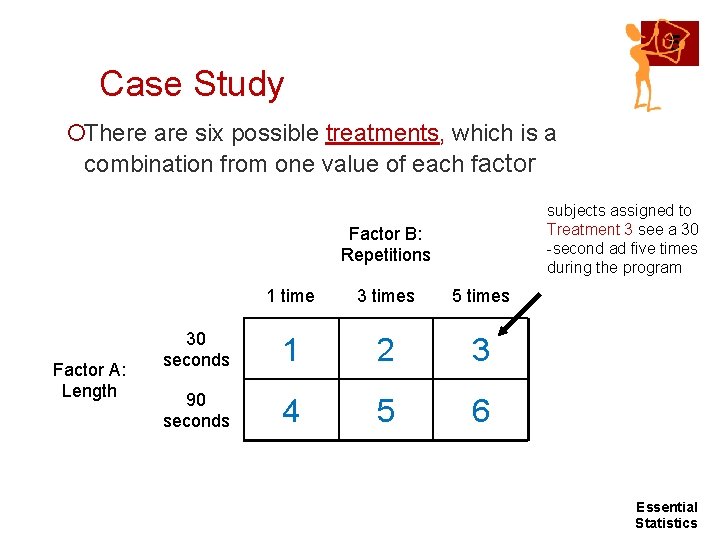
5 Case Study ¡There are six possible treatments, which is a combination from one value of each factor subjects assigned to Treatment 3 see a 30 -second ad five times during the program Factor B: Repetitions Factor A: Length 1 time 3 times 5 times 30 seconds 1 2 3 90 seconds 4 5 6 Essential Statistics
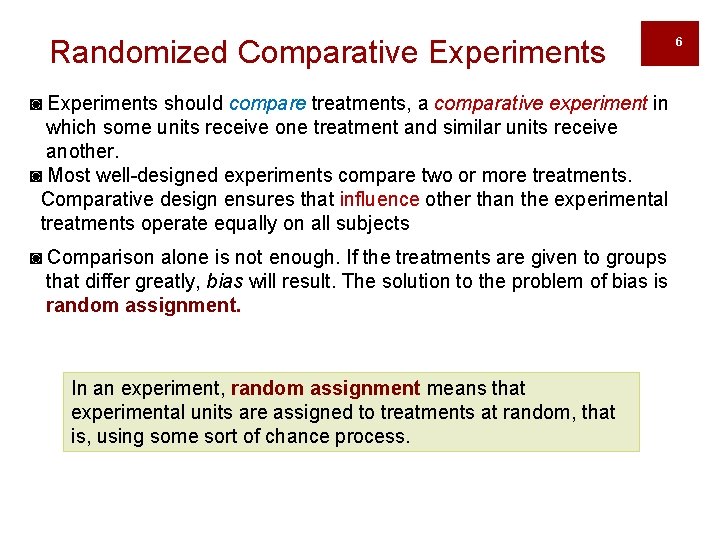
Randomized Comparative Experiments ◙ Experiments should compare treatments, a comparative experiment in which some units receive one treatment and similar units receive another. ◙ Most well-designed experiments compare two or more treatments. Comparative design ensures that influence other than the experimental treatments operate equally on all subjects ◙ Comparison alone is not enough. If the treatments are given to groups that differ greatly, bias will result. The solution to the problem of bias is random assignment. In an experiment, random assignment means that experimental units are assigned to treatments at random, that is, using some sort of chance process. 6
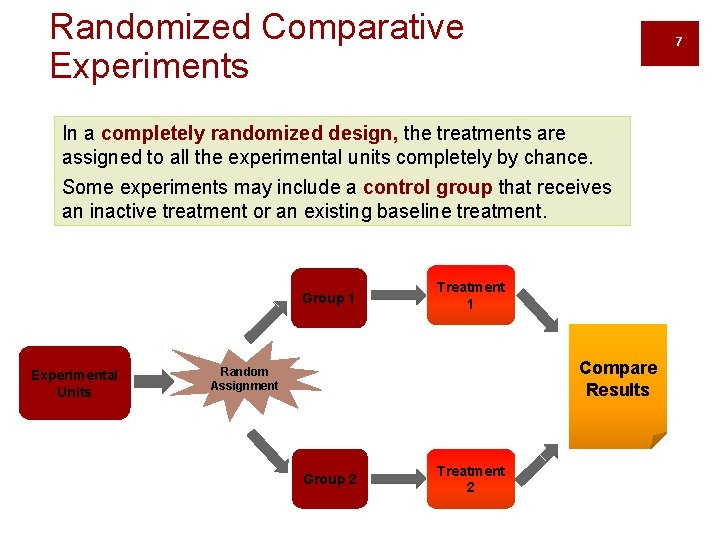
Randomized Comparative Experiments 7 In a completely randomized design, the treatments are assigned to all the experimental units completely by chance. Some experiments may include a control group that receives an inactive treatment or an existing baseline treatment. Group 1 Experimental Units Treatment 1 Compare Results Random Assignment Group 2 Treatment 2
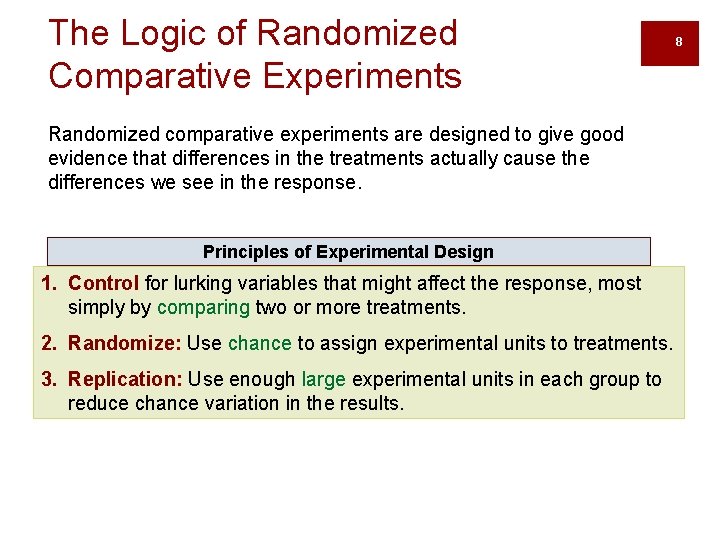
The Logic of Randomized Comparative Experiments Randomized comparative experiments are designed to give good evidence that differences in the treatments actually cause the differences we see in the response. Principles of Experimental Design 1. Control for lurking variables that might affect the response, most simply by comparing two or more treatments. 2. Randomize: Use chance to assign experimental units to treatments. 3. Replication: Use enough large experimental units in each group to reduce chance variation in the results. 8
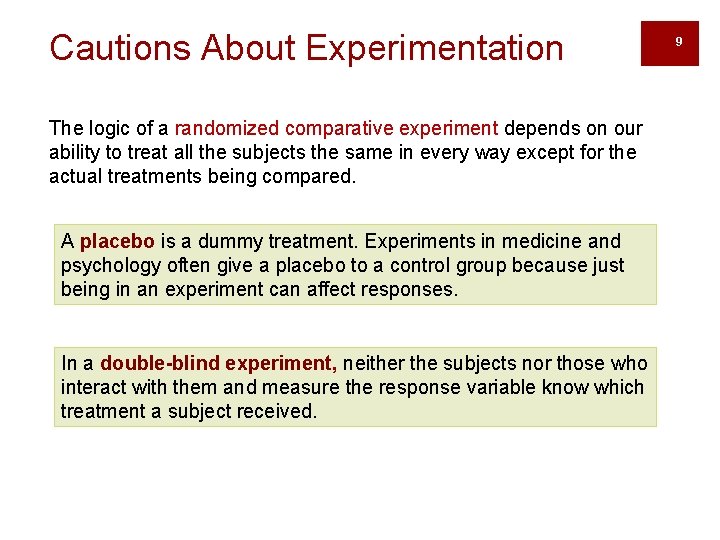
Cautions About Experimentation The logic of a randomized comparative experiment depends on our ability to treat all the subjects the same in every way except for the actual treatments being compared. A placebo is a dummy treatment. Experiments in medicine and psychology often give a placebo to a control group because just being in an experiment can affect responses. In a double-blind experiment, neither the subjects nor those who interact with them and measure the response variable know which treatment a subject received. 9
Matched Pairs Designs 10 A common type of randomized design for comparing two treatments is a matched pairs design. The idea is to create blocks by matching pairs of similar experimental units. A matched pairs design compares two treatments. Choose pairs of subjects that are as closely matched as possible. Use chance to decide which subject in a pair gets the first treatment. The other subject in that pair gets the other treatment. Sometimes, a “pair” in a matched pairs design consists of a single unit that receives both treatments. Since the order of the treatments can influence the response, chance is used to determine which treatment is applied first for each unit.