
Chapter 9 Probability 2010 Pearson Education Inc All
Chapter 9 Probability © 2010 Pearson Education, Inc. All rights reserved
NCTM Standard: Data Analysis and Probability § K– 2: Children should discuss events related to their experience as likely or unlikely. (p. 400) § 3– 5: Children should be able to “describe events as likely or unlikely and discuss the degree of likelihood using words such as certain, equally likely, and impossible. ” They should be able to “predict the probability of outcomes of simple experiments and test the predictions. ” They should “understand that the measure of the likelihood of an event can be represented by a number from 0 to 1. ” (p. 400) Copyright © 2010 Pearson Education, Inc. All rights reserved. Slide 9. 1 - 2
NCTM Standard: Data Analysis and Probability 6– 8: Children should “understand use appropriate terminology to describe complementary and mutually exclusive events. ” They should be able “to make and test conjectures about the results of experiments and simulations. ” They should be able to “compute probabilities of compound events using methods such as organized lists, tree diagrams, and area models. ” (p. 401) Copyright © 2010 Pearson Education, Inc. All rights reserved. Slide 9. 1 - 3
9 -1 How Probabilities are Determined § § Determining Probabilities Mutually Exclusive Events Complementary Events Non-Mutually Exclusive Events Copyright © 2010 Pearson Addison-Wesley. All rights reserved. Slide 9. 1 - 4
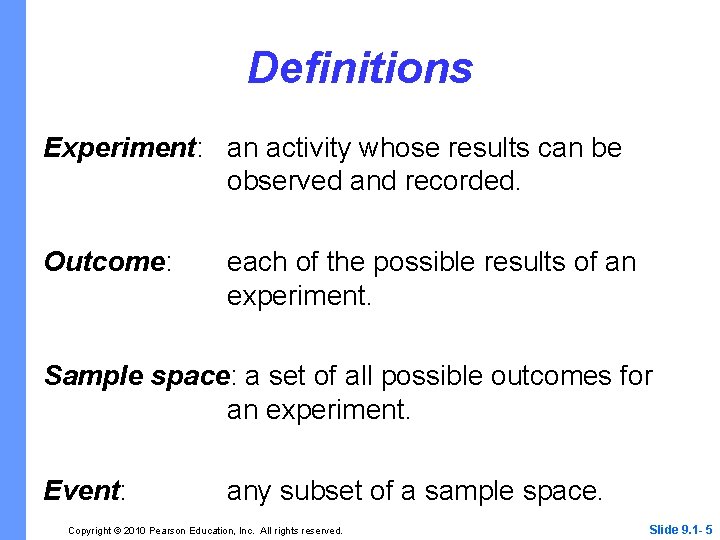
Definitions Experiment: an activity whose results can be observed and recorded. Outcome: each of the possible results of an experiment. Sample space: a set of all possible outcomes for an experiment. Event: any subset of a sample space. Copyright © 2010 Pearson Education, Inc. All rights reserved. Slide 9. 1 - 5
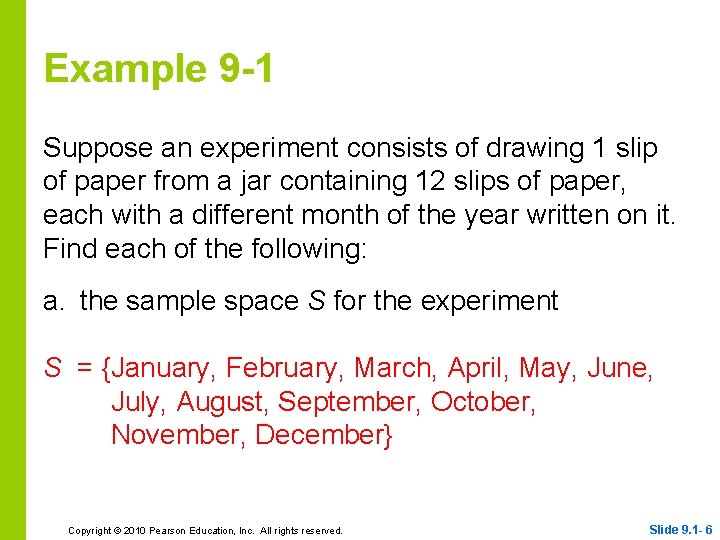
Example 9 -1 Suppose an experiment consists of drawing 1 slip of paper from a jar containing 12 slips of paper, each with a different month of the year written on it. Find each of the following: a. the sample space S for the experiment S = {January, February, March, April, May, June, July, August, September, October, November, December} Copyright © 2010 Pearson Education, Inc. All rights reserved. Slide 9. 1 - 6
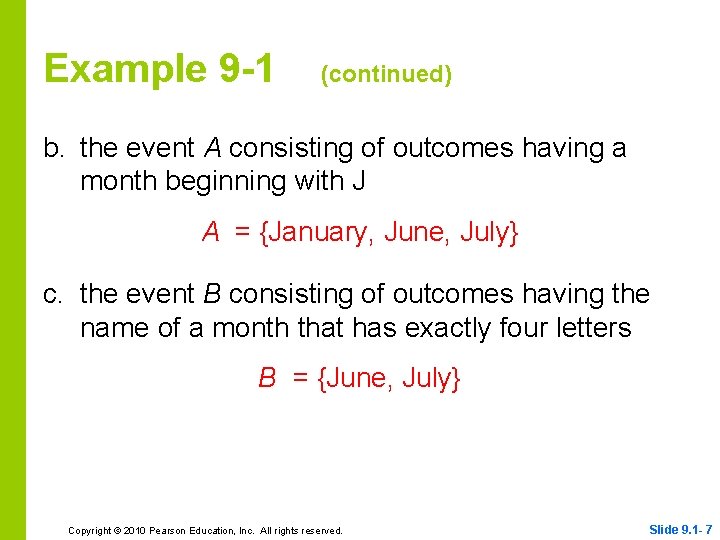
Example 9 -1 (continued) b. the event A consisting of outcomes having a month beginning with J A = {January, June, July} c. the event B consisting of outcomes having the name of a month that has exactly four letters B = {June, July} Copyright © 2010 Pearson Education, Inc. All rights reserved. Slide 9. 1 - 7
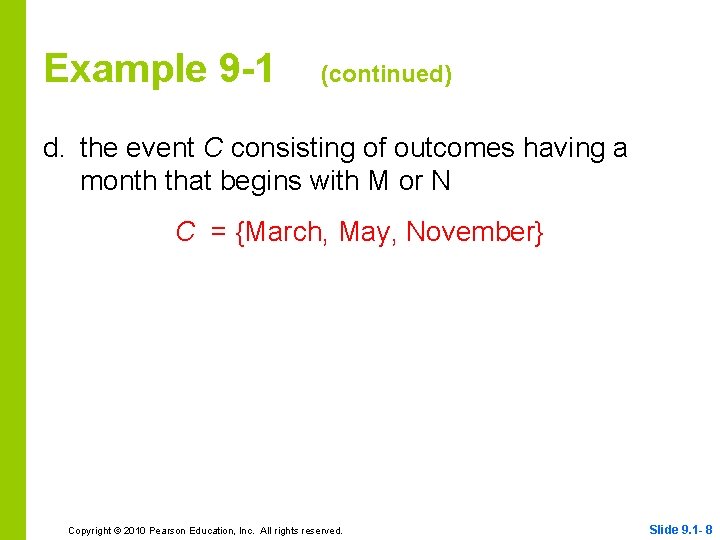
Example 9 -1 (continued) d. the event C consisting of outcomes having a month that begins with M or N C = {March, May, November} Copyright © 2010 Pearson Education, Inc. All rights reserved. Slide 9. 1 - 8
Determining Probabilities Experimental (empirical) probability: determined by observing outcomes of experiments. Theoretical probability: the outcome under ideal conditions. Equally likely: when one outcome is as likely as another Uniform sample space: each possible outcome of the sample space is equally likely. Copyright © 2010 Pearson Education, Inc. All rights reserved. Slide 9. 1 - 9
Law of Large Numbers (Bernoulli’s Theorem) If an experiment is repeated a large number of times, the experimental (empirical) probability of a particular outcome approaches a fixed number as the number or repetitions increases. Copyright © 2010 Pearson Education, Inc. All rights reserved. Slide 9. 1 - 10
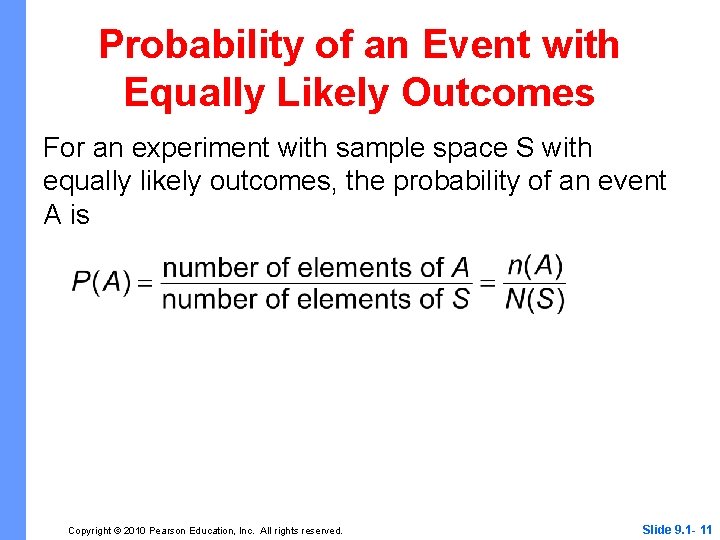
Probability of an Event with Equally Likely Outcomes For an experiment with sample space S with equally likely outcomes, the probability of an event A is Copyright © 2010 Pearson Education, Inc. All rights reserved. Slide 9. 1 - 11
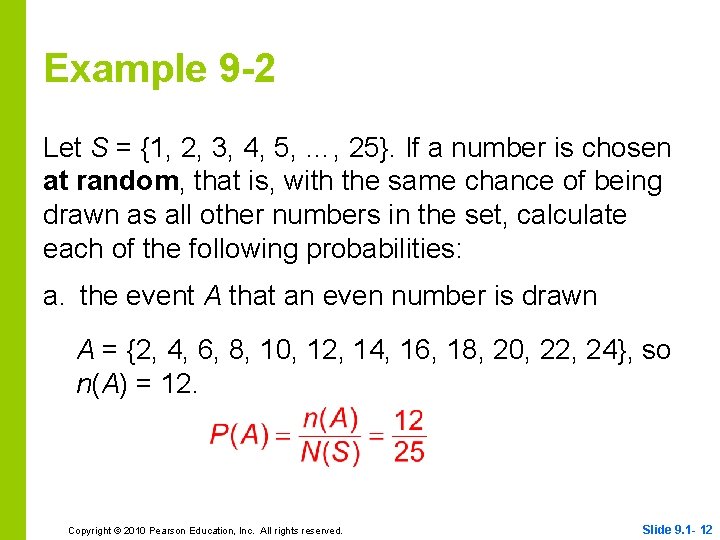
Example 9 -2 Let S = {1, 2, 3, 4, 5, …, 25}. If a number is chosen at random, that is, with the same chance of being drawn as all other numbers in the set, calculate each of the following probabilities: a. the event A that an even number is drawn A = {2, 4, 6, 8, 10, 12, 14, 16, 18, 20, 22, 24}, so n(A) = 12. Copyright © 2010 Pearson Education, Inc. All rights reserved. Slide 9. 1 - 12
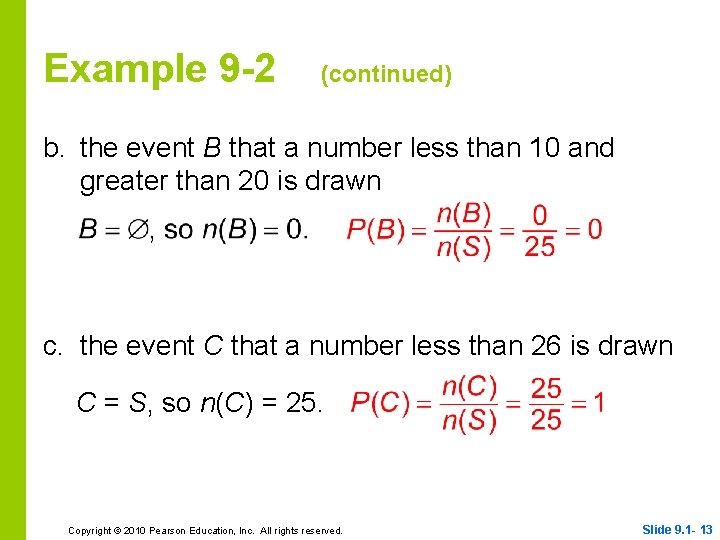
Example 9 -2 (continued) b. the event B that a number less than 10 and greater than 20 is drawn c. the event C that a number less than 26 is drawn C = S, so n(C) = 25. Copyright © 2010 Pearson Education, Inc. All rights reserved. Slide 9. 1 - 13
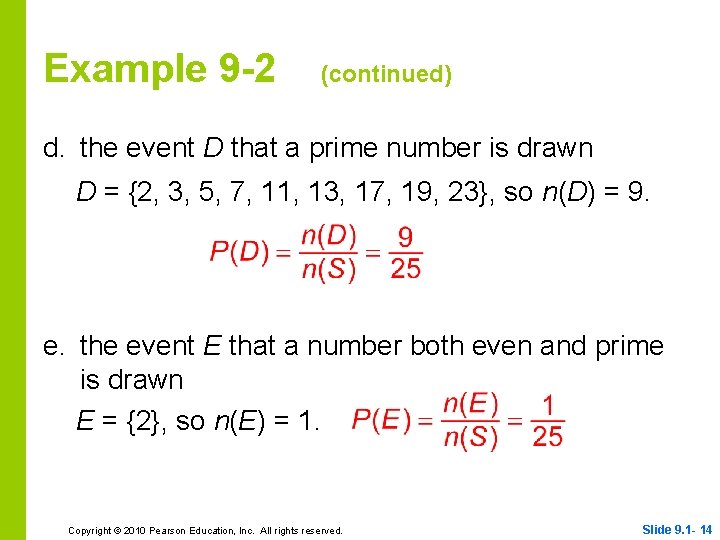
Example 9 -2 (continued) d. the event D that a prime number is drawn D = {2, 3, 5, 7, 11, 13, 17, 19, 23}, so n(D) = 9. e. the event E that a number both even and prime is drawn E = {2}, so n(E) = 1. Copyright © 2010 Pearson Education, Inc. All rights reserved. Slide 9. 1 - 14
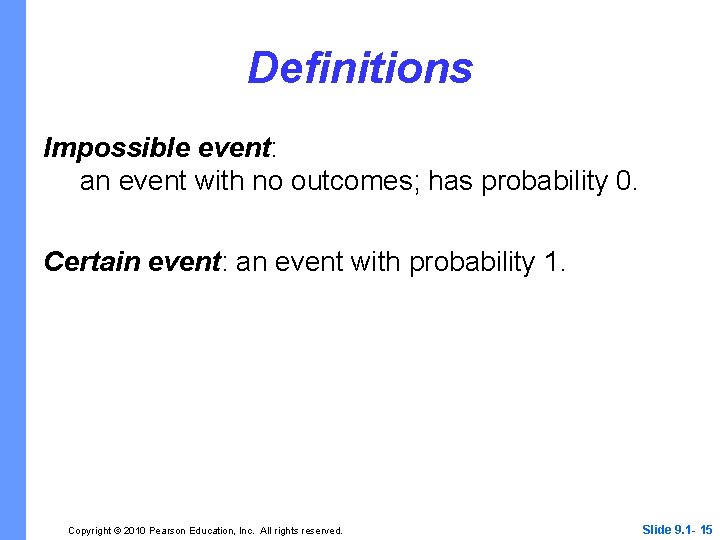
Definitions Impossible event: an event with no outcomes; has probability 0. Certain event: an event with probability 1. Copyright © 2010 Pearson Education, Inc. All rights reserved. Slide 9. 1 - 15
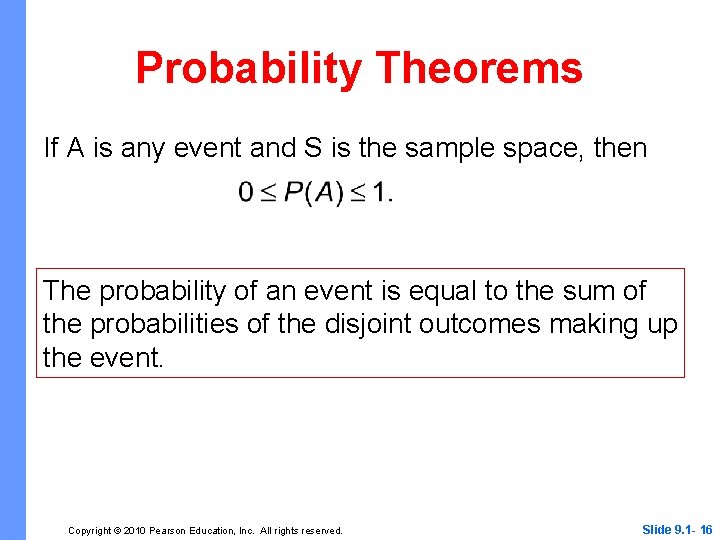
Probability Theorems If A is any event and S is the sample space, then The probability of an event is equal to the sum of the probabilities of the disjoint outcomes making up the event. Copyright © 2010 Pearson Education, Inc. All rights reserved. Slide 9. 1 - 16
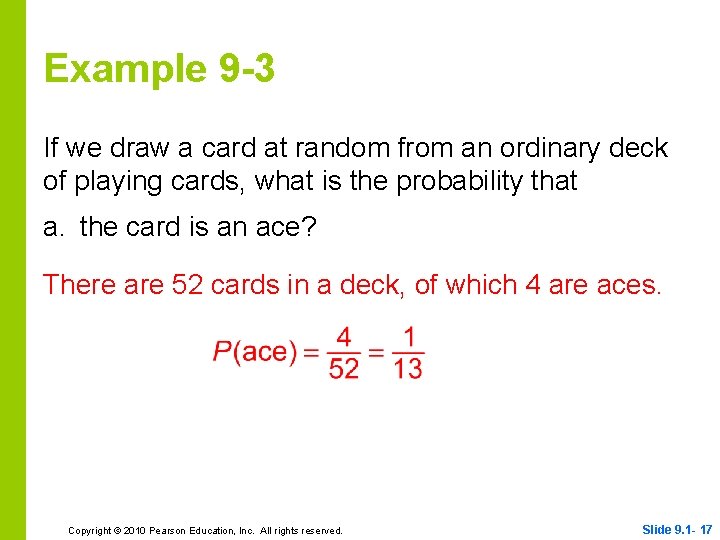
Example 9 -3 If we draw a card at random from an ordinary deck of playing cards, what is the probability that a. the card is an ace? There are 52 cards in a deck, of which 4 are aces. Copyright © 2010 Pearson Education, Inc. All rights reserved. Slide 9. 1 - 17
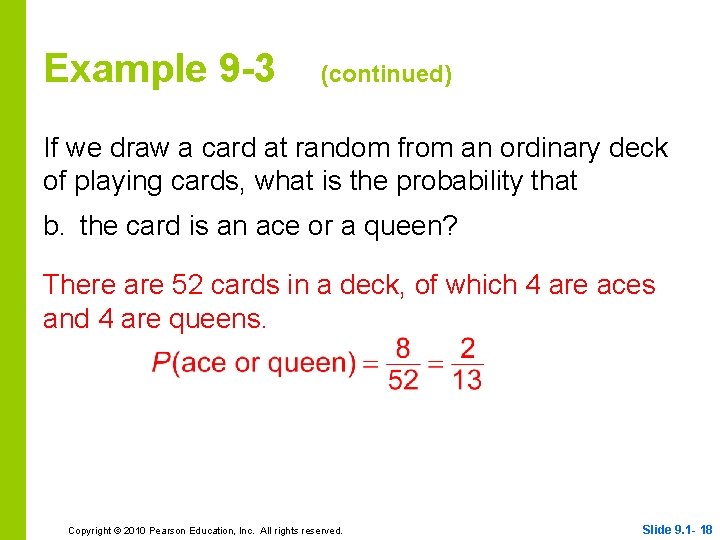
Example 9 -3 (continued) If we draw a card at random from an ordinary deck of playing cards, what is the probability that b. the card is an ace or a queen? There are 52 cards in a deck, of which 4 are aces and 4 are queens. Copyright © 2010 Pearson Education, Inc. All rights reserved. Slide 9. 1 - 18
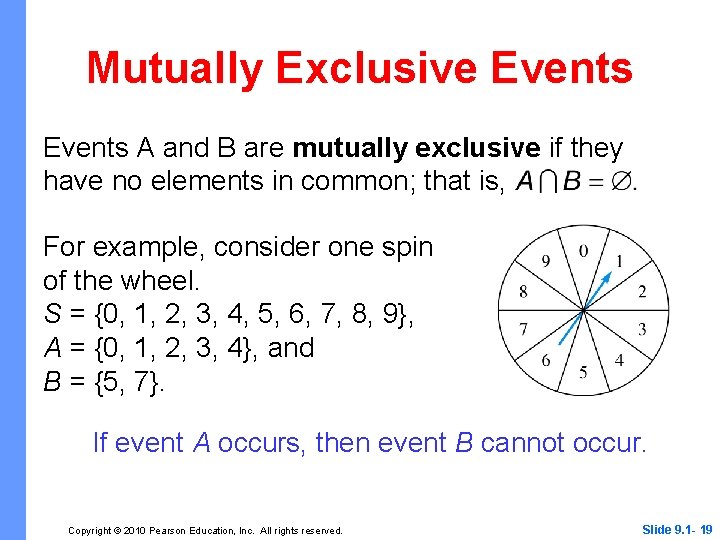
Mutually Exclusive Events A and B are mutually exclusive if they have no elements in common; that is, For example, consider one spin of the wheel. S = {0, 1, 2, 3, 4, 5, 6, 7, 8, 9}, A = {0, 1, 2, 3, 4}, and B = {5, 7}. If event A occurs, then event B cannot occur. Copyright © 2010 Pearson Education, Inc. All rights reserved. Slide 9. 1 - 19
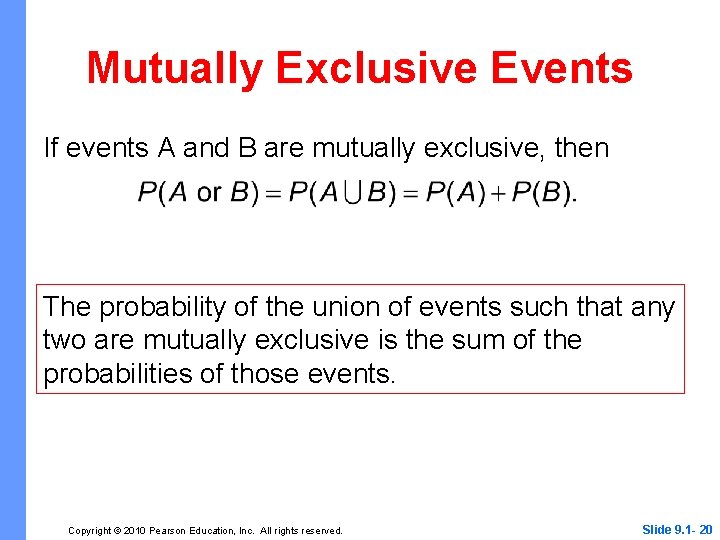
Mutually Exclusive Events If events A and B are mutually exclusive, then The probability of the union of events such that any two are mutually exclusive is the sum of the probabilities of those events. Copyright © 2010 Pearson Education, Inc. All rights reserved. Slide 9. 1 - 20
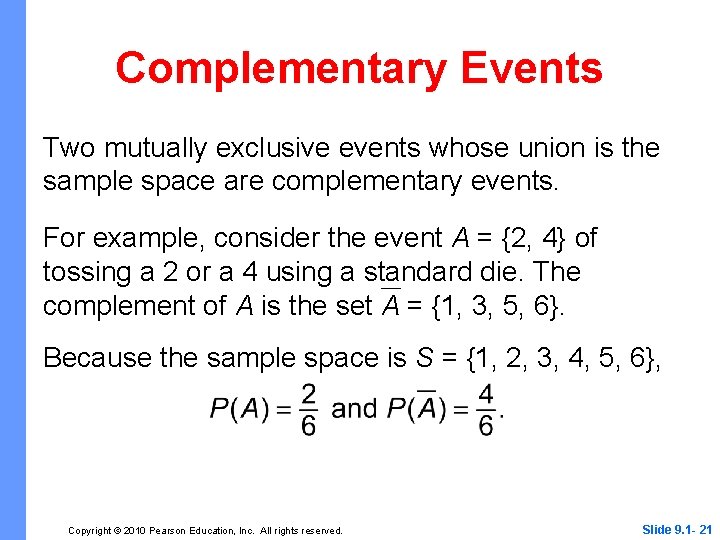
Complementary Events Two mutually exclusive events whose union is the sample space are complementary events. For example, consider the event A = {2, 4} of tossing a 2 or a 4 using a standard die. The complement of A is the set A = {1, 3, 5, 6}. Because the sample space is S = {1, 2, 3, 4, 5, 6}, Copyright © 2010 Pearson Education, Inc. All rights reserved. Slide 9. 1 - 21
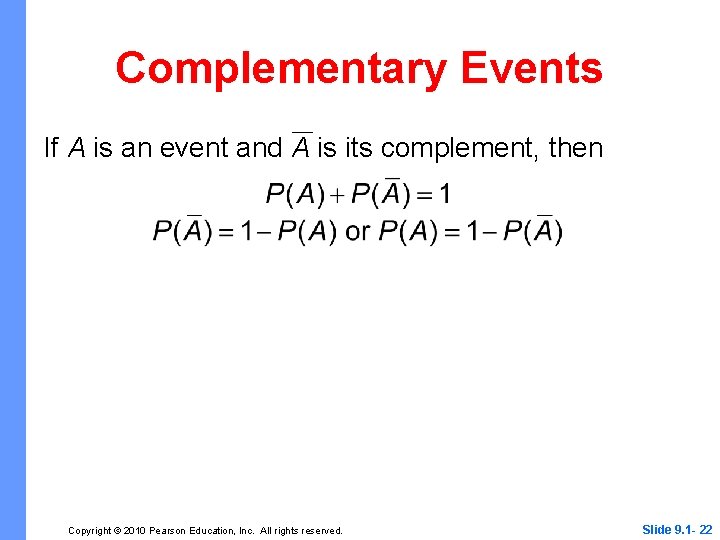
Complementary Events If A is an event and A is its complement, then Copyright © 2010 Pearson Education, Inc. All rights reserved. Slide 9. 1 - 22
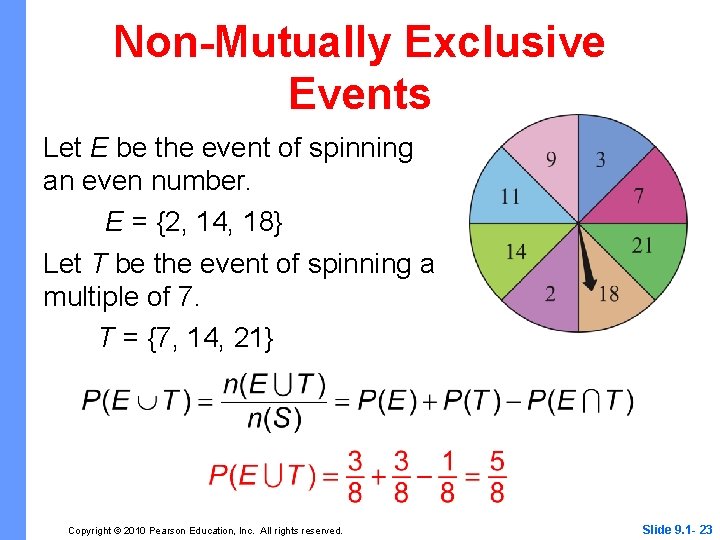
Non-Mutually Exclusive Events Let E be the event of spinning an even number. E = {2, 14, 18} Let T be the event of spinning a multiple of 7. T = {7, 14, 21} Copyright © 2010 Pearson Education, Inc. All rights reserved. Slide 9. 1 - 23
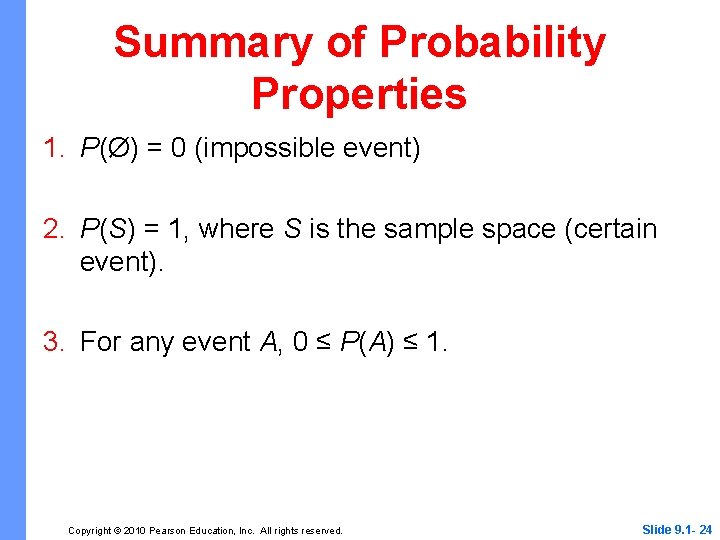
Summary of Probability Properties 1. P(Ø) = 0 (impossible event) 2. P(S) = 1, where S is the sample space (certain event). 3. For any event A, 0 ≤ P(A) ≤ 1. Copyright © 2010 Pearson Education, Inc. All rights reserved. Slide 9. 1 - 24
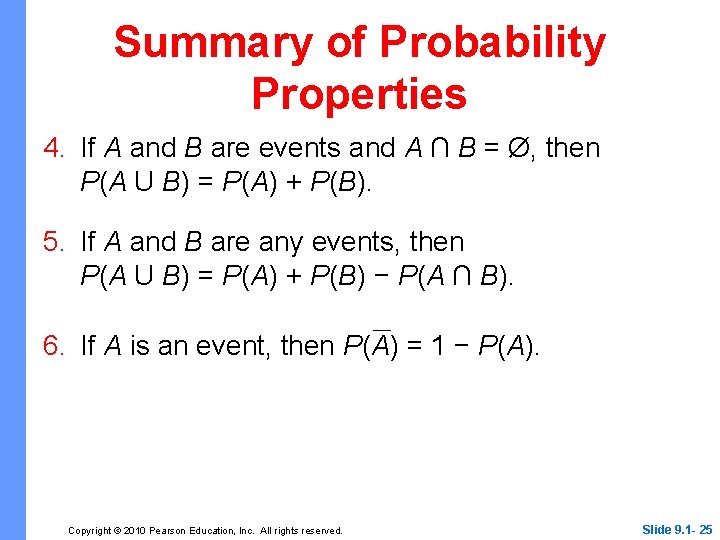
Summary of Probability Properties 4. If A and B are events and A ∩ B = Ø, then P(A U B) = P(A) + P(B). 5. If A and B are any events, then P(A U B) = P(A) + P(B) − P(A ∩ B). 6. If A is an event, then P(A) = 1 − P(A). Copyright © 2010 Pearson Education, Inc. All rights reserved. Slide 9. 1 - 25
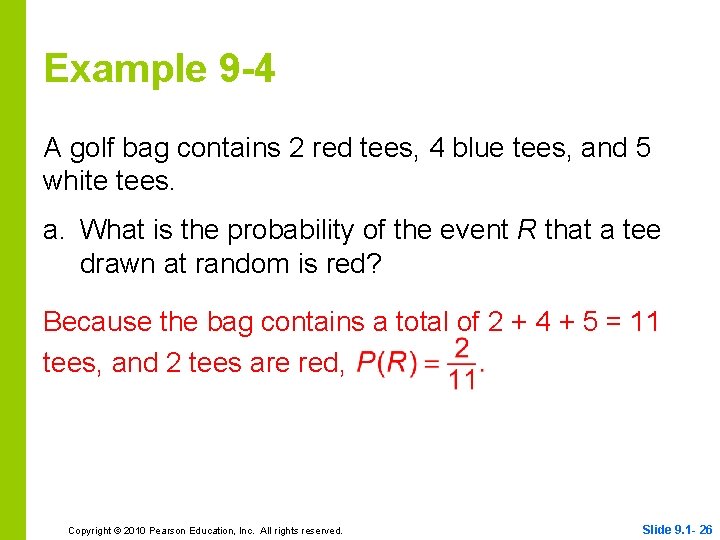
Example 9 -4 A golf bag contains 2 red tees, 4 blue tees, and 5 white tees. a. What is the probability of the event R that a tee drawn at random is red? Because the bag contains a total of 2 + 4 + 5 = 11 tees, and 2 tees are red, Copyright © 2010 Pearson Education, Inc. All rights reserved. Slide 9. 1 - 26
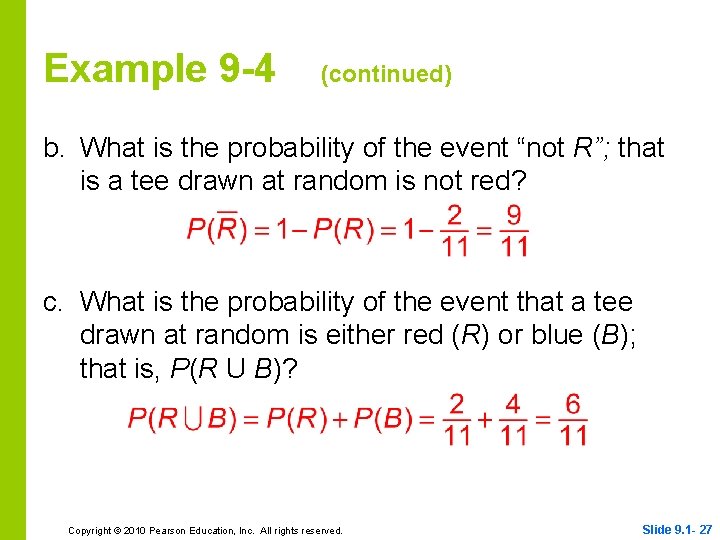
Example 9 -4 (continued) b. What is the probability of the event “not R”; that is a tee drawn at random is not red? c. What is the probability of the event that a tee drawn at random is either red (R) or blue (B); that is, P(R U B)? Copyright © 2010 Pearson Education, Inc. All rights reserved. Slide 9. 1 - 27
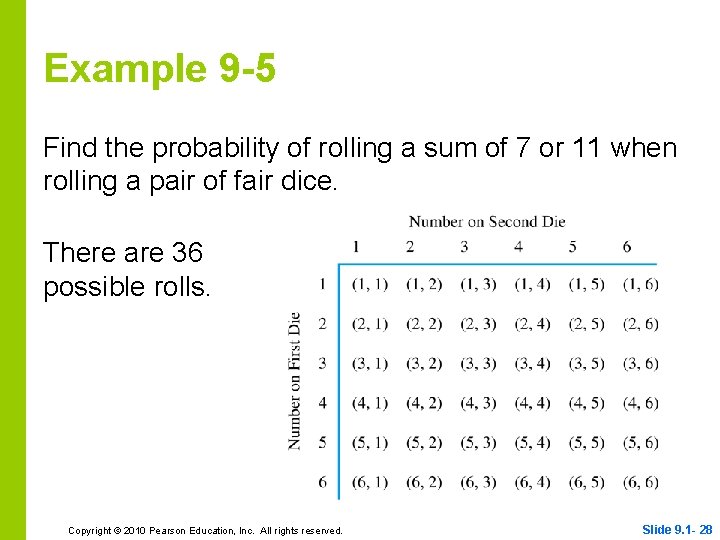
Example 9 -5 Find the probability of rolling a sum of 7 or 11 when rolling a pair of fair dice. There are 36 possible rolls. Copyright © 2010 Pearson Education, Inc. All rights reserved. Slide 9. 1 - 28
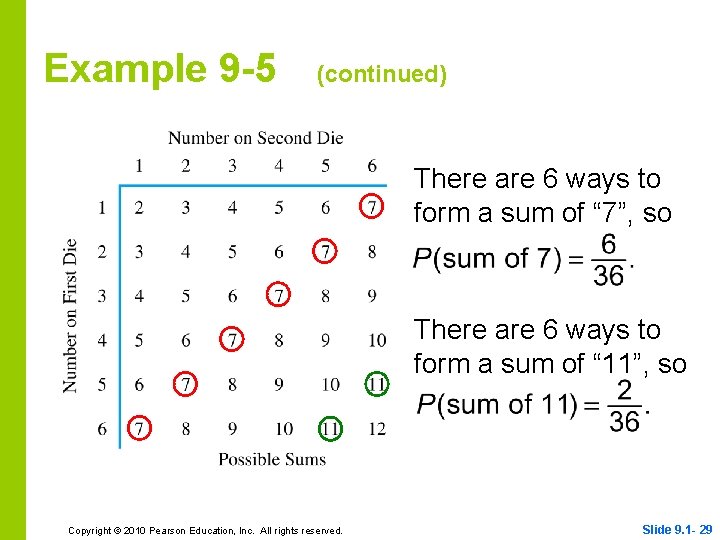
Example 9 -5 (continued) There are 6 ways to form a sum of “ 7”, so There are 6 ways to form a sum of “ 11”, so Copyright © 2010 Pearson Education, Inc. All rights reserved. Slide 9. 1 - 29
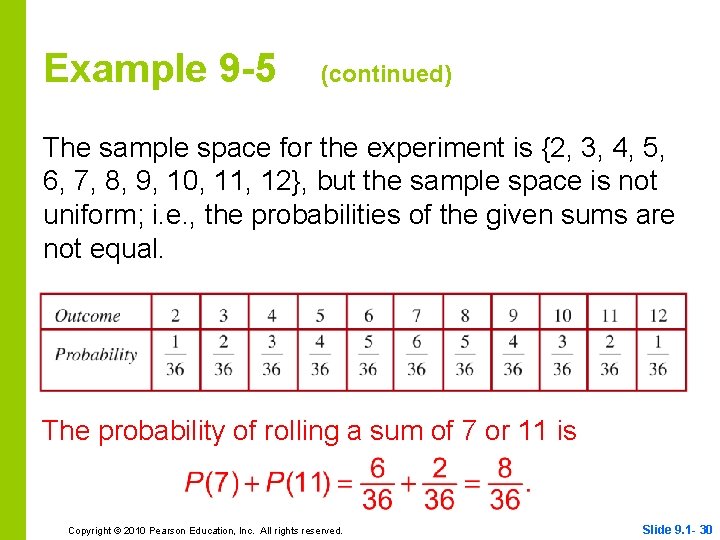
Example 9 -5 (continued) The sample space for the experiment is {2, 3, 4, 5, 6, 7, 8, 9, 10, 11, 12}, but the sample space is not uniform; i. e. , the probabilities of the given sums are not equal. The probability of rolling a sum of 7 or 11 is Copyright © 2010 Pearson Education, Inc. All rights reserved. Slide 9. 1 - 30
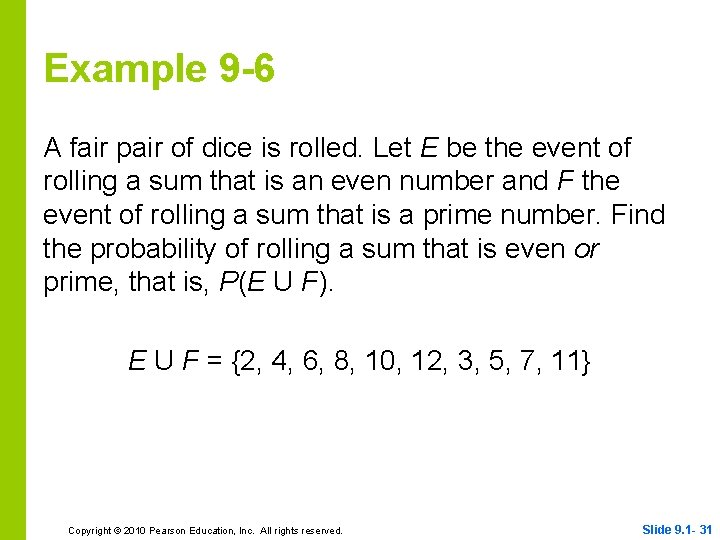
Example 9 -6 A fair pair of dice is rolled. Let E be the event of rolling a sum that is an even number and F the event of rolling a sum that is a prime number. Find the probability of rolling a sum that is even or prime, that is, P(E U F). E U F = {2, 4, 6, 8, 10, 12, 3, 5, 7, 11} Copyright © 2010 Pearson Education, Inc. All rights reserved. Slide 9. 1 - 31
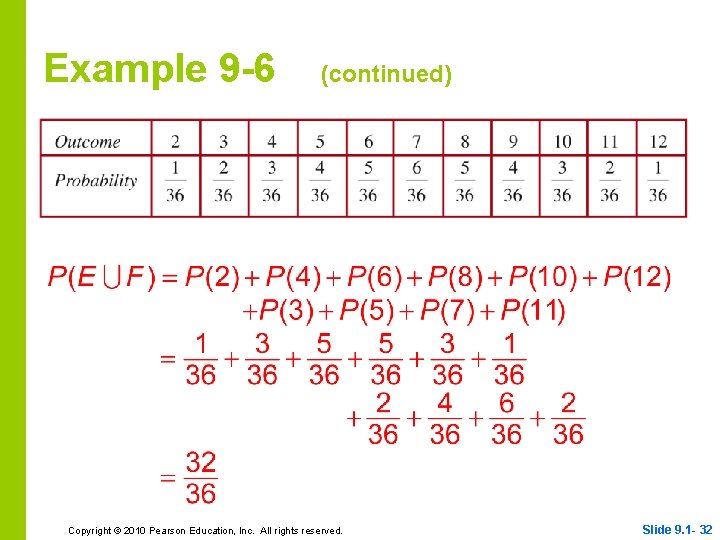
Example 9 -6 (continued) Copyright © 2010 Pearson Education, Inc. All rights reserved. Slide 9. 1 - 32
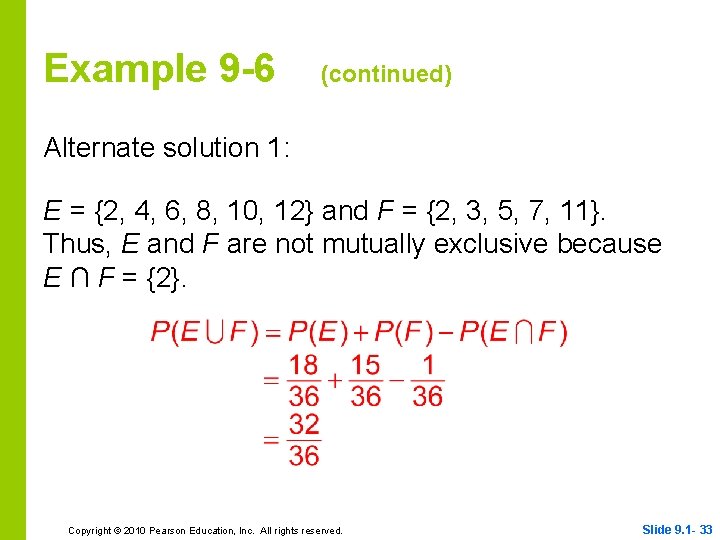
Example 9 -6 (continued) Alternate solution 1: E = {2, 4, 6, 8, 10, 12} and F = {2, 3, 5, 7, 11}. Thus, E and F are not mutually exclusive because E ∩ F = {2}. Copyright © 2010 Pearson Education, Inc. All rights reserved. Slide 9. 1 - 33
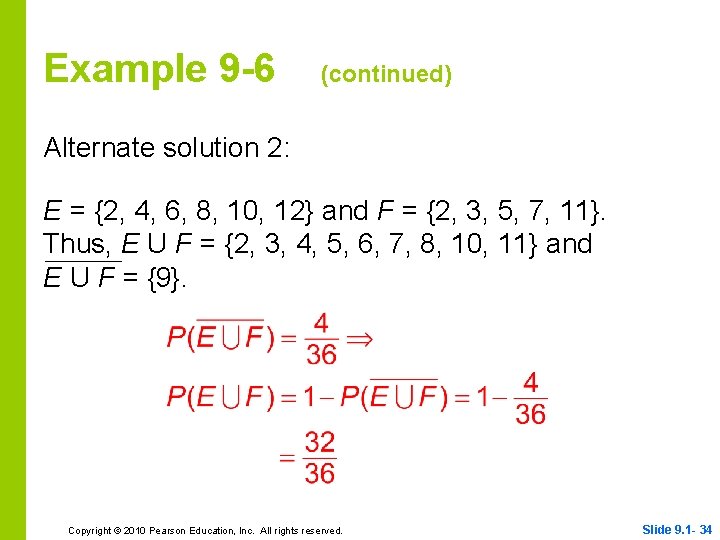
Example 9 -6 (continued) Alternate solution 2: E = {2, 4, 6, 8, 10, 12} and F = {2, 3, 5, 7, 11}. Thus, E U F = {2, 3, 4, 5, 6, 7, 8, 10, 11} and E U F = {9}. Copyright © 2010 Pearson Education, Inc. All rights reserved. Slide 9. 1 - 34
- Slides: 34