
Chapter 9 Power Point Programming for Movement Stability
Chapter 9 Power Point Programming for Movement, Stability and Mobility
Movement • Law of Gravity creates the need to absorb reactive forces through the kinetic chain. * • Joint stability: maintains control over joint movement or position • Joint mobility: range of motion uninhibited around joint or body segment • Arthrokinematics – Arthro (joint) Kinematics (movement) • Sensory input and motor output based on neurological and physiological systems • Proper joint mechanics • Joints for stability • • Scapulothoracic Lumbar Spine Knee Foot • Joints for mobility • • Shoulder Thoracic Spine Hip Ankle
Movement Concepts • Length-tension relationships: The degree of overlap with the contractile proteins actin and myosin determine the force output of the sarcomere/muscle. • • Too much overlap (fully contracted) decreases force: tight muscles Too little overlap (stretched) decreases force: weak muscles Optimal overlap is at the muscles resting length Why do athletes need to make flexibility a regular part of their exercise routine? • Appropriate muscle length leads to increased forced production* due to optimal overlap. • Force-couple relationships: muscles working together to move a joint • Example: hip flexors, erector spinae and latissimus dorsi working together to anteriorly rotate the pelvis • If one muscle is not working correctly the system becomes compromised
Movement Concepts • Neural control • Reciprocal Inhibition: reflex inhibition of motor neurons on antagonist muscles when agonist muscles are contracted • Autogenic Inhibition: activation of the golgi tendon organ (SMR) inhibits the muscle spindles allowing for further ranges of motion • Synergistic Dominance: when synergist carry out primary function of a weakened or inhibited prime mover • Altered Length Tension Relationship: when a muscle is too tight and cannot produce appropriate force • Altered Force Couple Relationship: when a tight or weak muscle compromises movement at a joint

Stability and Mobility • Phase 1: Stability and Mobility Training • Starts by enhancing the strength and endurance of the muscles surrounding the lumbar spine* • Slow-twitch muscle fibers • Enhances stabilizer muscle endurance, reduces fatigue • Most of this phase is dedicated to improving flexibility • Stretching: SMR, static, PNF, dynamic and ballistic

Stability and Mobility • Proximal stability: activating the core • Promotes stability of lumbar spine • Deep/innermost layer • Vertebral bones and disks, spinal ligaments on front and back of spinal column • Muscles include: Transverse Abdominis*, Multifidis, Pelvic Floor, Quadratus Lumborum • 3 stages • Core function – Learning to compress the abdomen by activating the Transverse Abdominis creates intraabdominal pressure and reduces joint and disc compression during loading* • Important for all clients to train the TVA* • Static balance – over fixed base of support enhances isolated stability • Dynamic balance – over dynamic base of support enhances whole body stability

Stability and Mobility • Proximal stability: Core function • Supine drawing-in exercise (centering or activating the TVA) • Progression: Kegels drawing-in both sustaining both with normal breathing • Quadruped drawing-in exercise with extremity movement • Sometimes extending the limbs too far will deactivate the drawing -in. You can tell if this happens when the low back begins to arch (lumbar lordosis which leads to a loss in stability)*
Stability and Mobility • Proximal Mobility: hips and thoracic spine • Improve mobility • The two joints immediately adjacent to lumbar spine • Increase thoracic extension, flexion and rotation • Increase hip extension and abduction • • Avoid compensations – keep a neutral pelvis during stretching Monoarticulated – muscles that cross one joint Biarticulated – muscles that cross two joints Exercises • • Cat-camel Pelvic tilts Hip flexor mobility: lying hip flexor stretch, half kneeling triplanar stretch Hamstring mobility: lying hamstring stretch Hip mobilization with glute activation: glute bridge, supine 90 -90 hip rotator stretch Thoracic spine (T-spine) mobilization: spinal extension and spinal twists Posterior mobilization: rocking quadrupeds
Stability and Mobility • Proximal stability around the shoulder • Improve stability within the scapulothoracic region during upper extremity movements (push/pull type movements) • Glenohumeral joint mobility • Promoting scapulothoracic region stability requirements • Thoracic mobility • Tissue extensibility • SMR, inferior capsule stretch, posterior capsule stretches, anterior capsule (pectoralis) stretch • Rotator Cuff Muscles* (SITS) • Supraspinatus • Infraspinatus • Teres Minor • Subscapularis
Stability and Mobility • Muscle balance within the parascapular muscles • Ability to resist upward glide and impingement against the coracoacromial arch during deltoid action • Closed-chain kinetic (CKC) movements • Distal segment is more fixed during movement • Load and compress joins, increase kinesthetic awareness and proprioception • Exercises • • • Internal/external humeral rotation, diagonals, reverse flys* with supine 90 -90, (good for internally rotated shoulders) prone arm lifts, CKC weight shifts, shoulder packing
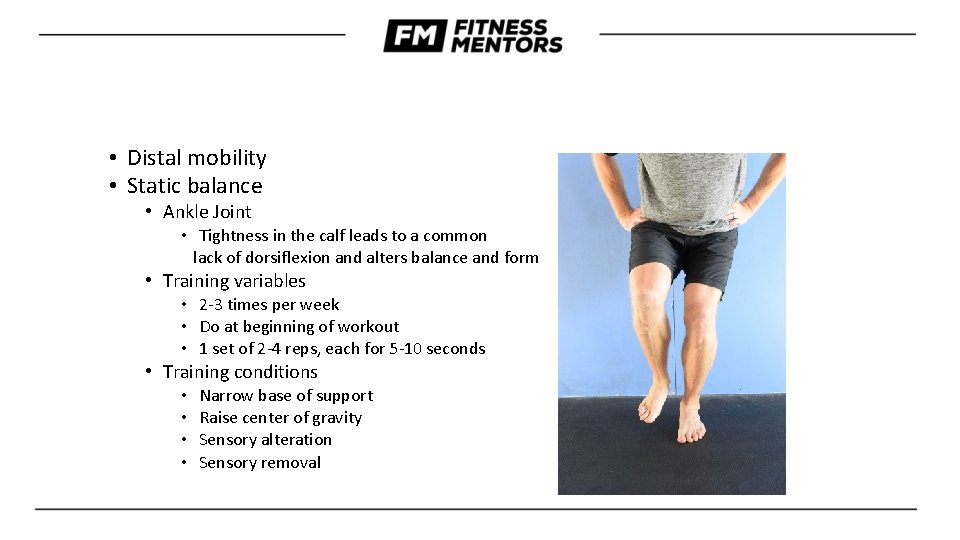
• Distal mobility • Static balance • Ankle Joint • Tightness in the calf leads to a common lack of dorsiflexion and alters balance and form • Training variables • 2 -3 times per week • Do at beginning of workout • 1 set of 2 -4 reps, each for 5 -10 seconds • Training conditions • • Narrow base of support Raise center of gravity Sensory alteration Sensory removal
CH 9 Functional Movements, Stability, and Mobility • Dynamic balance • React to changing surface • Progression includes • Narrow stance Hip width stance Split stance Staggered stance Tandem stance Single Leg* • Single-leg stand patterns • Identifying imbalances – use hurdle step screen • Exercises • Single-leg stands • Static balance on a single-leg • Progress by adding in upper and lower extremity movement while maintaining balance.
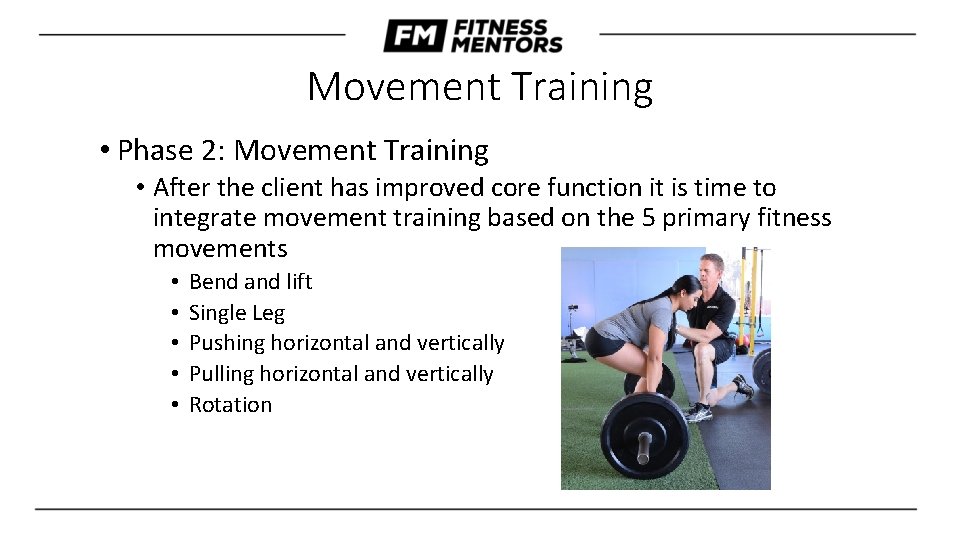
Movement Training • Phase 2: Movement Training • After the client has improved core function it is time to integrate movement training based on the 5 primary fitness movements • • • Bend and lift Single Leg Pushing horizontal and vertically Pulling horizontal and vertically Rotation
Movement Training • Bend and Lift - one of the most common ADLs • Teach the hip hinge and engaging the transverse abdominis* first and ensure proper alignment • When alignment looks off, increased lumbar lordosis or increased thoracic rounding, regress to the hip hinge exercise* • Before squatting always engage transverse abdominis and during the squat ensure proper tibial and torso alignment. • Single-leg – lunging, walking, running • Half-kneeling lunge rise • Lunges (90 degrees of knee flexion on each leg) • Multidirectional lunge
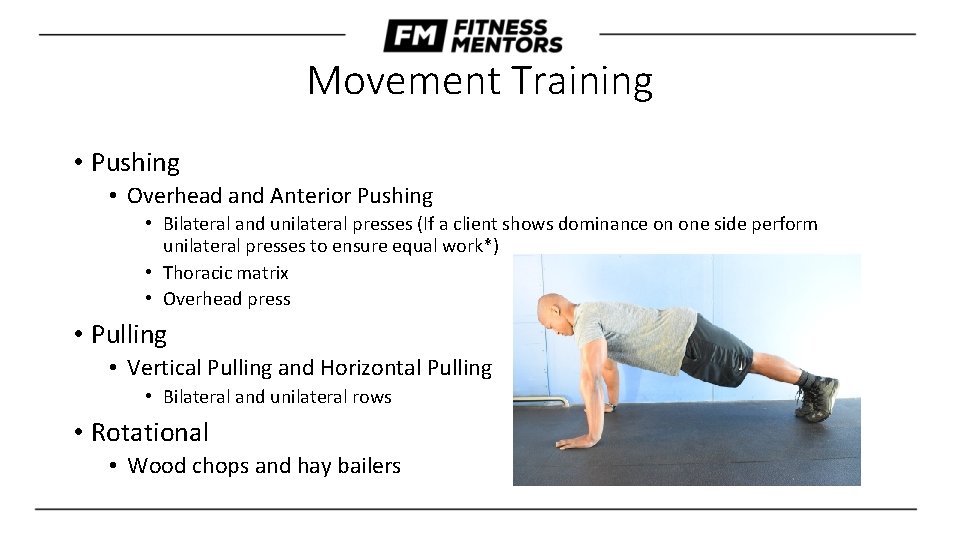
Movement Training • Pushing • Overhead and Anterior Pushing • Bilateral and unilateral presses (If a client shows dominance on one side perform unilateral presses to ensure equal work*) • Thoracic matrix • Overhead press • Pulling • Vertical Pulling and Horizontal Pulling • Bilateral and unilateral rows • Rotational • Wood chops and hay bailers
- Slides: 15