
Chapter 9 Plate Tectonics 9 1 Continental Drift
- Slides: 36
Chapter 9 Plate Tectonics
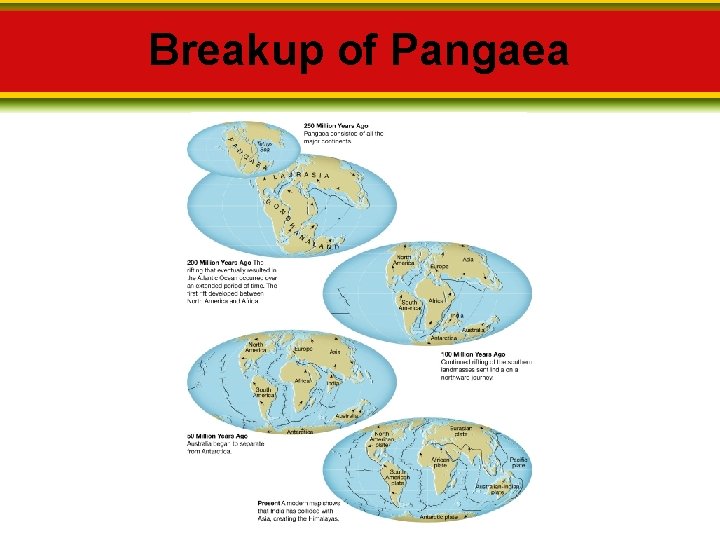
9. 1 Continental Drift An Idea Before Its Time Wegener’s ________ hypothesis stated that the continents had once been joined to form a single supercontinent. • Wegener proposed that the supercontinent, ______, began to break apart ___ million years ago and form the present landmasses.
Breakup of Pangaea
9. 1 Continental Drift An Idea Before Its Time Evidence • The Continental __________ • Matching _________ - Fossil evidence for continental drift includes several fossil organisms found on ______________________.
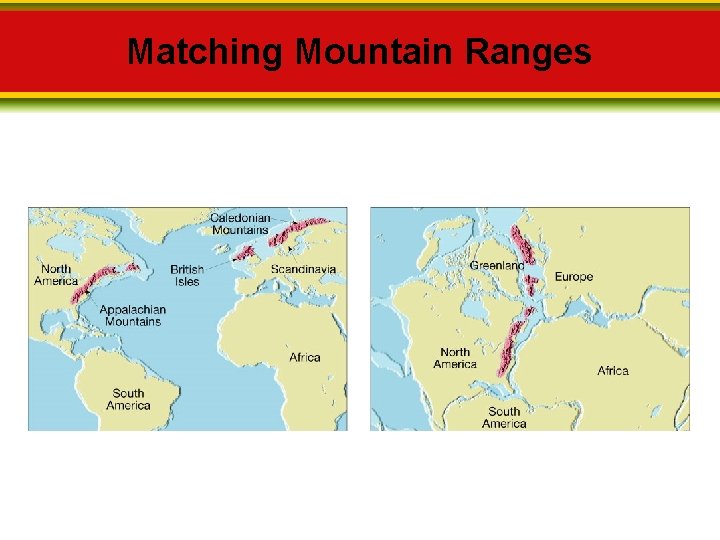
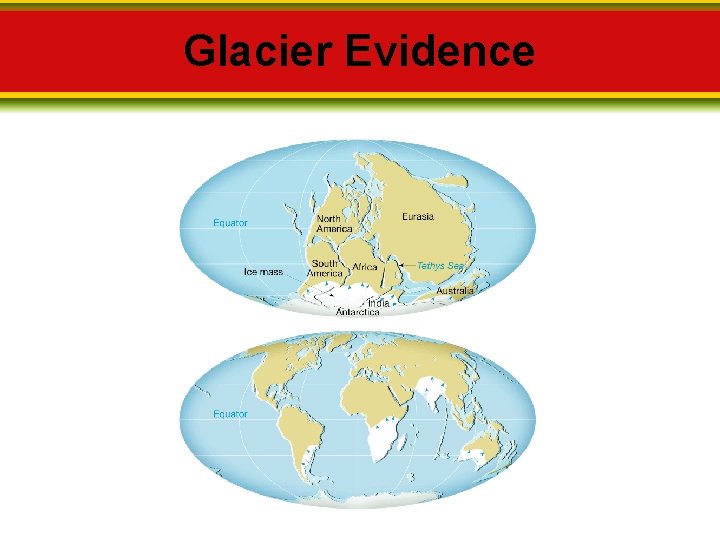
9. 1 Continental Drift An Idea Before Its Time Evidence • ______ and Structures _____ - Rock evidence for continental exists in the form of several mountain belts that end at one coastline, only to reappear on a landmass across the ocean. • Ancient _________
Matching Mountain Ranges
Glacier Evidence
9. 1 Continental Drift Rejecting the Hypothesis A New Theory Emerges • Wegener could not provide an explanation of exactly what made the continents ______. New technology lead to findings which then lead to a new theory called _____.
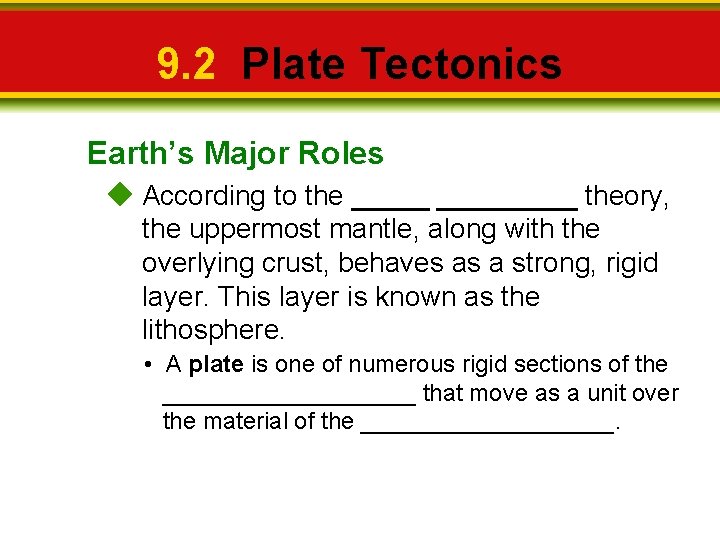
9. 2 Plate Tectonics Earth’s Major Roles According to the _________ theory, the uppermost mantle, along with the overlying crust, behaves as a strong, rigid layer. This layer is known as the lithosphere. • A plate is one of numerous rigid sections of the __________ that move as a unit over the material of the __________.
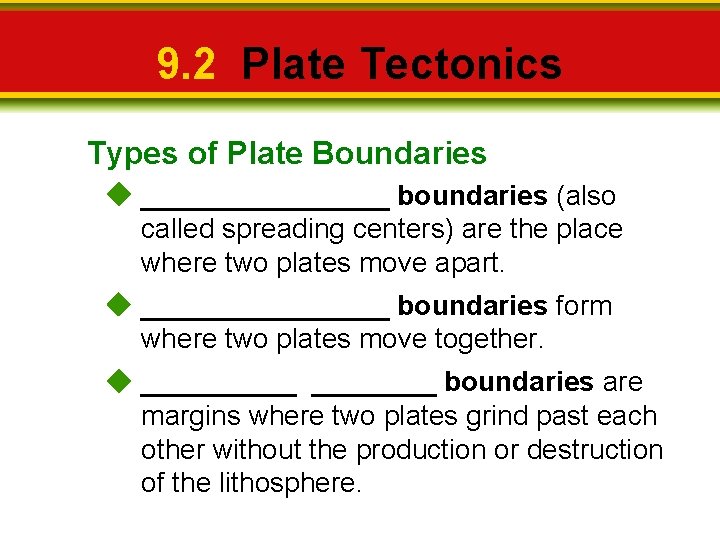
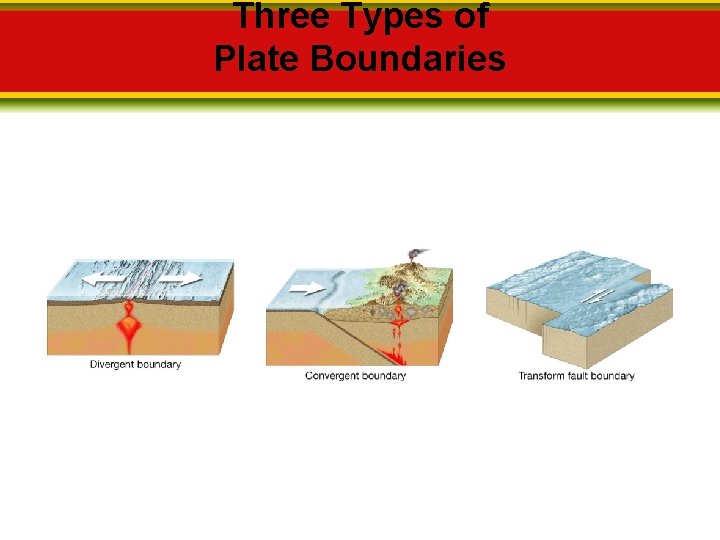
9. 2 Plate Tectonics Types of Plate Boundaries ________ boundaries (also called spreading centers) are the place where two plates move apart. ________ boundaries form where two plates move together. _____ boundaries are margins where two plates grind past each other without the production or destruction of the lithosphere.
Three Types of Plate Boundaries
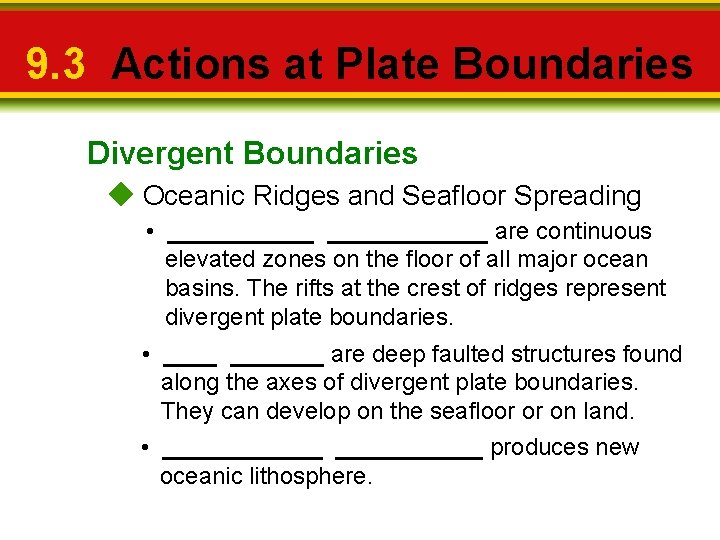
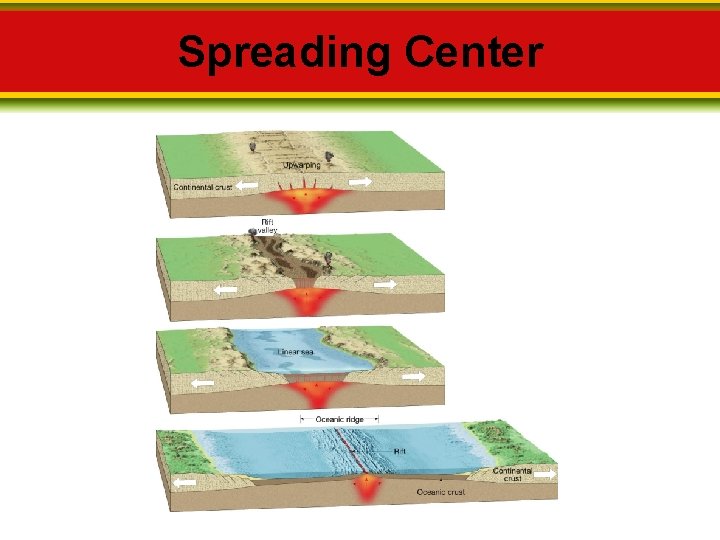
9. 3 Actions at Plate Boundaries Divergent Boundaries Oceanic Ridges and Seafloor Spreading • ____________ are continuous elevated zones on the floor of all major ocean basins. The rifts at the crest of ridges represent divergent plate boundaries. • _______ are deep faulted structures found along the axes of divergent plate boundaries. They can develop on the seafloor or on land. • ______ produces new oceanic lithosphere.
Spreading Center
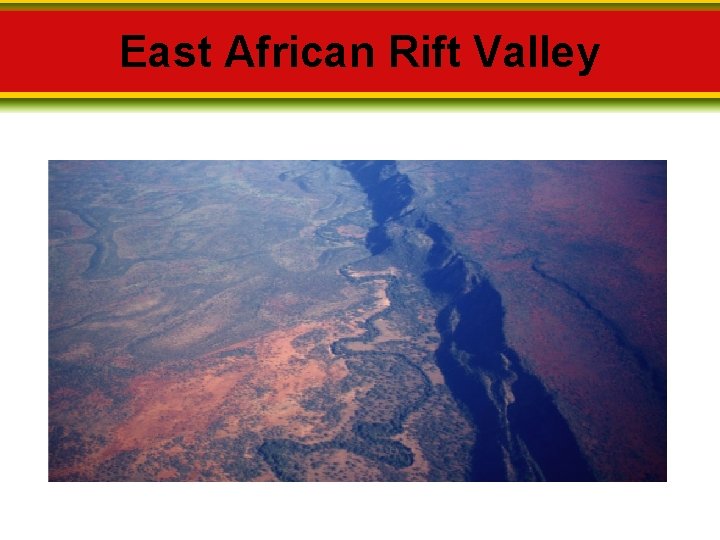
9. 3 Actions at Plate Boundaries Divergent Boundaries Continental Rifts • When spreading centers develop within a continent, the landmass may split into two or more smaller segments, forming a _______.
East African Rift Valley
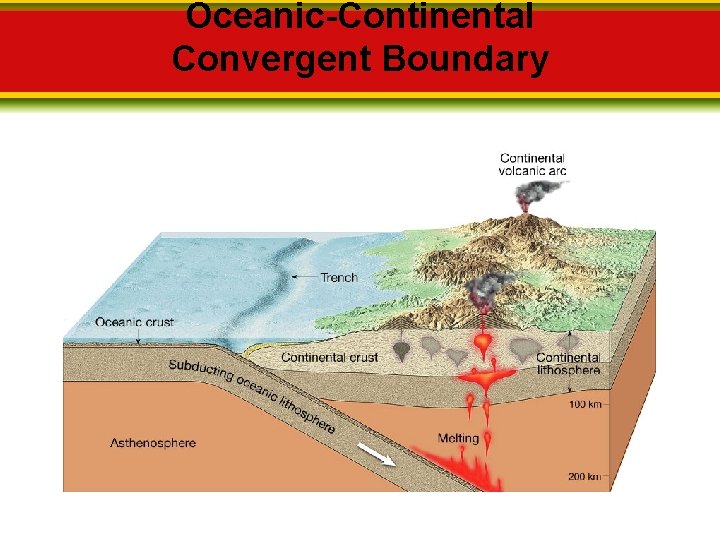
9. 3 Actions at Plate Boundaries Convergent Boundaries A subduction zone occurs when one oceanic _____ is forced ______ into the mantle beneath a second plate. Oceanic-Continental • Denser _______ slab _______ into the asthenosphere. • Pockets of magma develop and rise. • Continental _____ form in part by volcanic activity caused by the subduction of oceanic lithosphere beneath a continent. • Examples include the Andes, Cascades, and the Sierra Nevadas.
Oceanic-Continental Convergent Boundary
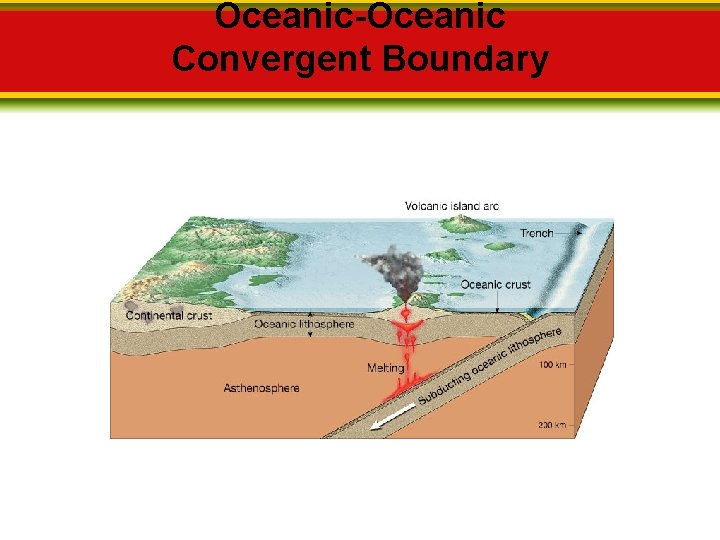
9. 3 Actions at Plate Boundaries Convergent Boundaries Oceanic-Oceanic • Two oceanic slabs converge and one descends beneath the other. • This kind of boundary often forms volcanoes on the ocean floor. • _______ form as volcanoes emerge from the sea. • Examples include the Aleutian, Mariana, and Tonga islands.
Oceanic-Oceanic Convergent Boundary
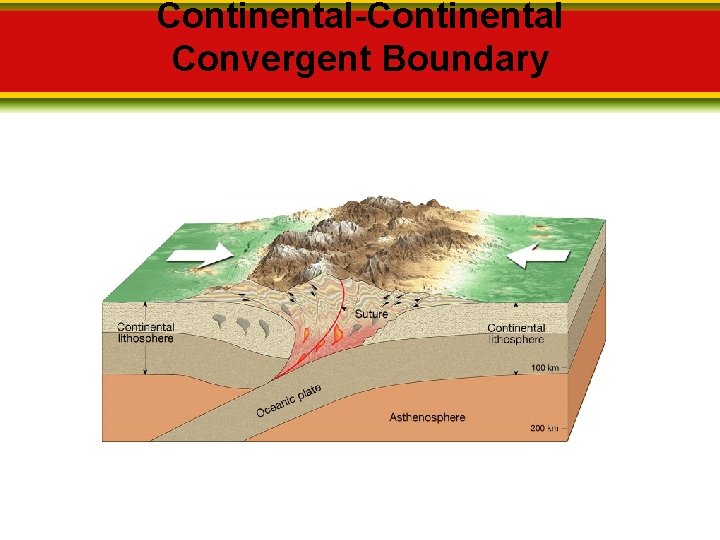
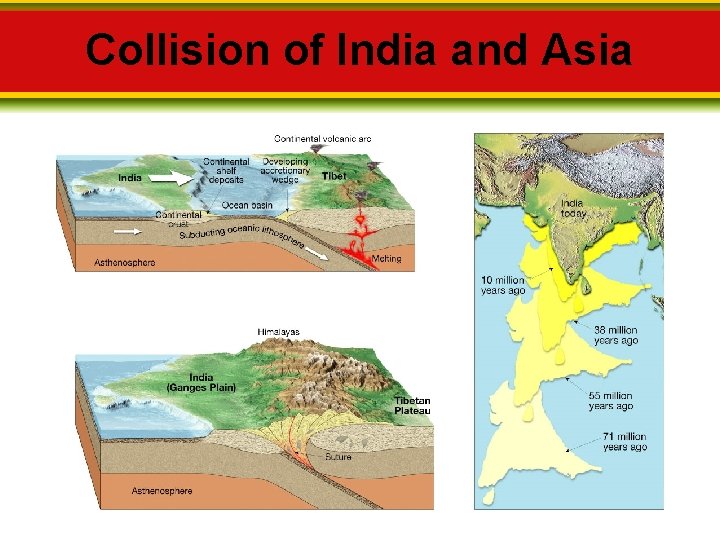
9. 3 Actions at Plate Boundaries Convergent Boundaries Continental-Continental • When the _______ plates contain continental material, two continents collide. • This kind of boundary can produce new mountain ranges, such as the Himalayas.
Continental-Continental Convergent Boundary
Collision of India and Asia
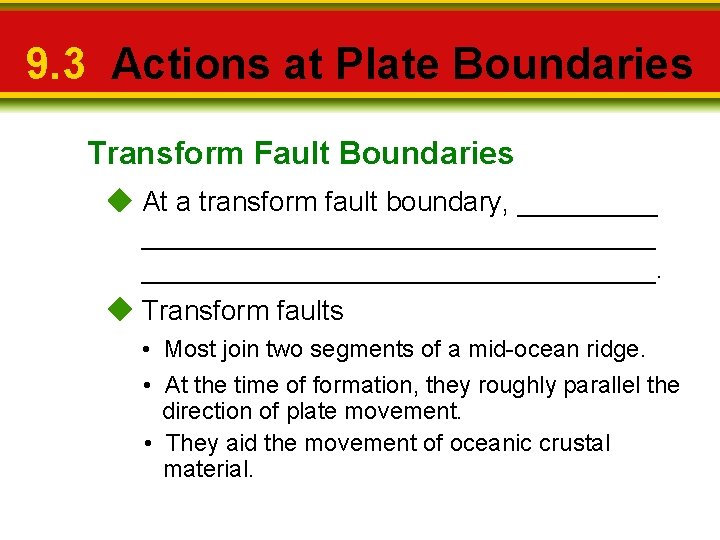
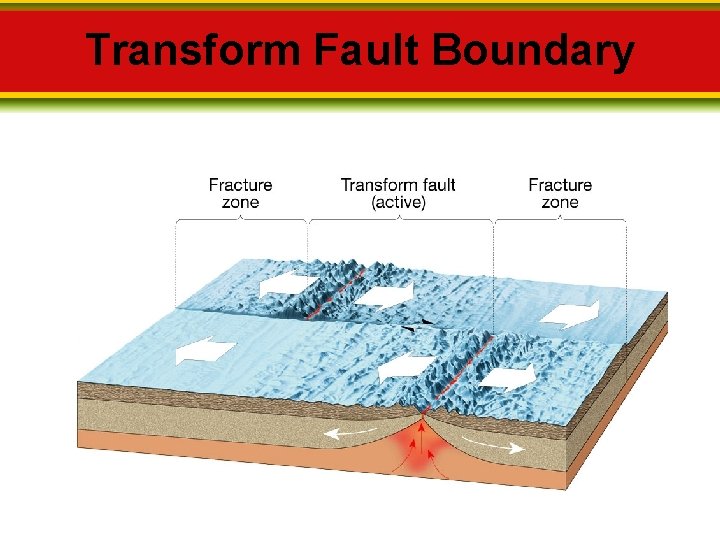
9. 3 Actions at Plate Boundaries Transform Fault Boundaries At a transform fault boundary, _____________________. Transform faults • Most join two segments of a mid-ocean ridge. • At the time of formation, they roughly parallel the direction of plate movement. • They aid the movement of oceanic crustal material.
Transform Fault Boundary
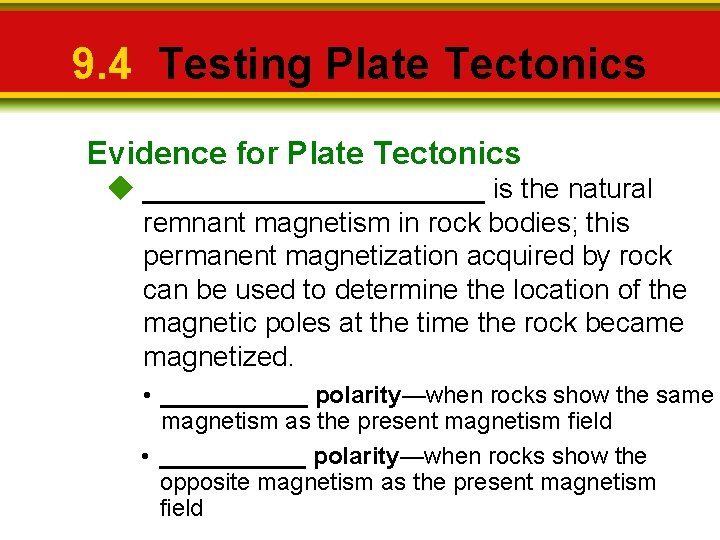
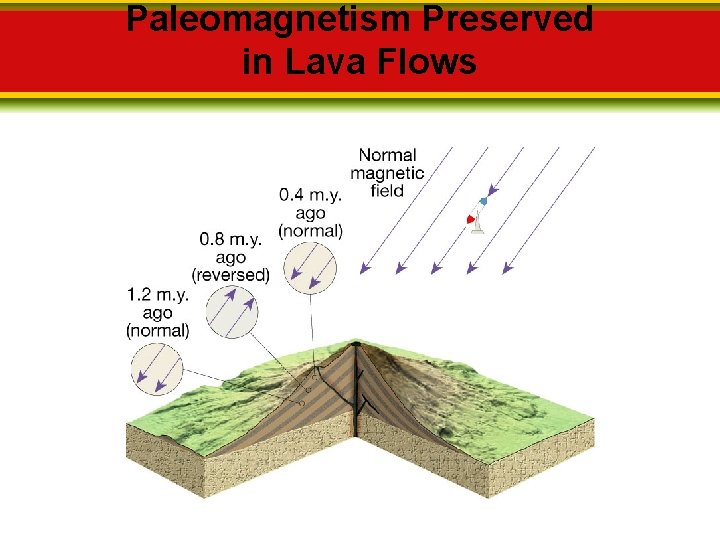
9. 4 Testing Plate Tectonics Evidence for Plate Tectonics ___________ is the natural remnant magnetism in rock bodies; this permanent magnetization acquired by rock can be used to determine the location of the magnetic poles at the time the rock became magnetized. • ______ polarity—when rocks show the same magnetism as the present magnetism field • ______ polarity—when rocks show the opposite magnetism as the present magnetism field
Paleomagnetism Preserved in Lava Flows
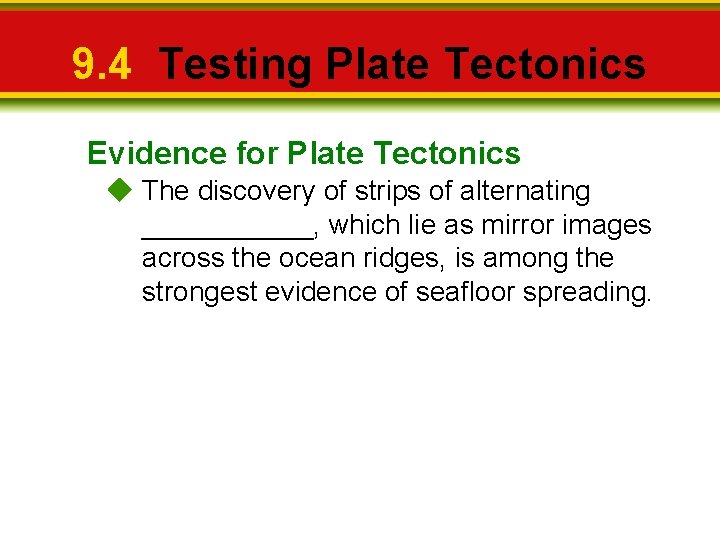
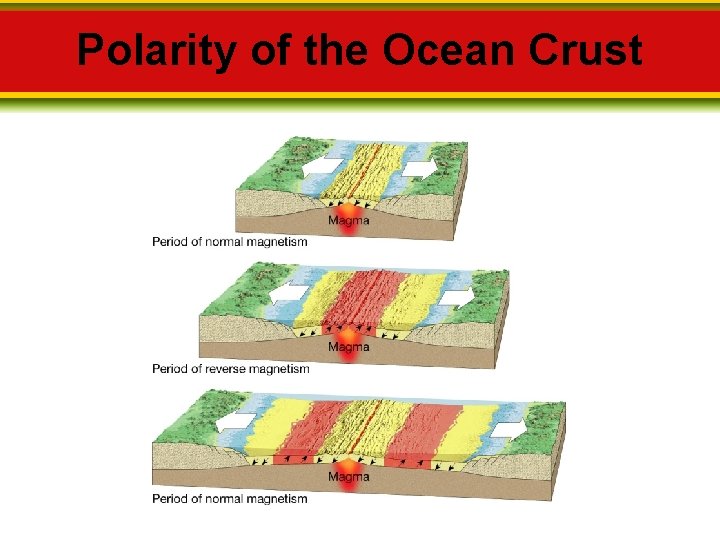
9. 4 Testing Plate Tectonics Evidence for Plate Tectonics The discovery of strips of alternating ______, which lie as mirror images across the ocean ridges, is among the strongest evidence of seafloor spreading.
Polarity of the Ocean Crust
9. 4 Testing Plate Tectonics Evidence for Plate Tectonics Earthquake Patterns • Scientists found a close link between _______ earthquakes and ocean _____. • The absence of deep-focus earthquakes along the oceanic ridge system was shown to be consistent with the new theory.
9. 4 Testing Plate Tectonics Evidence for Plate Tectonics Ocean Drilling • The data on the _____ of seafloor sediment confirmed what the seafloor spreading hypothesis predicted. • The ____est oceanic crust is at the ridge crest (middle), and the ____est oceanic crust is at the continental margins (edges).
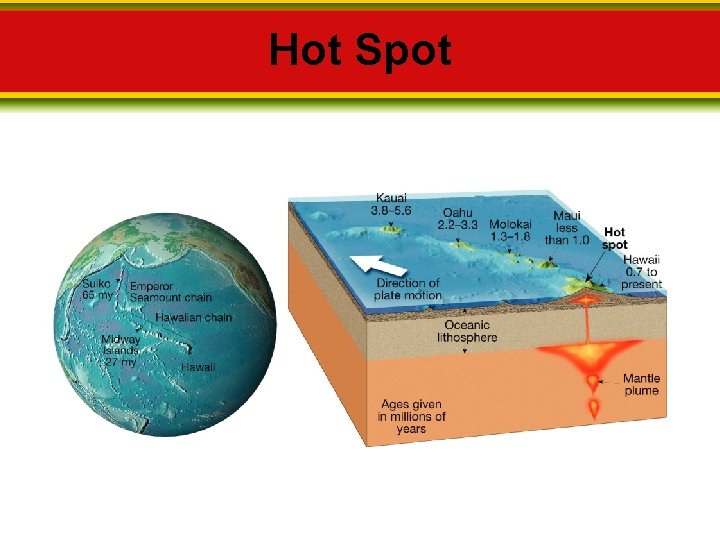
9. 4 Testing Plate Tectonics Evidence for Plate Tectonics Hot Spots • A hot spot is a concentration of heat in the mantle capable of producing magma, which ____ to Earth’s surface; The _____ moves over a hot spot, producing the Hawaiian Islands. • Hot spot evidence supports that the plates move over the Earth’s surface.
Hot Spot
9. 5 Mechanisms of Plate Motion Causes of Plate Motion Scientists generally agree that _____ occurring in the mantle is the basic driving force for plate movement. • ________ flow is the motion of matter resulting from changes in temperature.
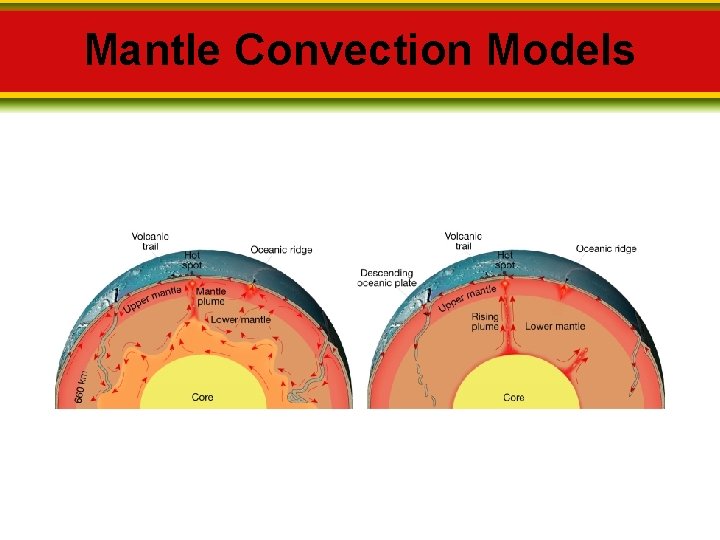
9. 5 Mechanisms of Plate Motion Causes of Plate Motion Slab-Pull and Ridge-Push • Slab-pull is a mechanism that contributes to plate motion in which cool, dense oceanic crust sinks into the mantle and “pulls” the trailing lithosphere along. It is thought to be the primary downward arm of convective flow in the mantle. • Ridge-push causes oceanic lithosphere to slide down the sides of the oceanic ridge under the pull of gravity. It may contribute to plate motion.
9. 5 Mechanisms of Plate Motion Causes of Plate Motion Mantle Convection • _______ are masses of hotter-thannormal mantle material that ascend toward the surface, where they may lead to igneous activity. • The unequal distribution of heat within Earth causes thermal ______ in the mantle that ultimately drives plate motion.
Mantle Convection Models