
Chapter 9 PLANNING TOOLS AND TECHNIQUES 2003 Pearson

- Slides: 29
Chapter 9 PLANNING TOOLS AND TECHNIQUES © 2003 Pearson Education Canada Inc. 9. 1
LEARNING OBJECTIVES • You should be able to: – Describe three techniques for assessing the environment – Describe four techniques for allocating resources – Tell why budgets are popular planning tools – Differentiate Gantt and load charts – Identify the steps in developing a PERT network © 2003 Pearson Education Canada Inc. 9. 2
LEARNING OBJECTIVES (continued) • You should be able to (continued): – State the factors that determine the breakeven point – Describe the requirements for using linear programming – Explain the concept of project management – Tell how managers might use scenarios in planning © 2003 Pearson Education Canada Inc. 9. 3
TECHNIQUES FOR ASSESSING THE ENVIRONMENT • Environmental Scanning – The screening of information to anticipate and interpret changes in the environment – Competitor intelligence - gathering information about one’s competitors – Global scanning - screening of information on global forces that might affect an organization that has global interests © 2003 Pearson Education Canada Inc. 9. 4
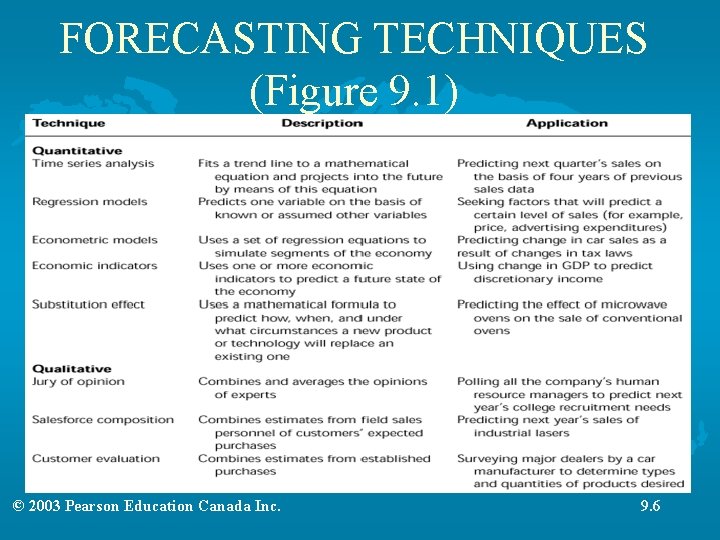
TECHNIQUES FOR ASSESSING THE ENVIRONMENT (continued) • Forecasting – Used to predict future events to facilitate decision making – Techniques • quantitative - applies a set of mathematical rules to a series of past data to predict outcomes • qualitative - uses the judgment and opinions of knowledgeable individuals to predict outcomes © 2003 Pearson Education Canada Inc. 9. 5
FORECASTING TECHNIQUES (Figure 9. 1) © 2003 Pearson Education Canada Inc. 9. 6
TECHNIQUES FOR ASSESSING THE ENVIRONMENT (continued) • Forecasting (continued) – Effectiveness - managers have had mixed success • forecasts are most accurate in relatively stable environments • forecasts are relatively ineffective in predicting nonseasonal events, unusual occurrences, and the actions of competitors • to improve forecasts - use simple forecasting methods © 2003 Pearson Education Canada Inc. 9. 7
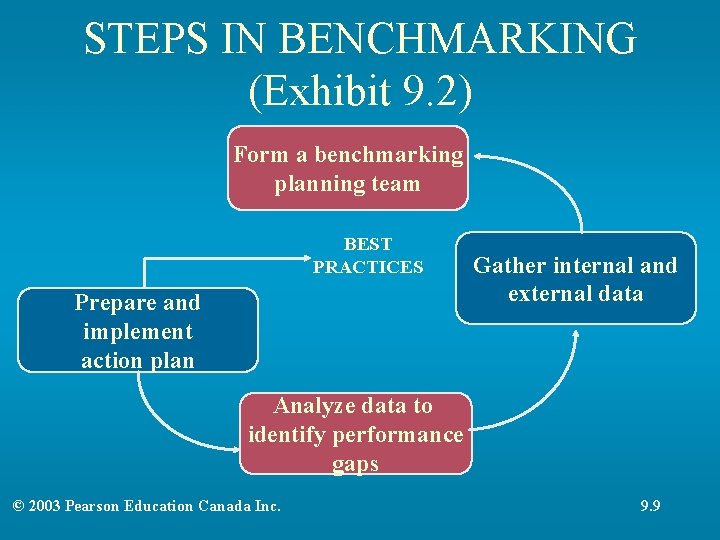
TECHNIQUES FOR ASSESSING THE ENVIRONMENT (continued) • Benchmarking – – – The search for the best practices in other organizations that lead to superior performance Standard tool of many organizations in quest for performance improvement Analyze and then copy the methods used by leaders in various fields Important to identify appropriate targets for benchmarking Organizations may share benchmarking information © 2003 Pearson Education Canada Inc. 9. 8
STEPS IN BENCHMARKING (Exhibit 9. 2) Form a benchmarking planning team BEST PRACTICES Prepare and implement action plan Gather internal and external data Analyze data to identify performance gaps © 2003 Pearson Education Canada Inc. 9. 9
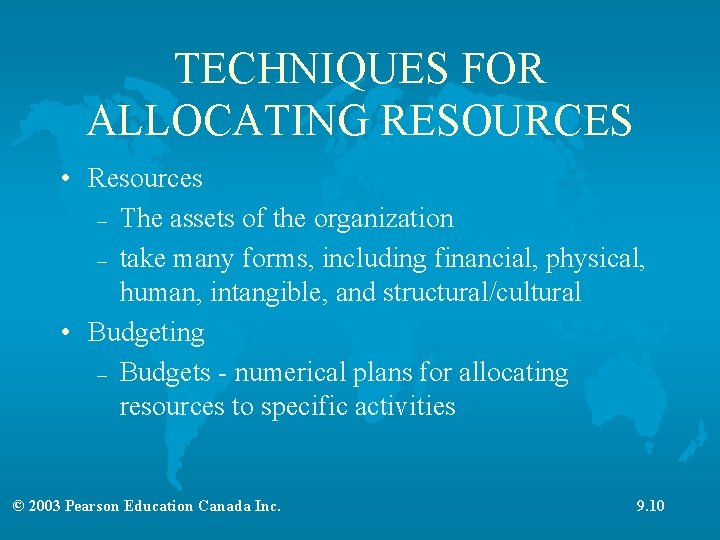
TECHNIQUES FOR ALLOCATING RESOURCES • Resources – The assets of the organization – take many forms, including financial, physical, human, intangible, and structural/cultural • Budgeting – Budgets - numerical plans for allocating resources to specific activities © 2003 Pearson Education Canada Inc. 9. 10
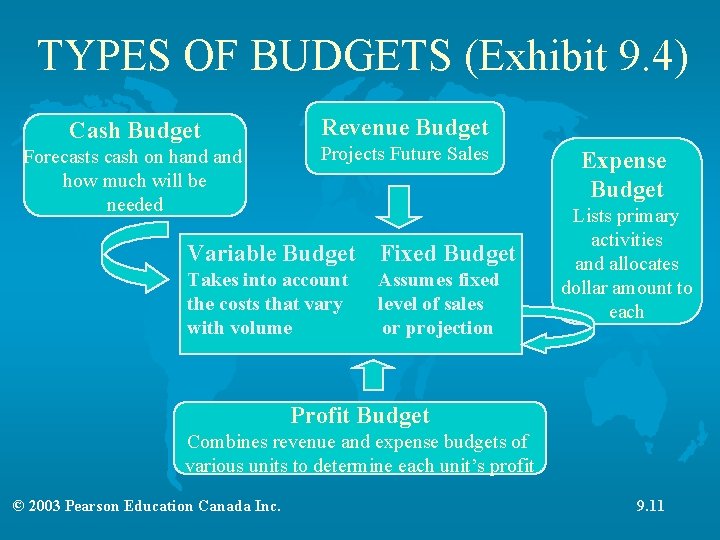
TYPES OF BUDGETS (Exhibit 9. 4) Cash Budget Forecasts cash on hand how much will be needed Revenue Budget Projects Future Sales Variable Budget Fixed Budget Takes into account the costs that vary with volume Assumes fixed level of sales or projection Expense Budget Lists primary activities and allocates dollar amount to each Profit Budget Combines revenue and expense budgets of various units to determine each unit’s profit © 2003 Pearson Education Canada Inc. 9. 11
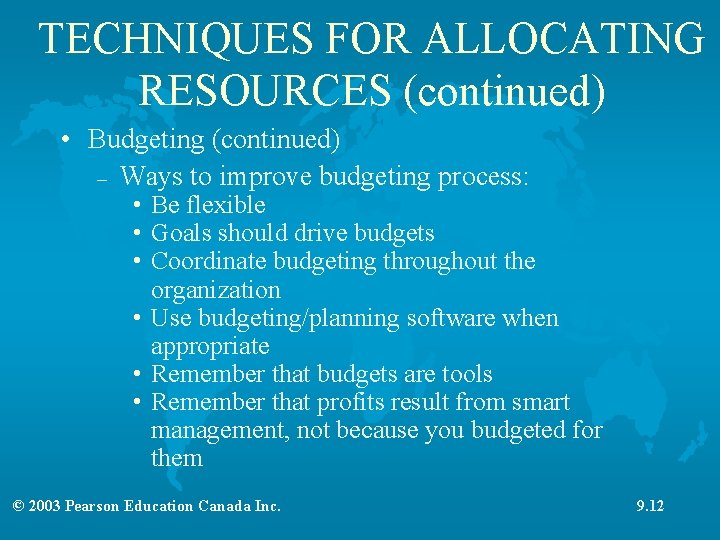
TECHNIQUES FOR ALLOCATING RESOURCES (continued) • Budgeting (continued) – Ways to improve budgeting process: • Be flexible • Goals should drive budgets • Coordinate budgeting throughout the organization • Use budgeting/planning software when appropriate • Remember that budgets are tools • Remember that profits result from smart management, not because you budgeted for them © 2003 Pearson Education Canada Inc. 9. 12
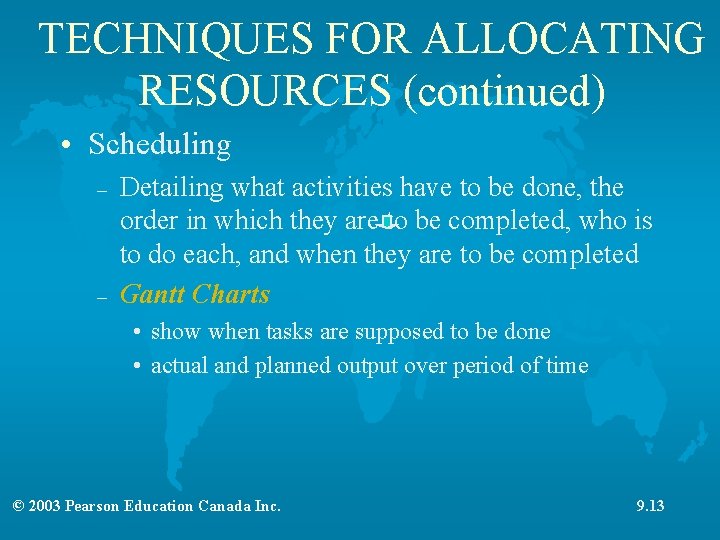
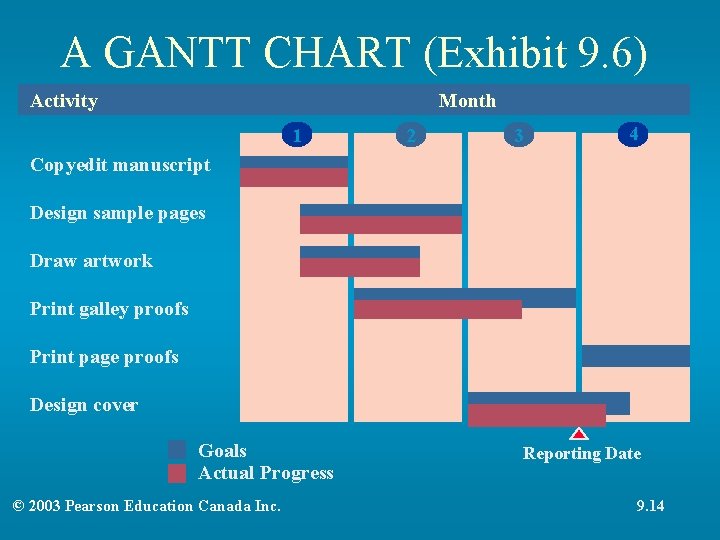
TECHNIQUES FOR ALLOCATING RESOURCES (continued) • Scheduling – – Detailing what activities have to be done, the order in which they are to be completed, who is to do each, and when they are to be completed Gantt Charts • show when tasks are supposed to be done • actual and planned output over period of time © 2003 Pearson Education Canada Inc. 9. 13
A GANTT CHART (Exhibit 9. 6) Activity Month 1 2 3 4 Copyedit manuscript Design sample pages Draw artwork Print galley proofs Print page proofs Design cover Goals Actual Progress © 2003 Pearson Education Canada Inc. Reporting Date 9. 14
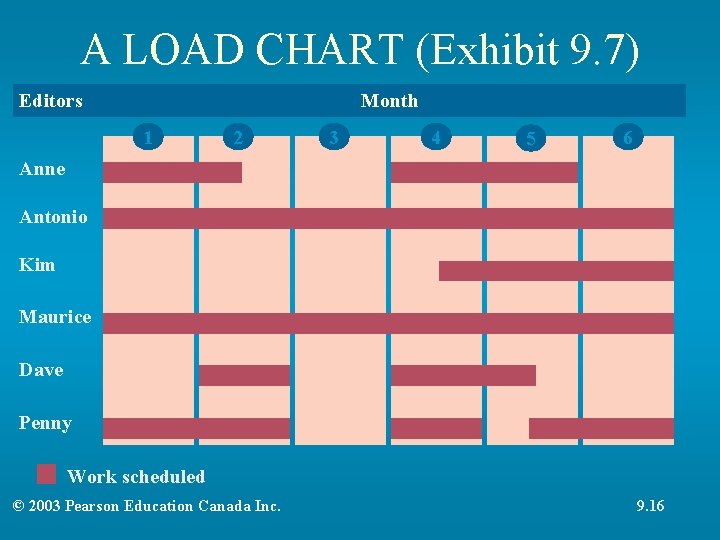
TECHNIQUES FOR ALLOCATING RESOURCES (continued) • Scheduling (continued) – Load Charts - modified Gantt Chart • schedule capacity by work areas – vertical axis lists either entire departments or specific resources • allow managers to plan and control capacity utilization © 2003 Pearson Education Canada Inc. 9. 15
A LOAD CHART (Exhibit 9. 7) Editors Month 1 2 3 4 5 6 Anne Antonio Kim Maurice Dave Penny Work scheduled © 2003 Pearson Education Canada Inc. 9. 16
TECHNIQUES FOR ALLOCATING RESOURCES (continued) • Scheduling (continued) – PERT (Program Evaluation and Review Technique) Network Analysis • used to schedule complex projects • flowchart diagram that depicts the sequence of activities needed to complete a project • indicates the time or costs associated with each activity • can compare the effects alternative actions might have on scheduling and costs © 2003 Pearson Education Canada Inc. 9. 17
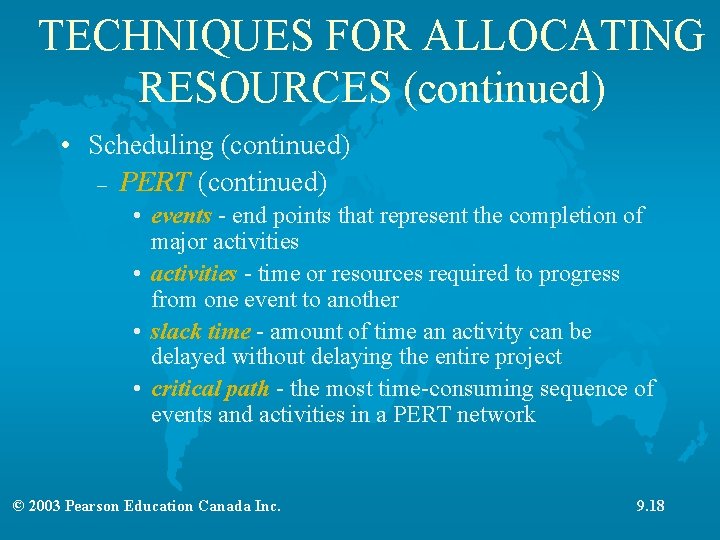
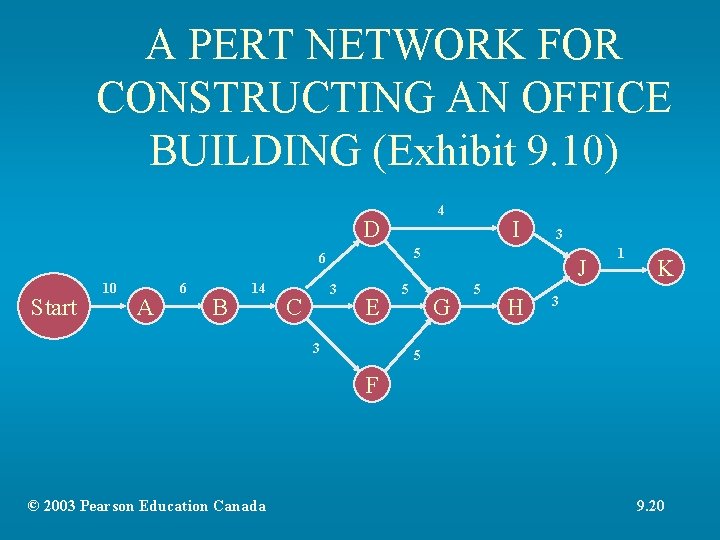
TECHNIQUES FOR ALLOCATING RESOURCES (continued) • Scheduling (continued) – PERT (continued) • events - end points that represent the completion of major activities • activities - time or resources required to progress from one event to another • slack time - amount of time an activity can be delayed without delaying the entire project • critical path - the most time-consuming sequence of events and activities in a PERT network © 2003 Pearson Education Canada Inc. 9. 18
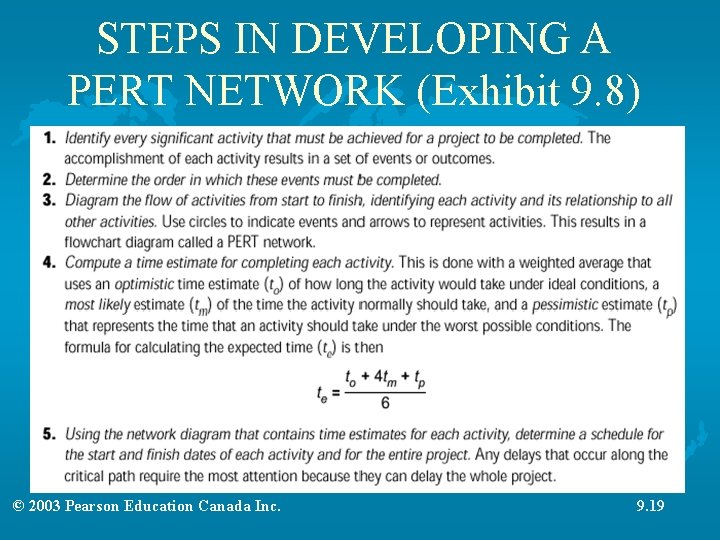
STEPS IN DEVELOPING A PERT NETWORK (Exhibit 9. 8) © 2003 Pearson Education Canada Inc. 9. 19
A PERT NETWORK FOR CONSTRUCTING AN OFFICE BUILDING (Exhibit 9. 10) 4 D Start A 6 B 14 3 C 3 5 6 10 I E 3 5 J G 5 H 1 K 3 5 F © 2003 Pearson Education Canada 9. 20
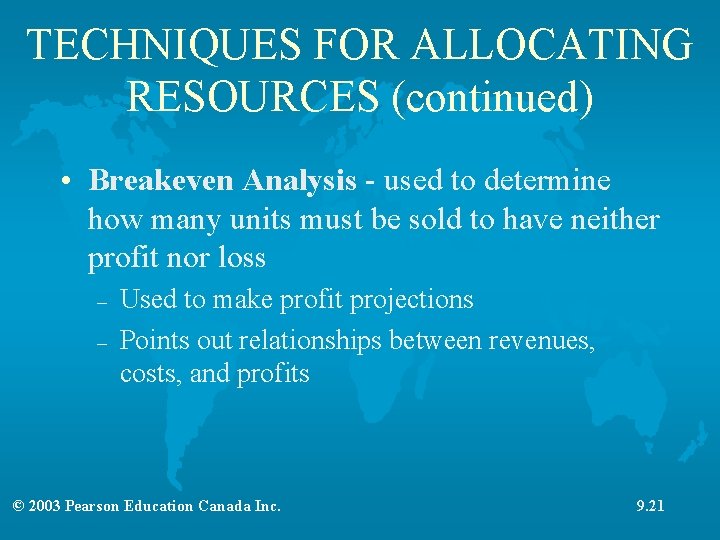
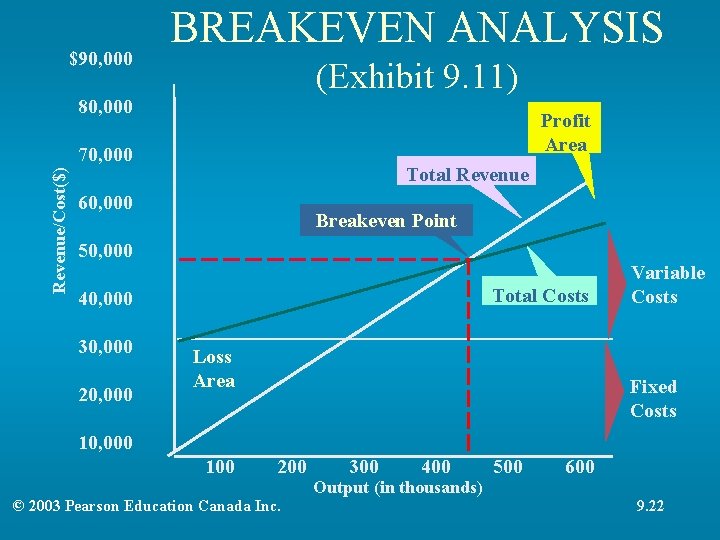
TECHNIQUES FOR ALLOCATING RESOURCES (continued) • Breakeven Analysis - used to determine how many units must be sold to have neither profit nor loss – – Used to make profit projections Points out relationships between revenues, costs, and profits © 2003 Pearson Education Canada Inc. 9. 21
$90, 000 BREAKEVEN ANALYSIS (Exhibit 9. 11) 80, 000 Profit Area Revenue/Cost($) 70, 000 Total Revenue 60, 000 Breakeven Point 50, 000 Total Costs 40, 000 30, 000 20, 000 Loss Area Variable Costs Fixed Costs 10, 000 100 200 © 2003 Pearson Education Canada Inc. 300 400 Output (in thousands) 500 600 9. 22
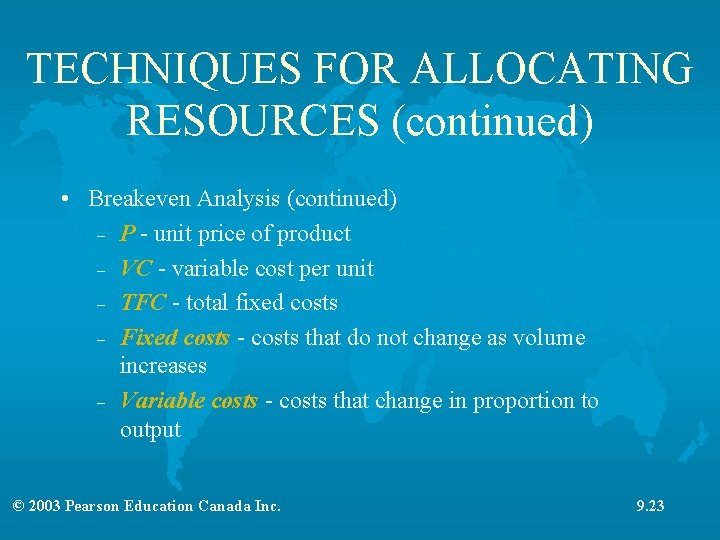
TECHNIQUES FOR ALLOCATING RESOURCES (continued) • Breakeven Analysis (continued) – P - unit price of product – VC - variable cost per unit – TFC - total fixed costs – Fixed costs - costs that do not change as volume increases – Variable costs - costs that change in proportion to output © 2003 Pearson Education Canada Inc. 9. 23
TECHNIQUES FOR ALLOCATING RESOURCES (continued) • Linear Programming – Mathematical technique that solve resource allocation problems – Requirements • resources are limited • outcome optimization is the goal • alternative methods exist for combining resources to produce a number of output mixes • a linear relationship exists between variables – technique has a variety of applications © 2003 Pearson Education Canada Inc. 9. 24
CONTEMPORARY PLANNING TECHNIQUES • Project Management – The task of getting a project’s activities done on time, within budget, and according to specifications • project - a one-time-only set of activities that has a definite beginning and ending point in time – Standardized planning procedures often are not appropriate for projects © 2003 Pearson Education Canada Inc. 9. 25
CONTEMPORARY PLANNING TECHNIQUES (continued) • Project Management (continued) – Project Management Process • team created from appropriate work areas • team reports to a project manager • project manager coordinates activities • team disbands when project is completed © 2003 Pearson Education Canada Inc. 9. 26
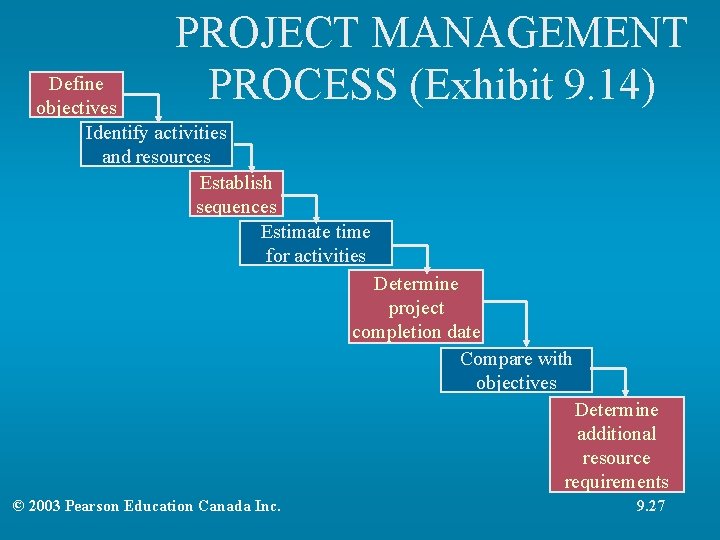
PROJECT MANAGEMENT PROCESS (Exhibit 9. 14) Define objectives Identify activities and resources Establish sequences Estimate time for activities Determine project completion date Compare with objectives Determine additional resource requirements © 2003 Pearson Education Canada Inc. 9. 27
CONTEMPORARY PLANNING TECHNIQUES (continued) • Project Management (continued) – Role of the Project Manager • role is affected by the one-shot nature of the project • role is difficult because team members still linked to their permanent work areas • managers must rely on their communication skills and powers of persuasion © 2003 Pearson Education Canada Inc. 9. 28
CONTEMPORARY PLANNING TECHNIQUES (continued) • Scenario Planning – Scenario - an imagined sequence of future events – Contingency planning - “if this happens, then these are the actions to take” – Intent is to reduce uncertainty by playing out potential situations under different specified conditions © 2003 Pearson Education Canada Inc. 9. 28