
Chapter 9 Planning for Learning Ashley Blakely AnneEliese
Chapter 9 Planning for Learning Ashley Blakely Anne-Eliese Raya Shanda Carpenter
“We are moving from thinking only about what we want to accomplish as the designer to thinking about who the learners – the endusers of our design – are and what they will need, individually and collectively, to achieve the desired results of Stage 1 and to perform well at the tasks proposed in Stage 2. ” (Wiggins & Mc. Tighe, 191)
Essential Questions: • What do learners need, given the desired results. • What is the best use of time spent in and out of the classroom, given the performance goals?
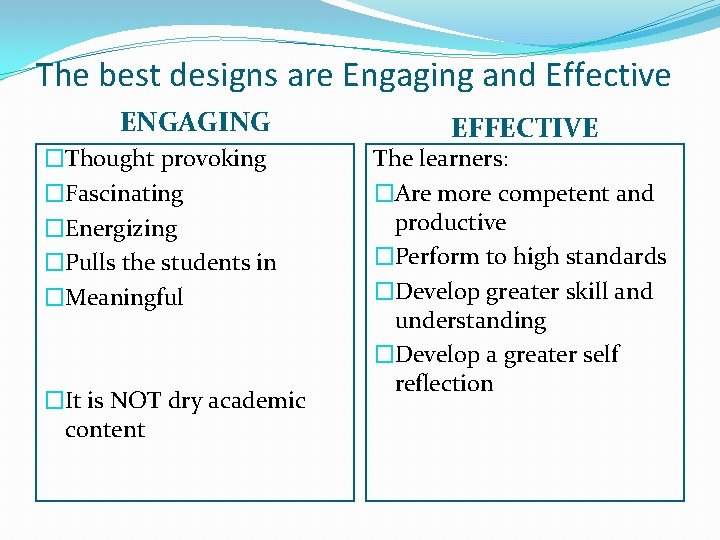
The best designs are Engaging and Effective ENGAGING �Thought provoking �Fascinating �Energizing �Pulls the students in �Meaningful �It is NOT dry academic content EFFECTIVE The learners: �Are more competent and productive �Perform to high standards �Develop greater skill and understanding �Develop a greater self reflection
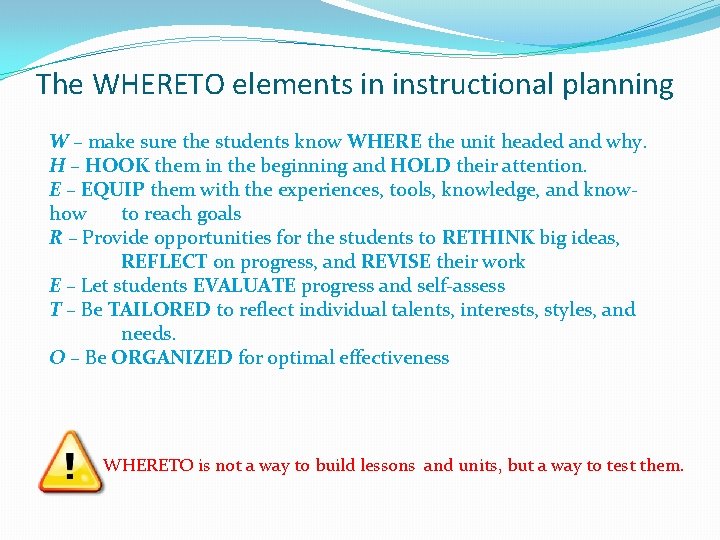
The WHERETO elements in instructional planning W – make sure the students know WHERE the unit headed and why. H – HOOK them in the beginning and HOLD their attention. E – EQUIP them with the experiences, tools, knowledge, and knowhow to reach goals R – Provide opportunities for the students to RETHINK big ideas, REFLECT on progress, and REVISE their work E – Let students EVALUATE progress and self-assess T – Be TAILORED to reflect individual talents, interests, styles, and needs. O – Be ORGANIZED for optimal effectiveness WHERETO is not a way to build lessons and units, but a way to test them.
Reference Page Wiggins, G. & Mc. Tighe, J. (2006) Understanding by Design. Upper Saddle River, New Jersey: Person Merrill Prentice Hall.

- Slides: 7