
Chapter 9 Planning and Learning Objectives of this
Chapter 9: Planning and Learning Objectives of this chapter: p Use of environment models p Integration of planning and learning methods R. S. Sutton and A. G. Barto: Reinforcement Learning: An Introduction 1
Models p Model: anything the agent can use to predict how the environment will respond to its actions p Distribution model: description of all possibilities and their probabilities n e. g. , p Sample model: produces sample experiences n e. g. , a simulation model p Both types of models can be used to produce simulated experience p Often sample models are much easier to come by R. S. Sutton and A. G. Barto: Reinforcement Learning: An Introduction 2
Planning p Planning: any computational process that uses a model to create or improve a policy p Planning in AI: n state-space planning n plan-space planning (e. g. , partial-order planner) p We take the following (unusual) view: n all state-space planning methods involve computing value functions, either explicitly or implicitly n they all apply backups to simulated experience R. S. Sutton and A. G. Barto: Reinforcement Learning: An Introduction 3
Planning Cont. p Classical DP methods are state-space planning methods p Heuristic search methods are state-space planning methods p A planning method based on Q-learning: Random-Sample One-Step Tabular Q-Planning R. S. Sutton and A. G. Barto: Reinforcement Learning: An Introduction 4
Learning, Planning, and Acting p Two uses of real experience: n model learning: to improve the model n direct RL: to directly improve the value function and policy p Improving value function and/or policy via a model is sometimes called indirect RL or modelbased R�L. Here, we call it planning. R. S. Sutton and A. G. Barto: Reinforcement Learning: An Introduction 5

Direct vs. Indirect RL p Indirect methods: n make fuller use of experience: get better policy with fewer environment interactions p Direct methods n simpler n not affected by bad models But they are very closely related and can be usefully combined: planning, acting, model learning, and direct RL can occur simultaneously and in parallel R. S. Sutton and A. G. Barto: Reinforcement Learning: An Introduction 6
The Dyna Architecture (Sutton 1990) R. S. Sutton and A. G. Barto: Reinforcement Learning: An Introduction 7
The Dyna-Q Algorithm direct RL model learning planning R. S. Sutton and A. G. Barto: Reinforcement Learning: An Introduction 8
Dyna-Q on a Simple Maze rewards = 0 until goal, when =1 R. S. Sutton and A. G. Barto: Reinforcement Learning: An Introduction 9
Dyna-Q Snapshots: Midway in 2 nd Episode R. S. Sutton and A. G. Barto: Reinforcement Learning: An Introduction 10
When the Model is Wrong: Blocking Maze The changed envirnoment is harder R. S. Sutton and A. G. Barto: Reinforcement Learning: An Introduction 11
Shortcut Maze The changed environment is easier R. S. Sutton and A. G. Barto: Reinforcement Learning: An Introduction 12
What is + Dyna-Q ? p Uses an “exploration bonus”: n Keeps track of time since each state-action pair was tried for real n An extra reward is added for transitions caused by stateaction pairs related to how long ago they were tried: the longer unvisited, the more reward for visiting n The agent actually “plans” how to visit long unvisited states R. S. Sutton and A. G. Barto: Reinforcement Learning: An Introduction 13
Prioritized Sweeping p Which states or state-action pairs should be generated during planning? p Work backwards from states whose values have just changed: n Maintain a queue of state-action pairs whose values would change a lot if backed up, prioritized by the size of the change n When a new backup occurs, insert predecessors according to their priorities n Always perform backups from first in queue p Moore and Atkeson 1993; Peng and Williams, 1993 R. S. Sutton and A. G. Barto: Reinforcement Learning: An Introduction 14
Prioritized Sweeping R. S. Sutton and A. G. Barto: Reinforcement Learning: An Introduction 15
Prioritized Sweeping vs. Dyna-Q Both use N=5 backups per environmental interaction R. S. Sutton and A. G. Barto: Reinforcement Learning: An Introduction 16
Rod Maneuvering (Moore and Atkeson 1993) R. S. Sutton and A. G. Barto: Reinforcement Learning: An Introduction 17
Full and Sample (One-Step) Backups R. S. Sutton and A. G. Barto: Reinforcement Learning: An Introduction 18
Full vs. Sample Backups b successor states, equally likely; initial error = 1; assume all next states’ values are correct R. S. Sutton and A. G. Barto: Reinforcement Learning: An Introduction 19
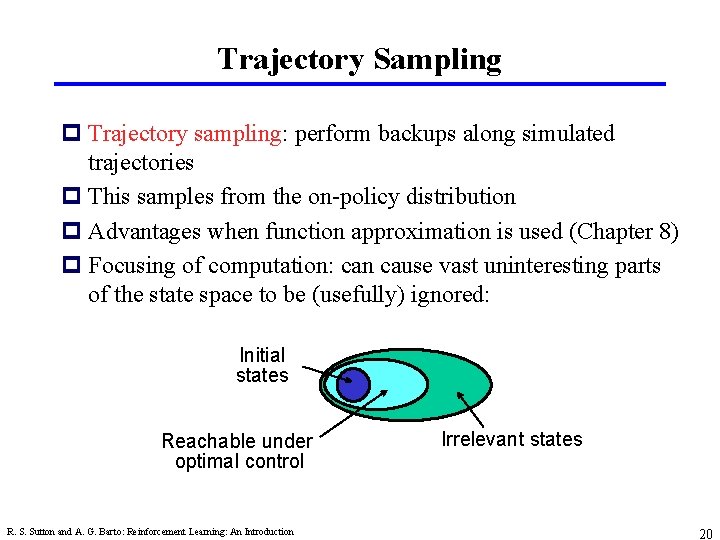
Trajectory Sampling p Trajectory sampling: perform backups along simulated trajectories p This samples from the on-policy distribution p Advantages when function approximation is used (Chapter 8) p Focusing of computation: can cause vast uninteresting parts of the state space to be (usefully) ignored: Initial states Reachable under optimal control R. S. Sutton and A. G. Barto: Reinforcement Learning: An Introduction Irrelevant states 20
Trajectory Sampling Experiment p one-step full tabular backups p uniform: cycled through all stateaction pairs p on-policy: backed up along simulated trajectories p 200 randomly generated undiscounted episodic tasks p 2 actions for each state, each with b equally likely next states p. 1 prob of transition to terminal state p expected reward on each transition selected from mean 0 variance 1 Gaussian R. S. Sutton and A. G. Barto: Reinforcement Learning: An Introduction 21
Heuristic Search p Used for action selection, not for changing a value function (=heuristic evaluation function) p Backed-up values are computed, but typically discarded p Extension of the idea of a greedy policy — only deeper p Also suggests ways to select states to backup: smart focusing: R. S. Sutton and A. G. Barto: Reinforcement Learning: An Introduction 22
Summary p Emphasized close relationship between planning and learning p Important distinction between distribution models and sample models p Looked at some ways to integrate planning and learning n synergy among planning, acting, model learning p Distribution of backups: focus of the computation n trajectory sampling: backup along trajectories n prioritized sweeping n heuristic search p Size of backups: full vs. sample; deep vs. shallow R. S. Sutton and A. G. Barto: Reinforcement Learning: An Introduction 23
- Slides: 23