
CHAPTER 9 PERSONALITY DISORDERS FEATURES OF PERSONALITY DISORDERS
- Slides: 14
CHAPTER 9 PERSONALITY DISORDERS
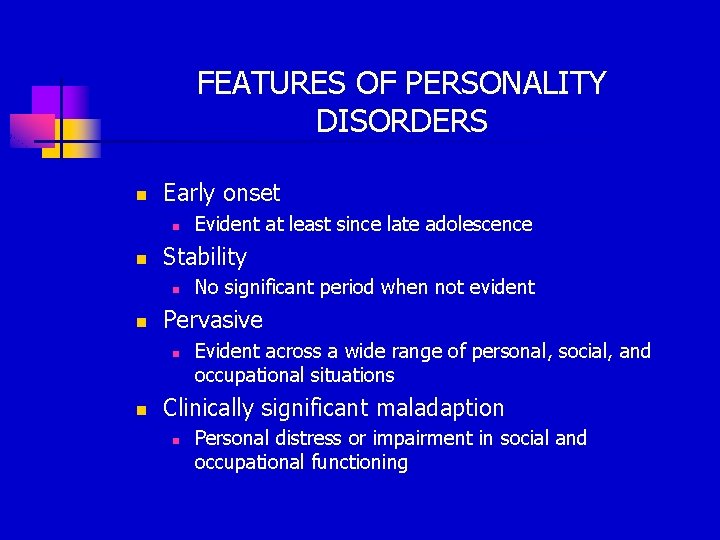
FEATURES OF PERSONALITY DISORDERS n Early onset n n Stability n n No significant period when not evident Pervasive n n Evident at least since late adolescence Evident across a wide range of personal, social, and occupational situations Clinically significant maladaption n Personal distress or impairment in social and occupational functioning
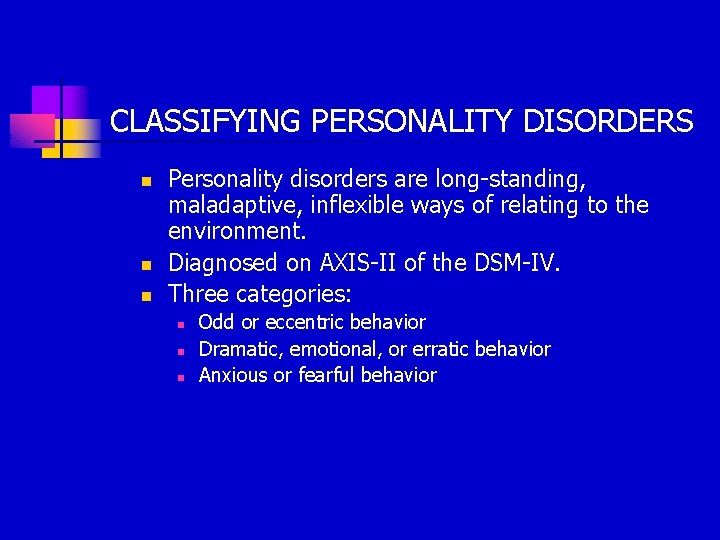
CLASSIFYING PERSONALITY DISORDERS n n n Personality disorders are long-standing, maladaptive, inflexible ways of relating to the environment. Diagnosed on AXIS-II of the DSM-IV. Three categories: n n n Odd or eccentric behavior Dramatic, emotional, or erratic behavior Anxious or fearful behavior
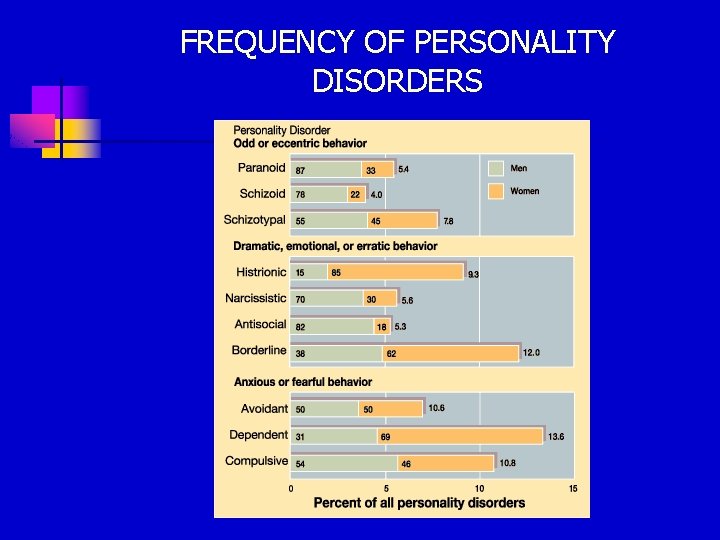
FREQUENCY OF PERSONALITY DISORDERS
ODD OR ECCENTRIC BEHAVIOR n n n Paranoid personality disorder n Suspicious or mistrusting of others n Hypersensitive Schizoid personality disorder n Withdrawn and reclusive n Not interested in relationships with other Schizotypal personality disorder n Odd ways of thinking, perceiving, communicating, and behaving n May be a weak form of schizophrenia
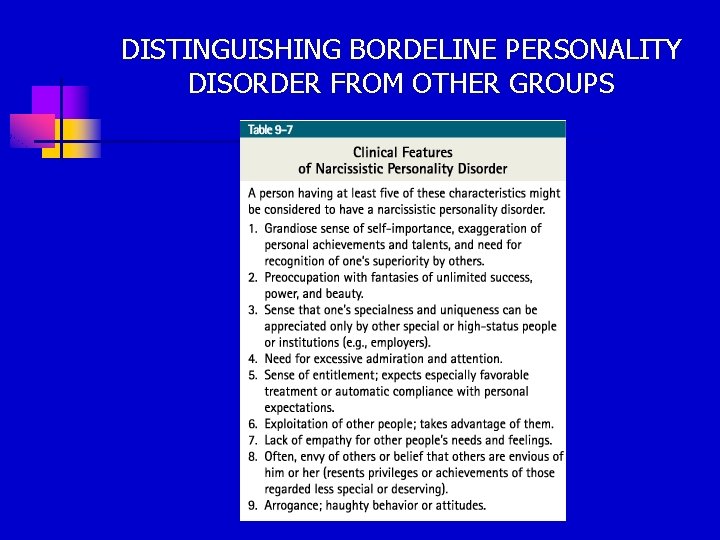
DRAMATIC, EMOTIONAL, OR ERRATIC BEHAVIOR n n Histrionic Personality Disorder n Self-centered and manipulative n Have stormy relationships Narcissistic Personality Disorder n Extreme sense of self-importance, yet with fragile self-esteem n Need for constant attention, lack of empathy for others Borderline Personality Disorder n Threaten and engage in self-destructive behavior n Impulsive n Unstable relationships, dependency on and manipulation of others Antisocial Personality Disorder n Chronic behavior that violates others’ rights and which began before the age of 15 n Likely to be reckless and sexually promiscuous n Lack of remorse for hurting others
CAUSES OF BORDERLINE PERSONALITY DISORDER n n Disturbed early relationship with parent Some have been physically or sexually abused Genetic vulnerability Splitting - Failure to integrate positive and negative experiences that occur between individual and other people
TREATMENT OF BORDERLINE PERSONALITY DISORDER n n n n n Identify its most distinctive features Psychodynamic therapy Cognitive therapy Behavior therapy Biological – Medication Combination of approaches is most effective Long-term prognosis is poor, though some improve Risk for alcoholism High suicide risk – 8 to 10% commit suicide; far more attempt suicide.
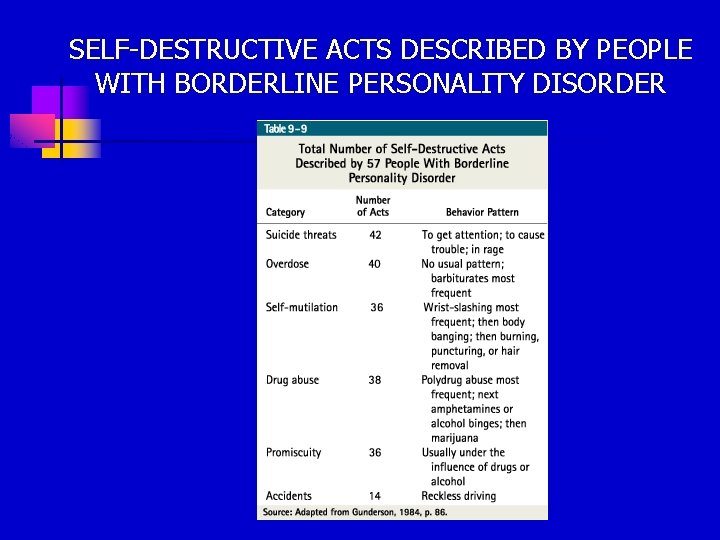
SELF-DESTRUCTIVE ACTS DESCRIBED BY PEOPLE WITH BORDERLINE PERSONALITY DISORDER
DISTINGUISHING BORDELINE PERSONALITY DISORDER FROM OTHER GROUPS
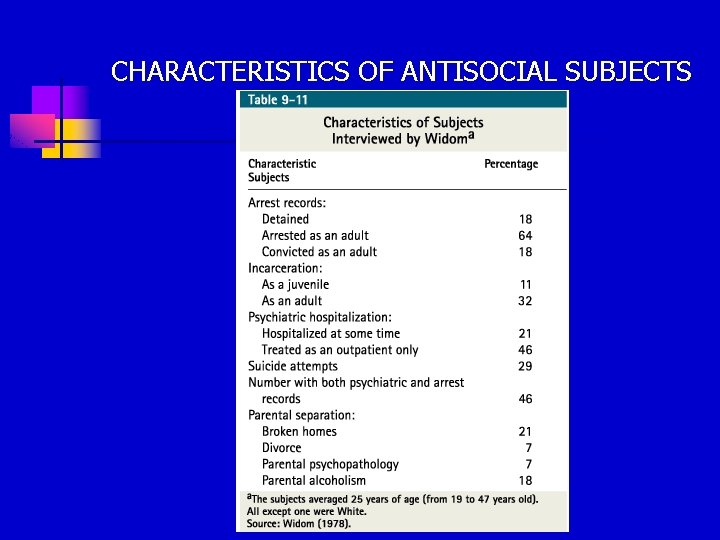
CHARACTERISTICS OF ANTISOCIAL SUBJECTS
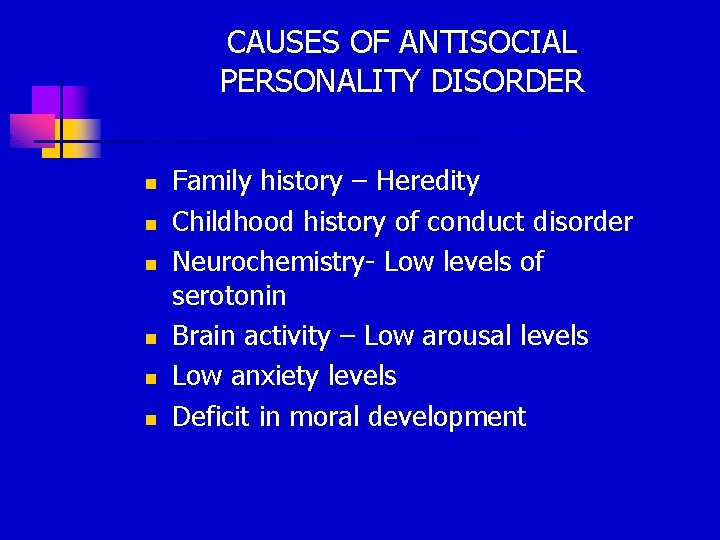
CAUSES OF ANTISOCIAL PERSONALITY DISORDER n n n Family history – Heredity Childhood history of conduct disorder Neurochemistry- Low levels of serotonin Brain activity – Low arousal levels Low anxiety levels Deficit in moral development
TREATMENT OF ANTISOCIAL PERSONALITY DISORDER n n Traditional psychotherapy not effective Highly structured, residential treatment, especially in correctional settings, is effective. Structured community alternatives to prison have some effect. Prognosis is poor.
ANXIOUS OR FEARFUL BEHAVIOR n Avoidant Personality Disorder n n Dependent Personality Disorder n n n Low-self esteem Worry about negative evaluation by others, but desire affection and relationships Avoid social interaction Lack confidence in ability to function independently Subordinate their needs to wishes of others to maintain relationship Obsessive-Compulsive Personality Disorder n n n Extreme perfectionism Rigid approach to doing things Lack of ability to express warm emotions