
Chapter 9 Personal Selling Relationship Building and Sales
Chapter 9 Personal Selling, Relationship Building, and Sales Management Key Terms Information Provision, Persuasion, After-sale Service, Prospecting, Random Lead Generation, Lead, Selected-lead Searching, Planning the Sales Call, Presenting, Responding to Objections, Obtaining Commitment, Long-term Relationship, Functional Relationships, Strategic Alliances, Missionary Salespeople, Technical Sales Specialist, Cross-functional Sales Team, Sales Force Organization, Forecasting Sales, Sales Territories and Quotas, Salary, Commission Mc. Graw-Hill/Irwin © 2009 The Mc. Graw-Hill Companies, All Rights Reserved
Personal Selling – Definition • Defined as a two-way flow of communication between a potential buyer and a salesperson • Use of personal selling depends partially on the nature of product • Key role played by salesperson in providing information about product • Use personal selling when products are • • • New and different Technically complex Expensive and require negotiation Mc. Graw-Hill/Irwin © 2009 The Mc. Graw-Hill Companies, All Rights Reserved
Sales Process • Refers to two basic factors • • The objectives the salesperson is trying to achieve while engaged in selling activities The sequence of stages or steps the salesperson should follow to achieve the objectives (relationshipbuilding process) Mc. Graw-Hill/Irwin © 2009 The Mc. Graw-Hill Companies, All Rights Reserved
Sales Force Objectives • Information provision • Persuasion • After-sale service Mc. Graw-Hill/Irwin © 2009 The Mc. Graw-Hill Companies, All Rights Reserved
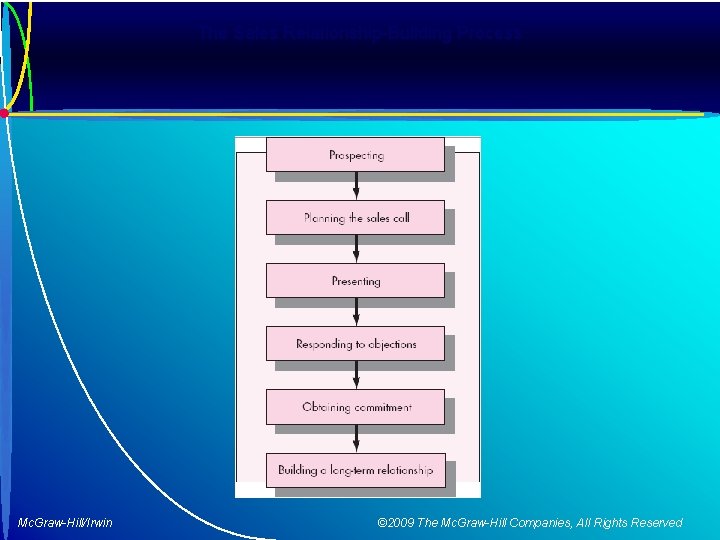
The Sales Relationship-Building Process Mc. Graw-Hill/Irwin © 2009 The Mc. Graw-Hill Companies, All Rights Reserved
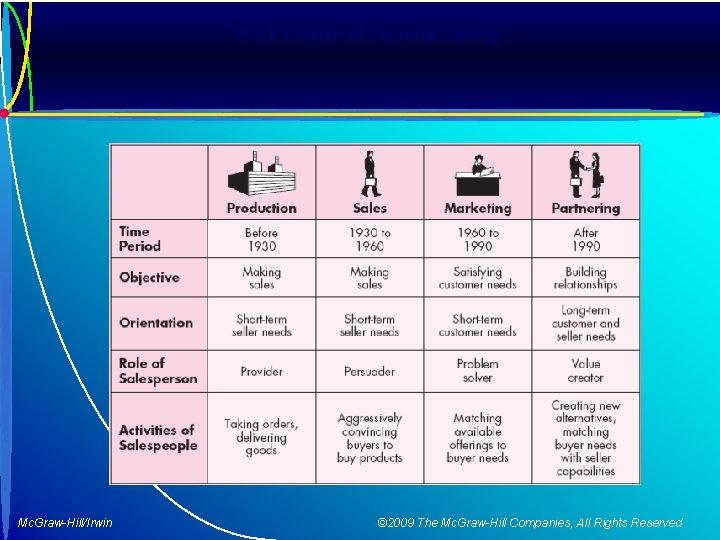
The Evolution of Personal Selling Mc. Graw-Hill/Irwin © 2009 The Mc. Graw-Hill Companies, All Rights Reserved
Prospecting – Locating Potential Customers • Lead – A candidate to whom a sale can be made – target of prospecting process • Random lead generation – Mass appeals that require a high number of contacts to generate qualified leads • Selected-lead searching – Uses existing contact to generate new ones – often called referrals Mc. Graw-Hill/Irwin © 2009 The Mc. Graw-Hill Companies, All Rights Reserved
Prospecting – A Screening Process • Does the lead have a want or need that can be satisfied by the purchase of the firm’s products or services? • Does the lead have the ability to pay? • Does the lead have the authority to pay? • Can the lead be approached favorably? • Is the lead eligible to buy? Mc. Graw-Hill/Irwin © 2009 The Mc. Graw-Hill Companies, All Rights Reserved
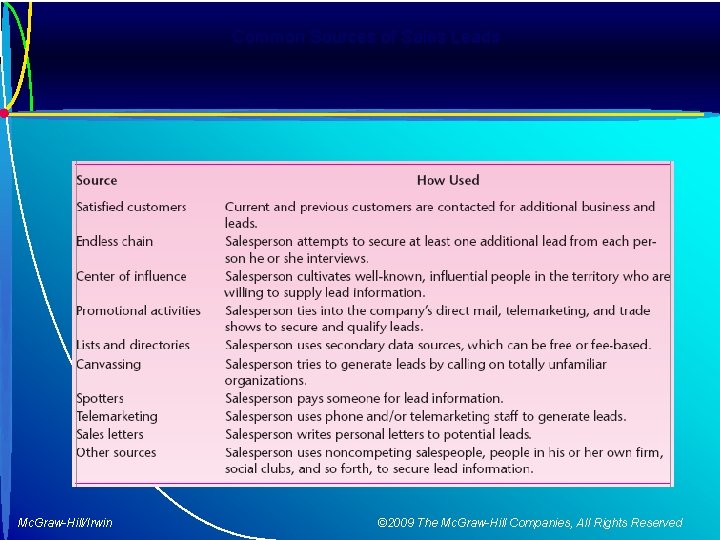
Common Sources of Sales Leads Mc. Graw-Hill/Irwin © 2009 The Mc. Graw-Hill Companies, All Rights Reserved
Planning the Sales Call • Thorough knowledge of representative company, including past history • Thorough knowledge of products and product lines • Good working knowledge of competitor’s products and product line • In-depth knowledge of the market for their merchandise • Accurate knowledge of buyer, or prospect Mc. Graw-Hill/Irwin © 2009 The Mc. Graw-Hill Companies, All Rights Reserved
Presenting • • Be well prepared and set a goal for your presentation Develop a checklist of items for discussion Development of good interpersonal skills Adapt your style to the prospect Mc. Graw-Hill/Irwin © 2009 The Mc. Graw-Hill Companies, All Rights Reserved
Overcoming Objections • Expect objections to occur at any time • • During efforts to secure appointments During the presentation and subsequent relationship During attempts to obtain a commitment During the after-sale follow-up • In response to an objection, a sales person should not challenge the customer • Make the necessary presentation in order to help the client make an intelligent decision Mc. Graw-Hill/Irwin © 2009 The Mc. Graw-Hill Companies, All Rights Reserved
Obtaining Commitment • Important to know how and when to close a sale • Not all sales end in a successful closing – Salespeople should analyze the reasons and determine whether • • More sales calls are necessary to obtain commitment Currently, there just does not exist a good match between customer needs and seller offerings Mc. Graw-Hill/Irwin © 2009 The Mc. Graw-Hill Companies, All Rights Reserved
Building Long-Term Relationships • After-marketing activities include • • • Establishing and maintaining a customer information file Monitoring order processing Ensuring initial proper use of product or service Providing customers ongoing guidance and support Analyzing customer feedback and responding quickly to questions and complaints Continually conducting customer satisfaction research and responding to it Mc. Graw-Hill/Irwin © 2009 The Mc. Graw-Hill Companies, All Rights Reserved
Relationships Can Lead to Partnerships • Functional relationships – When a buyer and a salesperson has a problem, they work together to solve it • Strategic relationships (strategic alliances) – Longterm, formal relationships in which both parties make significant commitments and investments in each other in order to pursue mutual goals and to improve the profitability of each other Mc. Graw-Hill/Irwin © 2009 The Mc. Graw-Hill Companies, All Rights Reserved
People Who Support the Sales Force • Missionary salespeople – Focus solely on promoting existing products and introduction of new products (e. g. : pharmaceuticals) • Technical sales specialists – Support the sales staff by providing training or other technical assistance • Cross-functional sales team – Increased in popularity since products increase in technical complexity, and units of the buying organization require specialized knowledge Mc. Graw-Hill/Irwin © 2009 The Mc. Graw-Hill Companies, All Rights Reserved
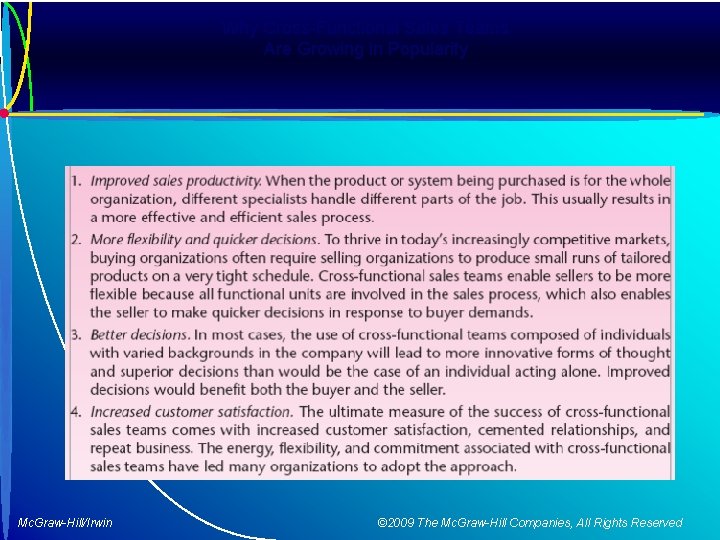
Why Cross-Functional Sales Teams Are Growing in Popularity Mc. Graw-Hill/Irwin © 2009 The Mc. Graw-Hill Companies, All Rights Reserved
Managing the Sales and Relationship-Building Process • Efficient and effective sales tools, continuous sales training, and adequate support from promotional tools • Efficient delivery and reorder system • Equitable compensation plan to reward and motivate performance, and promote company loyalty • Adequate supervision and evaluation of performance for continual improvement Mc. Graw-Hill/Irwin © 2009 The Mc. Graw-Hill Companies, All Rights Reserved
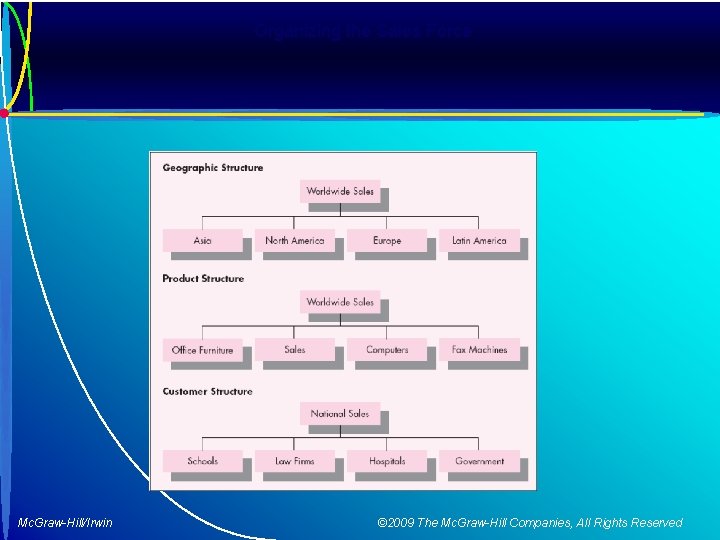
Organizing the Sales Force Mc. Graw-Hill/Irwin © 2009 The Mc. Graw-Hill Companies, All Rights Reserved
Sales Management Task – Sales Force Organization • Geographic structure – Provides practical benefit of limiting the distance each salesperson must travel • Product structure – Useful when sales force must have specific technical knowledge about products • Customer structure – Works best when different types of buyers have large or significantly different needs • Major account management – Use of team selling to focus on major customers to establish long-term relationships Mc. Graw-Hill/Irwin © 2009 The Mc. Graw-Hill Companies, All Rights Reserved
Forecasting Sales • Estimate of how much of the company’s output, either in dollars or in units, can be sold during a specified future period under a proposed marketing plan and under an assumed set of economic conditions • Used to • • Establish sales quotas Plan the personal selling efforts and other types of promotional activities Budget selling expenses Plan and coordinate production, logistics, inventories, personnel, and so forth Mc. Graw-Hill/Irwin © 2009 The Mc. Graw-Hill Companies, All Rights Reserved
Forecasting Methods • Jury of executive opinion method – Combines and averages views of top management from different departments • Sales force composite method – Sales force becomes the jury • Customer expectations method – Asks customer about the quantity they expect to purchase Mc. Graw-Hill/Irwin © 2009 The Mc. Graw-Hill Companies, All Rights Reserved
Forecasting Methods • Time-series analysis – Analyzes past sales data and the impact of factors influencing sales • Correlation analysis – Measures relationship between dependent and independent variables • Other quantitative techniques – Growth functions and simulation models Mc. Graw-Hill/Irwin © 2009 The Mc. Graw-Hill Companies, All Rights Reserved
Sales Territories and Quotas • Sales territories can be segmented on the bases of • • Geography Product specialization • Sales quotas • • Provide incentives for salespeople Provide a quantitative standard for performance measurement Evaluate and control the efforts of the sales force Activity quotas – Allows monitoring of whether salespersons are engaging in activities to the extent desired Mc. Graw-Hill/Irwin © 2009 The Mc. Graw-Hill Companies, All Rights Reserved
Sales Territories and Quotas • Sales quotas represent specific sales goals assigned to each territory or unit over designated time period • Management needs to consider these key factors • • • All territories will not have equal potential and, hence, compensation must be adjusted All salespeople will not have equal ability and assignments may have to be made accordingly Sales task in each territory may differ from time period to time period • Analyzing expenses – Sales forecasts should include a sales expense budget Mc. Graw-Hill/Irwin © 2009 The Mc. Graw-Hill Companies, All Rights Reserved
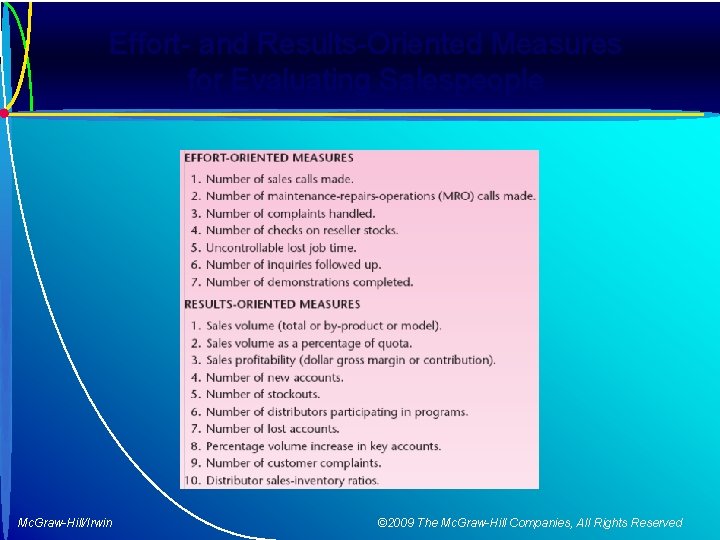
Effort- and Results-Oriented Measures for Evaluating Salespeople Mc. Graw-Hill/Irwin © 2009 The Mc. Graw-Hill Companies, All Rights Reserved
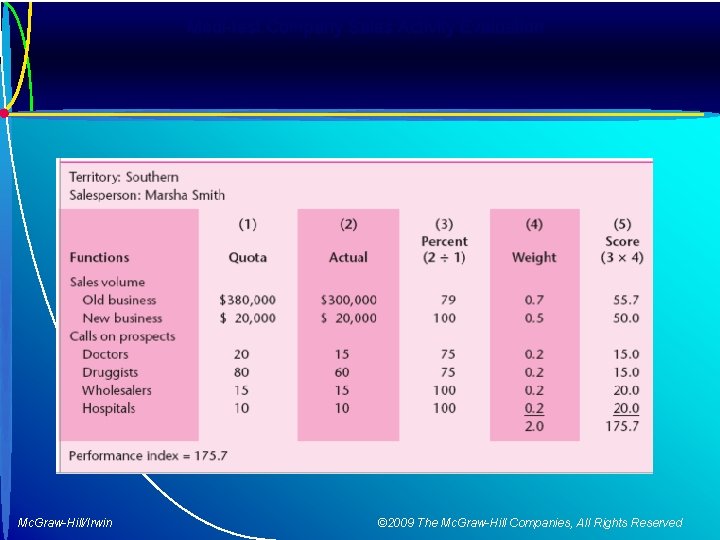
Medi-test Company Sales Activity Evaluation Mc. Graw-Hill/Irwin © 2009 The Mc. Graw-Hill Companies, All Rights Reserved
Motivating and Compensating Performance • Salary – Refers to a specific amount of monetary compensation at an agreed rate for definite time periods • Commission – Is monetary compensation provided for each unit of sales and expressed as a percentage of sales • May be computed on the bases of • • Volume of sales in units of product Gross sales in dollars Net sales after returns Sales volume in excess of a quota Mc. Graw-Hill/Irwin © 2009 The Mc. Graw-Hill Companies, All Rights Reserved
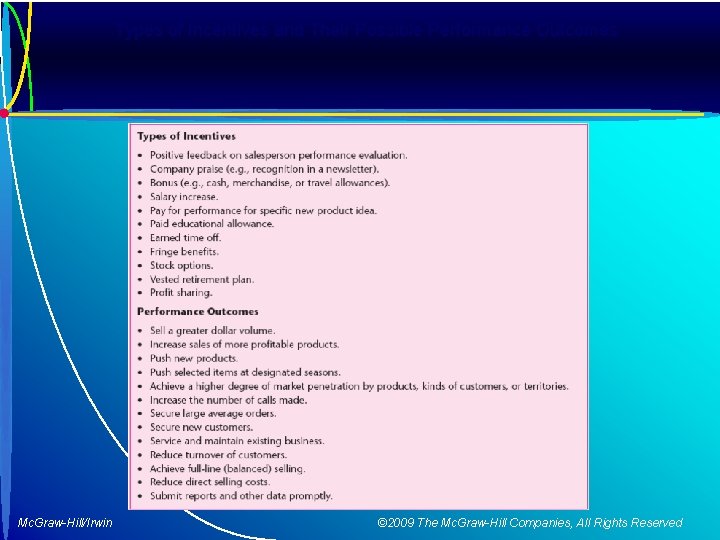
Types of Incentives and Their Possible Performance Outcomes Mc. Graw-Hill/Irwin © 2009 The Mc. Graw-Hill Companies, All Rights Reserved
- Slides: 30