
Chapter 9 Path TestingPart 1 Software Testing A
- Slides: 32
Chapter 9 Path Testing–Part 1 Software Testing: A Craftsman’s Approach, 3 rd Edition Path Testing I
Structural (Code-Based) Testing • Complement of/to Functional Testing • Based on Implementation • Powerful mathematical formulation – program graph – define-use path – Program slices • Basis for Coverage Metrics (a better answer for gaps and redundancies) • Usually done at the unit level • Not very helpful to identify test cases • Extensive commercial tool support Software Testing: A Craftsman’s Approach, 3 rd Edition Path Testing I
Path Testing • Paths derived from some graph construct. • When a test case executes, it traverses a path. • Huge number of paths implies some simplification is needed. • Big Problem: infeasible paths. • Big Question: what kinds of faults are associated with what kinds of paths? • By itself, path testing can lead to a false sense of security. Software Testing: A Craftsman’s Approach, 3 rd Edition Path Testing I
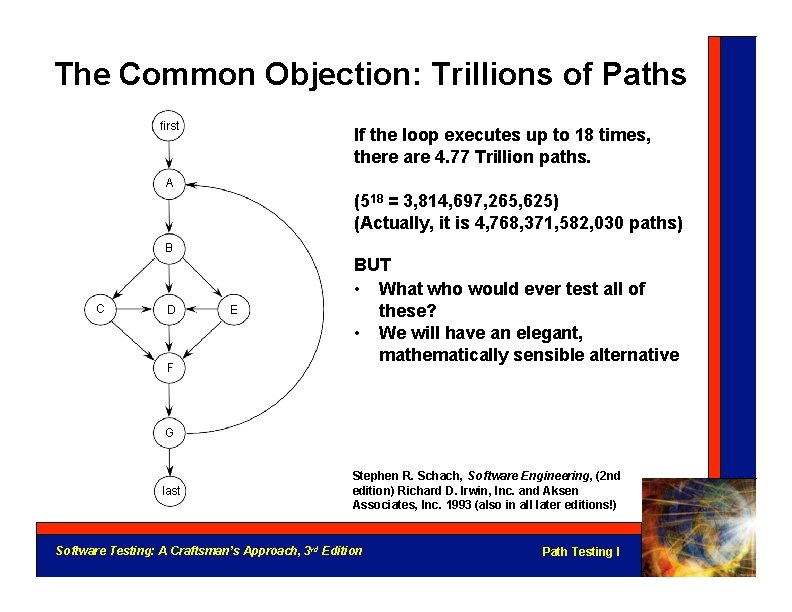
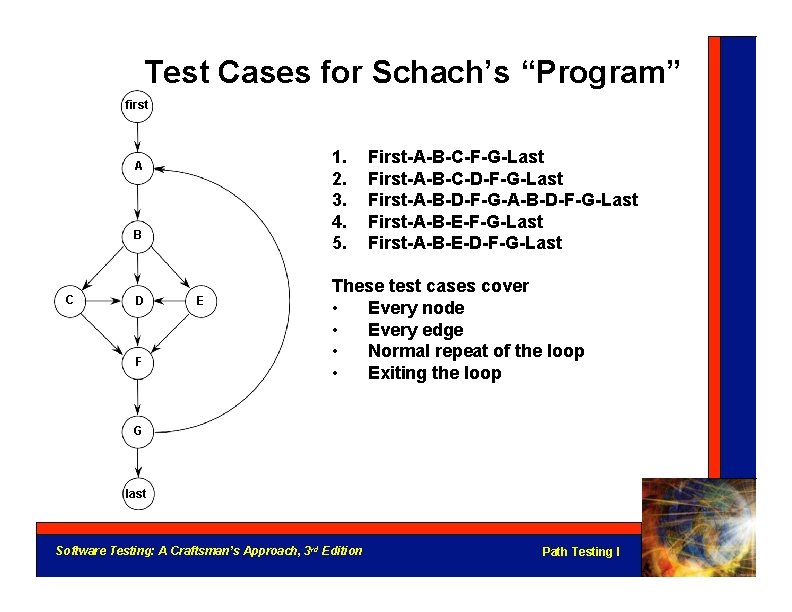
The Common Objection: Trillions of Paths first If the loop executes up to 18 times, there are 4. 77 Trillion paths. A (518 = 3, 814, 697, 265, 625) (Actually, it is 4, 768, 371, 582, 030 paths) B C D F E BUT • What who would ever test all of these? • We will have an elegant, mathematically sensible alternative G last Stephen R. Schach, Software Engineering, (2 nd edition) Richard D. Irwin, Inc. and Aksen Associates, Inc. 1993 (also in all later editions!) Software Testing: A Craftsman’s Approach, 3 rd Edition Path Testing I
Test Cases for Schach’s “Program” first 1. 2. 3. 4. 5. A B C D F E First-A-B-C-F-G-Last First-A-B-C-D-F-G-Last First-A-B-D-F-G-Last First-A-B-E-F-G-Last First-A-B-E-D-F-G-Last These test cases cover • Every node • Every edge • Normal repeat of the loop • Exiting the loop G last Software Testing: A Craftsman’s Approach, 3 rd Edition Path Testing I
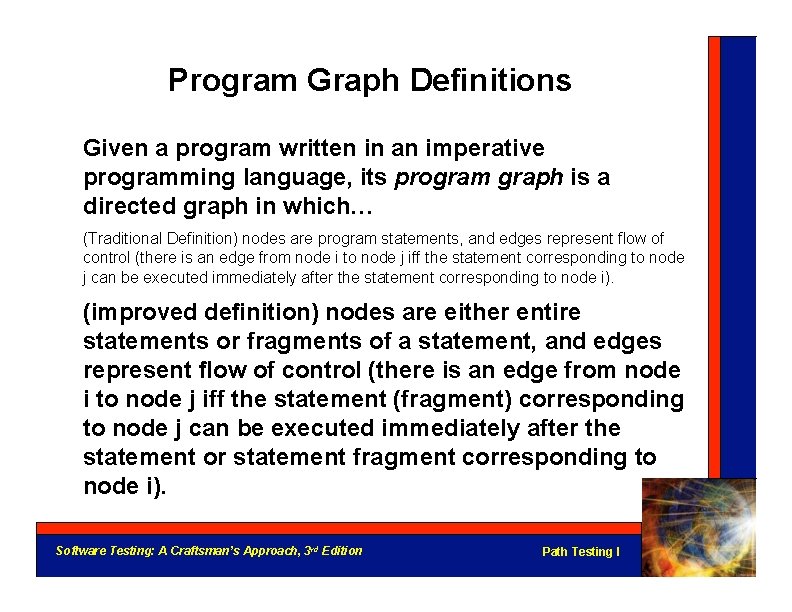
Program Graph Definitions Given a program written in an imperative programming language, its program graph is a directed graph in which… (Traditional Definition) nodes are program statements, and edges represent flow of control (there is an edge from node i to node j iff the statement corresponding to node j can be executed immediately after the statement corresponding to node i). (improved definition) nodes are either entire statements or fragments of a statement, and edges represent flow of control (there is an edge from node i to node j iff the statement (fragment) corresponding to node j can be executed immediately after the statement or statement fragment corresponding to node i). Software Testing: A Craftsman’s Approach, 3 rd Edition Path Testing I
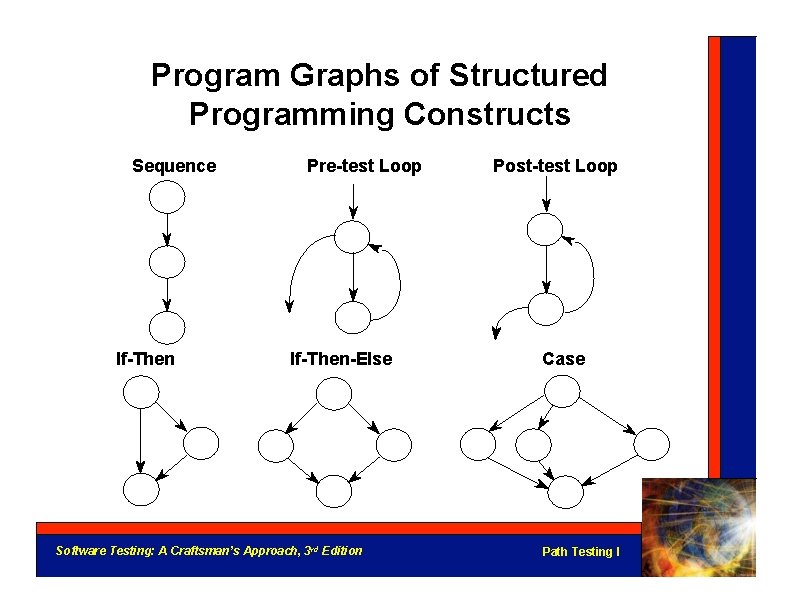
Program Graphs of Structured Programming Constructs Sequence If-Then Pre-test Loop If-Then-Else Software Testing: A Craftsman’s Approach, 3 rd Edition Post-test Loop Case Path Testing I
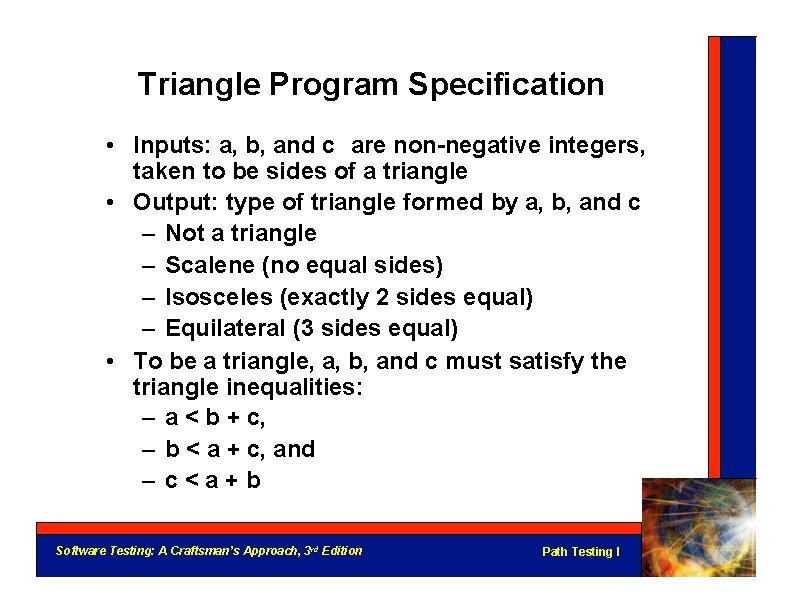
Triangle Program Specification • Inputs: a, b, and c are non-negative integers, taken to be sides of a triangle • Output: type of triangle formed by a, b, and c – Not a triangle – Scalene (no equal sides) – Isosceles (exactly 2 sides equal) – Equilateral (3 sides equal) • To be a triangle, a, b, and c must satisfy the triangle inequalities: – a < b + c, – b < a + c, and – c<a+b Software Testing: A Craftsman’s Approach, 3 rd Edition Path Testing I
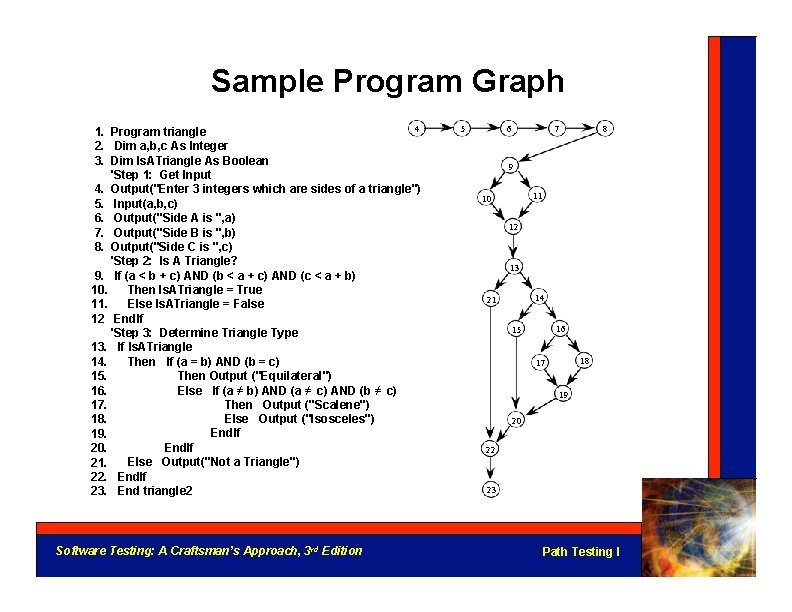
Sample Program Graph 4 1. Program triangle 2. Dim a, b, c As Integer 3. Dim Is. ATriangle As Boolean 'Step 1: Get Input 4. Output("Enter 3 integers which are sides of a triangle") 5. Input(a, b, c) 6. Output("Side A is ", a) 7. Output("Side B is ", b) 8. Output("Side C is ", c) 'Step 2: Is A Triangle? 9. If (a < b + c) AND (b < a + c) AND (c < a + b) 10. Then Is. ATriangle = True 11. Else Is. ATriangle = False 12 End. If 'Step 3: Determine Triangle Type 13. If Is. ATriangle 14. Then If (a = b) AND (b = c) Then Output ("Equilateral") 15. 16. Else If (a ≠ b) AND (a ≠ c) AND (b ≠ c) Then Output ("Scalene") 17. Else Output ("Isosceles") 18. End. If 19. End. If 20. Else Output("Not a Triangle") 21. 22. End. If 23. End triangle 2 Software Testing: A Craftsman’s Approach, 3 rd Edition 5 6 7 8 9 11 10 12 13 14 21 16 15 18 17 19 20 22 23 Path Testing I
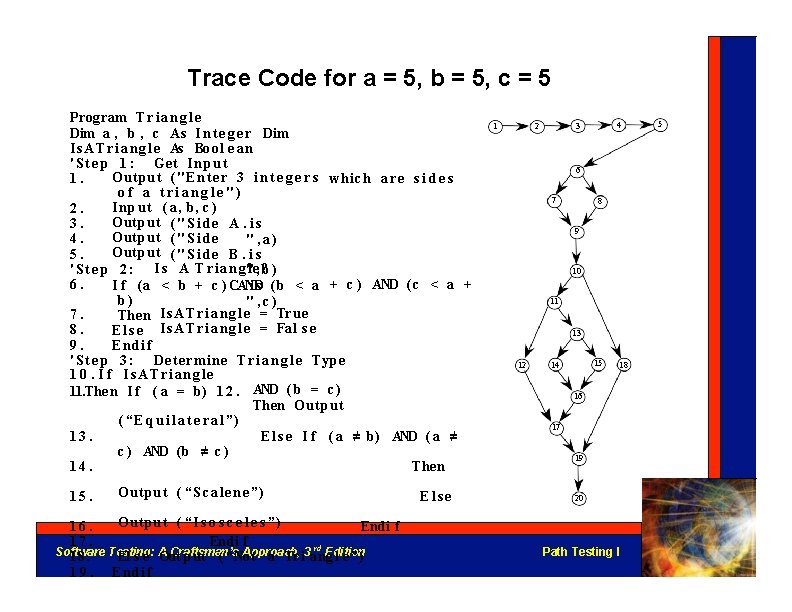
Trace Code for a = 5, b = 5, c = 5 Program T r i a n g l e Dim a , b , c As I n t e g e r Dim I s A T r i a n g l e As Bool e an ' S t e p 1 : Get I n p u t Output ( " E n t e r 3 i n t e g e r s which a r e s i d e s 1. of a triangle") I n p u t ( a, b, c ) 2. Output ( " S i d e A. i s 3. Output ( " S i d e 4. ", a) Output ( " S i d e B. i s 5. ' S t e p 2 : I s A T r i a n g"l e, ? b ) 6. I f ( a < b + c ) CAND. i s ( b < a + c ) AND ( c < a + b) ", c) 7. Then I s A T r i a n g l e = Tr ue 8. E l s e I s A T r i a n g l e = Fal s e 9. Endif ' S t e p 3 : Determin e T r i a n g l e Type 1 0. I f Is. ATriangle 11. The n I f ( a = b) 1 2. AND ( b = c ) Then Output ( “E q u i l a t e r a l”) 13. E l s e I f ( a ≠ b) AND ( a ≠ c ) AND ( b ≠ c ) 14. Then 15. Output ( “S c a l e n e ”) Output ( “I s o s c e l e s ”) 16. Endi f 17. Endi f rd Software Testing: A Craftsman’s Approach, Edition 18. El s e Out put ( “Not a Tr i 3 angl e ”) 1 9. Endif Else 1 2 4 3 6 7 8 9 10 11 13 12 15 14 18 16 17 19 20 Path Testing I 5
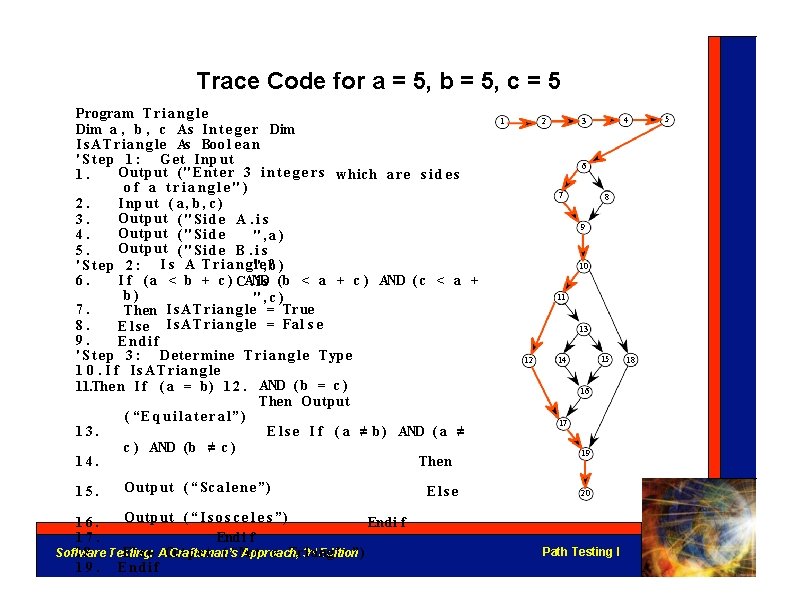
Trace Code for a = 5, b = 5, c = 5 Program T r i a n g l e Dim a , b , c As I n t e g e r Dim I s A T r i a n g l e As Bool e an ' S t e p 1 : Get I n p u t Output ( " E n t e r 3 i n t e g e r s which a r e s i d e s 1. of a triangle") I n p u t ( a, b, c ) 2. Output ( " S i d e A. i s 3. Output ( " S i d e 4. ", a) Output ( " S i d e B. i s 5. ' S t e p 2 : I s A T r i a n g"l e, ? b ) 6. I f ( a < b + c ) CAND. i s ( b < a + c ) AND ( c < a + b) ", c) 7. Then I s A T r i a n g l e = Tr ue 8. E l s e I s A T r i a n g l e = Fal s e 9. Endif ' S t e p 3 : Determin e T r i a n g l e Type 1 0. I f Is. ATriangle 11. The n I f ( a = b) 1 2. AND ( b = c ) Then Output ( “E q u i l a t e r a l”) 13. E l s e I f ( a ≠ b) AND ( a ≠ c ) AND ( b ≠ c ) 14. Then 15. Output ( “S c a l e n e ”) Output ( “I s o s c e l e s ”) 16. Endi f 17. Endi f Soft 1 w 8 a. re Tes. Etlinsge: AO Curtafptsum t an( ’“s N Aoptproaac. T h, r 3 i rd a. E ndgiltieon” ) 1 9. Endif Else 1 2 4 3 6 7 8 9 10 11 13 12 15 14 16 17 19 20 Path Testing I 18 5
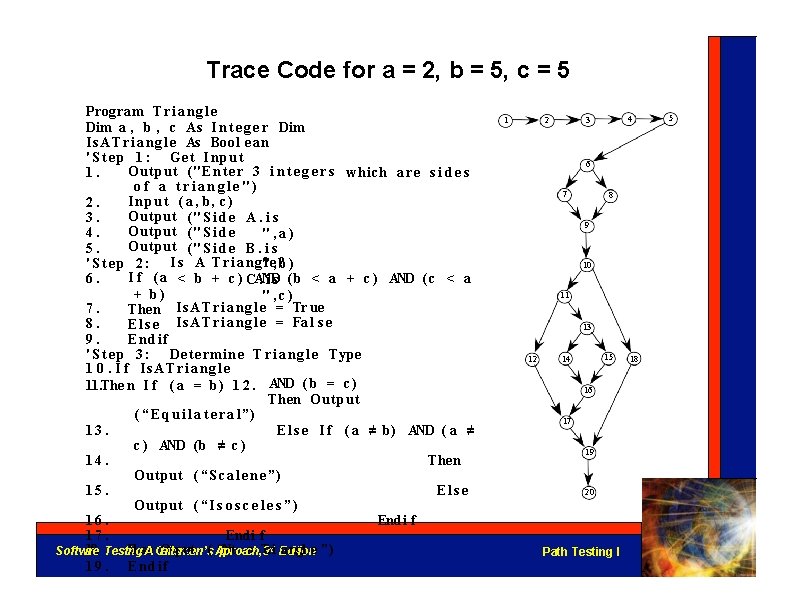
Trace Code for a = 2, b = 5, c = 5 Program T r i a n g l e Dim a , b , c As I n t e g e r Dim I s A T r i a n g l e As Bool e an ' S t e p 1 : Get I n p u t Output ( " E n t e r 3 i n t e g e r s which a r e s i d e s 1. of a triangle") I n p u t ( a, b, c ) 2. Output ( " S i d e A. i s 3. Output ( " S i d e 4. ", a) Output 5. ("Side B. i s ' S t e p 2 : I s A T r i a n g"l e, ? b ) I f ( a < b + c ) CAND 6. . i s ( b < a + c ) AND ( c < a + b) ", c) I s A T r i a n g l e = Tr ue 7. Then 8. E l s e I s A T r i a n g l e = Fal s e 9. Endif ' S t e p 3 : Determin e T r i a n g l e Type 1 0. I f Is. ATriangle 11. The n I f ( a = b) 1 2. AND ( b = c ) Then Output ( “E q u i l a t e r a l”) 13. E l s e I f ( a ≠ b) AND ( a ≠ c ) AND ( b ≠ c ) 14. Then Output ( “S c a l e n e ”) 15. Else Output ( “I s o s c e l e s ”) 16. Endi f 17. 8. Testi. E ut spm uat n’s( A“p. N otoach, a T 3 rrdi Eadnitgiol ne ” ) Softwa 1 re nlg: s. Ae CO raf pr 1 9. Endif 1 2 4 3 6 7 8 9 10 11 13 12 15 14 16 17 19 20 Path Testing I 18 5
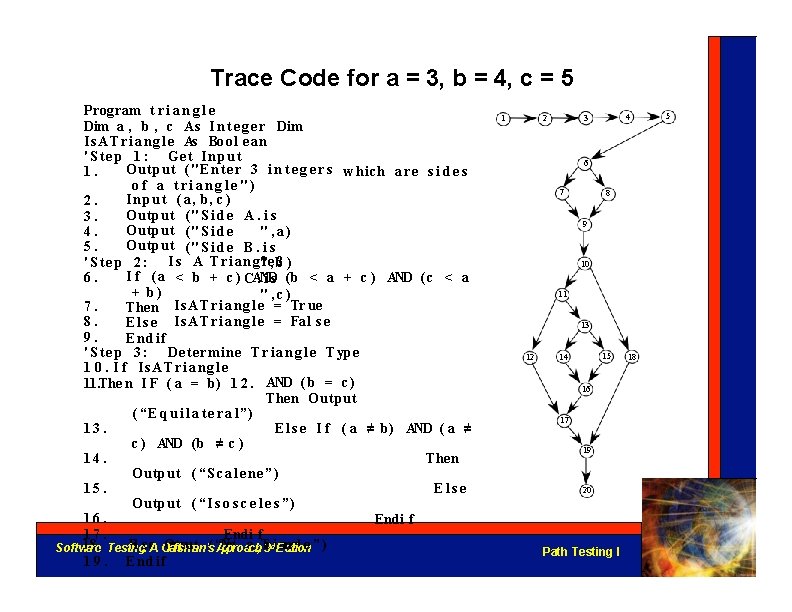
Trace Code for a = 3, b = 4, c = 5 Program t r i a n g l e Dim a , b , c As I n t e g e r Dim I s A T r i a n g l e As Bool e an ' S t e p 1 : Get I n p u t Output ( " E n t e r 3 i n t e g e r s which a r e s i d e s 1. of a triangle") I n p u t ( a, b, c ) 2. Output ( " S i d e A. i s 3. Output ( " S i d e 4. ", a) Output ( " S i d e B. i s 5. ' S t e p 2 : I s A T r i a n g"l e, ? b ) I f ( a < b + c ) CAND 6. . i s ( b < a + c ) AND ( c < a + b) ", c) I s A T r i a n g l e = Tr ue 7. Then 8. E l s e I s A T r i a n g l e = Fal s e 9. Endif ' S t e p 3 : Determin e T r i a n g l e Type 1 0. I f Is. ATriangle 11. The n I F ( a = b) 1 2. AND ( b = c ) Then Output ( “E q u i l a t e r a l”) 13. E l s e I f ( a ≠ b) AND ( a ≠ c ) AND ( b ≠ c ) 14. Then Output ( “S c a l e n e ”) 15. Else Output ( “I s o s c e l e s ”) 16. Endi f 17. El gs: e. A CO ufttsm putan’s( “AN anitgiol en ” ) Softw 1 ar 8 e. Testin ra po prtoaach, T 3 rrdi. Ed 1 9. Endif 1 2 4 3 6 7 8 9 10 11 13 12 15 14 16 17 19 20 Path Testing I 18 5
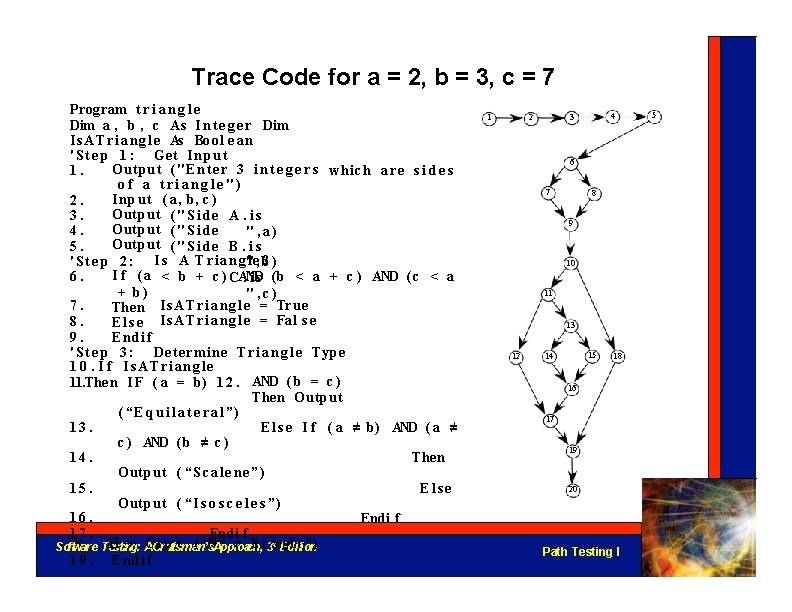
Trace Code for a = 2, b = 3, c = 7 Program t r i a n g l e Dim a , b , c As I n t e g e r Dim I s A T r i a n g l e As Bool e an ' S t e p 1 : Get I n p u t Output ( " E n t e r 3 i n t e g e r s which a r e s i d e s 1. of a triangle") I n p u t ( a, b, c ) 2. Output ( " S i d e A. i s 3. Output ( " S i d e 4. ", a) Output ( " S i d e B. i s 5. ' S t e p 2 : I s A T r i a n g"l e, ? b ) I f ( a < b + c ) CAND 6. . i s ( b < a + c ) AND ( c < a + b) ", c) 7. Then I s A T r i a n g l e = Tr ue 8. E l s e I s A T r i a n g l e = Fal s e 9. Endif ' S t e p 3 : Determin e T r i a n g l e Type 1 0. I f Is. ATriangle 11. The n I F ( a = b) 1 2. AND ( b = c ) Then Output ( “E q u i l a t e r a l”) 13. E l s e I f ( a ≠ b) AND ( a ≠ c ) AND ( b ≠ c ) 14. Then Output ( “S c a l e n e ”) 15. Else Output ( “I s o s c e l e s ”) 16. Endi f 17. 8. are Te. Esltisng: e A Ou pfts utma(n“’s. No t aoach Tr, i 3 ardn. Egdl iteio”n) Soft 1 w Ctra Appr 1 9. Endif 1 2 4 3 6 7 8 9 10 11 13 12 15 14 18 16 17 19 20 Path Testing I 5
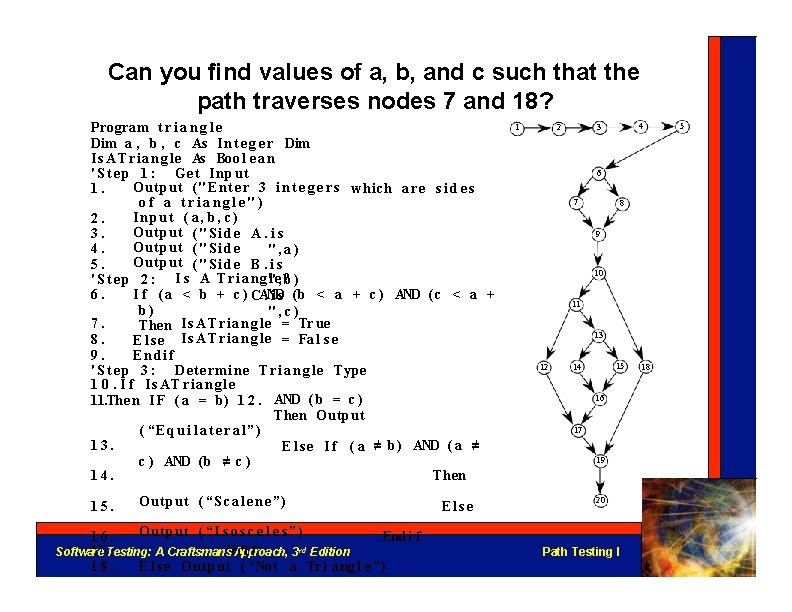
Can you find values of a, b, and c such that the path traverses nodes 7 and 18? Program t r i a n g l e Dim a , b , c As I n t e g e r Dim I s A T r i a n g l e As Bool e an ' S t e p 1 : Get I n p u t Output ( " E n t e r 3 i n t e g e r s which a r e s i d e s 1. of a triangle") I n p u t ( a, b, c ) 2. Output ( " S i d e A. i s 3. Output ( " S i d e 4. ", a) Output 5. ("Side B. i s ' S t e p 2 : I s A T r i a n g"l e, ? b ) 6. I f ( a < b + c ) CAND. i s ( b < a + c ) AND ( c < a + b) ", c) I s A T r i a n g l e 7. = Tr ue Then I s A T r i a n g l e 8. = Fal s e Else 9. Endif ' S t e p 3 : Determin e T r i a n g l e Type 1 0. I f Is. ATriangle 11. The n I F ( a = b) 1 2. AND ( b = c ) Then Output ( “E q u i l a t e r a l”) 13. E l s e I f ( a ≠ b) AND ( a ≠ c ) AND ( b ≠ c ) 14. Then 15. Output ( “S c a l e n e ”) Output ( “I s o s c e l e s ”) 16. Endi f 7 T. esting: A Craftsman’s. En. Adpipfroach, 3 rd Edition Softwa 1 re 18. E l s e Output ( “Not a Tr i angl e ”) Else 1 2 4 3 6 7 8 9 10 11 13 12 15 14 16 17 19 20 Path Testing I 18 5
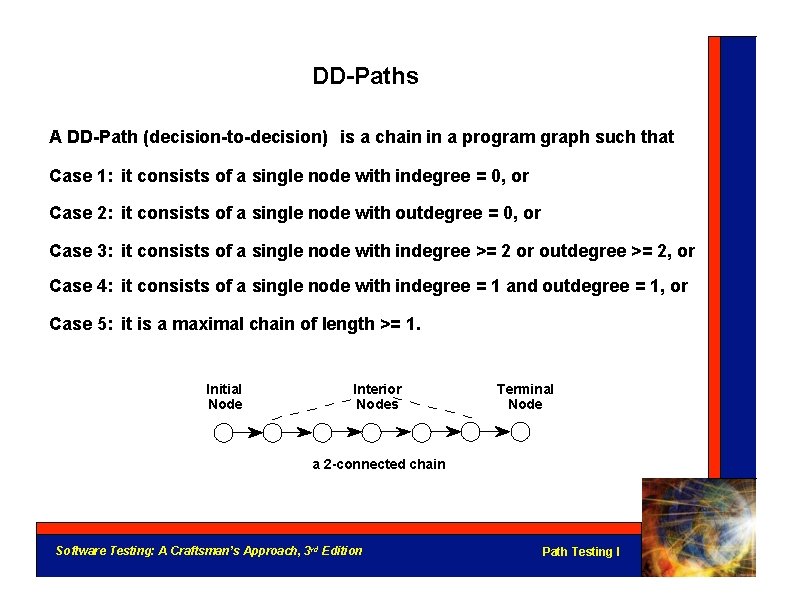
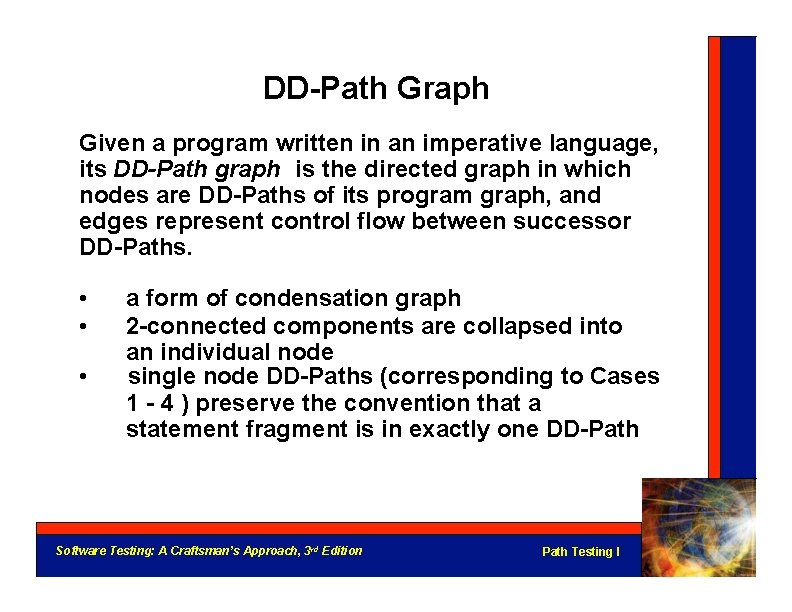
DD-Paths A DD-Path (decision-to-decision) is a chain in a program graph such that Case 1: it consists of a single node with indegree = 0, or Case 2: it consists of a single node with outdegree = 0, or Case 3: it consists of a single node with indegree >= 2 or outdegree >= 2, or Case 4: it consists of a single node with indegree = 1 and outdegree = 1, or Case 5: it is a maximal chain of length >= 1. Initial Node Interior Nodes Terminal Node a 2 -connected chain Software Testing: A Craftsman’s Approach, 3 rd Edition Path Testing I
DD-Path Graph Given a program written in an imperative language, its DD-Path graph is the directed graph in which nodes are DD-Paths of its program graph, and edges represent control flow between successor DD-Paths. • • • a form of condensation graph 2 -connected components are collapsed into an individual node single node DD-Paths (corresponding to Cases 1 - 4 ) preserve the convention that a statement fragment is in exactly one DD-Path Software Testing: A Craftsman’s Approach, 3 rd Edition Path Testing I
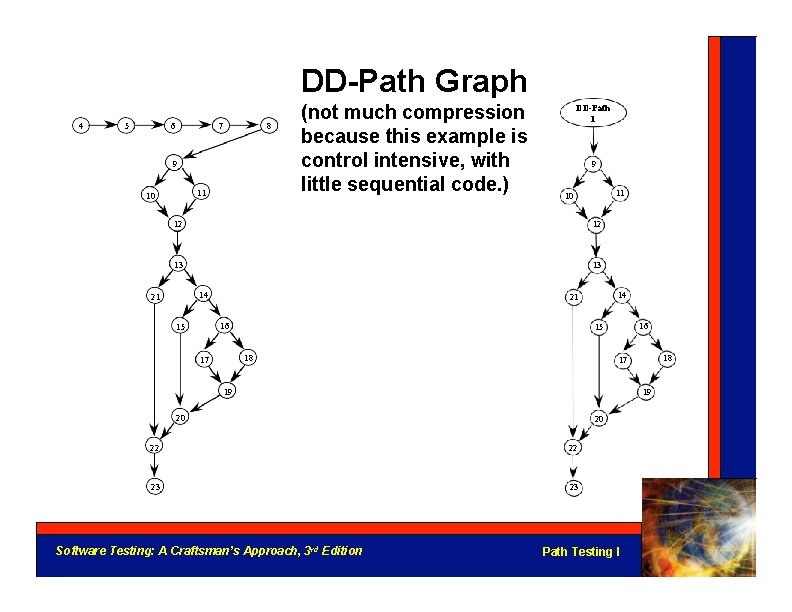
DD-Path Graph 4 5 6 7 8 9 11 10 (not much compression because this example is control intensive, with little sequential code. ) DD-Path 1 9 11 10 12 12 13 13 14 21 16 15 14 21 18 17 16 15 19 19 20 20 22 22 23 23 Software Testing: A Craftsman’s Approach, 3 rd Edition 18 17 Path Testing I
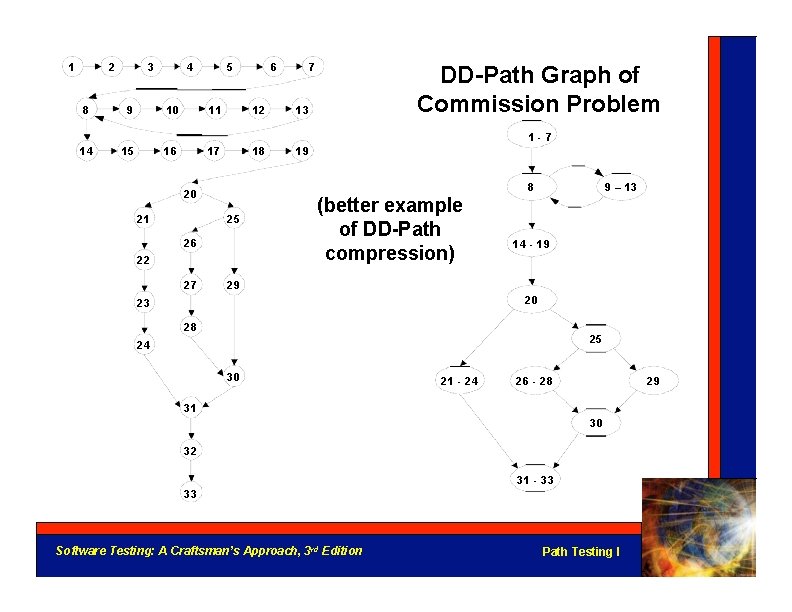
1 2 3 4 5 6 7 8 9 10 11 12 13 14 15 16 17 18 19 DD-Path Graph of Commission Problem 1 -7 20 21 25 26 22 27 (better example of DD-Path compression) 9 – 13 8 14 - 19 29 20 23 28 25 24 30 21 - 24 26 - 28 29 31 30 32 31 - 33 33 Software Testing: A Craftsman’s Approach, 3 rd Edition Path Testing I
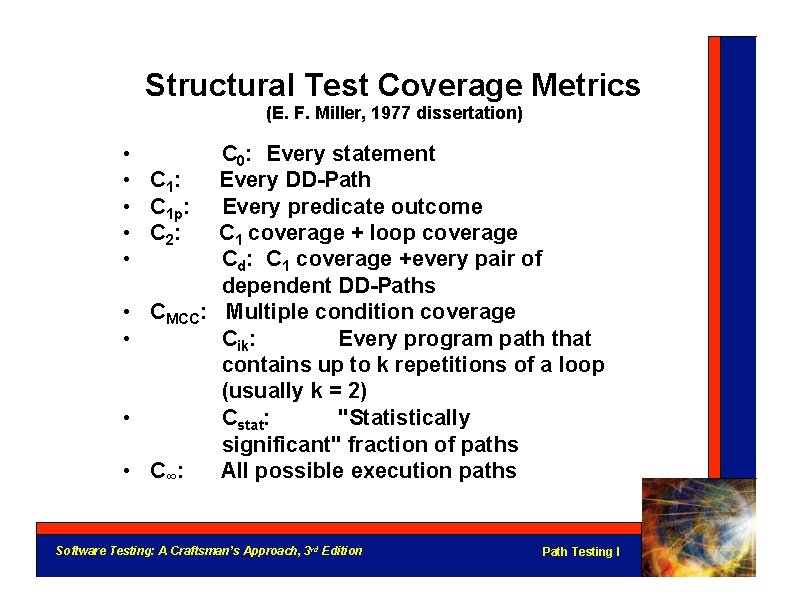
Structural Test Coverage Metrics (E. F. Miller, 1977 dissertation) • • C 1: • C 1 p: • C 2: • • • C 0: Every statement Every DD-Path Every predicate outcome C 1 coverage + loop coverage Cd: C 1 coverage +every pair of dependent DD-Paths CMCC: Multiple condition coverage Cik: Every program path that contains up to k repetitions of a loop (usually k = 2) Cstat: "Statistically significant" fraction of paths C∞: All possible execution paths Software Testing: A Craftsman’s Approach, 3 rd Edition Path Testing I
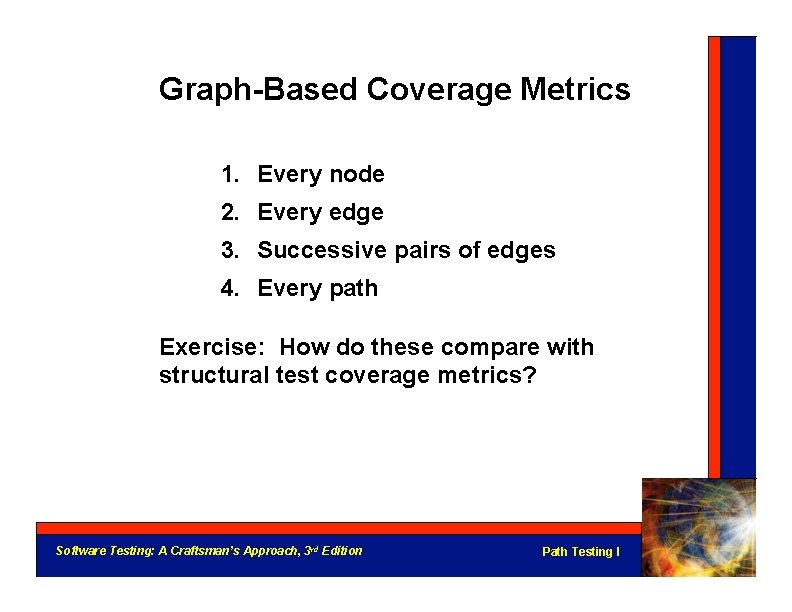
Graph-Based Coverage Metrics 1. Every node 2. Every edge 3. Successive pairs of edges 4. Every path Exercise: How do these compare with structural test coverage metrics? Software Testing: A Craftsman’s Approach, 3 rd Edition Path Testing I
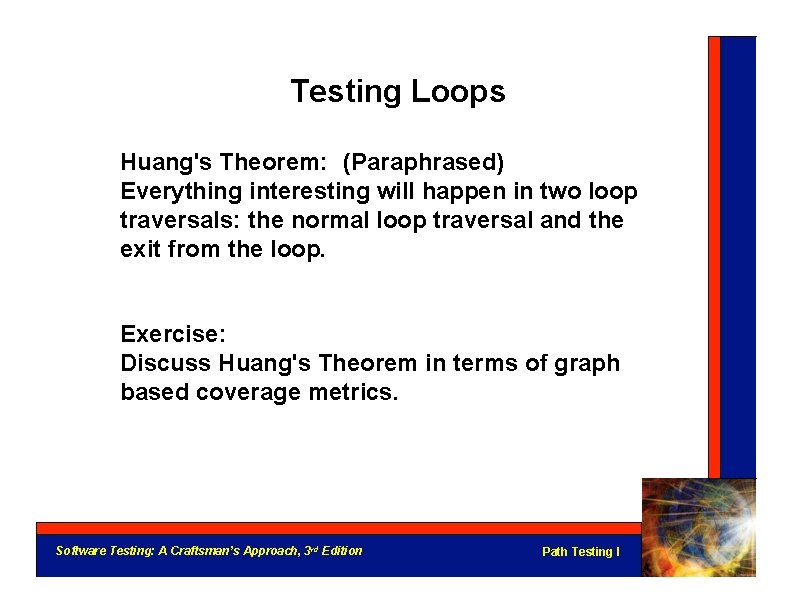
Testing Loops Huang's Theorem: (Paraphrased) Everything interesting will happen in two loop traversals: the normal loop traversal and the exit from the loop. Exercise: Discuss Huang's Theorem in terms of graph based coverage metrics. Software Testing: A Craftsman’s Approach, 3 rd Edition Path Testing I
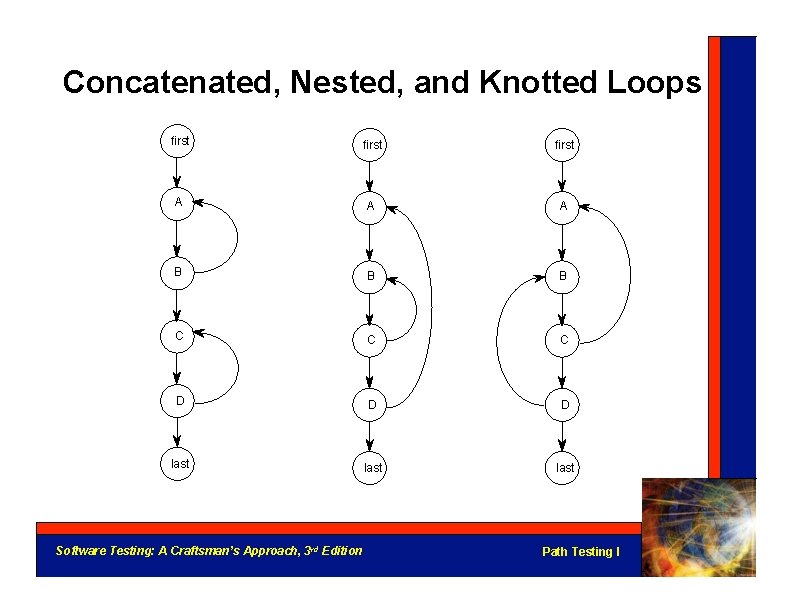
Concatenated, Nested, and Knotted Loops first A A A B B B C C C D D D last Software Testing: A Craftsman’s Approach, 3 rd Edition Path Testing I
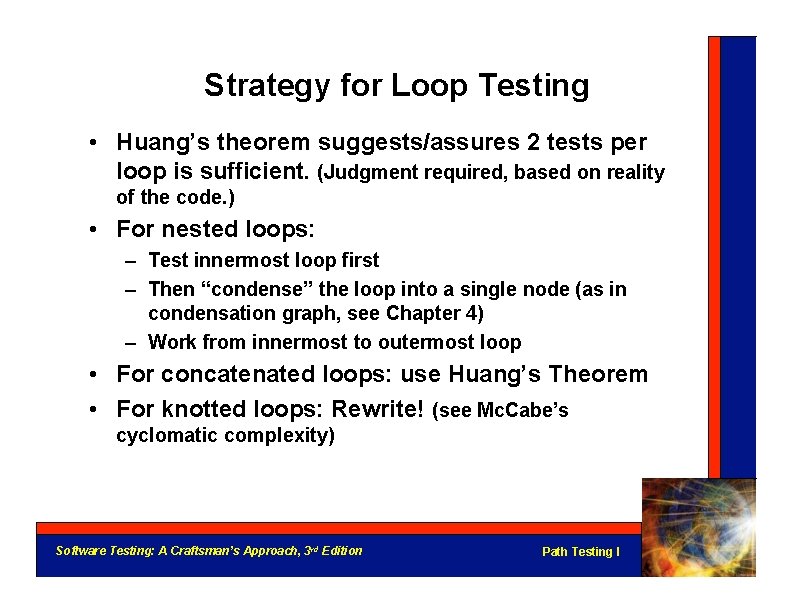
Strategy for Loop Testing • Huang’s theorem suggests/assures 2 tests per loop is sufficient. (Judgment required, based on reality of the code. ) • For nested loops: – Test innermost loop first – Then “condense” the loop into a single node (as in condensation graph, see Chapter 4) – Work from innermost to outermost loop • For concatenated loops: use Huang’s Theorem • For knotted loops: Rewrite! (see Mc. Cabe’s cyclomatic complexity) Software Testing: A Craftsman’s Approach, 3 rd Edition Path Testing I
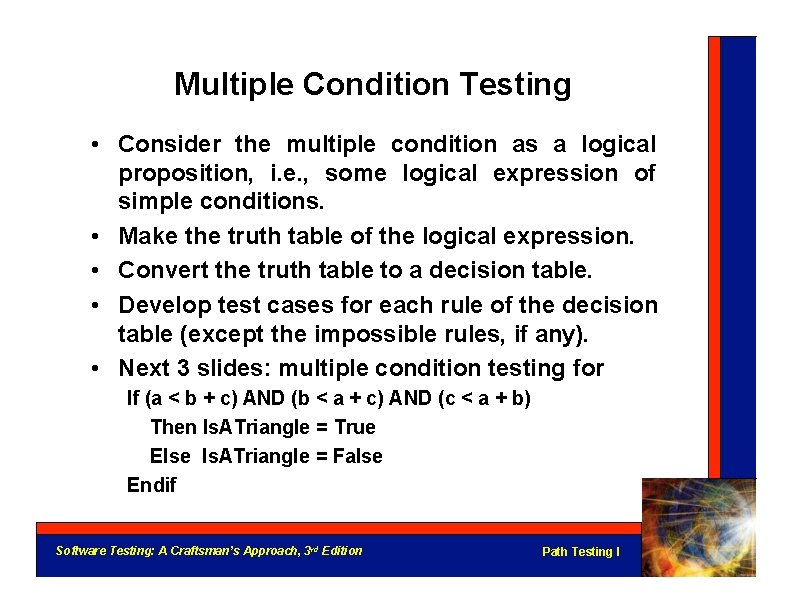
Multiple Condition Testing • Consider the multiple condition as a logical proposition, i. e. , some logical expression of simple conditions. • Make the truth table of the logical expression. • Convert the truth table to a decision table. • Develop test cases for each rule of the decision table (except the impossible rules, if any). • Next 3 slides: multiple condition testing for If (a < b + c) AND (b < a + c) AND (c < a + b) Then Is. ATriangle = True Else Is. ATriangle = False Endif Software Testing: A Craftsman’s Approach, 3 rd Edition Path Testing I
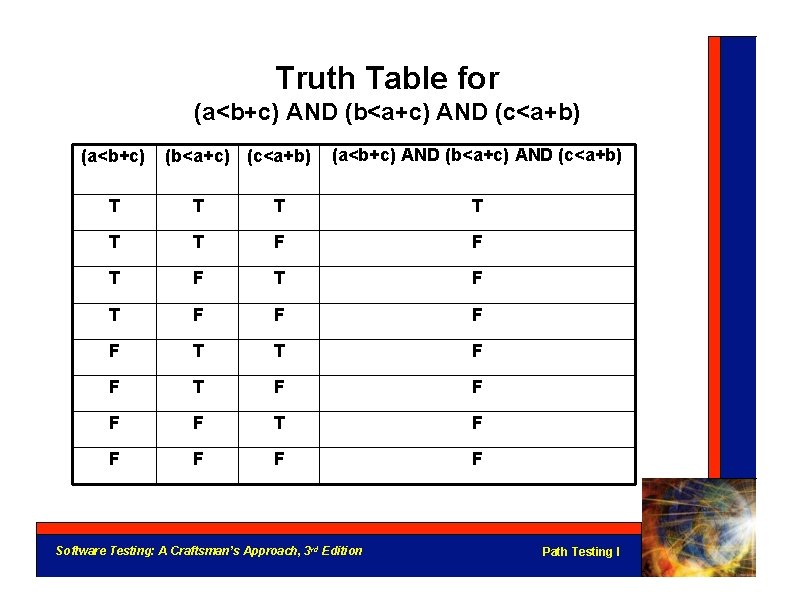
Truth Table for (a<b+c) AND (b<a+c) AND (c<a+b) (a<b+c) (b<a+c) (c<a+b) (a<b+c) AND (b<a+c) AND (c<a+b) T T T F F T F T F F T T F F F F T F F F Software Testing: A Craftsman’s Approach, 3 rd Edition Path Testing I
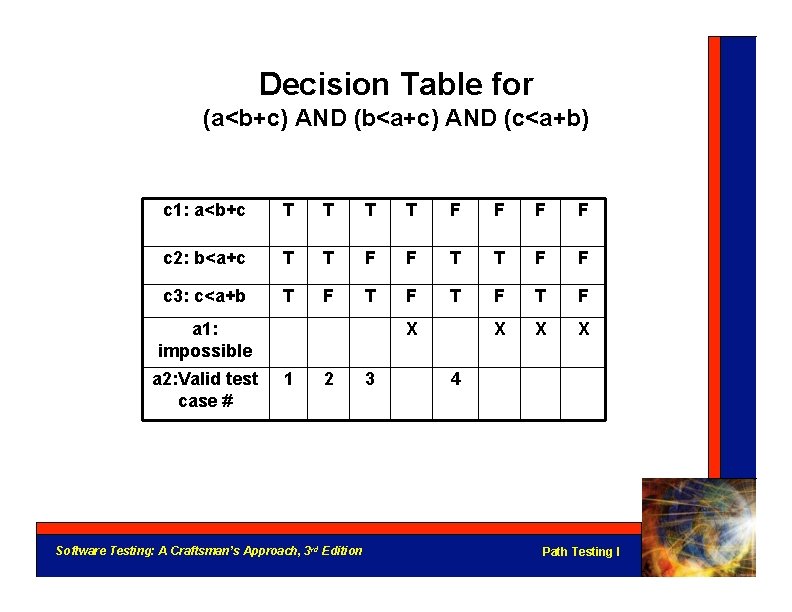
Decision Table for (a<b+c) AND (b<a+c) AND (c<a+b) c 1: a<b+c T T F F c 2: b<a+c T T F F c 3: c<a+b T F T F X X X a 1: impossible a 2: Valid test case # X 1 2 Software Testing: A Craftsman’s Approach, 3 rd Edition 3 4 Path Testing I
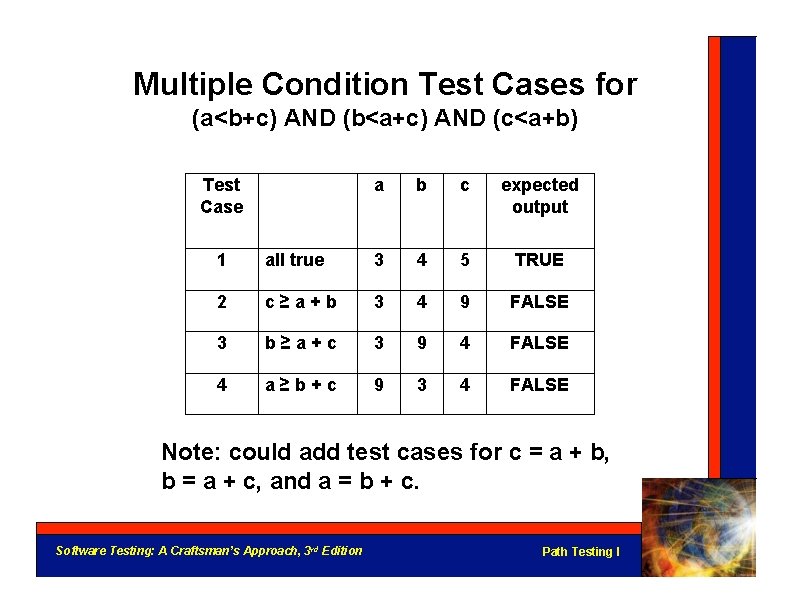
Multiple Condition Test Cases for (a<b+c) AND (b<a+c) AND (c<a+b) Test Case a b c expected output 1 all true 3 4 5 TRUE 2 c≥a+b 3 4 9 FALSE 3 b≥a+c 3 9 4 FALSE 4 a≥b+c 9 3 4 FALSE Note: could add test cases for c = a + b, b = a + c, and a = b + c. Software Testing: A Craftsman’s Approach, 3 rd Edition Path Testing I
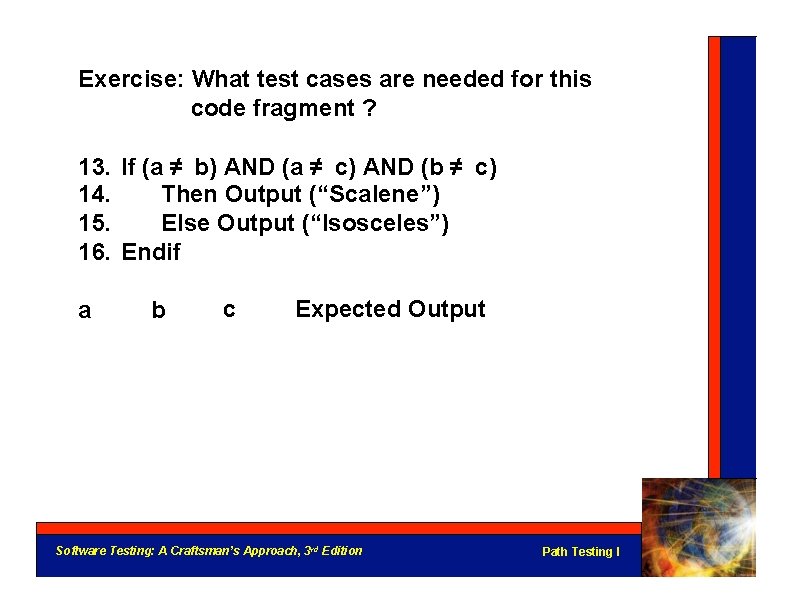
Exercise: What test cases are needed for this code fragment ? 13. If (a ≠ b) AND (a ≠ c) AND (b ≠ c) Then Output (“Scalene”) 14. Else Output (“Isosceles”) 15. 16. Endif a b c Expected Output Software Testing: A Craftsman’s Approach, 3 rd Edition Path Testing I
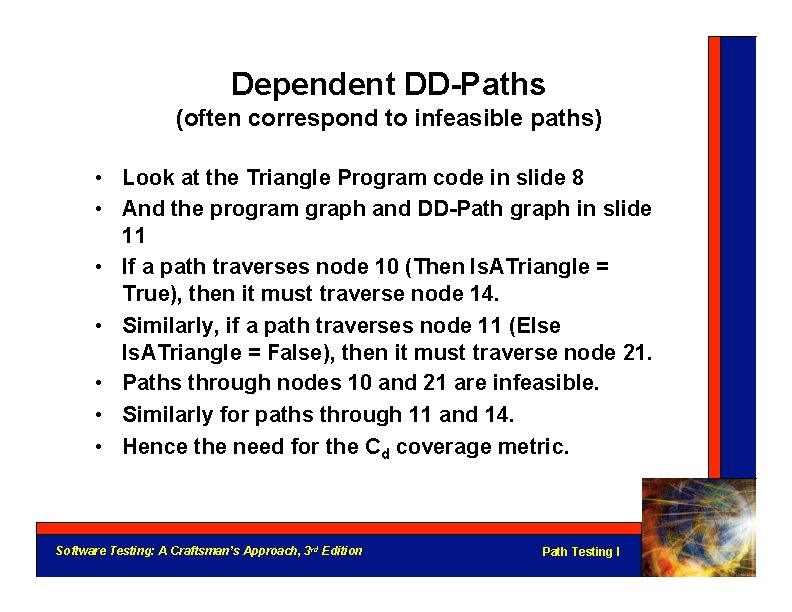
Dependent DD-Paths (often correspond to infeasible paths) • Look at the Triangle Program code in slide 8 • And the program graph and DD-Path graph in slide 11 • If a path traverses node 10 (Then Is. ATriangle = True), then it must traverse node 14. • Similarly, if a path traverses node 11 (Else Is. ATriangle = False), then it must traverse node 21. • Paths through nodes 10 and 21 are infeasible. • Similarly for paths through 11 and 14. • Hence the need for the Cd coverage metric. Software Testing: A Craftsman’s Approach, 3 rd Edition Path Testing I
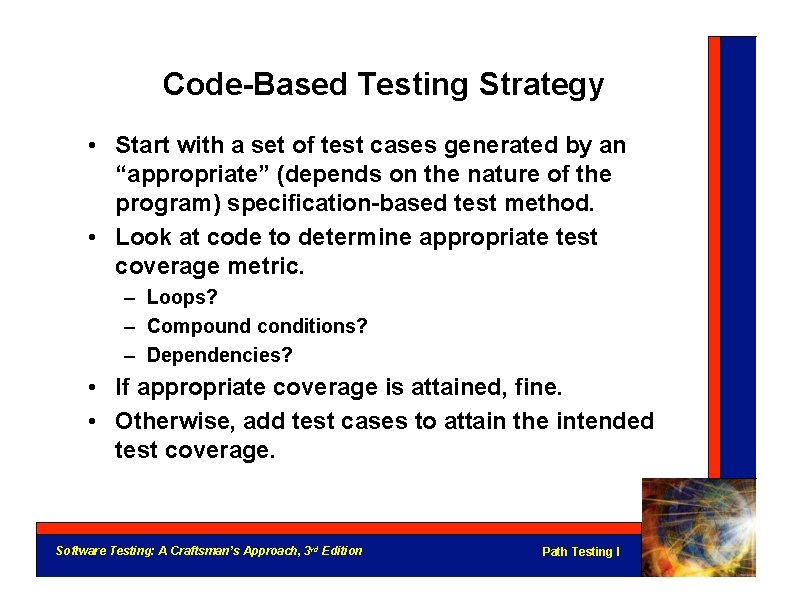
Code-Based Testing Strategy • Start with a set of test cases generated by an “appropriate” (depends on the nature of the program) specification-based test method. • Look at code to determine appropriate test coverage metric. – Loops? – Compound conditions? – Dependencies? • If appropriate coverage is attained, fine. • Otherwise, add test cases to attain the intended test coverage. Software Testing: A Craftsman’s Approach, 3 rd Edition Path Testing I
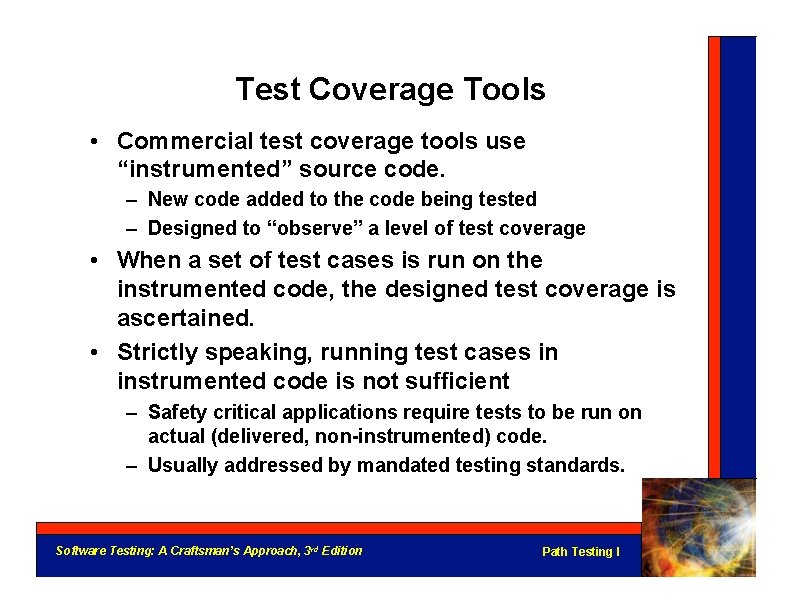
Test Coverage Tools • Commercial test coverage tools use “instrumented” source code. – New code added to the code being tested – Designed to “observe” a level of test coverage • When a set of test cases is run on the instrumented code, the designed test coverage is ascertained. • Strictly speaking, running test cases in instrumented code is not sufficient – Safety critical applications require tests to be run on actual (delivered, non-instrumented) code. – Usually addressed by mandated testing standards. Software Testing: A Craftsman’s Approach, 3 rd Edition Path Testing I