
Chapter 9 Parenting Roles and Responsibilities Section 9
Chapter 9 Parenting Roles and Responsibilities
Section 9 -1 Parenting Choices
Objectives • State the goal of parenthood. • Describe the challenges of parenthood. • Recognize the challenges faced in youth parenting. • Analyze the factors that influence parenthood decisions. Copyright Goodheart-Willcox Co. , Inc. May not be posted to a publicly accessible website.
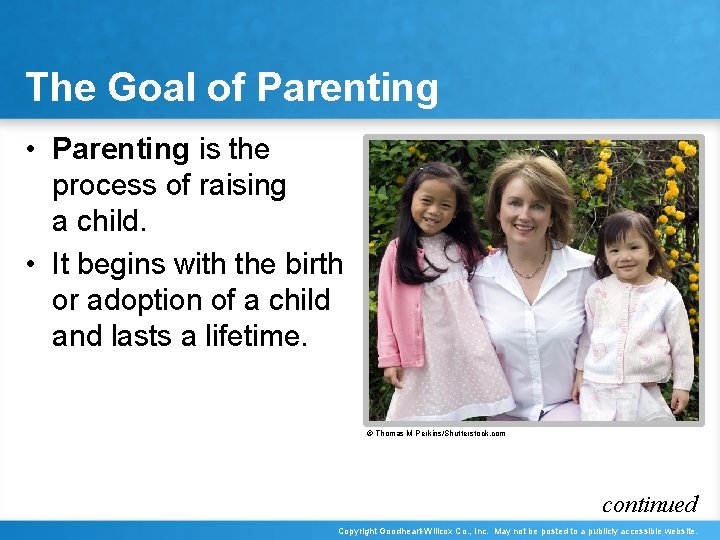
The Goal of Parenting • Parenting is the process of raising a child. • It begins with the birth or adoption of a child and lasts a lifetime. © Thomas M Perkins/Shutterstock. com continued Copyright Goodheart-Willcox Co. , Inc. May not be posted to a publicly accessible website.
The Goal of Parenting • The primary goal of parenting is to help children grow and become mature, independent individuals who can make their own decisions and accept responsibility for their actions. • There is no step-by-step guide for parenting since each child and each situation is unique. Copyright Goodheart-Willcox Co. , Inc. May not be posted to a publicly accessible website.
Helping Children Grow Up Responsibly • Difficult tasks for parents – teaching children values and standards – letting children have new experiences – recognizing the importance of others in children’s lives Copyright Goodheart-Willcox Co. , Inc. May not be posted to a publicly accessible website.
Teaching Values and Standards • Parents must – have firmly established values and standards of their own – live a lifestyle that reflects their beliefs • Then children can follow their examples and adopt similar values and standards. Copyright Goodheart-Willcox Co. , Inc. May not be posted to a publicly accessible website.
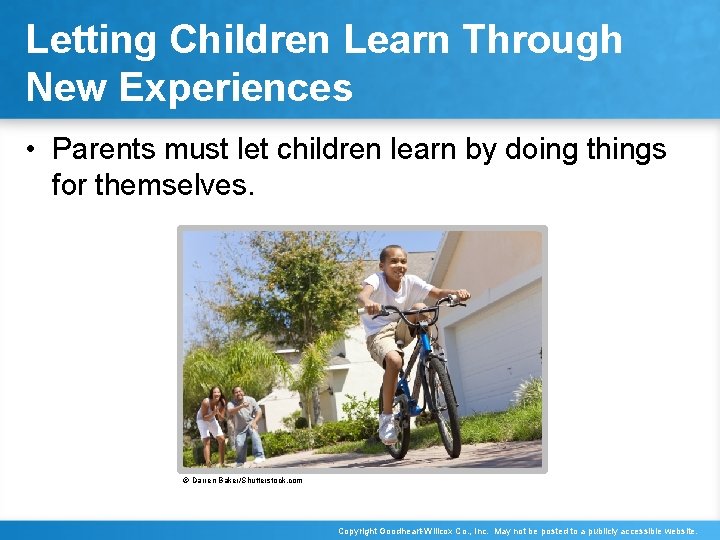
Letting Children Learn Through New Experiences • Parents must let children learn by doing things for themselves. © Darren Baker/Shutterstock. com Copyright Goodheart-Willcox Co. , Inc. May not be posted to a publicly accessible website.
Recognizing the Importance of Other People in Children’s Lives • As children mature, they want and need to meet many different people. • Parents with a healthy attitude about their children see this as a sign of growth. • Parents with a less healthy attitude may feel threatened by the loss of their children’s attention. Copyright Goodheart-Willcox Co. , Inc. May not be posted to a publicly accessible website.
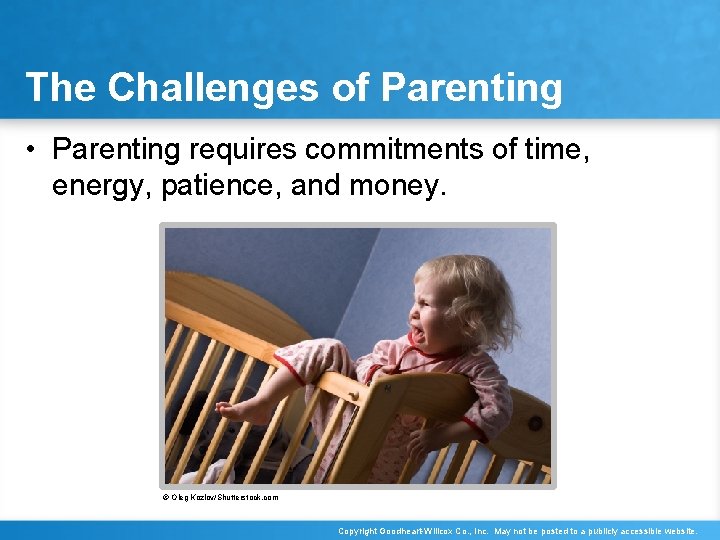
The Challenges of Parenting • Parenting requires commitments of time, energy, patience, and money. © Oleg Kozlov/Shutterstock. com Copyright Goodheart-Willcox Co. , Inc. May not be posted to a publicly accessible website.
Teen Parenting • Parenting during the teenage years is especially difficult. • Teens face several parenting challenges: – physical – emotional – social – education – career Copyright Goodheart-Willcox Co. , Inc. May not be posted to a publicly accessible website.
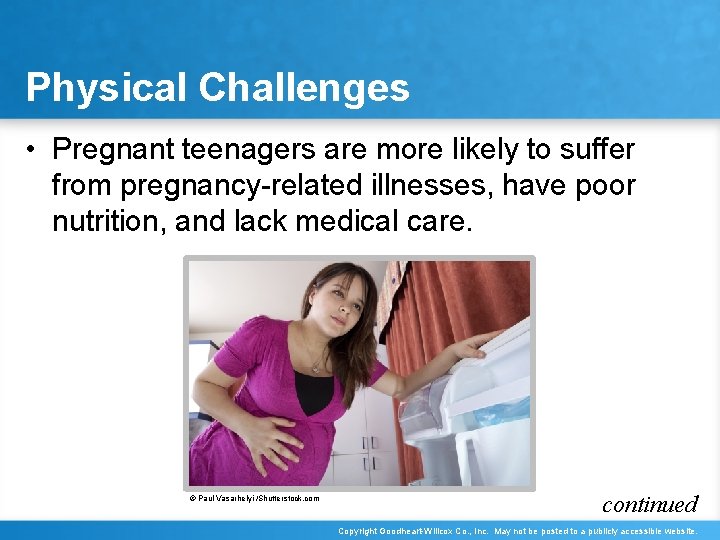
Physical Challenges • Pregnant teenagers are more likely to suffer from pregnancy-related illnesses, have poor nutrition, and lack medical care. © Paul Vasarhelyi /Shutterstock. com continued Copyright Goodheart-Willcox Co. , Inc. May not be posted to a publicly accessible website.
Physical Challenges • Preventable health risks for the baby include – low birthweight, caused by poor diet and smoking during pregnancy – neural tube defects (NTDs), caused by lack of folate-rich foods before and during pregnancy – fetal alcohol syndrome (FAS), caused by drinking alcohol during pregnancy Copyright Goodheart-Willcox Co. , Inc. May not be posted to a publicly accessible website.
Emotional Challenges • Many teenage marriages occur when a young woman becomes pregnant. • These marriages have a fairly high divorce rate. • The addition of a child increases the emotional and financial pressure on young couples. Copyright Goodheart-Willcox Co. , Inc. May not be posted to a publicly accessible website.
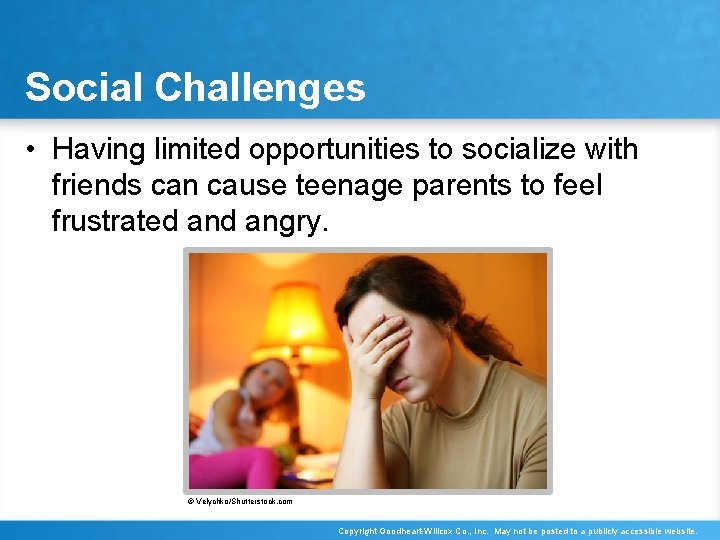
Social Challenges • Having limited opportunities to socialize with friends can cause teenage parents to feel frustrated angry. © Velychko/Shutterstock. com Copyright Goodheart-Willcox Co. , Inc. May not be posted to a publicly accessible website.
Education and Career • Many teenage parents drop out of high school and are limited to low-paying jobs. • Economic consequences for teenage parents and their children often include – reliance on government aid programs – financial dependence on family members – poverty Copyright Goodheart-Willcox Co. , Inc. May not be posted to a publicly accessible website.
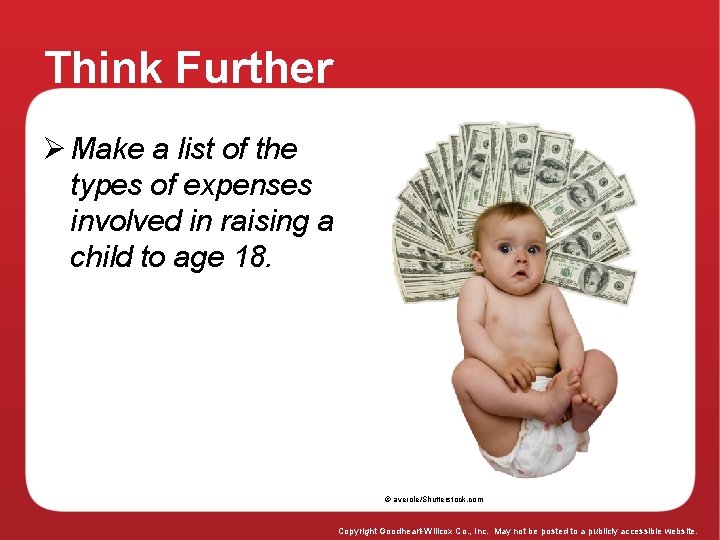
Think Further Ø Make a list of the types of expenses involved in raising a child to age 18. © averole/Shutterstock. com Copyright Goodheart-Willcox Co. , Inc. May not be posted to a publicly accessible website.
The Children of Teen Parents • Compared with children of older parents, children of teenagers are subject to more – health risks – academic risks – emotional risks – social risks – economic insecurity – low-quality child care – neglect and abuse Copyright Goodheart-Willcox Co. , Inc. May not be posted to a publicly accessible website.
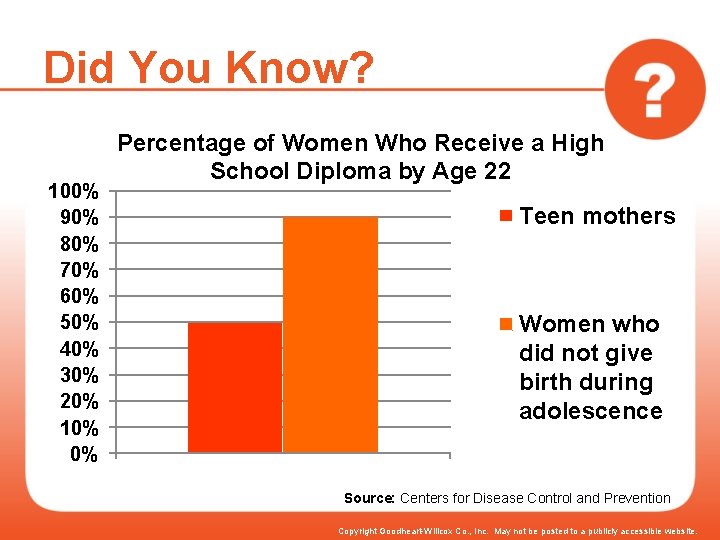
Did You Know? 100% 90% 80% 70% 60% 50% 40% 30% 20% 10% 0% Percentage of Women Who Receive a High School Diploma by Age 22 Teen mothers Women who did not give birth during adolescence Source: Centers for Disease Control and Prevention Copyright Goodheart-Willcox Co. , Inc. May not be posted to a publicly accessible website.
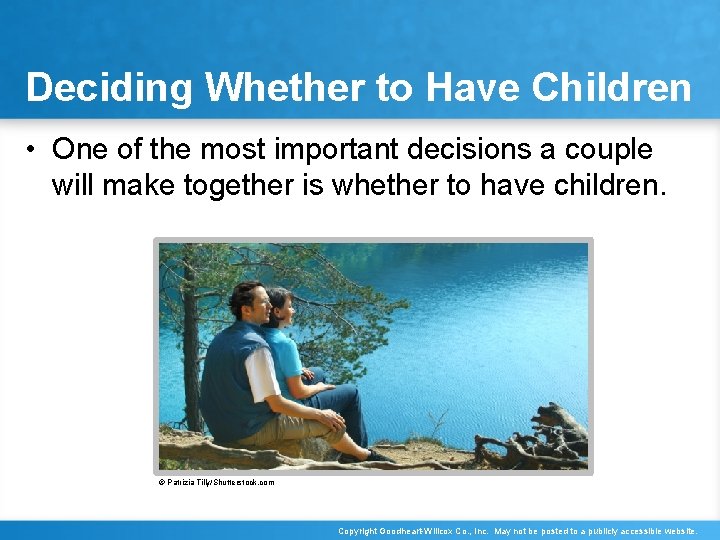
Deciding Whether to Have Children • One of the most important decisions a couple will make together is whether to have children. © Patrizia Tilly/Shutterstock. com Copyright Goodheart-Willcox Co. , Inc. May not be posted to a publicly accessible website.
Reasons for Having Children • To bond closer with a spouse by sharing the experience of rearing a child • To have a family lifestyle • To have the special experiences of life that children make possible • To fulfill role expectations Copyright Goodheart-Willcox Co. , Inc. May not be posted to a publicly accessible website.
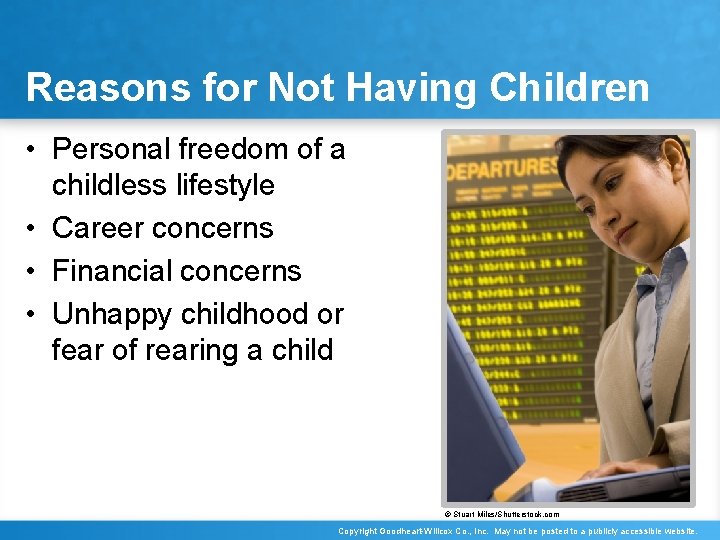
Reasons for Not Having Children • Personal freedom of a childless lifestyle • Career concerns • Financial concerns • Unhappy childhood or fear of rearing a child © Stuart Miles/Shutterstock. com Copyright Goodheart-Willcox Co. , Inc. May not be posted to a publicly accessible website.
Other Factors Affecting Parenthood Decisions • Couples should also discuss – their short- and long-term goals – the strength of their relationship and whether they are ready to accept the roles of parents – their readiness for children • Couples should not feel obligated to have children to satisfy their friends and relatives. • They should not feel selfish if they decide to remain childless. Copyright Goodheart-Willcox Co. , Inc. May not be posted to a publicly accessible website.
Section 9 -1 Review 1. True or false. If a child cannot do a task perfectly, a parent should do it. 2. Why do teenage parents often face financial difficulties? continued Copyright Goodheart-Willcox Co. , Inc. May not be posted to a publicly accessible website.
Section 9 -1 Review 3. List three reasons why couples choose to not have children. Copyright Goodheart-Willcox Co. , Inc. May not be posted to a publicly accessible website.
Section 9 -2 Being a Responsible Caregiver
Objectives • • • Name possible caregivers for children. List characteristics of a responsible caregiver. Describe the responsibilities of caregivers. Determine helpful resources for caregivers. Identify employment opportunities for caregivers. Copyright Goodheart-Willcox Co. , Inc. May not be posted to a publicly accessible website.
Who Are the Caregivers? • A caregiver is a person who provides care for someone else. • Many people may fill the role of caregiver – relatives (older siblings, grandparents) – babysitters – child care providers – preschool teachers – guardians and foster parents • Parents are a child’s primary caregivers. continued Copyright Goodheart-Willcox Co. , Inc. May not be posted to a publicly accessible website.
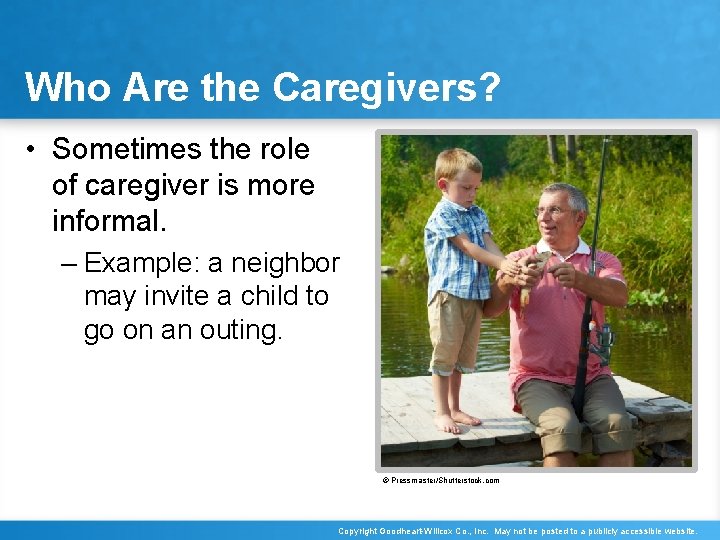
Who Are the Caregivers? • Sometimes the role of caregiver is more informal. – Example: a neighbor may invite a child to go on an outing. © Pressmaster/Shutterstock. com Copyright Goodheart-Willcox Co. , Inc. May not be posted to a publicly accessible website.
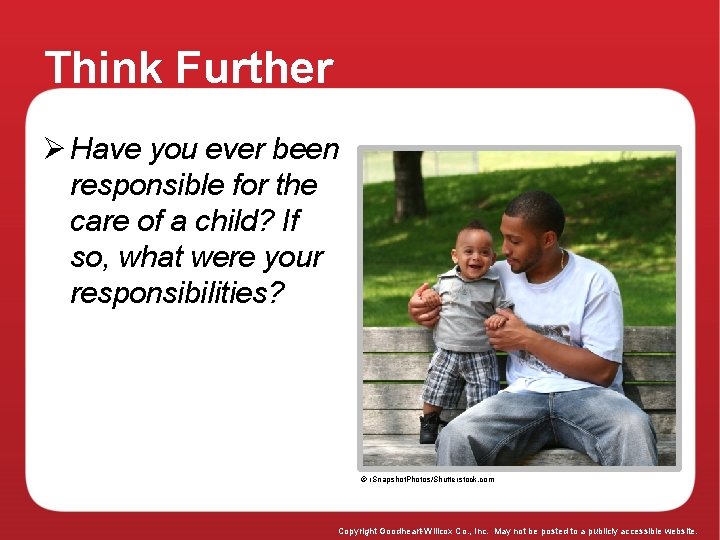
Think Further Ø Have you ever been responsible for the care of a child? If so, what were your responsibilities? © r. Snapshot. Photos/Shutterstock. com Copyright Goodheart-Willcox Co. , Inc. May not be posted to a publicly accessible website.
Characteristics of Responsible Caregivers • Everyone is not equally qualified to be a caregiver. • The characteristics of responsible caregivers fall into four categories: – personal qualities – personal skills – knowledge and experience – good health Copyright Goodheart-Willcox Co. , Inc. May not be posted to a publicly accessible website.
Personal Qualities • • Enjoy children Patient Flexible Alert to children’s needs Exercise self-control Consistent Set good examples Copyright Goodheart-Willcox Co. , Inc. May not be posted to a publicly accessible website.
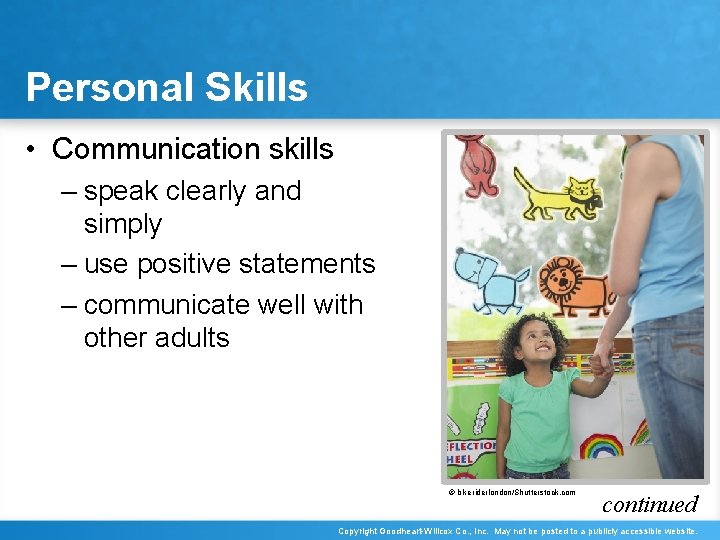
Personal Skills • Communication skills – speak clearly and simply – use positive statements – communicate well with other adults © bikeriderlondon/Shutterstock. com continued Copyright Goodheart-Willcox Co. , Inc. May not be posted to a publicly accessible website.
Personal Skills • Judgment skills – Caregivers make many decisions each day involving children in their care. – To help settle conflicts, they need to know when and how to get involved. – To maintain a healthful, safe environment, they need to be able to foresee and prevent problems. continued Copyright Goodheart-Willcox Co. , Inc. May not be posted to a publicly accessible website.
Personal Skills • Management skills – Caregivers need basic time management skills. – They need to know how to set priorities, or distinguish between important and urgent matters. Copyright Goodheart-Willcox Co. , Inc. May not be posted to a publicly accessible website.
Knowledge and Experience • All caregivers should have a basic knowledge of – child growth and development – children’s needs, abilities, and interests – appropriate activities • Experience is gained by interacting with children, reading books, and taking classes. Copyright Goodheart-Willcox Co. , Inc. May not be posted to a publicly accessible website.
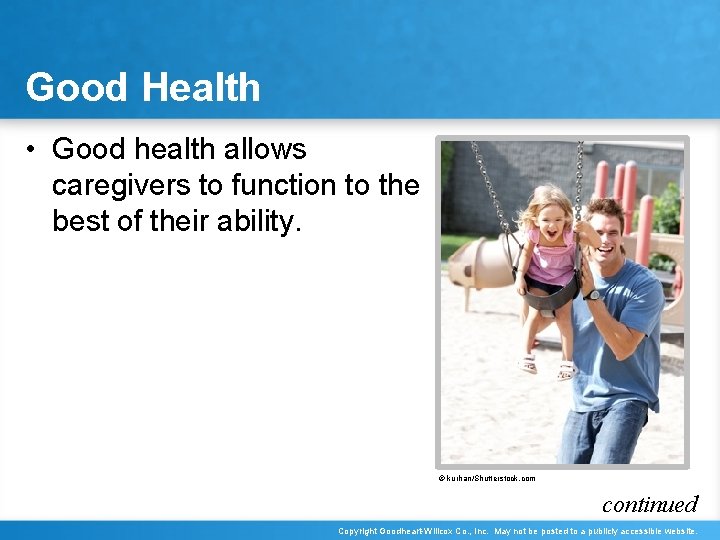
Good Health • Good health allows caregivers to function to the best of their ability. © kurhan/Shutterstock. com continued Copyright Goodheart-Willcox Co. , Inc. May not be posted to a publicly accessible website.
Good Health • Caring for children is demanding and requires – continuous physical activity – mental alertness to a child’s needs – ability to cope with stress and emotional pressures of meeting responsibilities • To stay healthy, caregivers need – proper nutrition – enough rest and exercise – regular immunizations Copyright Goodheart-Willcox Co. , Inc. May not be posted to a publicly accessible website.
Responsibilities of Caregivers • Parents and other caregivers are responsible for meeting children’s many needs including – physical needs – social needs – emotional needs – intellectual needs Copyright Goodheart-Willcox Co. , Inc. May not be posted to a publicly accessible website.
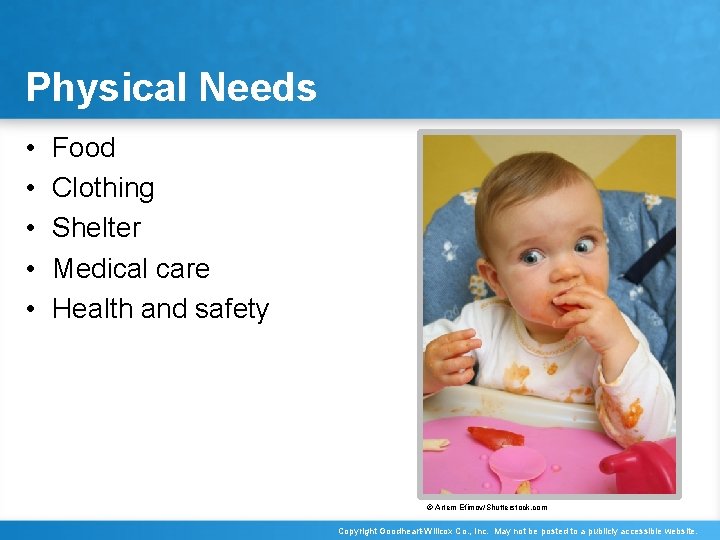
Physical Needs • • • Food Clothing Shelter Medical care Health and safety © Artem Efimov/Shutterstock. com Copyright Goodheart-Willcox Co. , Inc. May not be posted to a publicly accessible website.
Social Needs • Children must be taught how to interact with other children and adults—how to share, communicate, and compromise. • Children also need moral guidance – to learn right from wrong – to learn how to behave in socially acceptable ways Copyright Goodheart-Willcox Co. , Inc. May not be posted to a publicly accessible website.
Emotional Needs • Caregivers need to set limits, love, and guide children. • Children need to – feel loved no matter what they do – learn how to express emotions in acceptable ways – grow to become independent adults Copyright Goodheart-Willcox Co. , Inc. May not be posted to a publicly accessible website.
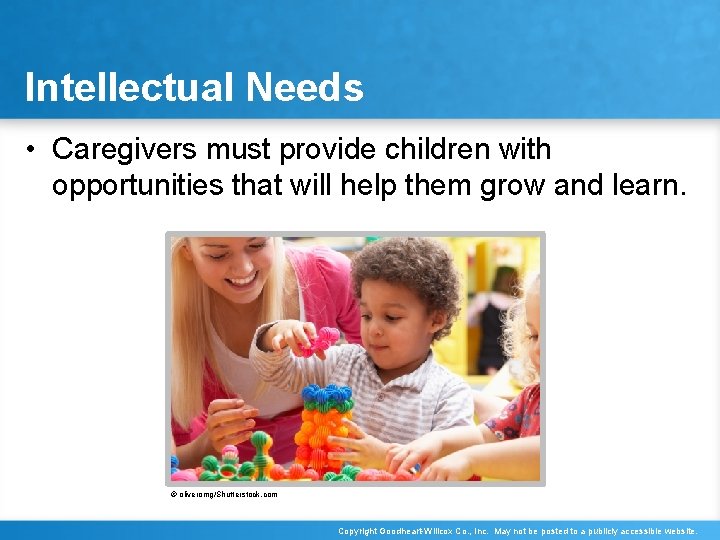
Intellectual Needs • Caregivers must provide children with opportunities that will help them grow and learn. © oliveromg/Shutterstock. com Copyright Goodheart-Willcox Co. , Inc. May not be posted to a publicly accessible website.
Resources for Caregivers • How to learn about being a responsible caregiver: – local library – reliable websites – public and private agencies – hotlines (phone numbers that people can call for information or assistance) – support groups Copyright Goodheart-Willcox Co. , Inc. May not be posted to a publicly accessible website.
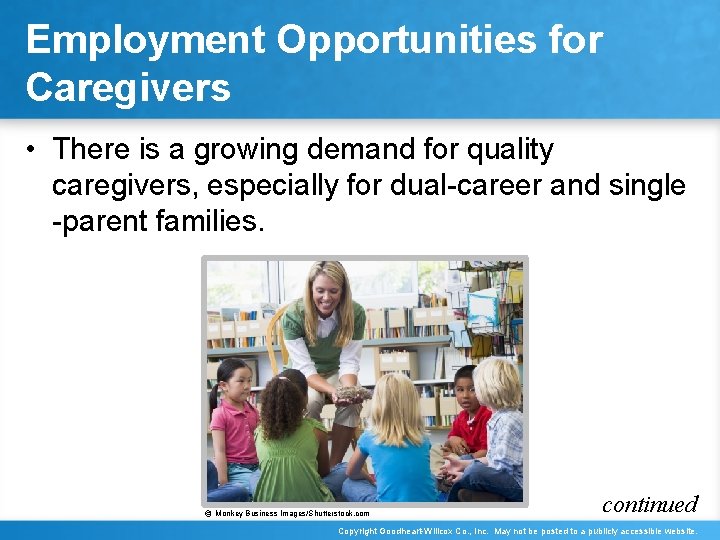
Employment Opportunities for Caregivers • There is a growing demand for quality caregivers, especially for dual-career and single -parent families. © Monkey Business Images/Shutterstock. com continued Copyright Goodheart-Willcox Co. , Inc. May not be posted to a publicly accessible website.
Employment Opportunities for Caregivers • As a minimum, a two-year associate’s degree in child development or a related area is often required. • Child care workers must meet state licensing requirements to work with young children. • To be licensed, workers in child care facilities must meet educational requirements. • Licensing requirements vary from state to state. continued Copyright Goodheart-Willcox Co. , Inc. May not be posted to a publicly accessible website.
Employment Opportunities for Caregivers • There are several types of child care programs: – child care in the parent’s home – child care in the caregiver’s home – child care cooperatives – school- or university-based child care – religious or social group – government sponsored – employer sponsored – privately owned or franchise Copyright Goodheart-Willcox Co. , Inc. May not be posted to a publicly accessible website.

Child Care in the Parent’s Home • The caregiver comes to the parent’s home and is often a relative or close friend. • Benefits – convenience – children feel more secure in a familiar setting – children receive individualized attention – consistent care © Rob Marmion/Shutterstock. com continued Copyright Goodheart-Willcox Co. , Inc. May not be posted to a publicly accessible website.
Child Care in the Parent’s Home • Child care in the parent’s home may be provided by a nanny. • Some nannies also do household chores. • Nannies are often costly. • Nannies who live with a family receive room and board plus a salary. Copyright Goodheart-Willcox Co. , Inc. May not be posted to a publicly accessible website.
Child Care in the Caregiver’s Home • The most common type of child care in the United States has been child care in the caregiver’s home. • Benefits – family-type setting – less structure allows for play and relaxation – hours are usually flexible – less costly than some other options Copyright Goodheart-Willcox Co. , Inc. May not be posted to a publicly accessible website.
Child Care Cooperatives • Child care cooperatives are formed by groups of parents. • Parents – formulate policy – establish the budget – determine the instructional program – provide care for the children – hire teachers or other personnel continued Copyright Goodheart-Willcox Co. , Inc. May not be posted to a publicly accessible website.
Child Care Cooperatives • Benefits – Parents have more control over the program. – It is less costly; instead of paying a fee, parents take turns caring for children in the center. • Parents must be more involved and volunteer their time. Copyright Goodheart-Willcox Co. , Inc. May not be posted to a publicly accessible website.
School- or University-Sponsored Child Care • These programs use student teachers to provide child care. • Benefits – high-quality staff – high-quality curriculum • These programs are not available in all areas. Copyright Goodheart-Willcox Co. , Inc. May not be posted to a publicly accessible website.
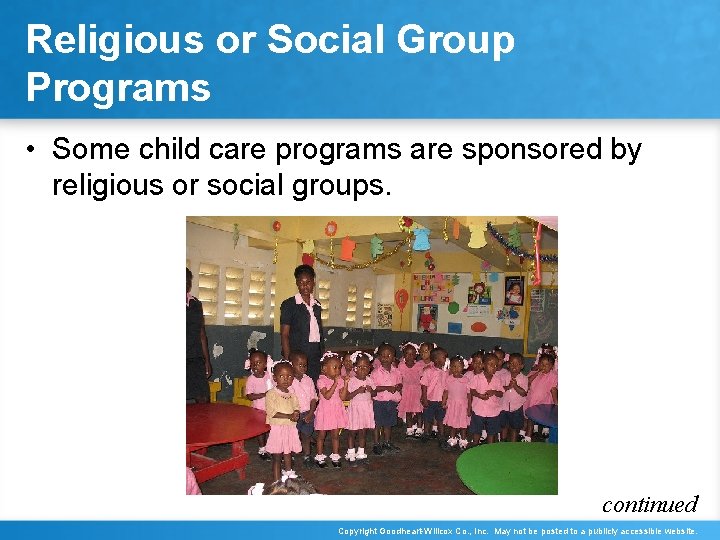
Religious or Social Group Programs • Some child care programs are sponsored by religious or social groups. continued Copyright Goodheart-Willcox Co. , Inc. May not be posted to a publicly accessible website.
Religious or Social Group Programs • Benefits – usually charge low fees because the sponsor helps fund the costs and provides space – usually high-quality programs – many provide religious education, which is important to some parents Copyright Goodheart-Willcox Co. , Inc. May not be posted to a publicly accessible website.
Government-Sponsored Child Care Programs • Programs are sponsored by the government for lower-income working families. • The benefit is very low or no fees. • Programs must meet strict guidelines to be licensed. Copyright Goodheart-Willcox Co. , Inc. May not be posted to a publicly accessible website.
Employer-Sponsored Child Care Services • Employers sponsor different types of child care facilities. • Benefits – Employers may pay all or part of the cost. – Employees whose children are cared for on-site are close at hand if needed. Copyright Goodheart-Willcox Co. , Inc. May not be posted to a publicly accessible website.
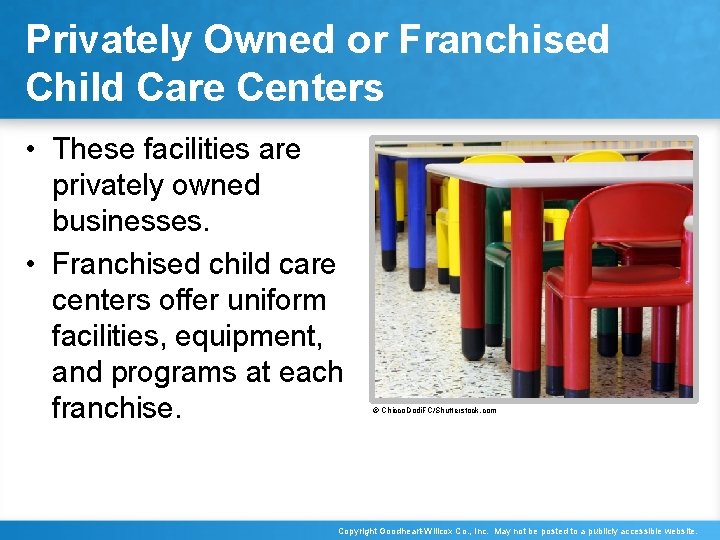
Privately Owned or Franchised Child Care Centers • These facilities are privately owned businesses. • Franchised child care centers offer uniform facilities, equipment, and programs at each franchise. © Chicco. Dodi. FC/Shutterstock. com Copyright Goodheart-Willcox Co. , Inc. May not be posted to a publicly accessible website.
Think Further Ø Research the types of child care available in your community. What are the costs of each option? © Elnur/Shutterstock. com Copyright Goodheart-Willcox Co. , Inc. May not be posted to a publicly accessible website.
Evaluating Quality Child Care • Evaluating each child care program is important. • Parents must evaluate the – facility – setting – programs – adult-child ratio – caregivers Copyright Goodheart-Willcox Co. , Inc. May not be posted to a publicly accessible website.

The Role of Society in Protecting Children’s Rights • All caregivers are responsible for the well-being of the children in their care. • If parents do not meet their children’s needs, the state can act on the children’s behalf. • In extreme cases, the state provides foster care for children needing temporary homes. continued Copyright Goodheart-Willcox Co. , Inc. May not be posted to a publicly accessible website.
The Role of Society in Protecting Children’s Rights • Laws protect children’s rights. – Laws require school attendance. – Child labor laws protect children. • The state or government provides child welfare services – food and assistance to families in need Copyright Goodheart-Willcox Co. , Inc. May not be posted to a publicly accessible website.
Section 9 -2 Review 1. List five personal qualities of responsible caregivers. 2. List the four categories of children’s needs. continued Copyright Goodheart-Willcox Co. , Inc. May not be posted to a publicly accessible website.
Section 9 -2 Review 3. Identify five types of child care programs. – (List five: ) child care in the parent’s home, child care in the caregiver’s home, child care cooperatives, school- or university-sponsored, religious, social group, government, employer, privately owned or franchised 4. Give an example of how society protects children. – (Answers will vary. ) Copyright Goodheart-Willcox Co. , Inc. May not be posted to a publicly accessible website.
- Slides: 65