
Chapter 9 Organizational Structure and Design Chapter 9

- Slides: 35
Chapter 9 Organizational Structure and Design Chapter 9, Stephen P. Robbins, Mary Coulter, and Nancy Langton, Management, Eighth Canadian Edition. Copyright © 2005 Pearson Education Canada Inc. 1
OUTLINE • Defining Organizational Structure – – – Work specialization Departmentalization Chain of Command Span of Control Centralize vs. Decentralize Formalization • Org. Design Decisions – Mechanistic and Organic – Contingency Factors – Common Designs Chapter 9, Stephen P. Robbins, Mary Coulter, and Nancy Langton, Management, Eighth Canadian Edition. Copyright © 2005 Pearson Education Canada Inc. 2
Defining Organizational Structure • Organizational Structure – • The formal arrangement of jobs within an organization Organizational Design – A process involving decisions about six key elements: 1. 2. 3. 4. 5. 6. Work specialization Departmentalization Chain of command Span of control Centralization and decentralization Formalization Chapter 9, Stephen P. Robbins, Mary Coulter, and Nancy Langton, Management, Eighth Canadian Edition. Copyright © 2005 Pearson Education Canada Inc. 3
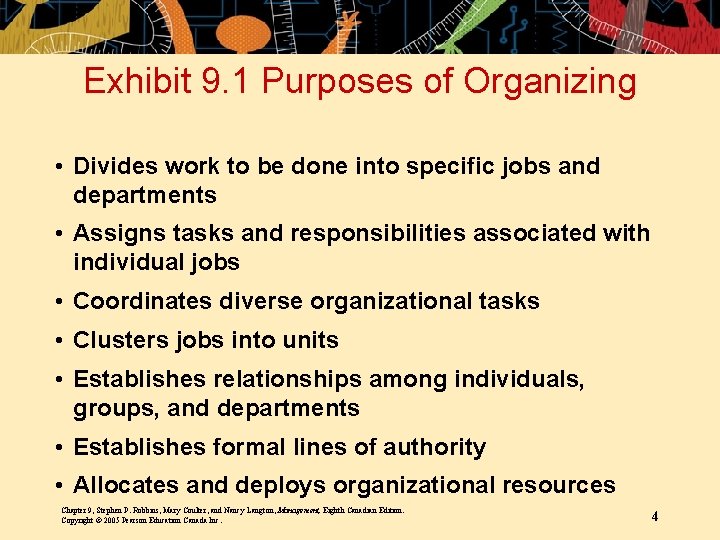
Exhibit 9. 1 Purposes of Organizing • Divides work to be done into specific jobs and departments • Assigns tasks and responsibilities associated with individual jobs • Coordinates diverse organizational tasks • Clusters jobs into units • Establishes relationships among individuals, groups, and departments • Establishes formal lines of authority • Allocates and deploys organizational resources Chapter 9, Stephen P. Robbins, Mary Coulter, and Nancy Langton, Management, Eighth Canadian Edition. Copyright © 2005 Pearson Education Canada Inc. 4
Organizational Structure • Work Specialization – The degree to which tasks in the organization are divided into separate jobs with each step completed by a different person • Overspecialization can result in human diseconomies from boredom, fatigue, stress, poor quality, increased absenteeism, and higher turnover Chapter 9, Stephen P. Robbins, Mary Coulter, and Nancy Langton, Management, Eighth Canadian Edition. Copyright © 2005 Pearson Education Canada Inc. 5
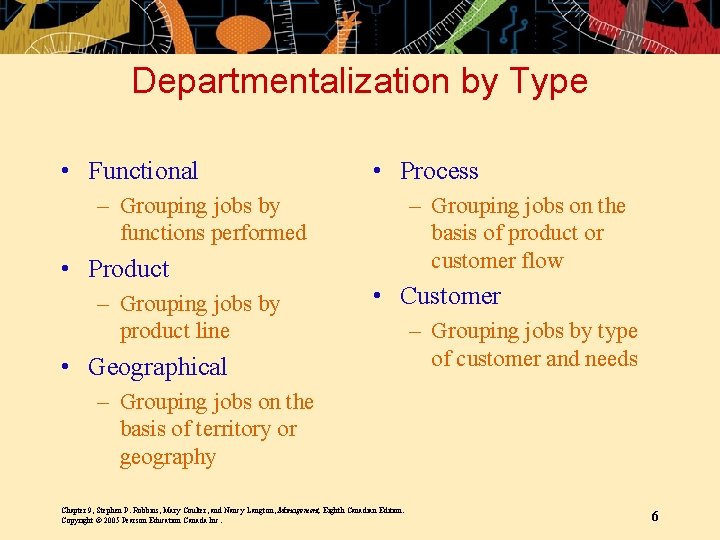
Departmentalization by Type • Functional • Process – Grouping jobs by functions performed • Product – Grouping jobs by product line – Grouping jobs on the basis of product or customer flow • Customer • Geographical – Grouping jobs by type of customer and needs – Grouping jobs on the basis of territory or geography Chapter 9, Stephen P. Robbins, Mary Coulter, and Nancy Langton, Management, Eighth Canadian Edition. Copyright © 2005 Pearson Education Canada Inc. 6
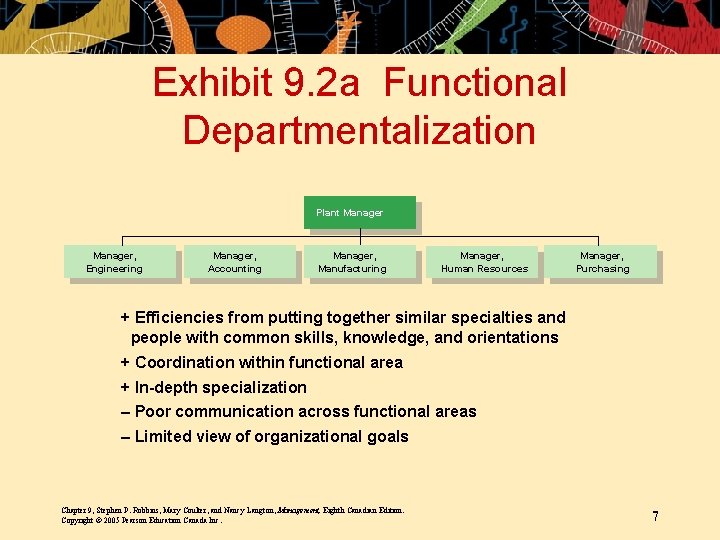
Exhibit 9. 2 a Functional Departmentalization Plant Manager, Engineering Manager, Accounting Manager, Manufacturing Manager, Human Resources Manager, Purchasing + Efficiencies from putting together similar specialties and people with common skills, knowledge, and orientations + Coordination within functional area + In-depth specialization – Poor communication across functional areas – Limited view of organizational goals Chapter 9, Stephen P. Robbins, Mary Coulter, and Nancy Langton, Management, Eighth Canadian Edition. Copyright © 2005 Pearson Education Canada Inc. 7
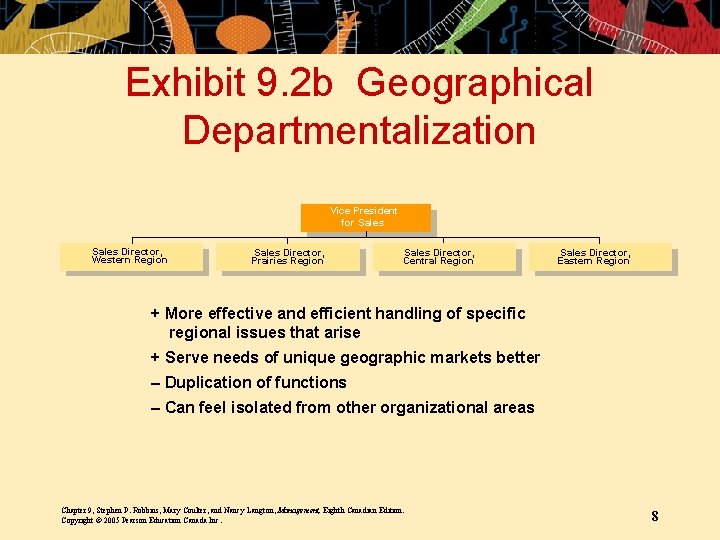
Exhibit 9. 2 b Geographical Departmentalization Vice President for Sales Director, Western Region Sales Director, Prairies Region Sales Director, Central Region Sales Director, Eastern Region + More effective and efficient handling of specific regional issues that arise + Serve needs of unique geographic markets better – Duplication of functions – Can feel isolated from other organizational areas Chapter 9, Stephen P. Robbins, Mary Coulter, and Nancy Langton, Management, Eighth Canadian Edition. Copyright © 2005 Pearson Education Canada Inc. 8
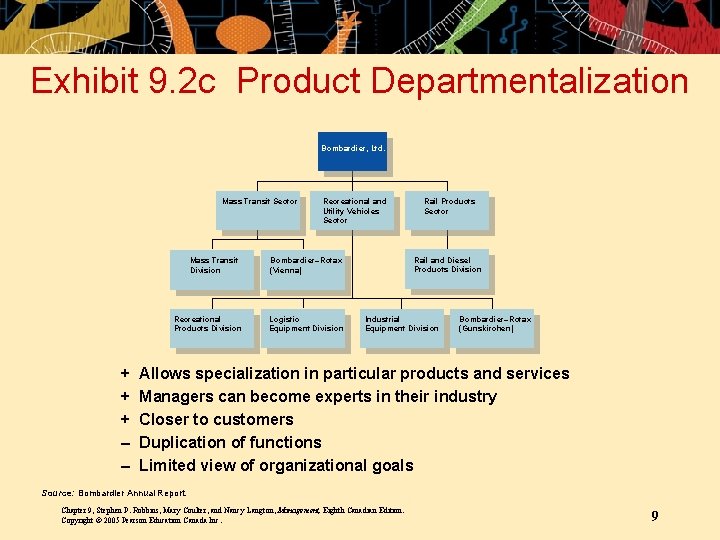
Exhibit 9. 2 c Product Departmentalization Bombardier, Ltd. Mass Transit Sector Mass Transit Division Recreational Products Division + + + – – Recreational and Utility Vehicles Sector Rail and Diesel Products Division Bombardier–Rotax (Vienna) Logistic Equipment Division Rail Products Sector Industrial Equipment Division Bombardier–Rotax (Gunskirchen) Allows specialization in particular products and services Managers can become experts in their industry Closer to customers Duplication of functions Limited view of organizational goals Source: Bombardier Annual Report. Chapter 9, Stephen P. Robbins, Mary Coulter, and Nancy Langton, Management, Eighth Canadian Edition. Copyright © 2005 Pearson Education Canada Inc. 9
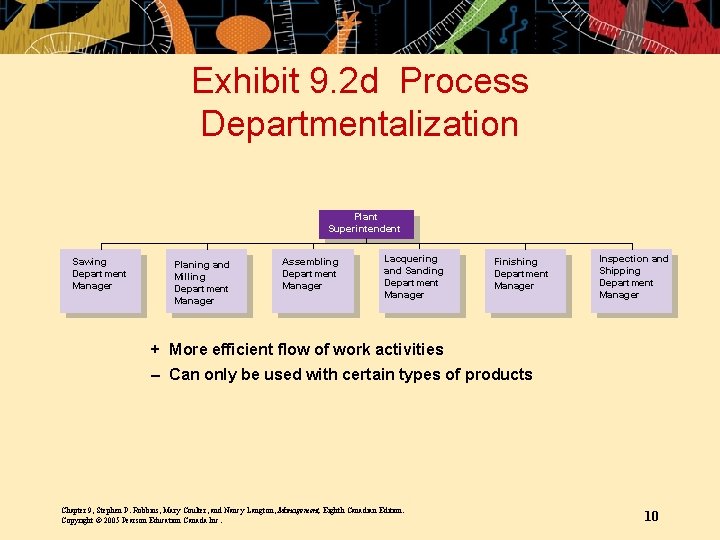
Exhibit 9. 2 d Process Departmentalization Plant Superintendent Sawing Department Manager Planing and Milling Department Manager Assembling Department Manager Lacquering and Sanding Department Manager Finishing Department Manager Inspection and Shipping Department Manager + More efficient flow of work activities – Can only be used with certain types of products Chapter 9, Stephen P. Robbins, Mary Coulter, and Nancy Langton, Management, Eighth Canadian Edition. Copyright © 2005 Pearson Education Canada Inc. 10
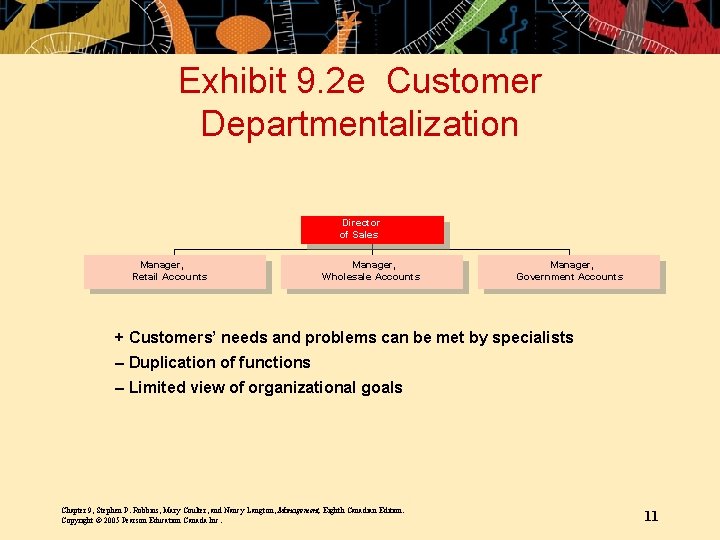
Exhibit 9. 2 e Customer Departmentalization Director of Sales Manager, Retail Accounts Manager, Wholesale Accounts Manager, Government Accounts + Customers’ needs and problems can be met by specialists – Duplication of functions – Limited view of organizational goals Chapter 9, Stephen P. Robbins, Mary Coulter, and Nancy Langton, Management, Eighth Canadian Edition. Copyright © 2005 Pearson Education Canada Inc. 11
Group Exercise • Think of a place where you have (or do) work(ed). Looking at the various forms of departmentalization…choose an example from one of your group members places of employment and answer the following: – Which would have been (would be) the most appropriate model of departmentalization for this workplace? Why – explain your rationale? Chapter 9, Stephen P. Robbins, Mary Coulter, and Nancy Langton, Management, Eighth Canadian Edition. Copyright © 2005 Pearson Education Canada Inc. 12
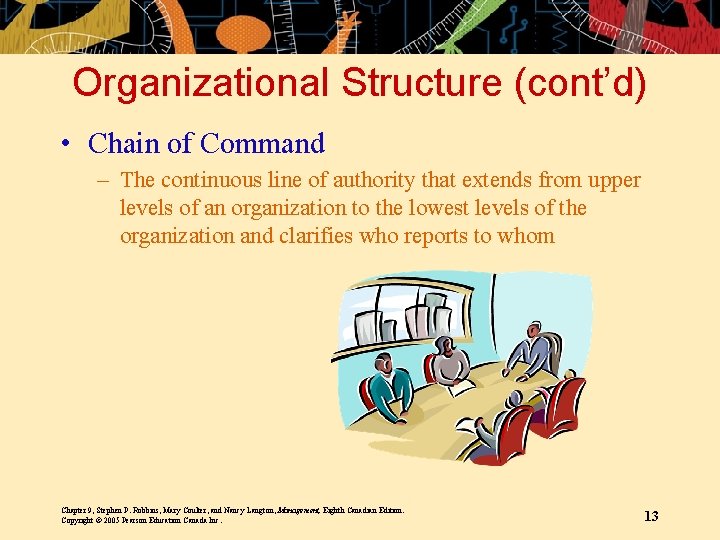
Organizational Structure (cont’d) • Chain of Command – The continuous line of authority that extends from upper levels of an organization to the lowest levels of the organization and clarifies who reports to whom Chapter 9, Stephen P. Robbins, Mary Coulter, and Nancy Langton, Management, Eighth Canadian Edition. Copyright © 2005 Pearson Education Canada Inc. 13
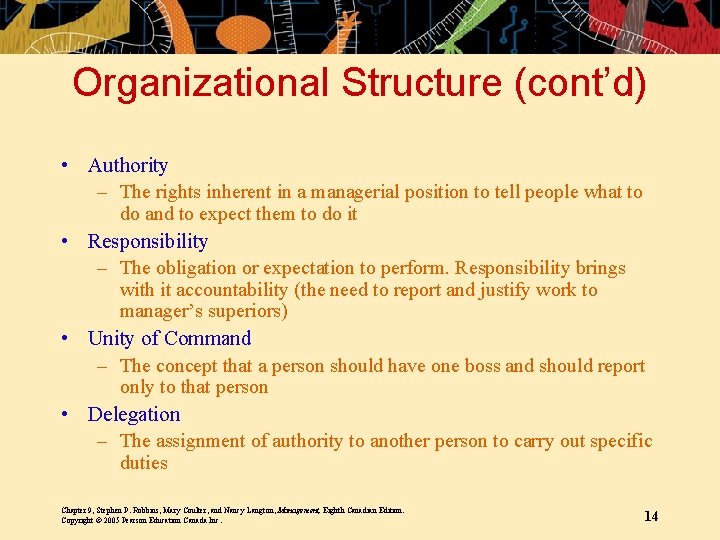
Organizational Structure (cont’d) • Authority – The rights inherent in a managerial position to tell people what to do and to expect them to do it • Responsibility – The obligation or expectation to perform. Responsibility brings with it accountability (the need to report and justify work to manager’s superiors) • Unity of Command – The concept that a person should have one boss and should report only to that person • Delegation – The assignment of authority to another person to carry out specific duties Chapter 9, Stephen P. Robbins, Mary Coulter, and Nancy Langton, Management, Eighth Canadian Edition. Copyright © 2005 Pearson Education Canada Inc. 14
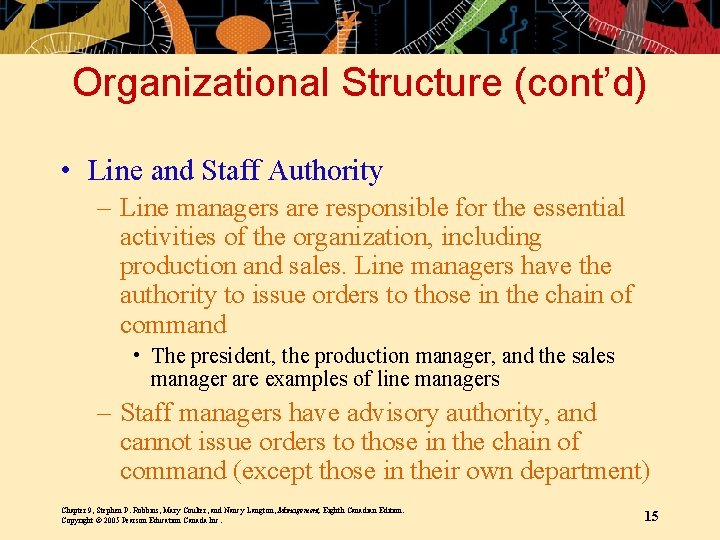
Organizational Structure (cont’d) • Line and Staff Authority – Line managers are responsible for the essential activities of the organization, including production and sales. Line managers have the authority to issue orders to those in the chain of command • The president, the production manager, and the sales manager are examples of line managers – Staff managers have advisory authority, and cannot issue orders to those in the chain of command (except those in their own department) Chapter 9, Stephen P. Robbins, Mary Coulter, and Nancy Langton, Management, Eighth Canadian Edition. Copyright © 2005 Pearson Education Canada Inc. 15
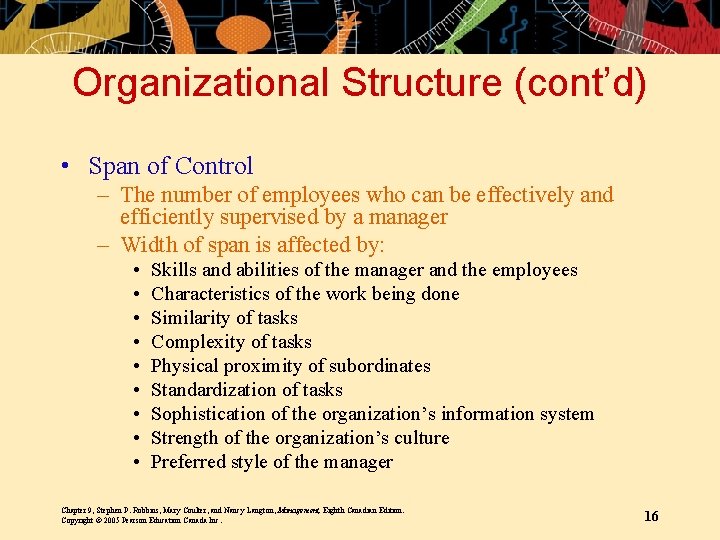
Organizational Structure (cont’d) • Span of Control – The number of employees who can be effectively and efficiently supervised by a manager – Width of span is affected by: • • • Skills and abilities of the manager and the employees Characteristics of the work being done Similarity of tasks Complexity of tasks Physical proximity of subordinates Standardization of tasks Sophistication of the organization’s information system Strength of the organization’s culture Preferred style of the manager Chapter 9, Stephen P. Robbins, Mary Coulter, and Nancy Langton, Management, Eighth Canadian Edition. Copyright © 2005 Pearson Education Canada Inc. 16
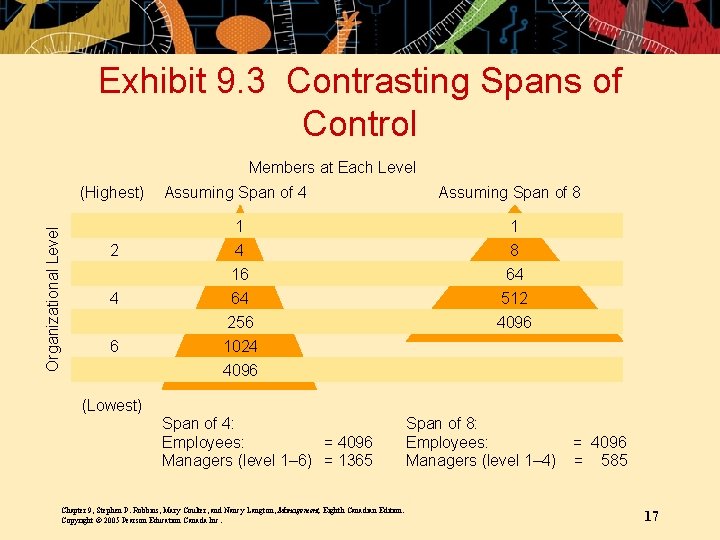
Exhibit 9. 3 Contrasting Spans of Control Organizational Level Members at Each Level (Highest) Assuming Span of 4 Assuming Span of 8 1 2 1 4 1 8 3 4 5 6 16 64 256 1024 64 512 4096 7 4096 (Lowest) Span of 4: Employees: = 4096 Managers (level 1– 6) = 1365 Chapter 9, Stephen P. Robbins, Mary Coulter, and Nancy Langton, Management, Eighth Canadian Edition. Copyright © 2005 Pearson Education Canada Inc. Span of 8: Employees: Managers (level 1– 4) = 4096 = 585 17
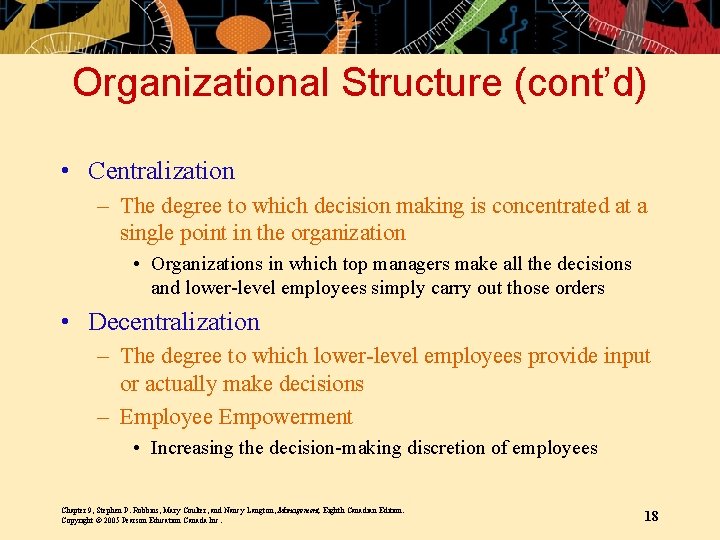
Organizational Structure (cont’d) • Centralization – The degree to which decision making is concentrated at a single point in the organization • Organizations in which top managers make all the decisions and lower-level employees simply carry out those orders • Decentralization – The degree to which lower-level employees provide input or actually make decisions – Employee Empowerment • Increasing the decision-making discretion of employees Chapter 9, Stephen P. Robbins, Mary Coulter, and Nancy Langton, Management, Eighth Canadian Edition. Copyright © 2005 Pearson Education Canada Inc. 18
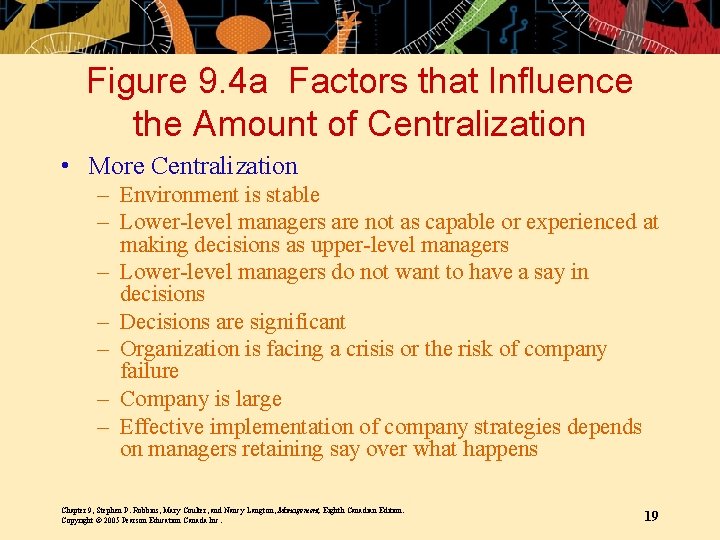
Figure 9. 4 a Factors that Influence the Amount of Centralization • More Centralization – Environment is stable – Lower-level managers are not as capable or experienced at making decisions as upper-level managers – Lower-level managers do not want to have a say in decisions – Decisions are significant – Organization is facing a crisis or the risk of company failure – Company is large – Effective implementation of company strategies depends on managers retaining say over what happens Chapter 9, Stephen P. Robbins, Mary Coulter, and Nancy Langton, Management, Eighth Canadian Edition. Copyright © 2005 Pearson Education Canada Inc. 19
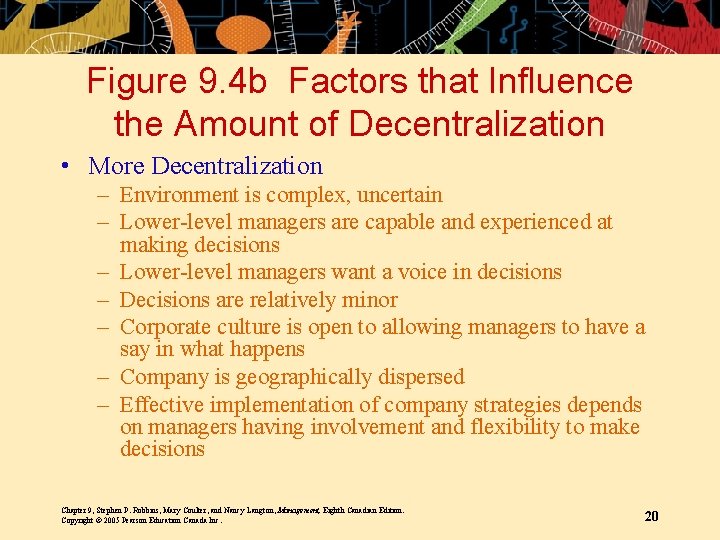
Figure 9. 4 b Factors that Influence the Amount of Decentralization • More Decentralization – Environment is complex, uncertain – Lower-level managers are capable and experienced at making decisions – Lower-level managers want a voice in decisions – Decisions are relatively minor – Corporate culture is open to allowing managers to have a say in what happens – Company is geographically dispersed – Effective implementation of company strategies depends on managers having involvement and flexibility to make decisions Chapter 9, Stephen P. Robbins, Mary Coulter, and Nancy Langton, Management, Eighth Canadian Edition. Copyright © 2005 Pearson Education Canada Inc. 20
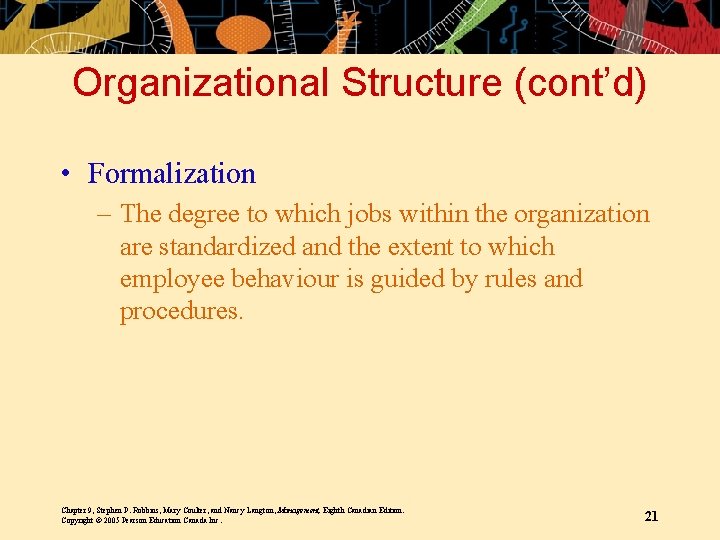
Organizational Structure (cont’d) • Formalization – The degree to which jobs within the organization are standardized and the extent to which employee behaviour is guided by rules and procedures. Chapter 9, Stephen P. Robbins, Mary Coulter, and Nancy Langton, Management, Eighth Canadian Edition. Copyright © 2005 Pearson Education Canada Inc. 21
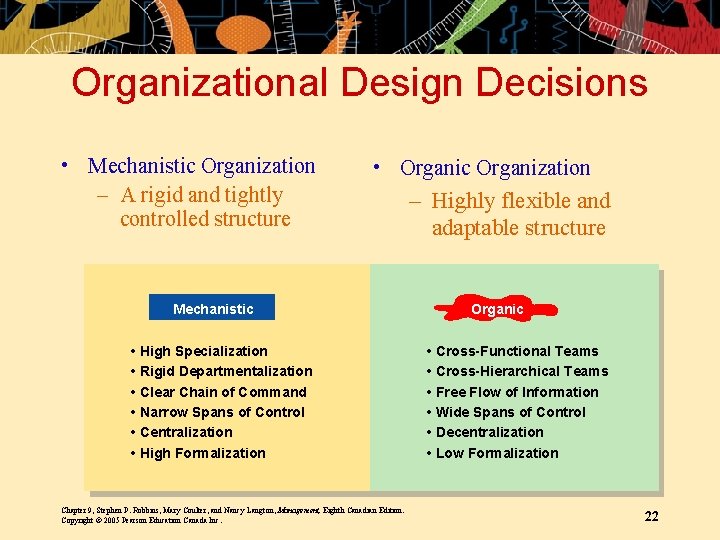
Organizational Design Decisions • Mechanistic Organization – A rigid and tightly controlled structure • Organic Organization – Highly flexible and adaptable structure Mechanistic • High Specialization • Rigid Departmentalization • Clear Chain of Command • Narrow Spans of Control • Centralization • High Formalization Chapter 9, Stephen P. Robbins, Mary Coulter, and Nancy Langton, Management, Eighth Canadian Edition. Copyright © 2005 Pearson Education Canada Inc. Organic • Cross-Functional Teams • Cross-Hierarchical Teams • Free Flow of Information • Wide Spans of Control • Decentralization • Low Formalization 22
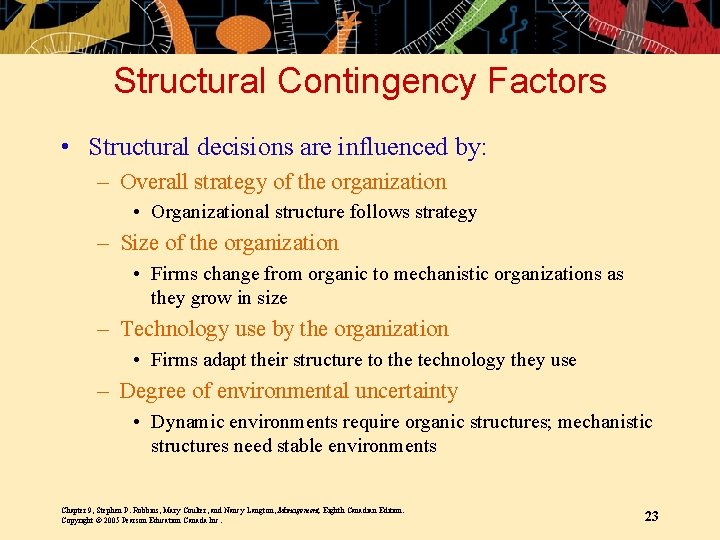
Structural Contingency Factors • Structural decisions are influenced by: – Overall strategy of the organization • Organizational structure follows strategy – Size of the organization • Firms change from organic to mechanistic organizations as they grow in size – Technology use by the organization • Firms adapt their structure to the technology they use – Degree of environmental uncertainty • Dynamic environments require organic structures; mechanistic structures need stable environments Chapter 9, Stephen P. Robbins, Mary Coulter, and Nancy Langton, Management, Eighth Canadian Edition. Copyright © 2005 Pearson Education Canada Inc. 23
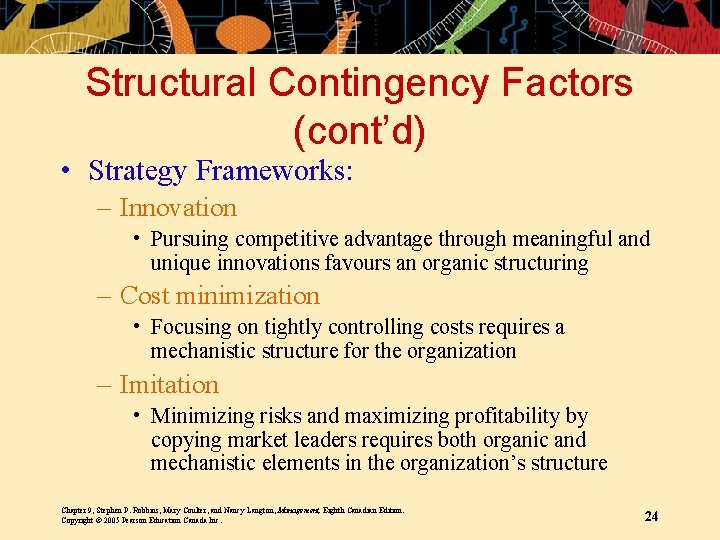
Structural Contingency Factors (cont’d) • Strategy Frameworks: – Innovation • Pursuing competitive advantage through meaningful and unique innovations favours an organic structuring – Cost minimization • Focusing on tightly controlling costs requires a mechanistic structure for the organization – Imitation • Minimizing risks and maximizing profitability by copying market leaders requires both organic and mechanistic elements in the organization’s structure Chapter 9, Stephen P. Robbins, Mary Coulter, and Nancy Langton, Management, Eighth Canadian Edition. Copyright © 2005 Pearson Education Canada Inc. 24
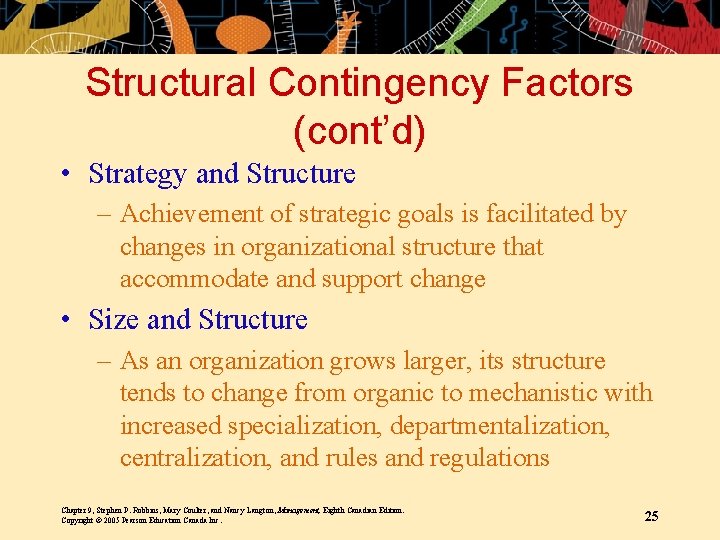
Structural Contingency Factors (cont’d) • Strategy and Structure – Achievement of strategic goals is facilitated by changes in organizational structure that accommodate and support change • Size and Structure – As an organization grows larger, its structure tends to change from organic to mechanistic with increased specialization, departmentalization, centralization, and rules and regulations Chapter 9, Stephen P. Robbins, Mary Coulter, and Nancy Langton, Management, Eighth Canadian Edition. Copyright © 2005 Pearson Education Canada Inc. 25
Structural Contingency Factors (cont’d) • Technology and Structure – Organizations adapt their structures to their technology – Routine technology = mechanistic organizations – Non–routine technology = organic organizations Chapter 9, Stephen P. Robbins, Mary Coulter, and Nancy Langton, Management, Eighth Canadian Edition. Copyright © 2005 Pearson Education Canada Inc. 26
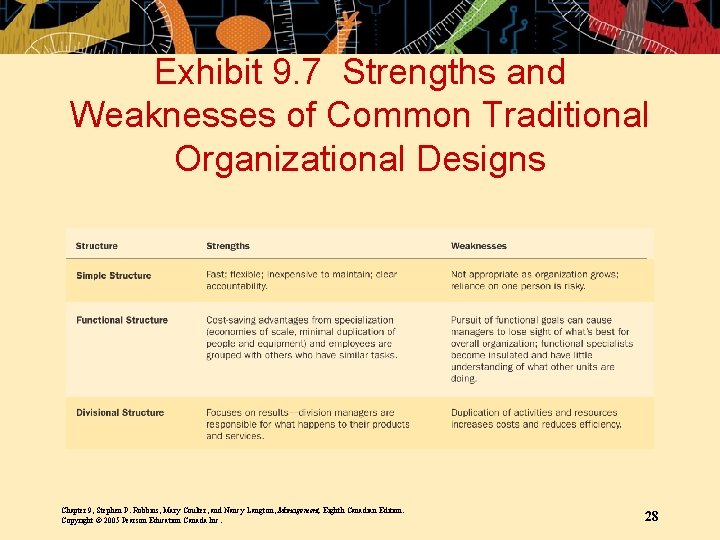
Common Organizational Designs • Traditional Designs – Simple Structure • Low departmentalization, wide spans of control, centralized authority, little formalization – Functional Structure • Departmentalization by function – Operations, finance, human resources, and product research and development – Divisional Structure • Composed of separate business units or divisions with limited autonomy under the coordination and control of the parent corporation Chapter 9, Stephen P. Robbins, Mary Coulter, and Nancy Langton, Management, Eighth Canadian Edition. Copyright © 2005 Pearson Education Canada Inc. 27
Exhibit 9. 7 Strengths and Weaknesses of Common Traditional Organizational Designs Chapter 9, Stephen P. Robbins, Mary Coulter, and Nancy Langton, Management, Eighth Canadian Edition. Copyright © 2005 Pearson Education Canada Inc. 28
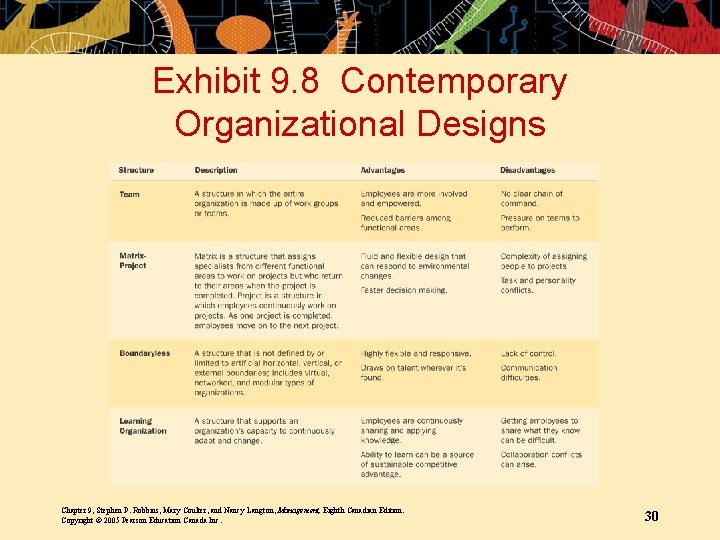
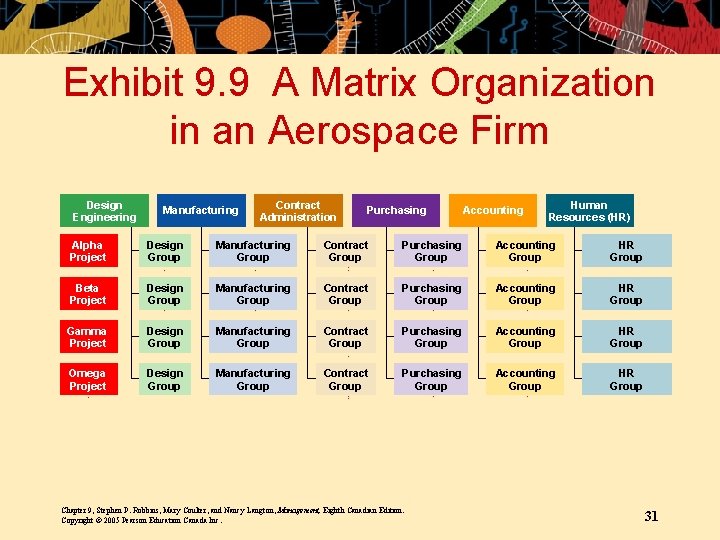
Organizational Designs (cont’d) • Contemporary Organizational Designs – Team Structures • The entire organization is made up of work groups or self -managed teams of empowered employees – Matrix Structures • Specialists for different functional departments are assigned to work on projects led by project managers • Matrix participants have two managers – Project Structures • Employees work continuously on projects, moving on to another project as each project is completed Chapter 9, Stephen P. Robbins, Mary Coulter, and Nancy Langton, Management, Eighth Canadian Edition. Copyright © 2005 Pearson Education Canada Inc. 29
Exhibit 9. 8 Contemporary Organizational Designs Chapter 9, Stephen P. Robbins, Mary Coulter, and Nancy Langton, Management, Eighth Canadian Edition. Copyright © 2005 Pearson Education Canada Inc. 30
Exhibit 9. 9 A Matrix Organization in an Aerospace Firm Design Engineering Manufacturing Contract Administration Purchasing Accounting Human Resources (HR) Alpha Project Design Group Manufacturing Group Contract Group Purchasing Group Accounting Group HR Group Beta Project Design Group Manufacturing Group Contract Group Purchasing Group Accounting Group HR Group Gamma Project Design Group Manufacturing Group Contract Group Purchasing Group Accounting Group HR Group Omega Project Design Group Manufacturing Group Contract Group Purchasing Group Accounting Group HR Group Chapter 9, Stephen P. Robbins, Mary Coulter, and Nancy Langton, Management, Eighth Canadian Edition. Copyright © 2005 Pearson Education Canada Inc. 31
Organizational Designs (cont’d) • Contemporary Organizational Designs (cont’d) – Boundaryless Organization • A flexible and an unstructured organizational design that is intended to break down external barriers between the organization and its customers and suppliers • Removes internal (horizontal) boundaries: – Eliminates the chain of command – Has limitless spans of control – Uses empowered teams rather than departments • Eliminates external boundaries: – Uses virtual, network, and modular organizational structures to get closer to stakeholders Chapter 9, Stephen P. Robbins, Mary Coulter, and Nancy Langton, Management, Eighth Canadian Edition. Copyright © 2005 Pearson Education Canada Inc. 32
Removing Boundaries • Virtual Organization – An organization that consists of a small core of full-time employees and that temporarily hires specialists to work on opportunities that arise • Network Organization – A small core organization that outsources its major business functions (e. g. , manufacturing) in order to concentrate on what it does best • Modular Organization – A manufacturing organization that uses outside suppliers to provide product components for its final assembly operations Chapter 9, Stephen P. Robbins, Mary Coulter, and Nancy Langton, Management, Eighth Canadian Edition. Copyright © 2005 Pearson Education Canada Inc. 33
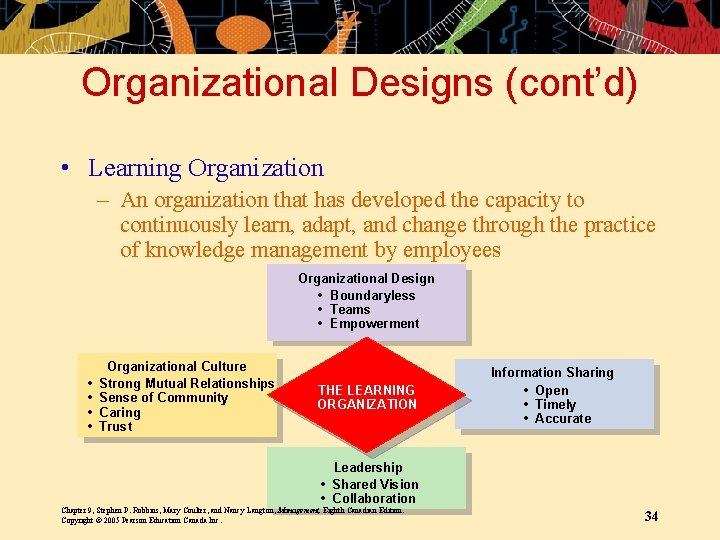
Organizational Designs (cont’d) • Learning Organization – An organization that has developed the capacity to continuously learn, adapt, and change through the practice of knowledge management by employees Organizational Design • Boundaryless • Teams • Empowerment • • Organizational Culture Strong Mutual Relationships Sense of Community Caring Trust THE LEARNING ORGANIZATION Information Sharing • Open • Timely • Accurate Leadership • Shared Vision • Collaboration Chapter 9, Stephen P. Robbins, Mary Coulter, and Nancy Langton, Management, Eighth Canadian Edition. Copyright © 2005 Pearson Education Canada Inc. 34
Thanks! Chapter 9, Stephen P. Robbins, Mary Coulter, and Nancy Langton, Management, Eighth Canadian Edition. Copyright © 2005 Pearson Education Canada Inc. 35