
Chapter 9 One and TwoSample Estimation Problems 9
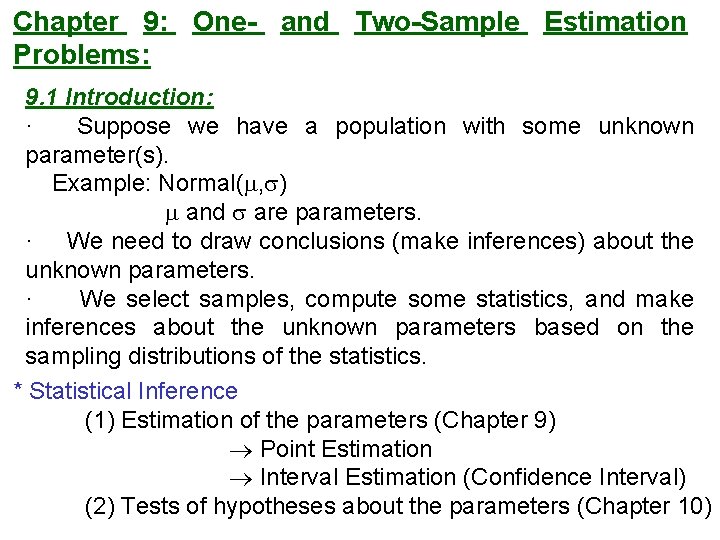
Chapter 9: One- and Two-Sample Estimation Problems: 9. 1 Introduction: · Suppose we have a population with some unknown parameter(s). Example: Normal( , ) and are parameters. · We need to draw conclusions (make inferences) about the unknown parameters. · We select samples, compute some statistics, and make inferences about the unknown parameters based on the sampling distributions of the statistics. * Statistical Inference (1) Estimation of the parameters (Chapter 9) Point Estimation Interval Estimation (Confidence Interval) (2) Tests of hypotheses about the parameters (Chapter 10)
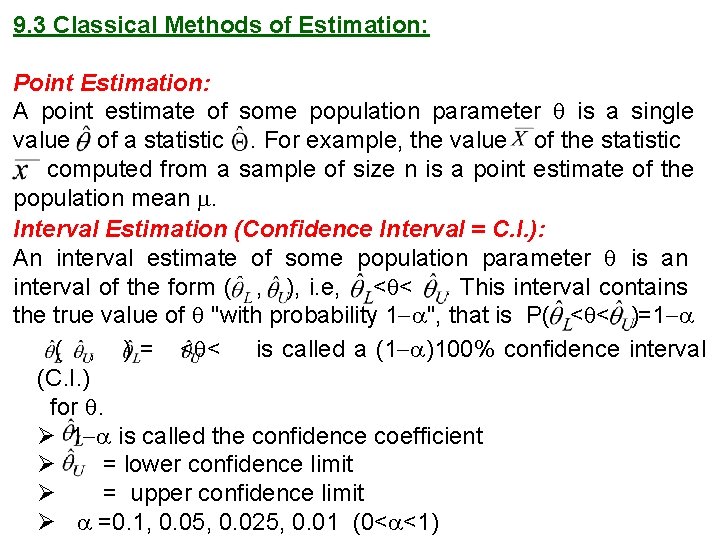
9. 3 Classical Methods of Estimation: Point Estimation: A point estimate of some population parameter is a single value of a statistic . For example, the value of the statistic computed from a sample of size n is a point estimate of the population mean . Interval Estimation (Confidence Interval = C. I. ): An interval estimate of some population parameter is an interval of the form ( , ), i. e, < < . This interval contains the true value of "with probability 1 ", that is P( < < )=1 ( , ) = < < is called a (1 )100% confidence interval (C. I. ) for . Ø 1 is called the confidence coefficient Ø = lower confidence limit Ø = upper confidence limit Ø =0. 1, 0. 05, 0. 025, 0. 01 (0< <1)
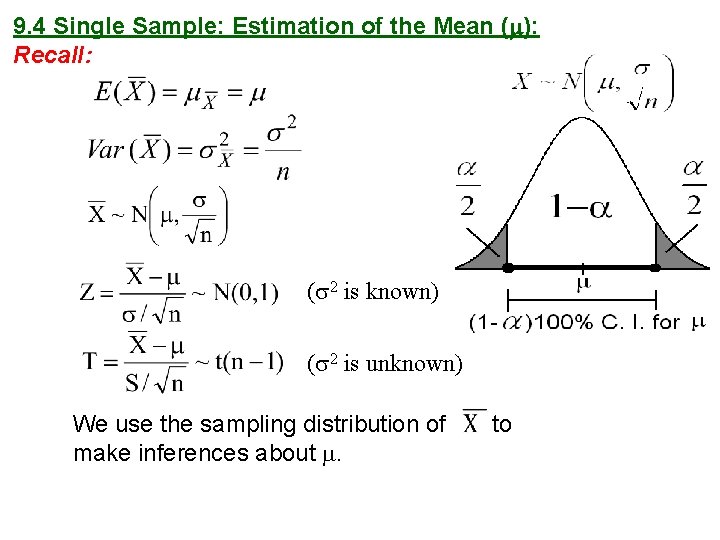
9. 4 Single Sample: Estimation of the Mean ( ): Recall: ( 2 is known) ( 2 is unknown) We use the sampling distribution of to make inferences about .
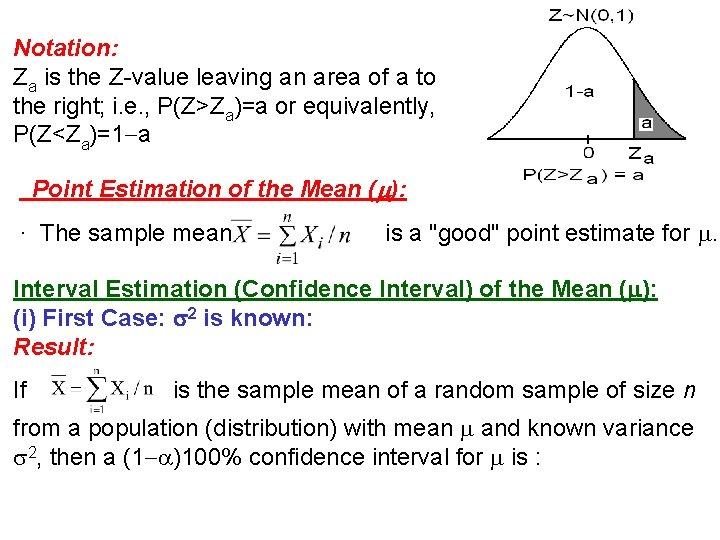
Notation: Za is the Z-value leaving an area of a to the right; i. e. , P(Z>Za)=a or equivalently, P(Z<Za)=1 a Point Estimation of the Mean ( ): · The sample mean is a "good" point estimate for . Interval Estimation (Confidence Interval) of the Mean ( ): (i) First Case: 2 is known: Result: If is the sample mean of a random sample of size n from a population (distribution) with mean and known variance 2, then a (1 )100% confidence interval for is :
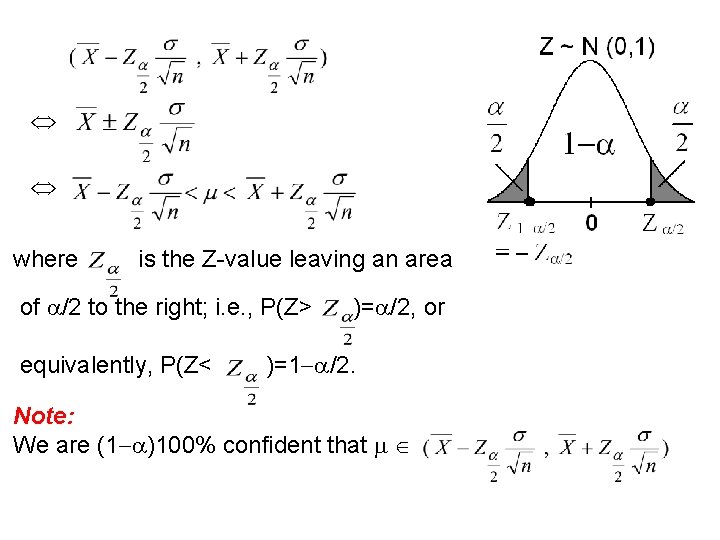
where is the Z-value leaving an area of /2 to the right; i. e. , P(Z> )= /2, or equivalently, P(Z< )=1 /2. Note: We are (1 )100% confident that
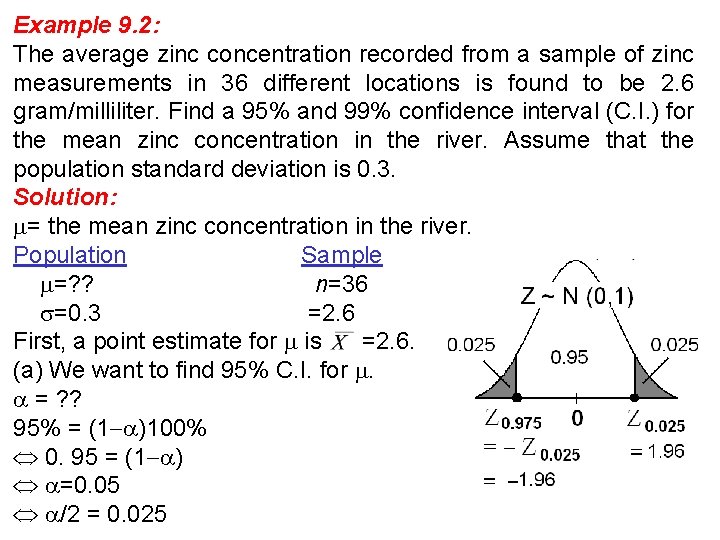
Example 9. 2: The average zinc concentration recorded from a sample of zinc measurements in 36 different locations is found to be 2. 6 gram/milliliter. Find a 95% and 99% confidence interval (C. I. ) for the mean zinc concentration in the river. Assume that the population standard deviation is 0. 3. Solution: = the mean zinc concentration in the river. Population Sample =? ? n=36 =0. 3 =2. 6 First, a point estimate for is =2. 6. (a) We want to find 95% C. I. for . = ? ? 95% = (1 )100% 0. 95 = (1 ) =0. 05 /2 = 0. 025
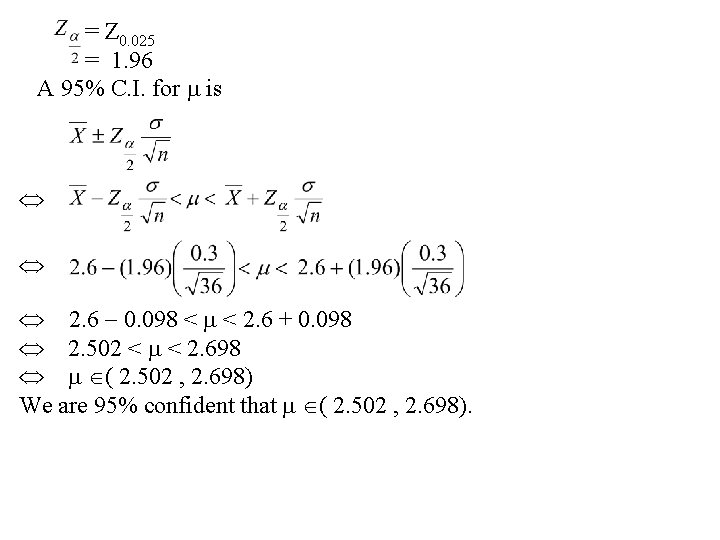
= Z 0. 025 = 1. 96 A 95% C. I. for is 2. 6 0. 098 < < 2. 6 + 0. 098 2. 502 < < 2. 698 ( 2. 502 , 2. 698) We are 95% confident that ( 2. 502 , 2. 698).
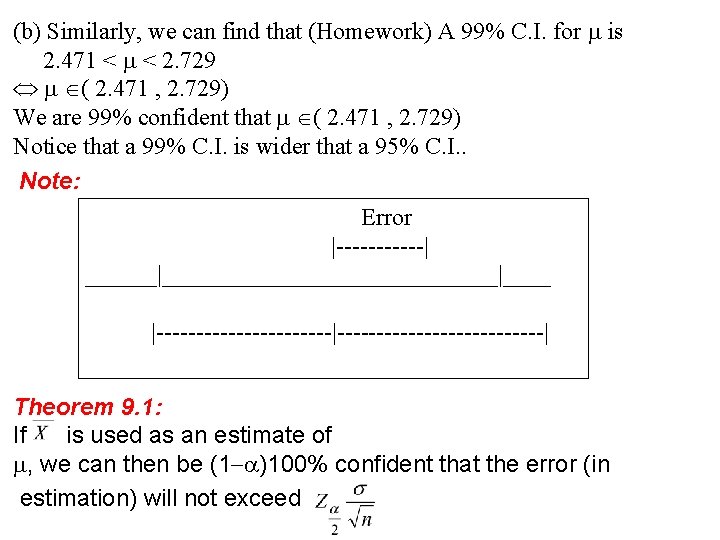
(b) Similarly, we can find that (Homework) A 99% C. I. for is 2. 471 < < 2. 729 ( 2. 471 , 2. 729) We are 99% confident that ( 2. 471 , 2. 729) Notice that a 99% C. I. is wider that a 95% C. I. . Note: Error |------| ______|______________|____ |--------------------------| Theorem 9. 1: If is used as an estimate of , we can then be (1 )100% confident that the error (in estimation) will not exceed
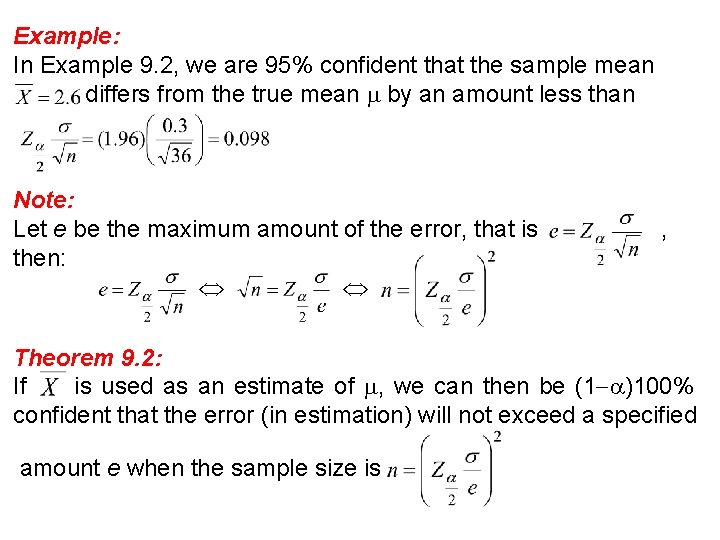
Example: In Example 9. 2, we are 95% confident that the sample mean differs from the true mean by an amount less than Note: Let e be the maximum amount of the error, that is then: , Theorem 9. 2: If is used as an estimate of , we can then be (1 )100% confident that the error (in estimation) will not exceed a specified amount e when the sample size is
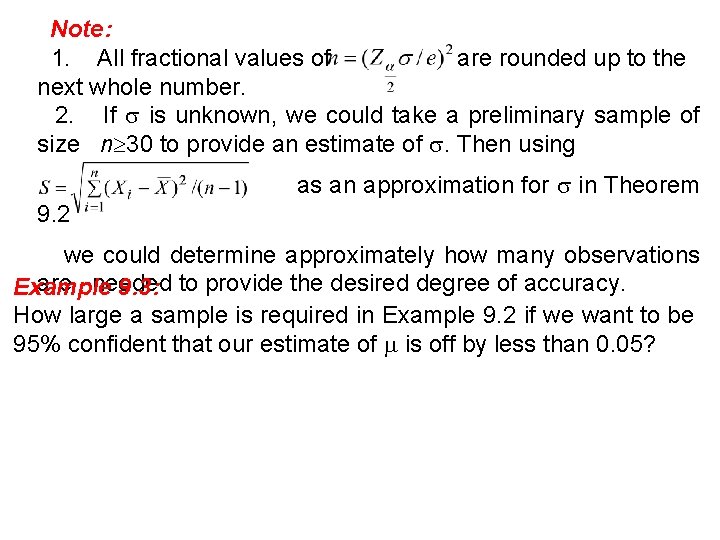
Note: 1. All fractional values of are rounded up to the next whole number. 2. If is unknown, we could take a preliminary sample of size n 30 to provide an estimate of . Then using as an approximation for in Theorem 9. 2 we could determine approximately how many observations are needed to provide the desired degree of accuracy. Example 9. 3: How large a sample is required in Example 9. 2 if we want to be 95% confident that our estimate of is off by less than 0. 05?
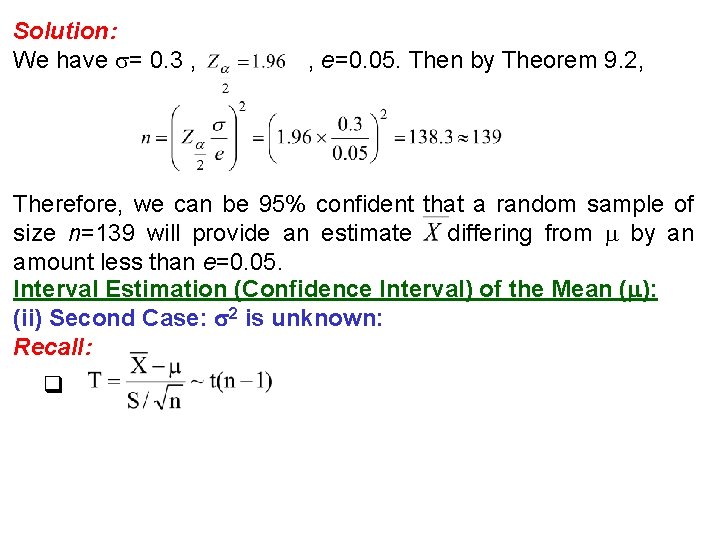
Solution: We have = 0. 3 , , e=0. 05. Then by Theorem 9. 2, Therefore, we can be 95% confident that a random sample of size n=139 will provide an estimate differing from by an amount less than e=0. 05. Interval Estimation (Confidence Interval) of the Mean ( ): (ii) Second Case: 2 is unknown: Recall: q
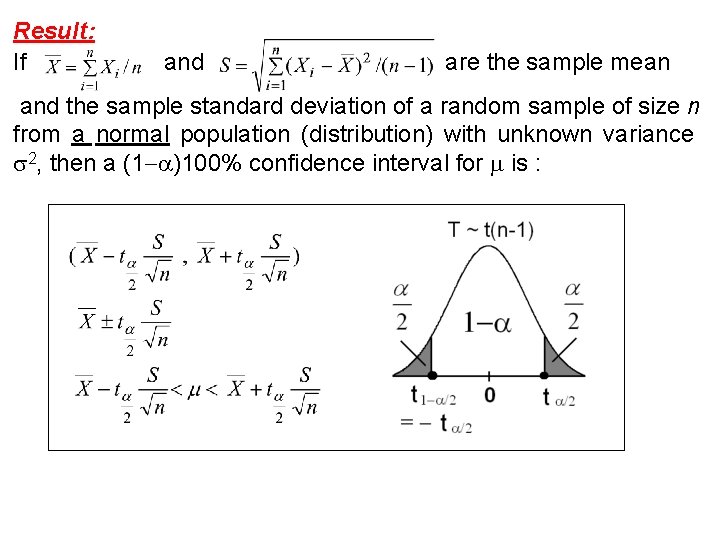
Result: If and are the sample mean and the sample standard deviation of a random sample of size n from a normal population (distribution) with unknown variance 2, then a (1 )100% confidence interval for is :
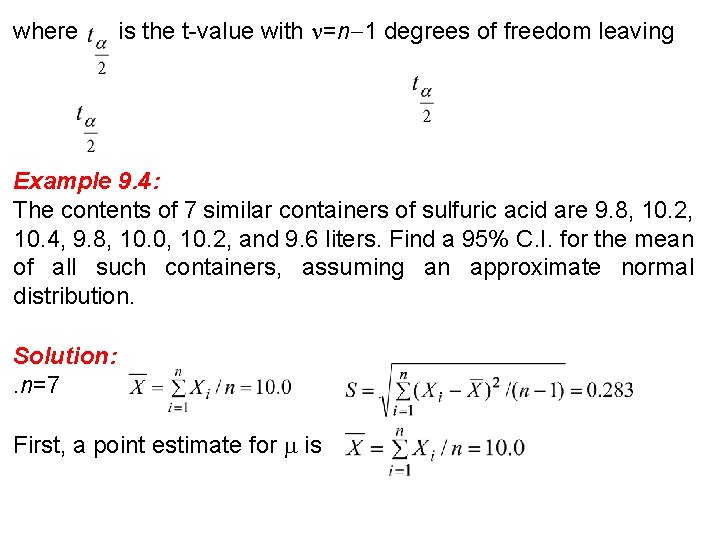
where is the t-value with =n 1 degrees of freedom leaving Example 9. 4: The contents of 7 similar containers of sulfuric acid are 9. 8, 10. 2, 10. 4, 9. 8, 10. 0, 10. 2, and 9. 6 liters. Find a 95% C. I. for the mean of all such containers, assuming an approximate normal distribution. Solution: . n=7 First, a point estimate for is
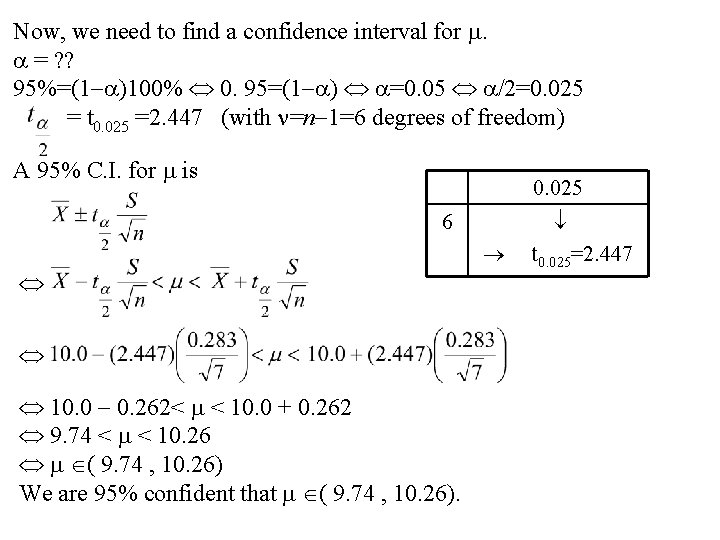
Now, we need to find a confidence interval for . = ? ? 95%=(1 )100% 0. 95=(1 ) =0. 05 /2=0. 025 = t 0. 025 =2. 447 (with =n 1=6 degrees of freedom) A 95% C. I. for is 0. 025 6 10. 0 0. 262< < 10. 0 + 0. 262 9. 74 < < 10. 26 ( 9. 74 , 10. 26) We are 95% confident that ( 9. 74 , 10. 26). t 0. 025=2. 447
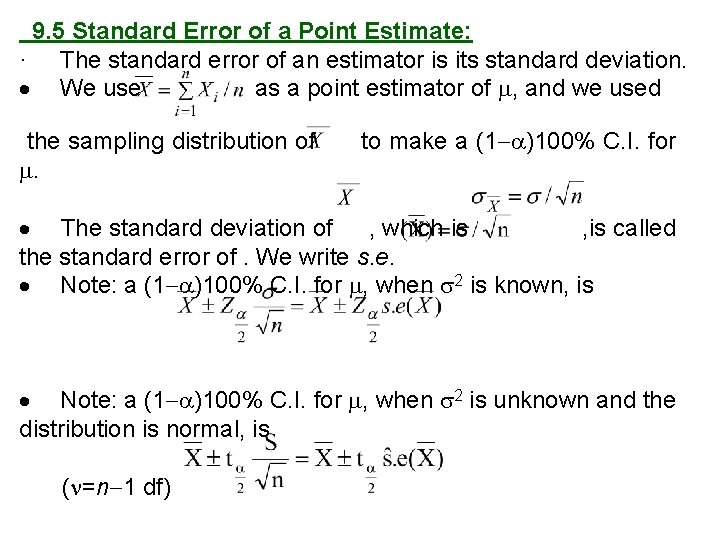
9. 5 Standard Error of a Point Estimate: · The standard error of an estimator is its standard deviation. · We use as a point estimator of , and we used the sampling distribution of to make a (1 )100% C. I. for . · The standard deviation of , which is , is called the standard error of. We write s. e. · Note: a (1 )100% C. I. for , when 2 is known, is · Note: a (1 )100% C. I. for , when 2 is unknown and the distribution is normal, is ( =n 1 df)
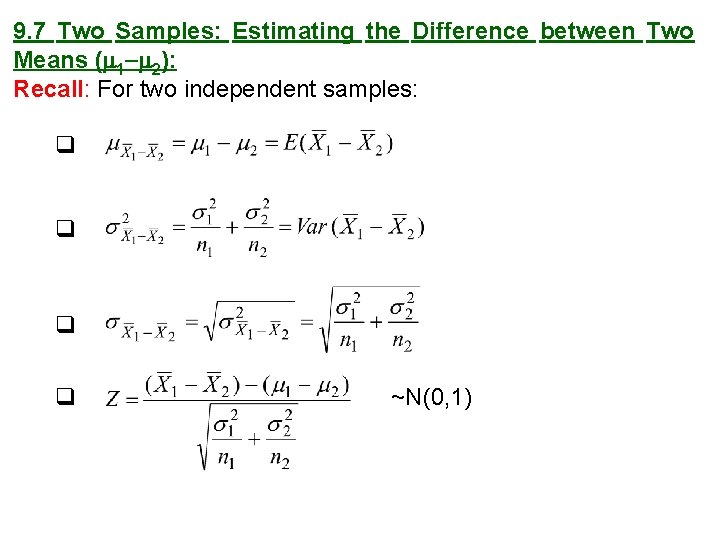
9. 7 Two Samples: Estimating the Difference between Two Means ( 1 2): Recall: For two independent samples: q q ~N(0, 1)
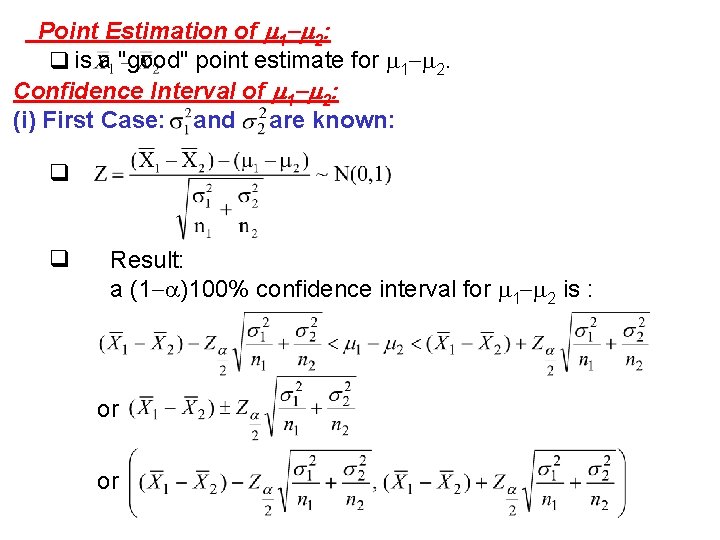
Point Estimation of 1 2: q is a "good" point estimate for 1 2. Confidence Interval of 1 2: (i) First Case: and are known: q q Result: a (1 )100% confidence interval for 1 2 is : or or
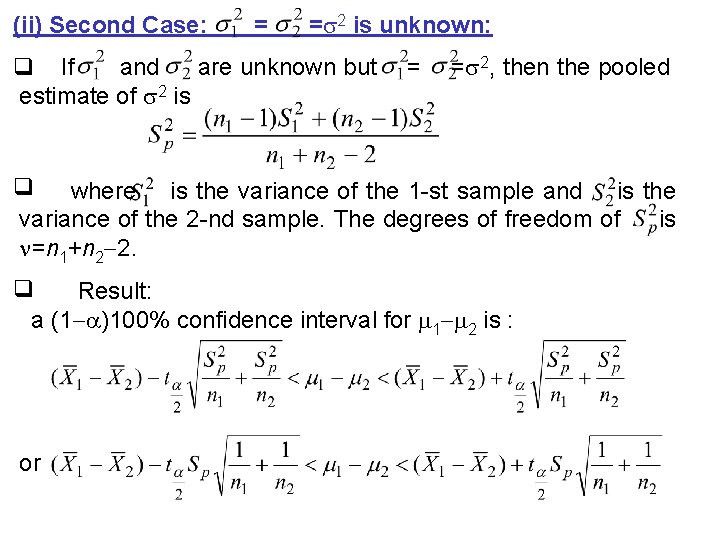
(ii) Second Case: = = 2 is unknown: 2, then the pooled q If and are unknown but = = estimate of 2 is q where is the variance of the 1 -st sample and is the variance of the 2 -nd sample. The degrees of freedom of is =n 1+n 2 2. q Result: a (1 )100% confidence interval for 1 2 is : or
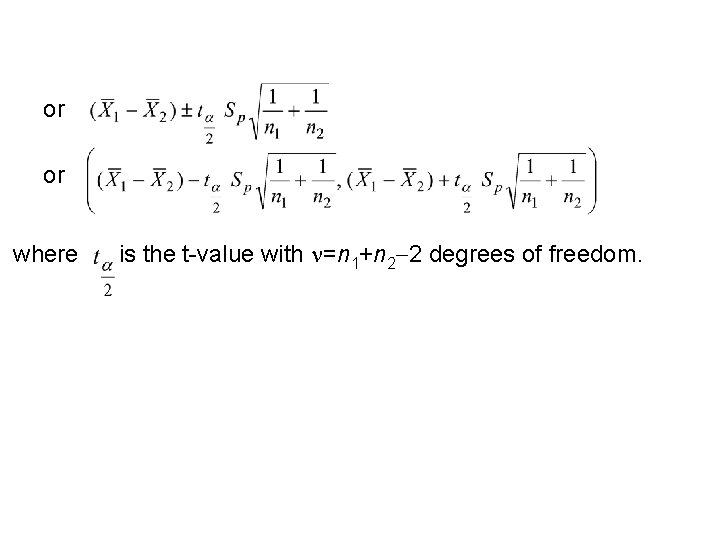
or or where is the t-value with =n 1+n 2 2 degrees of freedom.
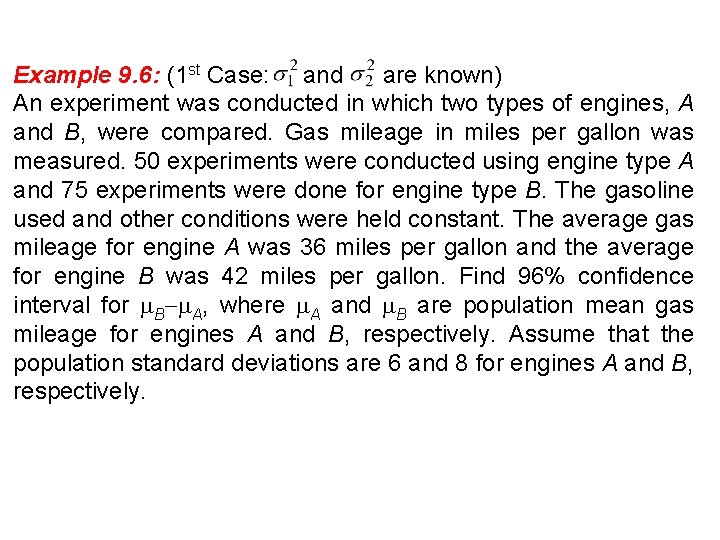
Example 9. 6: (1 st Case: and are known) An experiment was conducted in which two types of engines, A and B, were compared. Gas mileage in miles per gallon was measured. 50 experiments were conducted using engine type A and 75 experiments were done for engine type B. The gasoline used and other conditions were held constant. The average gas mileage for engine A was 36 miles per gallon and the average for engine B was 42 miles per gallon. Find 96% confidence interval for B A, where A and B are population mean gas mileage for engines A and B, respectively. Assume that the population standard deviations are 6 and 8 for engines A and B, respectively.

Solution: Engine A Engine B n. A=50 n. B=75 =36 =42 A=6 B=8 A point estimate for B A is =42 36=6. = ? ? 96% = (1 )100% 0. 96 = (1 ) =0. 04 /2 = 0. 02 = Z 0. 02 = 2. 05 A 96% C. I. for B A is
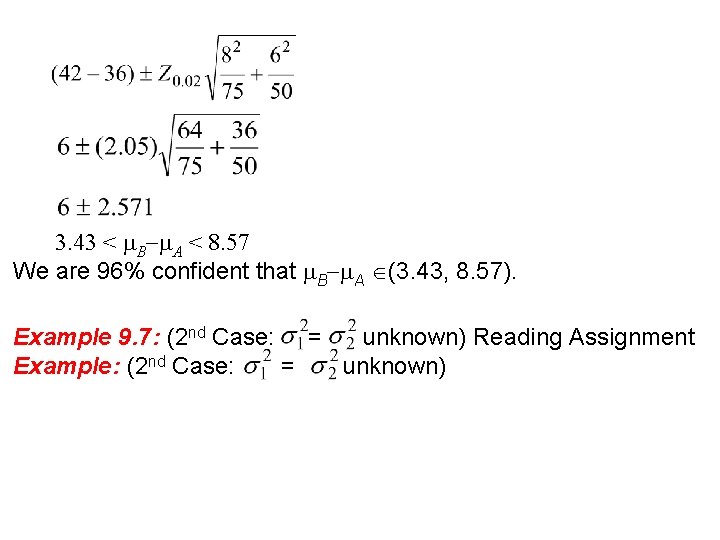
3. 43 < B A < 8. 57 We are 96% confident that B A (3. 43, 8. 57). Example 9. 7: (2 nd Case: = unknown) Reading Assignment Example: (2 nd Case: = unknown)
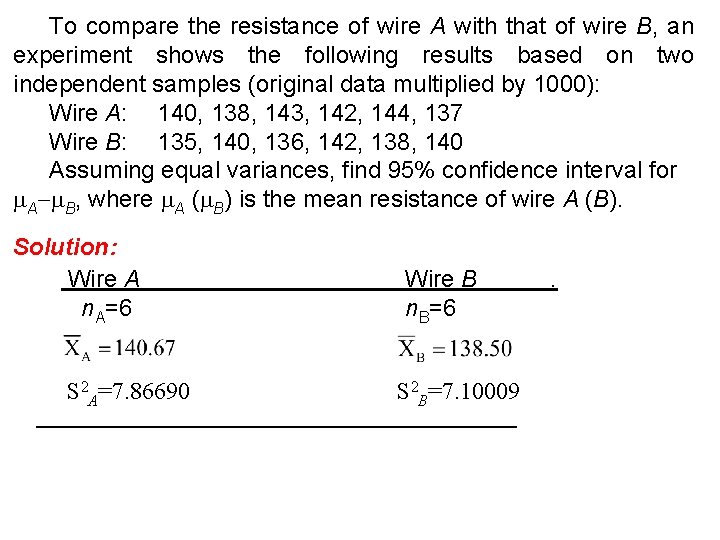
To compare the resistance of wire A with that of wire B, an experiment shows the following results based on two independent samples (original data multiplied by 1000): Wire A: 140, 138, 143, 142, 144, 137 Wire B: 135, 140, 136, 142, 138, 140 Assuming equal variances, find 95% confidence interval for A B, where A ( B) is the mean resistance of wire A (B). Solution: Wire A n. A=6 Wire B . n. B=6 S 2 A=7. 86690 S 2 B=7. 10009 __________________
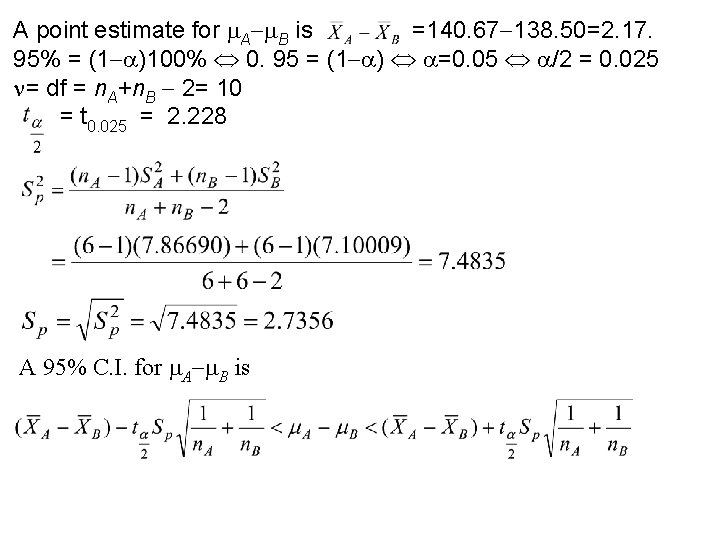
A point estimate for A B is =140. 67 138. 50=2. 17. 95% = (1 )100% 0. 95 = (1 ) =0. 05 /2 = 0. 025 = df = n. A+n. B 2= 10 = t 0. 025 = 2. 228 A 95% C. I. for A B is
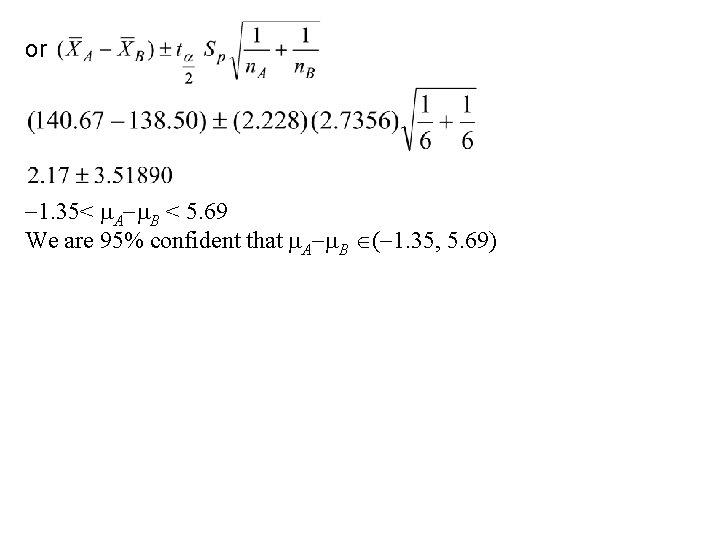
or 1. 35< A B < 5. 69 We are 95% confident that A B ( 1. 35, 5. 69)
- Slides: 25