
Chapter 9 Objectives v Name the parts of
Chapter 9 Objectives v Name the parts of drug labels v Label syringes and medicine cups for proper dosing v Read intravenous fluid administration bags v Use the drug label to find key dosing information
Reading Drug Labels, Medicine Cups, Syringes, and Intravenous Fluid Administration Bags Unit 9
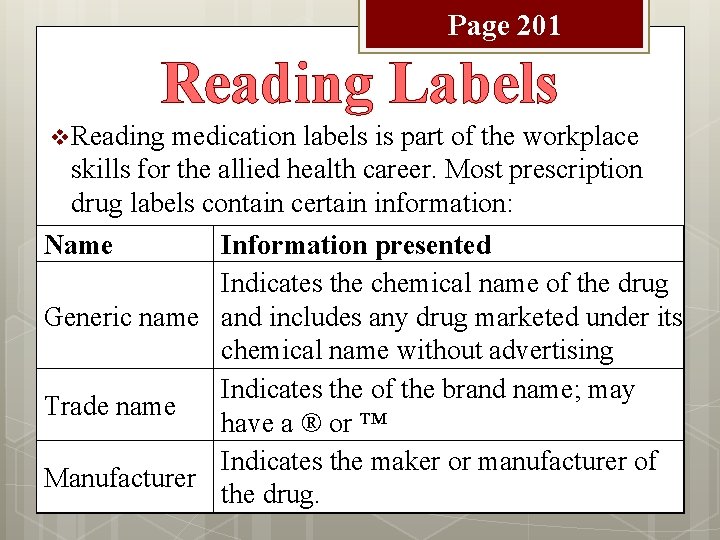
Page 201 Reading Labels v Reading medication labels is part of the workplace skills for the allied health career. Most prescription drug labels contain certain information: Name Information presented Indicates the chemical name of the drug Generic name and includes any drug marketed under its chemical name without advertising Indicates the of the brand name; may Trade name have a ® or ™ Indicates the maker or manufacturer of Manufacturer the drug.

Page 201 Reading Labels (Cont’d) Name National Drug Code (NDC) number Lot number (control number) Drug form Dosage strength Usual adult dose Information presented Identifies the manufacturer, medication, and the container size Placed on the label prior to shipping to identify the lot Indicates cream, capsule, caplet, drop, tablet, suppository, syrup, etc. Provides the strength per dose as in tablet, milliliter, syrup, etc. Indicates the usual adult dose for typical use
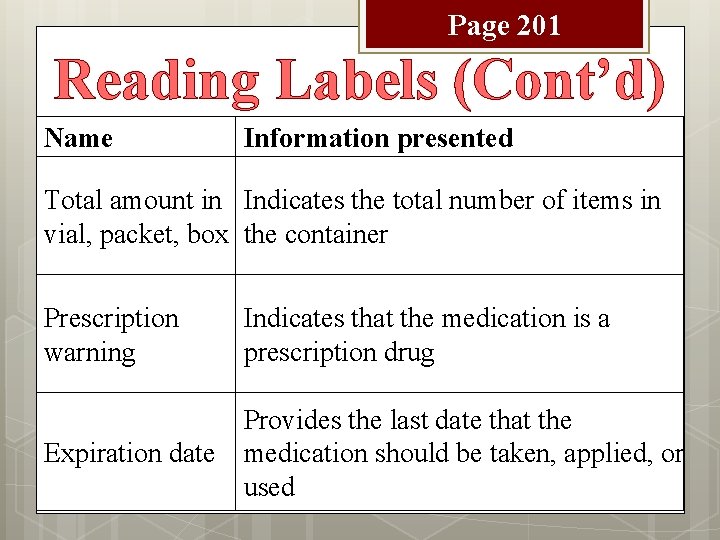
Page 201 Reading Labels (Cont’d) Name Information presented Total amount in Indicates the total number of items in vial, packet, box the container Prescription warning Indicates that the medication is a prescription drug Expiration date Provides the last date that the medication should be taken, applied, or used

Page 209 Medicine Cups v Medicine cups are used to dispose liquid medications such as cough syrup and Maalox (milk of magnesia). To measure accurately: • First pour the solution into the medicine cup • Next, place the cup on a level countertop to ensure the accuracy of the measurement.
Page 210 Syringes v Syringes are sterile and are used to inject these medications. Syringes are labels in tenths and hundredths, and the barrel of the syringe has markings in milliliters (m. L), or units indicating volume. Metric units are based on units of ten, making them easy to measure. By having one standard for syringes, fewer medication errors will occur. Carefully read the syringe from the edge of the plunger closest to the needle.
Page 211 IV Bags v Intravenous infusions, or through-the-vein dosing, are used to provide a wide range of fluids: blood, medication, and nutritional and/or electrolytebalanced water. Intravenous (IV) dosing goes directly into the vein and can be given to a client over time. Intravenous fluids administration bags are monitored by time, volume, and rate to ensure proper dosing.
Page 211 IV Bags (Cont’d) v IV bags are made from durable plastic and are supplied in a variety of sizes: 250 m. L, 500 m. L, and 1, 000 m. L. Smaller bags, which come in 100 m. L, are available for mixing specific medications. The capacity is noted on the bag. Determining the amount of liquid remaining in an IV bag is straightforward. To read the IV bag, subtract the volume of the infused fluid from the capacity noted on the bag.
- Slides: 9