
Chapter 9 Nontariff Trade Barriers and the New
Chapter 9 Non-tariff Trade Barriers and the New Protectionism 经济学院 柳哲
Chapter 9 Non-tariff Trade Barriers and the New Protectionism 9. 1 Import quotas a quota is the most important non-tariff trade barrier. It is a direct quantitative restriction on the amount of a commodity allowed to be imported or exported. 9. 1. 1 The effects of an import quota Import quotas ---- used by all industrial nations to protect their agriculture ---- used by developing nations to stimulate import substitution of manufactured products and for balance-of-payments reasons.
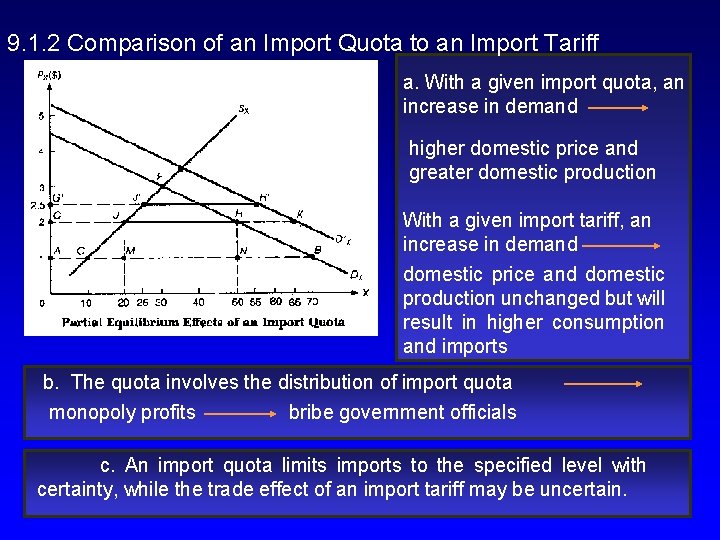
9. 1. 2 Comparison of an Import Quota to an Import Tariff a. With a given import quota, an increase in demand higher domestic price and greater domestic production With a given import tariff, an increase in demand domestic price and domestic production unchanged but will result in higher consumption and imports b. The quota involves the distribution of import quota monopoly profits bribe government officials c. An import quota limits imports to the specified level with certainty, while the trade effect of an import tariff may be uncertain.

9. 1. 3 the forms of quotas Global Quota (Unallocated Quota) Absolute Quota Country Quota Autonomous Quota (Unilateral Quota) Agreement Quota Importer Quota Tariff Quota 9. 2 Other non-tariff Barriers 9. 2. 1 Voluntary Export Restraints (VERs) An importing country induces another nation to reduce its exports of a commodity “voluntarily, ” under the threat of higher all-round trade restrictions, when these exports threaten an entire domestic industry.
9. 2. 2 Import License System Open General License --- OGL Specific License ---SL 9. 2. 3 Foreign Exchange control 9. 2. 4 Advanced Deposit 9. 2. 5 Minimum Price 9. 2. 6 Internal Taxes 9. 2. 7 State Monopoly (State trade) 9. 2. 8 Discriminatory Government Procurement Policy 9. 2. 9 Customs Procedures 9. 2. 10 Technical Barrier to Trade technical standard health and sanitary regulation packing and labeling regulation
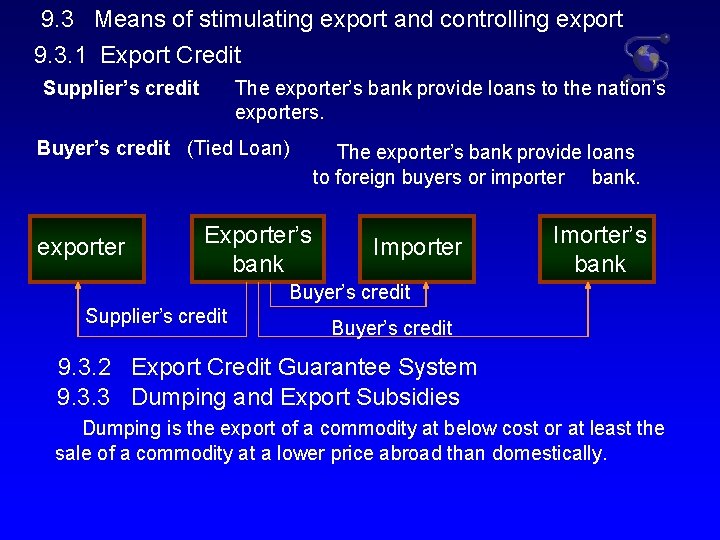
9. 3 Means of stimulating export and controlling export 9. 3. 1 Export Credit Supplier’s credit The exporter’s bank provide loans to the nation’s exporters. Buyer’s credit (Tied Loan) The exporter’s bank provide loans to foreign buyers or importer bank. exporter Exporter’s bank Importer Imorter’s bank Buyer’s credit Supplier’s credit Buyer’s credit 9. 3. 2 Export Credit Guarantee System 9. 3. 3 Dumping and Export Subsidies Dumping is the export of a commodity at below cost or at least the sale of a commodity at a lower price abroad than domestically.
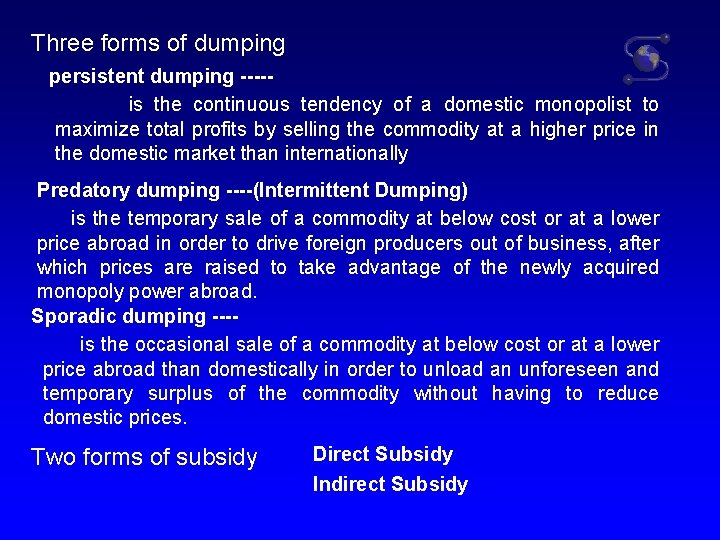
Three forms of dumping persistent dumping ---- is the continuous tendency of a domestic monopolist to maximize total profits by selling the commodity at a higher price in the domestic market than internationally Predatory dumping ----(Intermittent Dumping) is the temporary sale of a commodity at below cost or at a lower price abroad in order to drive foreign producers out of business, after which prices are raised to take advantage of the newly acquired monopoly power abroad. Sporadic dumping --- is the occasional sale of a commodity at below cost or at a lower price abroad than domestically in order to unload an unforeseen and temporary surplus of the commodity without having to reduce domestic prices. Two forms of subsidy Direct Subsidy Indirect Subsidy
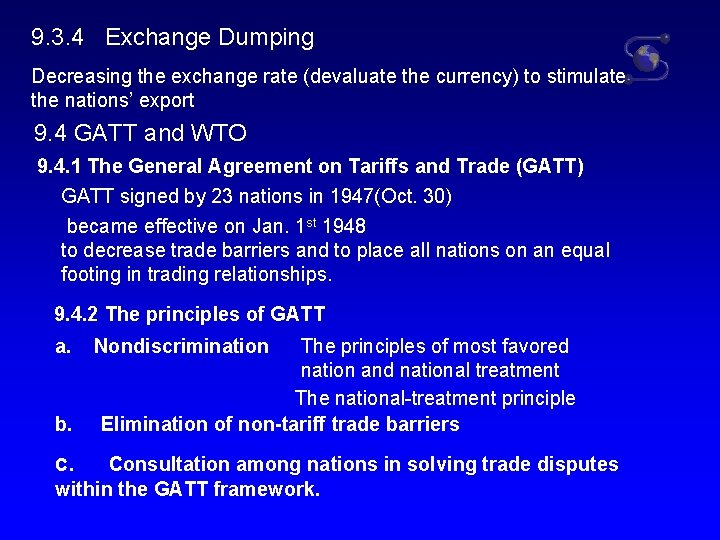
9. 3. 4 Exchange Dumping Decreasing the exchange rate (devaluate the currency) to stimulate the nations’ export 9. 4 GATT and WTO 9. 4. 1 The General Agreement on Tariffs and Trade (GATT) GATT signed by 23 nations in 1947(Oct. 30) became effective on Jan. 1 st 1948 to decrease trade barriers and to place all nations on an equal footing in trading relationships. 9. 4. 2 The principles of GATT a. b. c. Nondiscrimination The principles of most favored nation and national treatment The national-treatment principle Elimination of non-tariff trade barriers Consultation among nations in solving trade disputes within the GATT framework.
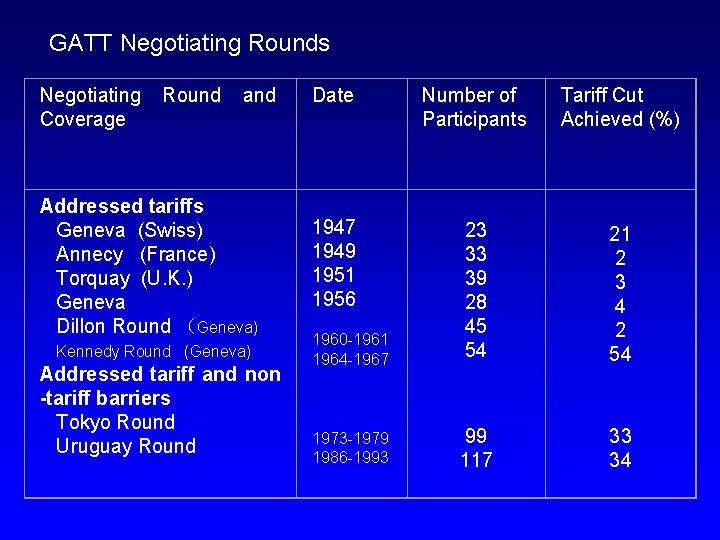
GATT Negotiating Rounds Negotiating Round and Coverage Addressed tariffs Geneva (Swiss) Annecy (France) Torquay (U. K. ) Geneva Dillon Round (Geneva) Kennedy Round (Geneva) Addressed tariff and non -tariff barriers Tokyo Round Uruguay Round Date 1947 1949 1951 1956 1960 -1961 1964 -1967 1973 -1979 1986 -1993 Number of Participants Tariff Cut Achieved (%) 23 33 39 28 45 54 99 117 21 2 3 4 2 54 33 34
9. 4. 3 The World Trade Organization On January 1, 1995, the Uruguay Round took effect, GATT was transformed into the World Trade Organization. 9. 4. 4 How different is the WTO from the old GATT ? a. The WTO is a permanent international organization, headquartered in Geneva, Switzerland, while the old GATT was basically a provisional treaty serviced b. The WTO has a far wider scope than the old GATT, bringing into the multilateral trading system, trade in services, intellectual property, and investment. c. The WTO also administers a unified package of agreements to which all members are committed; in contrast, the GATT framework included many side agreements whose membership was limited to a few nations.
d. The WTO reverses policies of protection in certain “sensitive” areas (for example, agriculture and textiles) that were more or less tolerated in the old GATT. e. The WTO is not a government; individual nations retain their right to determine how they will make national laws conforming to their international obligations.
- Slides: 11