
Chapter 9 Network Theorems Superposition Theorem Total current
- Slides: 41
Chapter 9 Network Theorems
Superposition Theorem • Total current through or voltage across a resistor or branch – Determine by adding effects due to each source acting independently • Replace a voltage source with a short 2
Superposition Theorem • Replace a current source with an open • Find results of branches using each source independently – Algebraically combine results 3
Superposition Theorem • Power – Not a linear quantity – Found by squaring voltage or current • Theorem does not apply to power – To find power using superposition – Determine voltage or current – Calculate power 4
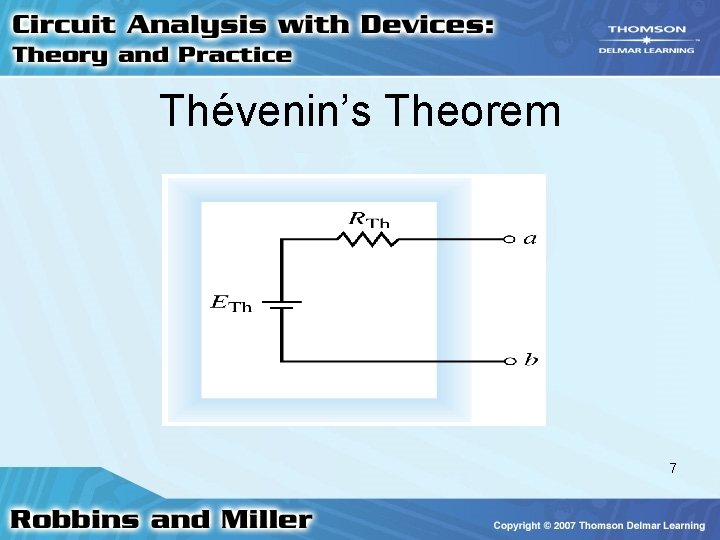
Thévenin’s Theorem • Lumped linear bilateral network – May be reduced to a simplified two-terminal circuit – Consists of a single voltage source and series resistance 5
Thévenin’s Theorem • Voltage source – Thévenin equivalent voltage, ETh. • Series resistance is Thévenin equivalent resistance, RTh 6
Thévenin’s Theorem 7
Thévenin’s Theorem • To convert to a Thévenin circuit – First identify and remove load from circuit • Label resulting open terminals 8
Thévenin’s Theorem • Set all sources to zero • Replace voltage sources with shorts, current sources with opens • Determine Thévenin equivalent resistance as seen by open circuit 9
Thévenin’s Theorem • Replace sources and calculate voltage across open • If there is more than one source – Superposition theorem could be used 10
Thévenin’s Theorem • Resulting open-circuit voltage is Thévenin equivalent voltage • Draw Thévenin equivalent circuit, including load 11
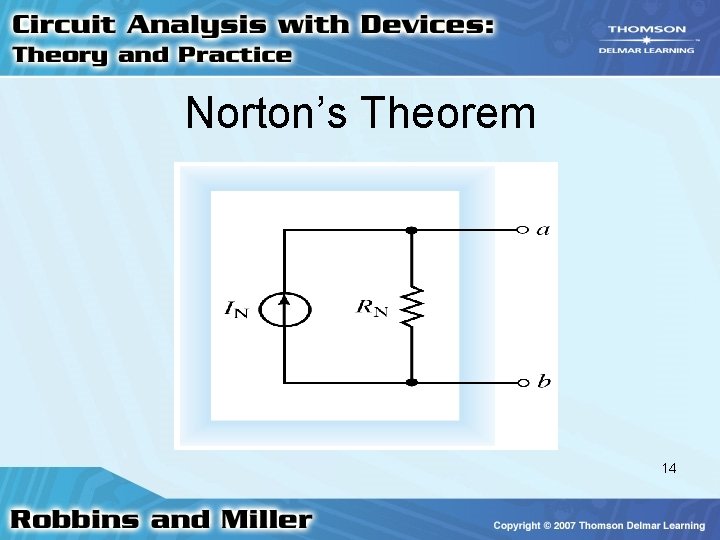
Norton’s Theorem • Similar to Thévenin circuit • Any lumped linear bilateral network – May be reduced to a two-terminal circuit – Single current source and single shunt resistor 12
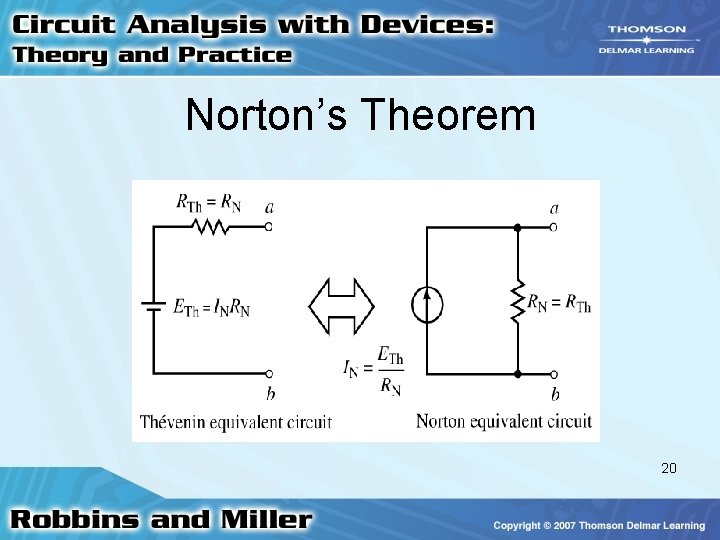
Norton’s Theorem • RN = RTh • IN is Norton equivalent current 13
Norton’s Theorem 14
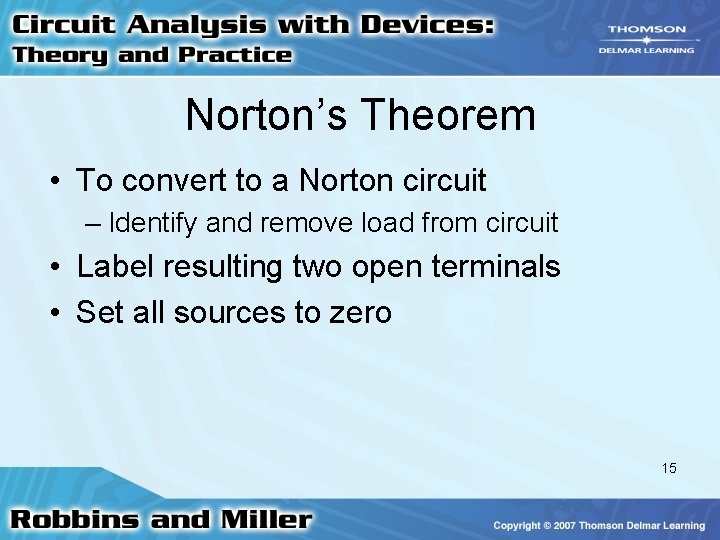
Norton’s Theorem • To convert to a Norton circuit – Identify and remove load from circuit • Label resulting two open terminals • Set all sources to zero 15
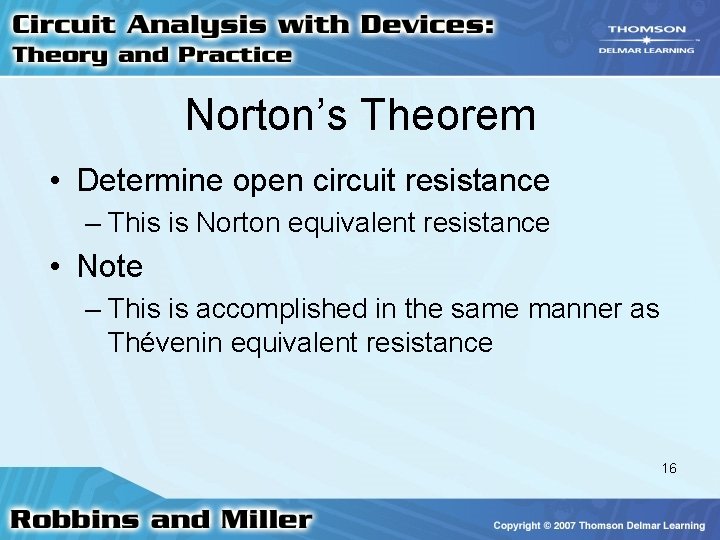
Norton’s Theorem • Determine open circuit resistance – This is Norton equivalent resistance • Note – This is accomplished in the same manner as Thévenin equivalent resistance 16
Norton’s Theorem • Replace sources and determine current that would flow through a short place between two terminals • This current is the Norton equivalent current 17
Norton’s Theorem • For multiple sources – Superposition theorem could be used • Draw the Norton equivalent circuit – Including the load 18
Norton’s Theorem • Norton equivalent circuit – May be determined directly from a Thévenin circuit (or vice-versa) by using source transformation theorem 19
Norton’s Theorem 20
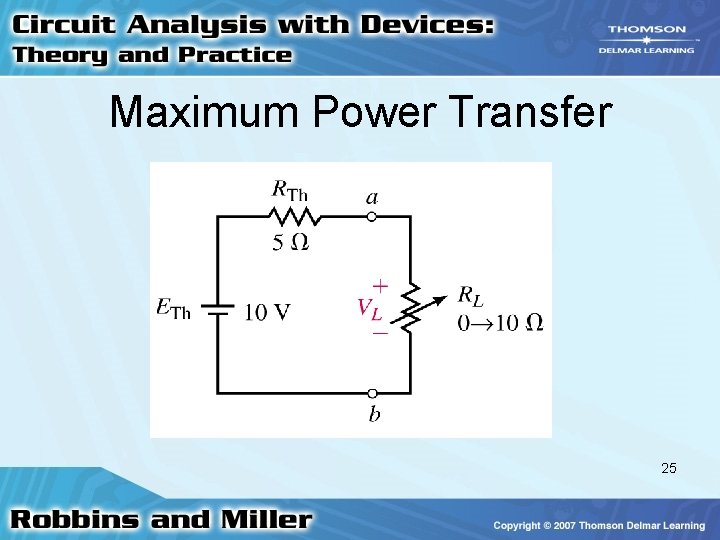
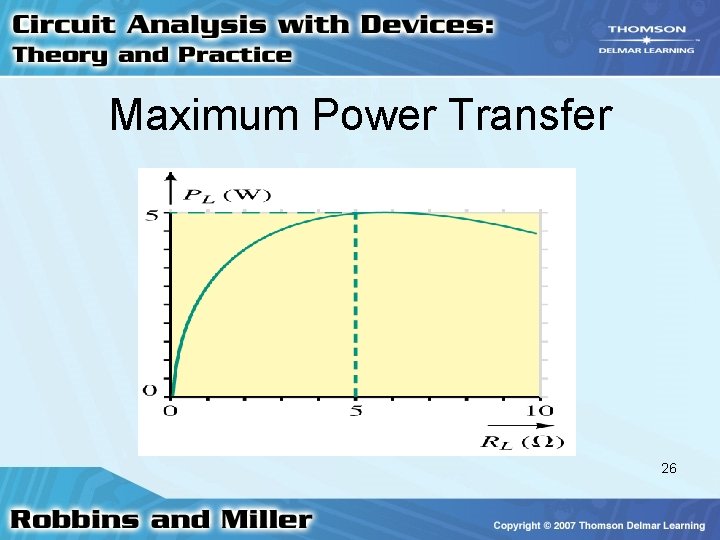
Maximum Power Transfer • Load should receive maximum amount of power from source • Maximum power transfer theorem states – Load will receive maximum power from a circuit when resistance of the load is exactly the same as Thévenin (or Norton) equivalent resistance of the circuit 21
Maximum Power Transfer • To calculate maximum power delivered by source to load – Use P = V 2/R • Voltage across load is one half of Thévenin equivalent voltage 22
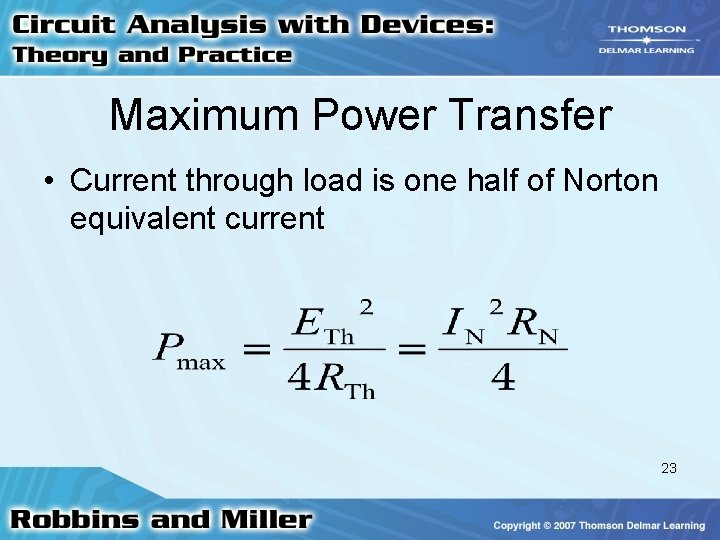
Maximum Power Transfer • Current through load is one half of Norton equivalent current 23
Maximum Power Transfer • Power across a load changes as load changes by using a variable resistance as the load 24
Maximum Power Transfer 25
Maximum Power Transfer 26
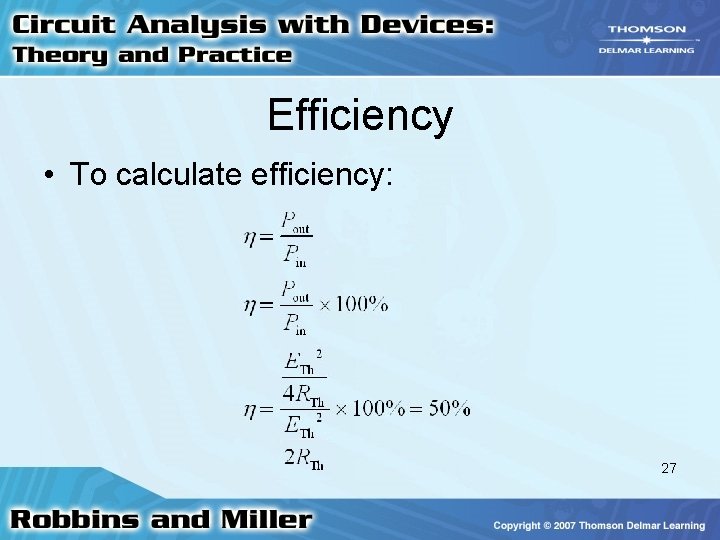
Efficiency • To calculate efficiency: 27
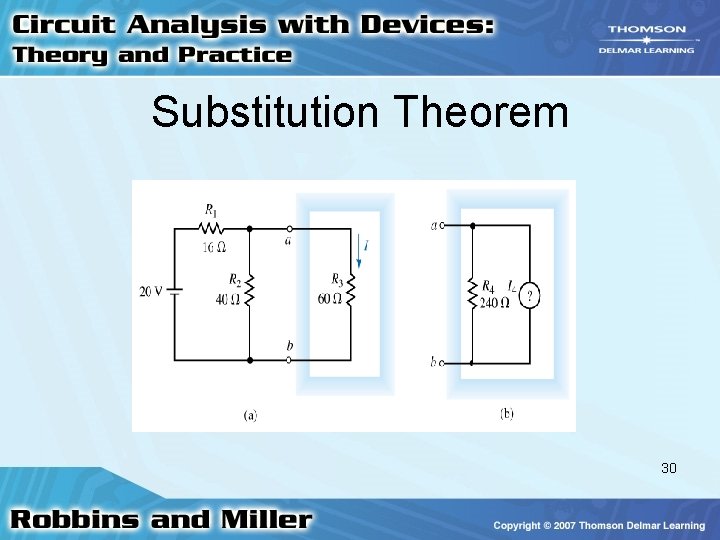
Substitution Theorem • Any branch within a circuit may be replaced by an equivalent branch – Provided the replacement branch has same current voltage • Theorem can replace any branch with an equivalent branch • Simplify analysis of remaining circuit 28
Substitution Theorem • Part of the circuit shown is to be replaced with a current source and a 240 shunt resistor – Determine value of the current source 29
Substitution Theorem 30
Millman’s Theorem • Used to simplify circuits that have – Several parallel-connected branches containing a voltage source and series resistance – Current source and parallel resistance – Combination of both 31
Millman’s Theorem • Other theorems may work, but Millman’s theorem provides a much simpler and more direct equivalent 32
Millman’s Theorem • Voltage sources – May be converted into an equivalent current source and parallel resistance using source transformation theorem • Parallel resistances may now be converted into a single equivalent resistance 33
Millman’s Theorem • First, convert voltage sources into current sources • Equivalent current, Ieq, is just the algebraic sum of all the parallel currents 34
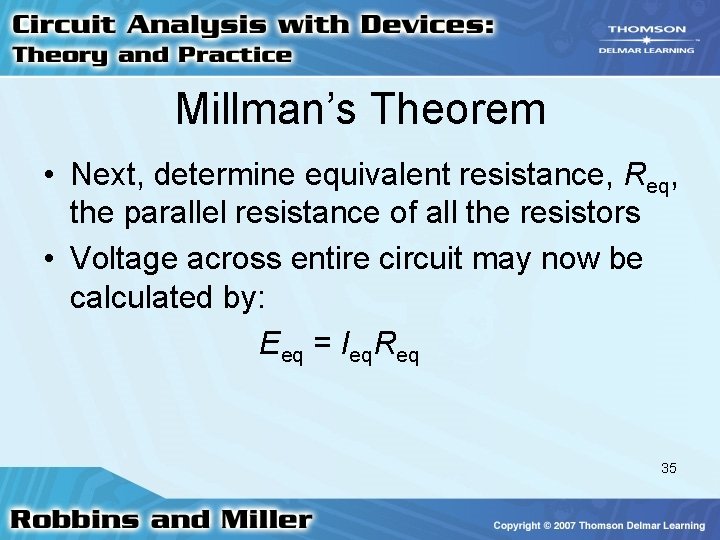
Millman’s Theorem • Next, determine equivalent resistance, Req, the parallel resistance of all the resistors • Voltage across entire circuit may now be calculated by: Eeq = Ieq. Req 35
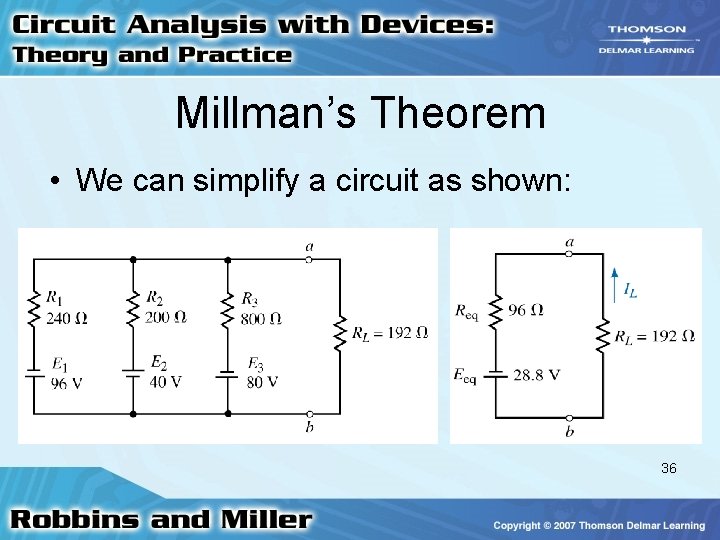
Millman’s Theorem • We can simplify a circuit as shown: 36
Reciprocity Theorem • A voltage source causing a current I in any branch – May be removed from original location and placed into that branch 37
Reciprocity Theorem • Voltage source in new location will produce a current in original source location – Equal to the original I 38
Reciprocity Theorem • Voltage source is replaced by a short circuit in original location • Direction of current must not change 39
Reciprocity Theorem • A current source causing a voltage V at any node – May be removed from original location and connected to that node • Current source in the new location – Will produce a voltage in original location equal to V 40
Reciprocity Theorem • Current source is replaced by an open circuit in original location • Voltage polarity cannot change 41