
Chapter 9 Muscle Tissue Power Point Lecture Slides


- Slides: 43
Chapter 9 Muscle Tissue Power. Point® Lecture Slides prepared by Jason La. Pres Lone Star College - North Harris Copyright © 2010 Pearson Education, Inc.
An Introduction to Muscle Tissue • Muscle Tissue – A primary tissue type, divided into • Skeletal muscle • Cardiac muscle • Smooth muscle Copyright © 2010 Pearson Education, Inc.
An Introduction to Muscle Tissue • Skeletal Muscles – Are attached to the skeletal system – Allow us to move – The muscular system • Includes only skeletal muscles Copyright © 2010 Pearson Education, Inc.
Functions of Skeletal Muscles • Produce skeletal movement • Maintain body position • Support soft tissues • Guard openings • Maintain body temperature • Store nutrient reserves Copyright © 2010 Pearson Education, Inc.
Skeletal Muscle Structures • Muscle tissue (muscle cells or fibers) • Connective tissues • Nerves • Blood vessels Copyright © 2010 Pearson Education, Inc.
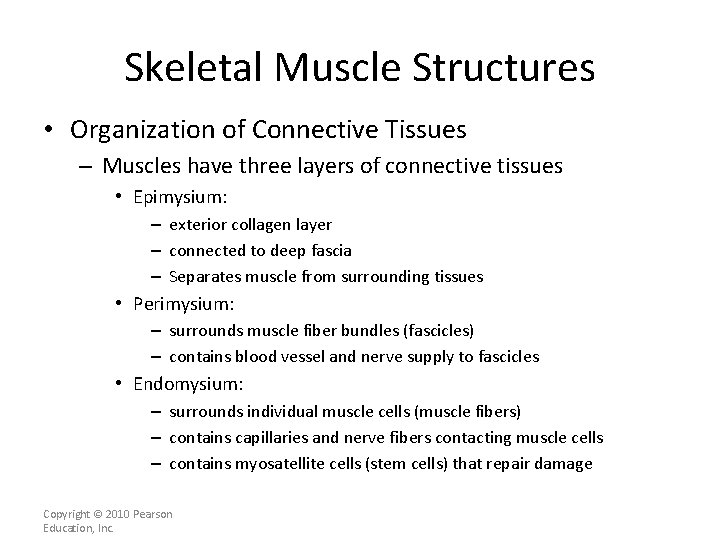
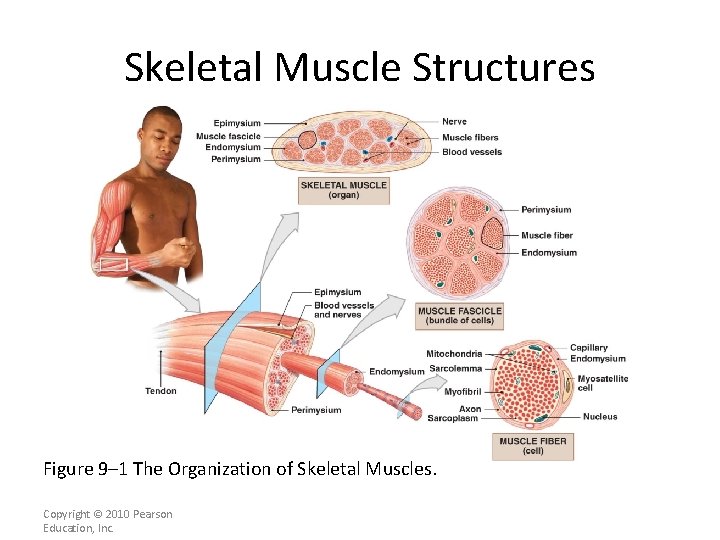
Skeletal Muscle Structures • Organization of Connective Tissues – Muscles have three layers of connective tissues • Epimysium: – exterior collagen layer – connected to deep fascia – Separates muscle from surrounding tissues • Perimysium: – surrounds muscle fiber bundles (fascicles) – contains blood vessel and nerve supply to fascicles • Endomysium: – surrounds individual muscle cells (muscle fibers) – contains capillaries and nerve fibers contacting muscle cells – contains myosatellite cells (stem cells) that repair damage Copyright © 2010 Pearson Education, Inc.
Skeletal Muscle Structures Figure 9– 1 The Organization of Skeletal Muscles. Copyright © 2010 Pearson Education, Inc.
Skeletal Muscle Structures • Organization of Connective Tissues – Muscle attachments • Endomysium, perimysium, and epimysium come together: – at ends of muscles – to form connective tissue attachment to bone matrix – i. e. , tendon (bundle) or aponeurosis (sheet) Copyright © 2010 Pearson Education, Inc.
Skeletal Muscle Structures • Nerves – Skeletal muscles are voluntary muscles, controlled by nerves of the central nervous system (brain and spinal cord) • Blood Vessels – Muscles have extensive vascular systems that • Supply large amounts of oxygen • Supply nutrients • Carry away wastes Copyright © 2010 Pearson Education, Inc.
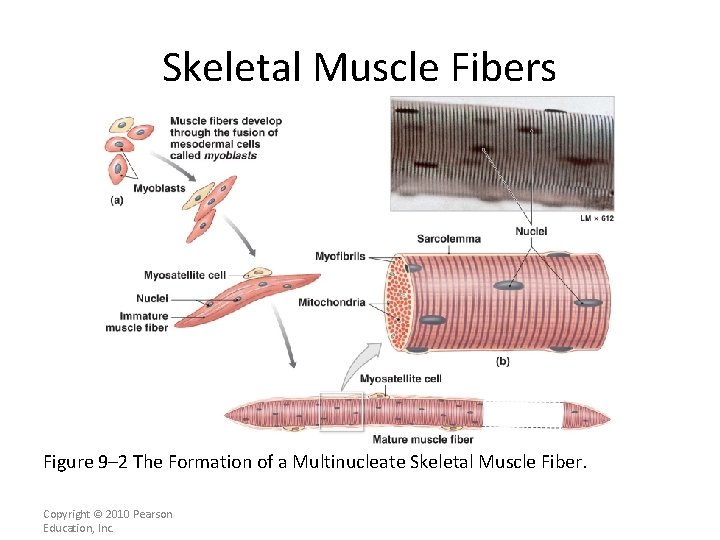
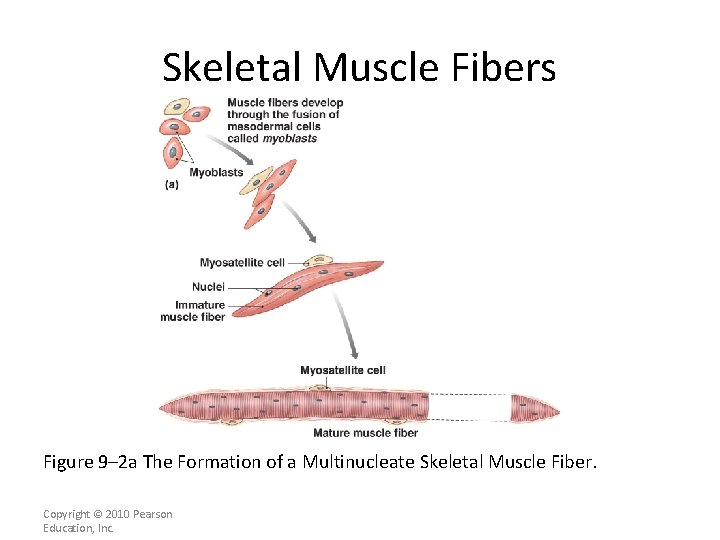
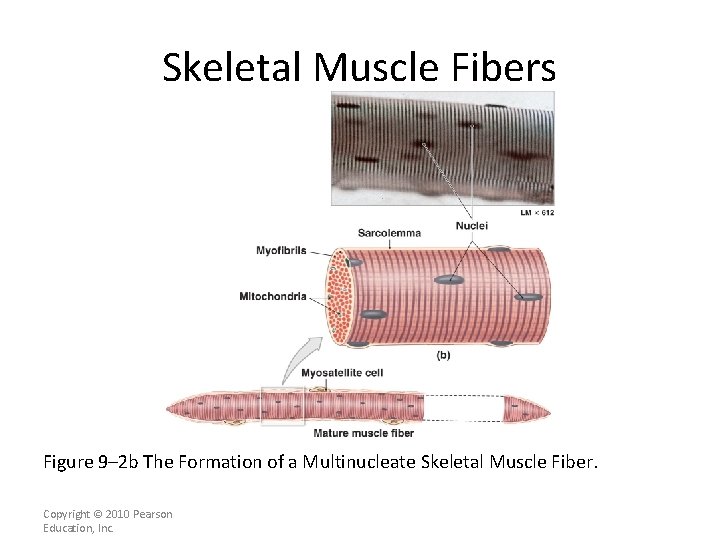
Skeletal Muscle Fibers • Are very long • Develop through fusion of mesodermal cells (myoblasts) • Become very large • Contain hundreds of nuclei Copyright © 2010 Pearson Education, Inc.
Skeletal Muscle Fibers Figure 9– 2 The Formation of a Multinucleate Skeletal Muscle Fiber. Copyright © 2010 Pearson Education, Inc.
Skeletal Muscle Fibers Figure 9– 2 a The Formation of a Multinucleate Skeletal Muscle Fiber. Copyright © 2010 Pearson Education, Inc.
Skeletal Muscle Fibers Figure 9– 2 b The Formation of a Multinucleate Skeletal Muscle Fiber. Copyright © 2010 Pearson Education, Inc.
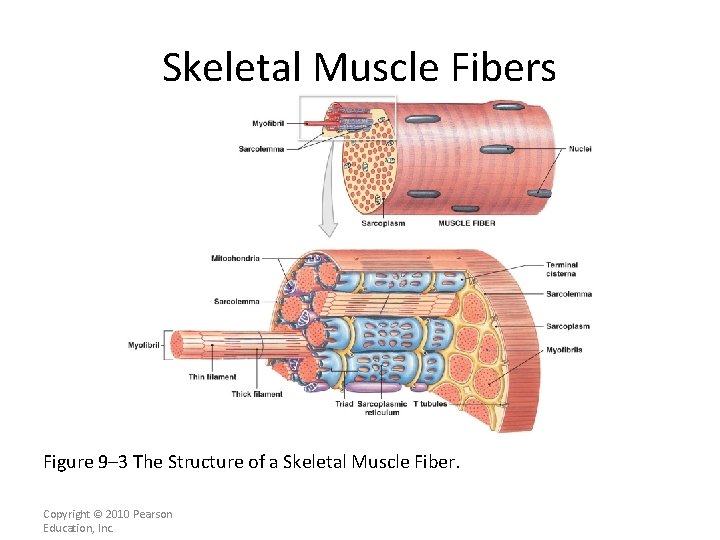
Skeletal Muscle Fibers • Internal Organization of Muscle Fibers – The sarcolemma • The cell membrane of a muscle fiber (cell) • Surrounds the sarcoplasm (cytoplasm of muscle fiber) • A change in transmembrane potential begins contractions Copyright © 2010 Pearson Education, Inc.
Skeletal Muscle Fibers • Internal Organization of Muscle Fibers – Transverse tubules (T tubules) • Transmit action potential through cell • Allow entire muscle fiber to contract simultaneously • Have same properties as sarcolemma Copyright © 2010 Pearson Education, Inc.
Skeletal Muscle Fibers • Internal Organization of Muscle Fibers – Myofibrils • Lengthwise subdivisions within muscle fiber • Made up of bundles of protein filaments (myofilaments) • Myofilaments are responsible for muscle contraction • Types of myofilaments: – thin filaments: » made of the protein actin – thick filaments: » made of the protein myosin Copyright © 2010 Pearson Education, Inc.
Skeletal Muscle Fibers • Internal Organization of Muscle Fibers – Sarcoplasmic reticulum (SR) • A membranous structure surrounding each myofibril • Helps transmit action potential to myofibril • Similar in structure to smooth endoplasmic reticulum • Forms chambers (terminal cisternae) attached to T tubules Copyright © 2010 Pearson Education, Inc.
Skeletal Muscle Fibers • Internal Organization of Muscle Fibers – Triad • Is formed by one T tubule and two terminal cisternae • Cisternae: – concentrate Ca 2+ (via ion pumps) – release Ca 2+ into sarcomeres to begin muscle contraction Copyright © 2010 Pearson Education, Inc.
Skeletal Muscle Fibers Figure 9– 3 The Structure of a Skeletal Muscle Fiber. Copyright © 2010 Pearson Education, Inc.
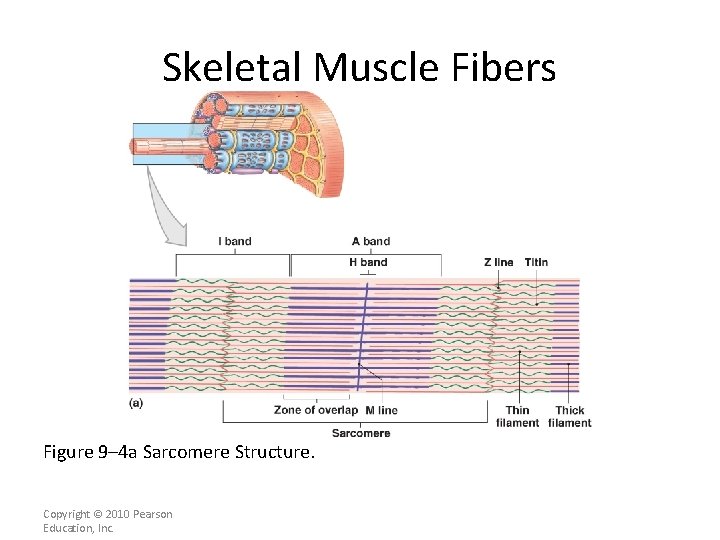
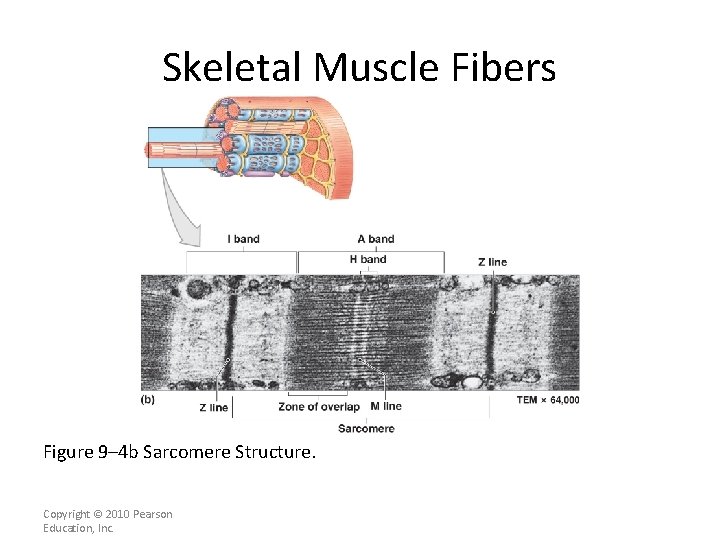
Skeletal Muscle Fibers • Internal Organization of Muscle Fibers – Sarcomeres • The contractile units of muscle • Structural units of myofibrils • Form visible patterns within myofibrils – Muscle striations • A striped or striated pattern within myofibrils: – alternating dark, thick filaments (A bands) and light, thin filaments (I bands) Copyright © 2010 Pearson Education, Inc.
Skeletal Muscle Fibers • Internal Organization of Muscle Fibers – Sarcomeres • M Lines and Z Lines: – M line: » the center of the A band » at midline of sarcomere – Z lines: » the centers of the I bands » at two ends of sarcomere Copyright © 2010 Pearson Education, Inc.
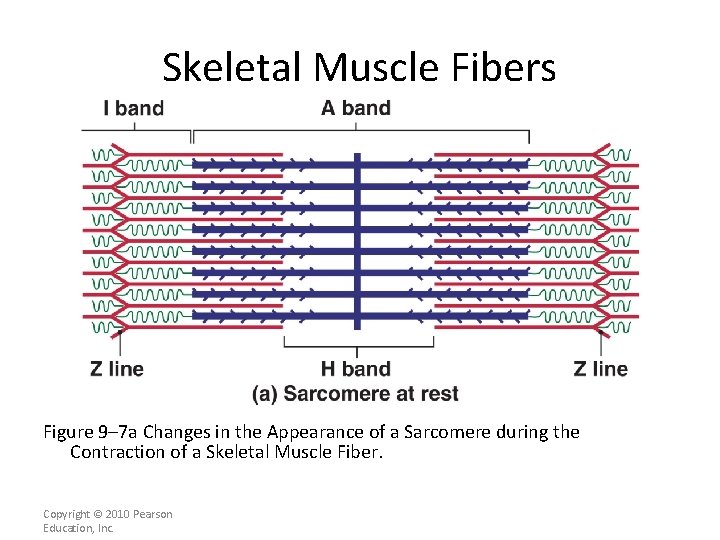
Skeletal Muscle Fibers • Internal Organization of Muscle Fibers – Sarcomeres • Zone of overlap: – the densest, darkest area on a light micrograph – where thick and thin filaments overlap • The H Band: – the area around the M line – has thick filaments but no thin filaments Copyright © 2010 Pearson Education, Inc.
Skeletal Muscle Fibers • Internal Organization of Muscle Fibers – Sarcomeres • Titin: – are strands of protein – reach from tips of thick filaments to the Z line – stabilize the filaments Copyright © 2010 Pearson Education, Inc.
Skeletal Muscle Fibers Figure 9– 4 a Sarcomere Structure. Copyright © 2010 Pearson Education, Inc.
Skeletal Muscle Fibers Figure 9– 4 b Sarcomere Structure. Copyright © 2010 Pearson Education, Inc.
Skeletal Muscle Fibers Figure 9– 5 Sarcomere Structure. Copyright © 2010 Pearson Education, Inc.
Skeletal Muscle Fibers • Sarcomere Function – Transverse tubules encircle the sarcomere near zones of overlap – Ca 2+ released by SR causes thin and thick filaments to interact Copyright © 2010 Pearson Education, Inc.
Skeletal Muscle Fibers • Muscle Contraction – Is caused by interactions of thick and thin filaments – Structures of protein molecules determine interactions Copyright © 2010 Pearson Education, Inc.
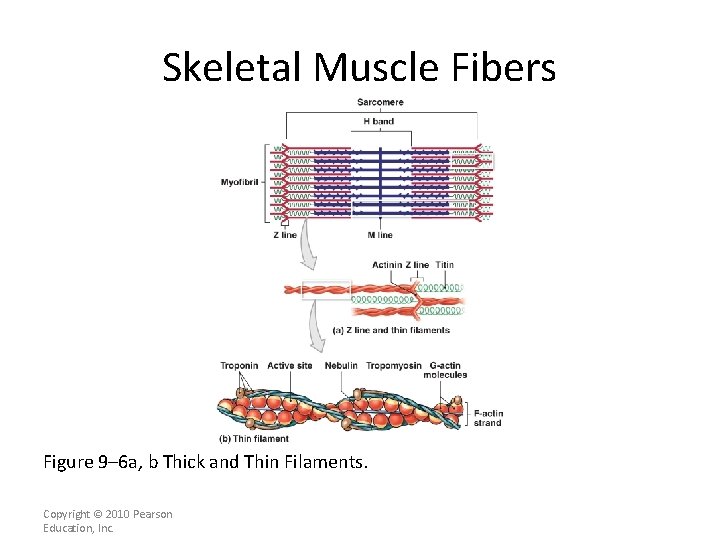
Skeletal Muscle Fibers • Four Thin Filament Proteins – F-actin (Filamentous actin) • Is two twisted rows of globular G-actin • The active sites on G-actin strands bind to myosin – Nebulin • Holds F-actin strands together – Tropomyosin • Is a double strand • Prevents actin–myosin interaction – Troponin • A globular protein • Binds tropomyosin to G-actin • Controlled by Ca 2+ Copyright © 2010 Pearson Education, Inc.
Skeletal Muscle Fibers Figure 9– 6 a, b Thick and Thin Filaments. Copyright © 2010 Pearson Education, Inc.
Skeletal Muscle Fibers • Initiating Contraction – Ca 2+ binds to receptor on troponin molecule – Troponin–tropomyosin complex changes – Exposes active site of F-actin Copyright © 2010 Pearson Education, Inc.
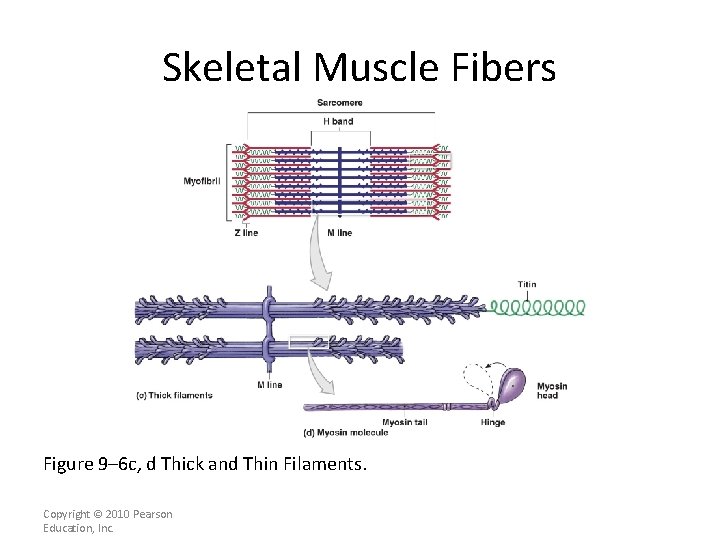
Skeletal Muscle Fibers • Thick Filaments – Contain twisted myosin subunits – Contain titin strands that recoil after stretching – The mysosin molecule • Tail: – binds to other myosin molecules • Head: – made of two globular protein subunits – reaches the nearest thin filament Copyright © 2010 Pearson Education, Inc.
Skeletal Muscle Fibers Figure 9– 6 c, d Thick and Thin Filaments. Copyright © 2010 Pearson Education, Inc.
Skeletal Muscle Fibers • Myosin Action – During contraction, myosin heads • Interact with actin filaments, forming cross-bridges • Pivot, producing motion Copyright © 2010 Pearson Education, Inc.
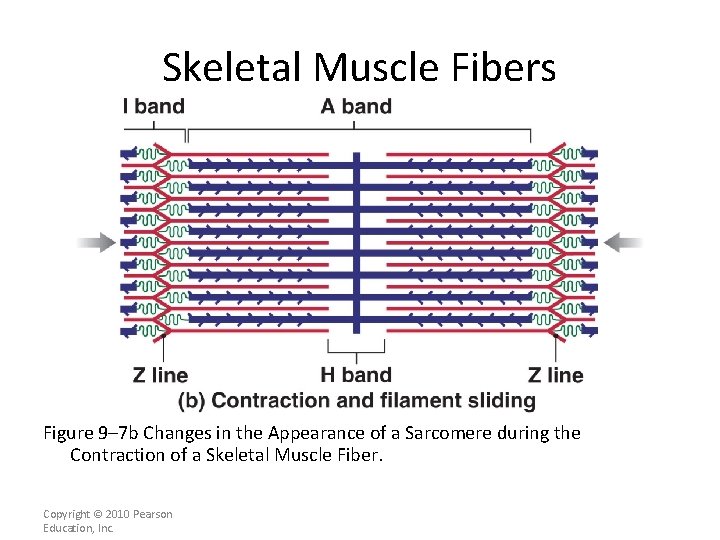
Skeletal Muscle Fibers • Skeletal Muscle Contraction – Sliding filament theory • Thin filaments of sarcomere slide toward M line, alongside thick filaments • The width of A zone stays the same • Z lines move closer together Copyright © 2010 Pearson Education, Inc.
Skeletal Muscle Fibers Figure 9– 7 a Changes in the Appearance of a Sarcomere during the Contraction of a Skeletal Muscle Fiber. Copyright © 2010 Pearson Education, Inc.
Skeletal Muscle Fibers Figure 9– 7 b Changes in the Appearance of a Sarcomere during the Contraction of a Skeletal Muscle Fiber. Copyright © 2010 Pearson Education, Inc.
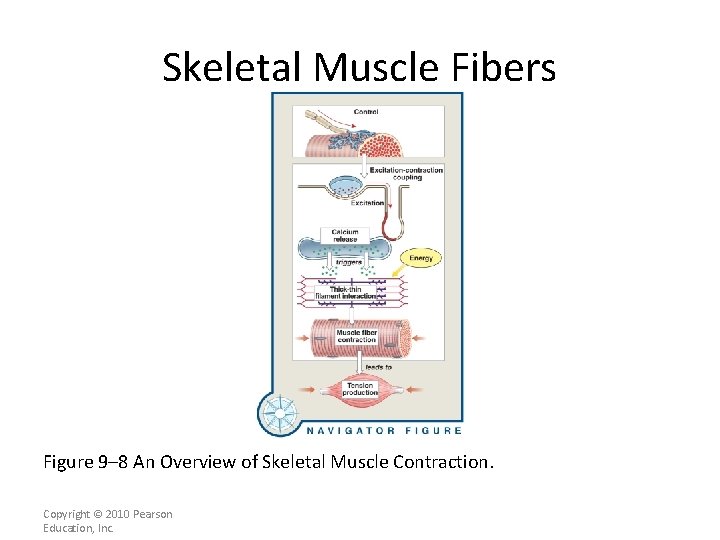
Skeletal Muscle Fibers • Skeletal Muscle Contraction – The process of contraction • Neural stimulation of sarcolemma: – causes excitation–contraction coupling • Cisternae of SR release Ca 2+: – which triggers interaction of thick and thin filaments – consuming ATP and producing tension Copyright © 2010 Pearson Education, Inc.
Skeletal Muscle Fibers Figure 9– 8 An Overview of Skeletal Muscle Contraction. Copyright © 2010 Pearson Education, Inc.
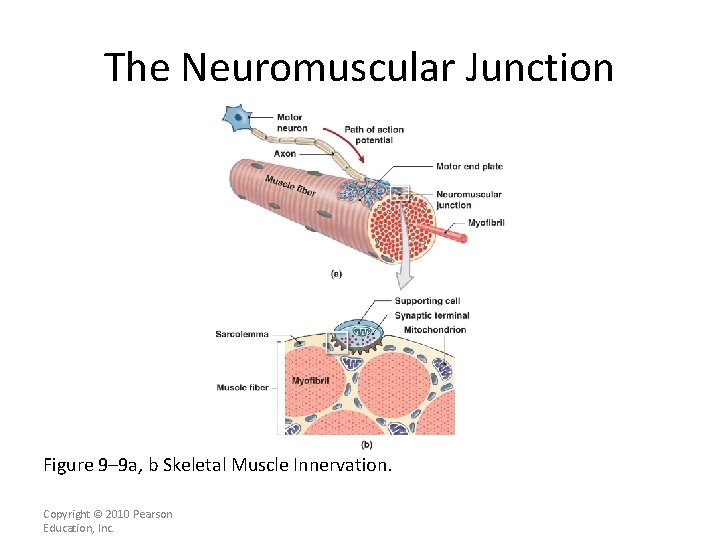
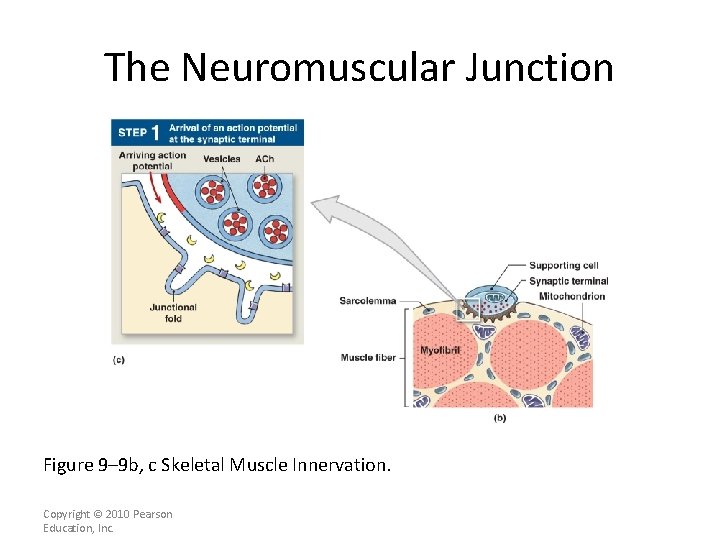
The Neuromuscular Junction • Is the location of neural stimulation • Action potential (electrical signal) – Travels along nerve axon – Ends at synaptic terminal • Synaptic terminal: – releases neurotransmitter (acetylcholine or ACh) – into the synaptic cleft (gap between synaptic terminal and motor end plate) Copyright © 2010 Pearson Education, Inc.
The Neuromuscular Junction Figure 9– 9 a, b Skeletal Muscle Innervation. Copyright © 2010 Pearson Education, Inc.
The Neuromuscular Junction Figure 9– 9 b, c Skeletal Muscle Innervation. Copyright © 2010 Pearson Education, Inc.