
Chapter 9 Motion MOTION An object is in
Chapter 9 Motion
MOTION • An object is in motion if its distance from another object is changing. • To decide if you are moving, you need a reference point.
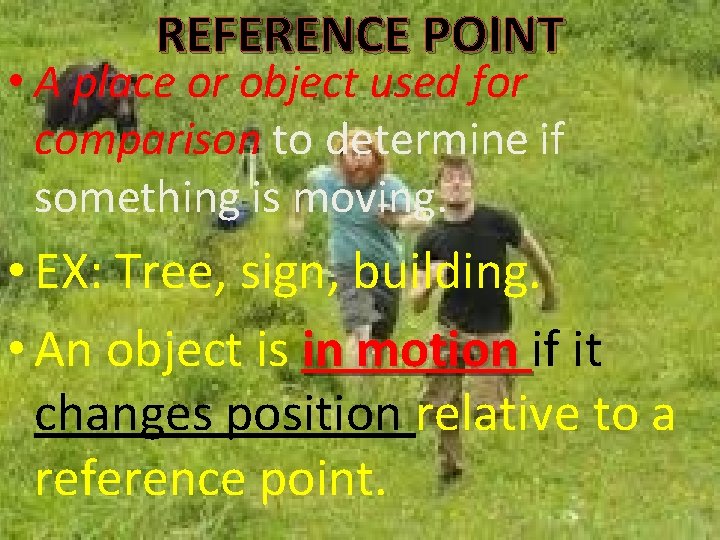
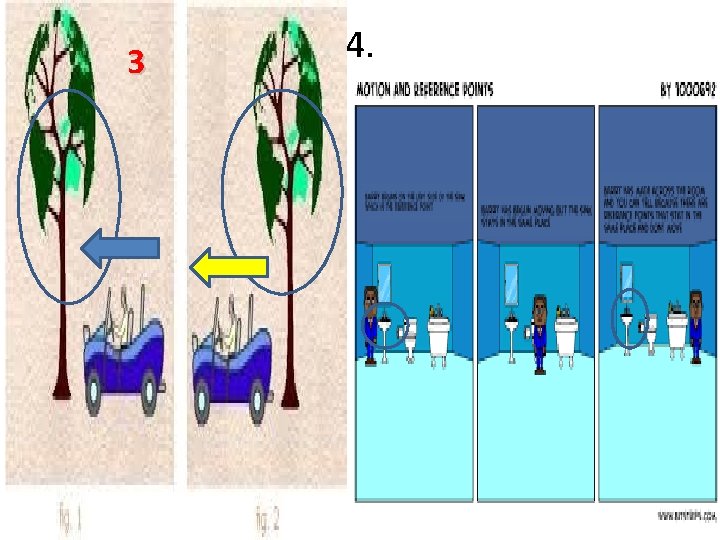
REFERENCE POINT • A place or object used for comparison to determine if something is moving. • EX: Tree, sign, building. • An object is in motion if it changes position relative to a reference point.
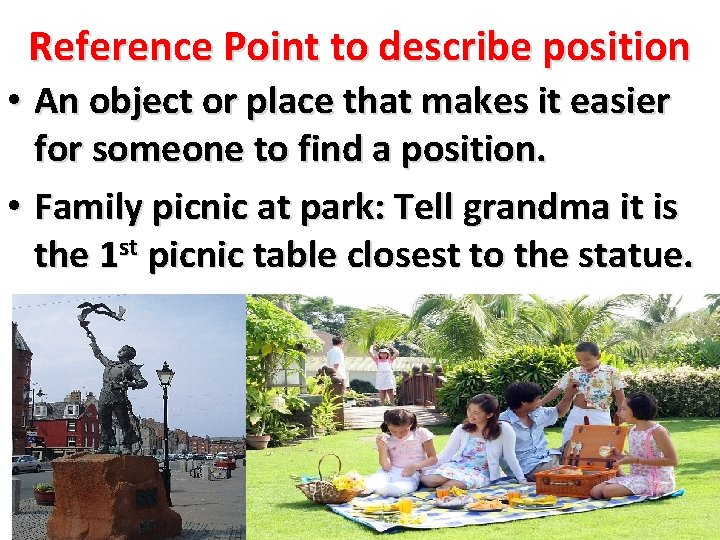
Reference Point to describe position • An object or place that makes it easier for someone to find a position. • Family picnic at park: Tell grandma it is the 1 st picnic table closest to the statue.
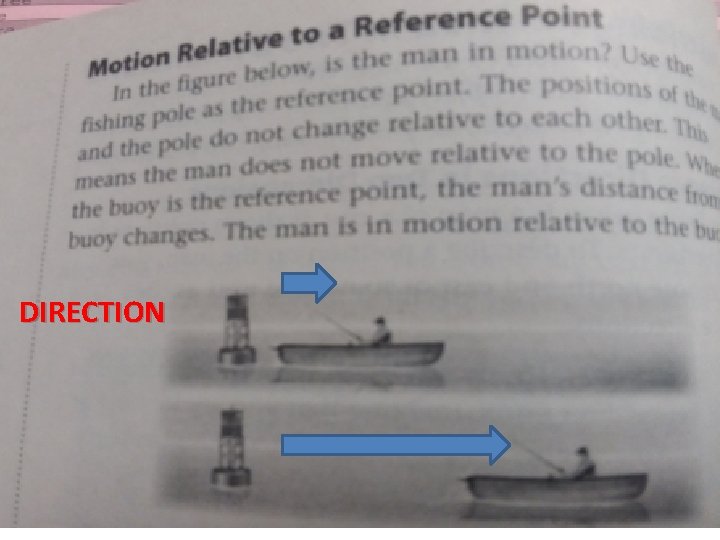
DIRECTION
Reference Point Moving • If reference point is moving, you will find it difficult to determine which direction you are moving or even if you are moving • Ex: 2 buses at stop light, the bus you are on looks like its moving backwards…. .
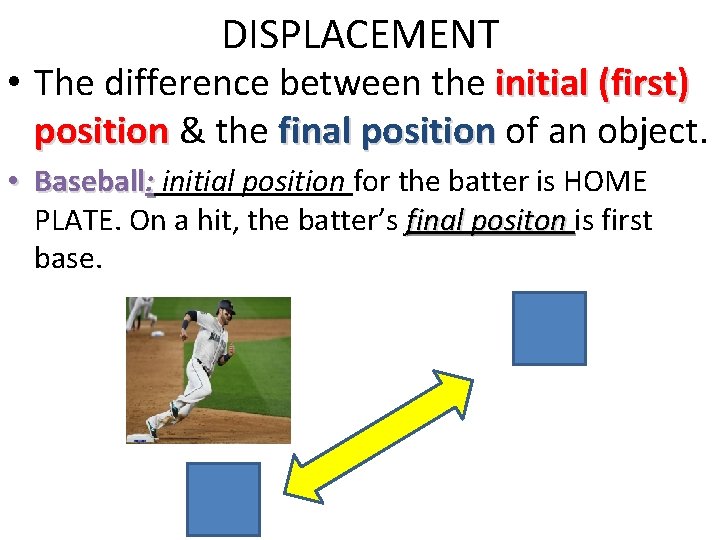
DISPLACEMENT • The difference between the initial (first) position & the final position of an object. • Baseball: initial position for the batter is HOME PLATE. On a hit, the batter’s final positon is first base.
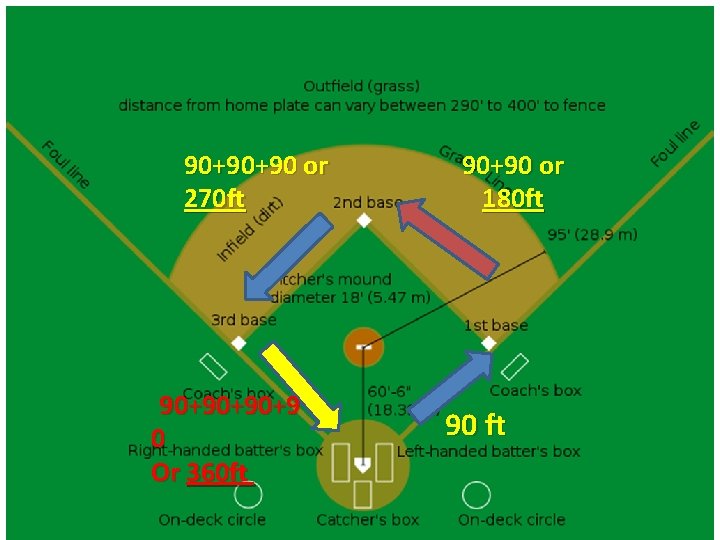
90+90+90 or 270 ft 90+90+90+9 0 Or 360 ft 90+90 or 180 ft 90 ft
MEASURING • Can use units of measurement to describe volume, weight, & length precisely. 2 systems: • English (Linear) System, & International or Metric System.
International System of Units (SI) • Scientists all over the world use the same system of measurement (SI) (metric) so they can communicate clearly. • Scientists use SI units to describe certain measurements. Distance = Length. Meter (m) km
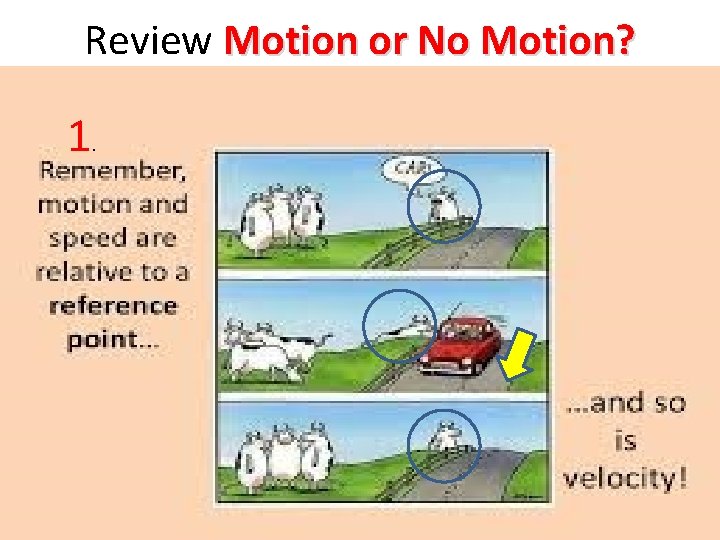
Review Motion or No Motion? 1 .

2.
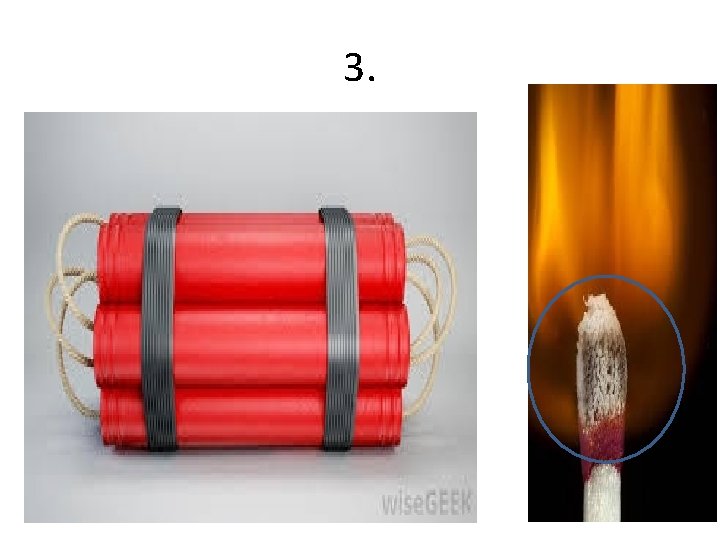
3.
3 4.
5. • Using what you know, write a sentence identifying 2 things you need to include when talking about an object’s motion.
6. • When a reference point is changed, the description of the _____ & the _______ to the object also must be changed.
A. Describing Position 1. A(n)_______ is a starting point you choose to describe the location, or position, of an object. 2. A(n)______ is an object’s distance and direction from a reference point. 3. A complete description of a position includes a distance, a(n)_______ , and a reference point. 4. A good choice for a(n)______ is something that is easy to find. 5. If a reference point changes, the description of an object’s_____ will also change.
6. Changing a reference point does not change the actual ______of an object. 7. When you describe an object’s position, you compare its location to a _____. 8. A reference direction can be described as a(n)______ direction. • C. Describing Changes in Position 1. is the process of changing position. It is always described relative to a(n) _____. 2. It is possible to move with regard to one & stay motionless with regard to another_____.
SECTION 2 • SPEED AND VELOCITY
SPEED BASICS • If you know the distance an object travels in a certain amount of time, you can calculate the speed of the object.
SPEED • The distance an object travels per unit of time. Speed a type of rate. Rate tells the amount of change in one unit of time.
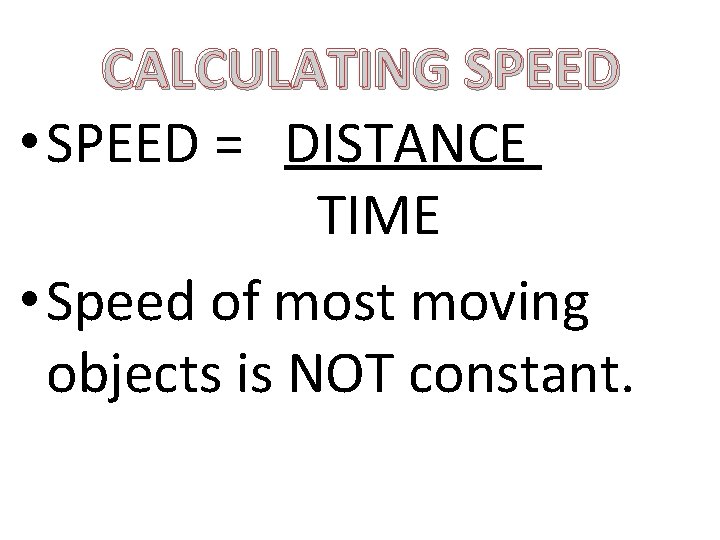
CALCULATING SPEED • SPEED = DISTANCE TIME • Speed of most moving objects is NOT constant.
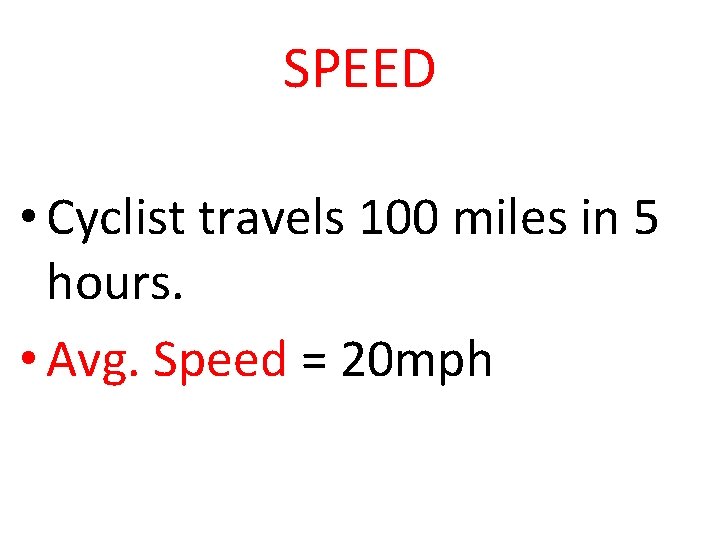
SPEED • Cyclist travels 100 miles in 5 hours. • Avg. Speed = 20 mph
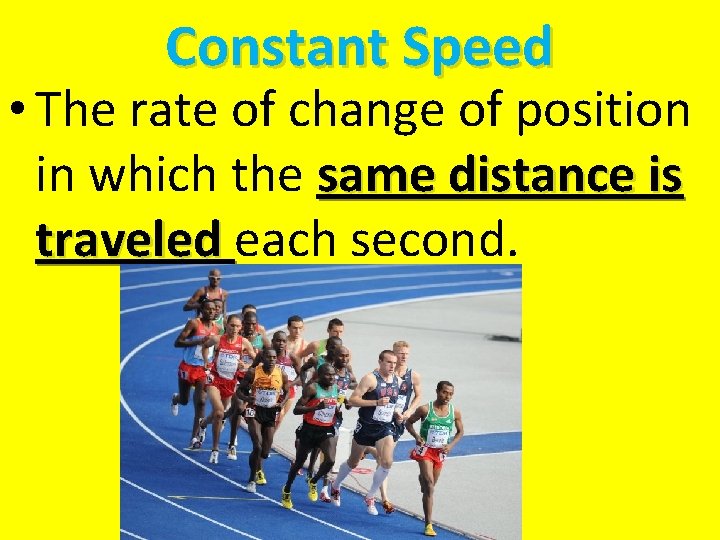
Constant Speed • The rate of change of position in which the same distance is traveled each second.
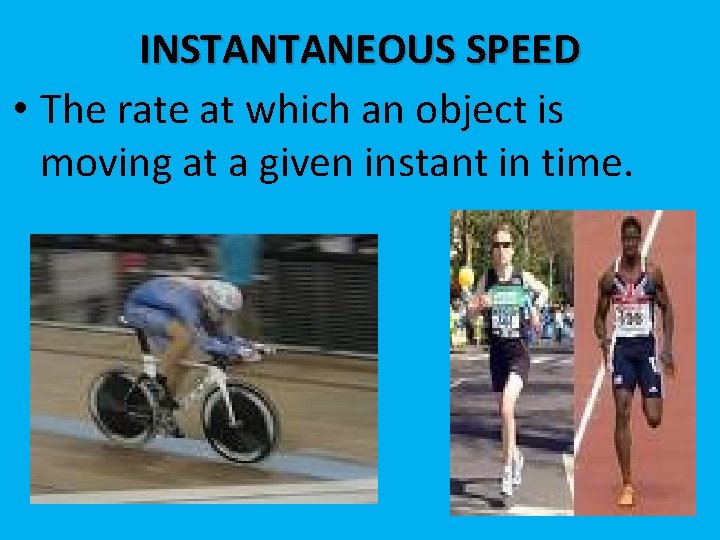
INSTANTANEOUS SPEED • The rate at which an object is moving at a given instant in time.
Graphing Motion • Can show motion of an object on a line graph, plotting distance versus time • X axis (horizontal axis) = Time • Y axis (vertical axis) = Distance
MOTION GRAPH
Changes In Speed on Graph • Slow down- downward curve • Stop- straight line • Speed up- upward curve
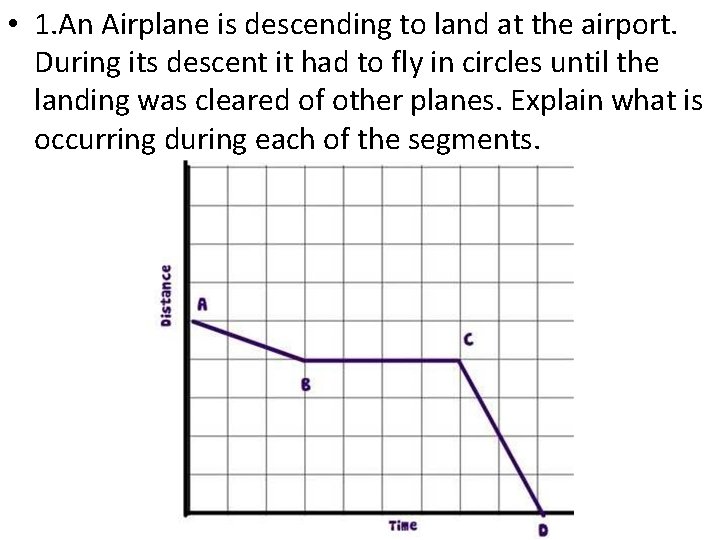
• 1. An Airplane is descending to land at the airport. During its descent it had to fly in circles until the landing was cleared of other planes. Explain what is occurring during each of the segments.
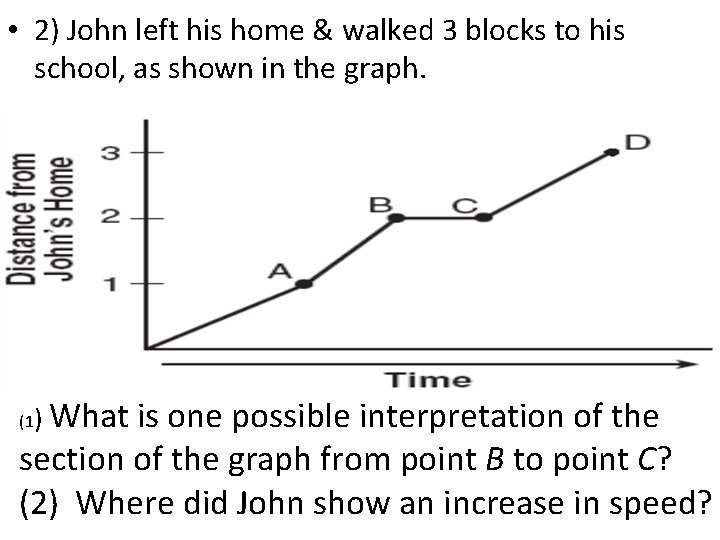
• 2) John left his home & walked 3 blocks to his school, as shown in the graph. What is one possible interpretation of the section of the graph from point B to point C? (2) Where did John show an increase in speed? (1)
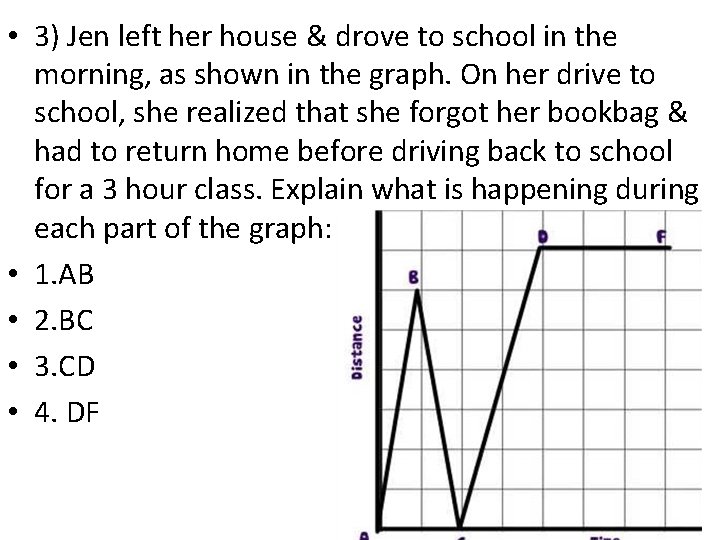
• 3) Jen left her house & drove to school in the morning, as shown in the graph. On her drive to school, she realized that she forgot her bookbag & had to return home before driving back to school for a 3 hour class. Explain what is happening during each part of the graph: • 1. AB • 2. BC • 3. CD • 4. DF
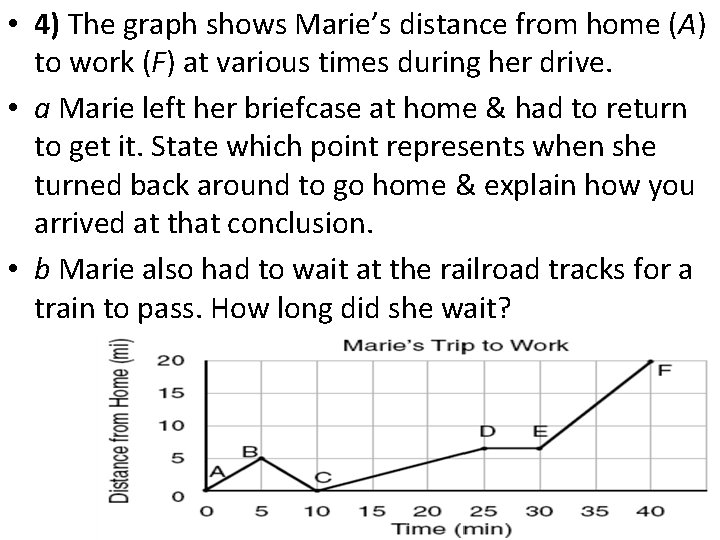
• 4) The graph shows Marie’s distance from home (A) to work (F) at various times during her drive. • a Marie left her briefcase at home & had to return to get it. State which point represents when she turned back around to go home & explain how you arrived at that conclusion. • b Marie also had to wait at the railroad tracks for a train to pass. How long did she wait?
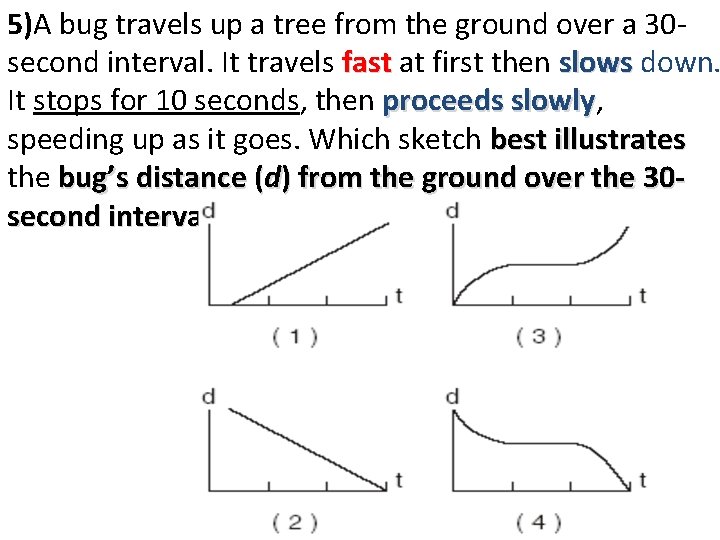
5)A bug travels up a tree from the ground over a 30 second interval. It travels fast at first then slows down. It stops for 10 seconds, then proceeds slowly, slowly speeding up as it goes. Which sketch best illustrates the bug’s distance (d) from the ground over the 30 second interval (t)?
VELOCITY • Speed in a given direction. • A thunderstorm traveling east at 25 mph.
average constant direction distance horizontal instantaneous steep time velocity 1. Speed is a measure of_____ the an object travels in a unit Of _____. 2. When a moving object’s change of position is equal in every second, it is moving at a(n) _______speed. 3. An object’s speed at any particular moment is its___ speed. 4. Its speed for the entire duration that it is in motion from one place to another is its_____ speed. 5. A(n)______ line on a distance-time graph shows a fast speed 6. A(n) ____portion on a distance-time graph shows a period of no motion. 7. The of a moving object includes its speed and_______.
ACCELERATION • SECTION 3
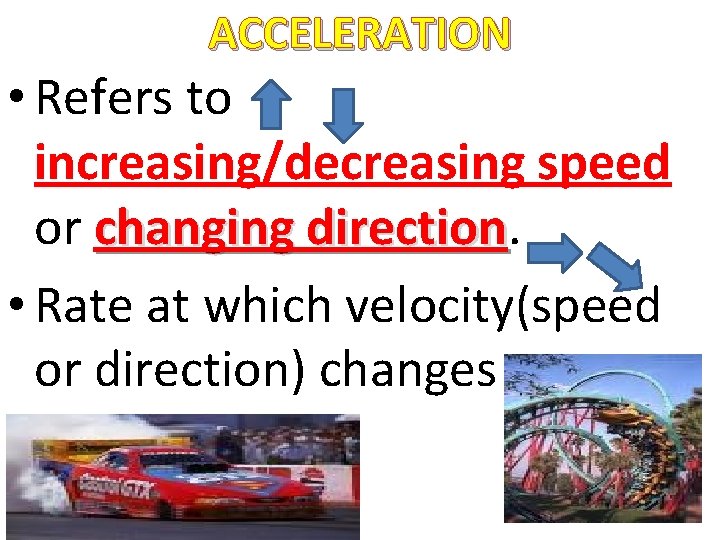
ACCELERATION • Refers to increasing/decreasing speed or changing direction • Rate at which velocity(speed or direction) changes
Increasing/Decreasing Speed • Objects accelerate when they speed up. Car speeds after a red light turns green. • Objects accelerate when they slow down. Rolling baseball eventually stops rolling. • Objects accelerate when they change direction. Car turns.
Calculating Acceleration • To determine the acceleration of an object moving, calculate the change in speed over a period of time
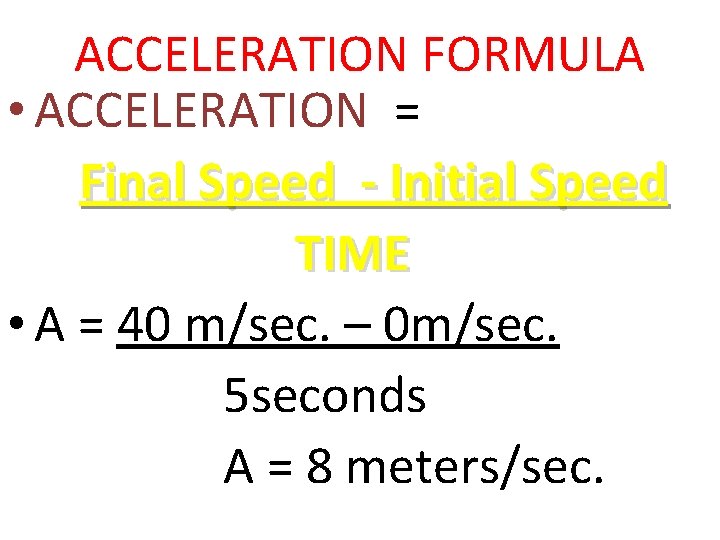
ACCELERATION FORMULA • ACCELERATION = Final Speed - Initial Speed TIME • A = 40 m/sec. – 0 m/sec. 5 seconds A = 8 meters/sec.
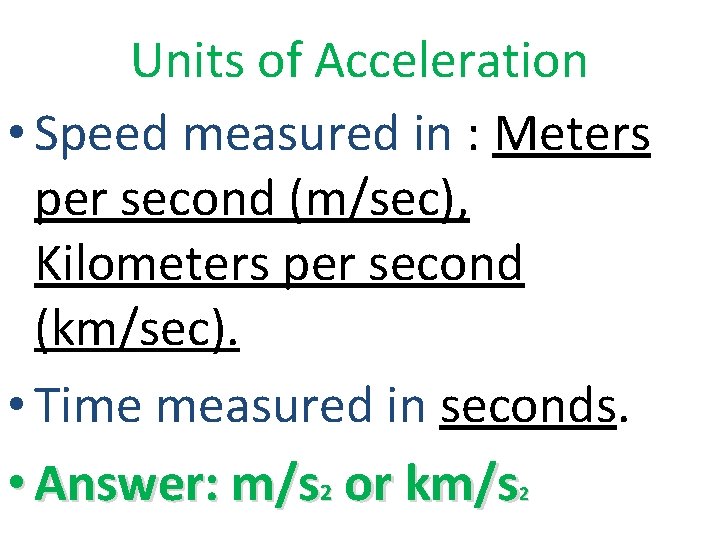
Units of Acceleration • Speed measured in : Meters per second (m/sec), Kilometers per second (km/sec). • Time measured in seconds. • Answer: m/s 2 or km/s 2
GRAPHING ACCELERATION • Speed-vs-time graph or distance-vs- time graph can be used.
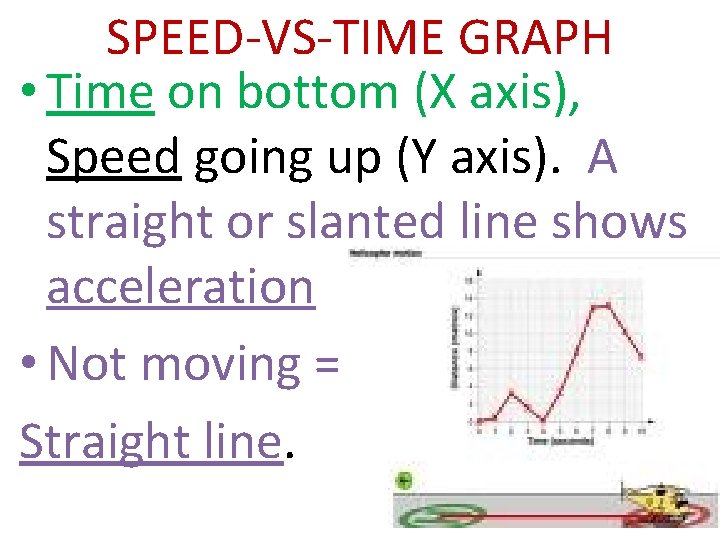
SPEED-VS-TIME GRAPH • Time on bottom (X axis), Speed going up (Y axis). A straight or slanted line shows acceleration • Not moving = Straight line.
The Concept of Acceleration 1. Accelerating objects are objects that are changing their velocity. Name the 2 controls on a car that cause it to accelerate. 2. An object is accelerating if it is moving _____. Circle all that apply. a. with changing speed b. extremely fast c. with constant velocity d. in a circle e. downward f. none of these 3. If an object is NOT accelerating, then one knows for sure that it is ______. a. at rest b. moving at a constant speed c. slowing down d. maintaining a constant speed
4. The rate of change of the speed of an object is called its ______. A) speed B)velocity C) acceleration 5. When an object is decreasing speed we can say it is a. Accelerating b. Motionless c. Decelerating d. Stopped 6 Units of measurement used to label a quantity of acceleration are: A) m 2/sec. B)sec 2/m. C)m/sec. D)m/sec 2. 7 Acceleration is: a. The distance between two dots. b. The distance divided by time. c. The rate of change in the speed of an object
• 8. An object is moving with constant speed. Describe two ways to change this motion that would cause the object to accelerate. Give an example of each.
- Slides: 46