
Chapter 9 Molecular Geometry and Bonding Theories 9

Chapter 9 Molecular Geometry and Bonding Theories
9. 1 Molecular Shapes
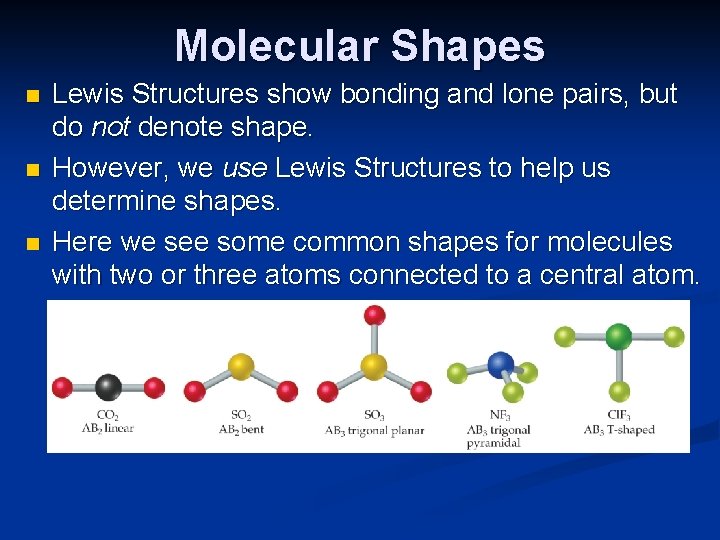
Molecular Shapes n n n Lewis Structures show bonding and lone pairs, but do not denote shape. However, we use Lewis Structures to help us determine shapes. Here we see some common shapes for molecules with two or three atoms connected to a central atom.
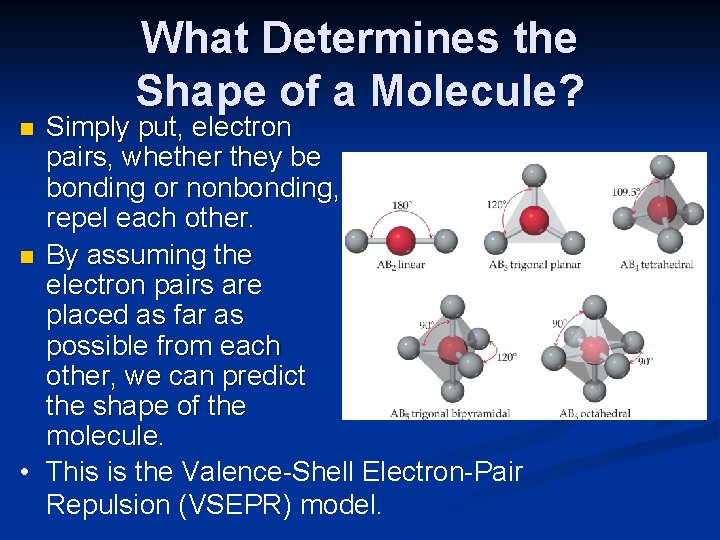
What Determines the Shape of a Molecule? Simply put, electron pairs, whether they be bonding or nonbonding, repel each other. n By assuming the electron pairs are placed as far as possible from each other, we can predict the shape of the molecule. • This is the Valence-Shell Electron-Pair Repulsion (VSEPR) model. n
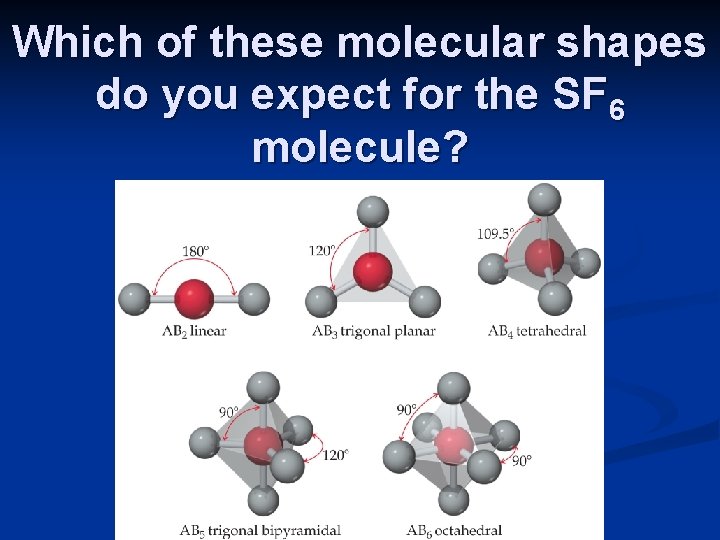
Which of these molecular shapes do you expect for the SF 6 molecule?
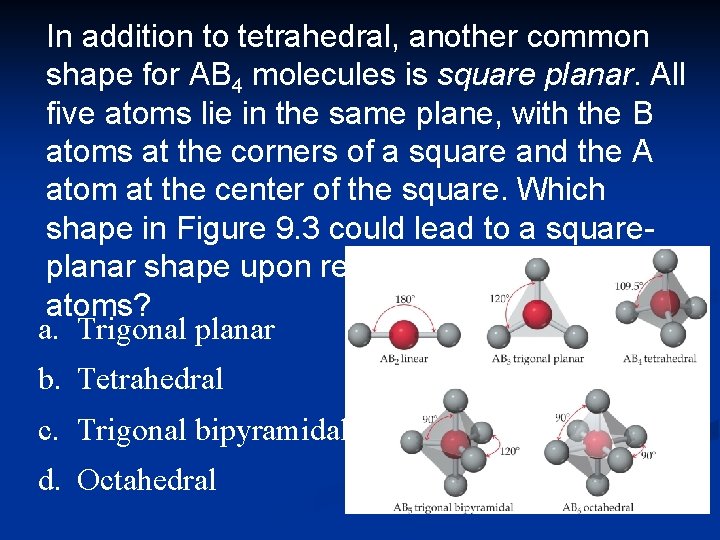
In addition to tetrahedral, another common shape for AB 4 molecules is square planar. All five atoms lie in the same plane, with the B atoms at the corners of a square and the A atom at the center of the square. Which shape in Figure 9. 3 could lead to a squareplanar shape upon removal of one or more atoms? a. Trigonal planar b. Tetrahedral c. Trigonal bipyramidal d. Octahedral
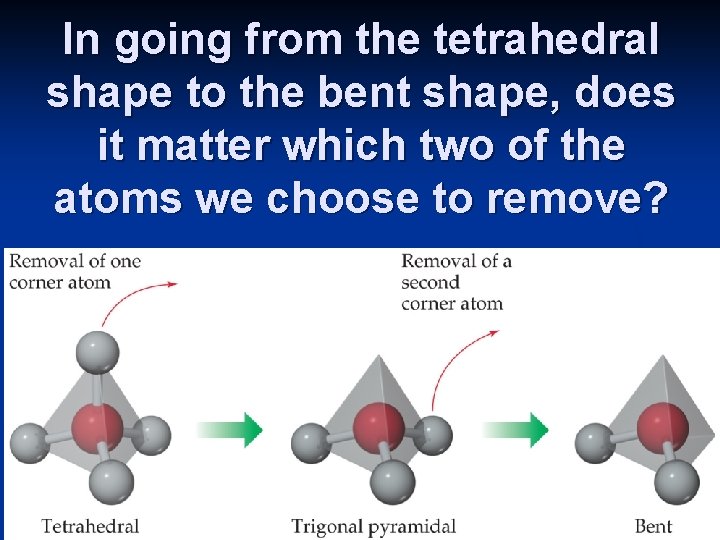
In going from the tetrahedral shape to the bent shape, does it matter which two of the atoms we choose to remove?

9. 2 The VSEPR Model
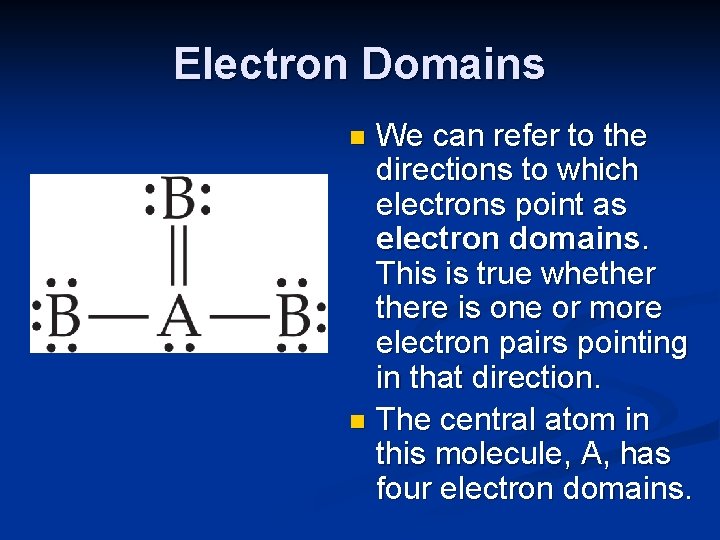
Electron Domains We can refer to the directions to which electrons point as electron domains. This is true whethere is one or more electron pairs pointing in that direction. n The central atom in this molecule, A, has four electron domains. n
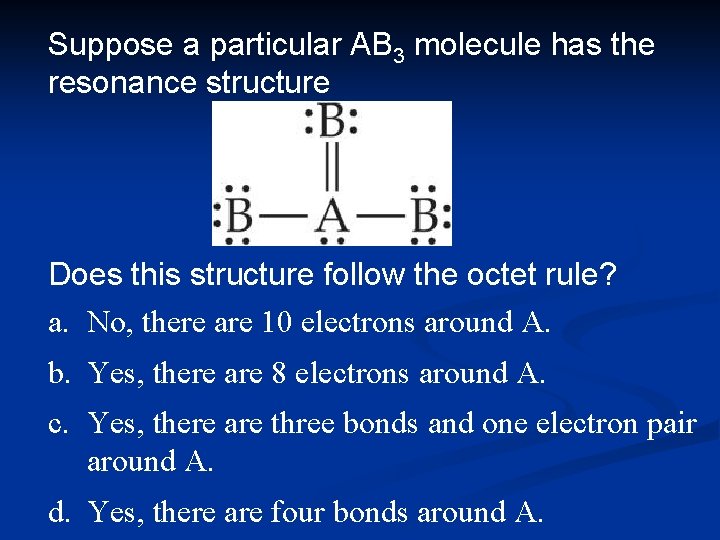
Suppose a particular AB 3 molecule has the resonance structure Does this structure follow the octet rule? a. No, there are 10 electrons around A. b. Yes, there are 8 electrons around A. c. Yes, there are three bonds and one electron pair around A. d. Yes, there are four bonds around A.
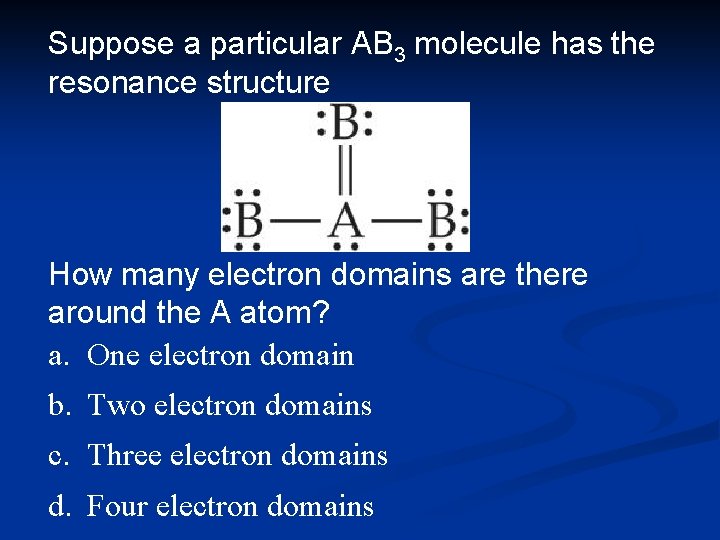
Suppose a particular AB 3 molecule has the resonance structure How many electron domains are there around the A atom? a. One electron domain b. Two electron domains c. Three electron domains d. Four electron domains
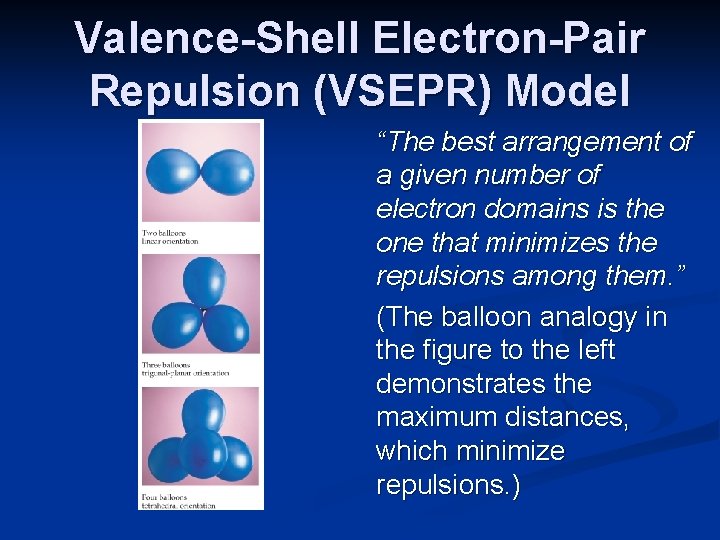
Valence-Shell Electron-Pair Repulsion (VSEPR) Model “The best arrangement of a given number of electron domains is the one that minimizes the repulsions among them. ” (The balloon analogy in the figure to the left demonstrates the maximum distances, which minimize repulsions. )
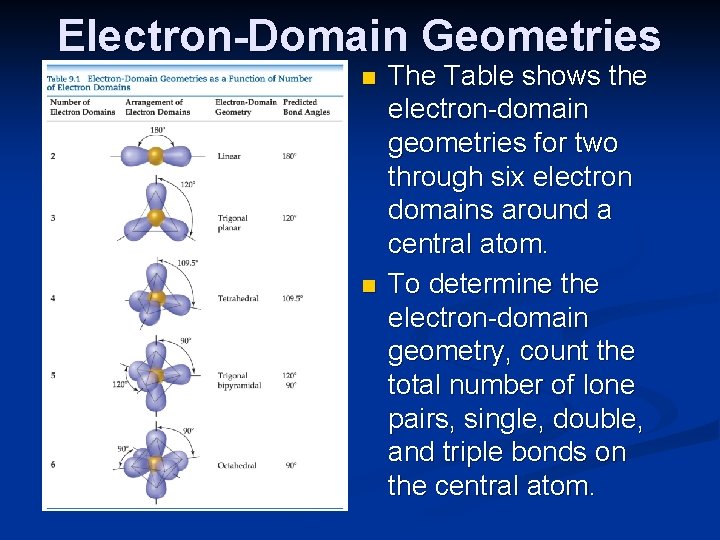
Electron-Domain Geometries n n The Table shows the electron-domain geometries for two through six electron domains around a central atom. To determine the electron-domain geometry, count the total number of lone pairs, single, double, and triple bonds on the central atom.
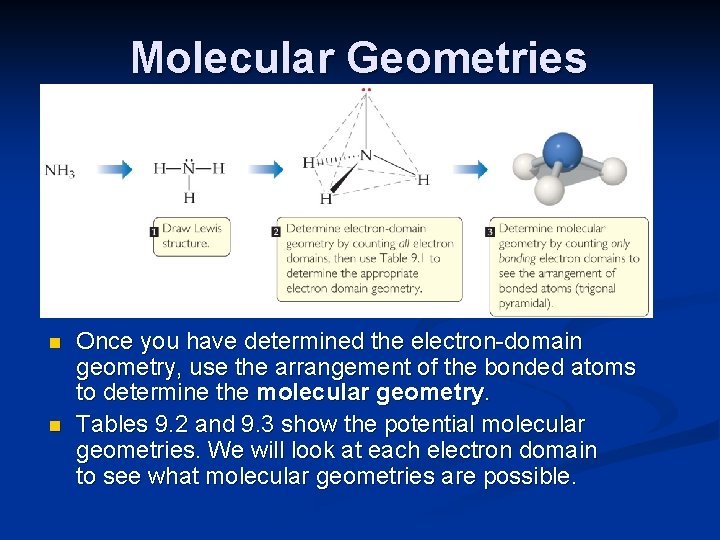
Molecular Geometries n n Once you have determined the electron-domain geometry, use the arrangement of the bonded atoms to determine the molecular geometry. Tables 9. 2 and 9. 3 show the potential molecular geometries. We will look at each electron domain to see what molecular geometries are possible.
From the standpoint of the VSEPR model, what do nonbonding electron pairs, single bonds, and multiple bonds have in common? a. There are no common features. b. Each occurs about the central atom only. c. Each represents a single electron domain. d. All exist when a particular Lewis structure is drawn.
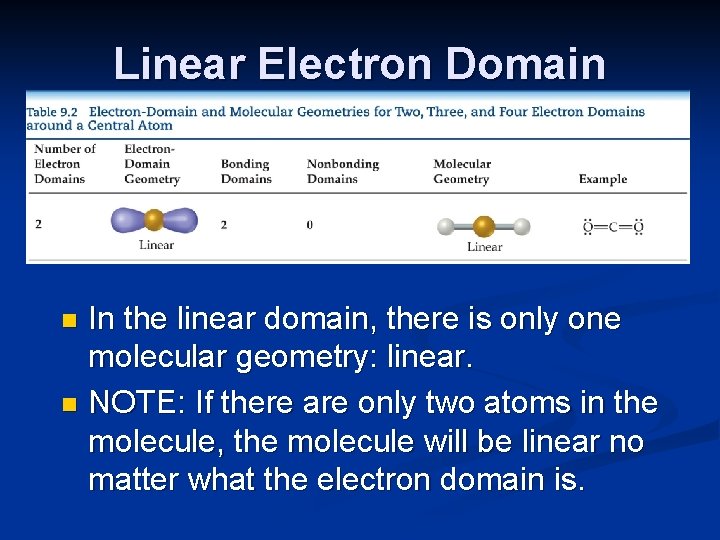
Linear Electron Domain In the linear domain, there is only one molecular geometry: linear. n NOTE: If there are only two atoms in the molecule, the molecule will be linear no matter what the electron domain is. n
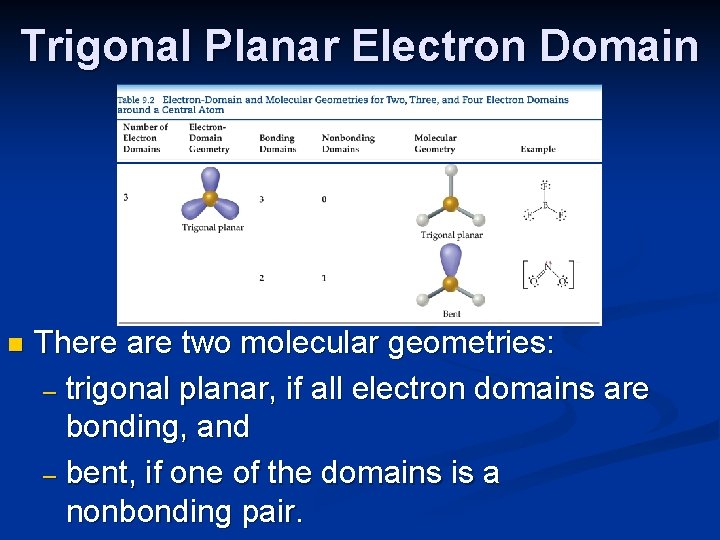
Trigonal Planar Electron Domain n There are two molecular geometries: – trigonal planar, if all electron domains are bonding, and – bent, if one of the domains is a nonbonding pair.
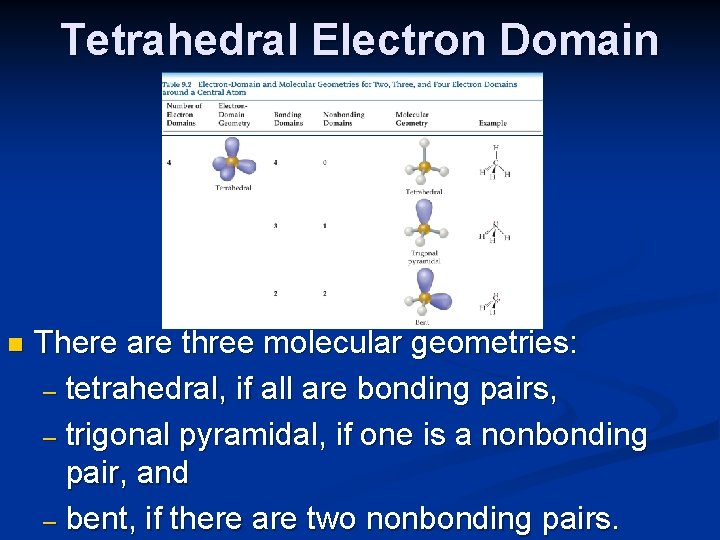
Tetrahedral Electron Domain n There are three molecular geometries: – tetrahedral, if all are bonding pairs, – trigonal pyramidal, if one is a nonbonding pair, and – bent, if there are two nonbonding pairs.
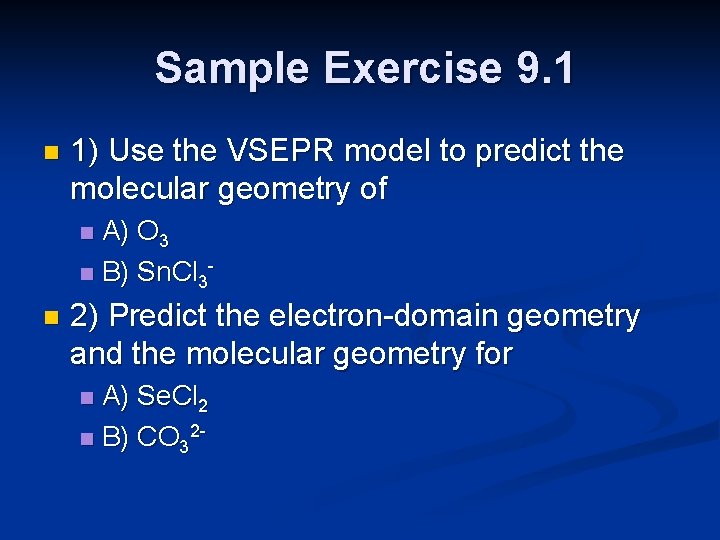
Sample Exercise 9. 1 n 1) Use the VSEPR model to predict the molecular geometry of A) O 3 n B) Sn. Cl 3 n n 2) Predict the electron-domain geometry and the molecular geometry for A) Se. Cl 2 n B) CO 32 n
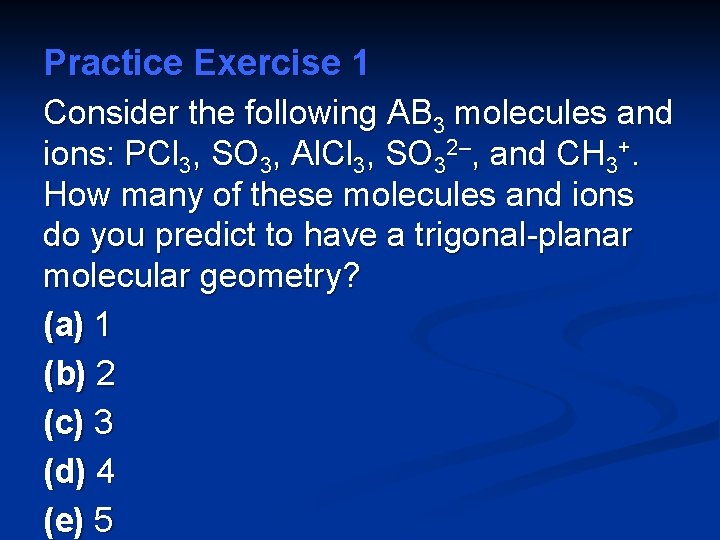
Practice Exercise 1 Consider the following AB 3 molecules and ions: PCl 3, SO 3, Al. Cl 3, SO 32–, and CH 3+. How many of these molecules and ions do you predict to have a trigonal-planar molecular geometry? (a) 1 (b) 2 (c) 3 (d) 4 (e) 5
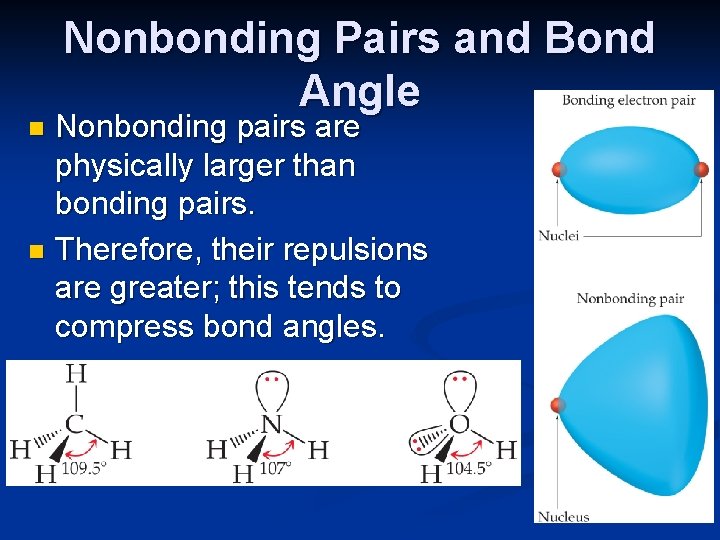
Nonbonding Pairs and Bond Angle Nonbonding pairs are physically larger than bonding pairs. n Therefore, their repulsions are greater; this tends to compress bond angles. n
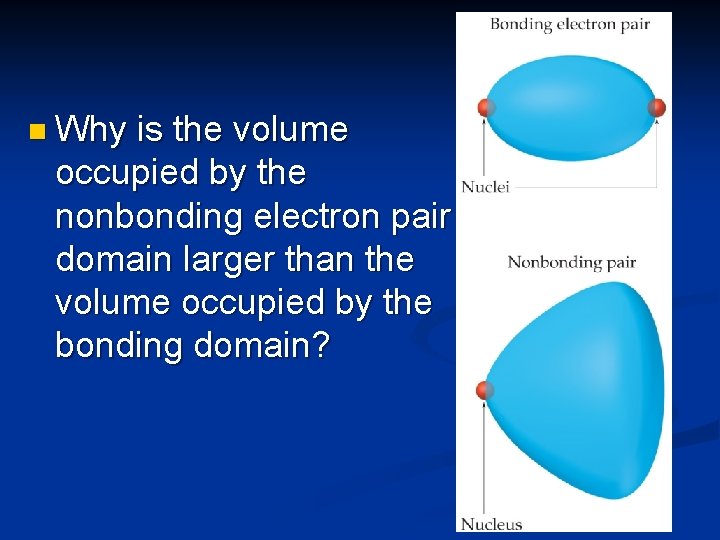
n Why is the volume occupied by the nonbonding electron pair domain larger than the volume occupied by the bonding domain?
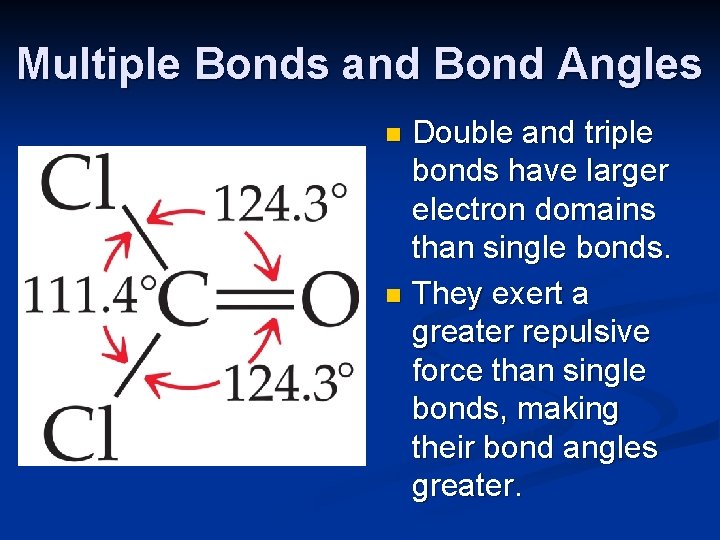
Multiple Bonds and Bond Angles Double and triple bonds have larger electron domains than single bonds. n They exert a greater repulsive force than single bonds, making their bond angles greater. n
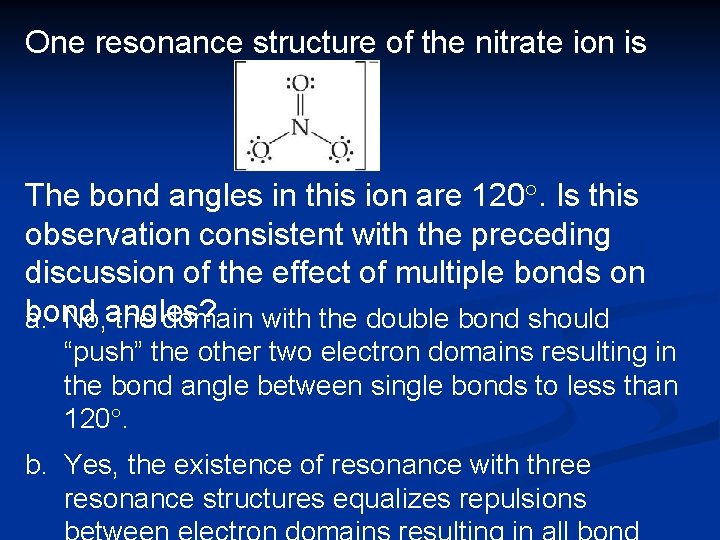
One resonance structure of the nitrate ion is The bond angles in this ion are 120°. Is this observation consistent with the preceding discussion of the effect of multiple bonds on bond a. No, angles? the domain with the double bond should “push” the other two electron domains resulting in the bond angle between single bonds to less than 120°. b. Yes, the existence of resonance with three resonance structures equalizes repulsions
Expanding beyond the Octet Rule n Remember that some elements can break the octet rule and make more than four bonds (or have more than four electron domains). n The result is two more possible electron domains: five = trigonal bipyramidal; six = octahedral (as was seen in the slide on electron-domain geometries).
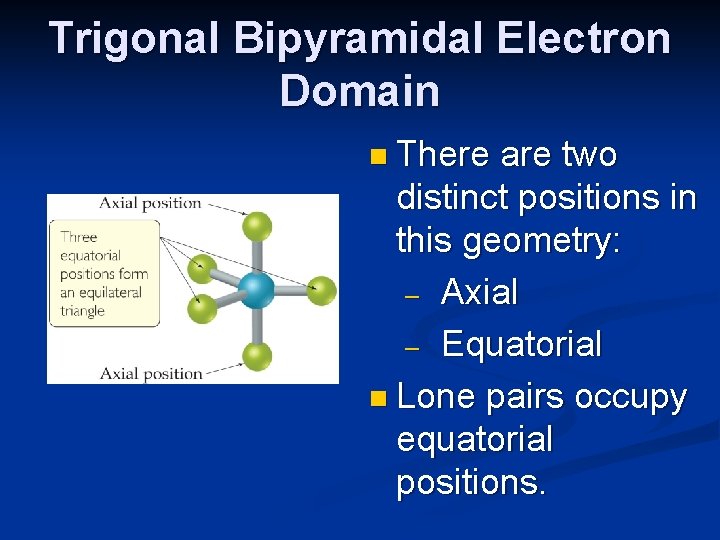
Trigonal Bipyramidal Electron Domain n There are two distinct positions in this geometry: – Axial – Equatorial n Lone pairs occupy equatorial positions.
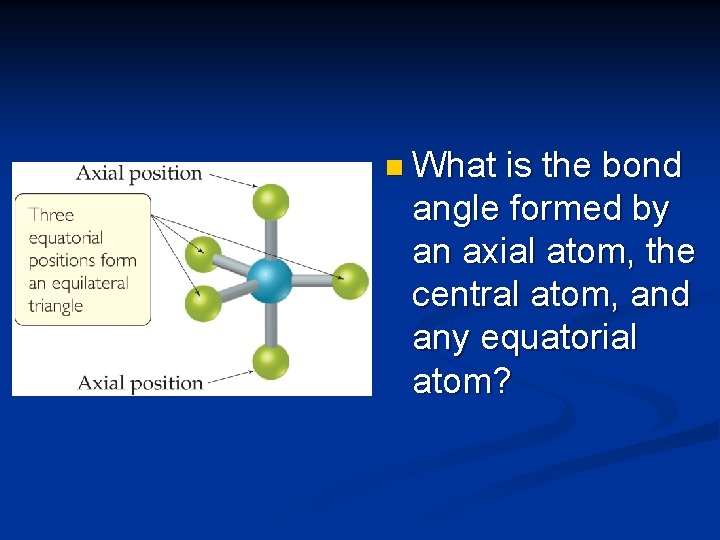
n What is the bond angle formed by an axial atom, the central atom, and any equatorial atom?
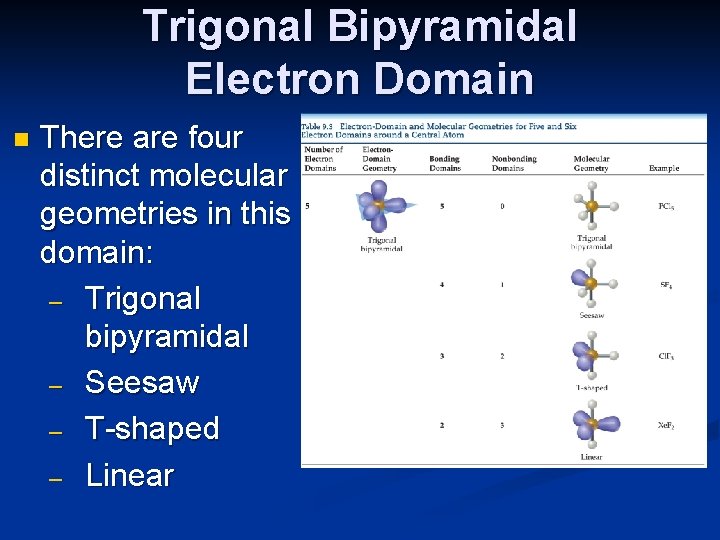
Trigonal Bipyramidal Electron Domain n There are four distinct molecular geometries in this domain: – Trigonal bipyramidal – Seesaw – T-shaped – Linear
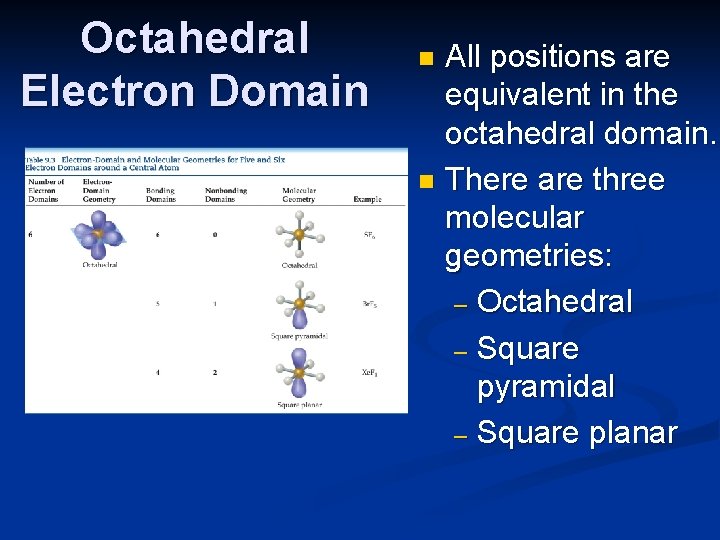
Octahedral Electron Domain All positions are equivalent in the octahedral domain. n There are three molecular geometries: – Octahedral – Square pyramidal – Square planar n
It might seem that a square-planar geometry of four electron domains around a central atom would be more favorable than a tetrahedron. Can you rationalize why the tetrahedron is preferred, based on angles between electron domains? a. Bond angles are not determined by a particular arrangement of electron domains. b. A tetrahedral arrangement of electron domains results in greater electron repulsions and a less favorable geometry than electron domains in a square planar geometry. c. A tetrahedral arrangement of electron domains results in smaller electron repulsions and a more favorable geometry than electron domains in a square planar geometry. d. A tetrahedral arrangement of electron domains results in no greater electron repulsions and no greater favorable geometry than electron domains in a square planar geometry.
Sample Exercise 9. 2 n 1) Use the VSEPR model to predict the molecular geometry of n A) SF 4 n B) IF 5
Practice Exercise 1 A certain AB 4 molecule has a square-planar molecular geometry. Which of the following statements about the molecule is or are true? : (i) The molecule has four electron domains about the central atom A. (ii) The B—A—B angles between neighboring B atoms is 90°. (iii) The molecule has two nonbonding pairs of electrons on atom A. (a) Only one of the statements is true. (b) Statements (i) and (ii) are true. (c) Statements (i) and (iii) are true. (d) Statements (ii) and (iii) are true.
Practice Exercise 2 Predict the electron-domain and molecular geometries of (a) Br. F 3 (b) SF 5+ (c) ICl 4 -
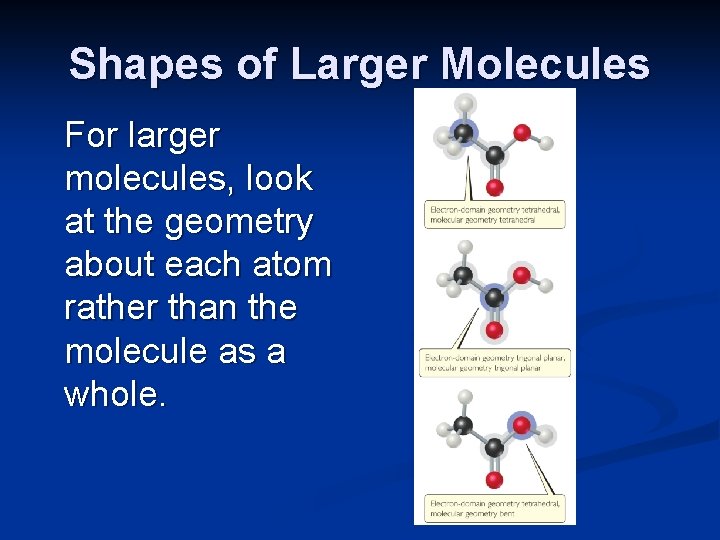
Shapes of Larger Molecules For larger molecules, look at the geometry about each atom rather than the molecule as a whole.
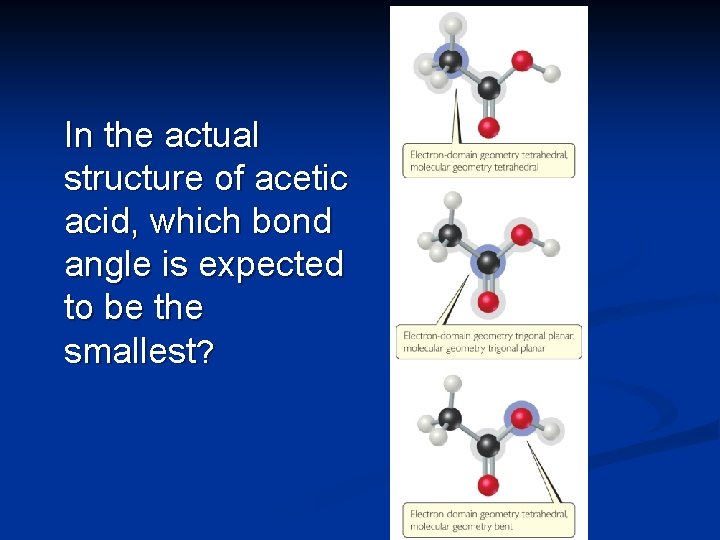
In the actual structure of acetic acid, which bond angle is expected to be the smallest?
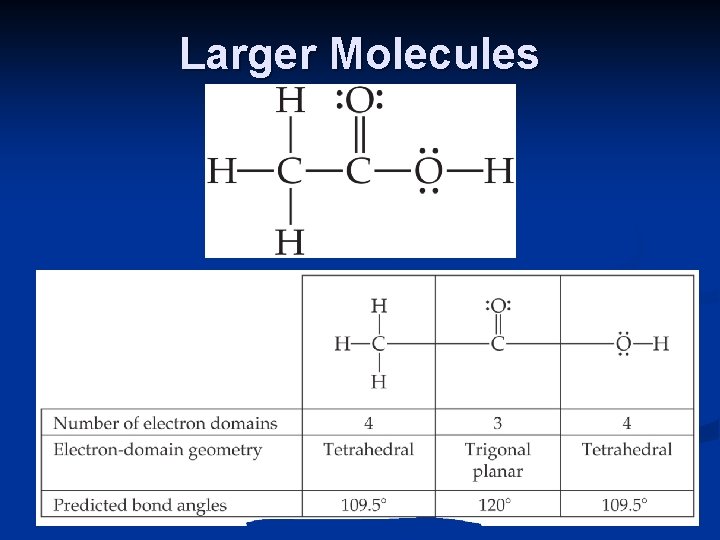
Larger Molecules
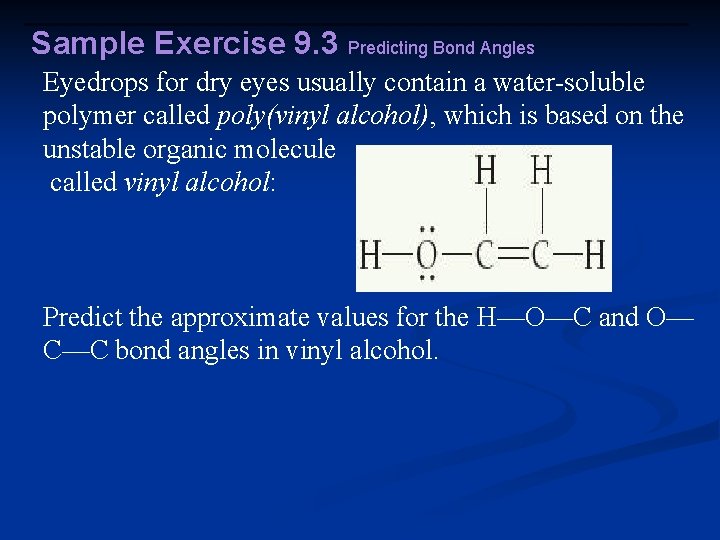
Sample Exercise 9. 3 Predicting Bond Angles Eyedrops for dry eyes usually contain a water-soluble polymer called poly(vinyl alcohol), which is based on the unstable organic molecule called vinyl alcohol: Predict the approximate values for the H—O—C and O— C—C bond angles in vinyl alcohol.
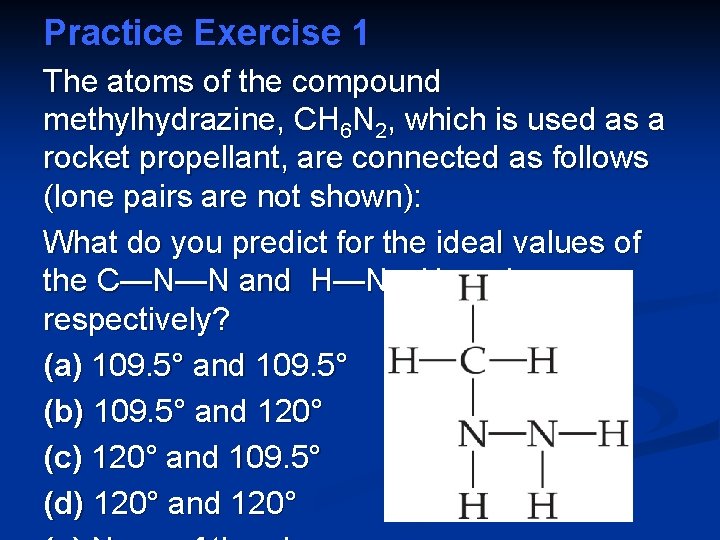
Practice Exercise 1 The atoms of the compound methylhydrazine, CH 6 N 2, which is used as a rocket propellant, are connected as follows (lone pairs are not shown): What do you predict for the ideal values of the C—N—N and H—N—H angles, respectively? (a) 109. 5° and 109. 5° (b) 109. 5° and 120° (c) 120° and 109. 5° (d) 120° and 120°
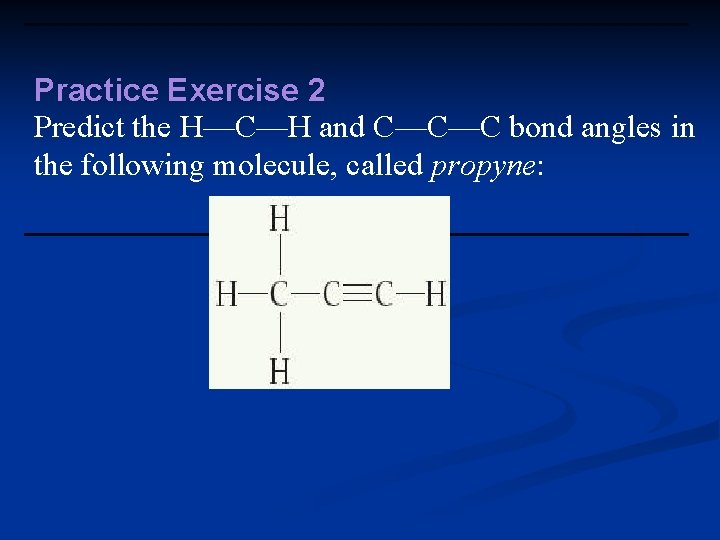
Practice Exercise 2 Predict the H—C—H and C—C—C bond angles in the following molecule, called propyne:
9. 3 Molecular Shape and Molecular Polarity
Polarity of Molecules Ask yourself: COVALENT or IONIC? If COVALENT: Are the BONDS polar? a. NO: The molecule is NONPOLAR! b. YES: Continue—Do the AVERAGE position of δ+ and δ– coincide? 1) YES: The molecule is NONPOLAR. 2) NO: The molecule is POLAR. NOTE: Different atoms attached to the central atom have different polarity of bonds.
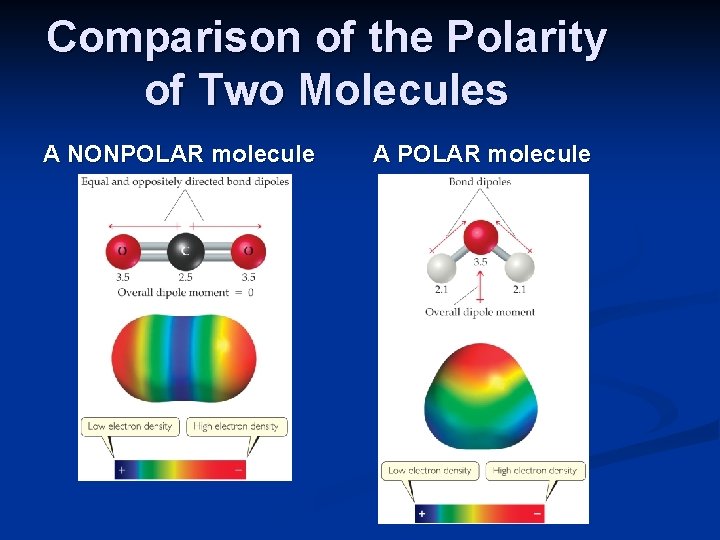
Comparison of the Polarity of Two Molecules A NONPOLAR molecule A POLAR molecule
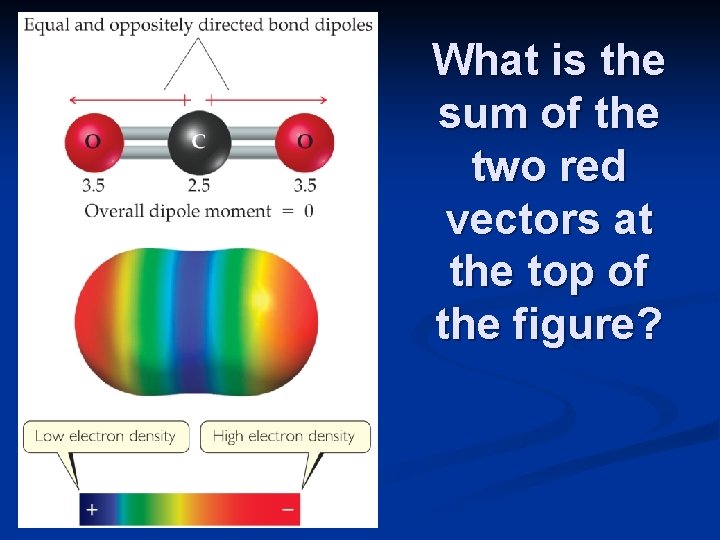
What is the sum of the two red vectors at the top of the figure?
The molecule O=C=S is linear and has a Lewis structure analogous to that of CO 2. Would you expect this molecule to be nonpolar? a. Yes, because COS has different elements than in CO 2. b. No, because COS is linear. c. Yes, because O and S have different electronegativities, and CO and CS bond dipoles do not cancel each other. d. No, because O and S have similar electronegativities, and CO and CS bond
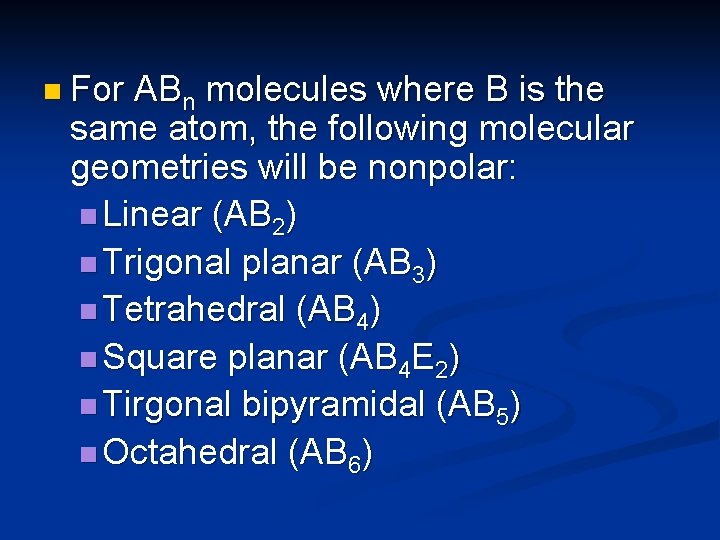
n For ABn molecules where B is the same atom, the following molecular geometries will be nonpolar: n Linear (AB 2) n Trigonal planar (AB 3) n Tetrahedral (AB 4) n Square planar (AB 4 E 2) n Tirgonal bipyramidal (AB 5) n Octahedral (AB 6)
Sample Exercise 9. 4 n Predict whether the following molecules are polar or nonpolar: n Br. Cl n SO 2 n SF 6
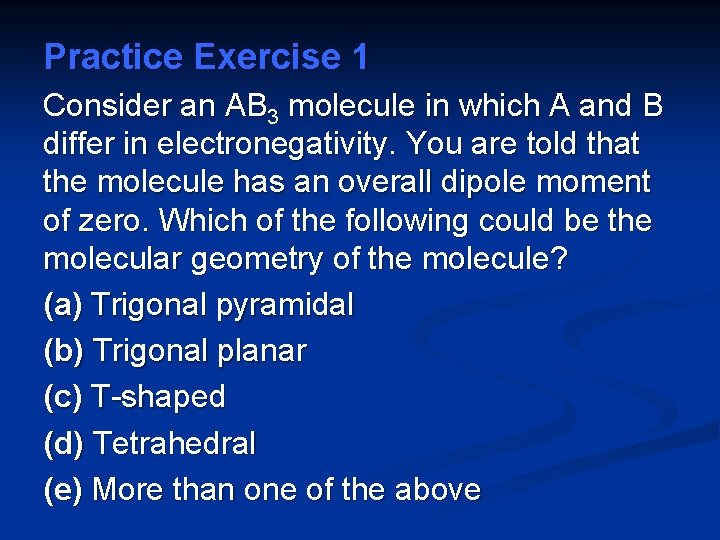
Practice Exercise 1 Consider an AB 3 molecule in which A and B differ in electronegativity. You are told that the molecule has an overall dipole moment of zero. Which of the following could be the molecular geometry of the molecule? (a) Trigonal pyramidal (b) Trigonal planar (c) T-shaped (d) Tetrahedral (e) More than one of the above
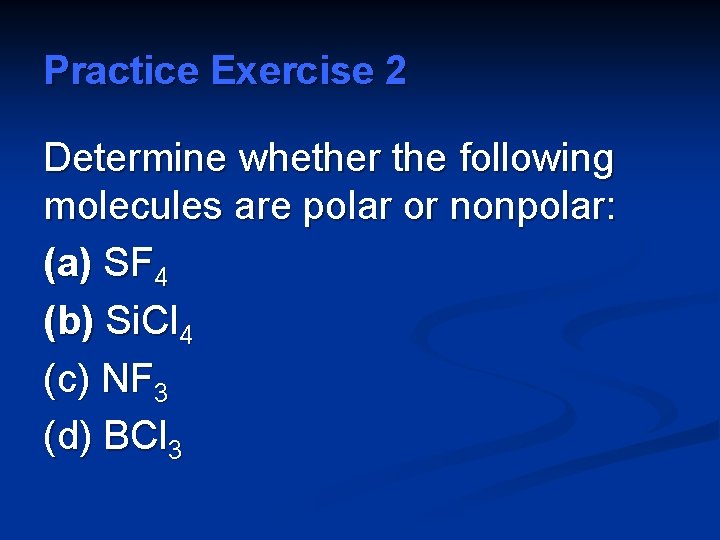
Practice Exercise 2 Determine whether the following molecules are polar or nonpolar: (a) SF 4 (b) Si. Cl 4 (c) NF 3 (d) BCl 3

9. 4 Covalent Bonding and Orbital Overlap
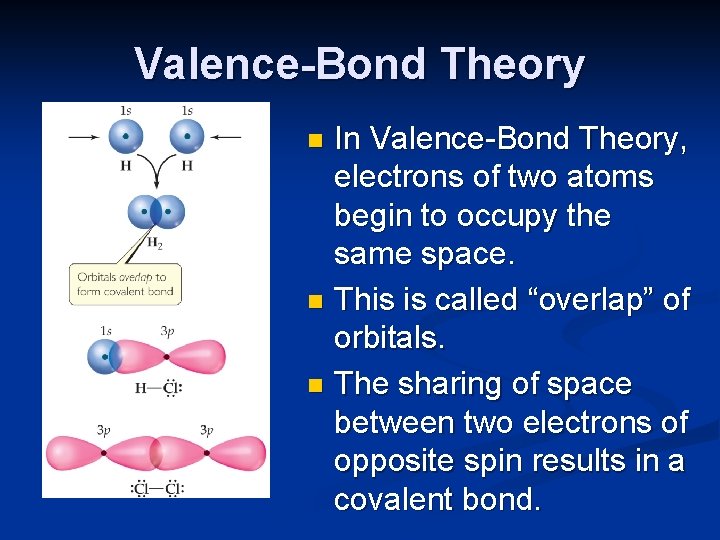
Valence-Bond Theory In Valence-Bond Theory, electrons of two atoms begin to occupy the same space. n This is called “overlap” of orbitals. n The sharing of space between two electrons of opposite spin results in a covalent bond. n
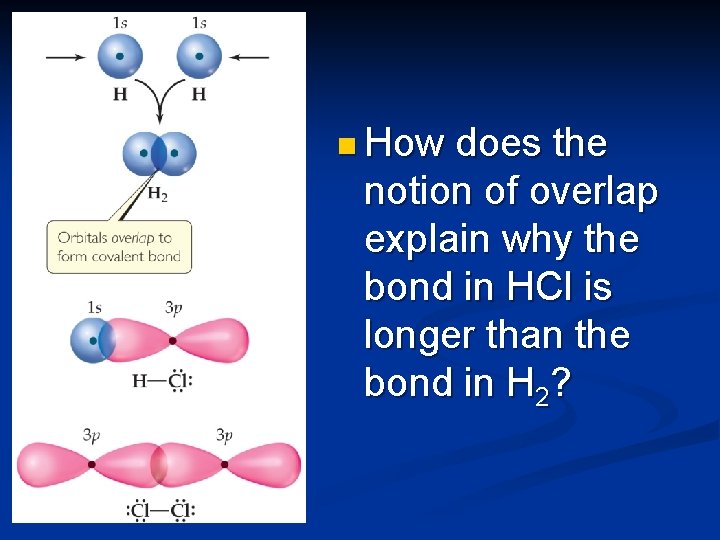
n How does the notion of overlap explain why the bond in HCl is longer than the bond in H 2?
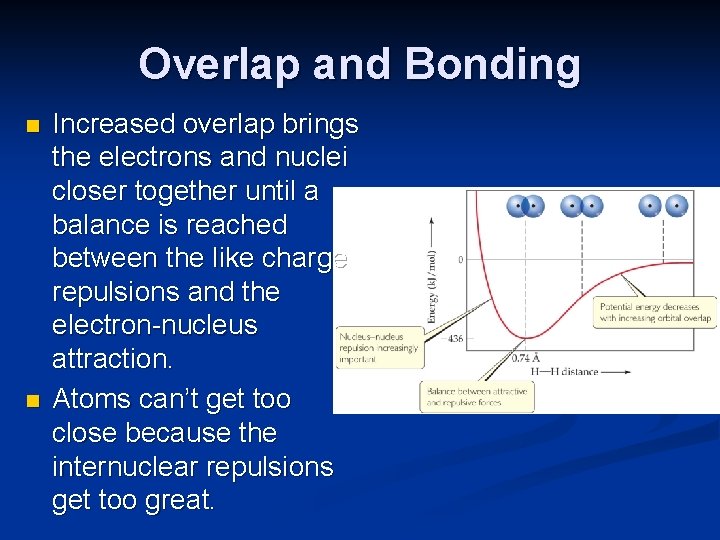
Overlap and Bonding n n Increased overlap brings the electrons and nuclei closer together until a balance is reached between the like charge repulsions and the electron-nucleus attraction. Atoms can’t get too close because the internuclear repulsions get too great.
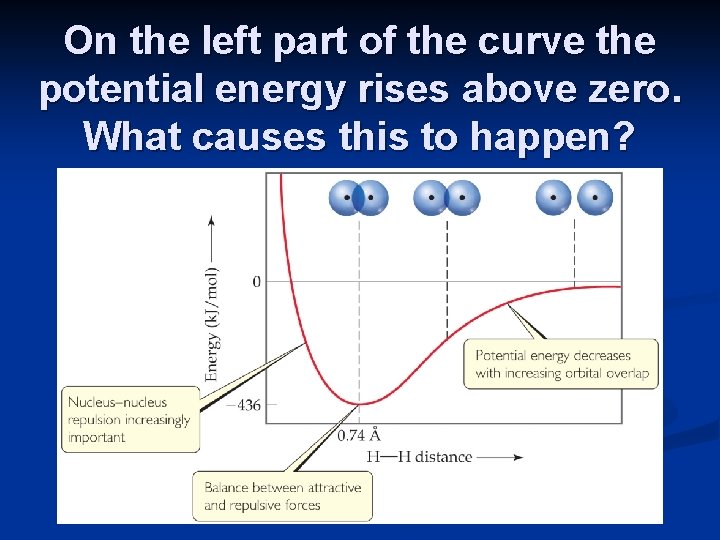
On the left part of the curve the potential energy rises above zero. What causes this to happen?

9. 5 Hybrid Orbitals
VSEPR and Hybrid Orbitals VSEPR predicts shapes of molecules very well. n How does that fit with orbitals? n Let’s use H 2 O as an example: n If we draw the best Lewis structure to assign VSEPR, it becomes bent. n If we look at oxygen, its electron configuration is 1 s 22 p 4. If it shares two electrons to fill its valence shell, they should be in 2 p. n Wouldn’t that make the angle 90°? n Why is it 104. 5°? n
Hybrid Orbitals n Hybrid orbitals form by “mixing” of atomic orbitals to create new orbitals of equal energy, called degenerate orbitals. n When two orbitals “mix” they create two orbitals; when three orbitals mix, they create three orbitals; etc.
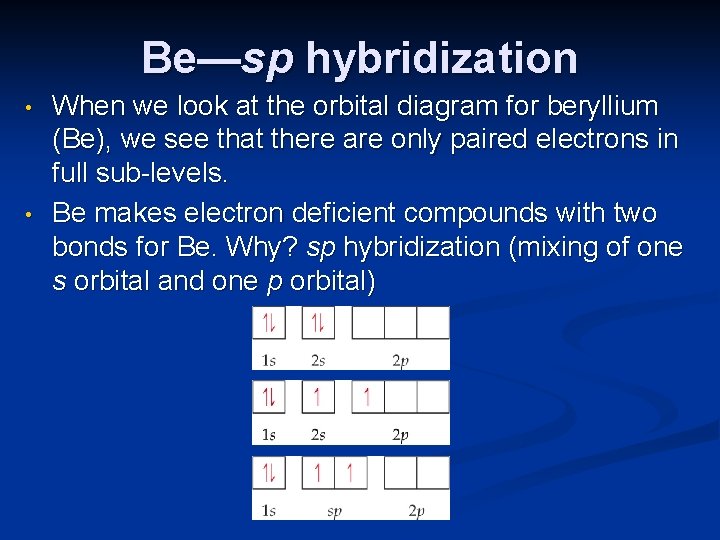
Be—sp hybridization • • When we look at the orbital diagram for beryllium (Be), we see that there are only paired electrons in full sub-levels. Be makes electron deficient compounds with two bonds for Be. Why? sp hybridization (mixing of one s orbital and one p orbital)
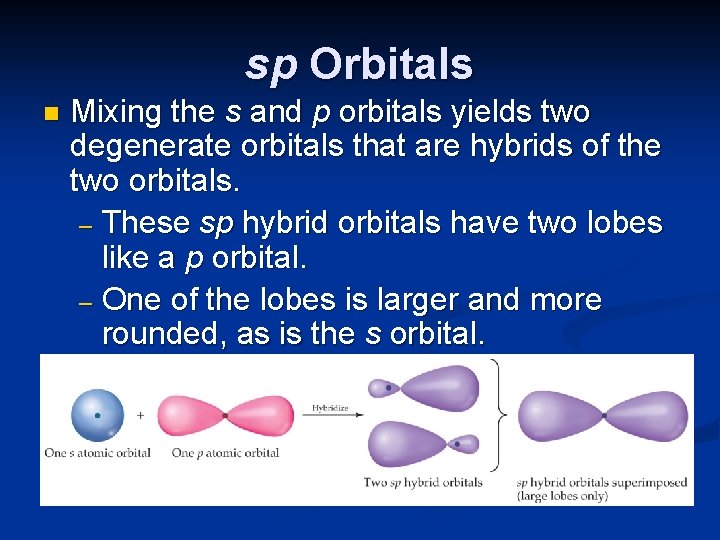
sp Orbitals n Mixing the s and p orbitals yields two degenerate orbitals that are hybrids of the two orbitals. – These sp hybrid orbitals have two lobes like a p orbital. – One of the lobes is larger and more rounded, as is the s orbital.
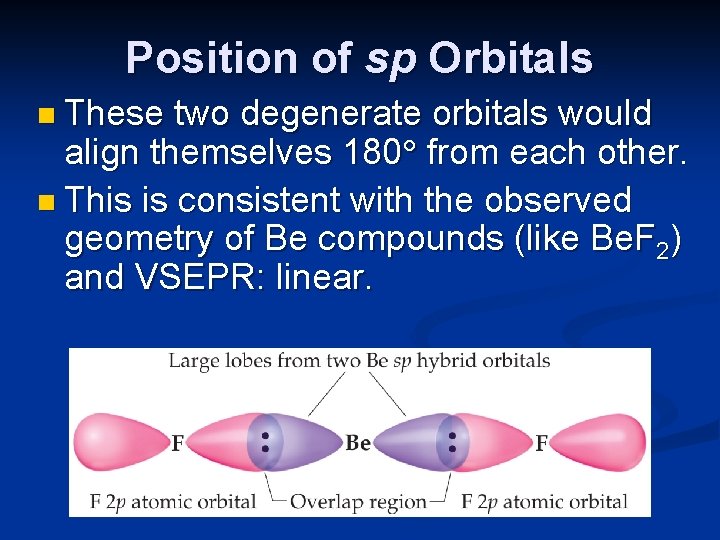
Position of sp Orbitals n These two degenerate orbitals would align themselves 180 from each other. n This is consistent with the observed geometry of Be compounds (like Be. F 2) and VSEPR: linear.
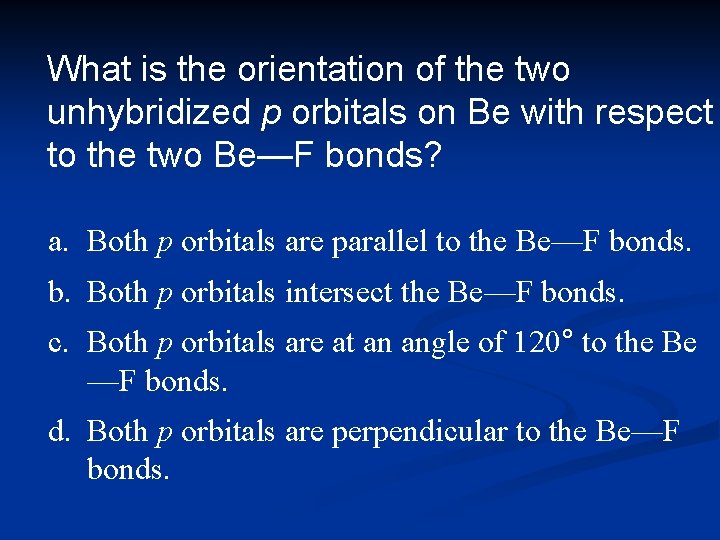
What is the orientation of the two unhybridized p orbitals on Be with respect to the two Be—F bonds? a. Both p orbitals are parallel to the Be—F bonds. b. Both p orbitals intersect the Be—F bonds. c. Both p orbitals are at an angle of 120° to the Be —F bonds. d. Both p orbitals are perpendicular to the Be—F bonds.
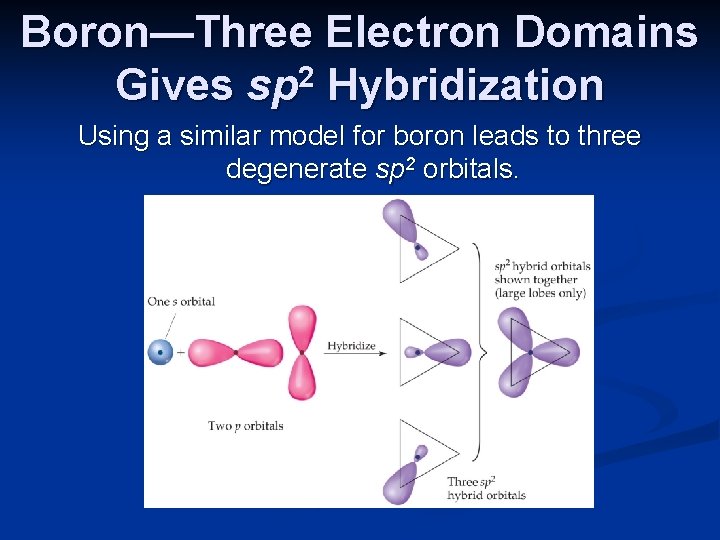
Boron—Three Electron Domains Gives sp 2 Hybridization Using a similar model for boron leads to three degenerate sp 2 orbitals.
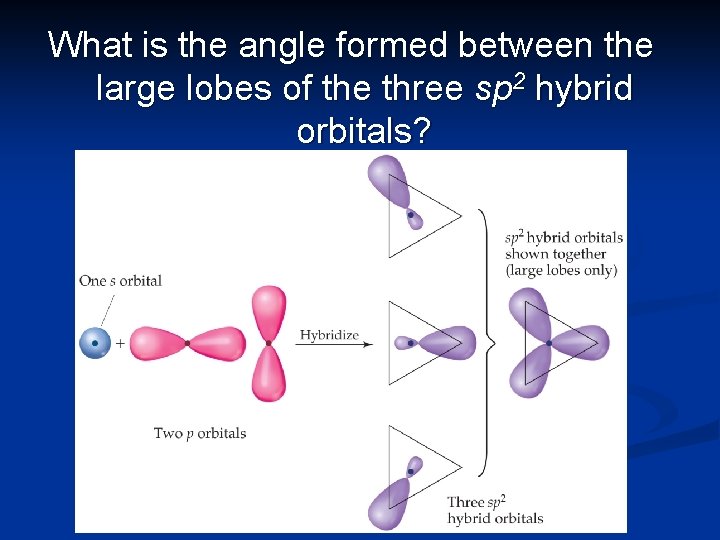
What is the angle formed between the large lobes of the three sp 2 hybrid orbitals?
In an sp 2 hybridized atom, we saw that there was one unhybridized 2 p orbital. How many unhybridized 2 p orbitals remain on an atom that has sp 3 hybrid orbitals? a. One b. Two c. Three d. None
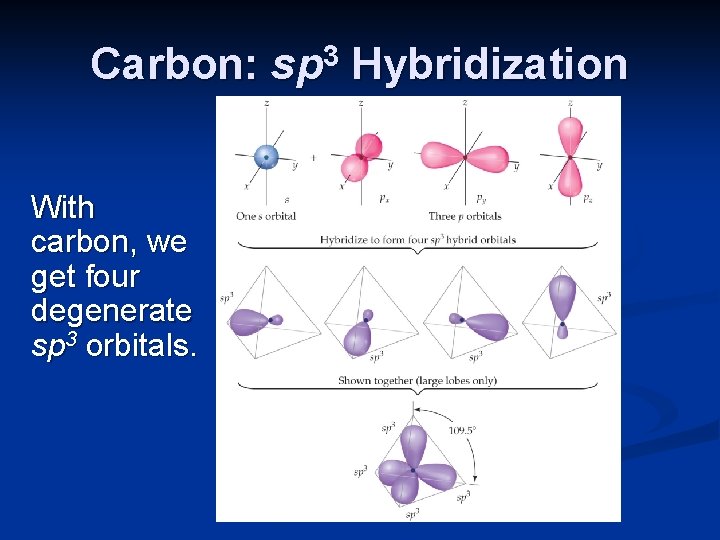
Carbon: sp 3 Hybridization With carbon, we get four degenerate sp 3 orbitals.
Hypervalent Molecules The elements which have more than an octet n Valence-Bond model would use d orbitals to make more than four bonds. n This view works for period 3 and below. n Theoretical studies suggest that the energy needed would be too great for this. n A more detailed bonding view is needed than we will use in this course. n
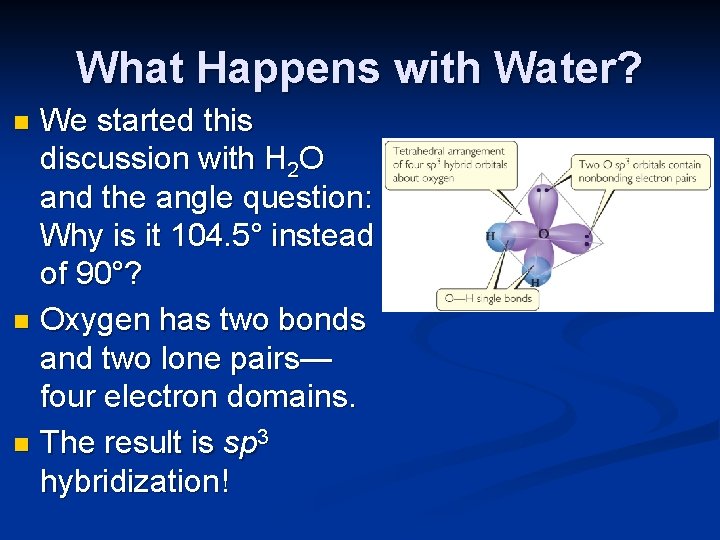
What Happens with Water? We started this discussion with H 2 O and the angle question: Why is it 104. 5° instead of 90°? n Oxygen has two bonds and two lone pairs— four electron domains. n The result is sp 3 hybridization! n
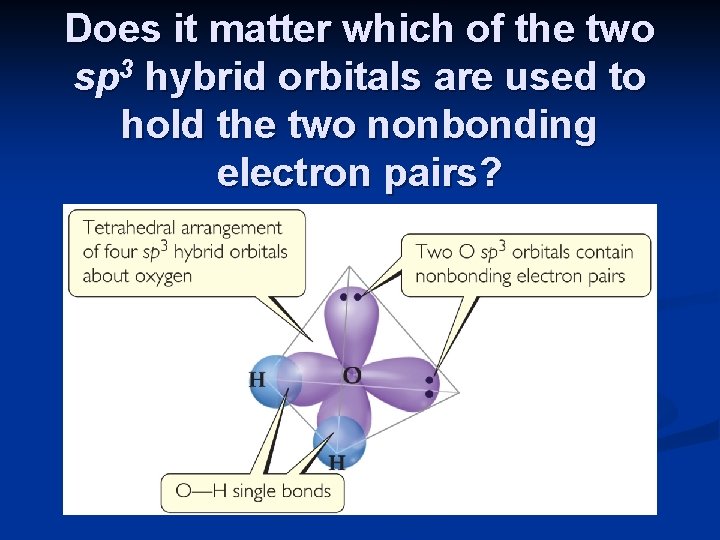
Does it matter which of the two sp 3 hybrid orbitals are used to hold the two nonbonding electron pairs?
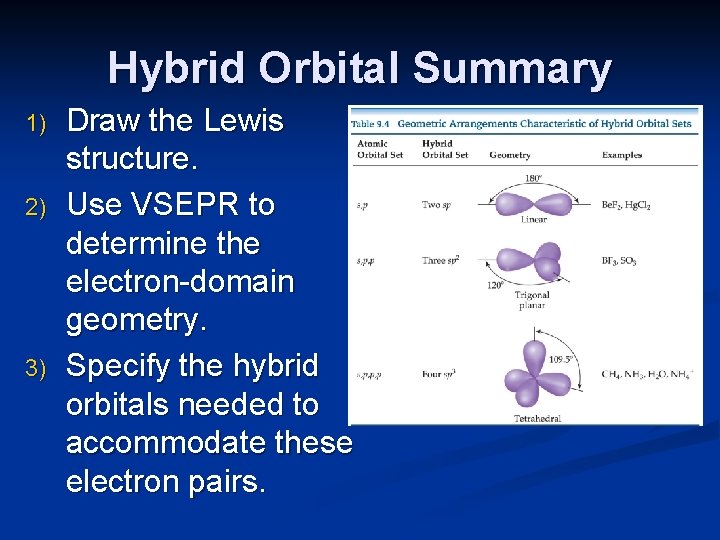
Hybrid Orbital Summary 1) 2) 3) Draw the Lewis structure. Use VSEPR to determine the electron-domain geometry. Specify the hybrid orbitals needed to accommodate these electron pairs.
Sample Exercise 9. 5 n 1) Indicate the hybridization of orbitals employed by the central atom in: n A) NH 2 - n 2) Predict the electron-domain geometry and the hybridization of the central atom in: n A) SO 32 -

Practice Exercise 1 For which of the following molecules or ions does the following description apply? “The bonding can be explained using a set of sp 2 hybrid orbitals on the central atom, with one of the hybrid orbitals holding a nonbonding pair of electrons. ” (a) CO 2 (b) H 2 S (c) O 3 (d) CO 32– (e) More than one of the above

9. 6 Multiple Bonds
n Single Bond Order bond = 1 n Double bond = 2 n Triple bond = 3 n If there is resonance, bond order is a fraction n Ex: ozone is 3/2 (three total bonds for two locations) n Ex: nitrate ion is 4/3 (four total bonds for three locations)
Types of Bonds How does a double or triple bond form? n It can’t, if we only use hybridized orbitals. n However, if we use the orbitals which are not hybridized, we can have a “sideways” overlap. n Two types of bonds: n Sigma (σ) bond n Pi (π) bond n
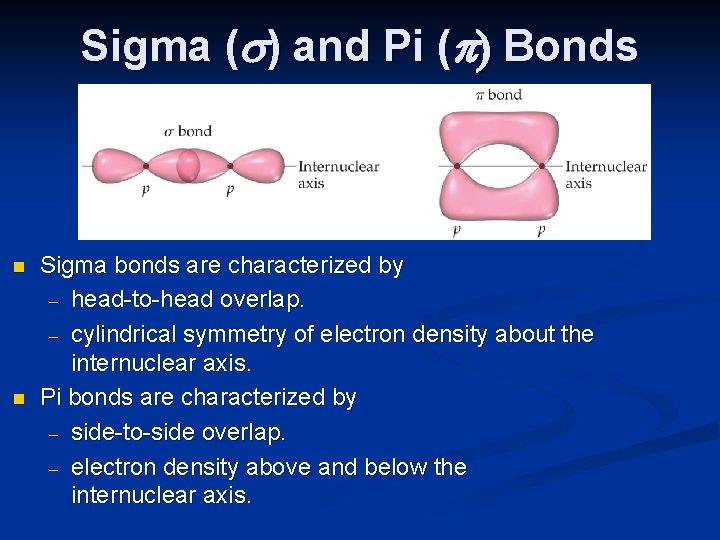
Sigma ( ) and Pi ( ) Bonds n n Sigma bonds are characterized by – head-to-head overlap. – cylindrical symmetry of electron density about the internuclear axis. Pi bonds are characterized by – side-to-side overlap. – electron density above and below the internuclear axis.
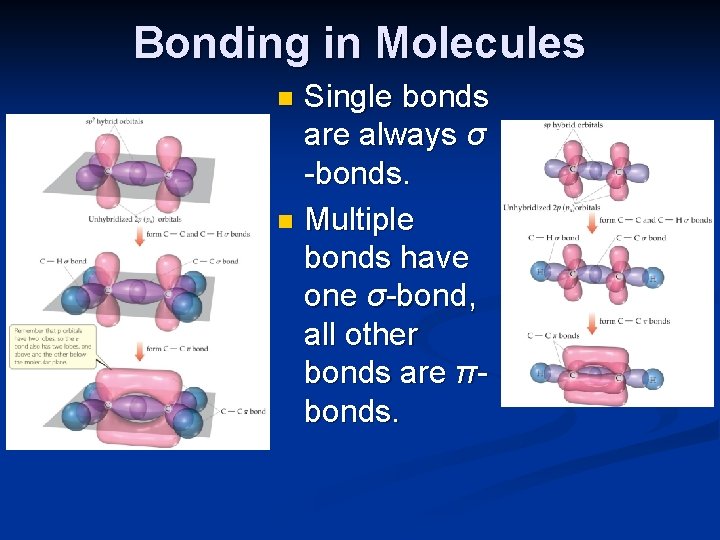
Bonding in Molecules Single bonds are always σ -bonds. n Multiple bonds have one σ-bond, all other bonds are πbonds. n
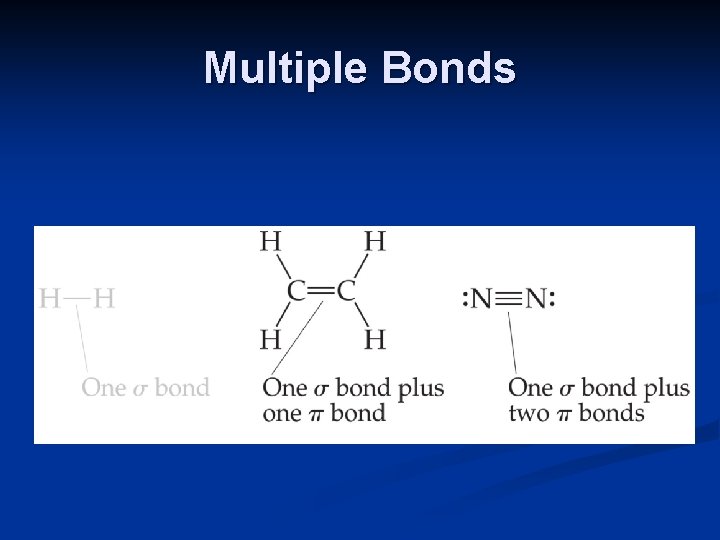
Multiple Bonds
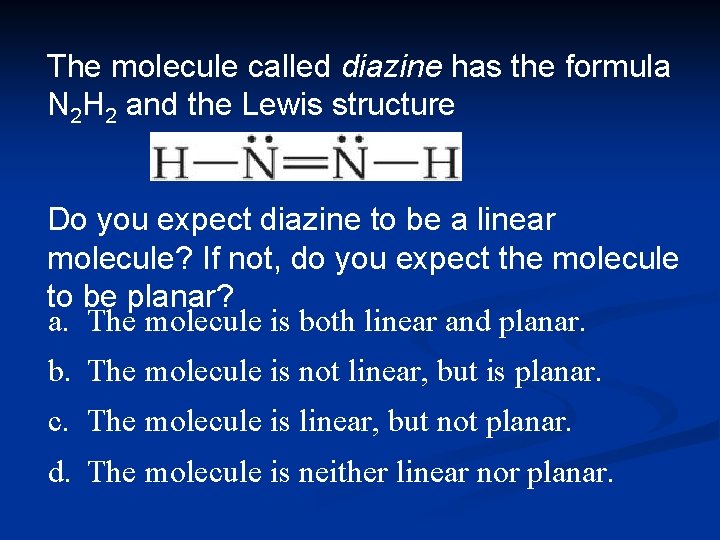
The molecule called diazine has the formula N 2 H 2 and the Lewis structure Do you expect diazine to be a linear molecule? If not, do you expect the molecule to be planar? a. The molecule is both linear and planar. b. The molecule is not linear, but is planar. c. The molecule is linear, but not planar. d. The molecule is neither linear nor planar.
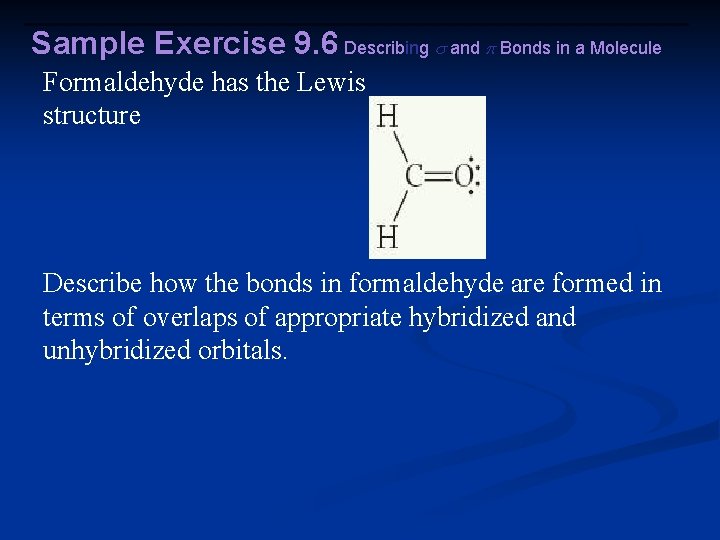
Sample Exercise 9. 6 Describing and Bonds in a Molecule Formaldehyde has the Lewis structure Describe how the bonds in formaldehyde are formed in terms of overlaps of appropriate hybridized and unhybridized orbitals.
Practice Exercise 1 We have just arrived at a bonding description for the formaldehyde molecule. Which of the following statements about the molecule is or are true? (i) Two of the electrons in the molecule are used to make the π bond in the molecule. (ii) Six of the electrons in the molecule are used to make the σ bonds in the molecule. (iii) The C—O bond length in formaldehyde should be shorter than that in methanol, H 3 COH. (a) Only one of the statements is true. (b) Statements (i) and (ii) are true. (c) Statements (i) and (iii) are true. (d) Statements (ii) and (iii) are true. (e) All three statements are true.
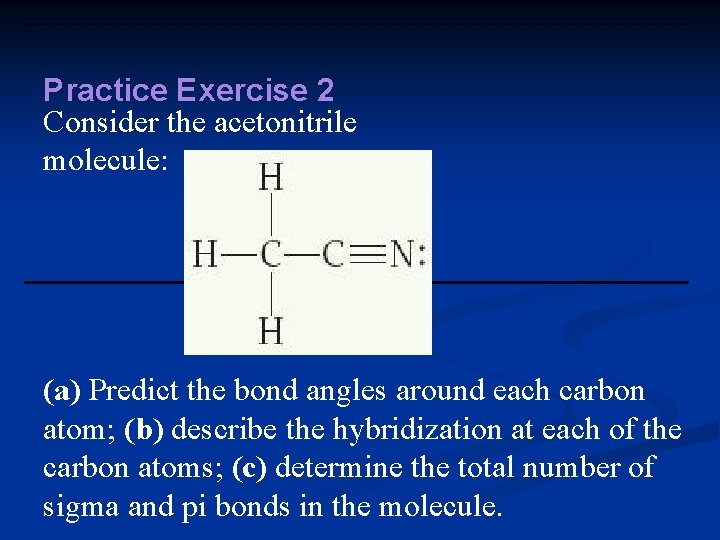
Practice Exercise 2 Consider the acetonitrile molecule: (a) Predict the bond angles around each carbon atom; (b) describe the hybridization at each of the carbon atoms; (c) determine the total number of sigma and pi bonds in the molecule.
Localized or Delocalized Electrons Bonding electrons (σ or π) that are specifically shared between two atoms are called localized electrons. n In many molecules, we can’t describe all electrons that way (resonance); the other electrons (shared by multiple atoms) are called delocalized electrons. n
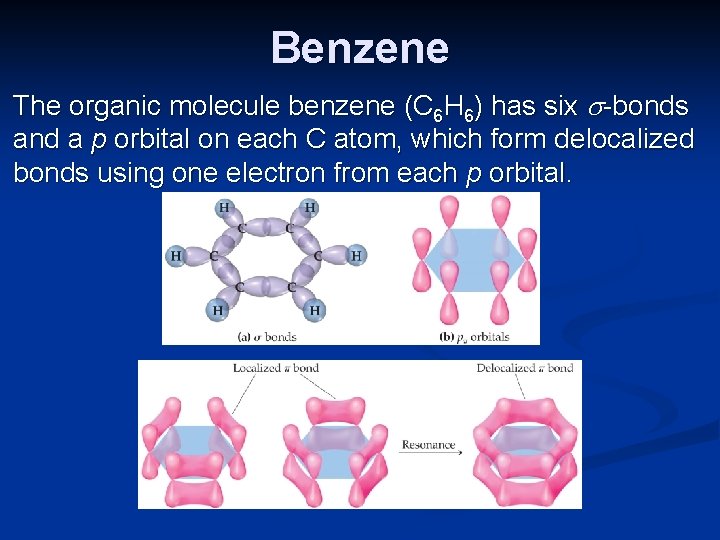
Benzene The organic molecule benzene (C 6 H 6) has six -bonds and a p orbital on each C atom, which form delocalized bonds using one electron from each p orbital.
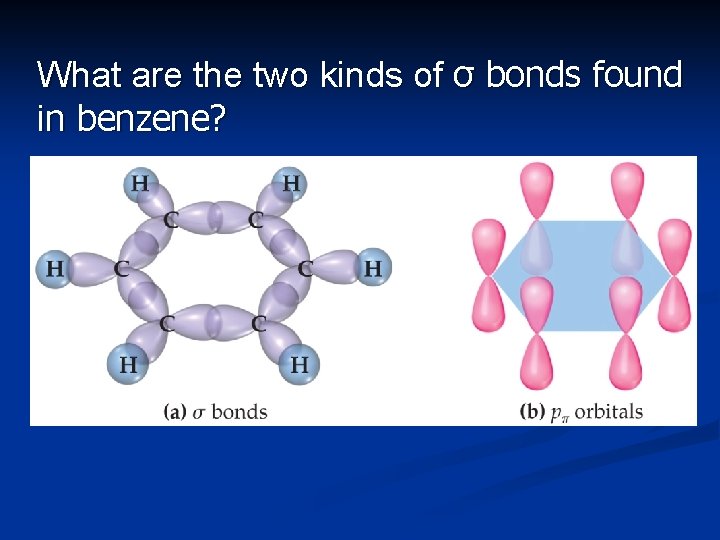
What are the two kinds of σ bonds found in benzene?
Sample Exercise 9. 7 Delocalized Bonding Describe the bonding in the nitrate ion, NO 3–. Does this ion have delocalized bonds?
Practice Exercise 2 n Which of the following molecules or ions will exhibit delocalized bonding: SO 2, SO 32 -, H 2 CO, and NH 4+?
Sample Integrative Exercise Elemental sulfur is a yellow solid that consists of S 8 molecules. The structure of the S 8 molecule is a puckered, eightmembered ring. Heating elemental sulfur to high temperatures produces gaseous S 2 molecules: S 8(s) → 4 S 2(g) (a) The electron configuration of which period 2 element is most similar to that of sulfur? (b) Use the VSEPR model to predict the S— S—S bond angles in S 8 and the hybridization at S in S 8. (c) Use average
- Slides: 86