
Chapter 9 Molecular Geometry and Bonding Theories 2015
Chapter 9 Molecular Geometry and Bonding Theories © 2015 Pearson Education, Inc.
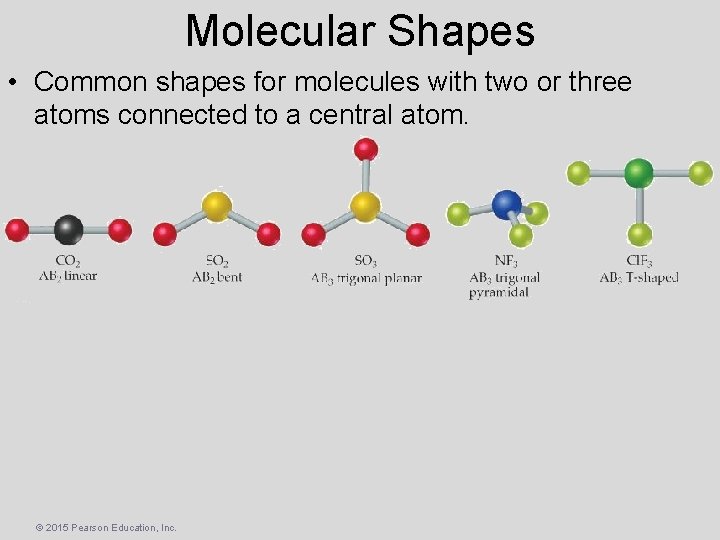
Molecular Shapes • Common shapes for molecules with two or three atoms connected to a central atom. © 2015 Pearson Education, Inc.
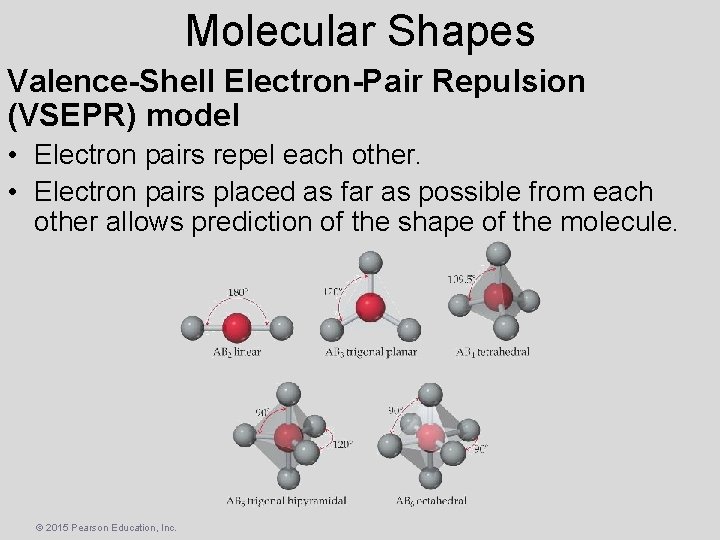
Molecular Shapes Valence-Shell Electron-Pair Repulsion (VSEPR) model • Electron pairs repel each other. • Electron pairs placed as far as possible from each other allows prediction of the shape of the molecule. © 2015 Pearson Education, Inc.
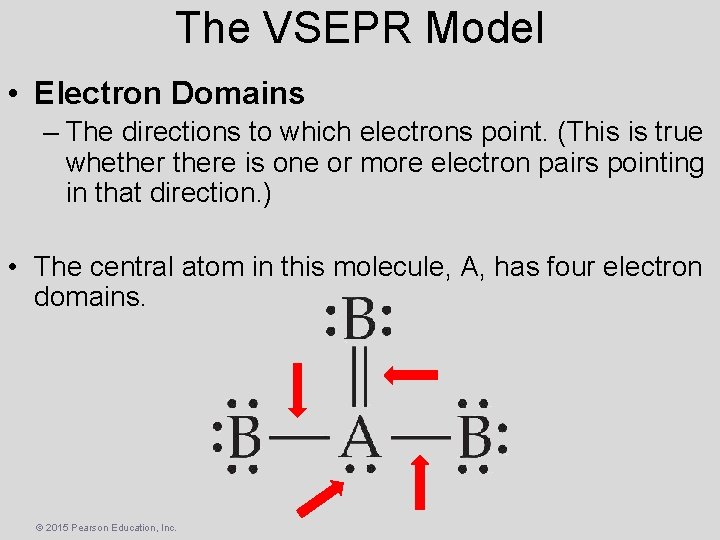
The VSEPR Model • Electron Domains – The directions to which electrons point. (This is true whethere is one or more electron pairs pointing in that direction. ) • The central atom in this molecule, A, has four electron domains. © 2015 Pearson Education, Inc.
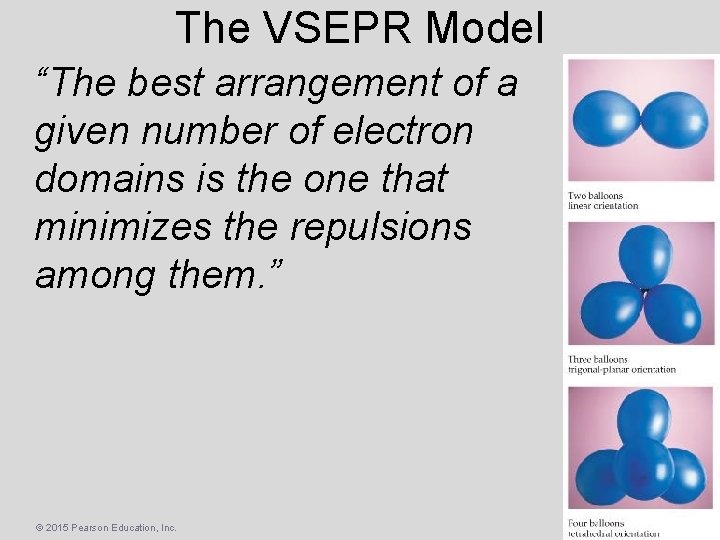
The VSEPR Model “The best arrangement of a given number of electron domains is the one that minimizes the repulsions among them. ” © 2015 Pearson Education, Inc.
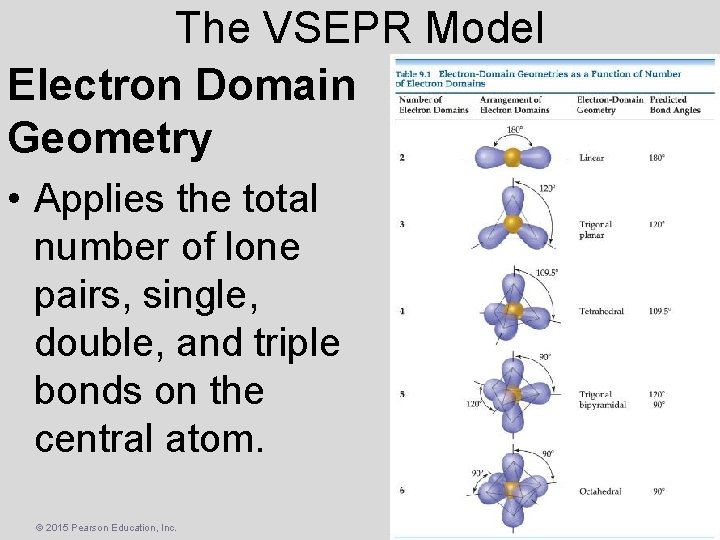
The VSEPR Model Electron Domain Geometry • Applies the total number of lone pairs, single, double, and triple bonds on the central atom. © 2015 Pearson Education, Inc.
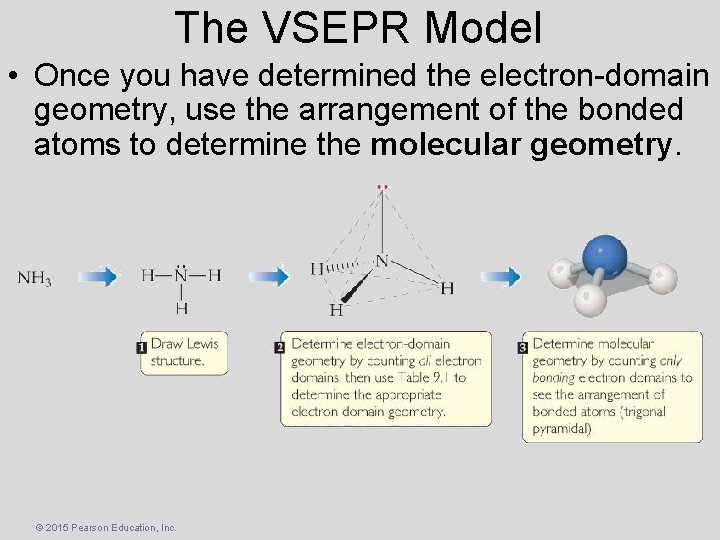
The VSEPR Model • Once you have determined the electron-domain geometry, use the arrangement of the bonded atoms to determine the molecular geometry. © 2015 Pearson Education, Inc.
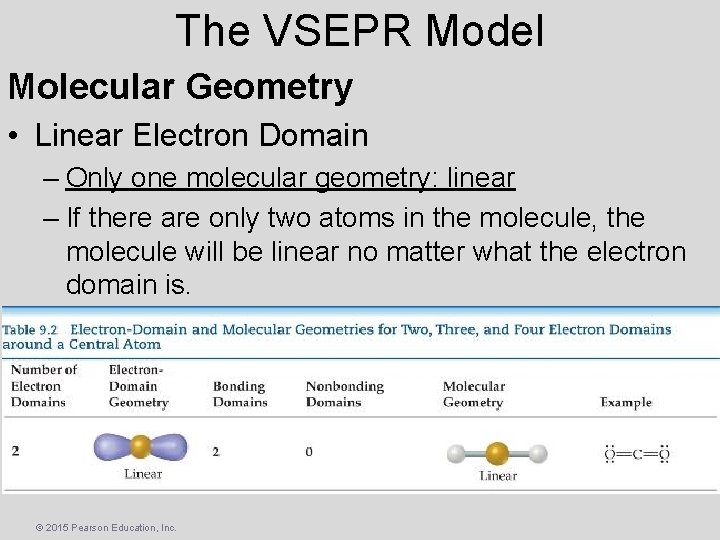
The VSEPR Model Molecular Geometry • Linear Electron Domain – Only one molecular geometry: linear – If there are only two atoms in the molecule, the molecule will be linear no matter what the electron domain is. © 2015 Pearson Education, Inc.
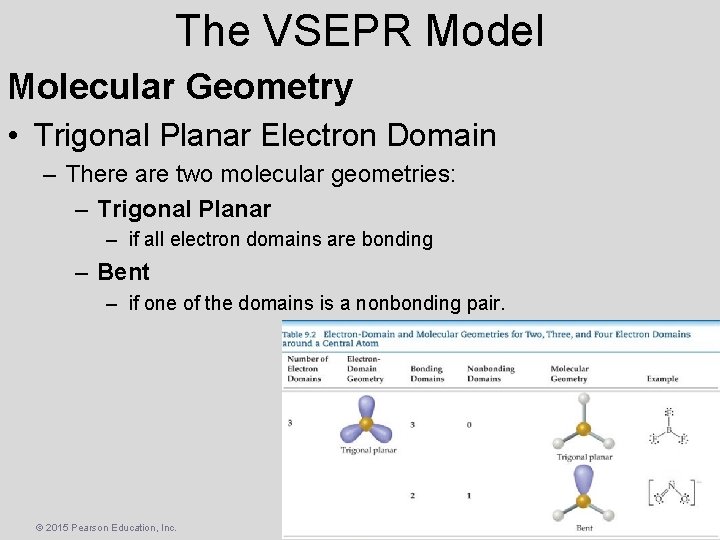
The VSEPR Model Molecular Geometry • Trigonal Planar Electron Domain – There are two molecular geometries: – Trigonal Planar – if all electron domains are bonding – Bent – if one of the domains is a nonbonding pair. © 2015 Pearson Education, Inc.
The VSEPR Model Molecular Geometry • Tetrahedral Electron Domain – There are three molecular geometries: – Tetrahedral – if all are bonding pairs – Trigonal Pyramidal – if one is a nonbonding pair, and – Bent – if there are two nonbonding pairs. © 2015 Pearson Education, Inc.
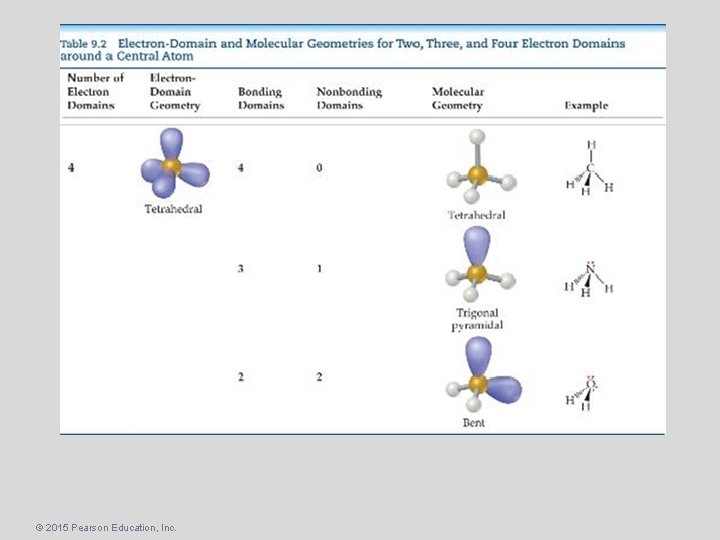
© 2015 Pearson Education, Inc.
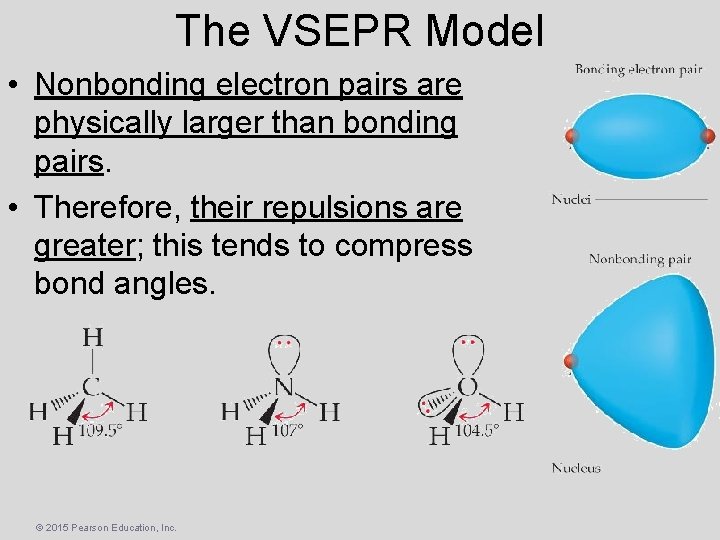
The VSEPR Model • Nonbonding electron pairs are physically larger than bonding pairs. • Therefore, their repulsions are greater; this tends to compress bond angles. © 2015 Pearson Education, Inc.
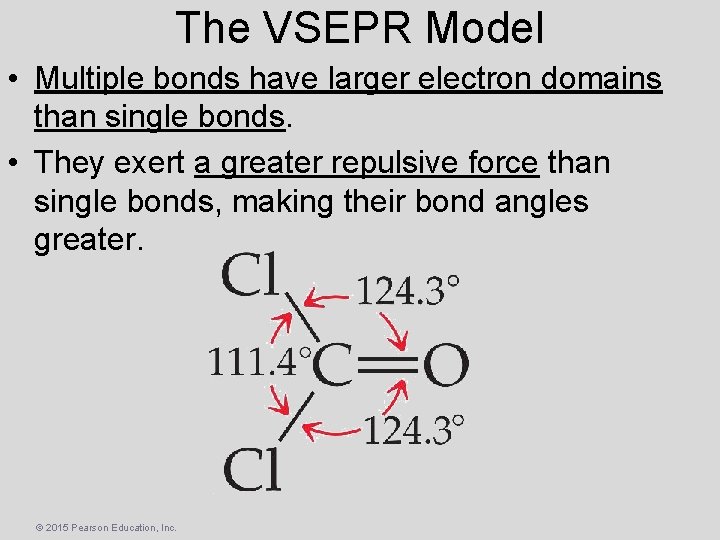
The VSEPR Model • Multiple bonds have larger electron domains than single bonds. • They exert a greater repulsive force than single bonds, making their bond angles greater. © 2015 Pearson Education, Inc.
Molecules with Expanded Valence Shells • Remember that some elements can break the octet rule and make more than four bonds (or have more than four electron domains). • The result is two more possible electron domains: – 5 = trigonal bipyramidal – 6 = octahedral © 2015 Pearson Education, Inc.
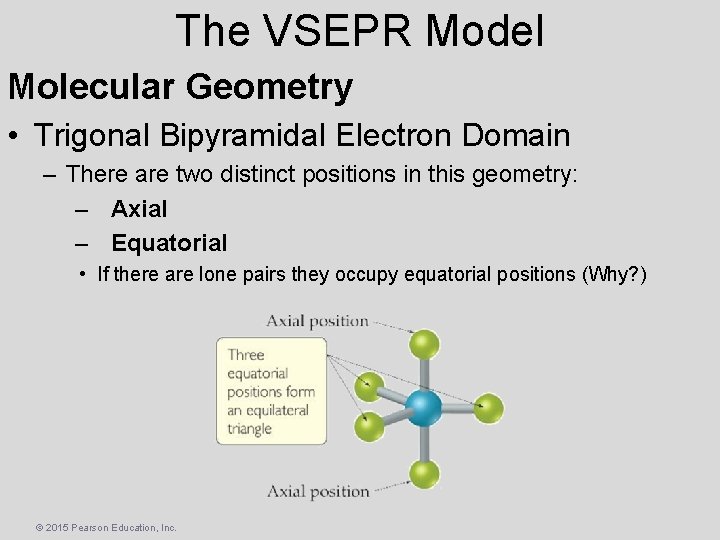
The VSEPR Model Molecular Geometry • Trigonal Bipyramidal Electron Domain – There are two distinct positions in this geometry: – Axial – Equatorial • If there are lone pairs they occupy equatorial positions (Why? ) © 2015 Pearson Education, Inc.
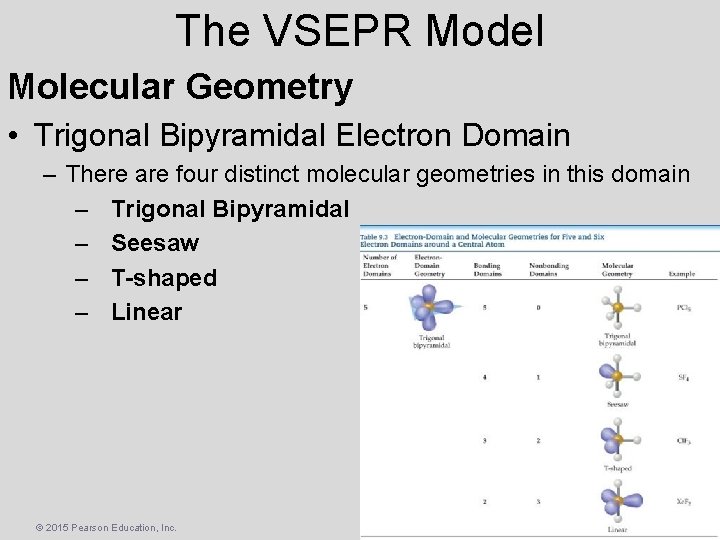
The VSEPR Model Molecular Geometry • Trigonal Bipyramidal Electron Domain – There are four distinct molecular geometries in this domain – Trigonal Bipyramidal – Seesaw – T-shaped – Linear © 2015 Pearson Education, Inc.
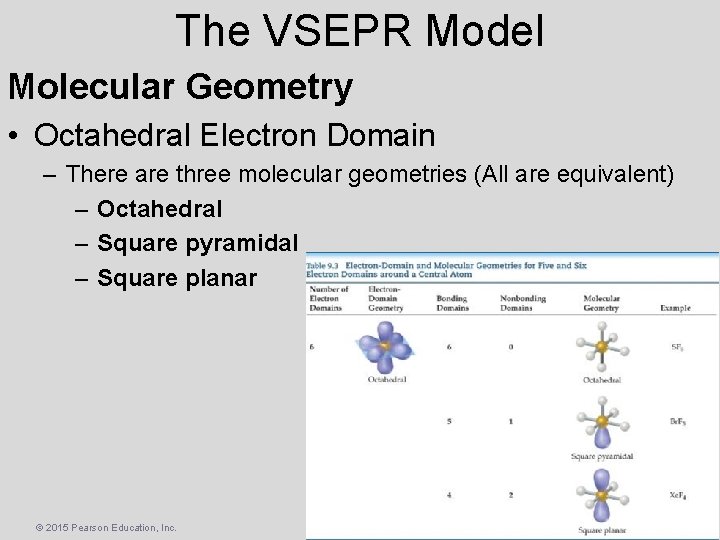
The VSEPR Model Molecular Geometry • Octahedral Electron Domain – There are three molecular geometries (All are equivalent) – Octahedral – Square pyramidal – Square planar © 2015 Pearson Education, Inc.
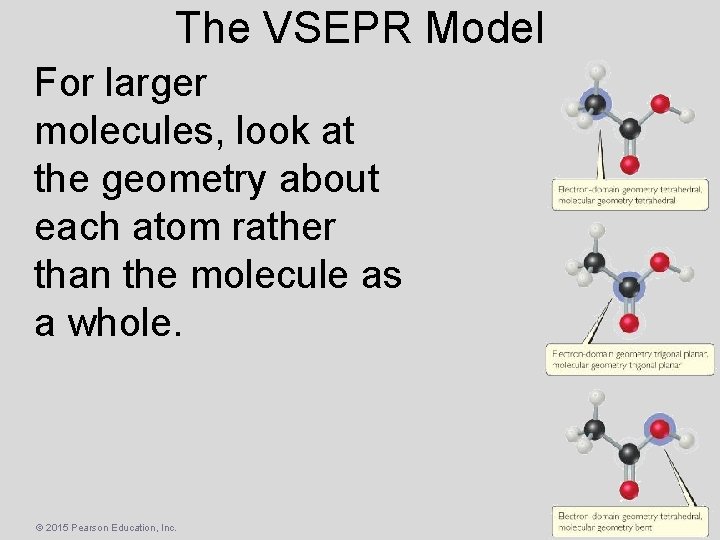
The VSEPR Model For larger molecules, look at the geometry about each atom rather than the molecule as a whole. © 2015 Pearson Education, Inc.
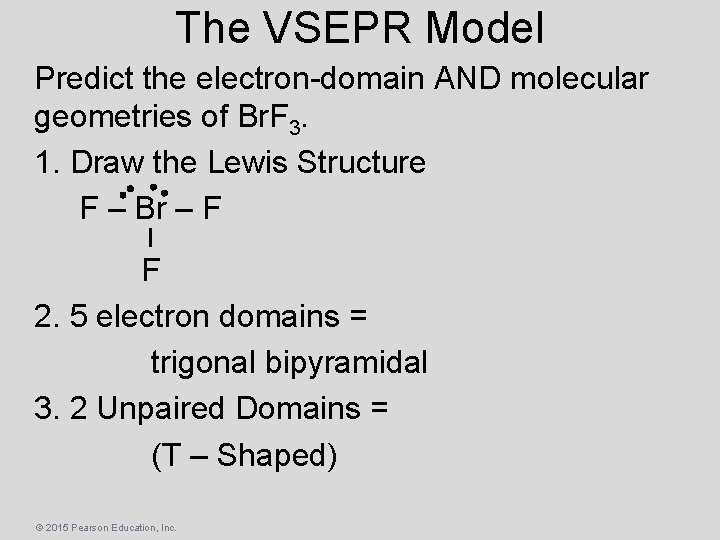
The VSEPR Model Predict the electron-domain AND molecular geometries of Br. F 3. 1. Draw the Lewis Structure F – Br – F F 2. 5 electron domains = trigonal bipyramidal 3. 2 Unpaired Domains = (T – Shaped) © 2015 Pearson Education, Inc.
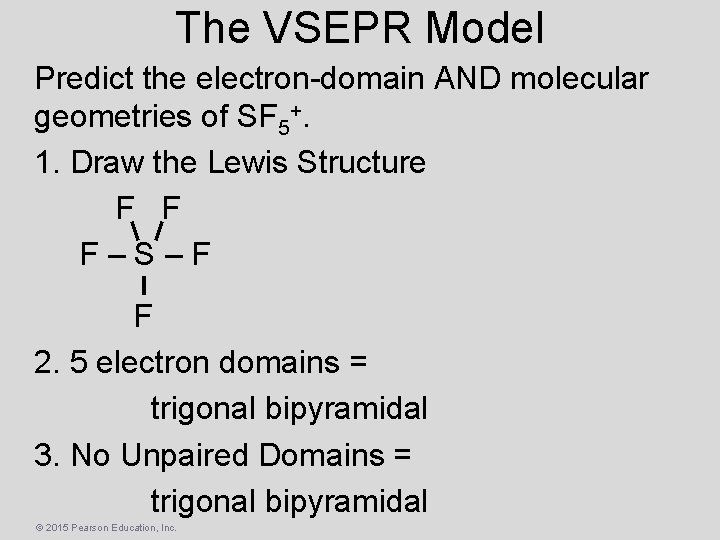
The VSEPR Model Predict the electron-domain AND molecular geometries of SF 5+. 1. Draw the Lewis Structure F F F–S–F F 2. 5 electron domains = trigonal bipyramidal 3. No Unpaired Domains = trigonal bipyramidal © 2015 Pearson Education, Inc.
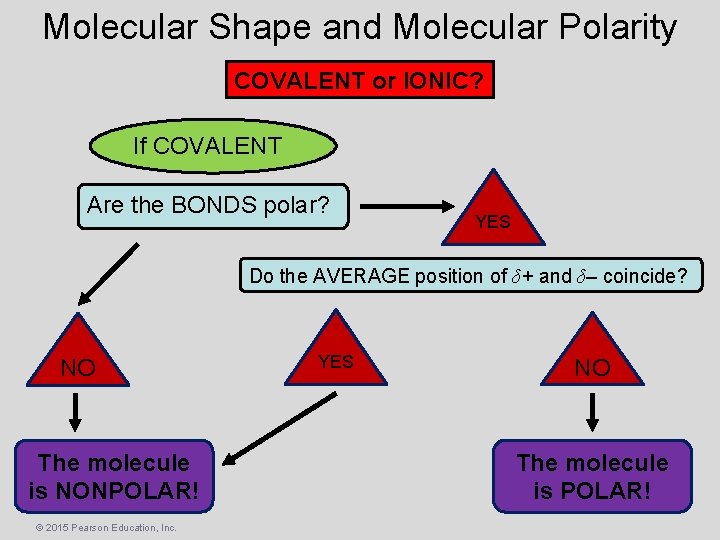
Molecular Shape and Molecular Polarity COVALENT or IONIC? If COVALENT Are the BONDS polar? YES Do the AVERAGE position of δ+ and δ– coincide? NO The molecule is NONPOLAR! © 2015 Pearson Education, Inc. YES NO The molecule is POLAR!
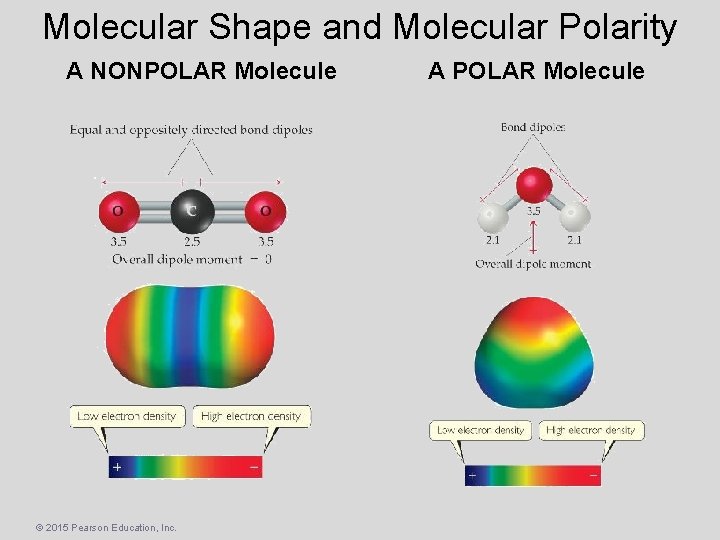
Molecular Shape and Molecular Polarity A NONPOLAR Molecule © 2015 Pearson Education, Inc. A POLAR Molecule
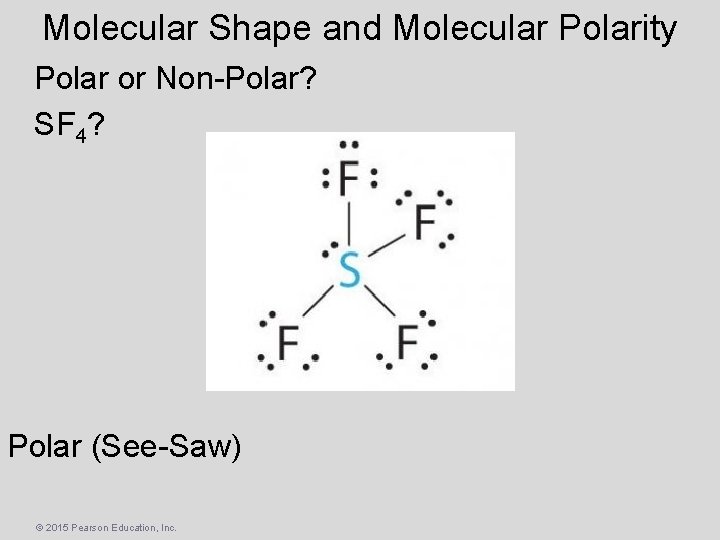
Molecular Shape and Molecular Polarity Polar or Non-Polar? SF 4? Polar (See-Saw) © 2015 Pearson Education, Inc.
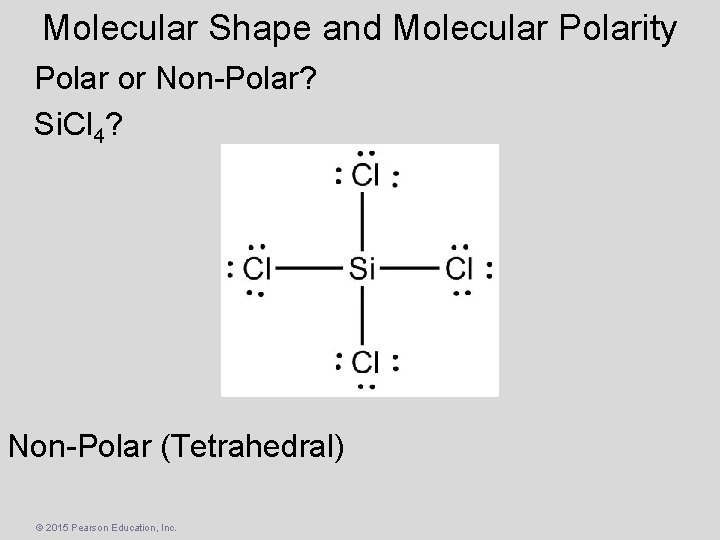
Molecular Shape and Molecular Polarity Polar or Non-Polar? Si. Cl 4? Non-Polar (Tetrahedral) © 2015 Pearson Education, Inc.
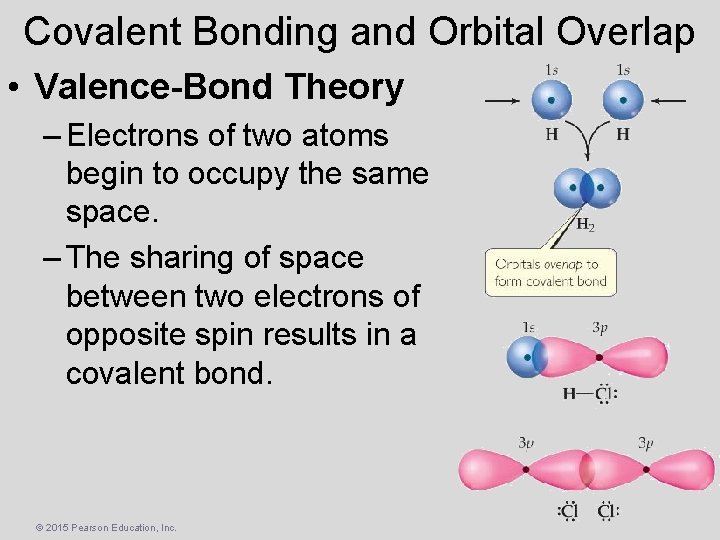
Covalent Bonding and Orbital Overlap • Valence-Bond Theory – Electrons of two atoms begin to occupy the same space. – The sharing of space between two electrons of opposite spin results in a covalent bond. © 2015 Pearson Education, Inc.
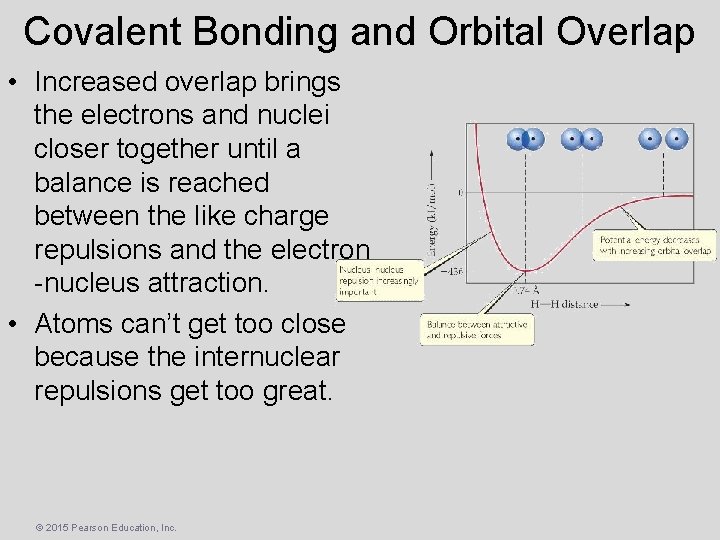
Covalent Bonding and Orbital Overlap • Increased overlap brings the electrons and nuclei closer together until a balance is reached between the like charge repulsions and the electron -nucleus attraction. • Atoms can’t get too close because the internuclear repulsions get too great. © 2015 Pearson Education, Inc.
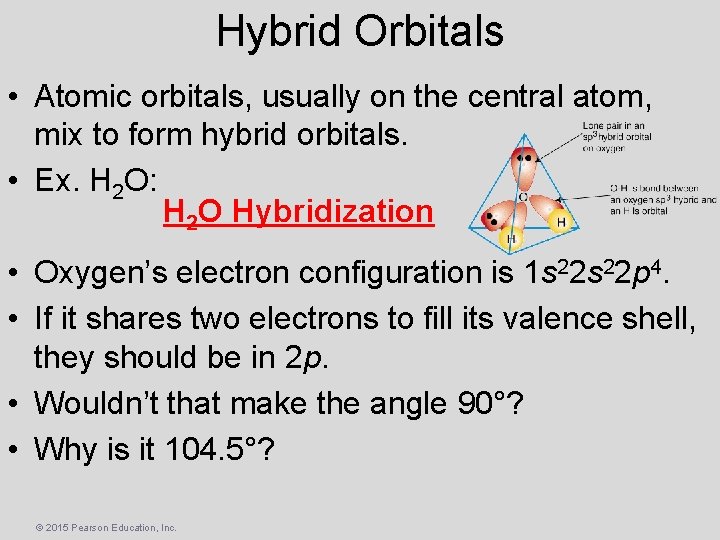
Hybrid Orbitals • Atomic orbitals, usually on the central atom, mix to form hybrid orbitals. • Ex. H 2 O: H 2 O Hybridization • Oxygen’s electron configuration is 1 s 22 p 4. • If it shares two electrons to fill its valence shell, they should be in 2 p. • Wouldn’t that make the angle 90°? • Why is it 104. 5°? © 2015 Pearson Education, Inc.
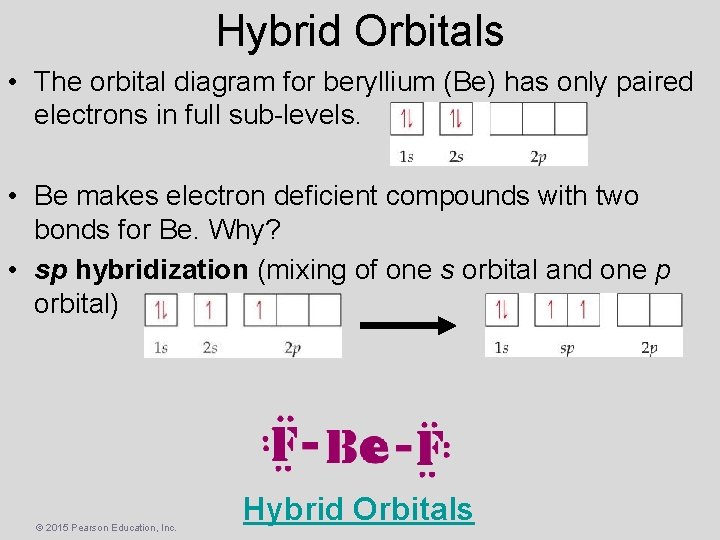
Hybrid Orbitals • The orbital diagram for beryllium (Be) has only paired electrons in full sub-levels. • Be makes electron deficient compounds with two bonds for Be. Why? • sp hybridization (mixing of one s orbital and one p orbital) © 2015 Pearson Education, Inc. Hybrid Orbitals
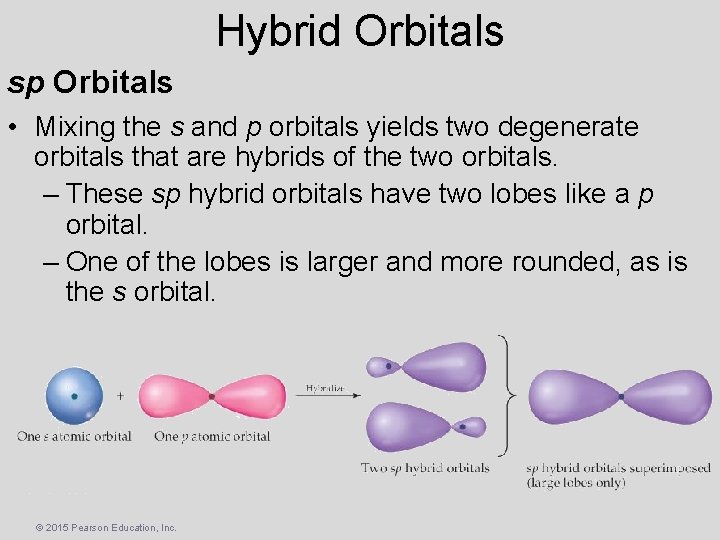
Hybrid Orbitals sp Orbitals • Mixing the s and p orbitals yields two degenerate orbitals that are hybrids of the two orbitals. – These sp hybrid orbitals have two lobes like a p orbital. – One of the lobes is larger and more rounded, as is the s orbital. © 2015 Pearson Education, Inc.
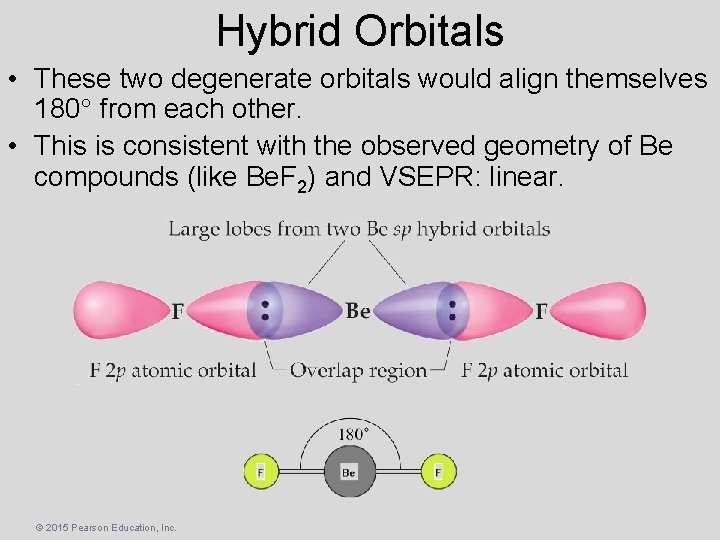
Hybrid Orbitals • These two degenerate orbitals would align themselves 180 from each other. • This is consistent with the observed geometry of Be compounds (like Be. F 2) and VSEPR: linear. © 2015 Pearson Education, Inc.
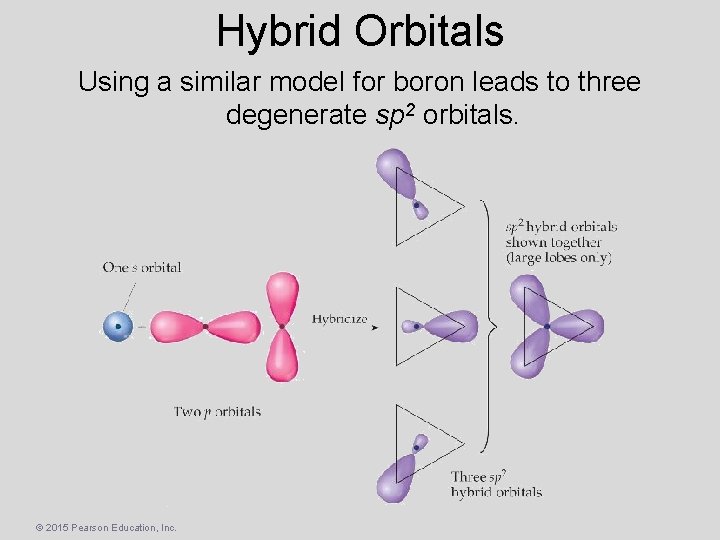
Hybrid Orbitals Using a similar model for boron leads to three degenerate sp 2 orbitals. © 2015 Pearson Education, Inc.
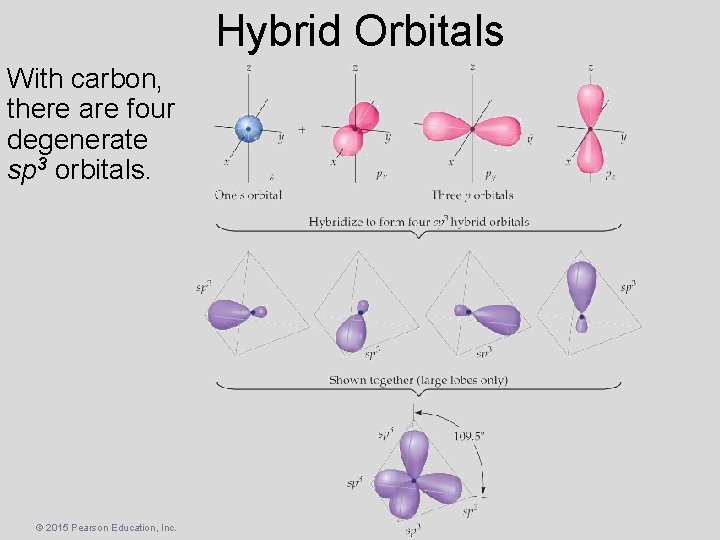
Hybrid Orbitals With carbon, there are four degenerate sp 3 orbitals. © 2015 Pearson Education, Inc.
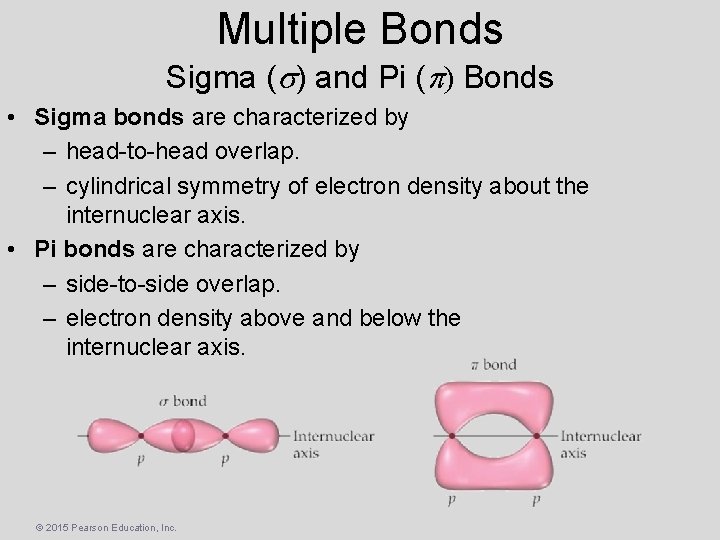
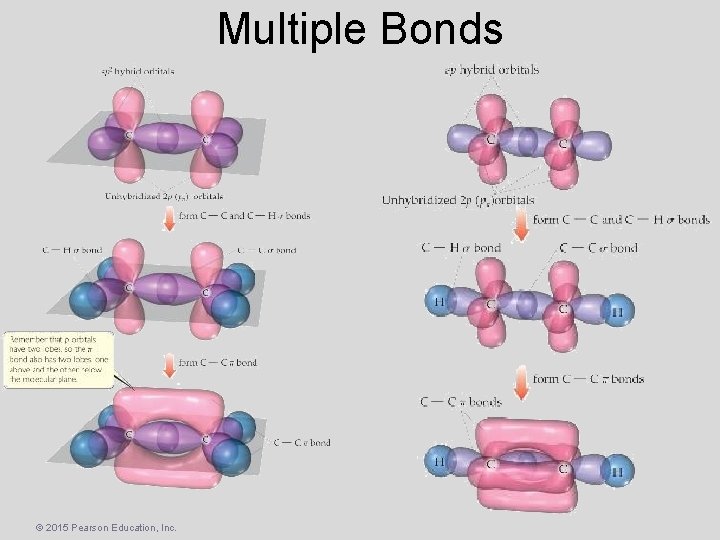
Multiple Bonds Sigma ( ) and Pi ( ) Bonds • Sigma bonds are characterized by – head-to-head overlap. – cylindrical symmetry of electron density about the internuclear axis. • Pi bonds are characterized by – side-to-side overlap. – electron density above and below the internuclear axis. © 2015 Pearson Education, Inc.
Multiple Bonds • Single bonds are always s-bonds. • Multiple bonds have one s-bond, all other bonds are p-bonds. © 2015 Pearson Education, Inc.
Multiple Bonds © 2015 Pearson Education, Inc.
Resonance Structures, Delocalization, and p Bonding • Bonding electrons (s or p) that are specifically shared between two atoms are called localized electrons. • In many molecules the other electrons (shared) are called delocalized electrons. – (Doesn’t describe all electrons that way ex. resonance) © 2015 Pearson Education, Inc.
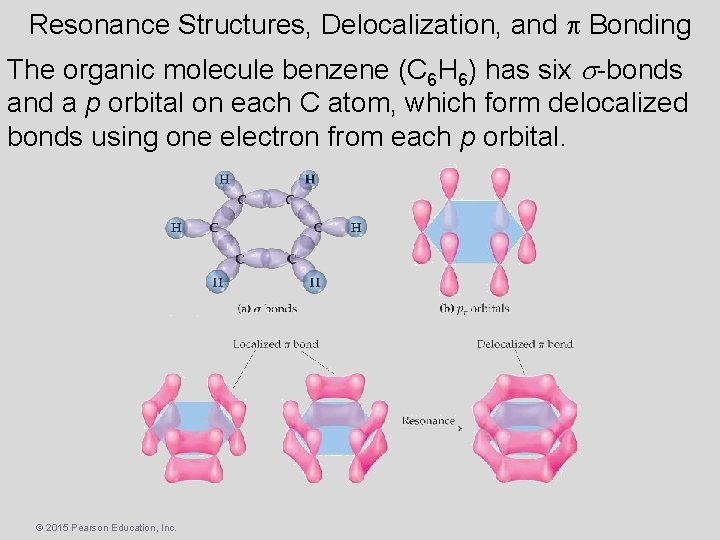
Resonance Structures, Delocalization, and p Bonding The organic molecule benzene (C 6 H 6) has six -bonds and a p orbital on each C atom, which form delocalized bonds using one electron from each p orbital. © 2015 Pearson Education, Inc.
Molecular Orbitals • Wave properties are used to describe the energy of the electrons in a molecule. • Molecular orbitals have many characteristics like atomic orbitals: – maximum of two electrons per orbital – Electrons in the same orbital have opposite spin. – Definite energy of orbital – Can visualize electron density by a contour diagram © 2015 Pearson Education, Inc.
Molecular Orbitals • Differ from atomic orbitals because they represent the entire molecule, not a single atom. • Whenever two atomic orbitals overlap, two molecular orbitals are formed: one bonding, one antibonding. • Bonding orbitals are constructive combinations of atomic orbitals. • Antibonding orbitals are destructive combinations of atomic orbitals. – A nodal plane occurs where electron density equals zero. © 2015 Pearson Education, Inc.
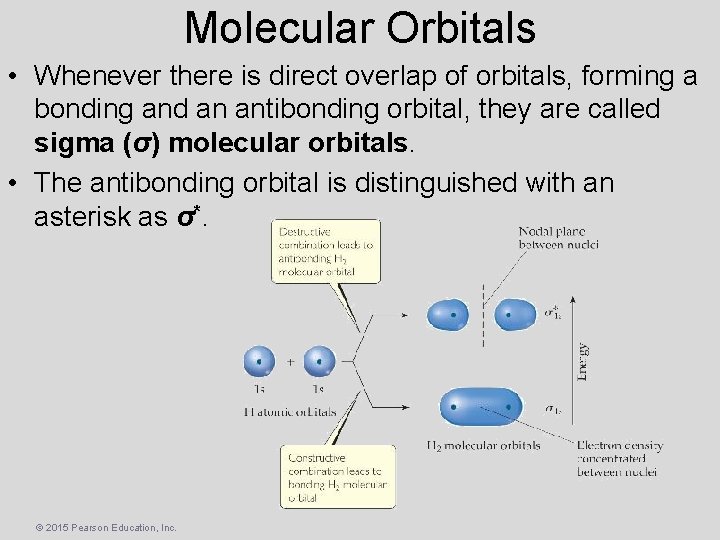
Molecular Orbitals • Whenever there is direct overlap of orbitals, forming a bonding and an antibonding orbital, they are called sigma (σ) molecular orbitals. • The antibonding orbital is distinguished with an asterisk as σ*. © 2015 Pearson Education, Inc.
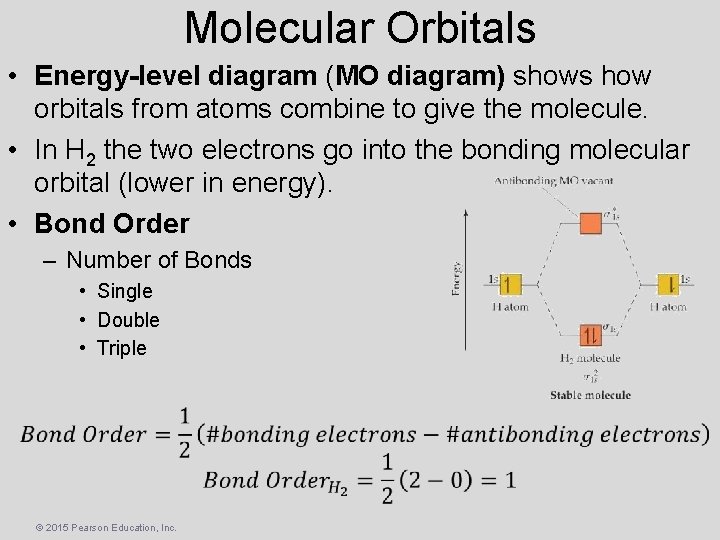
Molecular Orbitals • Energy-level diagram (MO diagram) shows how orbitals from atoms combine to give the molecule. • In H 2 the two electrons go into the bonding molecular orbital (lower in energy). • Bond Order – Number of Bonds • Single • Double • Triple © 2015 Pearson Education, Inc.
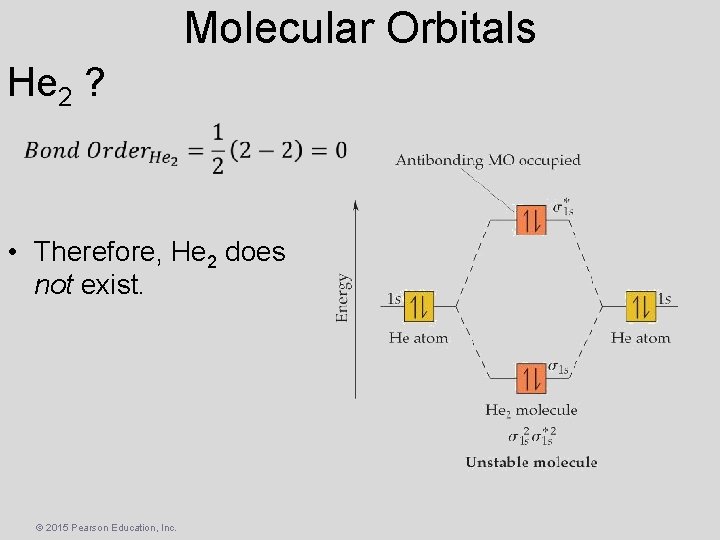
Molecular Orbitals He 2 ? • Therefore, He 2 does not exist. © 2015 Pearson Education, Inc.
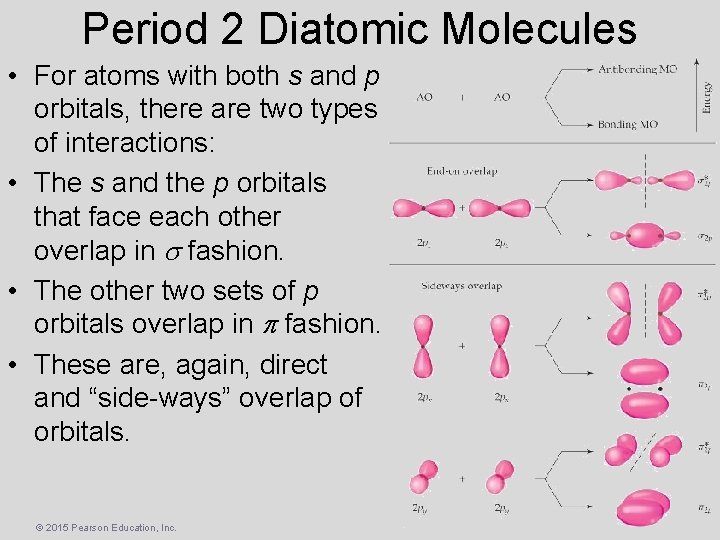
Period 2 Diatomic Molecules • For atoms with both s and p orbitals, there are two types of interactions: • The s and the p orbitals that face each other overlap in fashion. • The other two sets of p orbitals overlap in fashion. • These are, again, direct and “side-ways” overlap of orbitals. © 2015 Pearson Education, Inc.
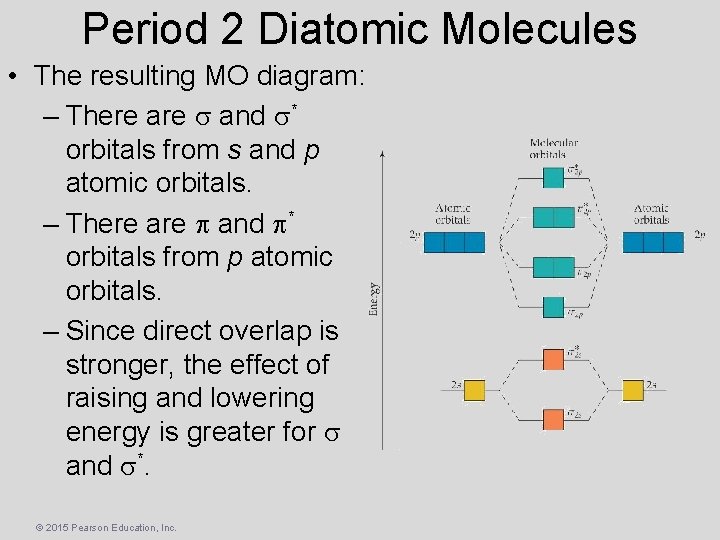
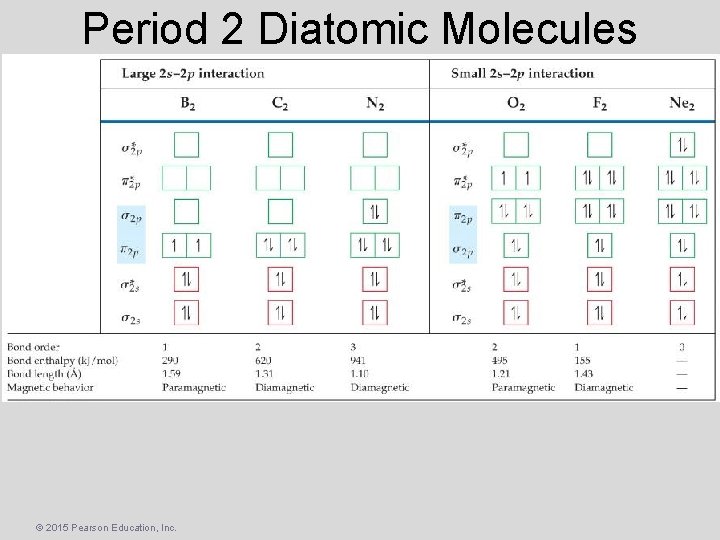
Period 2 Diatomic Molecules • The resulting MO diagram: – There are s and s* orbitals from s and p atomic orbitals. – There are p and p* orbitals from p atomic orbitals. – Since direct overlap is stronger, the effect of raising and lowering energy is greater for s and s*. © 2015 Pearson Education, Inc.
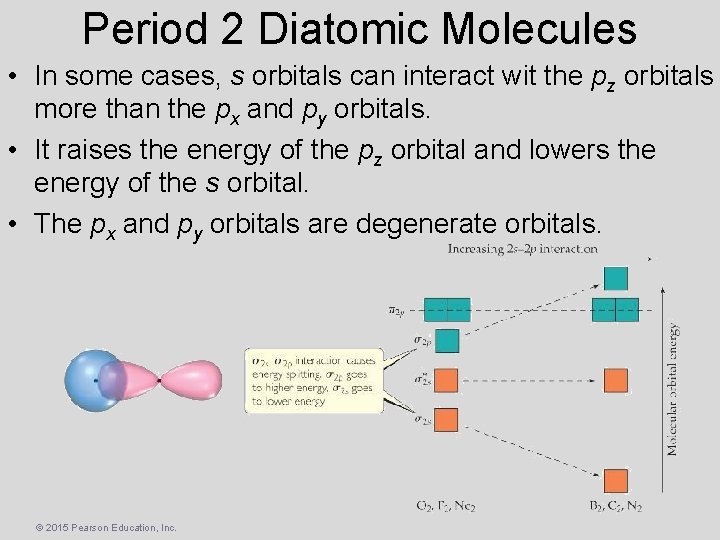
Period 2 Diatomic Molecules • In some cases, s orbitals can interact wit the pz orbitals more than the px and py orbitals. • It raises the energy of the pz orbital and lowers the energy of the s orbital. • The px and py orbitals are degenerate orbitals. © 2015 Pearson Education, Inc.
Period 2 Diatomic Molecules © 2015 Pearson Education, Inc.
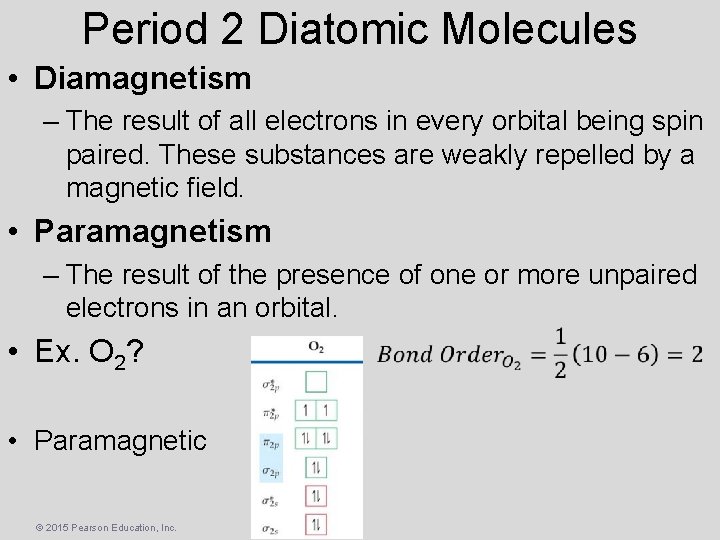
Period 2 Diatomic Molecules • Diamagnetism – The result of all electrons in every orbital being spin paired. These substances are weakly repelled by a magnetic field. • Paramagnetism – The result of the presence of one or more unpaired electrons in an orbital. • Ex. O 2? • Paramagnetic © 2015 Pearson Education, Inc.
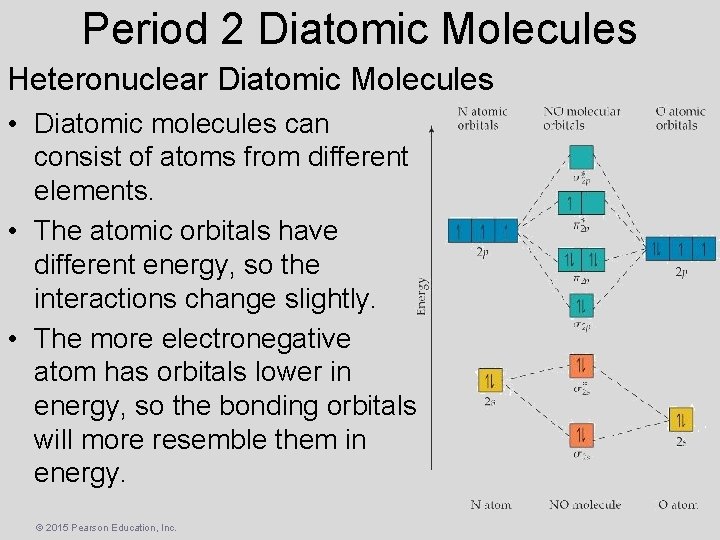
Period 2 Diatomic Molecules Heteronuclear Diatomic Molecules • Diatomic molecules can consist of atoms from different elements. • The atomic orbitals have different energy, so the interactions change slightly. • The more electronegative atom has orbitals lower in energy, so the bonding orbitals will more resemble them in energy. © 2015 Pearson Education, Inc.
- Slides: 48