
Chapter 9 Module 9 A Information Systems MIS
- Slides: 40
Chapter 9
Module 9 A Information Systems & MIS Module 9 B Systems Analysis & Design Module 9 C Program Development Chapter 9
Information Systems & MIS Module A 9 Computerized Information Systems l Understanding Complex Organizations l Chain of Command l Information: The Good Kind and the l Other Kind l Information Systems in Organizations
Information Systems & MIS Computerized Information Systems (CIS): Serving an Organizations Needs Module A 9 An information system processes data to produce information A system is a collection of components purposefully organized into a functioning whole to accomplish a goal An artificial system is deliberately constructed by people to serve some purpose
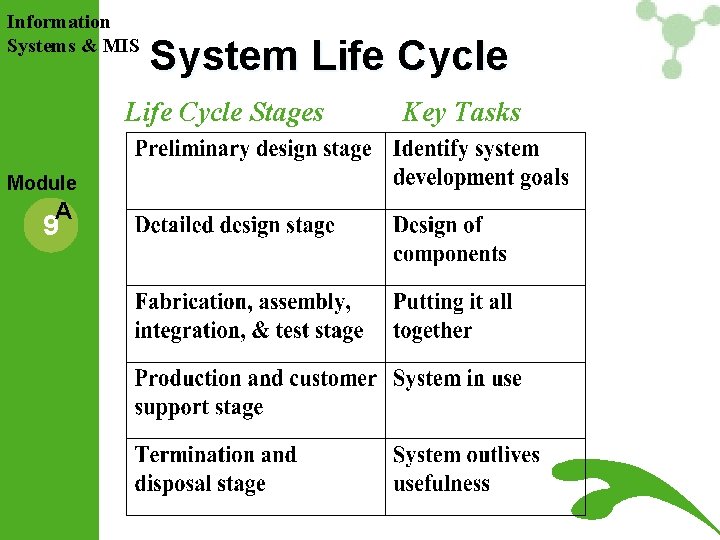
Information Systems & MIS System Life Cycle Stages Module A 9 Key Tasks
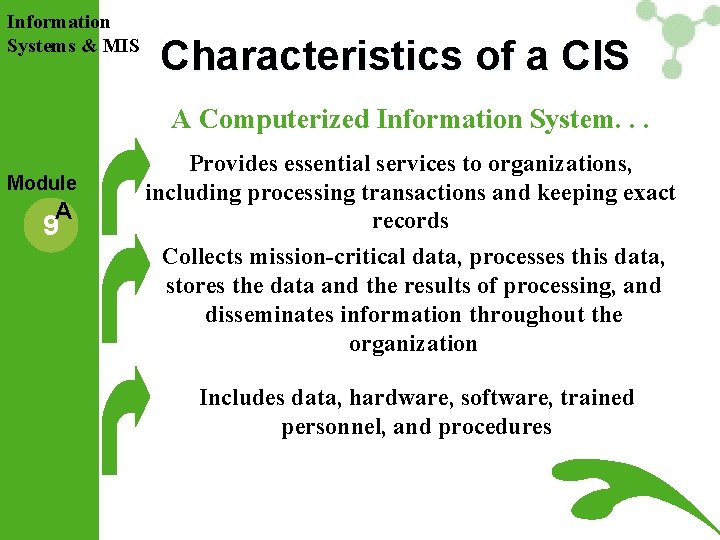
Information Systems & MIS Characteristics of a CIS A Computerized Information System. . . Module A 9 Provides essential services to organizations, including processing transactions and keeping exact records Collects mission-critical data, processes this data, stores the data and the results of processing, and disseminates information throughout the organization Includes data, hardware, software, trained personnel, and procedures
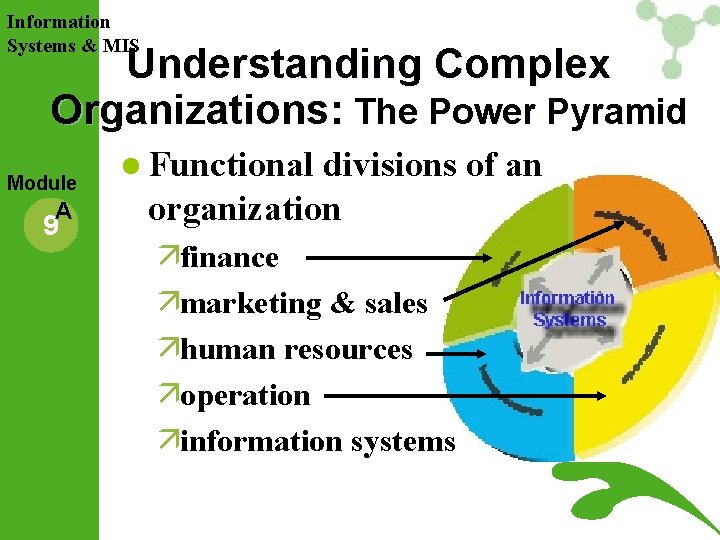
Information Systems & MIS Understanding Complex Organizations: The Power Pyramid Module A 9 l Functional divisions of an organization äfinance ämarketing & sales ähuman resources äoperation äinformation systems
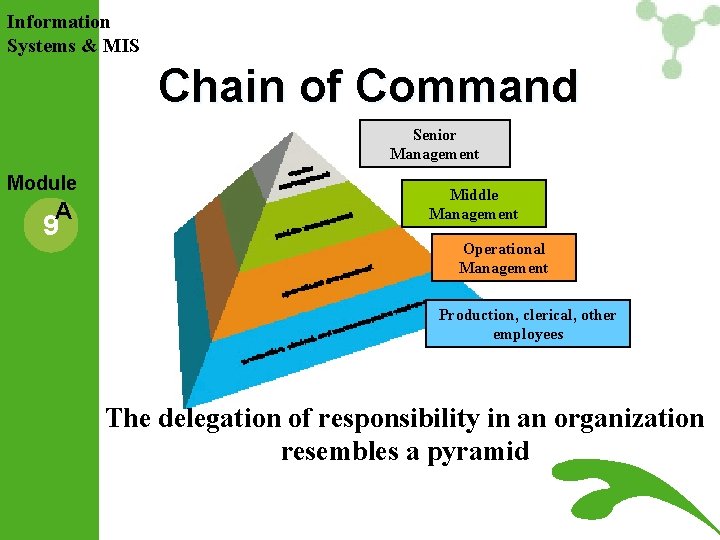
Information Systems & MIS Chain of Command Senior Management Module A 9 Middle Management Operational Management Production, clerical, other employees The delegation of responsibility in an organization resembles a pyramid
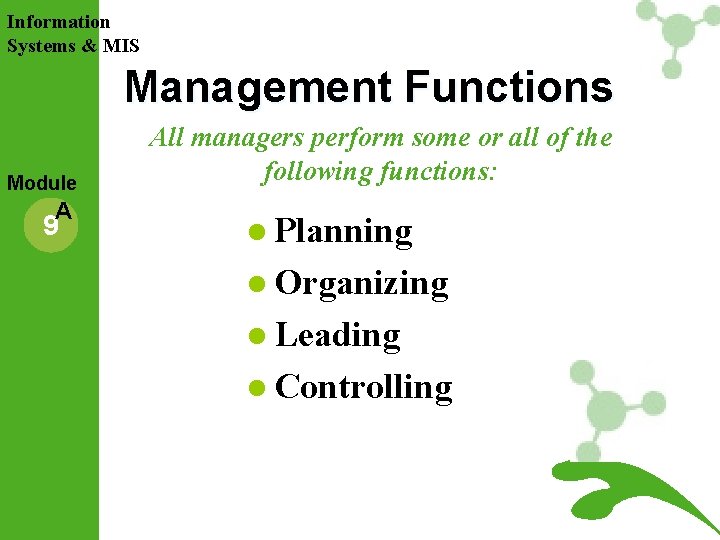
Information Systems & MIS Management Functions Module A 9 All managers perform some or all of the following functions: l Planning l Organizing l Leading l Controlling
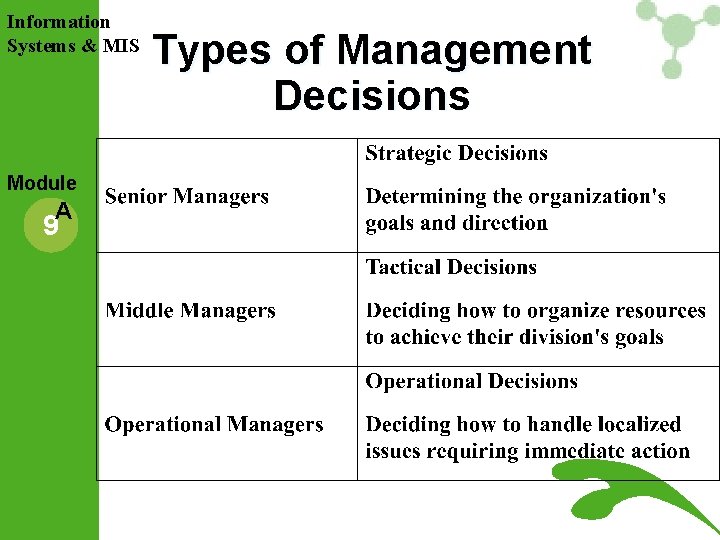
Information Systems & MIS Module A 9 Types of Management Decisions
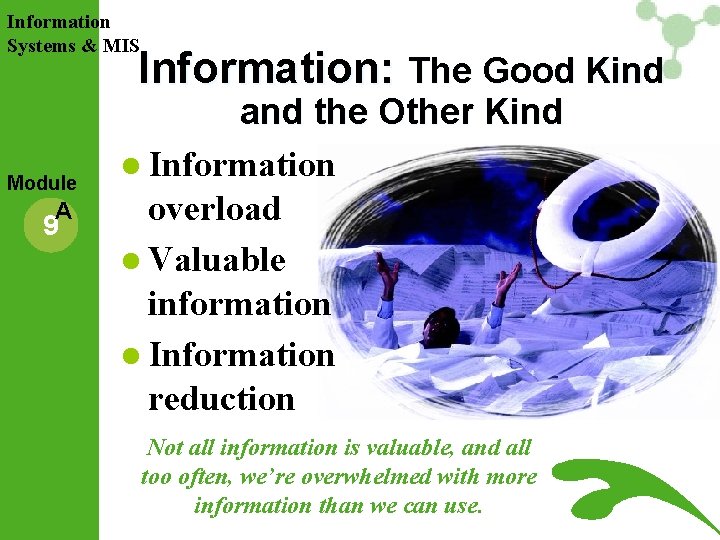
Information Systems & MIS Information: The Good Kind Module A 9 and the Other Kind l Information overload l Valuable information l Information reduction Not all information is valuable, and all too often, we’re overwhelmed with more information than we can use.
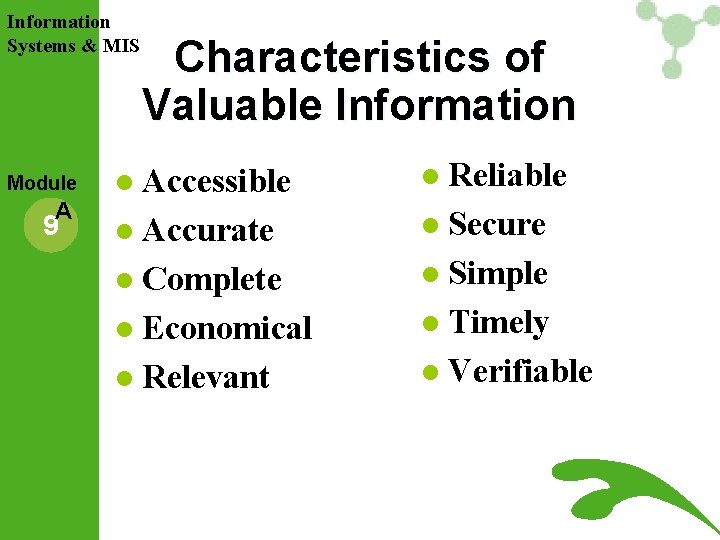
Information Systems & MIS Module A 9 Characteristics of Valuable Information l Accessible l Reliable l Accurate l Secure l Complete l Simple l Economical l Timely l Relevant l Verifiable
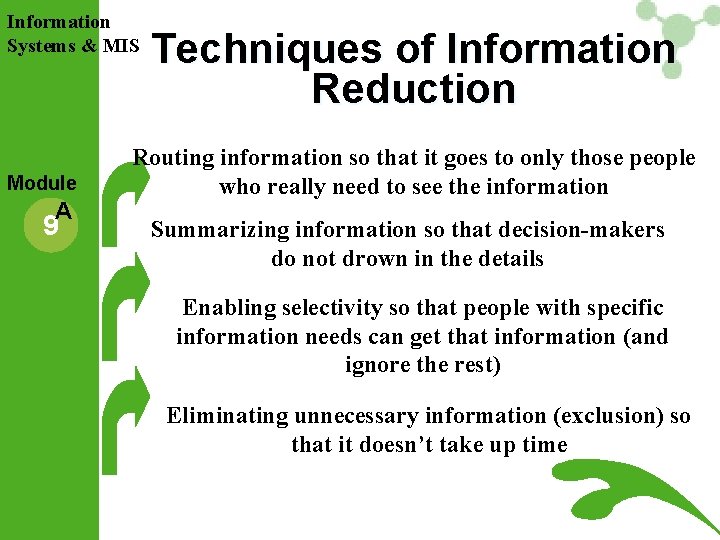
Information Systems & MIS Module A 9 Techniques of Information Reduction Routing information so that it goes to only those people who really need to see the information Summarizing information so that decision-makers do not drown in the details Enabling selectivity so that people with specific information needs can get that information (and ignore the rest) Eliminating unnecessary information (exclusion) so that it doesn’t take up time
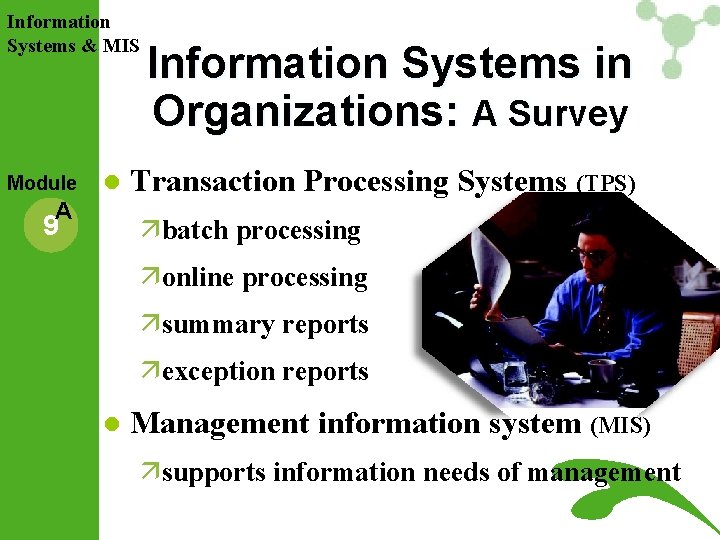
Information Systems & MIS Module l A 9 Information Systems in Organizations: A Survey Transaction Processing Systems (TPS) äbatch processing äonline processing äsummary reports äexception reports l Management information system (MIS) äsupports information needs of management
Information Systems & MIS Information Systems Decision support system (DSS) l Online analytical processing (OLAP) l Executive information system (EIS) l Module A 9 ä Also know as executive support system (ESS) Expert system l Knowledge management system l
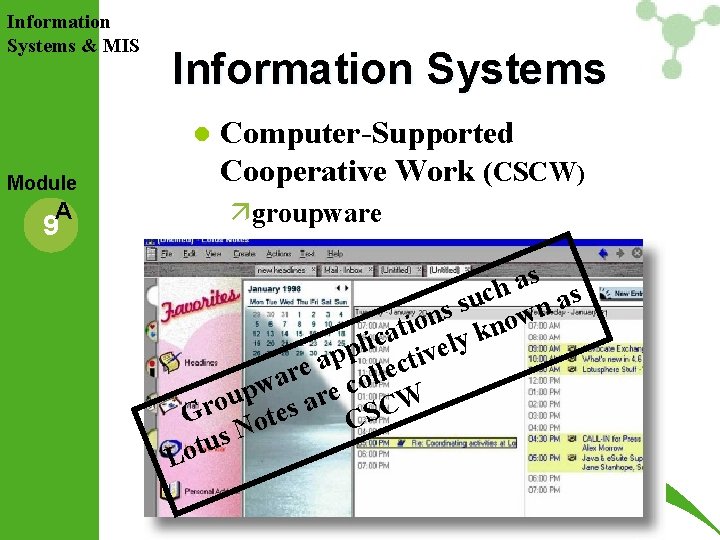
Information Systems & MIS Information Systems l Module A 9 Computer-Supported Cooperative Work (CSCW) ägroupware s a h c u as s n s w n o o i n t k a c i y l l e p v p i t a c e e l r l a o c w p e r u W a o r C s e S G C ot N s u t Lo
Information Systems & MIS Information Systems Workflow automation l Business process reengineering (BPR) l Module A äalso know as reengineering äcross-functional team 9 l Data warehousing & data mining To learn more about workflow management, visit the Workflow Management Coalition’s home page For more information on data warehousing, see the Data Warehousing Institute’s home page
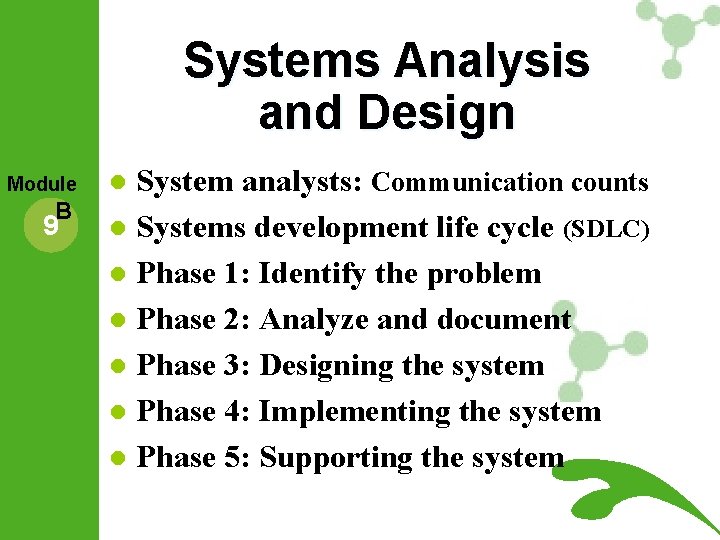
Systems Analysis and Design Module B 9 System analysts: Communication counts l Systems development life cycle (SDLC) l Phase 1: Identify the problem l Phase 2: Analyze and document l Phase 3: Designing the system l Phase 4: Implementing the system l Phase 5: Supporting the system l
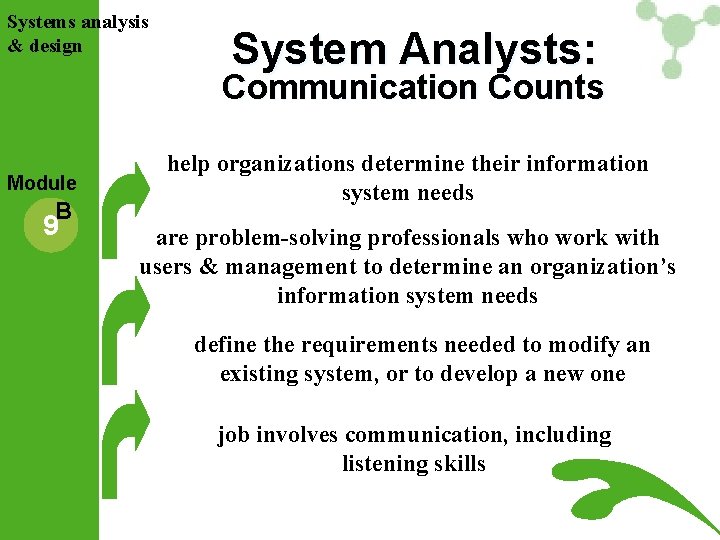
Systems analysis & design System Analysts: Communication Counts Module B 9 help organizations determine their information system needs are problem-solving professionals who work with users & management to determine an organization’s information system needs define the requirements needed to modify an existing system, or to develop a new one job involves communication, including listening skills
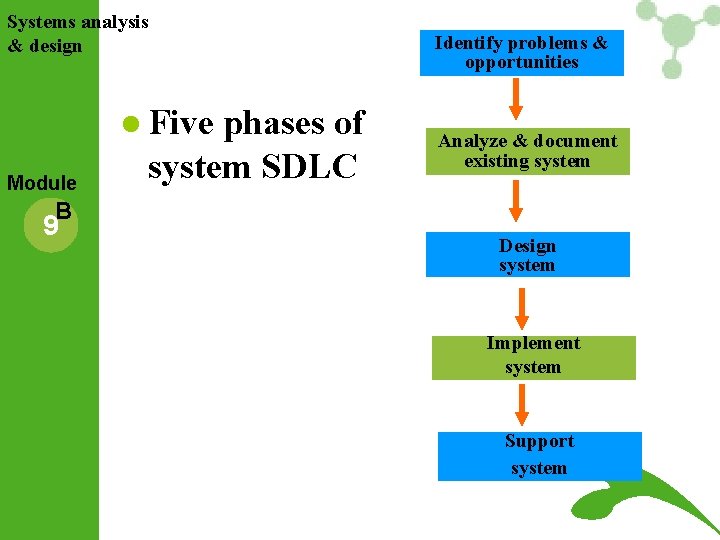
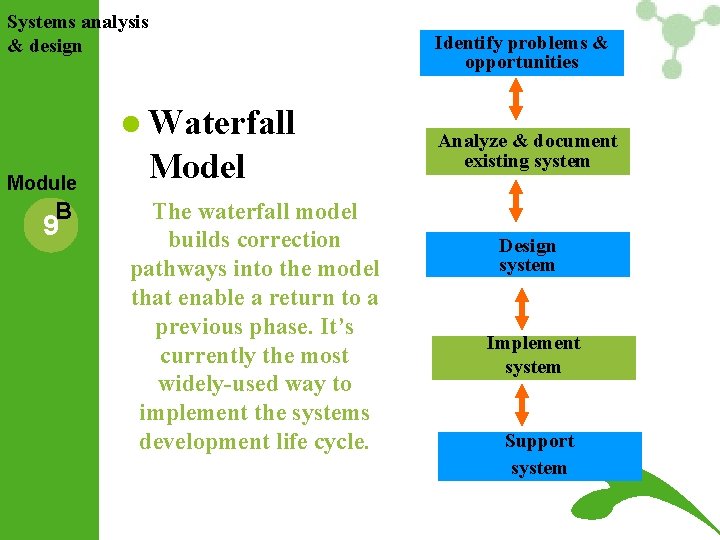
Systems analysis & design l Five Module phases of system SDLC Identify problems & opportunities Analyze & document existing system B 9 Design system Implement system Support system
Systems analysis & design User involvement is crucial l A problem-solving approach works best l Good project management skills are needed l Documentation is required l Use checkpoints to make sure the project’s on track l Design for growth and change l Module B 9 Avoiding Mistakes
Systems analysis & design l Waterfall Module B 9 Model The waterfall model builds correction pathways into the model that enable a return to a previous phase. It’s currently the most widely-used way to implement the systems development life cycle. Identify problems & opportunities Analyze & document existing system Design system Implement system Support system
Systems analysis & design Phase 1: Identifying the Problem & Opportunities Recognize the need for the system l Define the problem l Identify opportunities l Develop a plan l Determine feasibility l Module B 9 ätechnical, operational, economical ätangible, intangible benefits äreturn on investment (ROI) l Prepare the project proposal
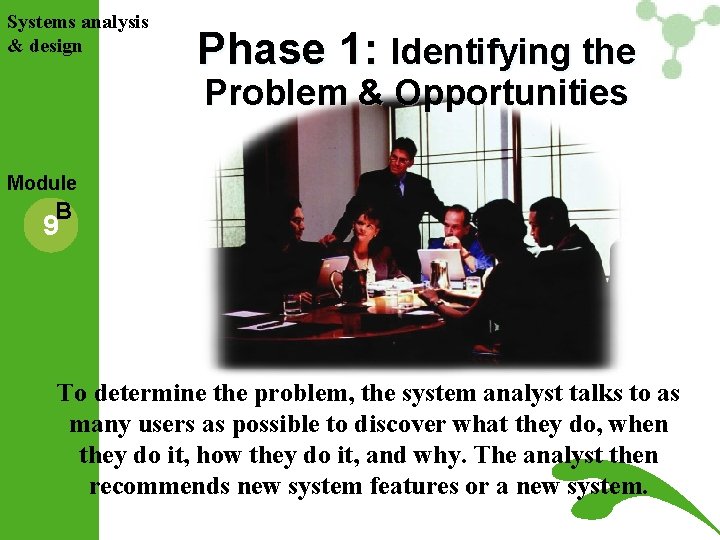
Systems analysis & design Phase 1: Identifying the Problem & Opportunities Module B 9 To determine the problem, the system analyst talks to as many users as possible to discover what they do, when they do it, how they do it, and why. The analyst then recommends new system features or a new system.
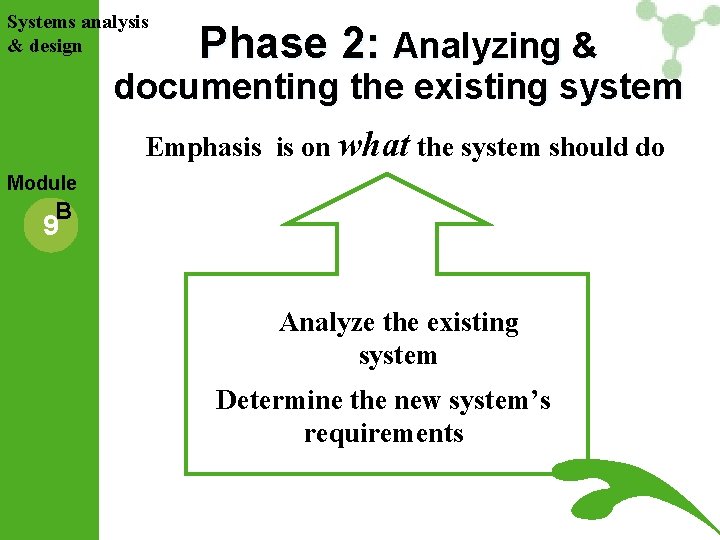
Systems analysis & design Phase 2: Analyzing & documenting the existing system Emphasis is on what the system should do Module B 9 Analyze the existing system Determine the new system’s requirements
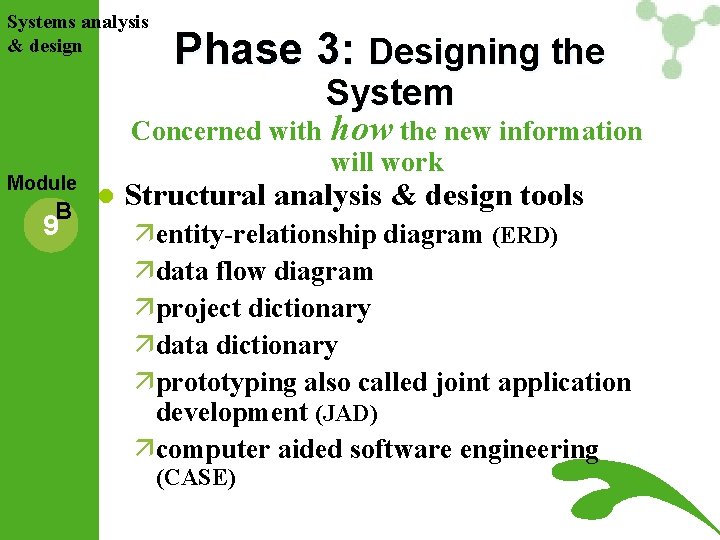
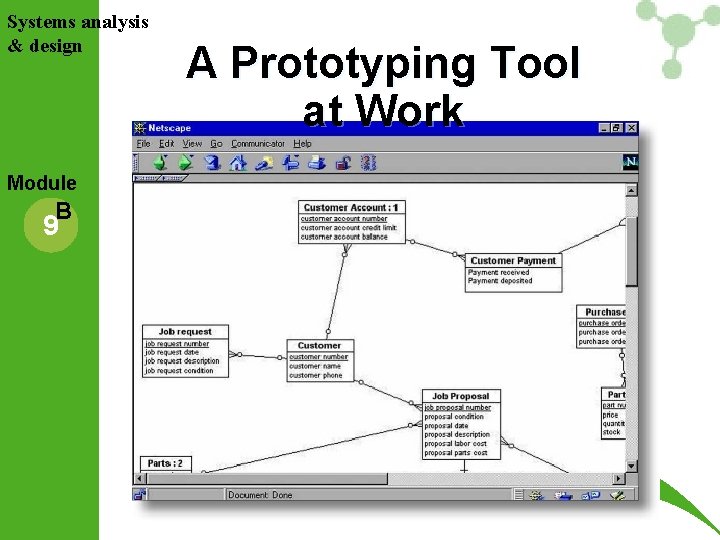
Systems analysis & design Phase 3: Designing the System Concerned with how the new information Module B 9 will work l Structural analysis & design tools äentity-relationship diagram (ERD) ädata flow diagram äproject dictionary ädata dictionary äprototyping also called joint application development (JAD) äcomputer aided software engineering (CASE)
Systems analysis & design Module B 9 A Prototyping Tool at Work
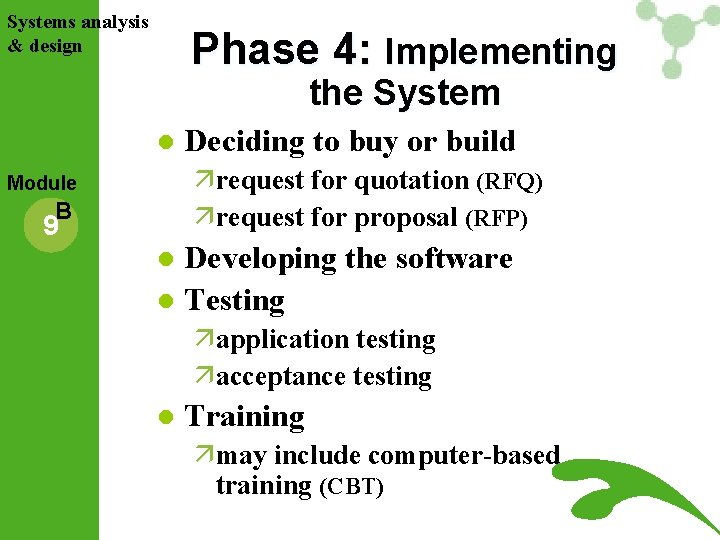
Systems analysis & design Phase 4: Implementing the System l ärequest for quotation (RFQ) ärequest for proposal (RFP) Module B 9 Deciding to buy or build Developing the software l Testing l äapplication testing äacceptance testing l Training ämay include computer-based training (CBT)
Systems analysis & design Phase 4: Implementing the System Module B 9 l Converting the system äparallel conversion äpilot conversion äphased conversion ädirect conversion
Systems analysis & design Phase 5: Supporting the System Module B 9 In the final phase, the new system receives ongoing assistance to ensure that it has met its intended needs and works correctly A post-implementation system review determines whether the system has met its goals
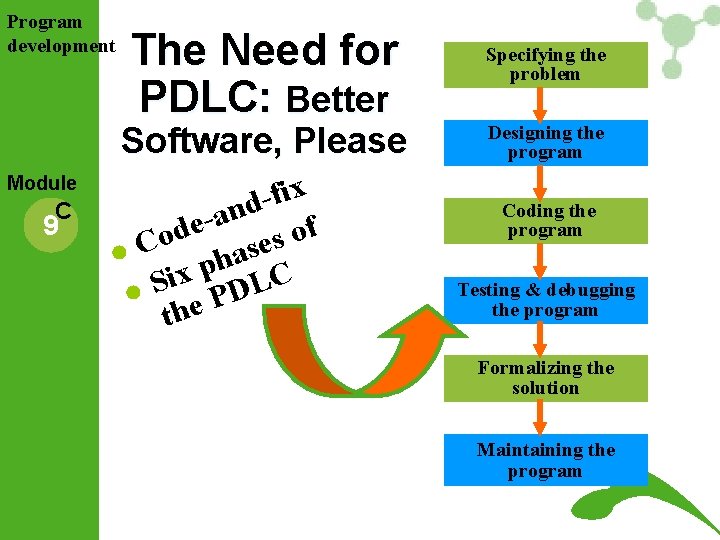
Program Development The Need for PDLC l Phase 1: Defining the problem l Phase 2: Designing the program l Phase 3: Coding the program l Phase 4: Testing & debugging l Phase 5: Formalizing the solution l Phase 6: Implementing & maintaining the program l Module C 9
Program development Program Development Module C 9 The program development life cycle (PDLC) is an organized method of software development that bears many similarities to the system development life cycle (SDLC)
Program development The Need for PDLC: Better Software, Please Module C 9 x i f d n a e f d o o s e s l. C a h p x C i S L D l P the Specifying the problem Designing the program Coding the program Testing & debugging the program Formalizing the solution Maintaining the program
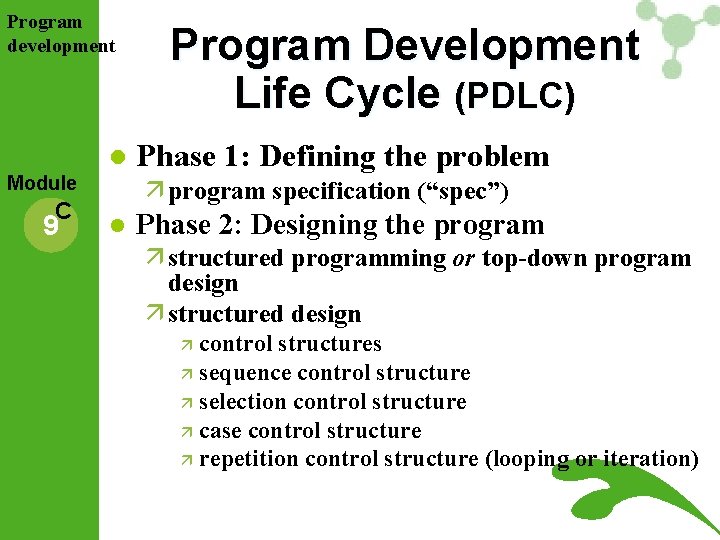
Program development l Module C 9 Program Development Life Cycle (PDLC) Phase 1: Defining the problem ä program specification (“spec”) l Phase 2: Designing the program ä structured programming or top-down program design ä structured design control structures ä sequence control structure ä selection control structure ä case control structure ä repetition control structure (looping or iteration) ä
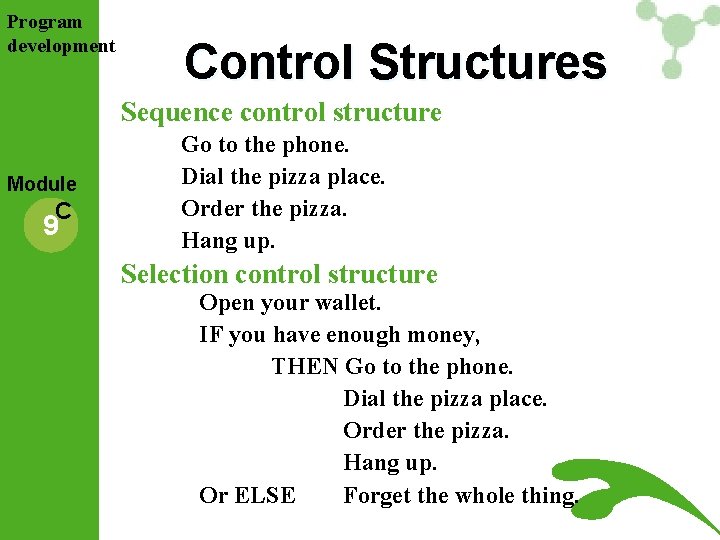
Program development Control Structures Sequence control structure Module C 9 Go to the phone. Dial the pizza place. Order the pizza. Hang up. Selection control structure Open your wallet. IF you have enough money, THEN Go to the phone. Dial the pizza place. Order the pizza. Hang up. Or ELSE Forget the whole thing.
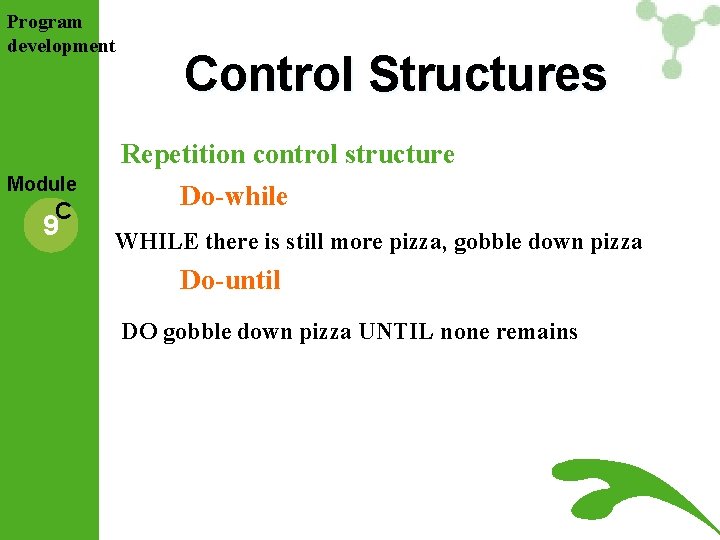
Program development Module C 9 Control Structures Repetition control structure Do-while WHILE there is still more pizza, gobble down pizza Do-until DO gobble down pizza UNTIL none remains
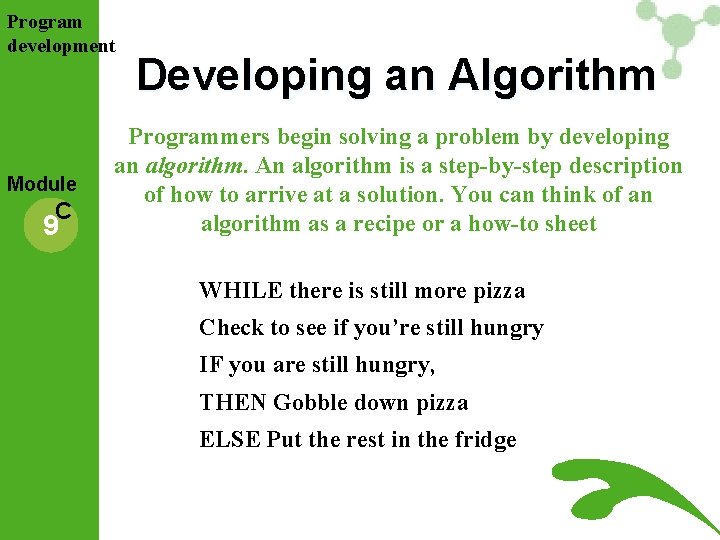
Program development Module C 9 Developing an Algorithm Programmers begin solving a problem by developing an algorithm. An algorithm is a step-by-step description of how to arrive at a solution. You can think of an algorithm as a recipe or a how-to sheet WHILE there is still more pizza Check to see if you’re still hungry IF you are still hungry, THEN Gobble down pizza ELSE Put the rest in the fridge
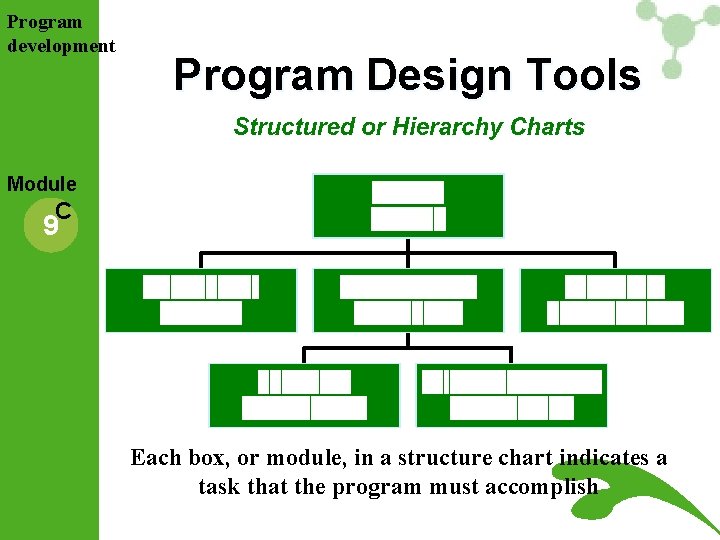
Program development Program Design Tools Module C 9 Each box, or module, in a structure chart indicates a task that the program must accomplish
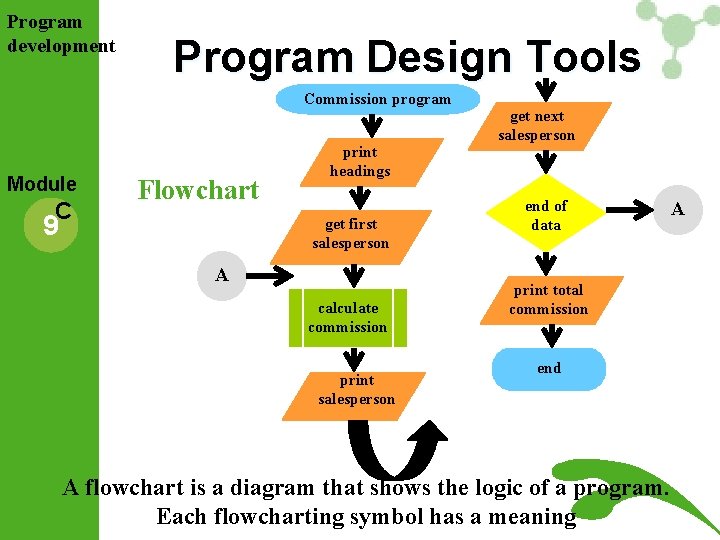
Program development Program Design Tools Commission program Module C Flowchart 9 print headings get first salesperson A calculate commission print salesperson get next salesperson end of data print total commission end A flowchart is a diagram that shows the logic of a program. Each flowcharting symbol has a meaning A
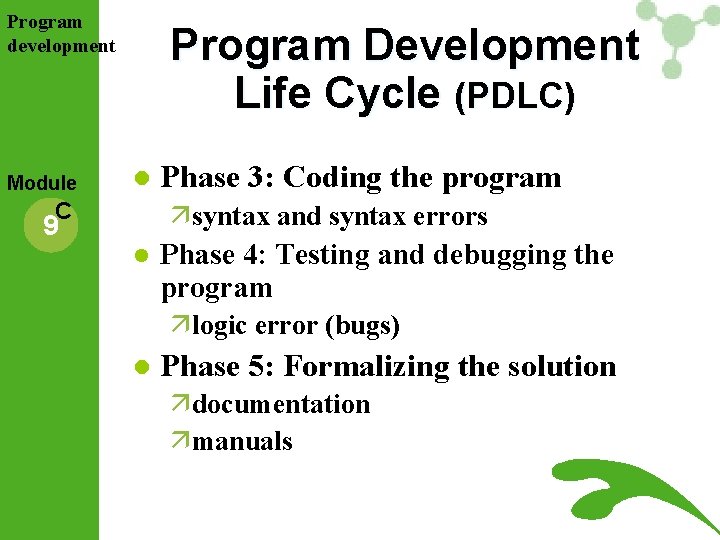
Program development Module Program Development Life Cycle (PDLC) l C Phase 3: Coding the program äsyntax and syntax errors 9 l Phase 4: Testing and debugging the program älogic error (bugs) l Phase 5: Formalizing the solution ädocumentation ämanuals