
Chapter 9 Memory The Phenomenon Memory In psychology

- Slides: 52
Chapter 9: Memory
The Phenomenon Memory • In psychology memory is the ability to store, retain and recall information. • Memory is studied so that researchers understand how memory works; including memory loss, storing memory
Side Note • Have you ever noticed how you can easily recall emotional moments from your past. For example almost drowning in a pool or a car accident.
Flashbulb Memory • A flashbulb memory is a clear memory of an emotionally significant moment or event. • Ex. Remembering 9 -11
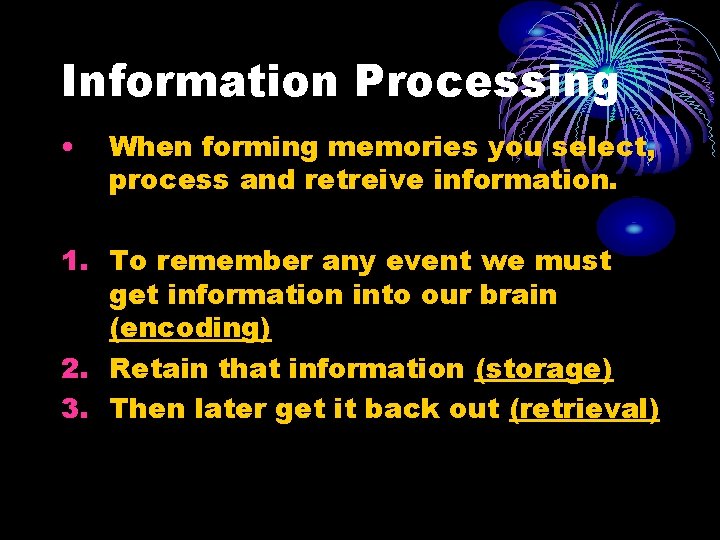
Information Processing • When forming memories you select, process and retreive information. 1. To remember any event we must get information into our brain (encoding) 2. Retain that information (storage) 3. Then later get it back out (retrieval)
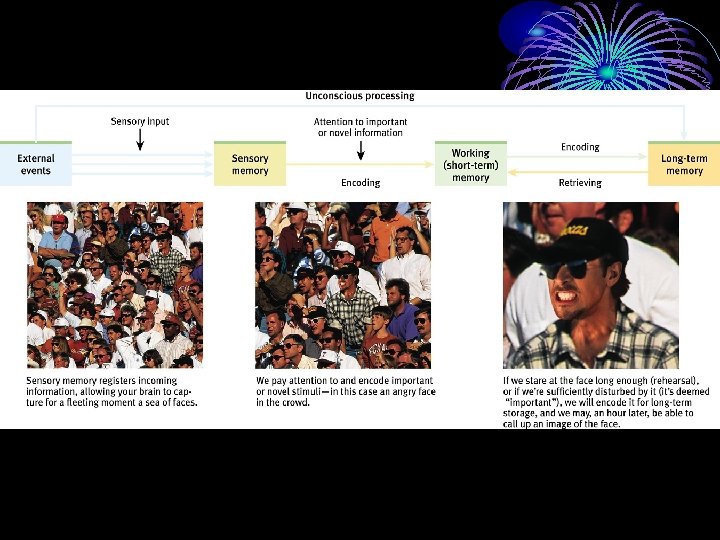
Richard Shiffrin and Akinson’s Classic 3 -stage processing model • The Atkinson-Schiffrin (1968) three-stage model of memory includes a) sensory memory, b) short-term memory, and c) longterm memory.
In other words 1. Register the memory (sensory memory) 2. Some of this information into short-term memories 3. Only a tiny part gets encoded for a long-term for later possible retrival.
Encoding: Getting information In • Some information (how to get to school) is automatically processed. • However, new or unusual information (friend’s new home address) requires attention and effort.
• Automatic Memory is unconsciously encoding information, that includes; space, time, frequency, and word meanings.
Automatic Processing • • • Space: While reading a textbook, you automatically encode the place of a picture on a page. Time: We accidentally note the events that take place in a day. Frequency: We keep track of things that happen that may have happened that day.
Effortless Processing • Encoding that requires attention and conscious effort
Rehearsal Processing • The conscious repetition of information trying to encode that information. • For ex. Studying for your AP Psychology Exams, going over defintions
Spacing Effect • Spacing Effect: We retain information better when we rehearse over time. • For Ex. Going over a word that you have trouble remembering once every week for a long period of time.
What we encode: Encoding by meaning Encoding by images Encoding by organization
• Visual encoding= Encoding of images • Acoustic Encoding= Encoding of sound • Semantic Encoding= Encoding of meanings
Visual Encoding • Mental pictures (imagery) are a powerful aid to effortful processing, especially when combined with semantic encoding.
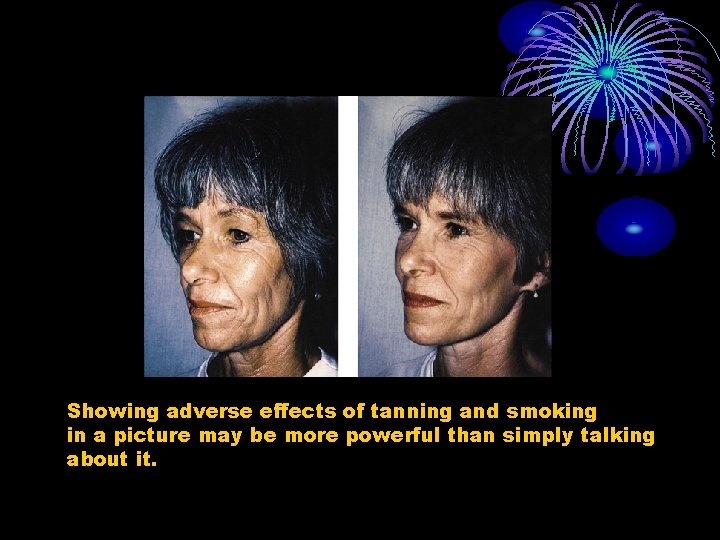
Showing adverse effects of tanning and smoking in a picture may be more powerful than simply talking about it.
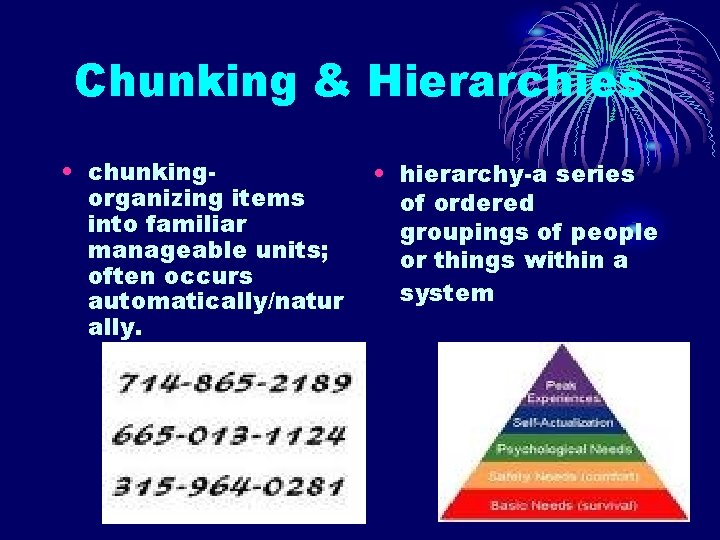
Chunking & Hierarchies • chunkingorganizing items into familiar manageable units; often occurs automatically/natur ally. • hierarchy-a series of ordered groupings of people or things within a system
• We remember organized information better than we do random data, and chunking and hierarchies are two ways to organize information.
Iconic Memory & Echoic Memory • iconic memorya photographic or picture-image memory lasting no more than a few tenths of a second. • echoic memoryif attention is elsewhere, sounds and words can still be recalled within 3 or 4 seconds.
• Without rehearsal, information disappears within seconds from short-term memory and is forgotten. • Unless our working memory meaningfully encodes or rehearses that information, it quickly disappears from our short-term store.
Memory • The average adult has about a billion bits of information in memory and a storage capacity that will accommodate probably 1, 000 to 1, 000 times that amount. • Our capacity for storing long-term memories is essentially limitless.
Memory Game
LTP • long-term potentiation (LTP)-an increase in synapse's firing potential after brief, rapid stimulation.
• Neuroscientists are expanding the search for the location of memories by exploring changes within and between single neurons. • Memories begin as impulses whizzing through brain circuits, somehow leaving permanent neural traces. • Where does the neural changes occur?
• The available clues point to the synapses. • synapses-the sites where nerve cells communicate with one another through their neurotransmitter messengers.
• Increased in a particular pathway, neural interconnection form or strengthen. • As experience strengthens the pathways between neurons , synapses transmit signals more efficiently. • LTP appears to be the neural basis for learning and memory.
Memory Boosting Drugs & CREB
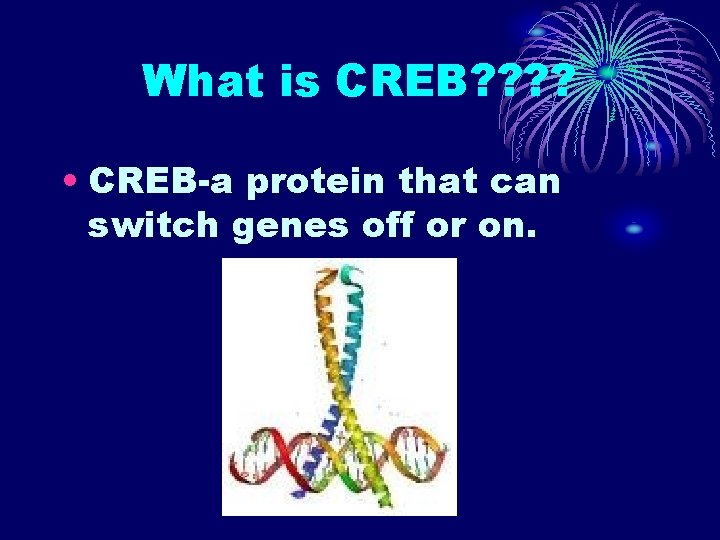
What is CREB? ? • CREB-a protein that can switch genes off or on.
• Drugs are created to boost the production of CREB. • If you boost CREB production, it might lead to increased production of proteins that help reshape synapses and consolidate a shortterm memory into a long-term memory.
Stress Hormones and Memory • The stress hormones that humans animals produce when excited or stressed make more glucose energy available to fuel brain activity, signaling the brain that something important has happened. • James Mc. Gaugh (1994, 2003) says that "stronger emotional experiences make for stronger, more reliable memories".
Examples • a house fire • war • a rape
Amnesia What is amnesia? ? ? Amnesia is the loss of memory.
Amnesia • can't recognize faces, remember events, can't form new memories
Storing Implicit and Explicit Memories • implicit memory-retention independent of conscious recollection. Also called procedural memory. • An individual can learn how to do something. • explicit memory-memory of facts and experiences that one can consciously know and "declare". Also called declarative memory.
Hippocampus • hippocampus-a neural center that is located in the limbic system and helps process explicit memories for storage. • When brain scans capture the brain forming a memory, they reveal activity in the hippocampus as well as in certain areas of the frontal lobes (Wagner & others, 1998).
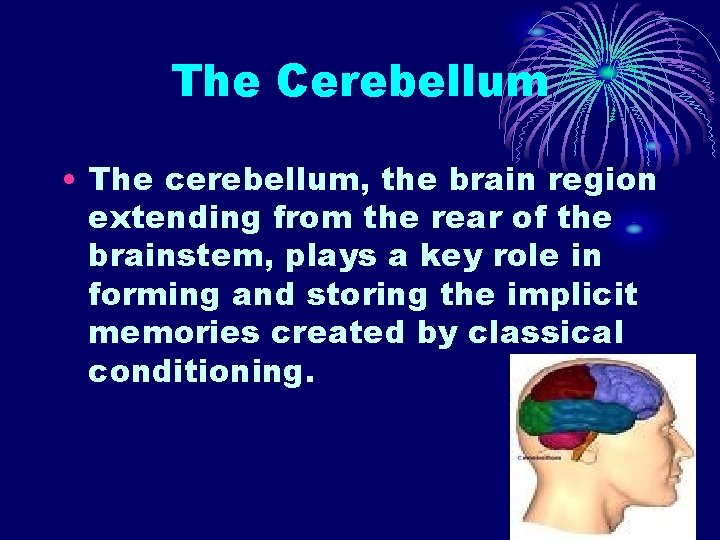
The Cerebellum • The cerebellum, the brain region extending from the rear of the brainstem, plays a key role in forming and storing the implicit memories created by classical conditioning.
• Damage to the cerebellum are incapable of developing certain conditioned reflexes. • Example: not blinking when an anticipated puff of air is blown in your eye.
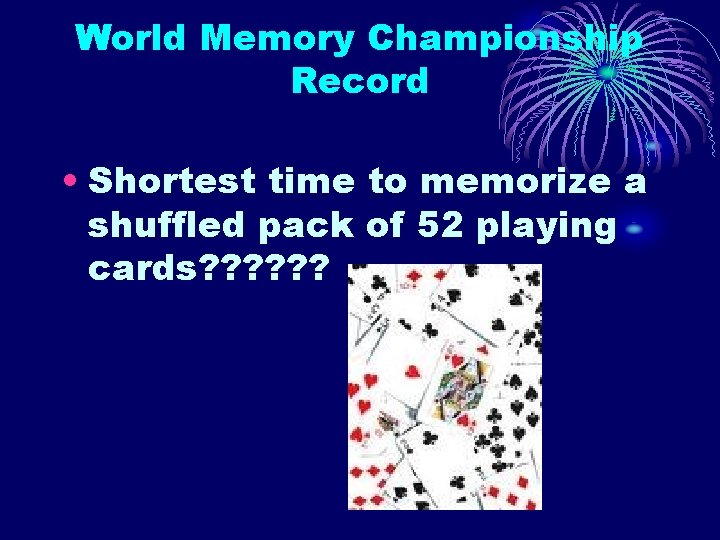
World Memory Championship Record • Shortest time to memorize a shuffled pack of 52 playing cards? ? ?
33 seconds!!!!!
Memory Construction
Misinformation and Imagination Effects • Memories are not stored as exact copies. We construct our memories, using both stored and new information. When eyewitnesses are subtly exposed to misinformation after an event, they often believe they saw the misleading details as part of the event.
Source Amnesia • By attributing something heard, read, or imagined to a wrong source. Because false memories feel like true memories and are seen as being equal.
Discerning True and False Memories • Since memory is reconstruction as well as reproduction, we can’t be sure whether a memory is real by how real it feels. • Memories we derive from experience have more detail than memories we derive from imagination.
Children’s Eyewitness Recall • Children are suggestible and if asked leading questions, can report false events. • If questioned about their experiences in neutral words they understand, the children often accurately recall what happened and who did it.
Repressed or Constructed Memories of Abuse • Memory researchers are especially suspicious of claims of long-repressed memories of sexual abuse, UFO abduction, or other traumas with the aid of a therapist or suggestive book.
• Those committed to protecting abused children and those committed to protecting wrongly accused adults agree on the following: • Injustice happens • Incest and other sexual abuse happens • Forgetting happens • Recovered memories are commonplace • Memories “recovered” under hynosis or the influence of drugs and of things happening before the age of 3 are unrelaible. • Memories whether real or false, can be emotionally upsetting.
Improving Memory • The psychology of memory suggests concrete strategies for improving memory • Study repeatedly to boost longterm recall. • Spend more time rehearsing or actively thinking about the material • Make the material personally
• To remember a list of unfamiliar items, use mnemonic devices which is devices intended to assist the memory. Example: Please Excuse My Dear Aunt Sally • Refresh your memory by activating retrieval cues. (Stimuli associated with info
• Recall events while they are fresh • Minimize interference • Test your own knowledge, both to rehearse it and to help determine what you do not know yet.