
Chapter 9 Markets for Differentiated Product Market for

- Slides: 22
Chapter 9 Markets for Differentiated Product • Market for Two Differentiated Products • Monopolistic Competition in Differentiated Products • Linear location model • Circular location model © 2010 Institute of Information Management National Chiao Tung University
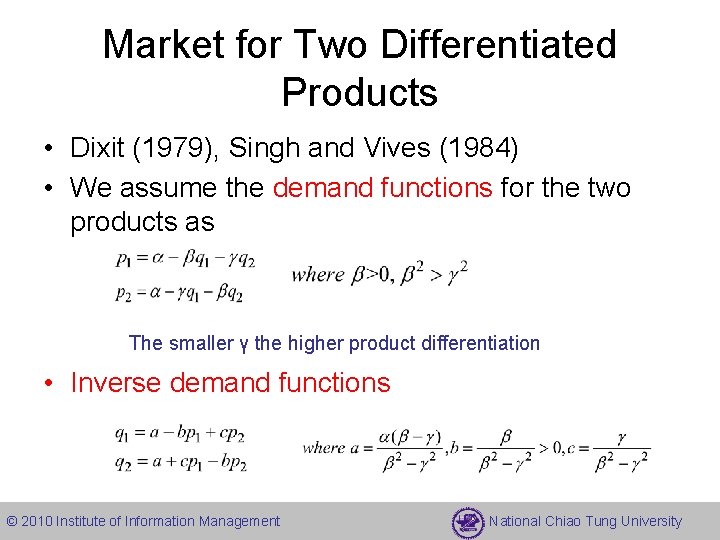
Market for Two Differentiated Products • Dixit (1979), Singh and Vives (1984) • We assume the demand functions for the two products as The smaller γ the higher product differentiation • Inverse demand functions © 2010 Institute of Information Management National Chiao Tung University
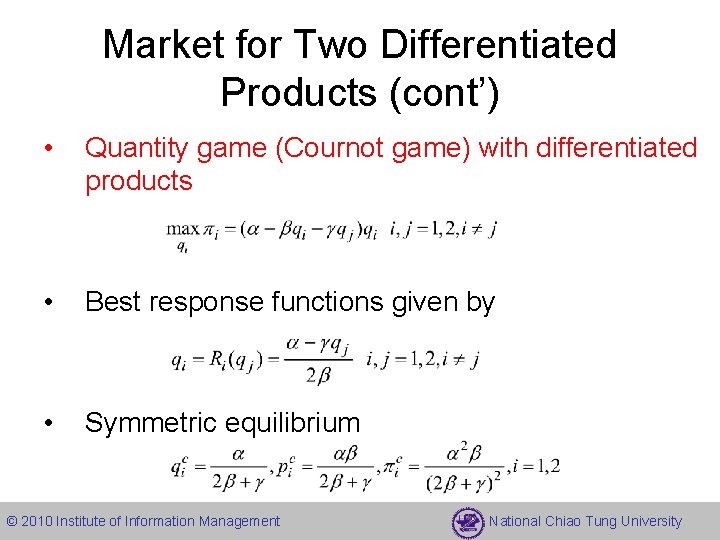
Market for Two Differentiated Products (cont’) • Quantity game (Cournot game) with differentiated products • Best response functions given by • Symmetric equilibrium © 2010 Institute of Information Management National Chiao Tung University
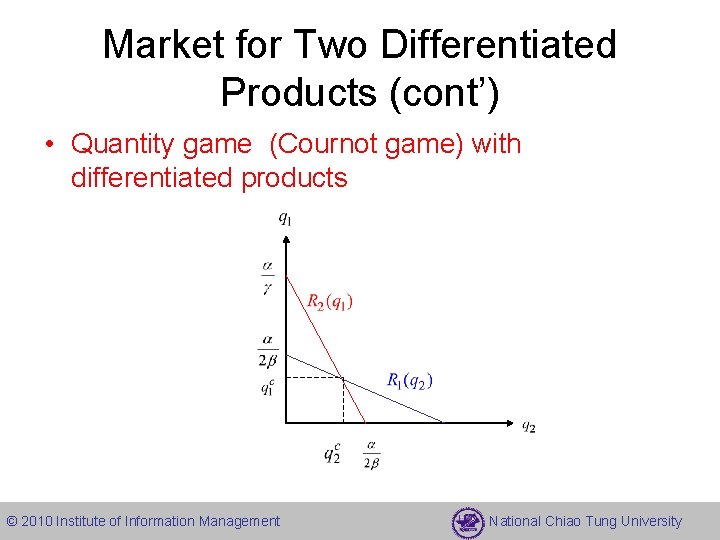
Market for Two Differentiated Products (cont’) • Quantity game (Cournot game) with differentiated products © 2010 Institute of Information Management National Chiao Tung University
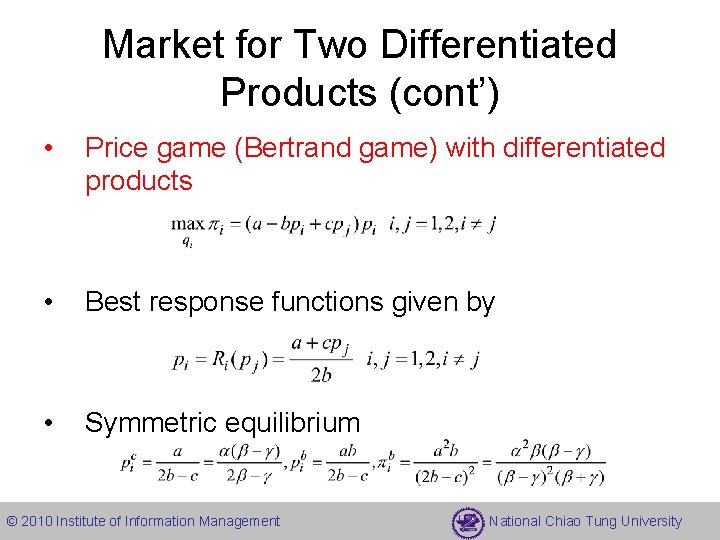
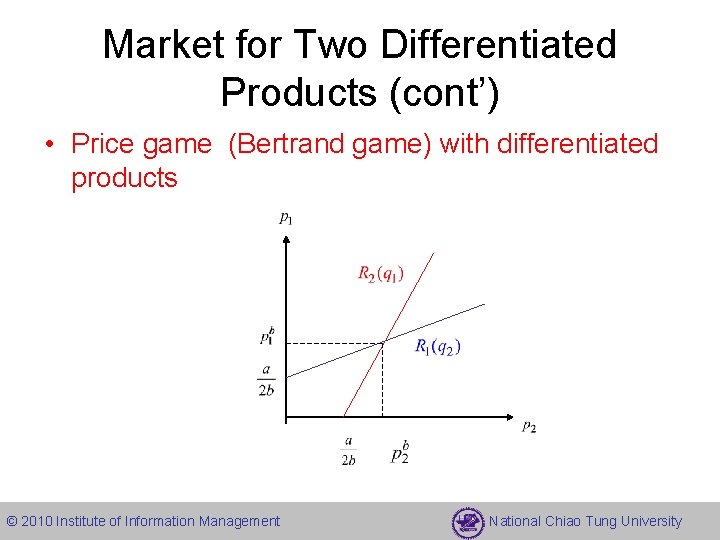
Market for Two Differentiated Products (cont’) • Price game (Bertrand game) with differentiated products • Best response functions given by • Symmetric equilibrium © 2010 Institute of Information Management National Chiao Tung University
Market for Two Differentiated Products (cont’) • Price game (Bertrand game) with differentiated products © 2010 Institute of Information Management National Chiao Tung University
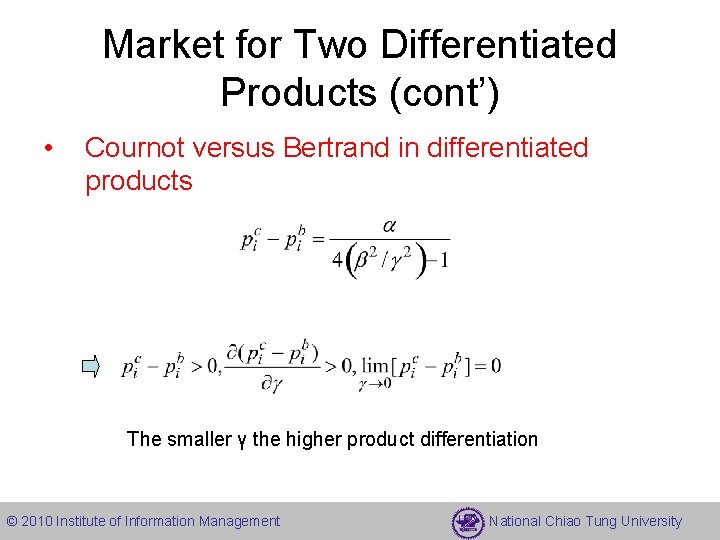
Market for Two Differentiated Products (cont’) • Cournot versus Bertrand in differentiated products The smaller γ the higher product differentiation © 2010 Institute of Information Management National Chiao Tung University
Monopolistic Competition in Differentiated Products • Monopolistic-competition environment (Chamberlin 19330) • The environment – (1)Consumers are homogeneous and can be represented by a single consumer who loves to consume a variety of brands – (2) There is an unlimited number of potentially produced brands – (3) Free entry of new-producing firms © 2010 Institute of Information Management National Chiao Tung University
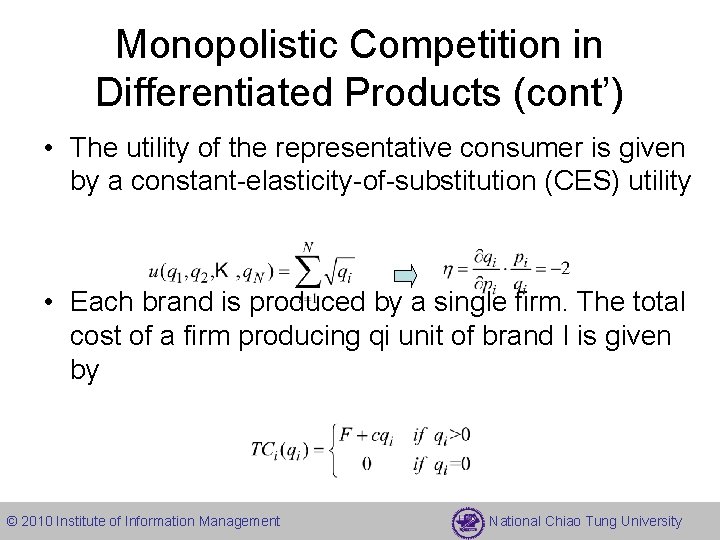
Monopolistic Competition in Differentiated Products (cont’) • The utility of the representative consumer is given by a constant-elasticity-of-substitution (CES) utility • Each brand is produced by a single firm. The total cost of a firm producing qi unit of brand I is given by © 2010 Institute of Information Management National Chiao Tung University
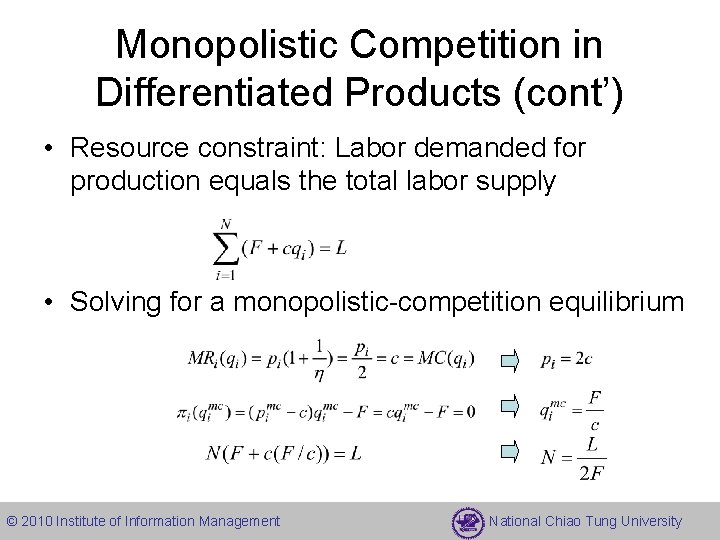
Monopolistic Competition in Differentiated Products (cont’) • Resource constraint: Labor demanded for production equals the total labor supply • Solving for a monopolistic-competition equilibrium © 2010 Institute of Information Management National Chiao Tung University
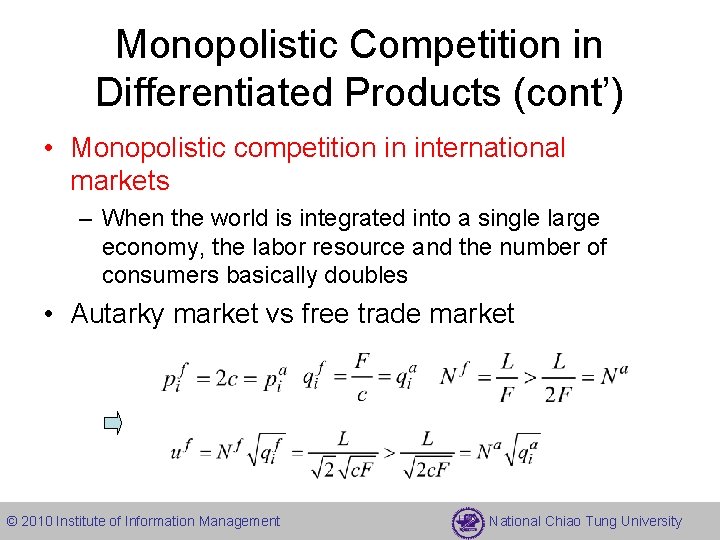
Monopolistic Competition in Differentiated Products (cont’) • Monopolistic competition in international markets – When the world is integrated into a single large economy, the labor resource and the number of consumers basically doubles • Autarky market vs free trade market © 2010 Institute of Information Management National Chiao Tung University
The linear “location “ model • Hotelling (1929) considers consumers who reside on a linear street with a length of L>0 • Suppose that the consumers are uniformly distributed on the interval, so that at each point lies a single consumer • The total number of consumers in the economy is L • Each consumer is indexed by , so x is just a name of consumer (located at point x from the origin) © 2010 Institute of Information Management National Chiao Tung University
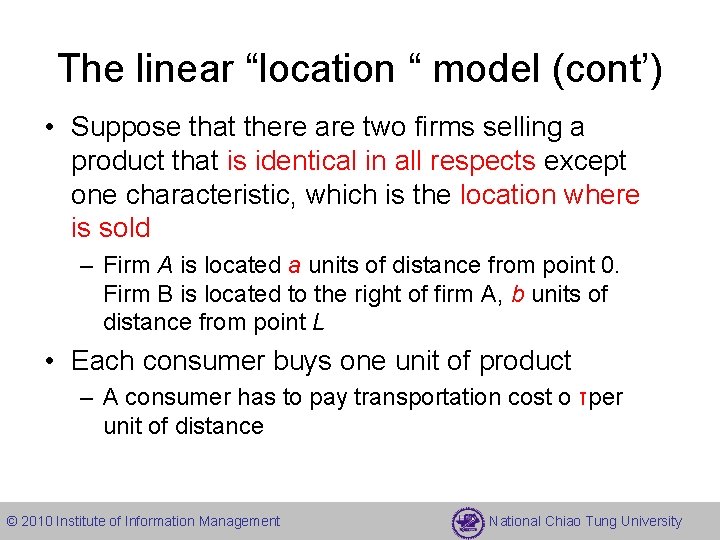
The linear “location “ model (cont’) • Suppose that there are two firms selling a product that is identical in all respects except one characteristic, which is the location where is sold – Firm A is located a units of distance from point 0. Firm B is located to the right of firm A, b units of distance from point L • Each consumer buys one unit of product – A consumer has to pay transportation cost o τper unit of distance © 2010 Institute of Information Management National Chiao Tung University
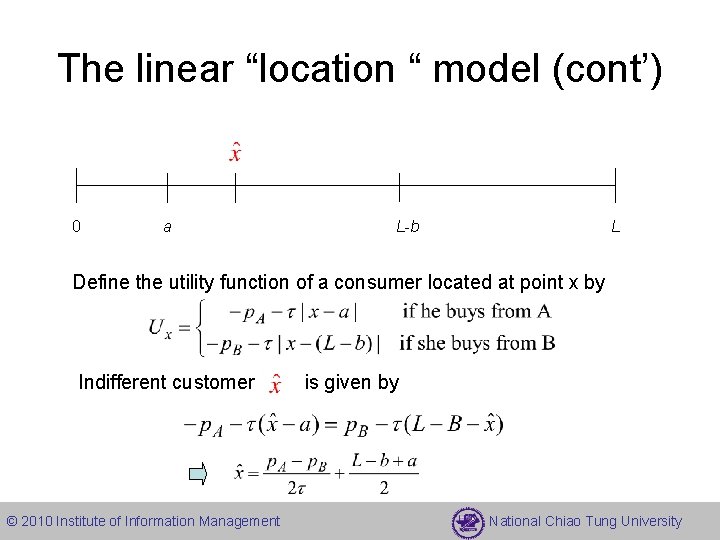
The linear “location “ model (cont’) 0 a L-b L Define the utility function of a consumer located at point x by Indifferent customer © 2010 Institute of Information Management is given by National Chiao Tung University
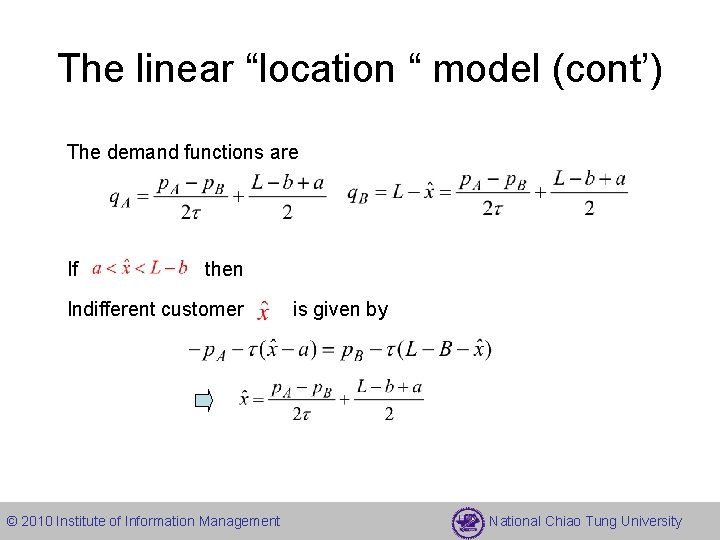
The linear “location “ model (cont’) The demand functions are If then Indifferent customer © 2010 Institute of Information Management is given by National Chiao Tung University
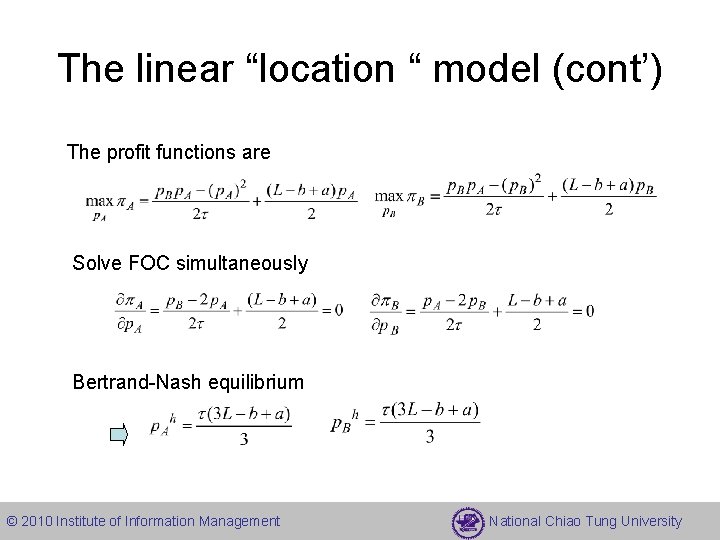
The linear “location “ model (cont’) The profit functions are Solve FOC simultaneously Bertrand-Nash equilibrium © 2010 Institute of Information Management National Chiao Tung University
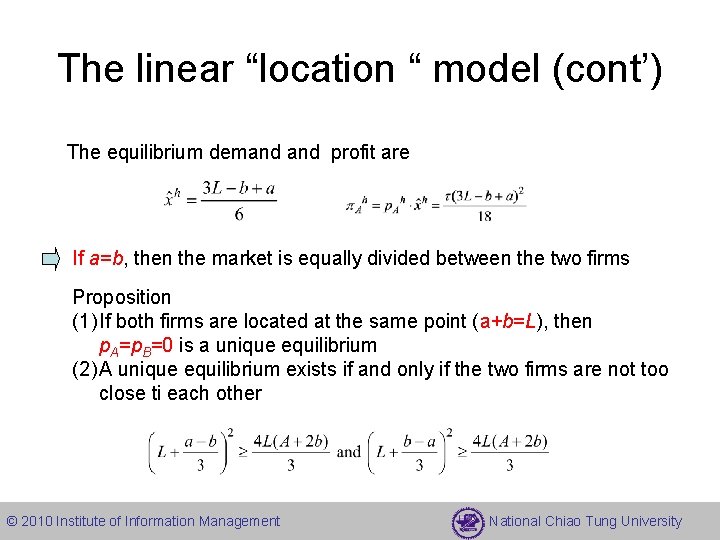
The linear “location “ model (cont’) The equilibrium demand profit are If a=b, then the market is equally divided between the two firms Proposition (1) If both firms are located at the same point (a+b=L), then p. A=p. B=0 is a unique equilibrium (2) A unique equilibrium exists if and only if the two firms are not too close ti each other © 2010 Institute of Information Management National Chiao Tung University
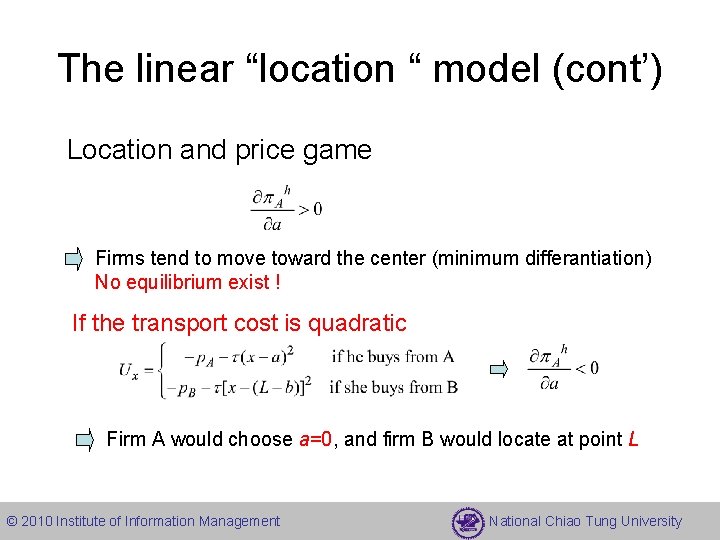
The linear “location “ model (cont’) Location and price game Firms tend to move toward the center (minimum differantiation) No equilibrium exist ! If the transport cost is quadratic Firm A would choose a=0, and firm B would locate at point L © 2010 Institute of Information Management National Chiao Tung University
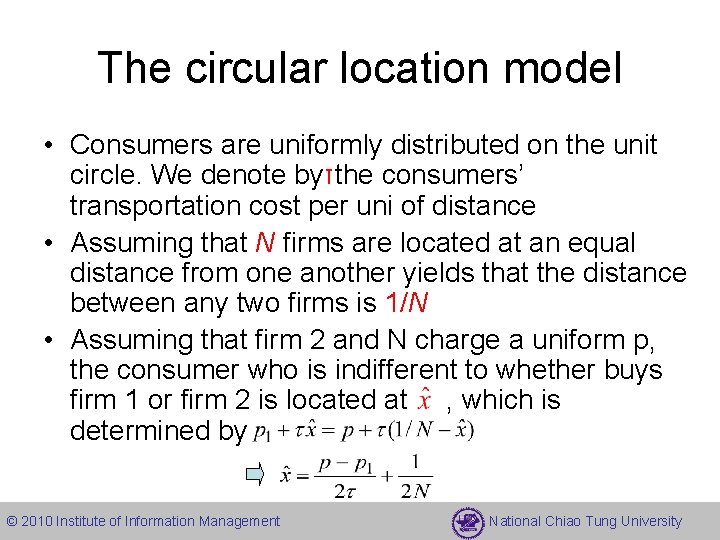
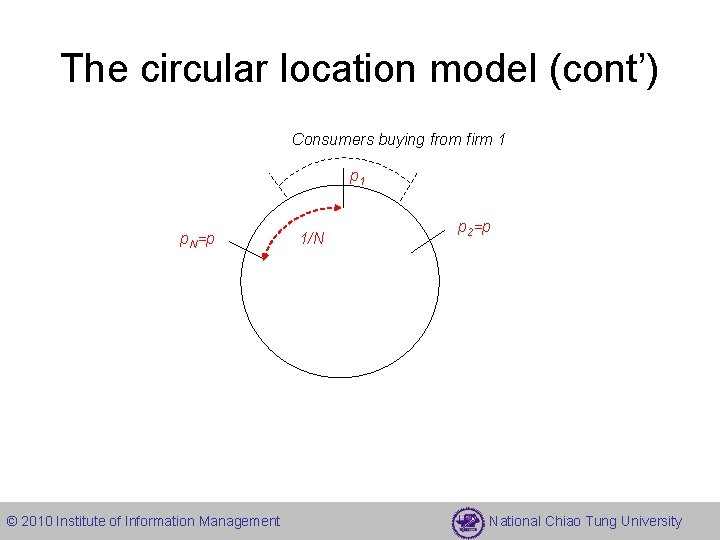
The circular location model • Consumers are uniformly distributed on the unit circle. We denote byτthe consumers’ transportation cost per uni of distance • Assuming that N firms are located at an equal distance from one another yields that the distance between any two firms is 1/N • Assuming that firm 2 and N charge a uniform p, the consumer who is indifferent to whether buys firm 1 or firm 2 is located at , which is determined by © 2010 Institute of Information Management National Chiao Tung University
The circular location model (cont’) Consumers buying from firm 1 p. N=p © 2010 Institute of Information Management 1/N p 2=p National Chiao Tung University
The circular location model (cont’) Demand function facing firm i Profit function facing firm i Solve FOC Symmetric equilibrium © 2010 Institute of Information Management National Chiao Tung University
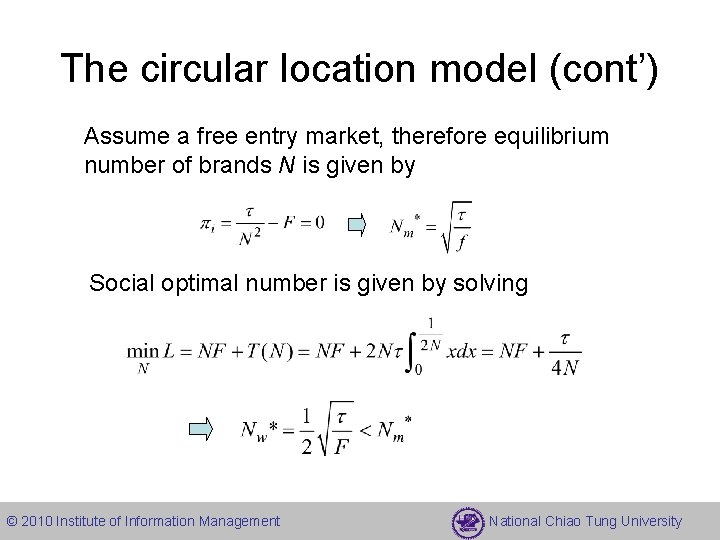
The circular location model (cont’) Assume a free entry market, therefore equilibrium number of brands N is given by Social optimal number is given by solving © 2010 Institute of Information Management National Chiao Tung University