
Chapter 9 Manpower Scheduling Prepared by Dr TsungNan
Chapter 9 Manpower Scheduling Prepared by: Dr. Tsung-Nan Tsai 排程概論 Sch_chap 9. ppt
Introduction n Organizations need manpower to function regardless of automations. n Manpower requirement depending on the type of service and demand. n Some production facilities have seasonal demands and employ workers who are also seasonal. (toys at Christmas) n A few organizations may have varied demand from day to day. (the no of nurses required in a hospital. n Purchasing crew work on a day shift. Operators may be required on all shifts in a 24 -hour-per-day operation) 12/25/2021 排程概論 Sch_chap 9. ppt 2
Introduction n Concentrating on manpower-scheduling problems associated with business that work 7 days a week in this textbook. The employees work a standard 40 hours and five days a week. Scheduling problems can be classed into: 1. On-off-day pattern, such as consecutive days off, weekdays off, and nonconsecutive days off. 2. Homogeneous versus heterogeneous work force 3. Varying daily work-force requirement. 12/25/2021 排程概論 Sch_chap 9. ppt 3
Introduction 1) Homogeneous workforce: when the available hours of each worker are the same and the workforce requirement remains constant throughout the shift. (manufacturing industry) 2) Heterogeneous workforce: when the available hours vary from one employee to another or the workforce requirement varies within a shift. (fast good restaurant) 3) Workstretch(定時型): defined as the number of days an employee is scheduled to work without any off-days in between. (four or five days) 12/25/2021 排程概論 Sch_chap 9. ppt 4
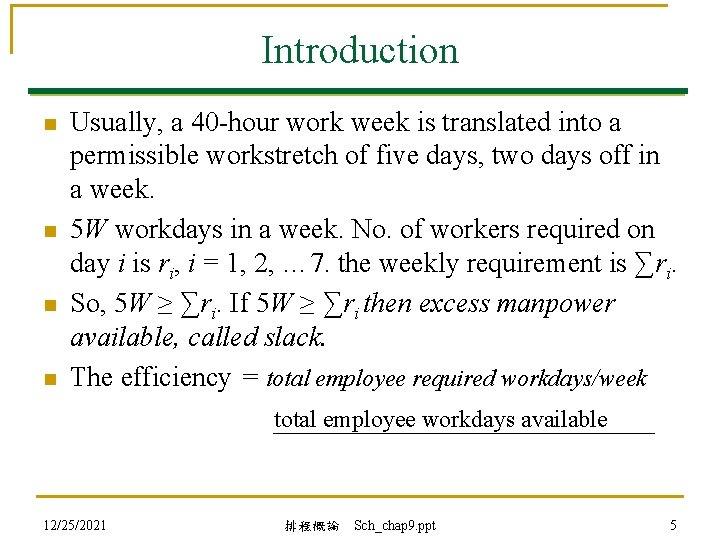
Introduction n n Usually, a 40 -hour work week is translated into a permissible workstretch of five days, two days off in a week. 5 W workdays in a week. No. of workers required on day i is ri, i = 1, 2, … 7. the weekly requirement is ∑ri. So, 5 W ≥ ∑ri. If 5 W ≥ ∑ri then excess manpower available, called slack. The efficiency = total employee required workdays/week total employee workdays available 12/25/2021 排程概論 Sch_chap 9. ppt 5
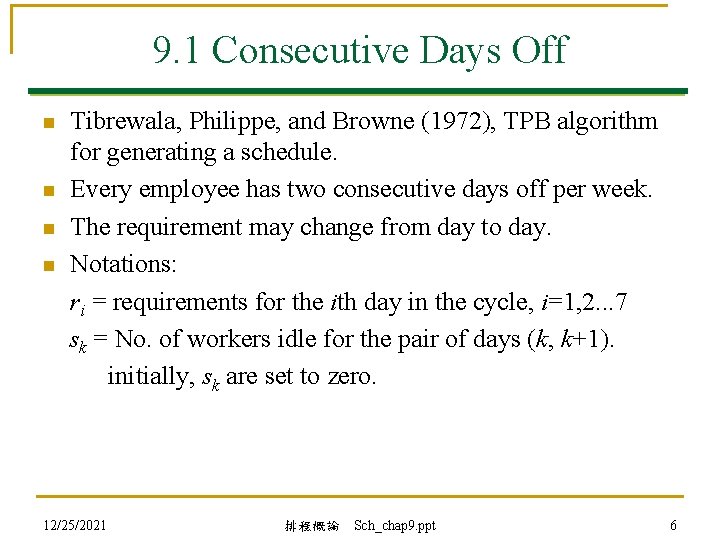
9. 1 Consecutive Days Off n n Tibrewala, Philippe, and Browne (1972), TPB algorithm for generating a schedule. Every employee has two consecutive days off per week. The requirement may change from day to day. Notations: ri = requirements for the ith day in the cycle, i=1, 2. . . 7 sk = No. of workers idle for the pair of days (k, k+1). initially, sk are set to zero. 12/25/2021 排程概論 Sch_chap 9. ppt 6

9. 1 Consecutive Days Off n Step 1. a. Choose two consecutive days, (k, k+1) for 7 days. b. If (k, k+1) is not uniquely determined, choose from among the tied (k, k+1) the pair with a minimum sum. c. If (k, k+1) is still not satisfied, select any pair among the tied pairs, (k-1, k). d. If there is no such pair, then all ri must be equal, in which any pair (k+1) can be chosen. q Step 2. sk + 1 for the k chosen in step 1 and ri – 1, except for i = k and k+1. q Repeat steps 1 and 2 until all requirements are satisfied, ri values are reduced to zero. 12/25/2021 排程概論 Sch_chap 9. ppt 7

9. 1 Consecutive Days Off – TPB example the no. of workers off on a given day i is: n TPB example: the no. of workers required for each day i of the week: 12/25/2021 排程概論 Sch_chap 9. ppt 8

9. 1 Consecutive Days Off – TPB example Step 1 b and 1 c to untie -1 8 10 6 Min=4 See page 222 for more explanations 12/25/2021 排程概論 Sch_chap 9. ppt 9
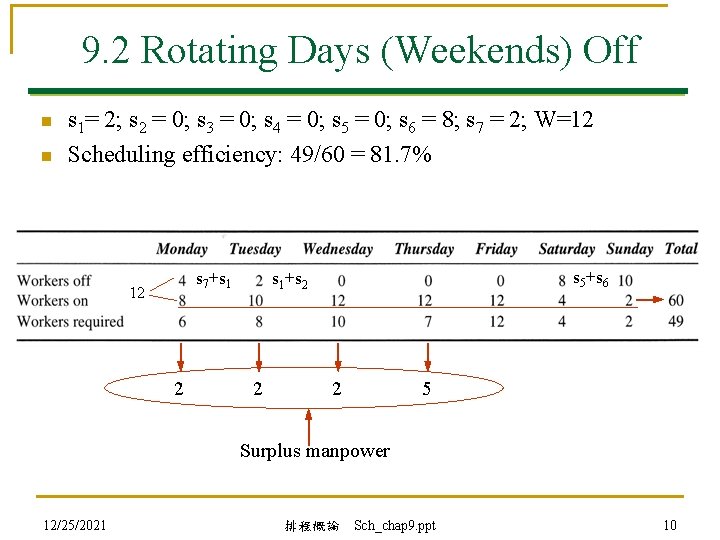
9. 2 Rotating Days (Weekends) Off n n s 1= 2; s 2 = 0; s 3 = 0; s 4 = 0; s 5 = 0; s 6 = 8; s 7 = 2; W=12 Scheduling efficiency: 49/60 = 81. 7% s 7+s 1 12 2 s 5+s 6 s 1+s 2 2 2 5 Surplus manpower 12/25/2021 排程概論 Sch_chap 9. ppt 10
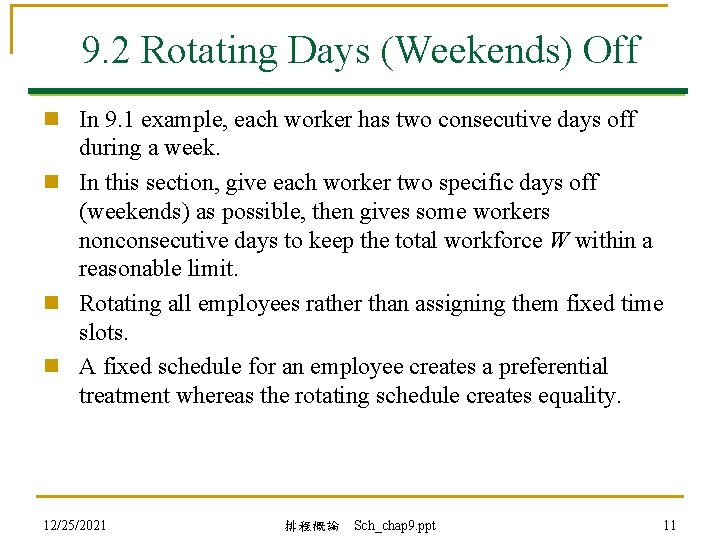
9. 2 Rotating Days (Weekends) Off n In 9. 1 example, each worker has two consecutive days off during a week. n In this section, give each worker two specific days off (weekends) as possible, then gives some workers nonconsecutive days to keep the total workforce W within a reasonable limit. n Rotating all employees rather than assigning them fixed time slots. n A fixed schedule for an employee creates a preferential treatment whereas the rotating schedule creates equality. 12/25/2021 排程概論 Sch_chap 9. ppt 11
9. 2 Rotating Days (Weekends) Off n The algorithm developed by Burns and Carter (1985). With following characteristics: 1. The number of employees required each day of the week can vary. 2. The algorithm solution meets the following constraints: a. Each employee works exactly five days per week b. Each employee has at least every other weekend off (or each worker is given at least A out of B weekends off) c. No one works more than six consecutive days. n The algorithm determines the minimum of number of employee W first to satisfy the weekly requirements. W is calculated based on 3 lower bounds set: 12/25/2021 排程概論 Sch_chap 9. ppt 12
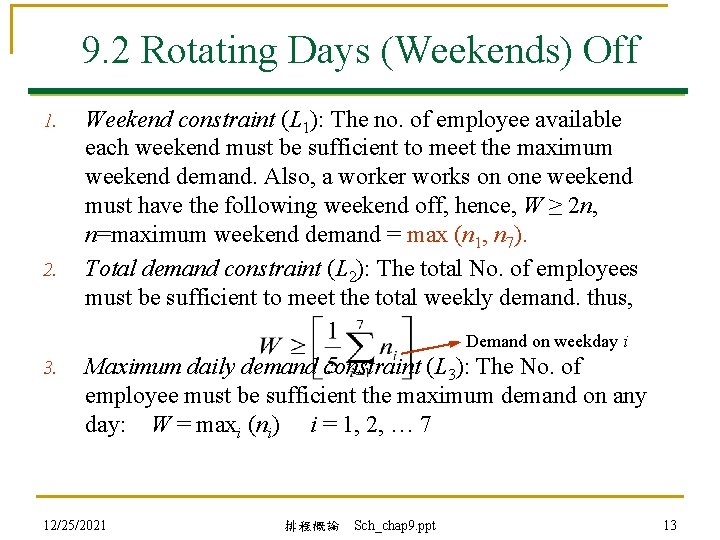
9. 2 Rotating Days (Weekends) Off 1. 2. Weekend constraint (L 1): The no. of employee available each weekend must be sufficient to meet the maximum weekend demand. Also, a worker works on one weekend must have the following weekend off, hence, W ≥ 2 n, n=maximum weekend demand = max (n 1, n 7). Total demand constraint (L 2): The total No. of employees must be sufficient to meet the total weekly demand. thus, Demand on weekday i 3. Maximum daily demand constraint (L 3): The No. of employee must be sufficient the maximum demand on any day: W = maxi (ni) i = 1, 2, … 7 12/25/2021 排程概論 Sch_chap 9. ppt 13
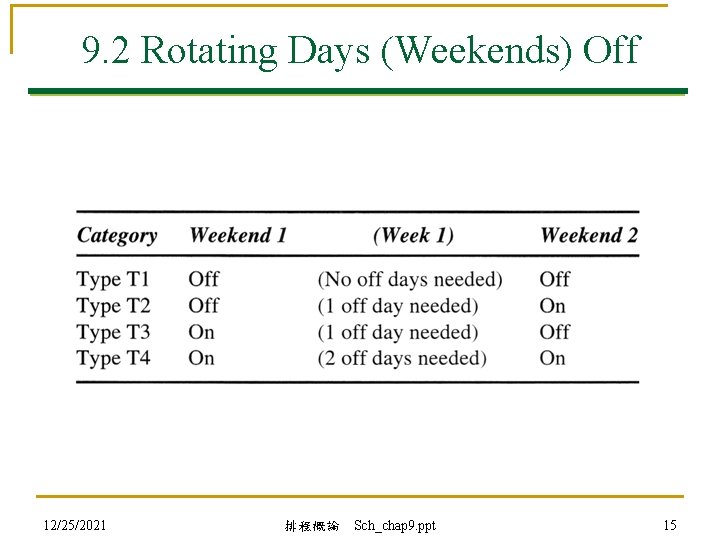
9. 2 Rotating Days (Weekends) Off n The BC algorithm considers a span of B weeks (two weeks in this example), to design A weekends off for each employee. Steps are: 1. Compute the minimum workforce: Calculate the 3 bounds L 1, L 2, and L 3. W = max(L 1, L 2, L 3). 2. Schedule the weekends off: At least n (a maximum requirement) workers to work on any day during the weekend. So (W-n) workers can be off. 3. Determine the additional off-day pairs: each employee must have exactly two days off. Since (W – n) Sundays and Saturdays are assigned to be off. Calculate the surplus of employees Sj during a weekday by subtracting the daily requirement from the W. Sj = W – nj (see textbook on p. 224) 4. Assigning off-day pairs in week 1: (see textbook on p. 224 and next slide) 12/25/2021 排程概論 Sch_chap 9. ppt 14
9. 2 Rotating Days (Weekends) Off 12/25/2021 排程概論 Sch_chap 9. ppt 15
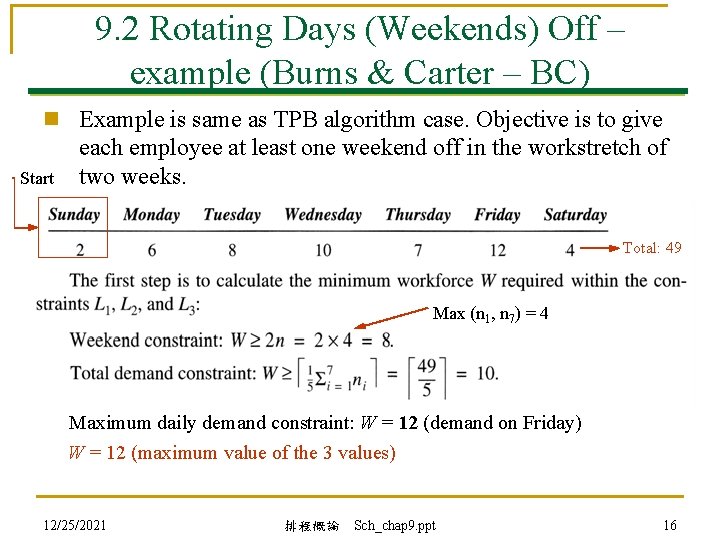
9. 2 Rotating Days (Weekends) Off – example (Burns & Carter – BC) n Example is same as TPB algorithm case. Objective is to give Start each employee at least one weekend off in the workstretch of two weeks. Total: 49 Max (n 1, n 7) = 4 Maximum daily demand constraint: W = 12 (demand on Friday) W = 12 (maximum value of the 3 values) 12/25/2021 排程概論 Sch_chap 9. ppt 16
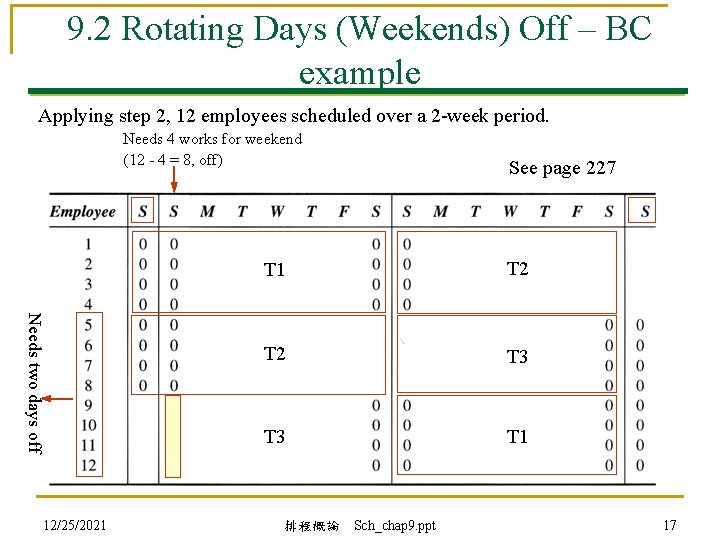
9. 2 Rotating Days (Weekends) Off – BC example Applying step 2, 12 employees scheduled over a 2 -week period. Needs 4 works for weekend (12 - 4 = 8, off) Needs two days off 12/25/2021 See page 227 T 1 T 2 T 3 T 1 排程概論 Sch_chap 9. ppt 17
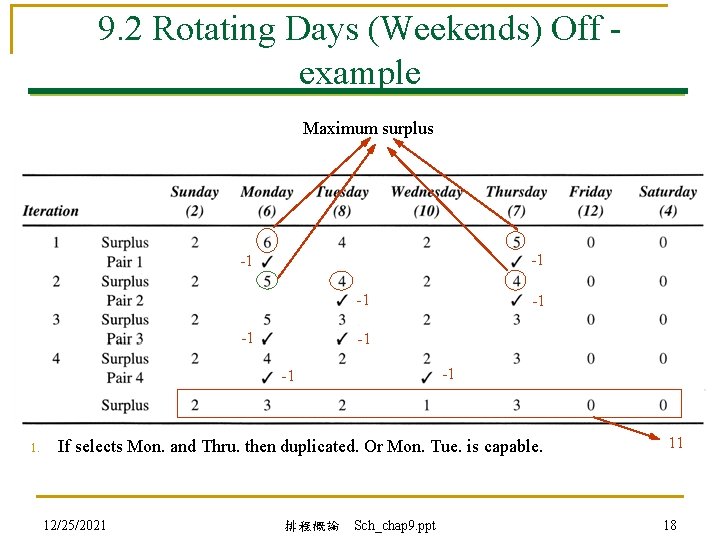
9. 2 Rotating Days (Weekends) Off example Maximum surplus -1 -1 -1 1. -1 -1 If selects Mon. and Thru. then duplicated. Or Mon. Tue. is capable. 12/25/2021 排程概論 Sch_chap 9. ppt 11 18
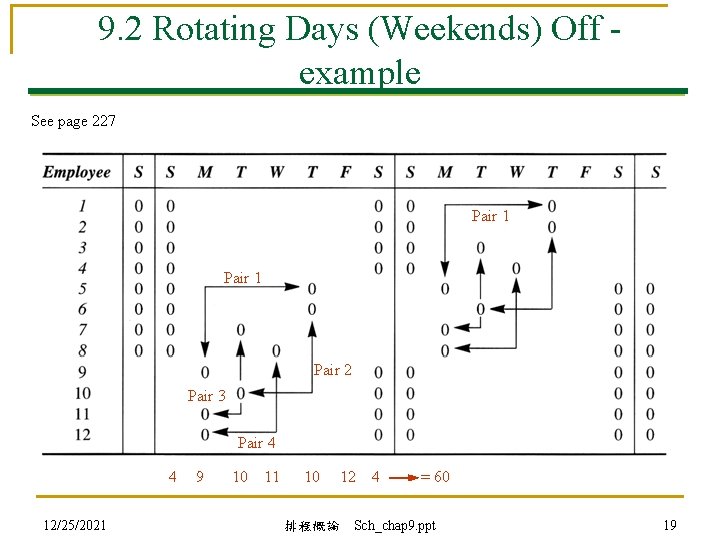
9. 2 Rotating Days (Weekends) Off example See page 227 Pair 1 Pair 2 Pair 3 Pair 4 4 12/25/2021 9 10 11 10 12 4 = 60 排程概論 Sch_chap 9. ppt 19
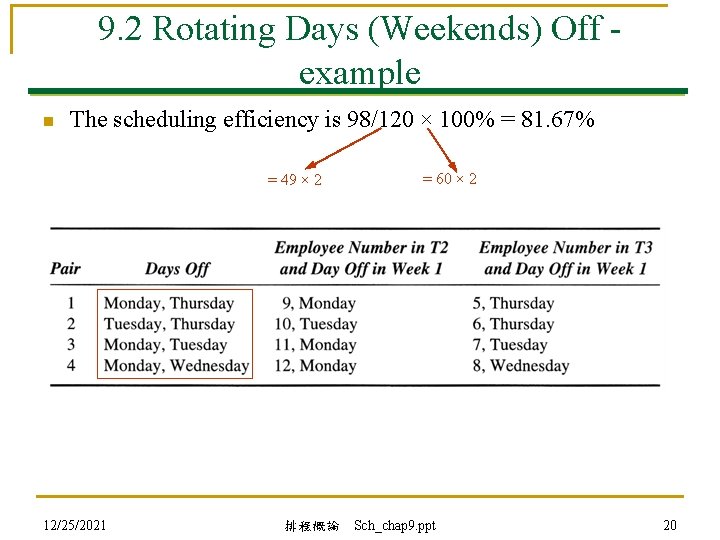
9. 2 Rotating Days (Weekends) Off example n The scheduling efficiency is 98/120 × 100% = 81. 67% = 49 × 2 12/25/2021 = 60 × 2 排程概論 Sch_chap 9. ppt 20
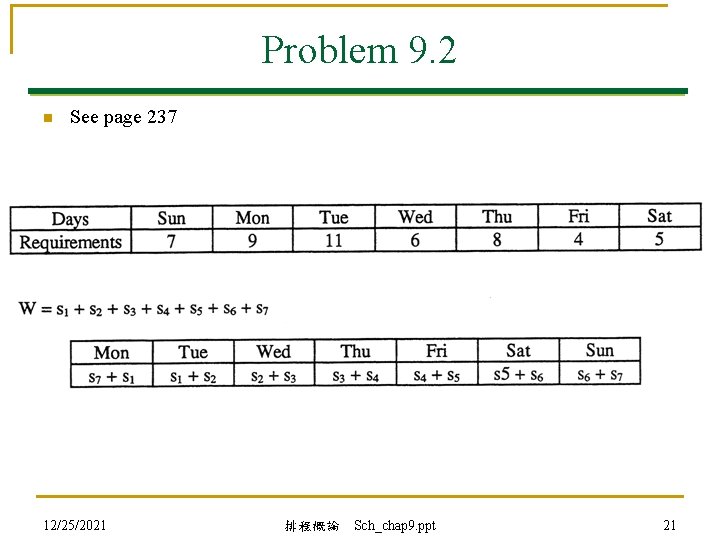
Problem 9. 2 n See page 237 12/25/2021 排程概論 Sch_chap 9. ppt 21
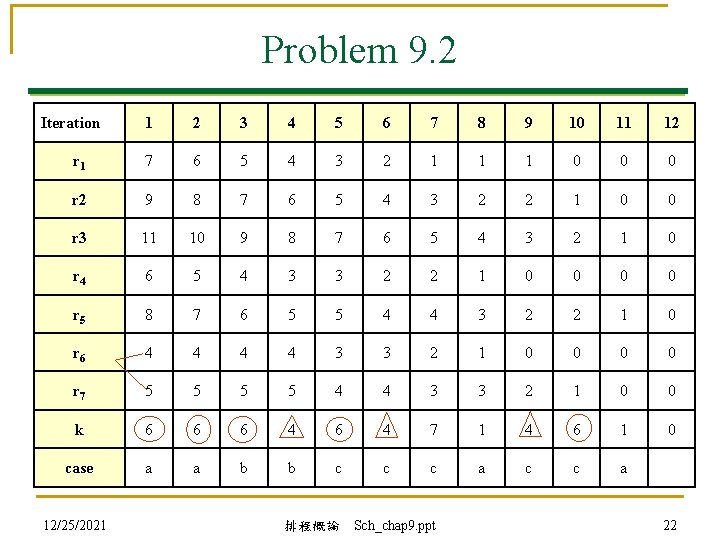
Problem 9. 2 Iteration 1 2 3 4 5 6 7 8 9 10 11 12 r 1 7 6 5 4 3 2 1 1 1 0 0 0 r 2 9 8 7 6 5 4 3 2 2 1 0 0 r 3 11 10 9 8 7 6 5 4 3 2 1 0 r 4 6 5 4 3 3 2 2 1 0 0 r 5 8 7 6 5 5 4 4 3 2 2 1 0 r 6 4 4 3 3 2 1 0 0 r 7 5 5 4 4 3 3 2 1 0 0 k 6 6 6 4 7 1 4 6 1 0 case a a b b c c c a 12/25/2021 排程概論 Sch_chap 9. ppt 22
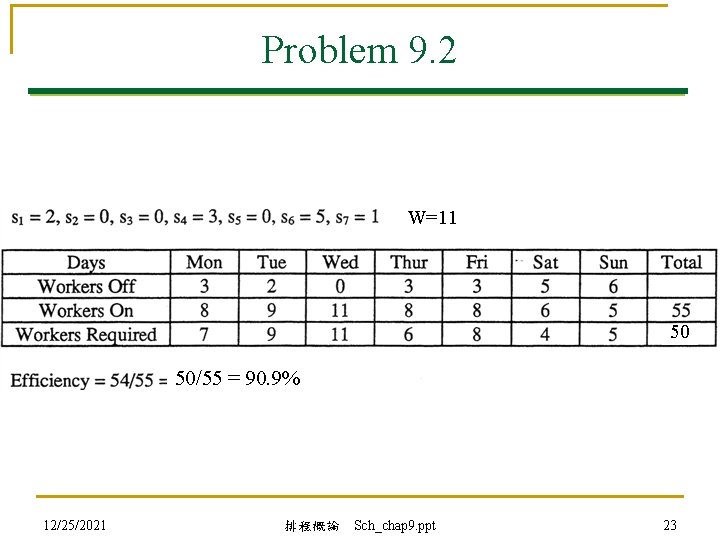
Problem 9. 2 W=11 50 50/55 = 90. 9% 12/25/2021 排程概論 Sch_chap 9. ppt 23
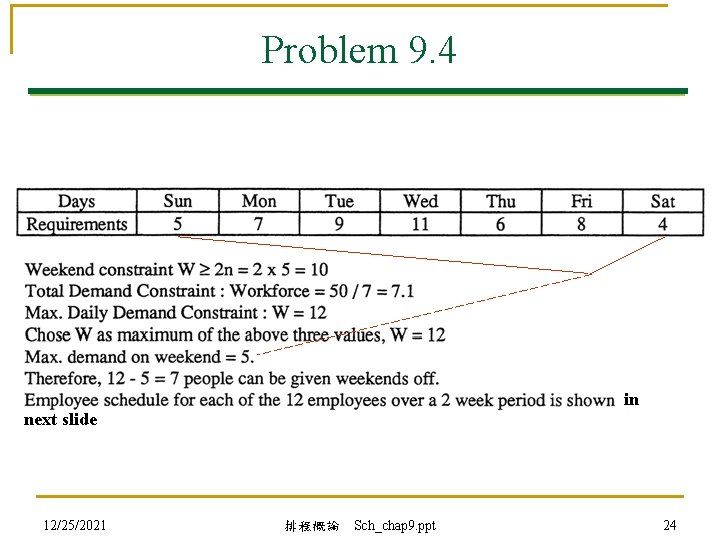
Problem 9. 4 in next slide 12/25/2021 排程概論 Sch_chap 9. ppt 24
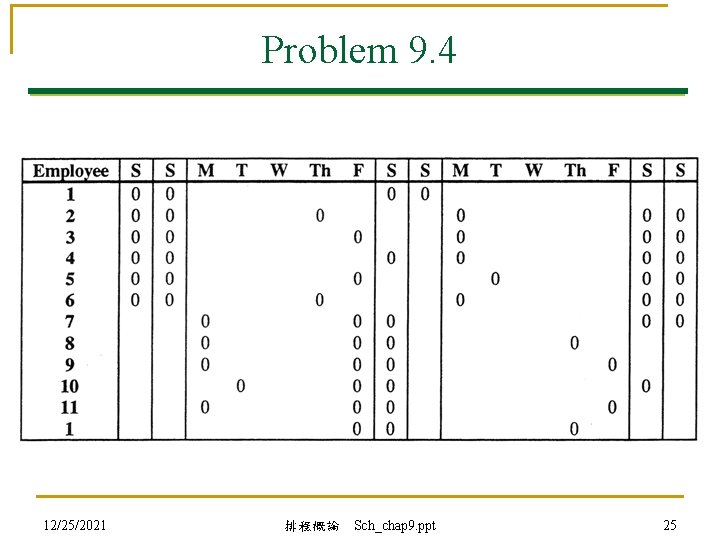
Problem 9. 4 12/25/2021 排程概論 Sch_chap 9. ppt 25
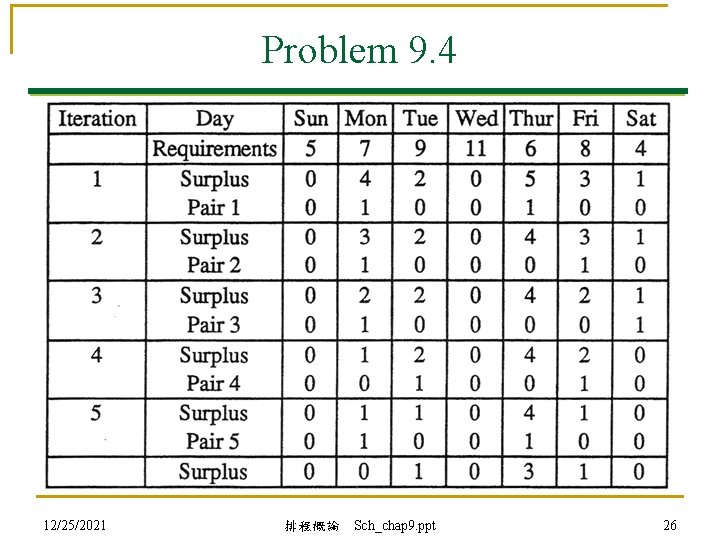
Problem 9. 4 12/25/2021 排程概論 Sch_chap 9. ppt 26
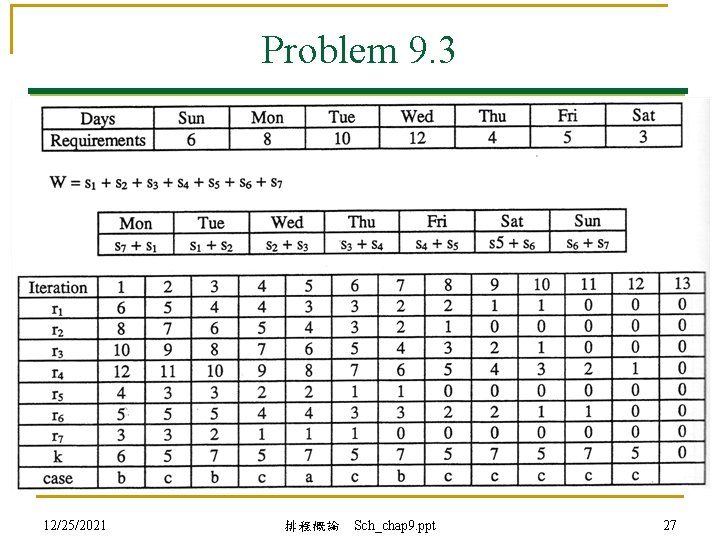
Problem 9. 3 12/25/2021 排程概論 Sch_chap 9. ppt 27
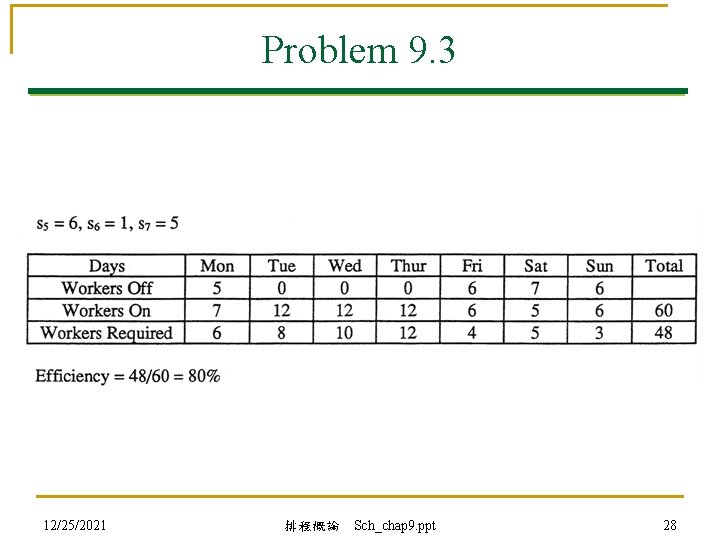
Problem 9. 3 12/25/2021 排程概論 Sch_chap 9. ppt 28
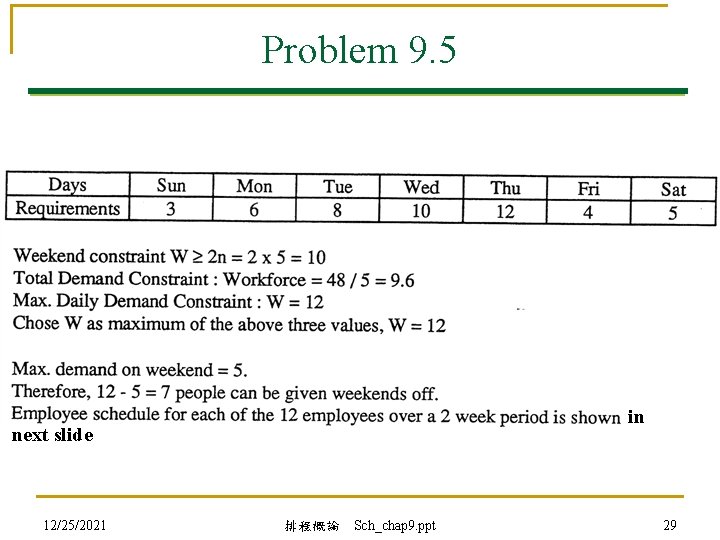
Problem 9. 5 in next slide 12/25/2021 排程概論 Sch_chap 9. ppt 29
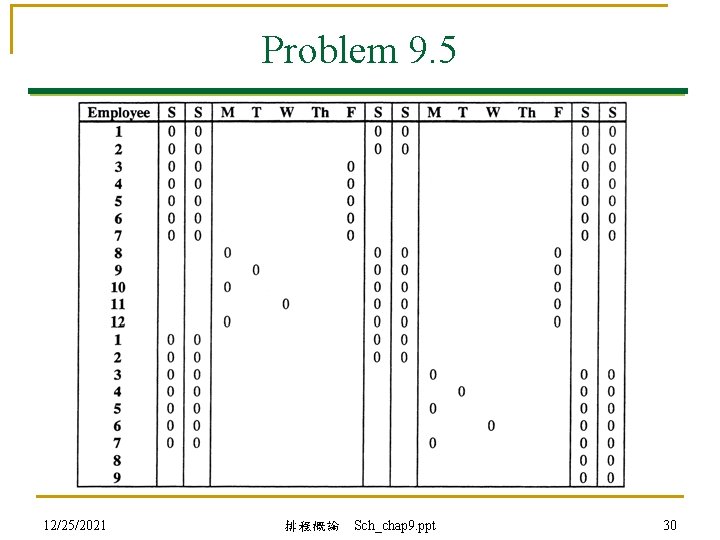
Problem 9. 5 12/25/2021 排程概論 Sch_chap 9. ppt 30
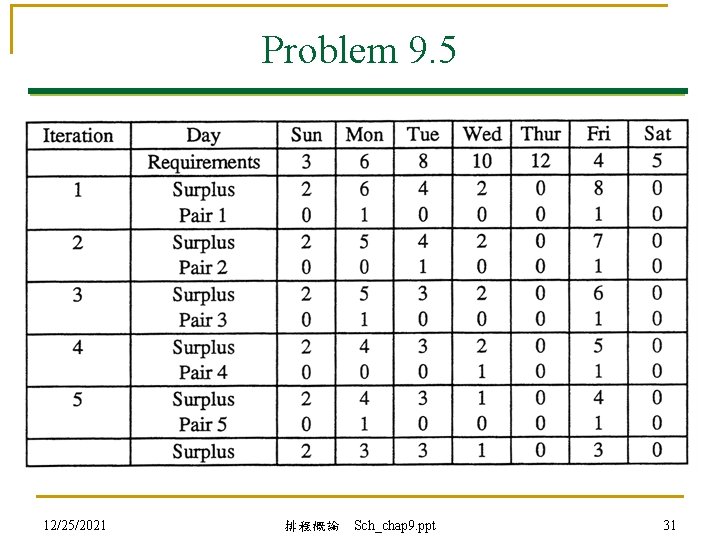
Problem 9. 5 12/25/2021 排程概論 Sch_chap 9. ppt 31
- Slides: 31