
CHAPTER 9 Managing Strategy and Strategic Planning Slide
- Slides: 13
CHAPTER 9 Managing Strategy and Strategic Planning Slide content created by Joseph B. Mosca, Monmouth University. Copyright © Houghton Mifflin Company. All rights reserved. 1
The Nature of Strategic Management n n Strategy: a comprehensive plan for accomplishing an organization’s goals. Strategic management: a comprehensive and ongoing management process aimed at formulating and implementing effective strategies; it is a way of approaching business opportunities and challenges. 2
Effective Strategy n A strategy that promotes a superior alignment between the organization and its environment and between the organization and the achievement of its strategic goals. 3
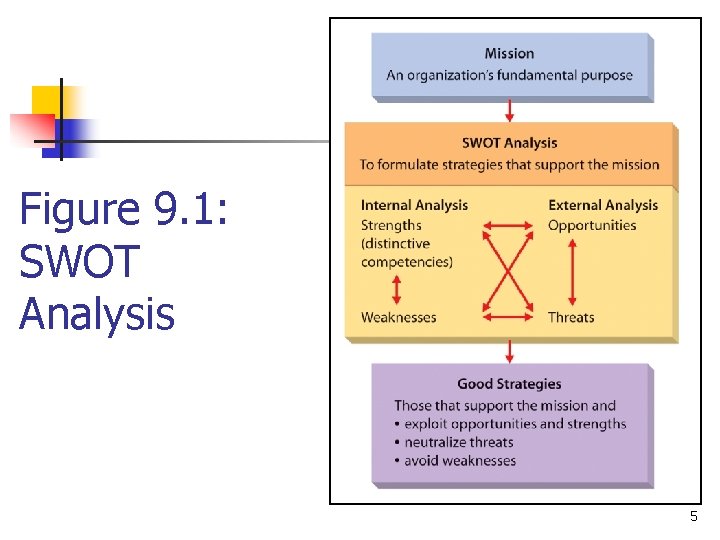
Using SWOT Analysis to Formulate Strategy n n n SWOT: An acronym that stands for strengths, weaknesses, opportunities, and threats. Organizational strength: a skill or capability that enables an organization to conceive of and implement its strategies. Common strength: an organizational capability possessed by numerous competing firms. 4
Figure 9. 1: SWOT Analysis 5
SWOT: Evaluating Strengths n n Strategic imitation: the practice of duplicating another organization’s distinctive competency and thereby implementing a valuable strategy. Sustained competitive advantage: a competitive advantage that exists after all attempts at strategic imitation have ceased. 6
Evaluating an Organization’s Weaknesses n n Organizational weakness: a skill or capability that does not enable an organization to choose and implement strategies that support its mission. Competitive disadvantage: a situation in which an organization is not implementing valuable strategies that are being implemented by competing organizations. 7
Evaluating an Organization’s Opportunities and Threats n n Organizational opportunity: an area in the environment that, if exploited, may generate higher performance. Organizational threats: an area in the environment that increases the difficulty of an organization performing at a high level. 8
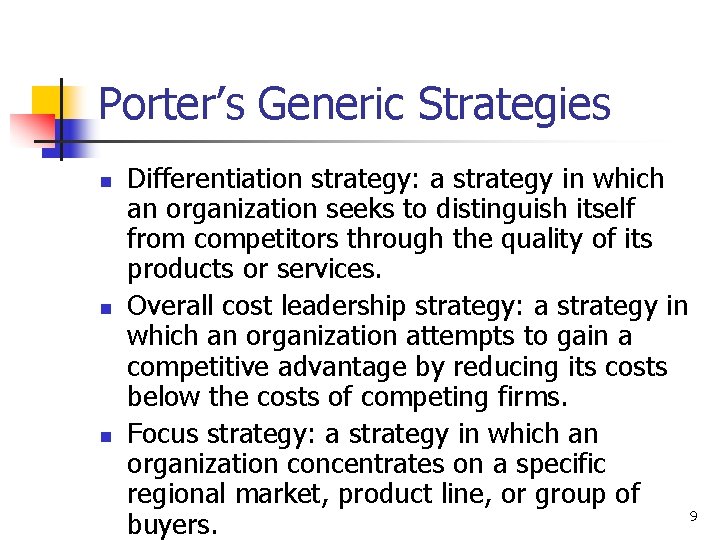
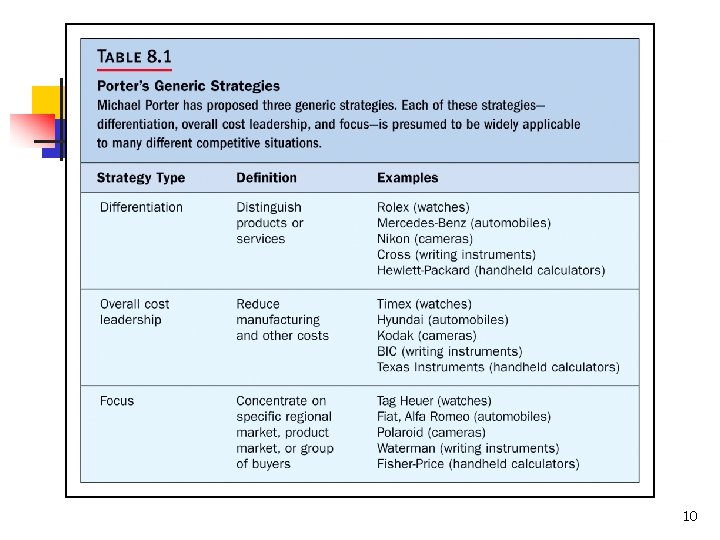
Porter’s Generic Strategies n n n Differentiation strategy: a strategy in which an organization seeks to distinguish itself from competitors through the quality of its products or services. Overall cost leadership strategy: a strategy in which an organization attempts to gain a competitive advantage by reducing its costs below the costs of competing firms. Focus strategy: a strategy in which an organization concentrates on a specific regional market, product line, or group of 9 buyers.
10
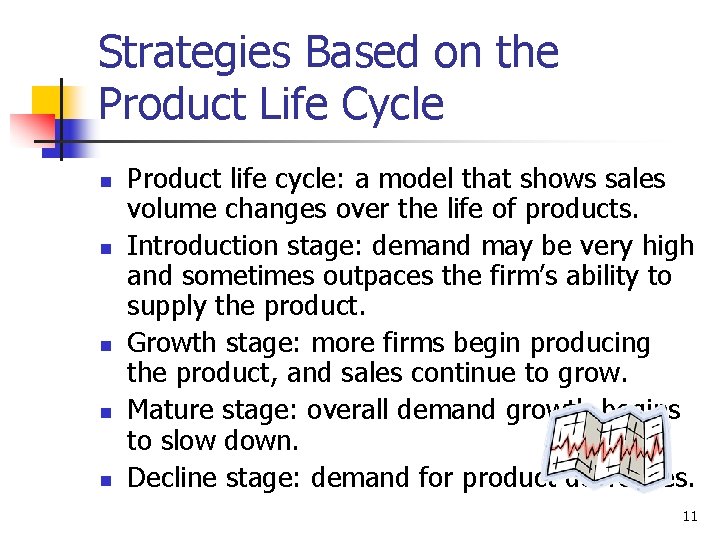
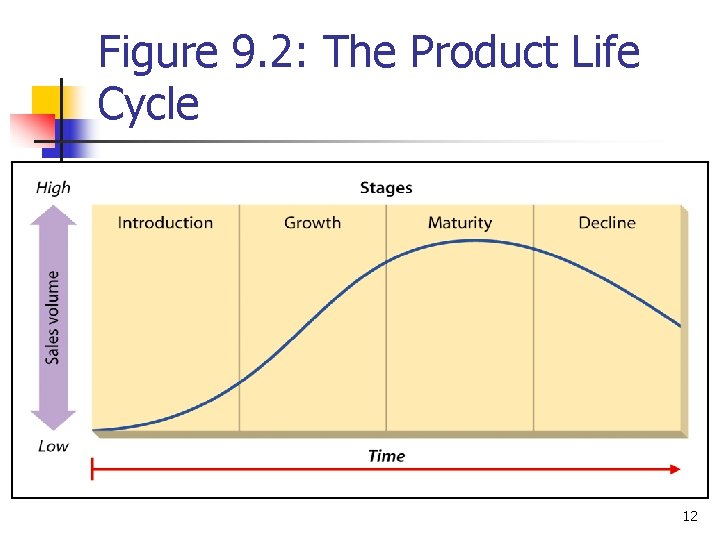
Strategies Based on the Product Life Cycle n n n Product life cycle: a model that shows sales volume changes over the life of products. Introduction stage: demand may be very high and sometimes outpaces the firm’s ability to supply the product. Growth stage: more firms begin producing the product, and sales continue to grow. Mature stage: overall demand growth begins to slow down. Decline stage: demand for product decreases. 11
Figure 9. 2: The Product Life Cycle n Insert Figure 8. 2 12
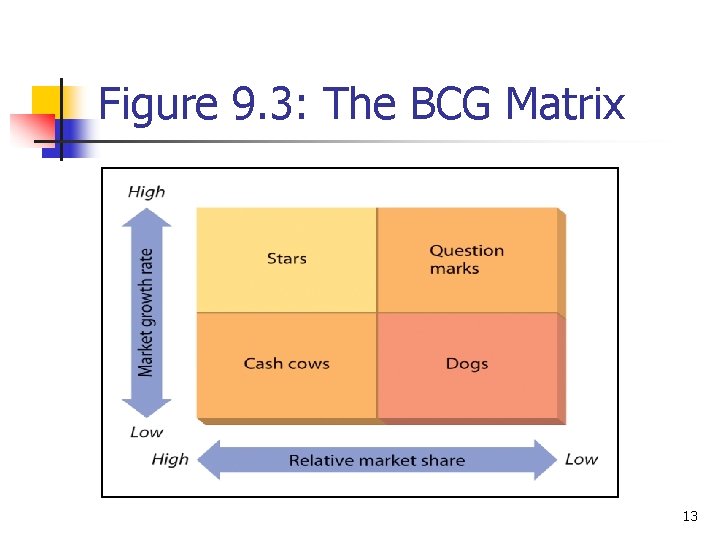
Figure 9. 3: The BCG Matrix 13