
Chapter 9 Managing Strategy 1 Strategic Management The
- Slides: 23
Chapter 9 Managing Strategy 1
Strategic Management �The set of managerial decisions and actions that determines the long-run performance of an organization 2
Why Strategic Management Is Important �It results in higher organizational performance �It requires that managers examine and adapt to business environment changes �It coordinates diverse organizational units, helping them focus on organizational goals �It is very much involved in the managerial decision-making process 3
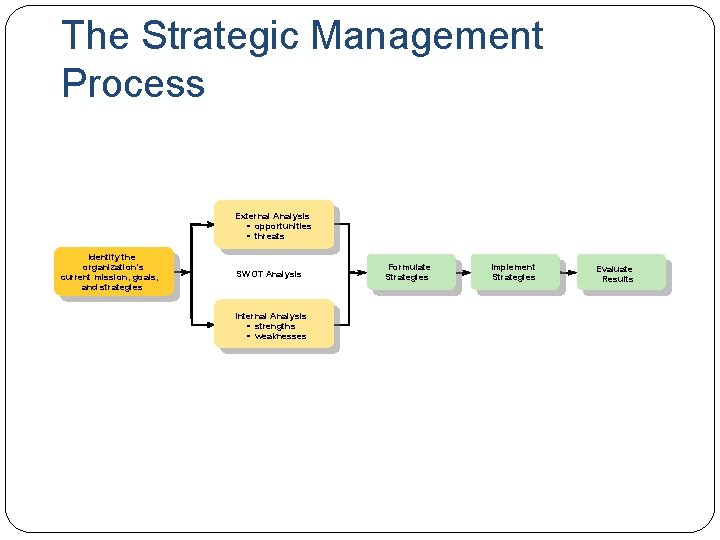
The Strategic Management Process External Analysis • opportunities • threats Identify the organization's current mission, goals, and strategies SWOT Analysis Internal Analysis • strengths • weaknesses 4 Formulate Strategies Implement Strategies Evaluate Results
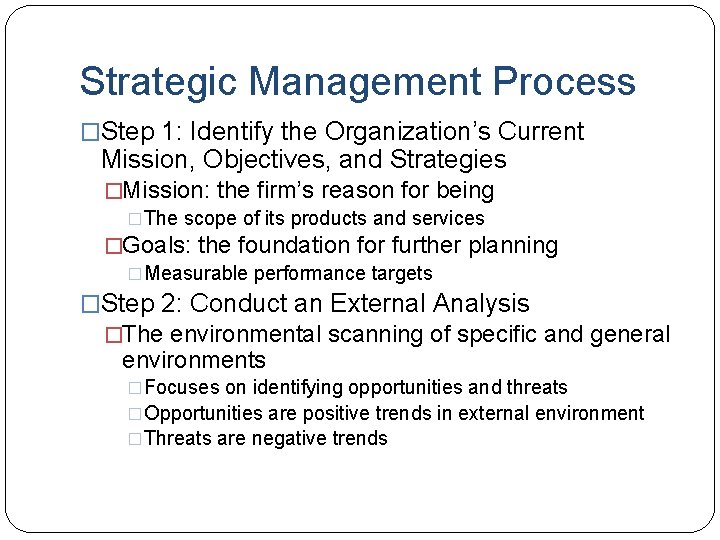
Strategic Management Process �Step 1: Identify the Organization’s Current Mission, Objectives, and Strategies �Mission: the firm’s reason for being �The scope of its products and services �Goals: the foundation for further planning �Measurable performance targets �Step 2: Conduct an External Analysis �The environmental scanning of specific and general environments �Focuses on identifying opportunities and threats �Opportunities are positive trends in external environment �Threats are negative trends 5
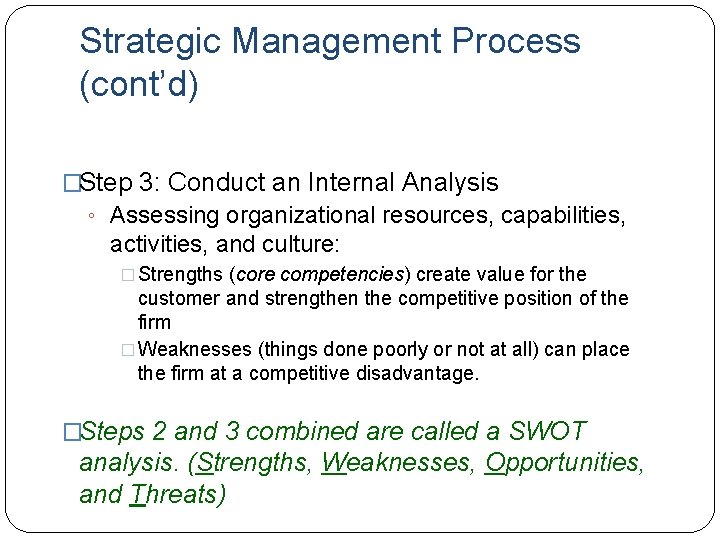
Strategic Management Process (cont’d) �Step 3: Conduct an Internal Analysis ◦ Assessing organizational resources, capabilities, activities, and culture: � Strengths (core competencies) create value for the customer and strengthen the competitive position of the firm � Weaknesses (things done poorly or not at all) can place the firm at a competitive disadvantage. �Steps 2 and 3 combined are called a SWOT 6 analysis. (Strengths, Weaknesses, Opportunities, and Threats)
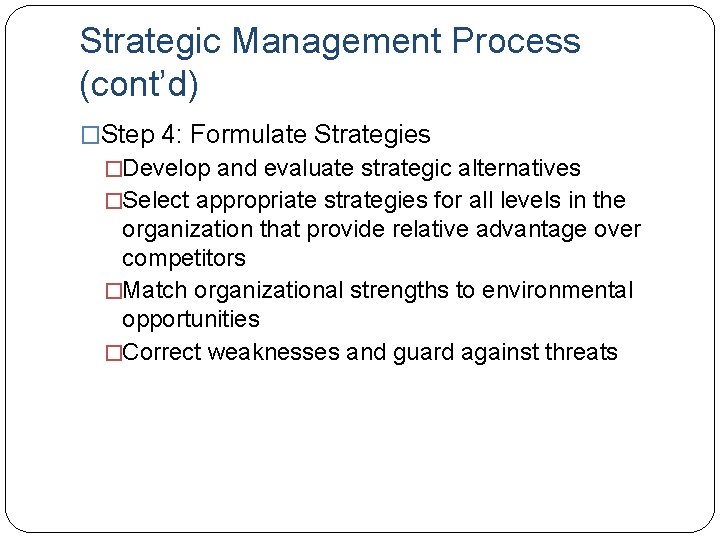
Strategic Management Process (cont’d) �Step 4: Formulate Strategies �Develop and evaluate strategic alternatives �Select appropriate strategies for all levels in the organization that provide relative advantage over competitors �Match organizational strengths to environmental opportunities �Correct weaknesses and guard against threats 7
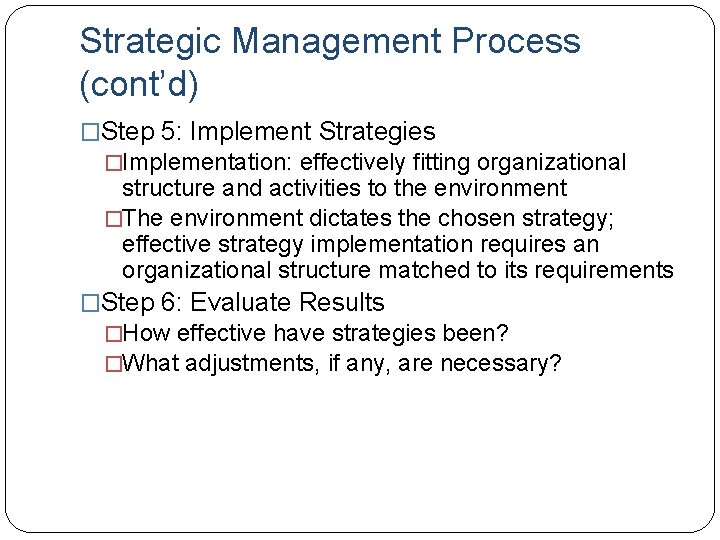
Strategic Management Process (cont’d) �Step 5: Implement Strategies �Implementation: effectively fitting organizational structure and activities to the environment �The environment dictates the chosen strategy; effective strategy implementation requires an organizational structure matched to its requirements �Step 6: Evaluate Results �How effective have strategies been? �What adjustments, if any, are necessary? 8
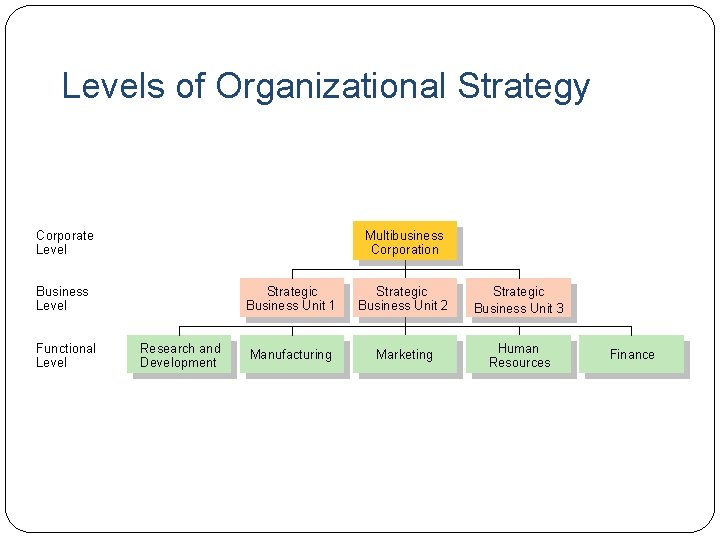
Levels of Organizational Strategy Corporate Level Multibusiness Corporation Business Level Functional Level 9 Research and Development Strategic Business Unit 1 Strategic Business Unit 2 Strategic Business Unit 3 Manufacturing Marketing Human Resources Finance
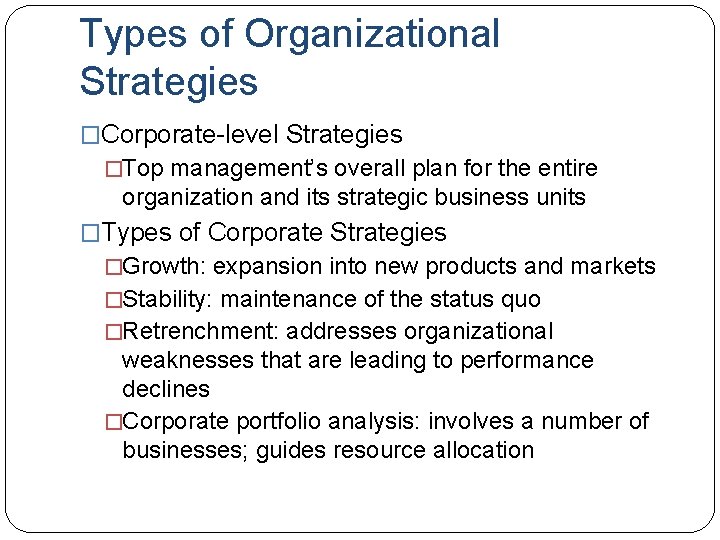
Types of Organizational Strategies �Corporate-level Strategies �Top management’s overall plan for the entire organization and its strategic business units �Types of Corporate Strategies �Growth: expansion into new products and markets �Stability: maintenance of the status quo �Retrenchment: addresses organizational weaknesses that are leading to performance declines �Corporate portfolio analysis: involves a number of businesses; guides resource allocation 1 0
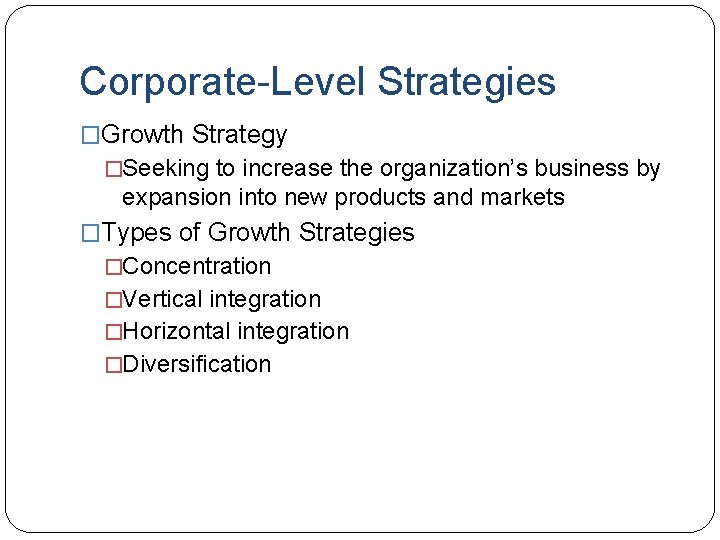
Corporate-Level Strategies �Growth Strategy �Seeking to increase the organization’s business by expansion into new products and markets �Types of Growth Strategies �Concentration �Vertical integration �Horizontal integration �Diversification 1 1
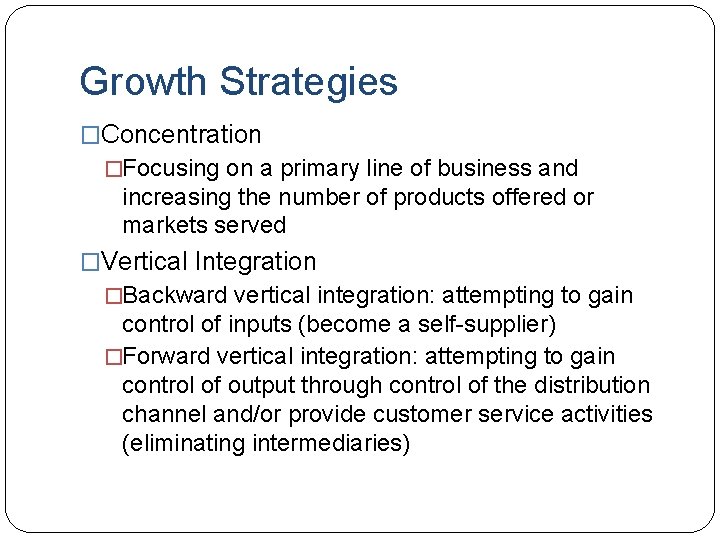
Growth Strategies �Concentration �Focusing on a primary line of business and increasing the number of products offered or markets served �Vertical Integration �Backward vertical integration: attempting to gain control of inputs (become a self-supplier) �Forward vertical integration: attempting to gain control of output through control of the distribution channel and/or provide customer service activities (eliminating intermediaries) 1 2
Growth Strategies (cont’d) �Horizontal Integration �Combining operations with another competitor in the same industry to increase competitive strengths and lower competition among industry rivals �Diversification �Related Diversification �Expanding by merging with or acquiring firms in different, but related industries that are “strategic fits” �Unrelated Diversification �Growing by merging with or acquiring firms in unrelated industries where higher financial returns are possible 1 3
Corporate-Level Strategies (cont’d) �Stability Strategy �A strategy that seeks to maintain the status quo to deal with the uncertainty of a dynamic environment, when the industry is experiencing slow- or nogrowth conditions, or if the owners of the firm elect not to grow for personal reasons 1 4
Corporate-Level Strategies (cont’d) �Retrenchment Strategy �Reduces the company’s activities or operations �Retrenchment strategies include: �Cost reductions �Layoffs �Closing underperforming units �Closing entire product lines or services 1 5
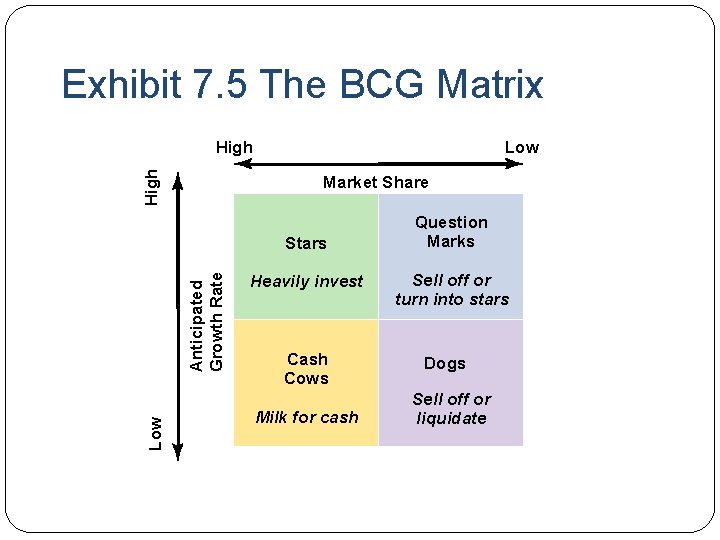
Corporate-Level Strategies (cont’d) �Corporate Portfolio Analysis � BCG Matrix �Developed by the Boston Consulting Group �Considers market share and industry growth rate �Classifies firms as: �Cash cows: low growth rate, high market share �Stars: high growth rate, high market share �Question marks: high growth rate, low market share �Dogs: low growth rate, low market share 1 6
Exhibit 7. 5 The BCG Matrix High Low Market Share Low Anticipated Growth Rate Stars 1 7 Heavily invest Cash Cows Milk for cash Question Marks Sell off or turn into stars Dogs Sell off or liquidate
Business-Level Strategy �A strategy that seeks to determine how an organization should compete in each of its SBUs (strategic business units) 1 8
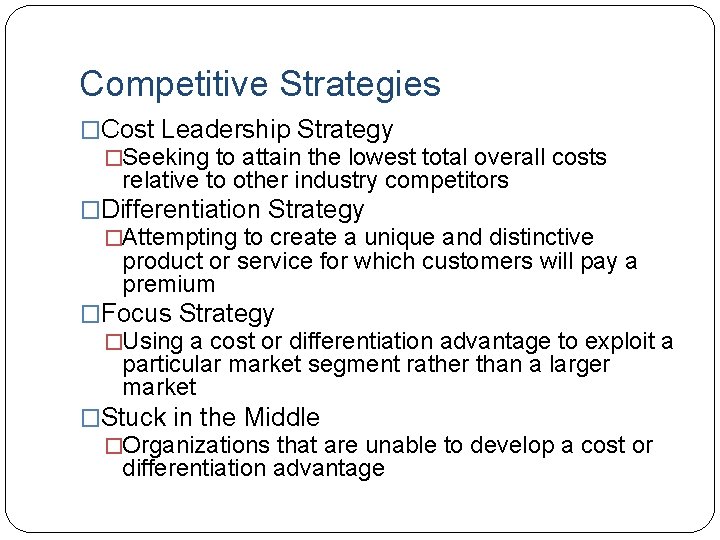
Competitive Strategies �Cost Leadership Strategy �Seeking to attain the lowest total overall costs relative to other industry competitors �Differentiation Strategy �Attempting to create a unique and distinctive product or service for which customers will pay a premium �Focus Strategy �Using a cost or differentiation advantage to exploit a particular market segment rather than a larger market �Stuck in the Middle �Organizations that are unable to develop a cost or differentiation advantage 1 9
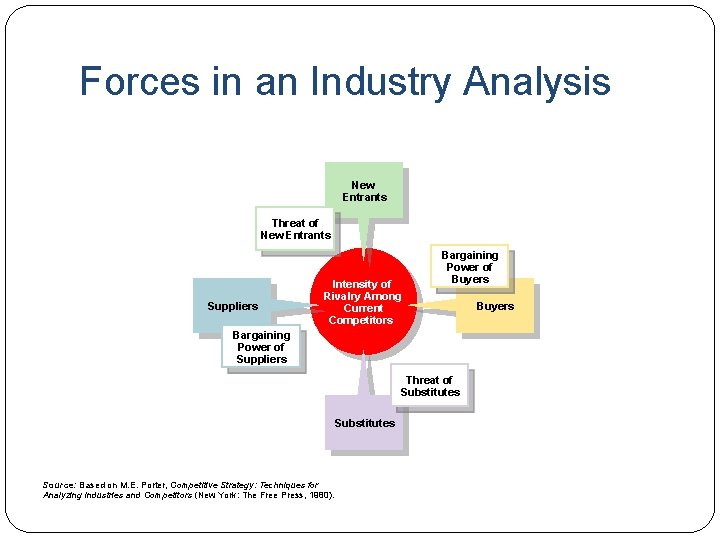
Forces in an Industry Analysis New Entrants Threat of New Entrants Suppliers Intensity of Rivalry Among Current Competitors Bargaining Power of Buyers Bargaining Power of Suppliers Threat of Substitutes 2 0 Source: Based on M. E. Porter, Competitive Strategy: Techniques for Analyzing Industries and Competitors (New York: The Free Press, 1980). Buyers
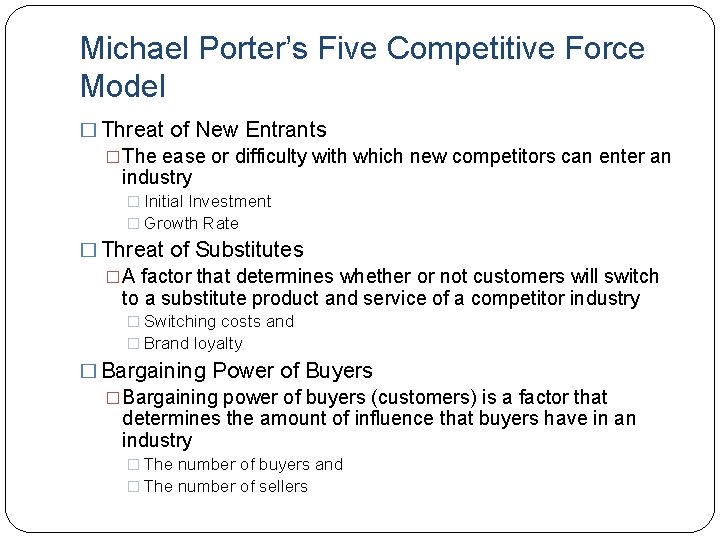
Michael Porter’s Five Competitive Force Model � Threat of New Entrants �The ease or difficulty with which new competitors can enter an industry � Initial Investment � Growth Rate � Threat of Substitutes �A factor that determines whether or not customers will switch to a substitute product and service of a competitor industry � Switching costs and � Brand loyalty � Bargaining Power of Buyers �Bargaining power of buyers (customers) is a factor that determines the amount of influence that buyers have in an industry 2 1 � The number of buyers and � The number of sellers
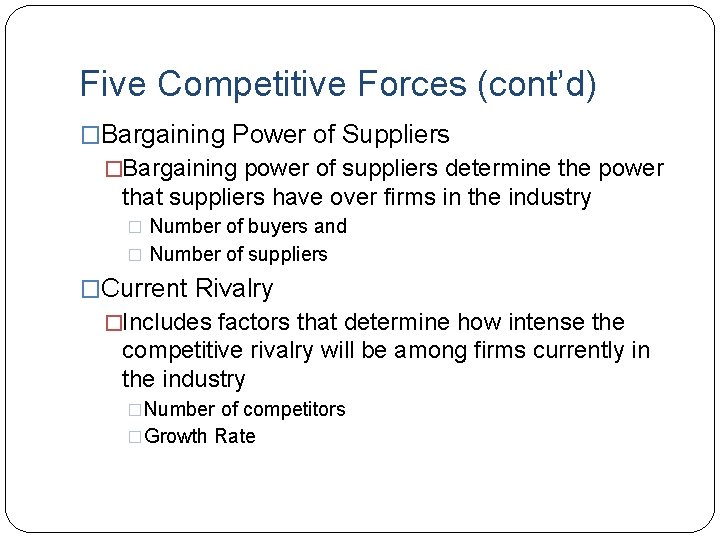
Five Competitive Forces (cont’d) �Bargaining Power of Suppliers �Bargaining power of suppliers determine the power that suppliers have over firms in the industry � Number of buyers and � Number of suppliers �Current Rivalry �Includes factors that determine how intense the competitive rivalry will be among firms currently in the industry �Number of competitors �Growth Rate 2 2
Functional-Level Strategy �Functional-level strategies support the business- level strategy �i. e. , Marketing, human resources, research and development, and finance all support the businesslevel strategy �Problems occur when employees or customers don’t understand a company’s strategy 2 3