
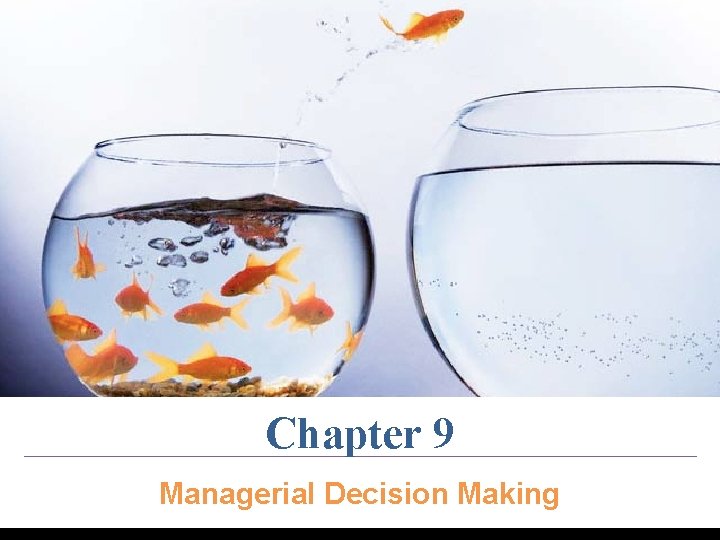
Chapter 9 Managerial Decision Making Types of Decisions
- Slides: 10
Chapter 9 Managerial Decision Making
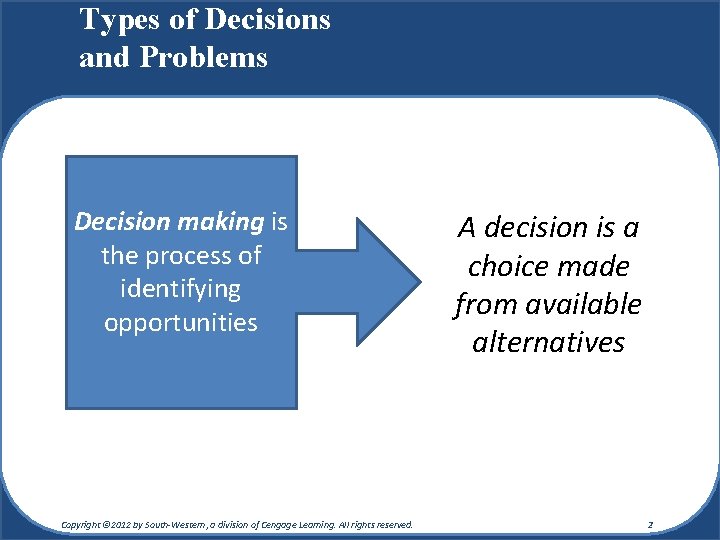
Types of Decisions and Problems Decision making is the process of identifying opportunities Copyright © 2012 by South-Western, a division of Cengage Learning. All rights reserved. A decision is a choice made from available alternatives 2
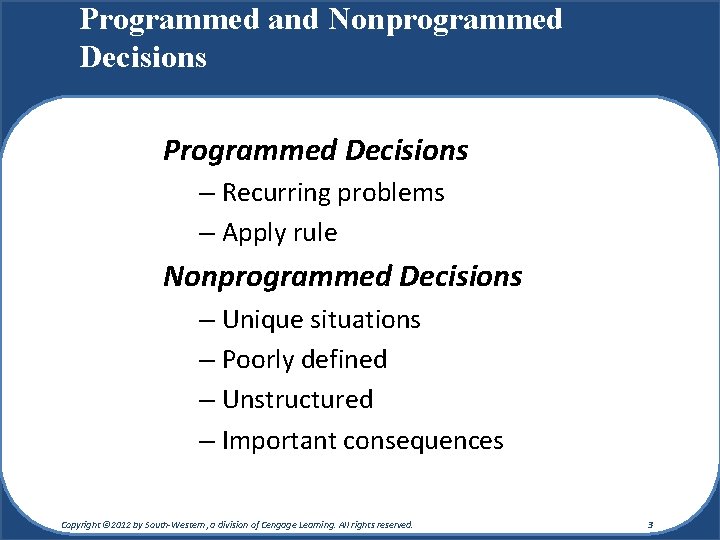
Programmed and Nonprogrammed Decisions Programmed Decisions – Recurring problems – Apply rule Nonprogrammed Decisions – Unique situations – Poorly defined – Unstructured – Important consequences Copyright © 2012 by South-Western, a division of Cengage Learning. All rights reserved. 3
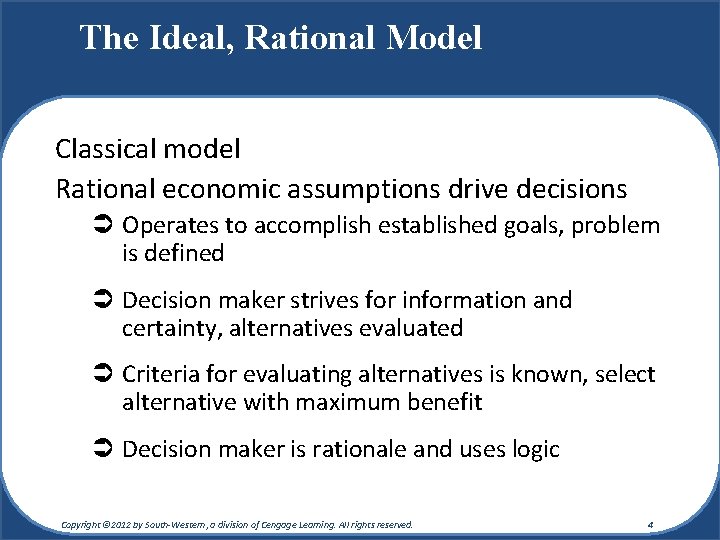
The Ideal, Rational Model Classical model Rational economic assumptions drive decisions Ü Operates to accomplish established goals, problem is defined Ü Decision maker strives for information and certainty, alternatives evaluated Ü Criteria for evaluating alternatives is known, select alternative with maximum benefit Ü Decision maker is rationale and uses logic Copyright © 2012 by South-Western, a division of Cengage Learning. All rights reserved. 4
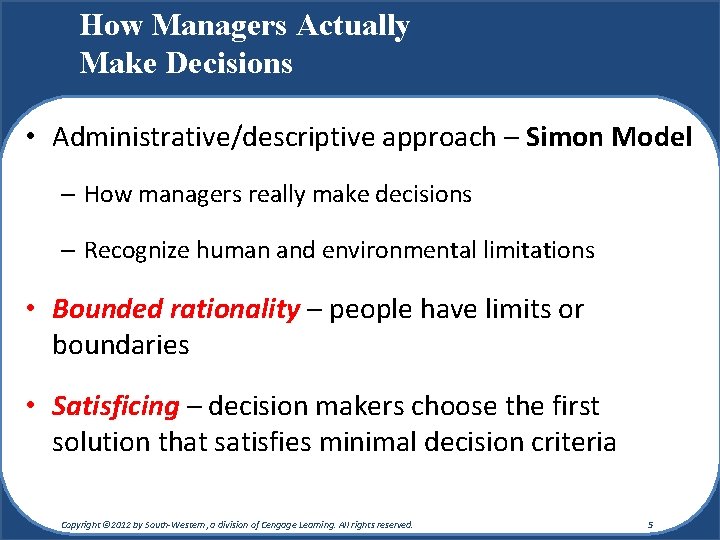
How Managers Actually Make Decisions • Administrative/descriptive approach – Simon Model – How managers really make decisions – Recognize human and environmental limitations • Bounded rationality – people have limits or boundaries • Satisficing – decision makers choose the first solution that satisfies minimal decision criteria Copyright © 2012 by South-Western, a division of Cengage Learning. All rights reserved. 5
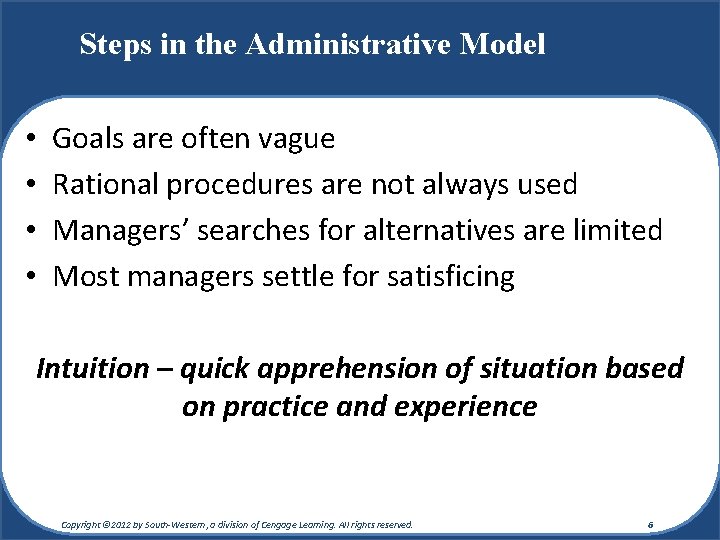
Steps in the Administrative Model • • Goals are often vague Rational procedures are not always used Managers’ searches for alternatives are limited Most managers settle for satisficing Intuition – quick apprehension of situation based on practice and experience Copyright © 2012 by South-Western, a division of Cengage Learning. All rights reserved. 6
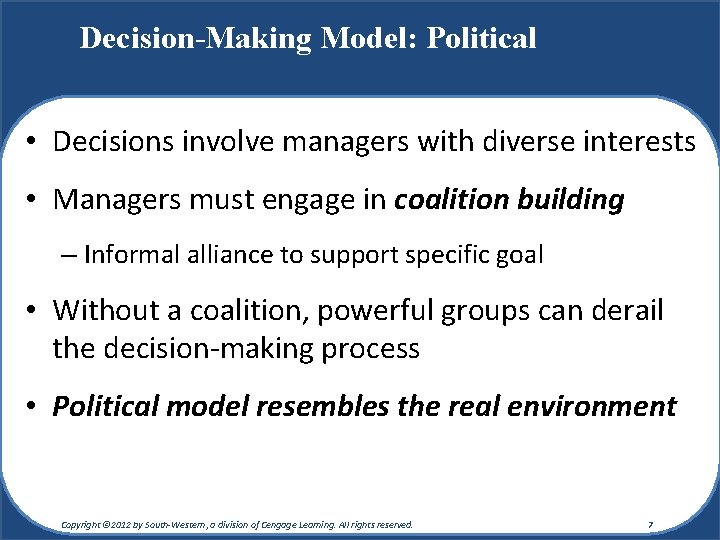
Decision-Making Model: Political • Decisions involve managers with diverse interests • Managers must engage in coalition building – Informal alliance to support specific goal • Without a coalition, powerful groups can derail the decision-making process • Political model resembles the real environment Copyright © 2012 by South-Western, a division of Cengage Learning. All rights reserved. 7
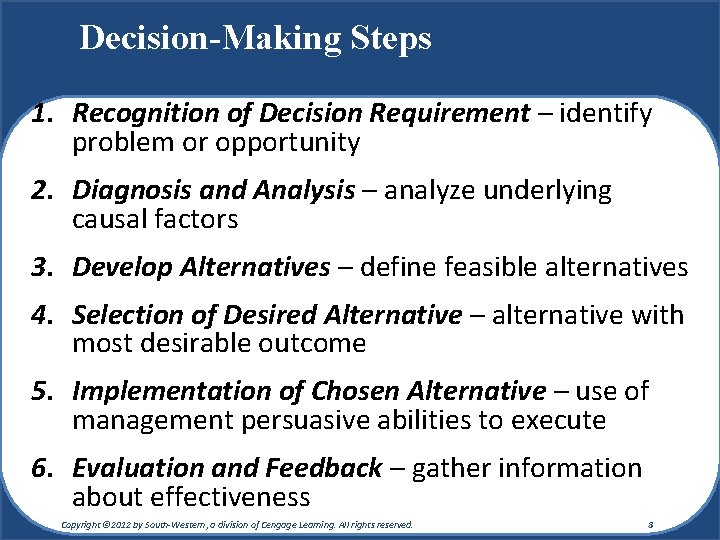
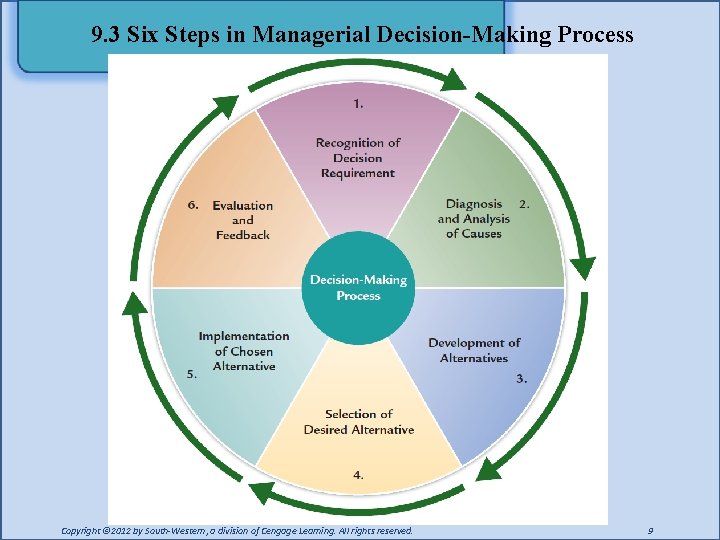
Decision-Making Steps 1. Recognition of Decision Requirement – identify problem or opportunity 2. Diagnosis and Analysis – analyze underlying causal factors 3. Develop Alternatives – define feasible alternatives 4. Selection of Desired Alternative – alternative with most desirable outcome 5. Implementation of Chosen Alternative – use of management persuasive abilities to execute 6. Evaluation and Feedback – gather information about effectiveness Copyright © 2012 by South-Western, a division of Cengage Learning. All rights reserved. 8
9. 3 Six Steps in Managerial Decision-Making Process Copyright © 2012 by South-Western, a division of Cengage Learning. All rights reserved. 9
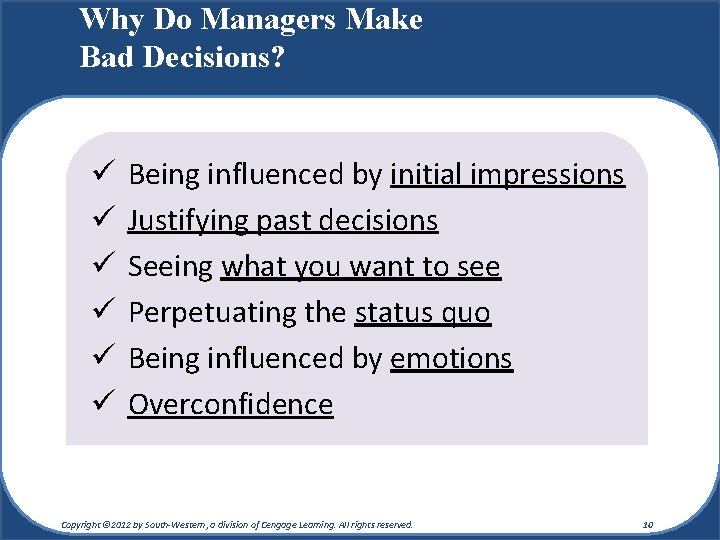
Why Do Managers Make Bad Decisions? ü ü ü Being influenced by initial impressions Justifying past decisions Seeing what you want to see Perpetuating the status quo Being influenced by emotions Overconfidence Copyright © 2012 by South-Western, a division of Cengage Learning. All rights reserved. 10