
Chapter 9 Management Principles The Management Process Management
- Slides: 57
Chapter 9 Management Principles
The Management Process Management – a process whereby unrelated resources are integrated into a total system for accomplishment of objectives. l Involves: l l l Planning Organizing Staffing Leading Controlling © 2004 Pearson Education, Inc. Upper Saddle River, New Jersey 07458 Foodservice Organizations, 5 th edition Spears & Gregoire
Managing Organizations l Organization – a group of people working together in a structured & coordinated way to achieve goals. l Management is a set of activities directed at an organization’s resources for achieving goals effectively & efficiently. © 2004 Pearson Education, Inc. Upper Saddle River, New Jersey 07458 Foodservice Organizations, 5 th edition Spears & Gregoire
Management Concepts l Authority – delegation from top to lower levels of management & the right of managers to direct others & take action of their position. l Responsibility – obligation to perform an assigned activity or see that someone else performs it. © 2004 Pearson Education, Inc. Upper Saddle River, New Jersey 07458 Foodservice Organizations, 5 th edition Spears & Gregoire
Management Concepts l Accountability – state of being responsible to one’s self, to some organization, or to the public. l Efficiency – “Doing things right. ” l Effectiveness – “Doing the right things. ” © 2004 Pearson Education, Inc. Upper Saddle River, New Jersey 07458 Foodservice Organizations, 5 th edition Spears & Gregoire
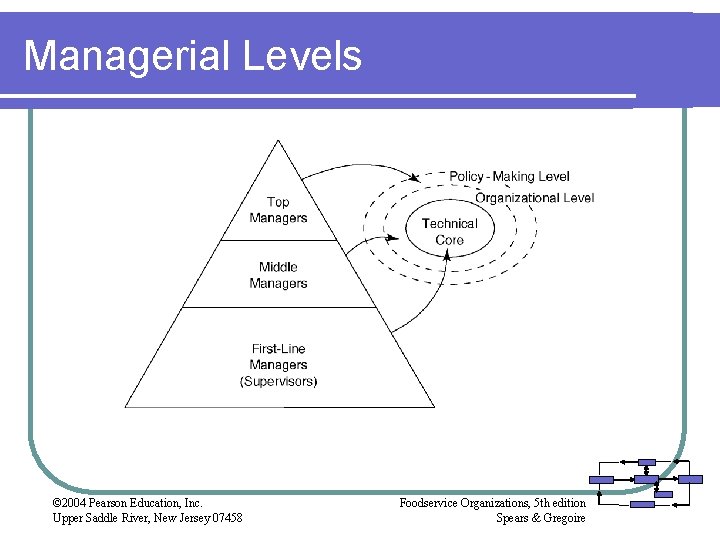
Managerial Levels l Manager – anyone responsible for people & other organizational resources. l Managerial Levels: First-line –supervises employees l Middle – coordinates activities implementing an organization’s policies l Top – executives that control the organization l © 2004 Pearson Education, Inc. Upper Saddle River, New Jersey 07458 Foodservice Organizations, 5 th edition Spears & Gregoire
Managerial Levels © 2004 Pearson Education, Inc. Upper Saddle River, New Jersey 07458 Foodservice Organizations, 5 th edition Spears & Gregoire
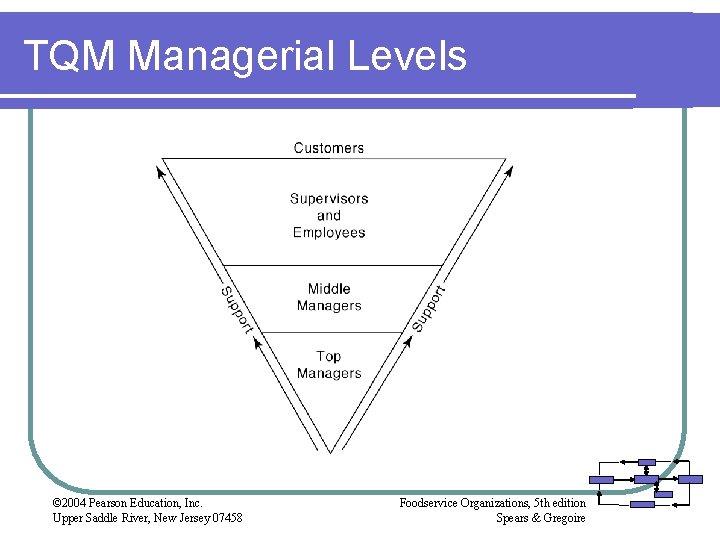
TQM Managerial Levels © 2004 Pearson Education, Inc. Upper Saddle River, New Jersey 07458 Foodservice Organizations, 5 th edition Spears & Gregoire
TQM Managerial Levels l TQM philosophy adaptations: Create smaller organizational units l Form cross-functioning teams l Empower employees to make decisions l Reduce the number of organizational levels l Place emphasis on vision & values l Find ways to take advantage of the Internet l © 2004 Pearson Education, Inc. Upper Saddle River, New Jersey 07458 Foodservice Organizations, 5 th edition Spears & Gregoire
General & Functional Managers l General manager – responsible for all activities of a organizational unit. l Functional manager – responsible only for one area of organizational activity. © 2004 Pearson Education, Inc. Upper Saddle River, New Jersey 07458 Foodservice Organizations, 5 th edition Spears & Gregoire
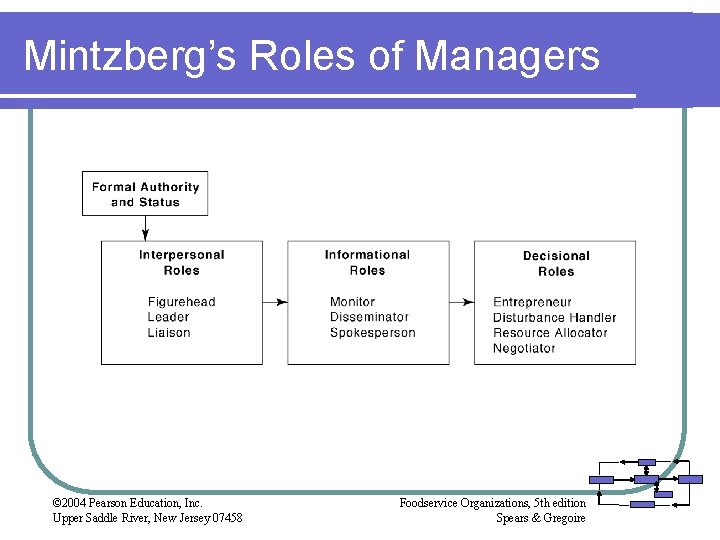
Mintzberg’s Roles of Managers © 2004 Pearson Education, Inc. Upper Saddle River, New Jersey 07458 Foodservice Organizations, 5 th edition Spears & Gregoire
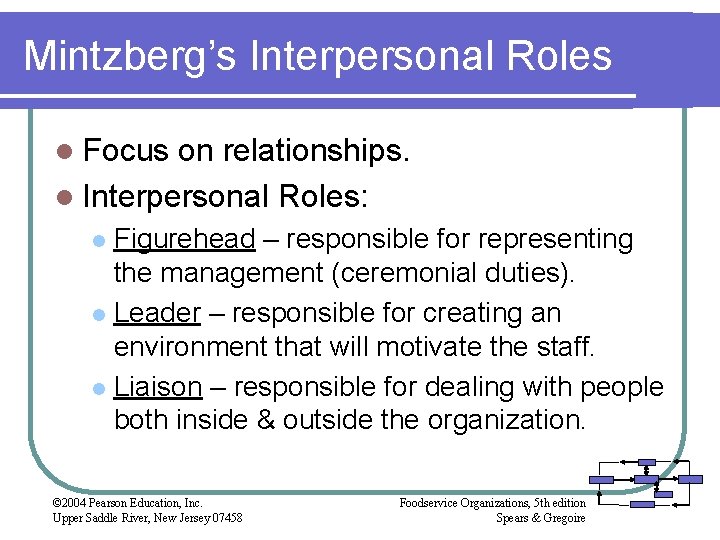
Mintzberg’s Interpersonal Roles l Focus on relationships. l Interpersonal Roles: Figurehead – responsible for representing the management (ceremonial duties). l Leader – responsible for creating an environment that will motivate the staff. l Liaison – responsible for dealing with people both inside & outside the organization. l © 2004 Pearson Education, Inc. Upper Saddle River, New Jersey 07458 Foodservice Organizations, 5 th edition Spears & Gregoire
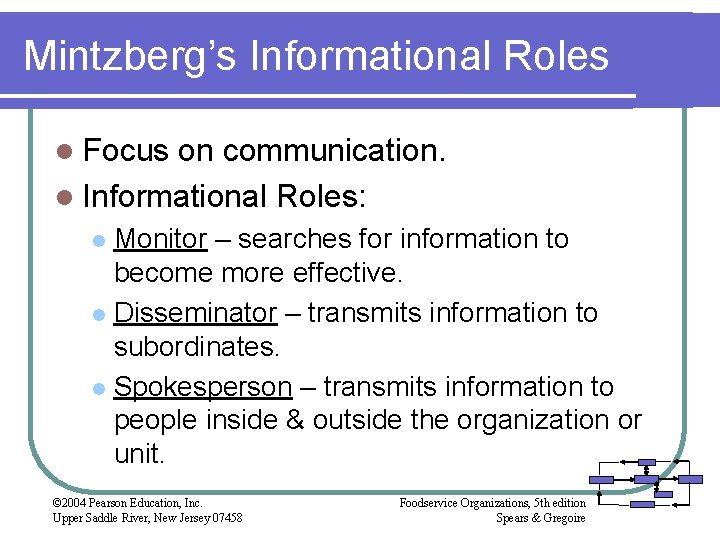
Mintzberg’s Informational Roles l Focus on communication. l Informational Roles: Monitor – searches for information to become more effective. l Disseminator – transmits information to subordinates. l Spokesperson – transmits information to people inside & outside the organization or unit. l © 2004 Pearson Education, Inc. Upper Saddle River, New Jersey 07458 Foodservice Organizations, 5 th edition Spears & Gregoire
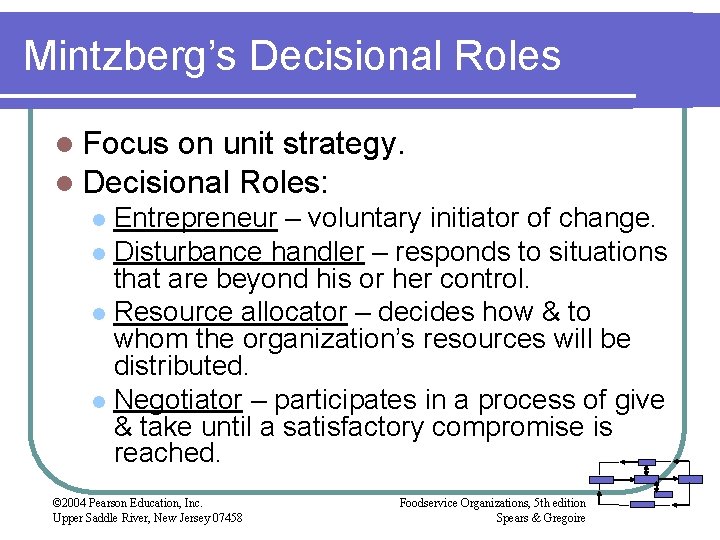
Mintzberg’s Decisional Roles l Focus on unit strategy. l Decisional Roles: Entrepreneur – voluntary initiator of change. l Disturbance handler – responds to situations that are beyond his or her control. l Resource allocator – decides how & to whom the organization’s resources will be distributed. l Negotiator – participates in a process of give & take until a satisfactory compromise is reached. l © 2004 Pearson Education, Inc. Upper Saddle River, New Jersey 07458 Foodservice Organizations, 5 th edition Spears & Gregoire
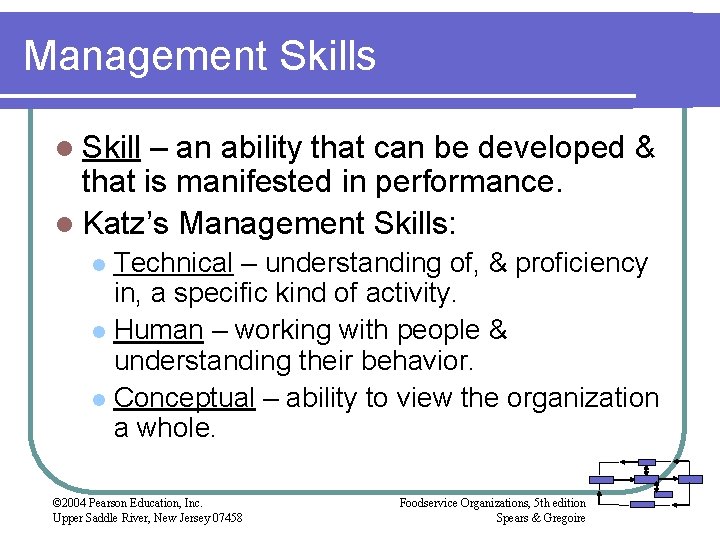
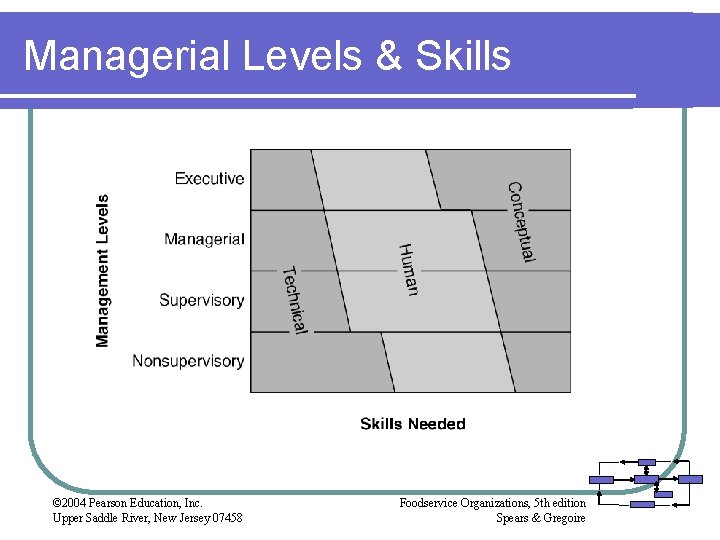
Management Skills l Skill – an ability that can be developed & that is manifested in performance. l Katz’s Management Skills: Technical – understanding of, & proficiency in, a specific kind of activity. l Human – working with people & understanding their behavior. l Conceptual – ability to view the organization a whole. l © 2004 Pearson Education, Inc. Upper Saddle River, New Jersey 07458 Foodservice Organizations, 5 th edition Spears & Gregoire
Managerial Levels & Skills © 2004 Pearson Education, Inc. Upper Saddle River, New Jersey 07458 Foodservice Organizations, 5 th edition Spears & Gregoire
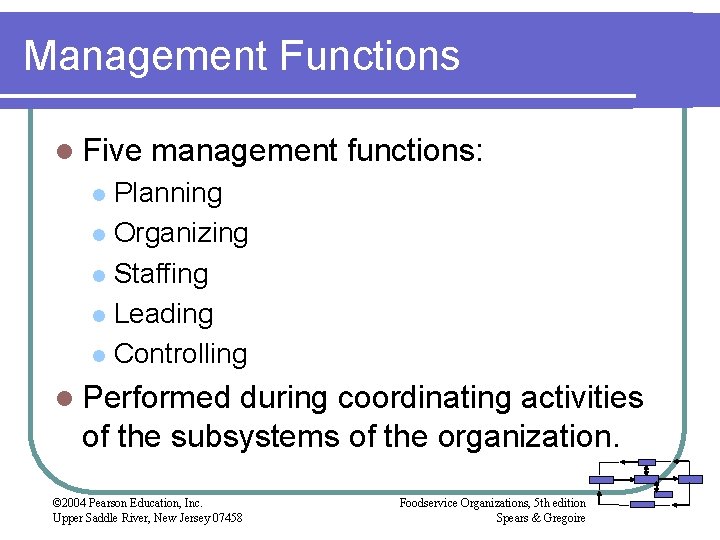
Management Functions l Five management functions: Planning l Organizing l Staffing l Leading l Controlling l l Performed during coordinating activities of the subsystems of the organization. © 2004 Pearson Education, Inc. Upper Saddle River, New Jersey 07458 Foodservice Organizations, 5 th edition Spears & Gregoire
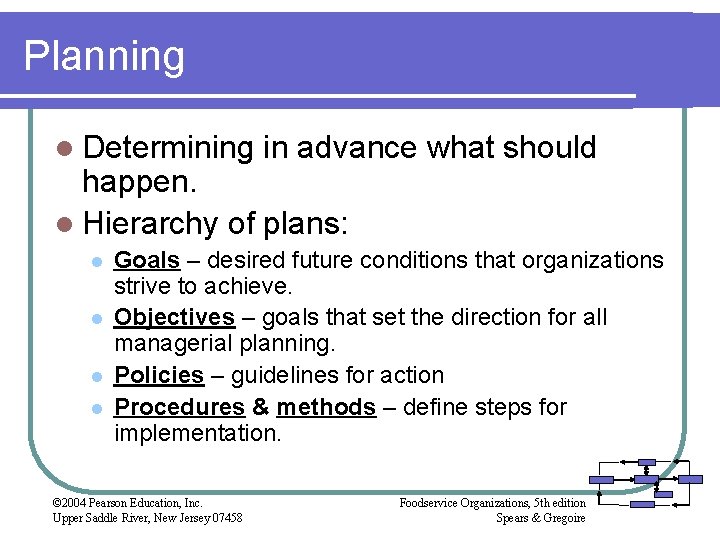
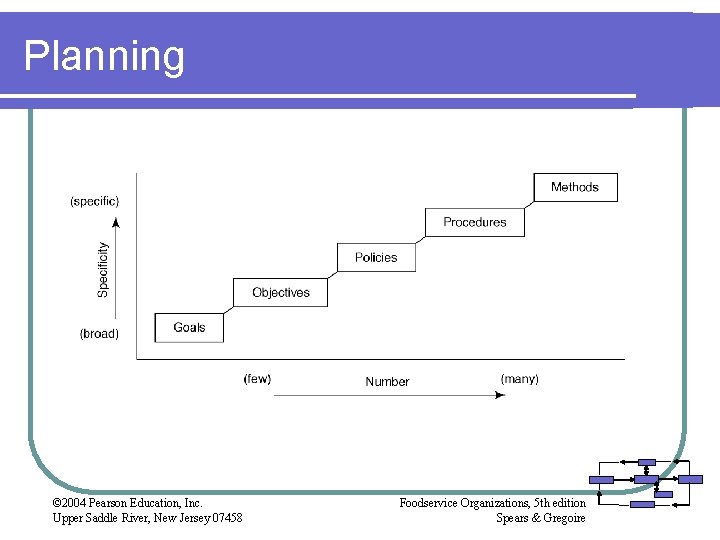
Planning l Determining in advance what should happen. l Hierarchy of plans: l l Goals – desired future conditions that organizations strive to achieve. Objectives – goals that set the direction for all managerial planning. Policies – guidelines for action Procedures & methods – define steps for implementation. © 2004 Pearson Education, Inc. Upper Saddle River, New Jersey 07458 Foodservice Organizations, 5 th edition Spears & Gregoire
Planning © 2004 Pearson Education, Inc. Upper Saddle River, New Jersey 07458 Foodservice Organizations, 5 th edition Spears & Gregoire
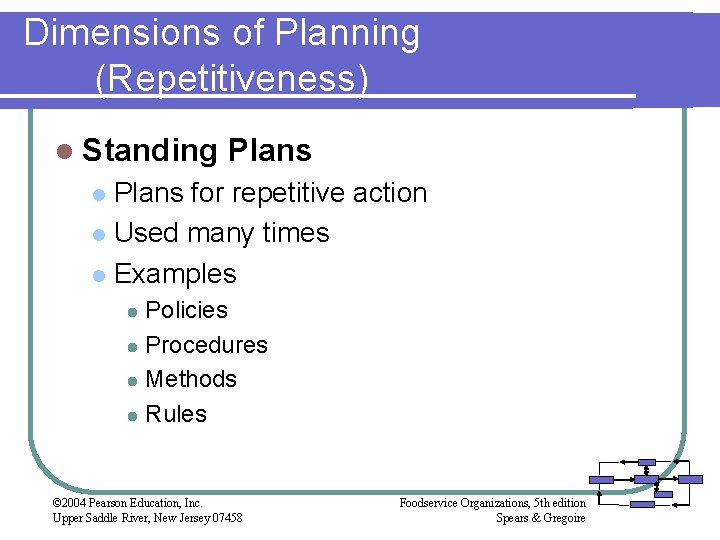
Dimensions of Planning (Repetitiveness) l Standing Plans for repetitive action l Used many times l Examples l Policies l Procedures l Methods l Rules l © 2004 Pearson Education, Inc. Upper Saddle River, New Jersey 07458 Foodservice Organizations, 5 th edition Spears & Gregoire
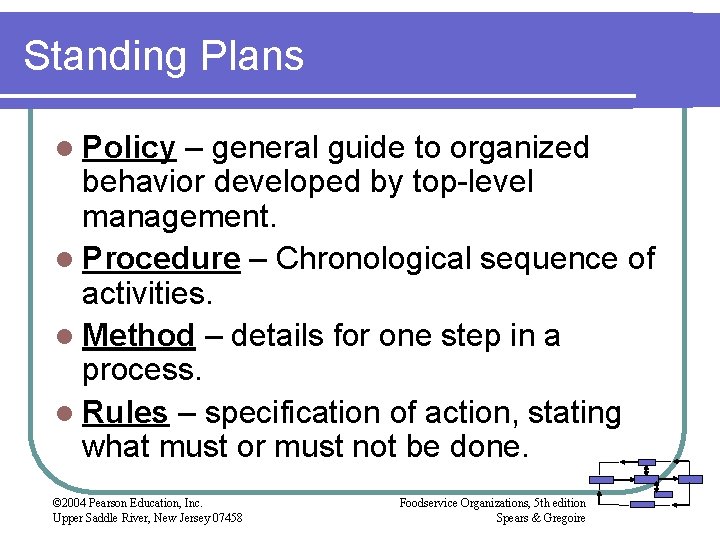
Standing Plans l Policy – general guide to organized behavior developed by top-level management. l Procedure – Chronological sequence of activities. l Method – details for one step in a process. l Rules – specification of action, stating what must or must not be done. © 2004 Pearson Education, Inc. Upper Saddle River, New Jersey 07458 Foodservice Organizations, 5 th edition Spears & Gregoire
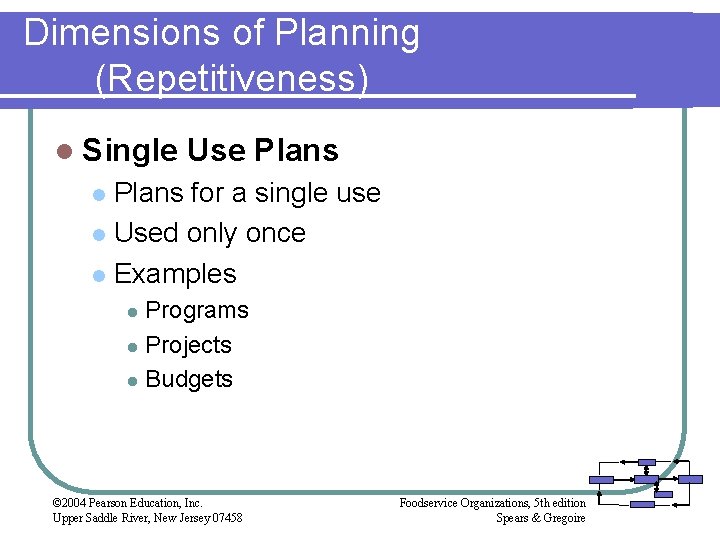
Dimensions of Planning (Repetitiveness) l Single Use Plans for a single use l Used only once l Examples l Programs l Projects l Budgets l © 2004 Pearson Education, Inc. Upper Saddle River, New Jersey 07458 Foodservice Organizations, 5 th edition Spears & Gregoire
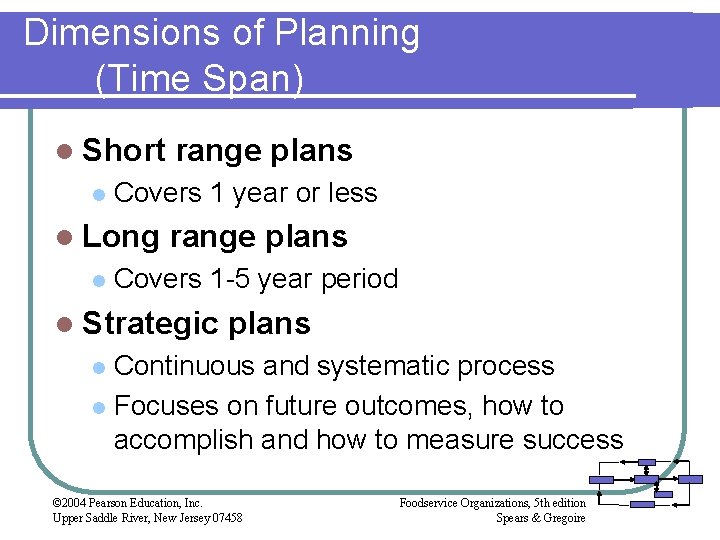
Dimensions of Planning (Time Span) l Short l Covers 1 year or less l Long l range plans Covers 1 -5 year period l Strategic plans Continuous and systematic process l Focuses on future outcomes, how to accomplish and how to measure success l © 2004 Pearson Education, Inc. Upper Saddle River, New Jersey 07458 Foodservice Organizations, 5 th edition Spears & Gregoire
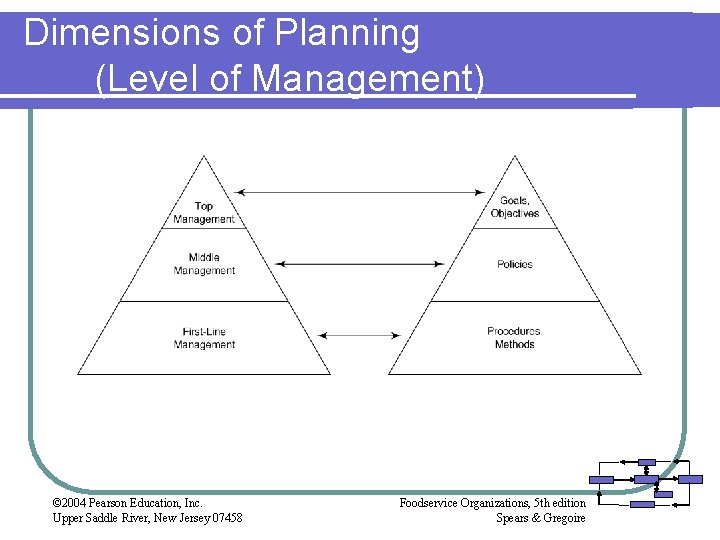
Dimensions of Planning (Level of Management) © 2004 Pearson Education, Inc. Upper Saddle River, New Jersey 07458 Foodservice Organizations, 5 th edition Spears & Gregoire
Organizing l Process of: Grouping activities l Delegating authority to accomplish activities l Providing for coordination of relationships l Facilitating decision making l l Formal Organization – the outcome of organizing, usually in chart form. © 2004 Pearson Education, Inc. Upper Saddle River, New Jersey 07458 Foodservice Organizations, 5 th edition Spears & Gregoire
Span of Management l Number of employees that can be effectively supervised by one manager. l Factors in determining proper number: Organizational policies l Availability of staff experts l Competence of staff l Objective standards l Nature of the work l Distribution of workforce l © 2004 Pearson Education, Inc. Upper Saddle River, New Jersey 07458 Foodservice Organizations, 5 th edition Spears & Gregoire
Delegation l Delegation - assigning job activities & authority to a specific employee within the organization. l Authority is delegated down the hierarchy of the organization. l Effective delegation elements: Specific tasks must be assigned clearly. l Sufficient authority must be granted. l Responsibility must be created. l © 2004 Pearson Education, Inc. Upper Saddle River, New Jersey 07458 Foodservice Organizations, 5 th edition Spears & Gregoire
Staffing l The recruitment, selection, training, & development of people who will be most effective in helping the organization meet its goals. l Primarily carried out by a personnel department. l Line managers are responsible for training, & development. © 2004 Pearson Education, Inc. Upper Saddle River, New Jersey 07458 Foodservice Organizations, 5 th edition Spears & Gregoire
Staffing Steps l Human Resources Planning l l Recruitment & Selection l l designed to ensure an organization’s labor requirements are continuously met. concerned with developing, evaluating, & choosing a pool of job applicants. Orientation, Training, & Development l acquaints newcomers with organization & its goals & policies & informs them of their responsibilities. © 2004 Pearson Education, Inc. Upper Saddle River, New Jersey 07458 Foodservice Organizations, 5 th edition Spears & Gregoire
Staffing Steps l Performance l Appraisal compares an individual’s performance with established standards for the job. l Compensation l encompasses all activities concerned with administration of the wage, salary, and benefits program. © 2004 Pearson Education, Inc. Upper Saddle River, New Jersey 07458 Foodservice Organizations, 5 th edition Spears & Gregoire
Leading l Management function of directing human resources for the accomplishment of objectives. l Includes: Morale l Employee satisfaction l Productivity l Communication l © 2004 Pearson Education, Inc. Upper Saddle River, New Jersey 07458 Foodservice Organizations, 5 th edition Spears & Gregoire
Controlling Management function of ensuring that plans are being followed. l Involves: l l Measuring actual performance & comparing it with desired performance or standards. Analyzing deviations between actual & desired performance & determining whether or not deviations are within acceptable limits. Taking actions to correct unacceptable deviations. © 2004 Pearson Education, Inc. Upper Saddle River, New Jersey 07458 Foodservice Organizations, 5 th edition Spears & Gregoire
Quality of Work Life (QWL) l Guidelines: Decisions are made at the lowest possible level. l Teams of employees are responsible for a complete job. l Technical & social potential of employees & the organization is developed. l Quality & quality of employees are emphasized. l © 2004 Pearson Education, Inc. Upper Saddle River, New Jersey 07458 Foodservice Organizations, 5 th edition Spears & Gregoire
Quality of Work Life (QWL) l Guidelines (cont. ): Safety & health of employees are emphasized. l Availability of immediate feedback of information required to perform a job. l Problems are solved by teams, but responsibility is shared by all levels of the organization. l © 2004 Pearson Education, Inc. Upper Saddle River, New Jersey 07458 Foodservice Organizations, 5 th edition Spears & Gregoire
Quality of Work Life Participative management – involving employees in the decision making process. l Leader-member relations – refers to nature of the relationship between the leader & work group. l Team-based leadership – two or more people who interact regularly to accomplish a common purpose or goal. l Self-managed teams – teams that do the daily work. l © 2004 Pearson Education, Inc. Upper Saddle River, New Jersey 07458 Foodservice Organizations, 5 th edition Spears & Gregoire
Corporate Culture l Includes shared: Philosophies l Values l Assumptions l Beliefs l Expectations l Attitudes l Norms l l Knits an organization together. © 2004 Pearson Education, Inc. Upper Saddle River, New Jersey 07458 Foodservice Organizations, 5 th edition Spears & Gregoire
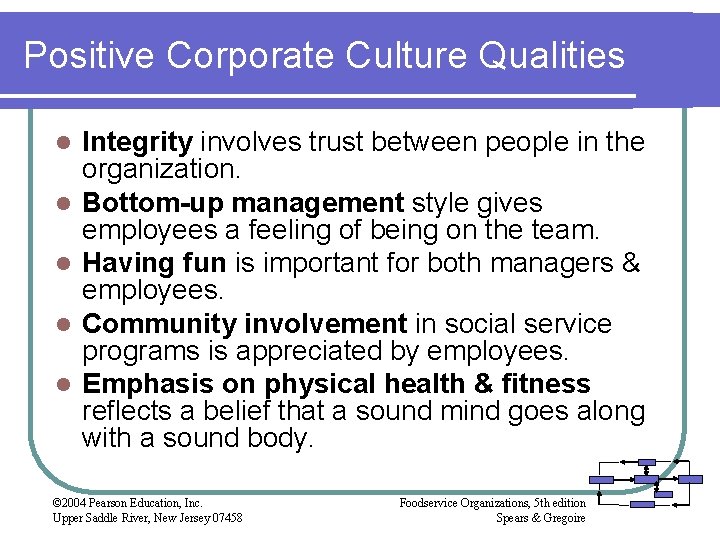
Positive Corporate Culture Qualities l l l Integrity involves trust between people in the organization. Bottom-up management style gives employees a feeling of being on the team. Having fun is important for both managers & employees. Community involvement in social service programs is appreciated by employees. Emphasis on physical health & fitness reflects a belief that a sound mind goes along with a sound body. © 2004 Pearson Education, Inc. Upper Saddle River, New Jersey 07458 Foodservice Organizations, 5 th edition Spears & Gregoire
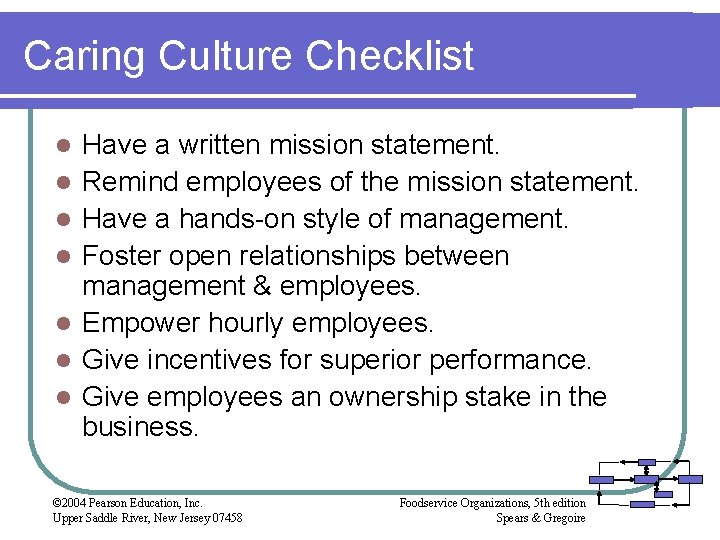
Caring Culture Checklist l l l l Have a written mission statement. Remind employees of the mission statement. Have a hands-on style of management. Foster open relationships between management & employees. Empower hourly employees. Give incentives for superior performance. Give employees an ownership stake in the business. © 2004 Pearson Education, Inc. Upper Saddle River, New Jersey 07458 Foodservice Organizations, 5 th edition Spears & Gregoire
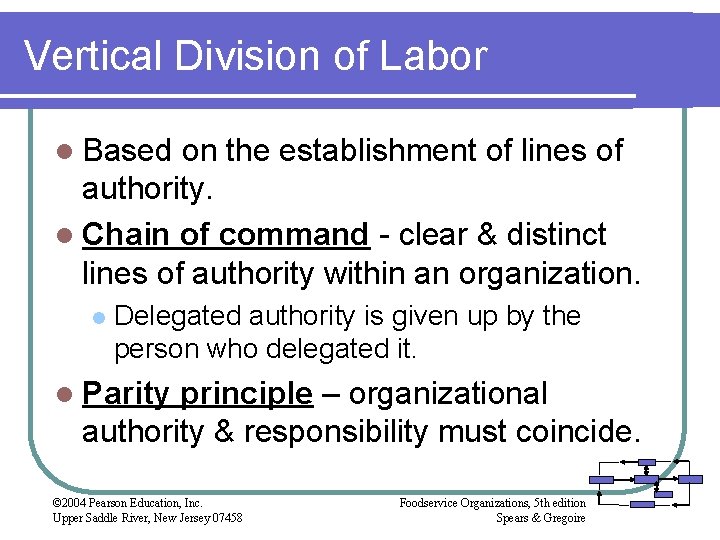
Vertical Division of Labor l Based on the establishment of lines of authority. l Chain of command - clear & distinct lines of authority within an organization. l Delegated authority is given up by the person who delegated it. l Parity principle – organizational authority & responsibility must coincide. © 2004 Pearson Education, Inc. Upper Saddle River, New Jersey 07458 Foodservice Organizations, 5 th edition Spears & Gregoire
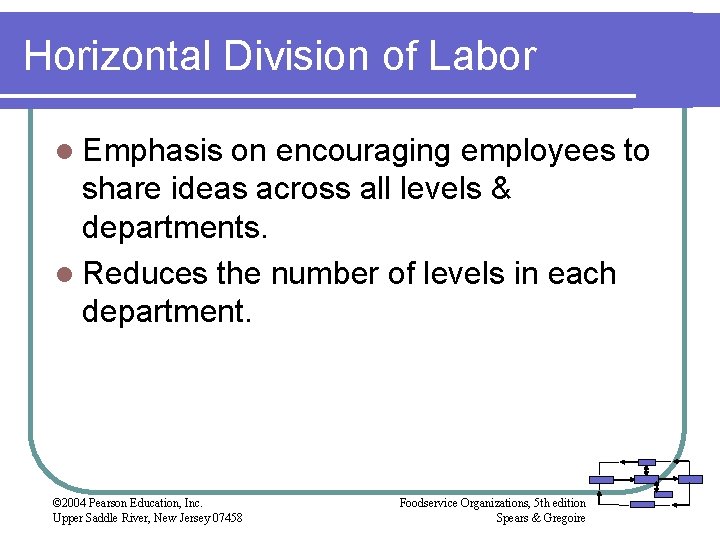
Horizontal Division of Labor l Emphasis on encouraging employees to share ideas across all levels & departments. l Reduces the number of levels in each department. © 2004 Pearson Education, Inc. Upper Saddle River, New Jersey 07458 Foodservice Organizations, 5 th edition Spears & Gregoire
Underlying Concepts of Organization l Different areas of organizational activity must be defined. l Someone must be placed in charge of each area. l The source & use of authority is fundamental to organizational effectiveness. © 2004 Pearson Education, Inc. Upper Saddle River, New Jersey 07458 Foodservice Organizations, 5 th edition Spears & Gregoire
Authority l Formal authority – exists because of position in the organization. l Positional authority – derived from the position or office. l Acceptance authority – based on employee’s acceptance of that authority. l Authority of competence – based on a manager’s competence or expertise. © 2004 Pearson Education, Inc. Upper Saddle River, New Jersey 07458 Foodservice Organizations, 5 th edition Spears & Gregoire
Departmentalization Process of grouping jobs according to some logical arrangement. l Departments are commonly organized by: l l l l Function Product Geography Customer Process/Equipment Time or Shift © 2004 Pearson Education, Inc. Upper Saddle River, New Jersey 07458 Foodservice Organizations, 5 th edition Spears & Gregoire
Line & Staff l Line Position – a position in the direct chain of command. l Staff Position – intended to provide expertise, advice, & support for line positions. l Line Authority – formal authority created by the organizational hierarchy. l Staff Authority – based on expertise in specialized activities. © 2004 Pearson Education, Inc. Upper Saddle River, New Jersey 07458 Foodservice Organizations, 5 th edition Spears & Gregoire
Administrative Intensity l Degree to which managerial positions are concentrated in staff positions. l High Administrative Intensity – many staff positions relative to line positions. l Low Administrative Intensity – emphasizes more line positions. © 2004 Pearson Education, Inc. Upper Saddle River, New Jersey 07458 Foodservice Organizations, 5 th edition Spears & Gregoire
Organization Chart l Graphic portrayal of the organization structure. l Depicts basic relationships of positions & function. l Specifies the formal authority & communication network of the organization. © 2004 Pearson Education, Inc. Upper Saddle River, New Jersey 07458 Foodservice Organizations, 5 th edition Spears & Gregoire
Coordination l Process of linking activities of various departments in the organization. l Linking role – manager who links with managers at higher levels with those at their own level l Mechanisms for coordination: Committees l Task forces l © 2004 Pearson Education, Inc. Upper Saddle River, New Jersey 07458 Foodservice Organizations, 5 th edition Spears & Gregoire
Job Analysis l Process of determining duties & tasks of a job. l Involves a systematic investigation of jobs such as: Collecting data on tasks l Performance standards l Skills required l l Occupational Information Network, O*NET (www. onetcenter. org) © 2004 Pearson Education, Inc. Upper Saddle River, New Jersey 07458 Foodservice Organizations, 5 th edition Spears & Gregoire
Job Description List of duties, working conditions, & tools & equipment needed to perform the job. l Job Description Sections: l l Title – used to indicate level in the organization. Identification – includes location of the job, the person to whom the jobholder reports, & often the number of employees in the department. Duties – statements of duties arranged in order of importance. © 2004 Pearson Education, Inc. Upper Saddle River, New Jersey 07458 Foodservice Organizations, 5 th edition Spears & Gregoire
Job Specification (job spec) l List of abilities, skills, & other credentials needed to do the job. l Statement of job conditions relating to the health, safety, & comfort of the employee. © 2004 Pearson Education, Inc. Upper Saddle River, New Jersey 07458 Foodservice Organizations, 5 th edition Spears & Gregoire
Performance Standards l Desired results at a definite level of quality for a specified job. l Performance – the attainment of a desired result at a defined level of quality for a specified purpose. l Should be based on work-related behaviors & clearly stated in writing. © 2004 Pearson Education, Inc. Upper Saddle River, New Jersey 07458 Foodservice Organizations, 5 th edition Spears & Gregoire
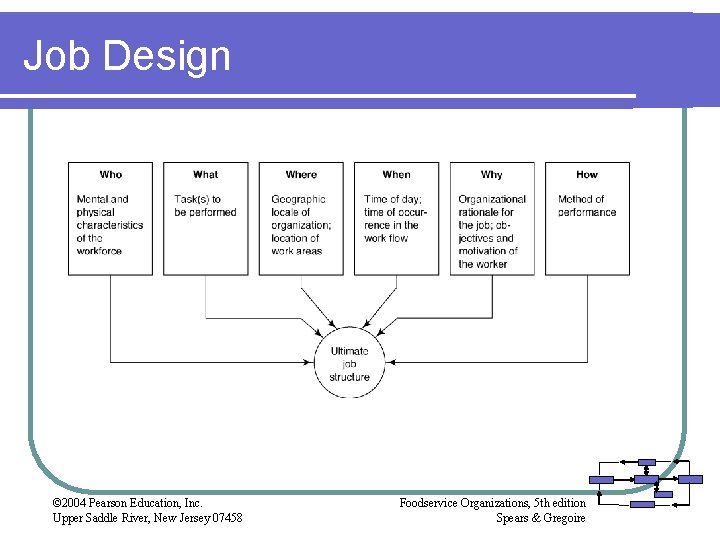
Job Design l An outgrowth of job analysis. l Concerned with structuring jobs to improve organization efficiency & employee job satisfaction. l Job – a set of all tasks that must be performed by a given employee. © 2004 Pearson Education, Inc. Upper Saddle River, New Jersey 07458 Foodservice Organizations, 5 th edition Spears & Gregoire
Job Design © 2004 Pearson Education, Inc. Upper Saddle River, New Jersey 07458 Foodservice Organizations, 5 th edition Spears & Gregoire
Job Enlargement l Developed to increase the total number of tasks that employees perform. l Tasks – individual activities that make up a job. l Prevents employee boredom from repetition of same tasks day after day. © 2004 Pearson Education, Inc. Upper Saddle River, New Jersey 07458 Foodservice Organizations, 5 th edition Spears & Gregoire
Job Enrichment l Increases the variety & number of tasks & control the employee has over the job. l Factors for motivating employees: Achievement l Recognition l Growth l Responsibility l Performance l © 2004 Pearson Education, Inc. Upper Saddle River, New Jersey 07458 Foodservice Organizations, 5 th edition Spears & Gregoire
Job Characteristics l Job dimensions that improve efficiency & job satisfaction: Skill variety l Task identity l Task significance l Autonomy l feedback l © 2004 Pearson Education, Inc. Upper Saddle River, New Jersey 07458 Foodservice Organizations, 5 th edition Spears & Gregoire
Employee Work Teams l Two or more employees who interact regularly to accomplish a narrow set of goals. l Created by management to solve specific problems. © 2004 Pearson Education, Inc. Upper Saddle River, New Jersey 07458 Foodservice Organizations, 5 th edition Spears & Gregoire