
Chapter 9 Management of Quality Chapter 9 Learning
- Slides: 44
Chapter 9 Management of Quality
Chapter 9: Learning Objectives v You should be able to: Define the term quality as it relates to products and as it relates to services Explain why quality is important and the consequences of poor quality Identify the determinants of quality Distinguish the costs associated with quality Compare the quality awards Discuss the philosophies of quality gurus Describe TQM Give an overview of problem solving Give an overview of process improvement Describe and use various quality tools 9 -2
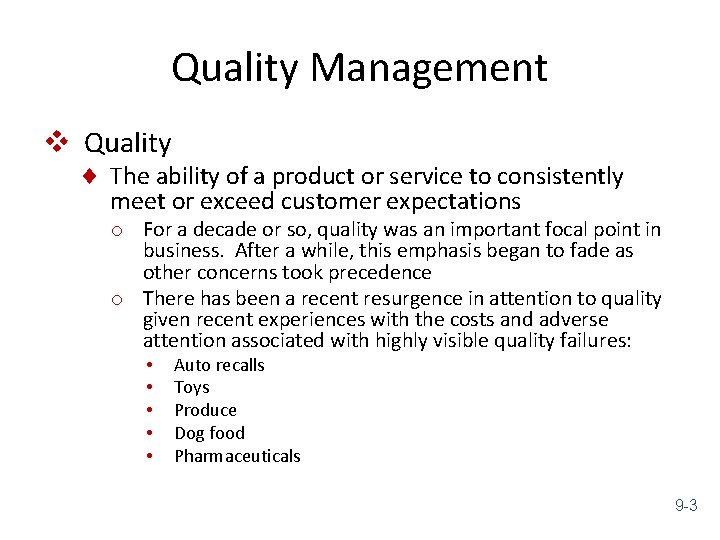
Quality Management v Quality The ability of a product or service to consistently meet or exceed customer expectations o For a decade or so, quality was an important focal point in business. After a while, this emphasis began to fade as other concerns took precedence o There has been a recent resurgence in attention to quality given recent experiences with the costs and adverse attention associated with highly visible quality failures: • • • Auto recalls Toys Produce Dog food Pharmaceuticals 9 -3
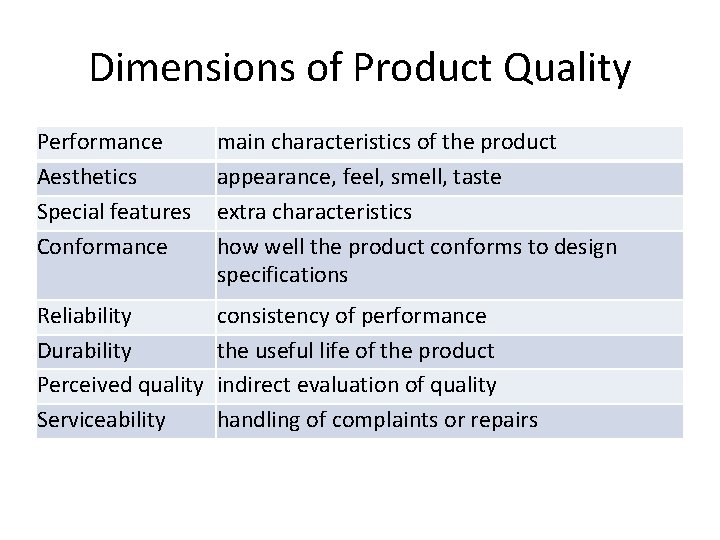
Dimensions of Product Quality Performance Aesthetics Special features Conformance main characteristics of the product appearance, feel, smell, taste extra characteristics how well the product conforms to design specifications Reliability Durability Perceived quality Serviceability consistency of performance the useful life of the product indirect evaluation of quality handling of complaints or repairs
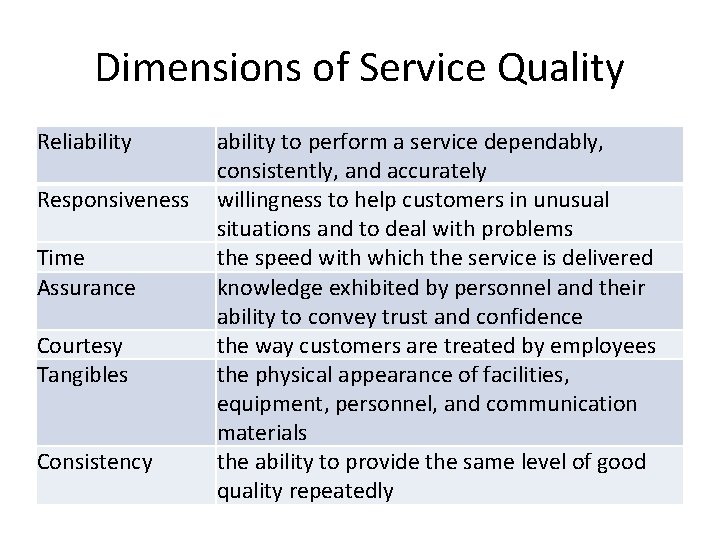
Dimensions of Service Quality Reliability Responsiveness Time Assurance Courtesy Tangibles Consistency ability to perform a service dependably, consistently, and accurately willingness to help customers in unusual situations and to deal with problems the speed with which the service is delivered knowledge exhibited by personnel and their ability to convey trust and confidence the way customers are treated by employees the physical appearance of facilities, equipment, personnel, and communication materials the ability to provide the same level of good quality repeatedly
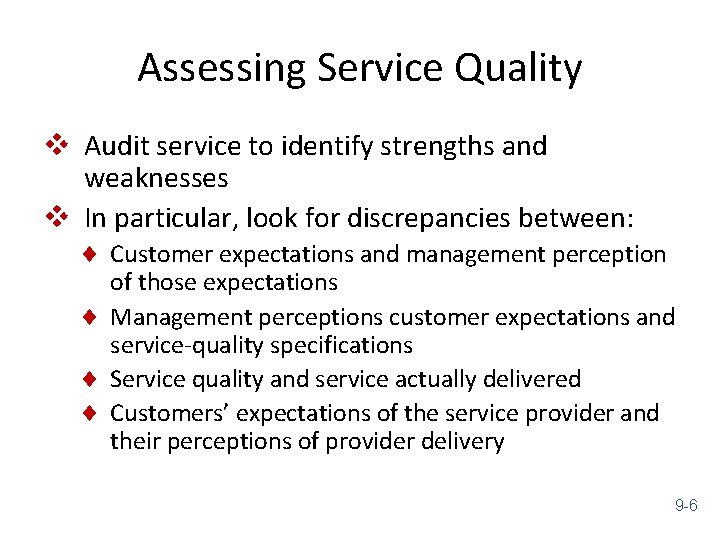
Assessing Service Quality v Audit service to identify strengths and weaknesses v In particular, look for discrepancies between: Customer expectations and management perception of those expectations Management perceptions customer expectations and service-quality specifications Service quality and service actually delivered Customers’ expectations of the service provider and their perceptions of provider delivery 9 -6
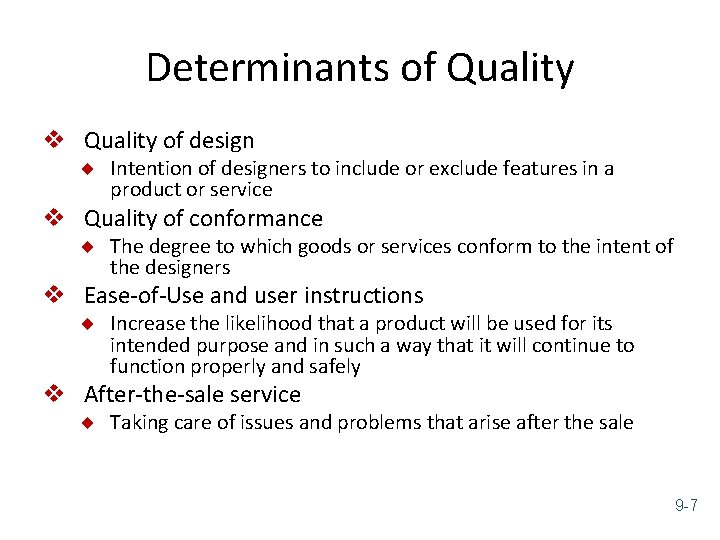
Determinants of Quality v Quality of design Intention of designers to include or exclude features in a product or service v Quality of conformance The degree to which goods or services conform to the intent of the designers v Ease-of-Use and user instructions Increase the likelihood that a product will be used for its intended purpose and in such a way that it will continue to function properly and safely v After-the-sale service Taking care of issues and problems that arise after the sale 9 -7
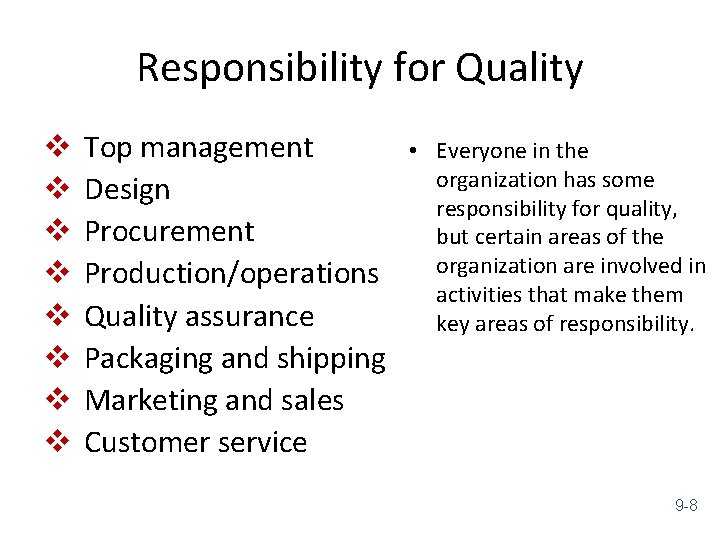
Responsibility for Quality v v v v Top management Design Procurement Production/operations Quality assurance Packaging and shipping Marketing and sales Customer service • Everyone in the organization has some responsibility for quality, but certain areas of the organization are involved in activities that make them key areas of responsibility. 9 -8
Benefits of Good Quality v v v v Enhanced reputation for quality Ability to command premium prices Increased market share Greater customer loyalty Lower liability costs Fewer production or service problems Lower production costs Higher profits 9 -9
The Consequences of Poor Quality v v Loss of business Liability Productivity Costs 9 -10
Costs of Quality v Appraisal Costs of activities designed to ensure quality or uncover defects v Prevention Costs All TQ training, TQ planning, customer assessment, process control, and quality improvement costs to prevent defects from occurring 9 -11
Costs of Quality v Failure Costs - costs incurred by defective parts/products or faulty services. Internal Failure Costs o Costs incurred to fix problems that are detected before the product/service is delivered to the customer. External Failure Costs o All costs incurred to fix problems that are detected after the product/service is delivered to the customer 9 -12
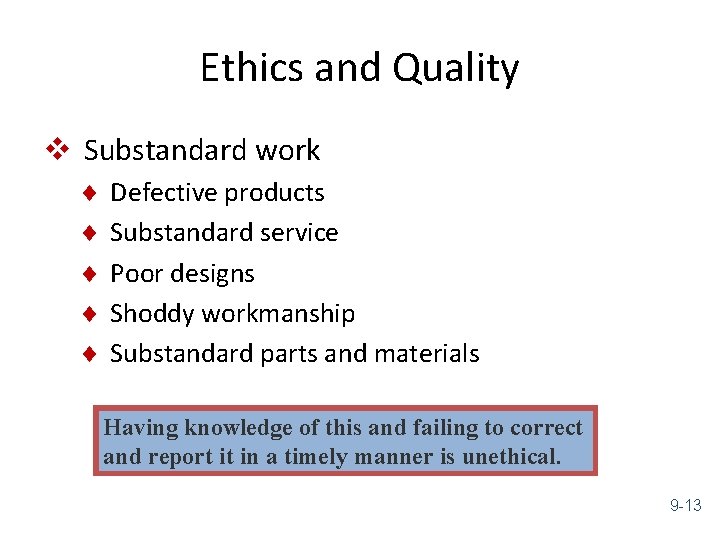
Ethics and Quality v Substandard work Defective products Substandard service Poor designs Shoddy workmanship Substandard parts and materials Having knowledge of this and failing to correct and report it in a timely manner is unethical. 9 -13
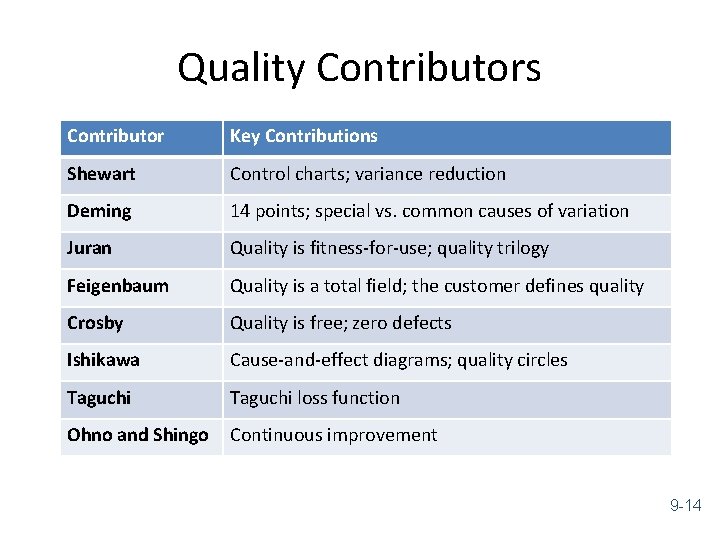
Quality Contributors Contributor Key Contributions Shewart Control charts; variance reduction Deming 14 points; special vs. common causes of variation Juran Quality is fitness-for-use; quality trilogy Feigenbaum Quality is a total field; the customer defines quality Crosby Quality is free; zero defects Ishikawa Cause-and-effect diagrams; quality circles Taguchi loss function Ohno and Shingo Continuous improvement 9 -14
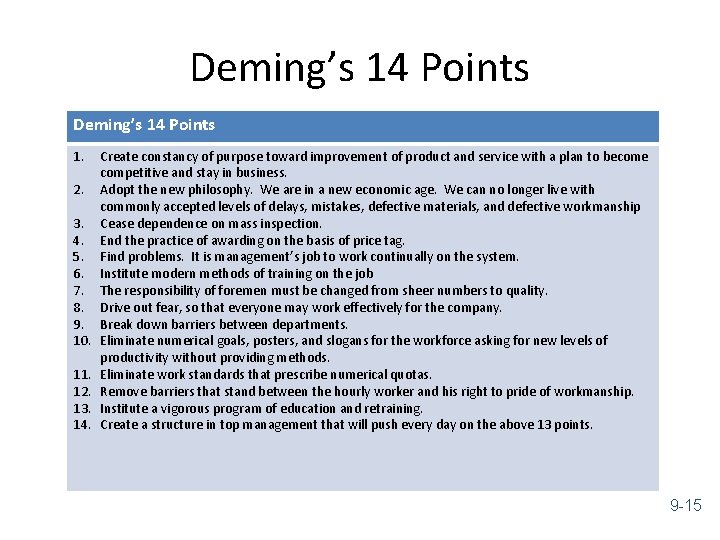
Deming’s 14 Points 1. 2. 3. 4. 5. 6. 7. 8. 9. 10. 11. 12. 13. 14. Create constancy of purpose toward improvement of product and service with a plan to become competitive and stay in business. Adopt the new philosophy. We are in a new economic age. We can no longer live with commonly accepted levels of delays, mistakes, defective materials, and defective workmanship Cease dependence on mass inspection. End the practice of awarding on the basis of price tag. Find problems. It is management’s job to work continually on the system. Institute modern methods of training on the job The responsibility of foremen must be changed from sheer numbers to quality. Drive out fear, so that everyone may work effectively for the company. Break down barriers between departments. Eliminate numerical goals, posters, and slogans for the workforce asking for new levels of productivity without providing methods. Eliminate work standards that prescribe numerical quotas. Remove barriers that stand between the hourly worker and his right to pride of workmanship. Institute a vigorous program of education and retraining. Create a structure in top management that will push every day on the above 13 points. 9 -15
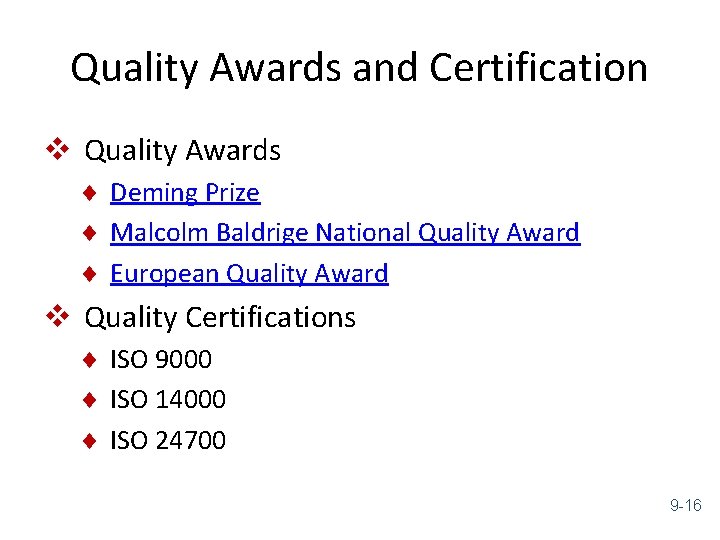
Quality Awards and Certification v Quality Awards Deming Prize Malcolm Baldrige National Quality Award European Quality Award v Quality Certifications ISO 9000 ISO 14000 ISO 24700 9 -16
The Baldrige Competition v Benefits of the Baldrige Competition Winners achieve financial success Winners share their knowledge The process motivates employees The process requires obtaining data The process provides feedback 9 -17
The Baldrige Competition v Award Categories Education Healthcare Manufacturing Nonprofit/Government Service Small Business 9 -18
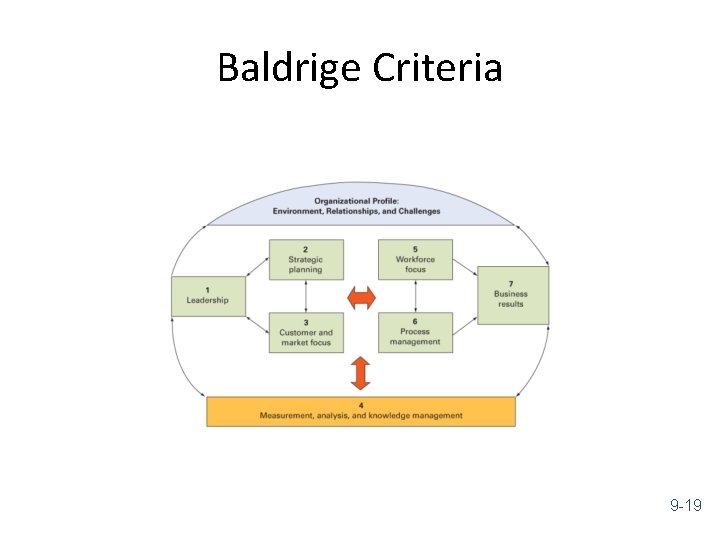
Baldrige Criteria 9 -19
Quality Certification v International Organization for Standardization v ISO 9000 Set of international standards on quality management and quality assurance, critical to international business v ISO 14000 A set of international standards for assessing a company’s environmental performance v ISO 24700 Pertains to the quality and performance of office equipment that contains reused components 9 -20
Quality Certification v ISO 9000: 2005 Quality Principles: o o o o Principle 1 Customer focus Principle 2 Leadership Principle 3 Involvement of people Principle 4 Process approach Principle 5 System approach to management Principle 6 Continual improvement Principle 7 Factual approach to decision making Principle 8 Mutually beneficial supplier relationships 9 -21
Quality and the Supply Chain v Business leaders are increasingly recognizing the importance of their supply chains in achieving their quality goals Requires: o Measuring customer perceptions of quality o Identifying problem areas o Correcting these problems Supply chain quality management can benefit from a collaborative relationship with suppliers o Helping suppliers with quality assurance efforts o Information sharing on quality-related matters 9 -22
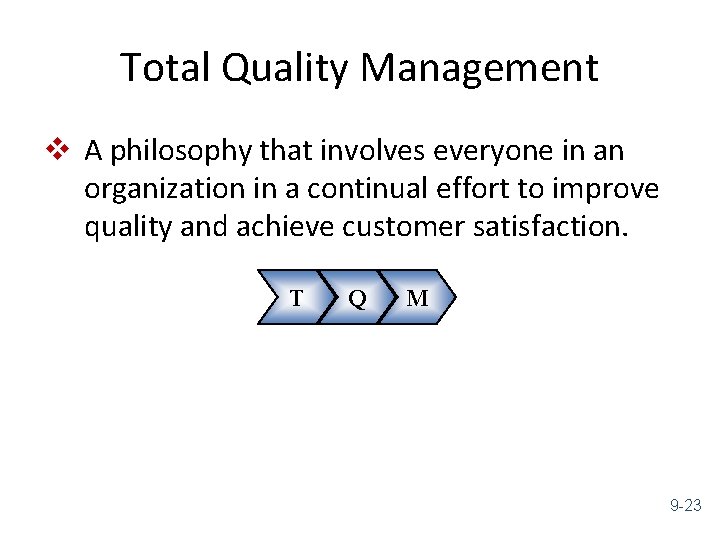
Total Quality Management v A philosophy that involves everyone in an organization in a continual effort to improve quality and achieve customer satisfaction. T Q M 9 -23
TQM Approach v Find out what the customer wants v Design a product or service that meets or exceeds customer wants v Design processes that facilitate doing the job right the first time v Keep track of results v Extend these concepts throughout the supply chain 9 -24
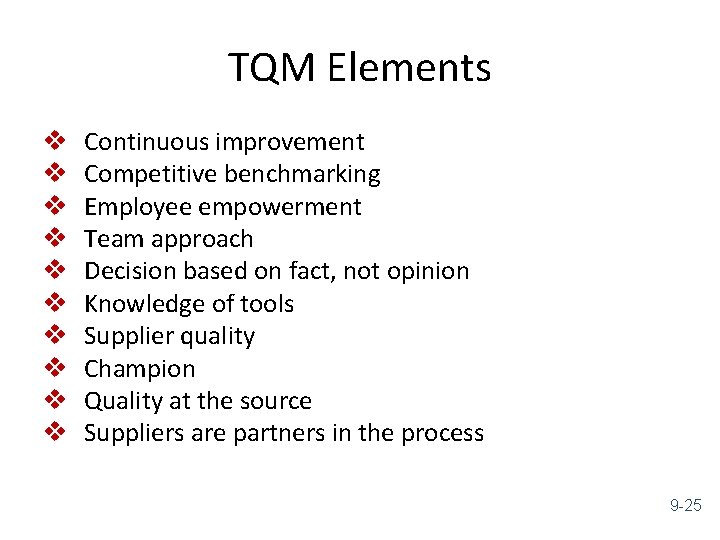
TQM Elements v v v v v Continuous improvement Competitive benchmarking Employee empowerment Team approach Decision based on fact, not opinion Knowledge of tools Supplier quality Champion Quality at the source Suppliers are partners in the process 9 -25
Continuous Improvement v Continuous Improvement Philosophy that seeks to make never-ending improvements to the process of converting inputs into outputs Kaizen o Japanese word for continuous improvement. 9 -26
Quality at the Source v The philosophy of making each worker responsible for the quality of his or her work “Do it right” and “If it isn’t right, fix it” 9 -27
Six Sigma v Six Sigma A business process for improving quality, reducing costs, and increasing customer satisfaction Statistically o Having no more than 3. 4 defects per million Conceptually o Program designed to reduce defects o Requires the use of certain tools and techniques 9 -28
Lean Six Sigma v Lean Six Sigma A balanced approach to process improvement that integrates principles from lean operation and statistical tools for variation reduction from six sigma to achieve speed and quality An approach that is equally applicable to products and services o Early application in service support functions of General electric and Caterpillar Finance 9 -29
Obstacles to Implementing TQM v Obstacles include: Lack of company-wide definition of quality Lack of strategic plan for change Lack of customer focus Poor inter-organizational communication Lack of employee empowerment View of quality as a “quick fix” Emphasis on short-term financial results Inordinate presence of internal politics and “turf” issues Lack of strong motivation Lack of time to devote to quality initiatives Lack of leadership 9 -30
Quality Tools v v v v Flowcharts Check sheet Histogram Pareto analysis Scatter diagrams Control charts Cause-and-Effect diagrams 9 -31
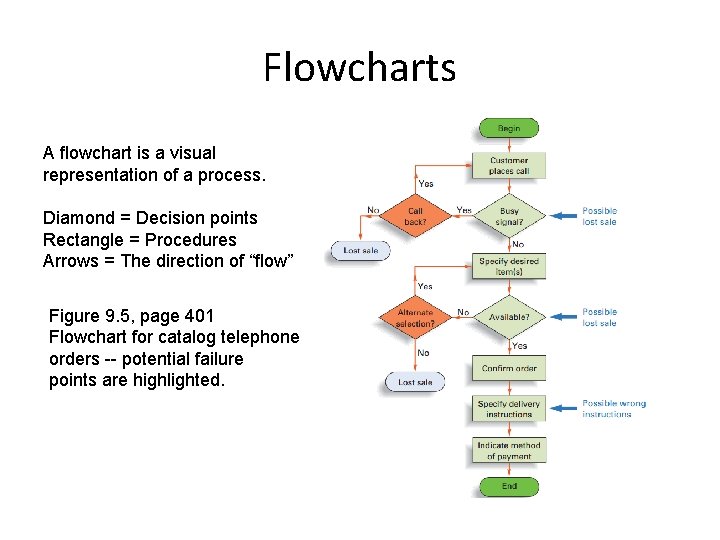
Flowcharts A flowchart is a visual representation of a process. Diamond = Decision points Rectangle = Procedures Arrows = The direction of “flow” Figure 9. 5, page 401 Flowchart for catalog telephone orders -- potential failure points are highlighted.
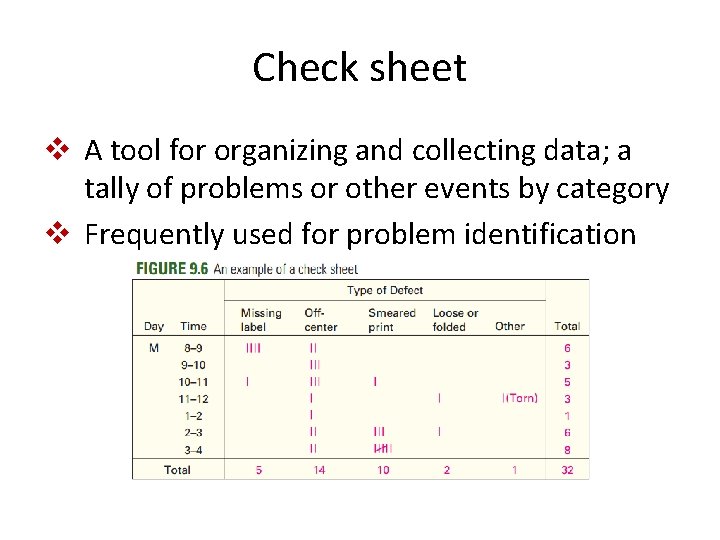
Check sheet v A tool for organizing and collecting data; a tally of problems or other events by category v Frequently used for problem identification
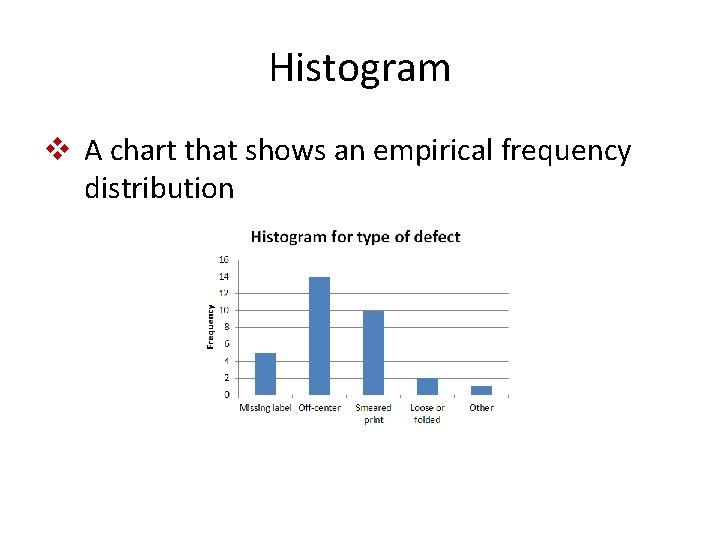
Histogram v A chart that shows an empirical frequency distribution
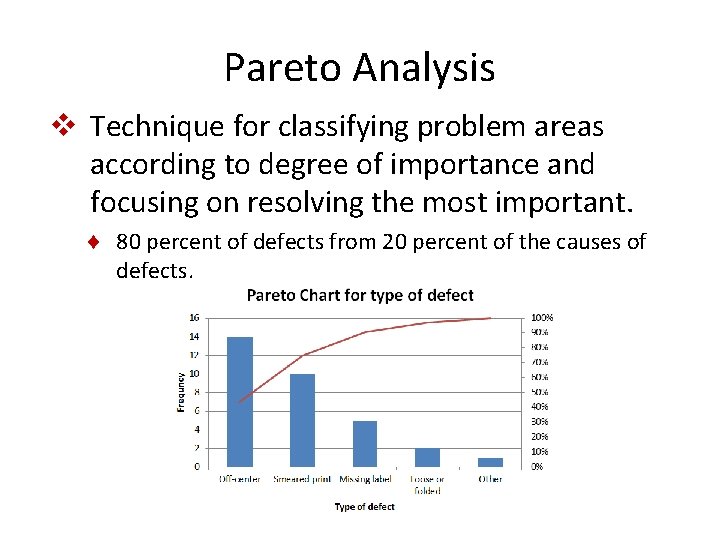
Pareto Analysis v Technique for classifying problem areas according to degree of importance and focusing on resolving the most important. 80 percent of defects from 20 percent of the causes of defects.
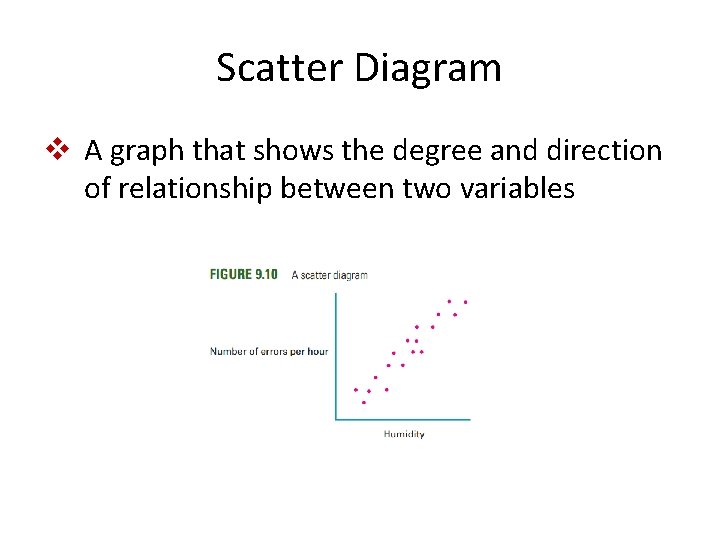
Scatter Diagram v A graph that shows the degree and direction of relationship between two variables
Control charts v Time ordered plot of statistics calculated from samples taken from the process v Used to detect the presence of correctable causes of process variation
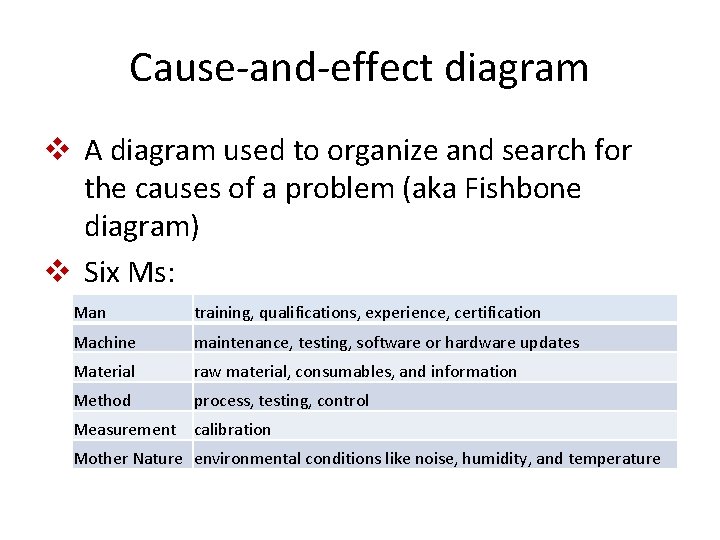
Cause-and-effect diagram v A diagram used to organize and search for the causes of a problem (aka Fishbone diagram) v Six Ms: Man training, qualifications, experience, certification Machine maintenance, testing, software or hardware updates Material raw material, consumables, and information Method process, testing, control Measurement calibration Mother Nature environmental conditions like noise, humidity, and temperature
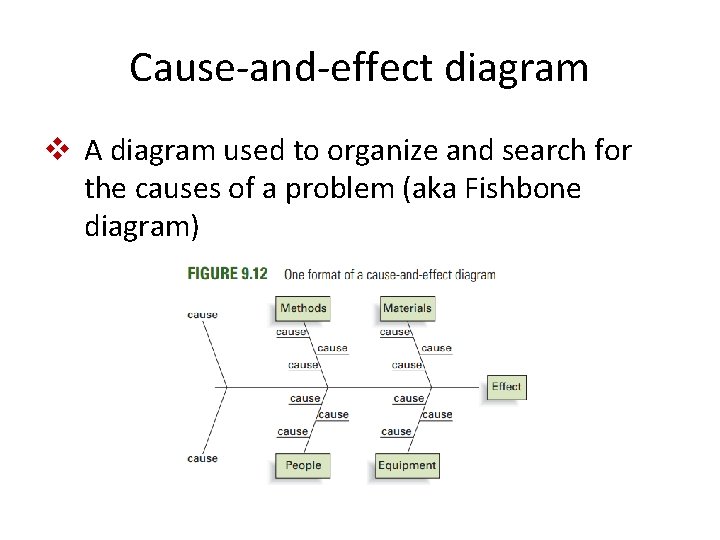
Cause-and-effect diagram v A diagram used to organize and search for the causes of a problem (aka Fishbone diagram)
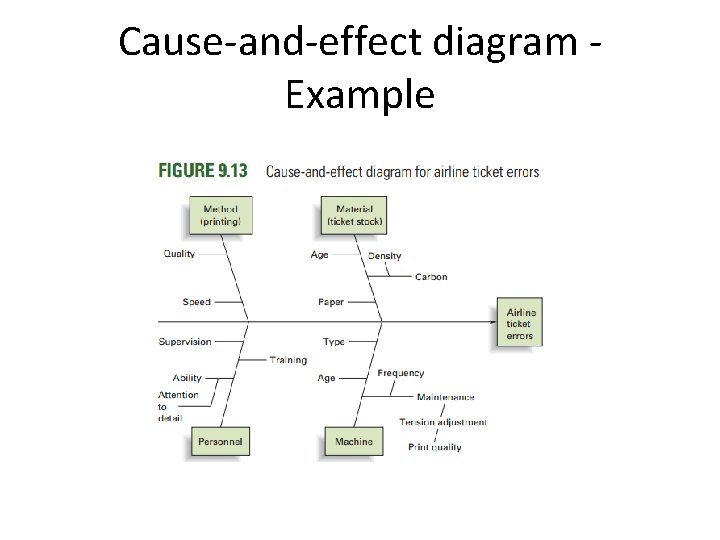
Cause-and-effect diagram Example
Methods for Generating Ideas v v v Brainstorming Affinity Diagram Quality circles Interviewing Benchmarking 5 W 2 H 9 -41
Quality Circles v Quality Circle Groups of workers who meet to discuss ways of improving products or processes o Less structured and more informal than teams involved in continuous improvement o Quality circle teams have historically had relatively little authority to make any but the most minor changes 9 -42
Benchmarking Process v Identify a critical process that needs improvement v Identify an organization that excels in this process v Contact that organization v Analyze the data v Improve the critical process 9 -43
Operations Strategy v Quality is a strategic imperative for organizations Customers are very concerned with the quality of goods and services they receive v Quality is a never-ending journey It is important that most organizational members understand buy into this idea v Customer satisfaction ≠ customer loyalty v Quality needs to be incorporated throughout the entire supply chain, not just the organization itself 9 -44