
Chapter 9 Lecture Patterns of Inheritance Power Point
- Slides: 58
Chapter 9 Lecture Patterns of Inheritance Power. Point® Lectures created by Edward J. Zalisko for Campbell Essential Biology, Seventh Edition, and Campbell Essential Biology with Physiology, Sixth Edition – Eric J. Simon, Jean L. Dickey, and Jane B. Reece © 2019 Pearson Education, Inc.
Why Genetics Matters © 2019 Pearson Education, Inc.
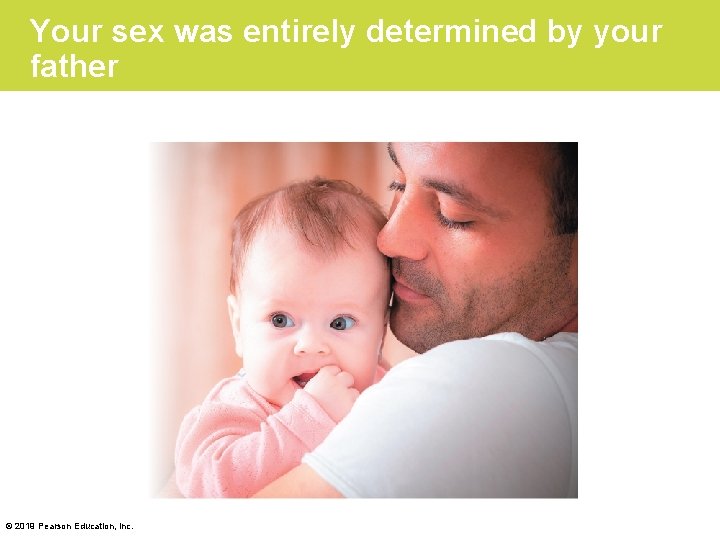
Your sex was entirely determined by your father © 2019 Pearson Education, Inc.
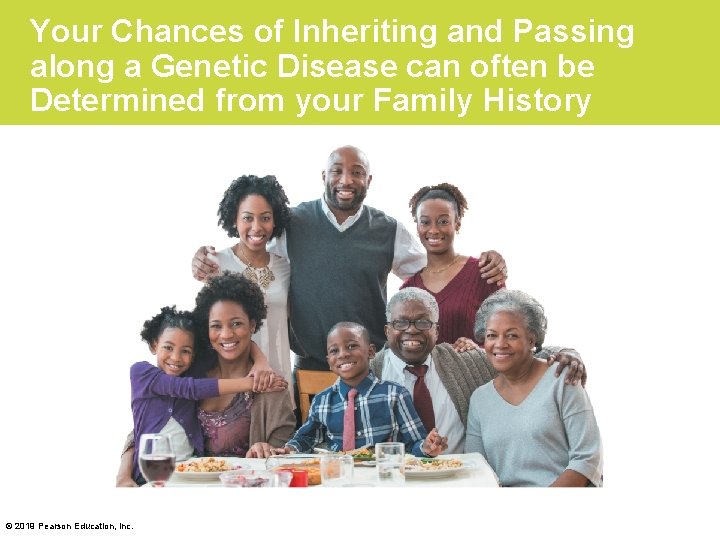
Your Chances of Inheriting and Passing along a Genetic Disease can often be Determined from your Family History © 2019 Pearson Education, Inc.
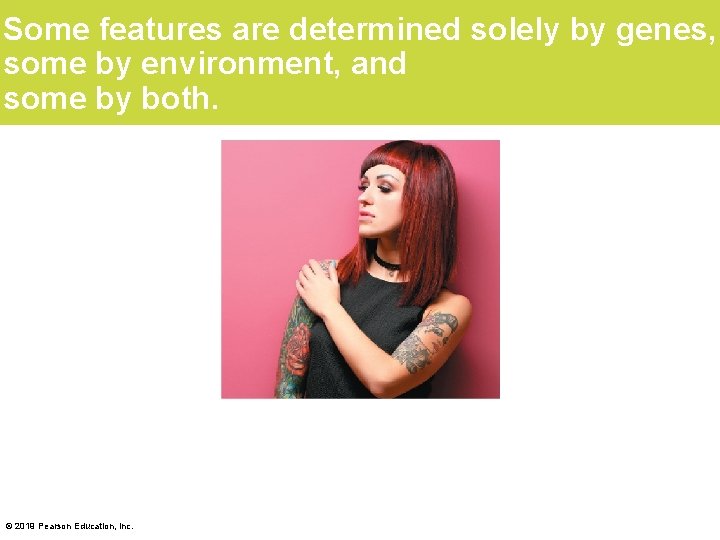
Some features are determined solely by genes, some by environment, and some by both. © 2019 Pearson Education, Inc.
Genetics and Heredity • Heredity is the transmission of traits from one generation to the next. • Genetics is the scientific study of heredity. • Gregor Mendel worked in the 1860 s and found that – parents pass on to their offspring discrete genes (which he called “heritable factors”), – genes are responsible for inherited traits, and – genes retain their individual identities generation after generation. © 2019 Pearson Education, Inc.
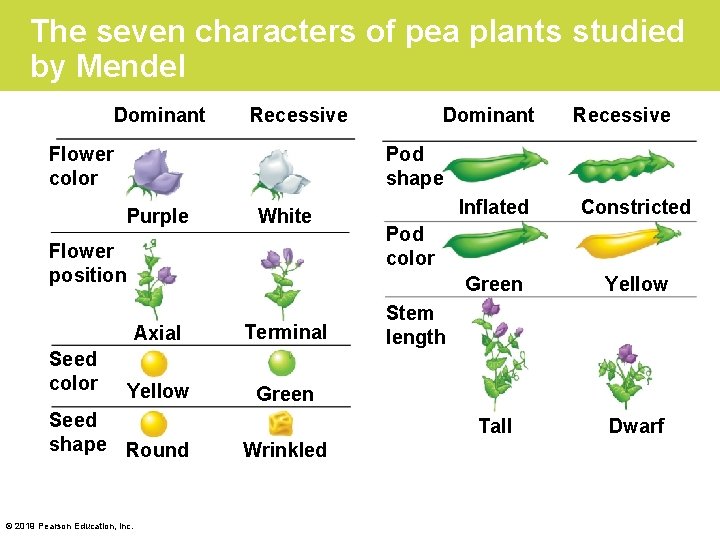
In an Abbey Garden • A character is a heritable feature that varies among individuals. – A trait is a variant of a character. – Each of the characters Mendel studied occurred in two distinct traits. • . © 2019 Pearson Education, Inc.
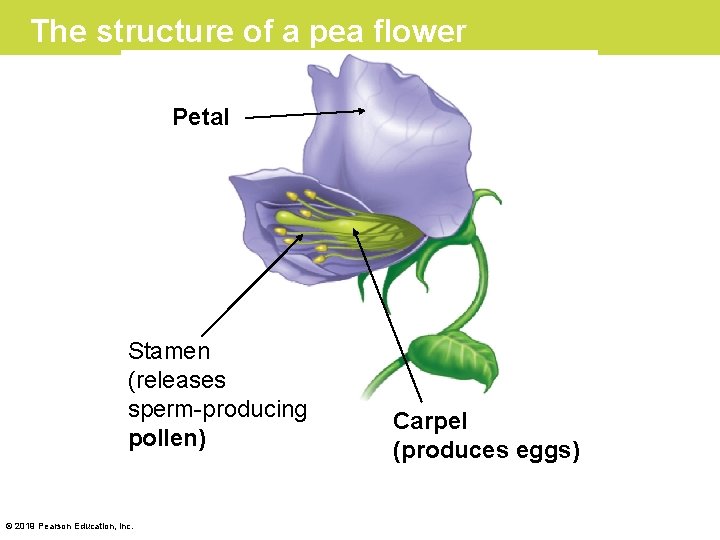
The structure of a pea flower Petal Stamen (releases sperm-producing pollen) © 2019 Pearson Education, Inc. Carpel (produces eggs)
In an Abbey Garden (Cont. ) • When Mendel wanted to fertilize one plant with pollen from a different plant, he pollinated the plants by hand was always sure of the parentage of his new plants. • Mendel created purebred varieties of plants and crossed two different purebred varieties. © 2019 Pearson Education, Inc.
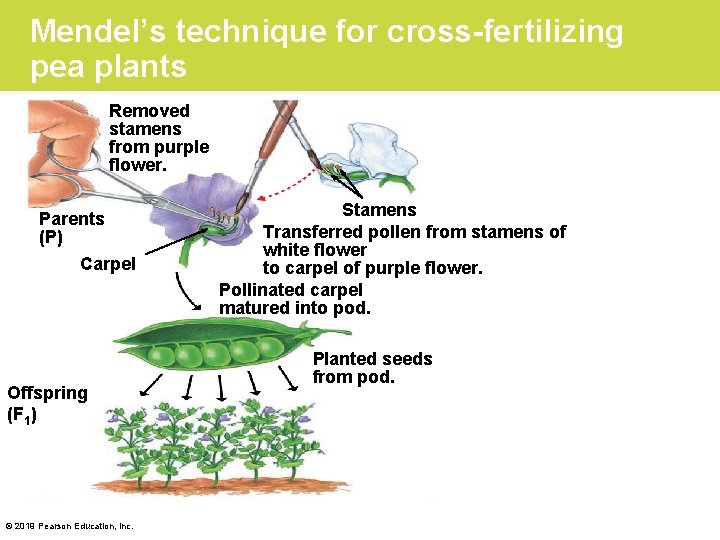
Mendel’s technique for cross-fertilizing pea plants Removed stamens from purple flower. Parents (P) Carpel Offspring (F 1) © 2019 Pearson Education, Inc. Stamens Transferred pollen from stamens of white flower to carpel of purple flower. Pollinated carpel matured into pod. Planted seeds from pod.
In an Abbey Garden (Cont. ) • Hybrids are the offspring of two different purebred varieties. – The cross-fertilization itself is referred to as a genetic cross. – The parental plants are the P generation. – Their hybrid offspring are the F 1 generation. – A cross of the F 1 plants forms the F 2 generation. © 2019 Pearson Education, Inc.
Mendel’s Law of Segregation • Mendel performed many experiments in which he tracked the inheritance of characters, such as flower color, that occur as two alternative traits. • The results led him to formulate several hypotheses about inheritance. © 2019 Pearson Education, Inc.
The seven characters of pea plants studied by Mendel Dominant Recessive Flower color Recessive Pod shape Purple White Flower position Seed color Dominant Axial Terminal Yellow Green Seed shape Round © 2019 Pearson Education, Inc. Wrinkled Inflated Constricted Green Yellow Tall Dwarf Pod color Stem length
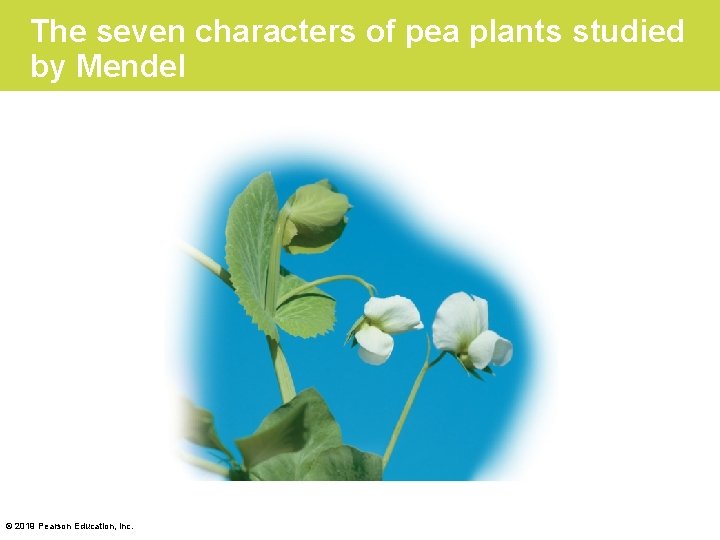
The seven characters of pea plants studied by Mendel © 2019 Pearson Education, Inc.
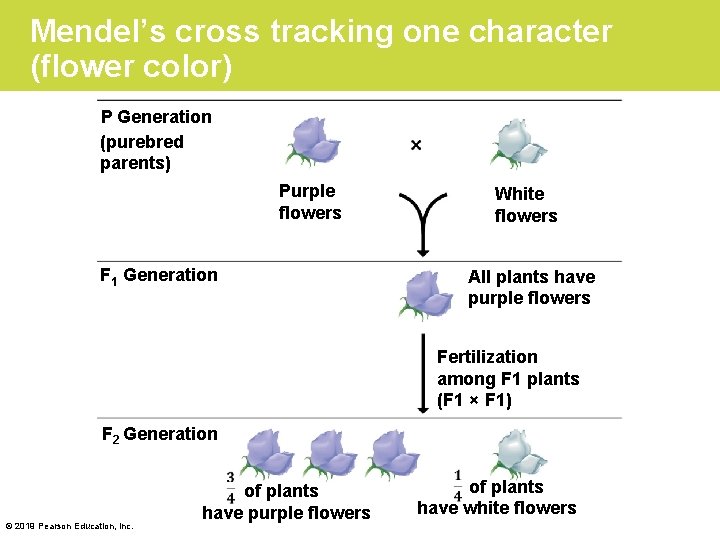
Mendel’s cross tracking one character (flower color) P Generation (purebred parents) Purple flowers F 1 Generation White flowers All plants have purple flowers Fertilization among F 1 plants (F 1 × F 1) F 2 Generation © 2019 Pearson Education, Inc. of plants have purple flowers of plants have white flowers
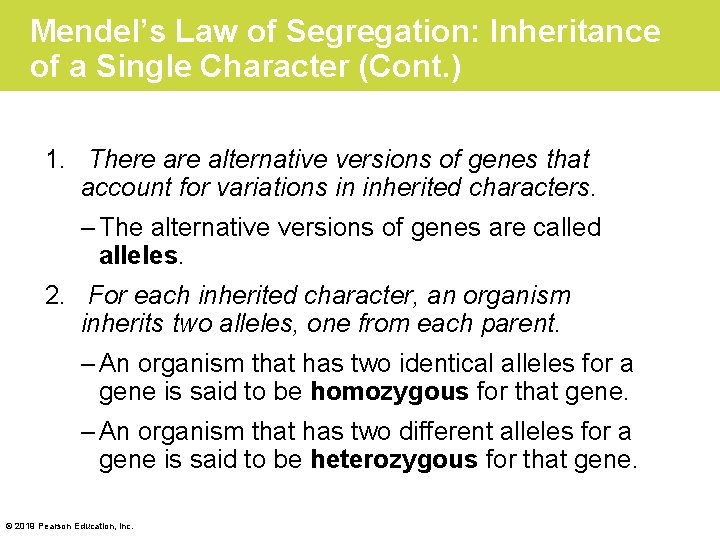
Mendel’s Law of Segregation: Inheritance of a Single Character (Cont. ) 1. There alternative versions of genes that account for variations in inherited characters. – The alternative versions of genes are called alleles. 2. For each inherited character, an organism inherits two alleles, one from each parent. – An organism that has two identical alleles for a gene is said to be homozygous for that gene. – An organism that has two different alleles for a gene is said to be heterozygous for that gene. © 2019 Pearson Education, Inc.
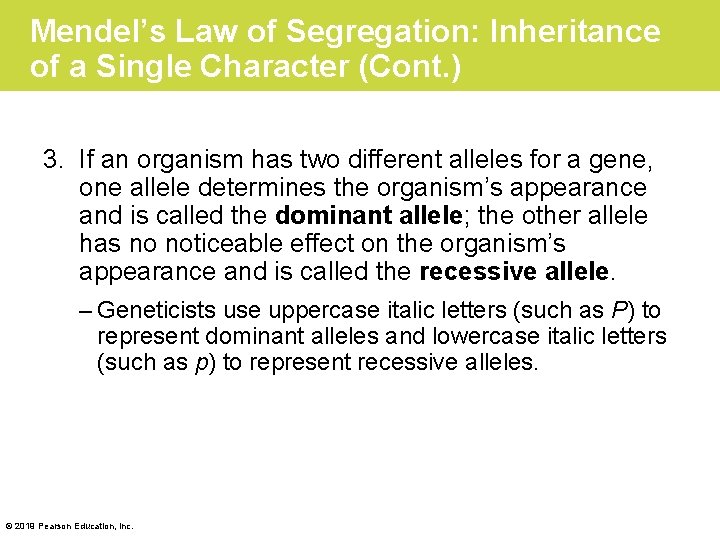
Mendel’s Law of Segregation: Inheritance of a Single Character (Cont. ) 3. If an organism has two different alleles for a gene, one allele determines the organism’s appearance and is called the dominant allele; the other allele has no noticeable effect on the organism’s appearance and is called the recessive allele. – Geneticists use uppercase italic letters (such as P) to represent dominant alleles and lowercase italic letters (such as p) to represent recessive alleles. © 2019 Pearson Education, Inc.
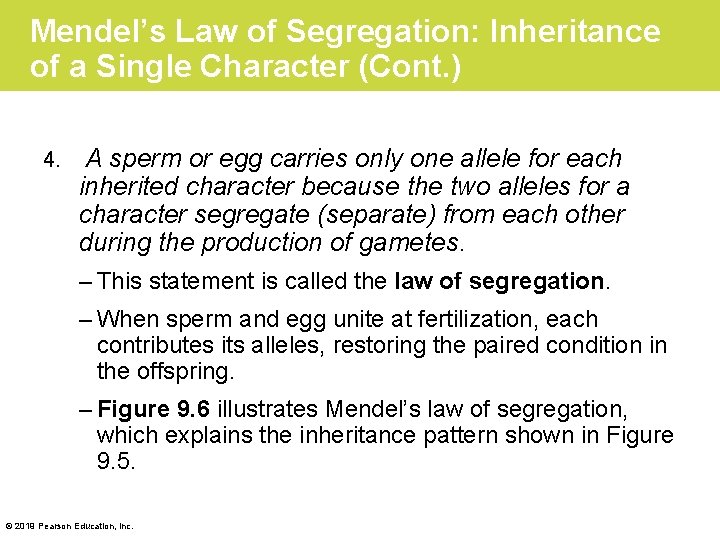
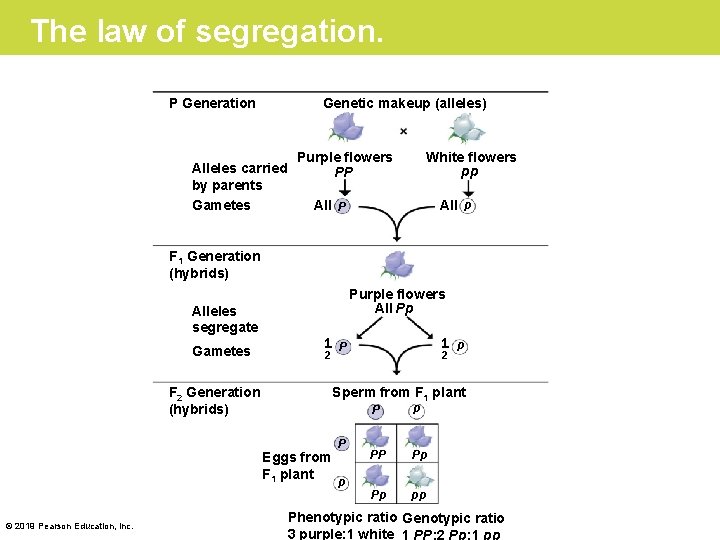
Mendel’s Law of Segregation: Inheritance of a Single Character (Cont. ) 4. A sperm or egg carries only one allele for each inherited character because the two alleles for a character segregate (separate) from each other during the production of gametes. – This statement is called the law of segregation. – When sperm and egg unite at fertilization, each contributes its alleles, restoring the paired condition in the offspring. – Figure 9. 6 illustrates Mendel’s law of segregation, which explains the inheritance pattern shown in Figure 9. 5. © 2019 Pearson Education, Inc.
The law of segregation. P Generation Genetic makeup (alleles) Alleles carried by parents Gametes Purple flowers PP White flowers pp All P F 1 Generation (hybrids) Purple flowers All Pp Alleles segregate Gametes F 2 Generation (hybrids) Sperm from F 1 plant Eggs from F 1 plant © 2019 Pearson Education, Inc. 1 p 2 1 P 2 P p PP Pp Pp pp Phenotypic ratio Genotypic ratio 3 purple: 1 white 1 PP: 2 Pp: 1 pp
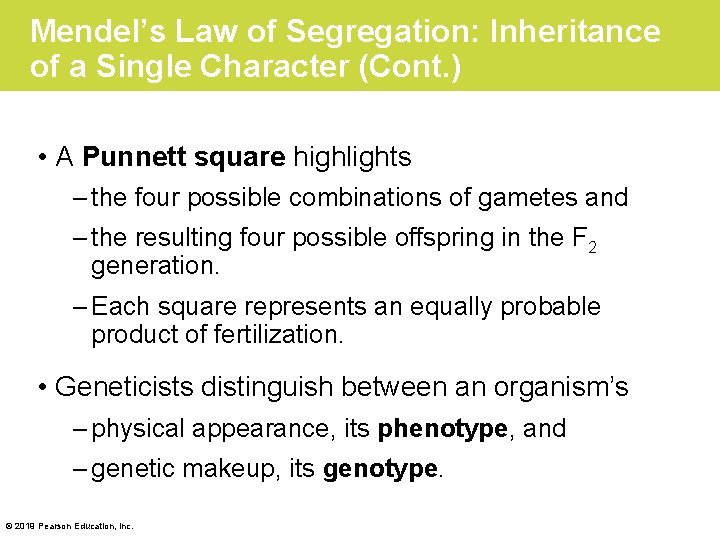
Mendel’s Law of Segregation: Inheritance of a Single Character (Cont. ) • A Punnett square highlights – the four possible combinations of gametes and – the resulting four possible offspring in the F 2 generation. – Each square represents an equally probable product of fertilization. • Geneticists distinguish between an organism’s – physical appearance, its phenotype, and – genetic makeup, its genotype. © 2019 Pearson Education, Inc.
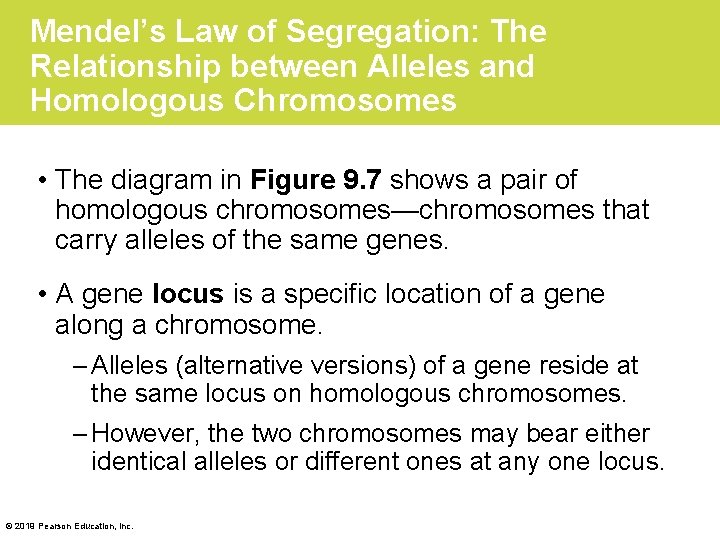
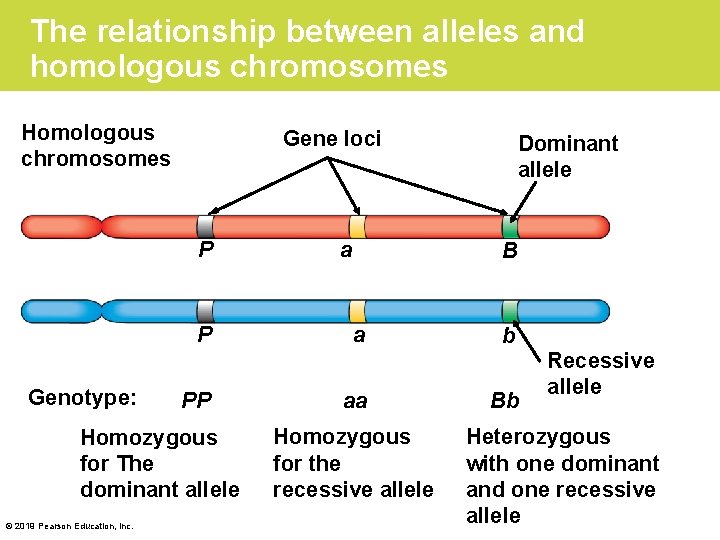
Mendel’s Law of Segregation: The Relationship between Alleles and Homologous Chromosomes • The diagram in Figure 9. 7 shows a pair of homologous chromosomes—chromosomes that carry alleles of the same genes. • A gene locus is a specific location of a gene along a chromosome. – Alleles (alternative versions) of a gene reside at the same locus on homologous chromosomes. – However, the two chromosomes may bear either identical alleles or different ones at any one locus. © 2019 Pearson Education, Inc.
The relationship between alleles and homologous chromosomes Homologous chromosomes Gene loci P P Genotype: PP Homozygous for The dominant allele © 2019 Pearson Education, Inc. a Dominant allele B a aa Homozygous for the recessive allele b Bb Recessive allele Heterozygous with one dominant and one recessive allele
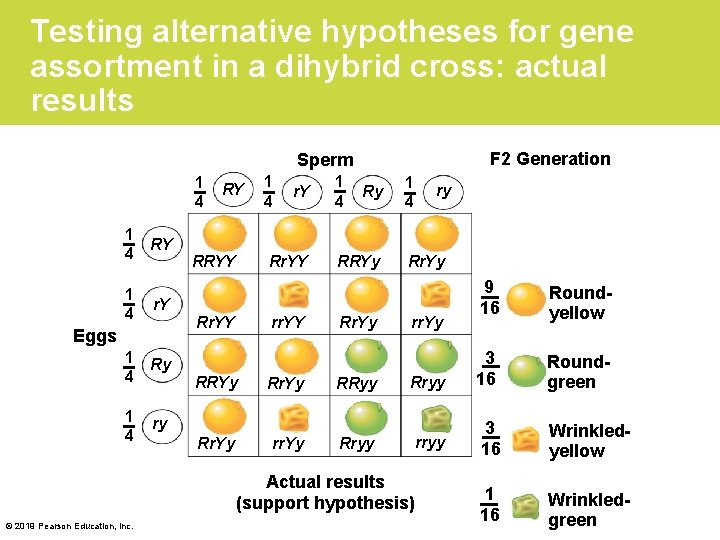
Mendel’s Law of Independent Assortment • Mendel deduced his law of segregation by following one character through two generations. – A cross between two individuals that are heterozygous for one character is called a monohybrid cross. – What would result from a dihybrid cross, a cross between two organisms that are each heterozygous for two characters being followed? Checkpoint: (a) If two plants have the same genotype, must they have the same phenotype? (b) If two plants have the same phenotype, must they have the same genotype? © 2019 Pearson Education, Inc.
Testing alternative hypotheses for gene assortment in a dihybrid cross: actual results F 2 Generation Sperm 1 4 RY 1 4 r. Y 1 4 Ry 1 4 ry RY RRYY rr. YY RRYy Rr. Yy r. Y Rr. YY Eggs 1 4 Rr. Yy rr. Yy 1 4 Ry RRYy Rr. Yy RRyy Rryy 1 4 ry Rr. Yy rr. Yy Rryy rryy Actual results (support hypothesis) © 2019 Pearson Education, Inc. 9 16 Roundyellow 3 16 Roundgreen 3 16 Wrinkledyellow 1 16 Wrinkledgreen
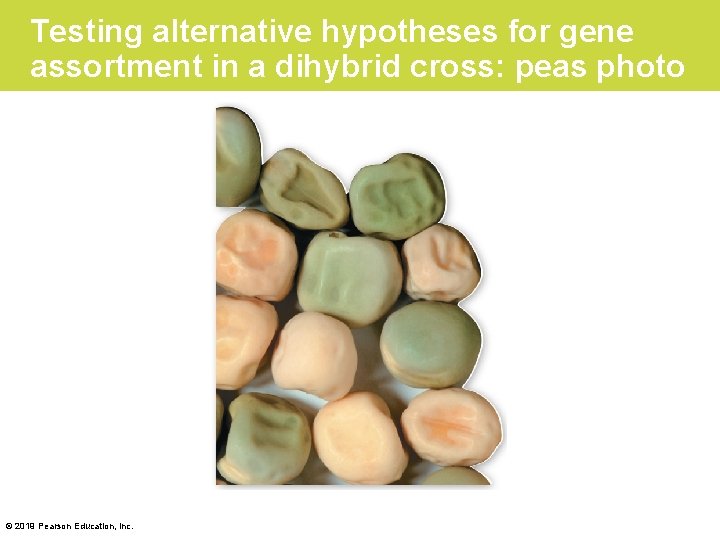
Testing alternative hypotheses for gene assortment in a dihybrid cross: peas photo © 2019 Pearson Education, Inc.
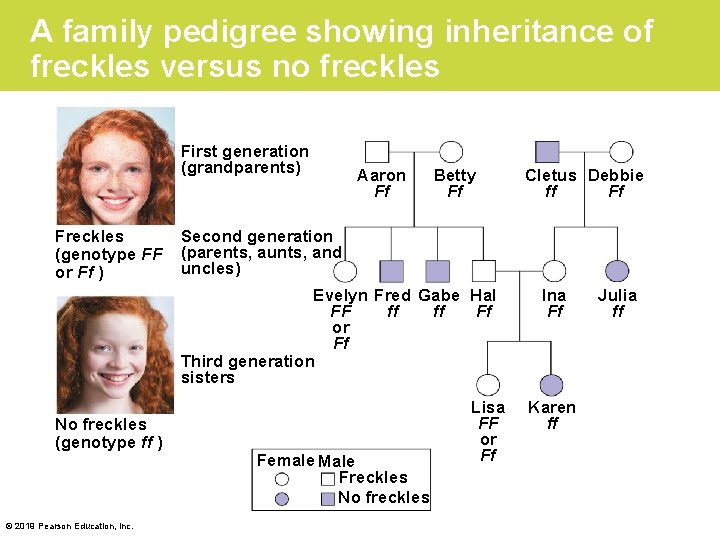
Family Pedigrees • Geneticists who study people obviously cannot control the mating of their research participants. Instead, they must analyze the results of matings that have already occurred. – First, a geneticist collects as much information as possible about a family’s history for a trait. – Then the researcher assembles this information into a family tree, called a pedigree. – Mendel’s laws enable us to deduce the genotypes for most of the people in the pedigree. © 2019 Pearson Education, Inc.
A family pedigree showing inheritance of freckles versus no freckles First generation (grandparents) Freckles (genotype FF or Ff ) Aaron Ff Betty Ff Second generation (parents, aunts, and uncles) Evelyn Fred Gabe Hal ff ff Ff FF or Ff Third generation sisters No freckles (genotype ff ) © 2019 Pearson Education, Inc. Cletus Debbie ff Ff Female Male Freckles No freckles Lisa FF or Ff Ina Ff Karen ff Julia ff
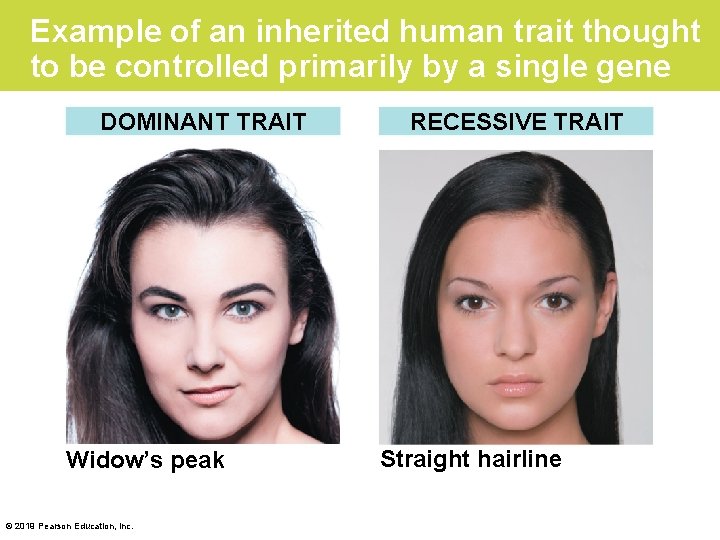
Family Pedigrees (Cont. ) • A trait that is dominant does not imply that it is either normal or more common than a recessive phenotype. Instead, dominance means that a heterozygous genotype results in the dominant phenotype. • Wild-type traits (those seen most often in nature) are not necessarily specified by dominant alleles. © 2019 Pearson Education, Inc.
Example of an inherited human trait thought to be controlled primarily by a single gene DOMINANT TRAIT Widow’s peak © 2019 Pearson Education, Inc. RECESSIVE TRAIT Straight hairline
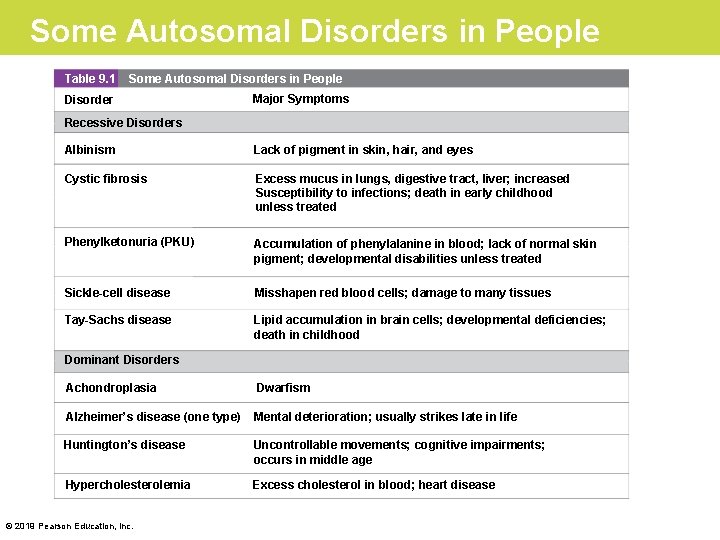
Some Autosomal Disorders in People Table 9. 1 Some Autosomal Disorders in People Disorder Major Symptoms Recessive Disorders Albinism Lack of pigment in skin, hair, and eyes Cystic fibrosis Excess mucus in lungs, digestive tract, liver; increased Susceptibility to infections; death in early childhood unless treated Phenylketonuria (PKU) Accumulation of phenylalanine in blood; lack of normal skin pigment; developmental disabilities unless treated Sickle-cell disease Misshapen red blood cells; damage to many tissues Tay-Sachs disease Lipid accumulation in brain cells; developmental deficiencies; death in childhood Dominant Disorders Achondroplasia Dwarfism Alzheimer’s disease (one type) Mental deterioration; usually strikes late in life Huntington’s disease Uncontrollable movements; cognitive impairments; occurs in middle age Hypercholesterolemia Excess cholesterol in blood; heart disease © 2019 Pearson Education, Inc.
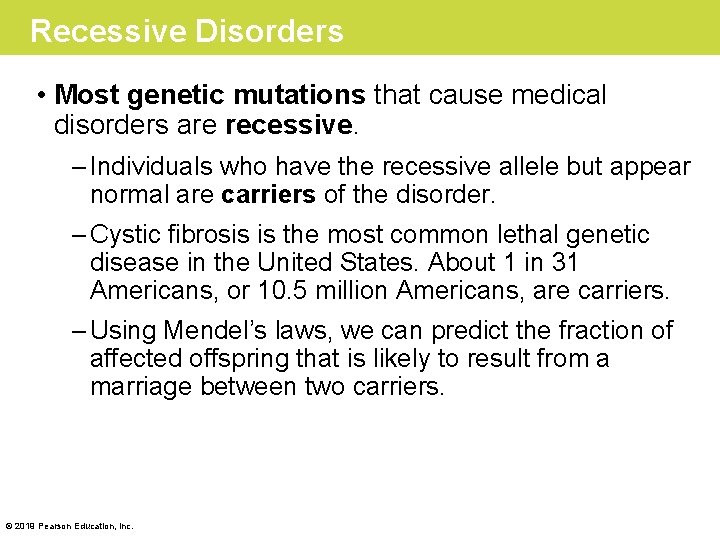
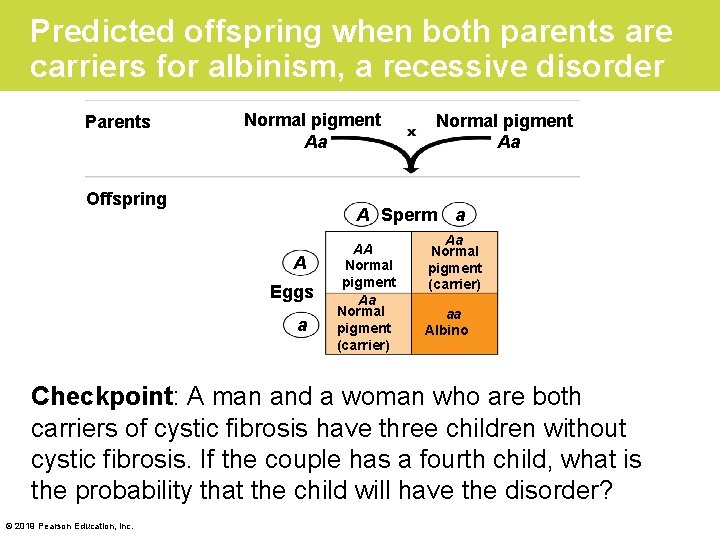
Recessive Disorders • Most genetic mutations that cause medical disorders are recessive. – Individuals who have the recessive allele but appear normal are carriers of the disorder. – Cystic fibrosis is the most common lethal genetic disease in the United States. About 1 in 31 Americans, or 10. 5 million Americans, are carriers. – Using Mendel’s laws, we can predict the fraction of affected offspring that is likely to result from a marriage between two carriers. © 2019 Pearson Education, Inc.
Predicted offspring when both parents are carriers for albinism, a recessive disorder Parents Normal pigment Aa Offspring Normal pigment Aa A Sperm a A Eggs a AA Normal pigment Aa Normal pigment (carrier) aa Albino Checkpoint: A man and a woman who are both carriers of cystic fibrosis have three children without cystic fibrosis. If the couple has a fourth child, what is the probability that the child will have the disorder? © 2019 Pearson Education, Inc.
Incomplete Dominance in Plants and People • In incomplete dominance, F 1 hybrids have an appearance between the parent phenotypes. • Hypercholesterolemia is a human trait that is an example of incomplete dominance and is characterized by dangerously high levels of cholesterol in the blood. – Heterozygotes have blood cholesterol levels about twice normal. – Homozygotes have about five times the normal amount of blood cholesterol and may have heart attacks as early as age 2. © 2019 Pearson Education, Inc.
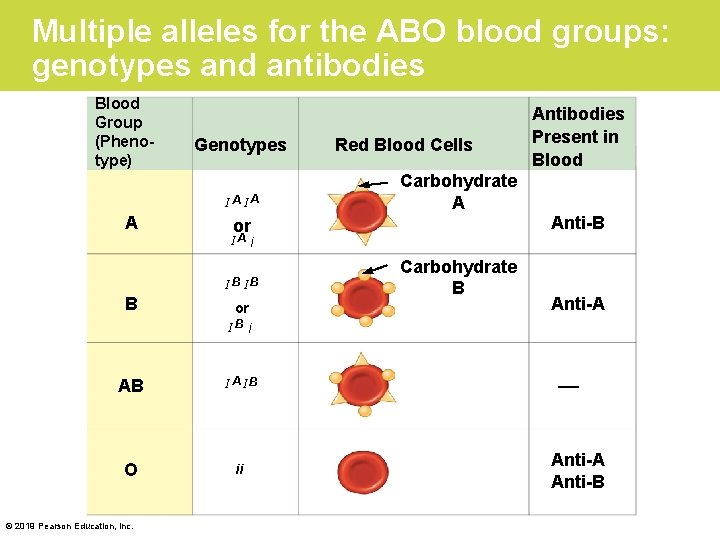
ABO Blood Groups: An Example of Multiple Alleles and Codominance • The ABO blood groups in humans involve three alleles of a single gene. – Various combinations of these three alleles produce four phenotypes. Therefore, a person’s blood type may be A, B, AB, or O. – These letters refer to two carbohydrates, designated A and B, that may be found on the surface of red blood cells. © 2019 Pearson Education, Inc.
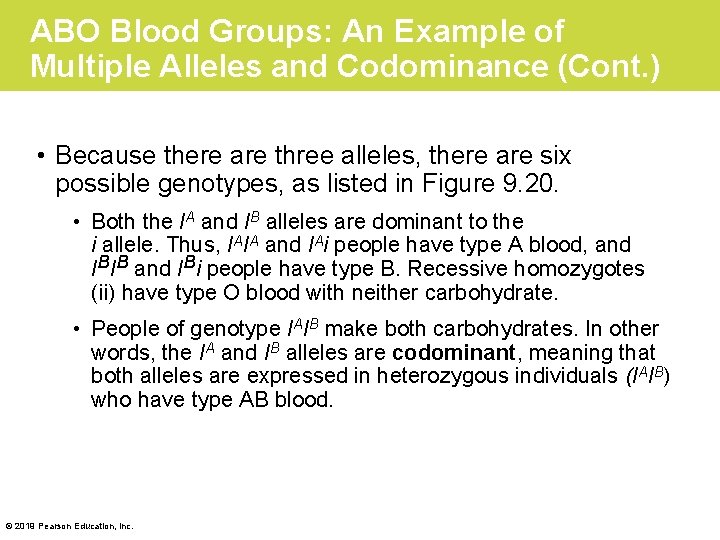
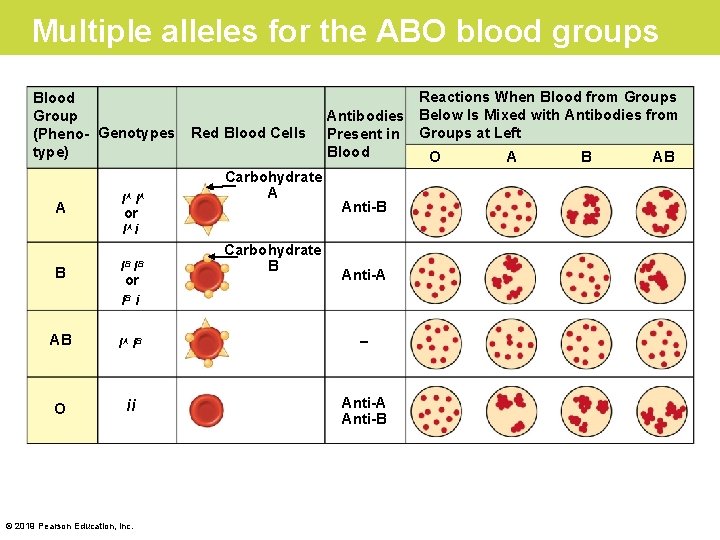
ABO Blood Groups: An Example of Multiple Alleles and Codominance (Cont. ) • Because there are three alleles, there are six possible genotypes, as listed in Figure 9. 20. • Both the IA and IB alleles are dominant to the i allele. Thus, IAIA and IAi people have type A blood, and IBIB and IBi people have type B. Recessive homozygotes (ii) have type O blood with neither carbohydrate. • People of genotype IAIB make both carbohydrates. In other words, the IA and IB alleles are codominant, meaning that both alleles are expressed in heterozygous individuals (IAIB) who have type AB blood. © 2019 Pearson Education, Inc.
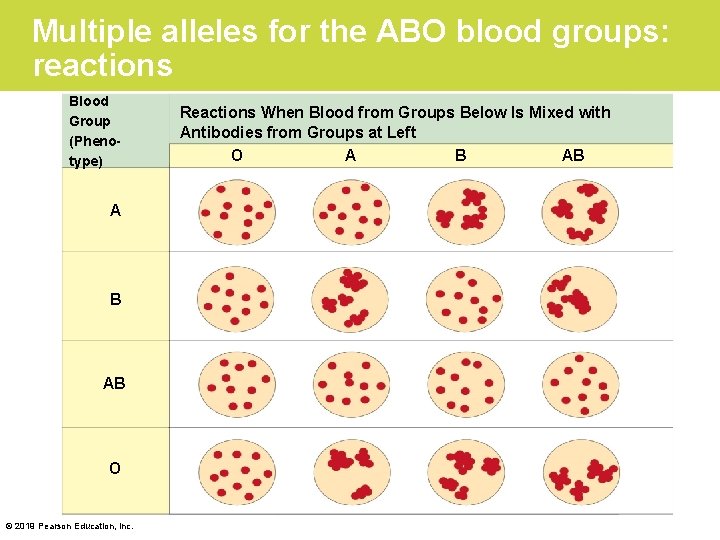
Multiple alleles for the ABO blood groups Blood Group (Pheno- Genotypes type) A IA IA or IAi B IB IB AB IA IB O ii or IB i © 2019 Pearson Education, Inc. Red Blood Cells Carbohydrate A Carbohydrate B Reactions When Blood from Groups Antibodies Below Is Mixed with Antibodies from Present in Groups at Left Blood O A B AB Anti-A _ Anti-A Anti-B
Multiple alleles for the ABO blood groups: genotypes and antibodies Blood Group (Phenotype) Genotypes IA IA A Anti-B IA i or IB i AB I A IB O ii © 2019 Pearson Education, Inc. Carbohydrate A or IB IB B Red Blood Cells Antibodies Present in Blood Carbohydrate B Anti-A Anti-B
Multiple alleles for the ABO blood groups: reactions Blood Group (Phenotype) A B AB O © 2019 Pearson Education, Inc. Reactions When Blood from Groups Below Is Mixed with Antibodies from Groups at Left O A B AB
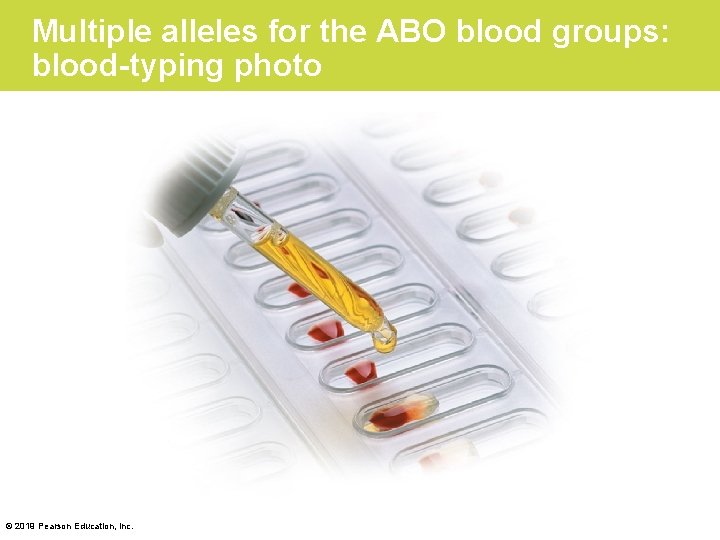
Multiple alleles for the ABO blood groups: blood-typing photo © 2019 Pearson Education, Inc.
ABO Blood Groups: An Example of Multiple Alleles and Codominance (Cont. ) • Matching compatible blood groups is critical for safe blood transfusions. – If a donor’s blood cells have a carbohydrate (A or B) that is foreign to the recipient, then the recipient’s immune system produces blood proteins called antibodies that bind to the foreign carbohydrates. – These antibodies cause the donor blood cells to clump together, potentially killing the recipient. © 2019 Pearson Education, Inc.
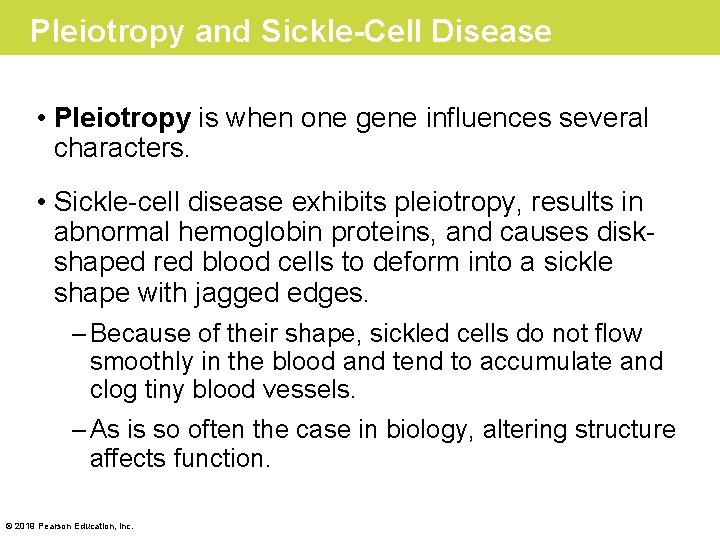
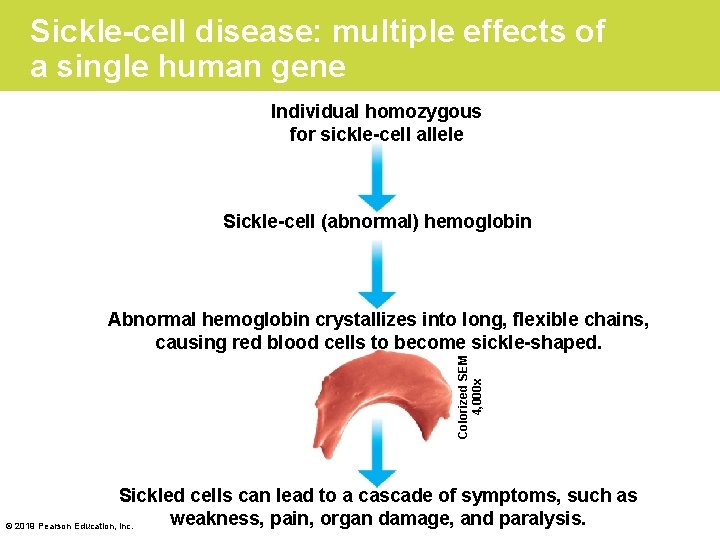
Pleiotropy and Sickle-Cell Disease • Pleiotropy is when one gene influences several characters. • Sickle-cell disease exhibits pleiotropy, results in abnormal hemoglobin proteins, and causes diskshaped red blood cells to deform into a sickle shape with jagged edges. – Because of their shape, sickled cells do not flow smoothly in the blood and tend to accumulate and clog tiny blood vessels. – As is so often the case in biology, altering structure affects function. © 2019 Pearson Education, Inc.
Sickle-cell disease: multiple effects of a single human gene Individual homozygous for sickle-cell allele Sickle-cell (abnormal) hemoglobin Colorized SEM 4, 000 x Abnormal hemoglobin crystallizes into long, flexible chains, causing red blood cells to become sickle-shaped. Sickled cells can lead to a cascade of symptoms, such as weakness, pain, organ damage, and paralysis. © 2019 Pearson Education, Inc.
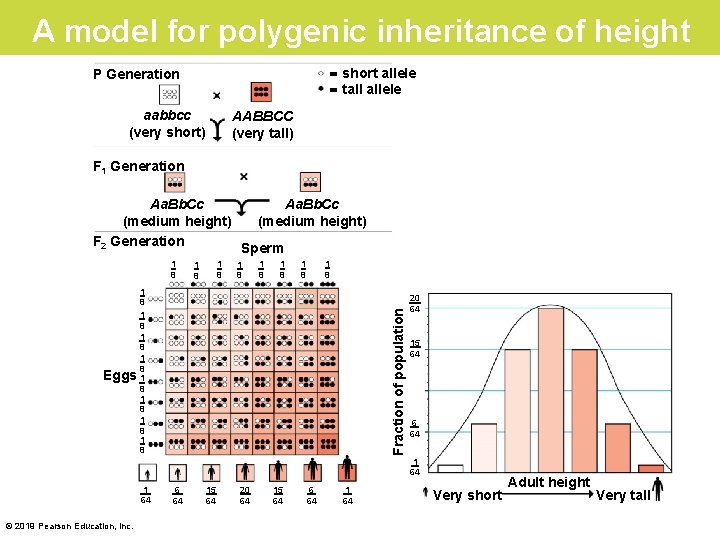
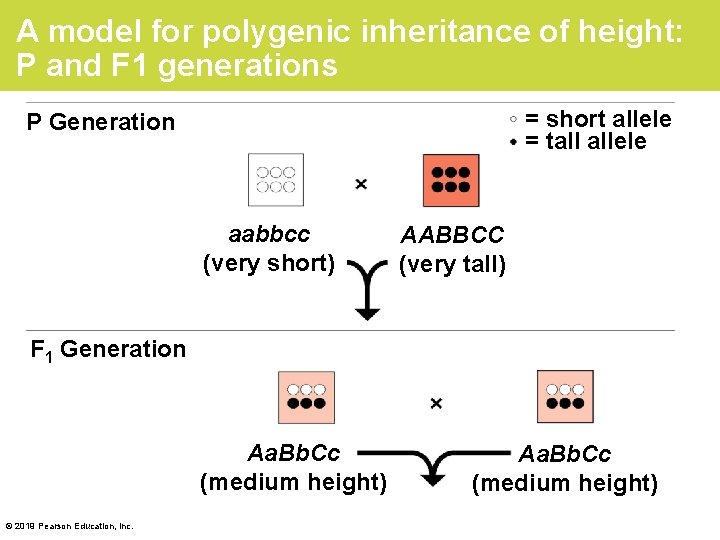
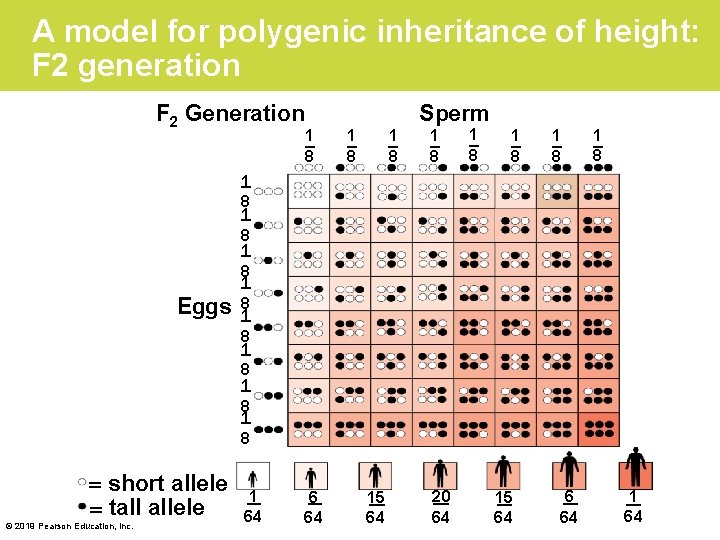
Polygenic Inheritance • Polygenic inheritance is the additive effects of two or more genes on a single phenotypic character and the logical opposite of pleiotropy, in which one gene affects several characters. – There is evidence that height in people is controlled by several genes that are inherited separately. – Many diseases, including diabetes, heart disease, and cancer, display polygenic inheritance. – Polygenic inheritance is an example of theme of interactions—that a new property can result from the interactions of many smaller parts (genes). © 2019 Pearson Education, Inc.
A model for polygenic inheritance of height = short allele = tall allele P Generation aabbcc (very short) AABBCC (very tall) F 1 Generation Aa. Bb. Cc (medium height) F 2 Generation Sperm 1 8 1 8 Fraction of population 1 8 1 8 Eggs 1 8 1 8 20 64 15 64 6 64 1 64 © 2019 Pearson Education, Inc. 6 64 15 64 20 64 15 64 6 64 1 64 Very short Adult height Very tall
A model for polygenic inheritance of height: P and F 1 generations = short allele = tall allele P Generation aabbcc (very short) AABBCC (very tall) F 1 Generation Aa. Bb. Cc (medium height) © 2019 Pearson Education, Inc. Aa. Bb. Cc (medium height)
A model for polygenic inheritance of height: F 2 generation F 2 Generation Eggs = short allele = tall allele © 2019 Pearson Education, Inc. 1 8 1 8 Sperm 1 8 1 8 1 8 1 8 1 64 6 64 15 64 20 64 15 64 6 64 1 64
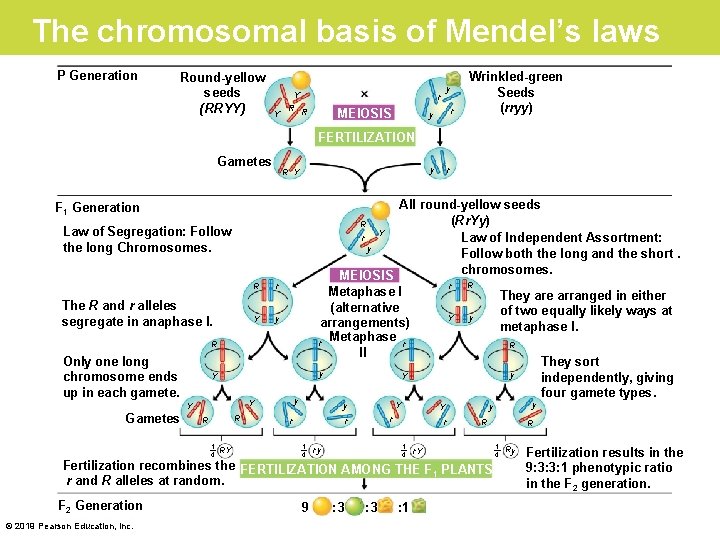
The chromosomal basis of Mendel’s laws P Generation Round-yellow seeds (RRYY) Y Y R R y r MEIOSIS r y Wrinkled-green Seeds (rryy) FERTILIZATION Gametes y R Y All round-yellow seeds (Rr. Yy) Law of Independent Assortment: Follow both the long and the short. chromosomes. F 1 Generation R Law of Segregation: Follow the long Chromosomes. y The R and r alleles segregate in anaphase I. R r Y y MEIOSIS Metaphase I (alternative arrangements) Metaphase r r II R Only one long chromosome ends up in each gamete. y Y Y Y Gametes R R 1 RY 4 Y r r y R Y y They are arranged in either of two equally likely ways at metaphase I. R Y r r 1 4 ry R r. Y Fertilization recombines the FERTILIZATION AMONG THE F PLANTS 1 r and R alleles at random. F 2 Generation © 2019 Pearson Education, Inc. 9 : 3 : 1 y y Y r r They sort independently, giving four gamete types. y Y y 1 4 r R 1 R y 4 Fertilization results in the 9: 3: 3: 1 phenotypic ratio in the F 2 generation.
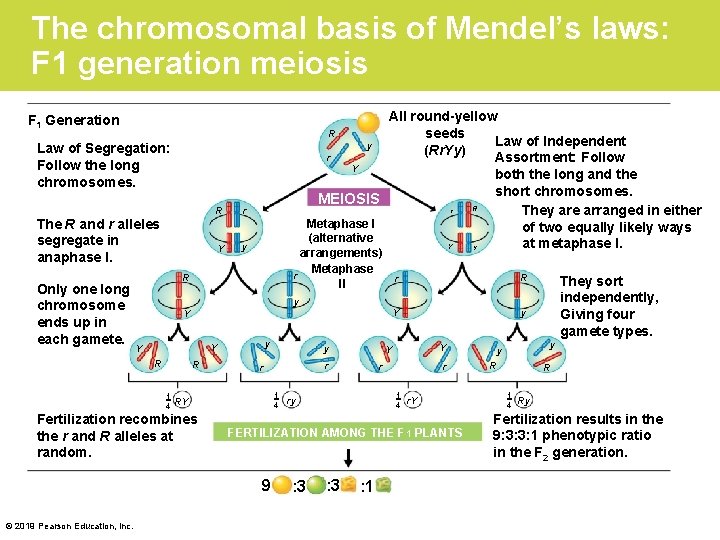
The chromosomal basis of Mendel’s laws: F 1 generation meiosis All round-yellow R seeds Law of Independent y (Rr. Yy) r Assortment: Follow Y both the long and the short chromosomes. MEIOSIS R r They are arranged in either MEIOSIS Metaphase I of two equally likely ways (alternative at metaphase I. Y y F 1 Generation Law of Segregation: Follow the long chromosomes. The R and r alleles segregate in anaphase I. Only one long chromosome ends up in each gamete. R r Y y arrangements) Metaphase MEIOSIS r II R R Y y y Y Y R R 1 4 y 1 4 Y Y r r RY Fertilization recombines the r and R alleles at random. r r 1 4 ry r. Y FERTILIZATION AMONG THE F 1 PLANTS 9 © 2019 Pearson Education, Inc. r : 3 : 1 y y R They sort independently, Giving four gamete types. R 1 4 Ry Fertilization results in the 9: 3: 3: 1 phenotypic ratio in the F 2 generation.
Linked Genes • Linked genes are located near each other on the same chromosome and tend to travel together during meiosis and fertilization. – Linked genes are often inherited as a set and therefore often do not follow Mendel’s law of independent assortment. • So far, the patterns of genetic inheritance we’ve discussed have always involved genes located on autosomes, not on the sex chromosomes. – We are now ready to look at the role of sex chromosomes and the inheritance patterns exhibited by the characters they control. © 2019 Pearson Education, Inc.
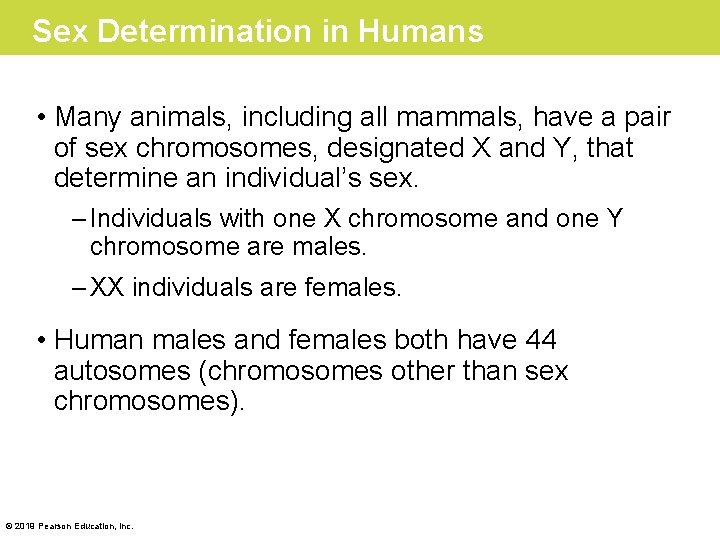
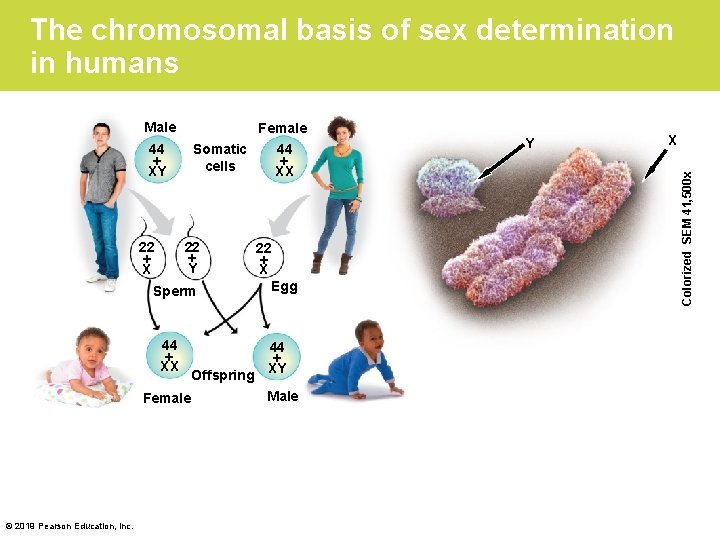
Sex Determination in Humans • Many animals, including all mammals, have a pair of sex chromosomes, designated X and Y, that determine an individual’s sex. – Individuals with one X chromosome and one Y chromosome are males. – XX individuals are females. • Human males and females both have 44 autosomes (chromosomes other than sex chromosomes). © 2019 Pearson Education, Inc.
The chromosomal basis of sex determination in humans Female 44 XY 22 X Somatic cells 22 Y Sperm 44 XX Female © 2019 Pearson Education, Inc. 44 XX 22 X Egg 44 XY Offspring Male Y X Colorized SEM 41, 500 x Male
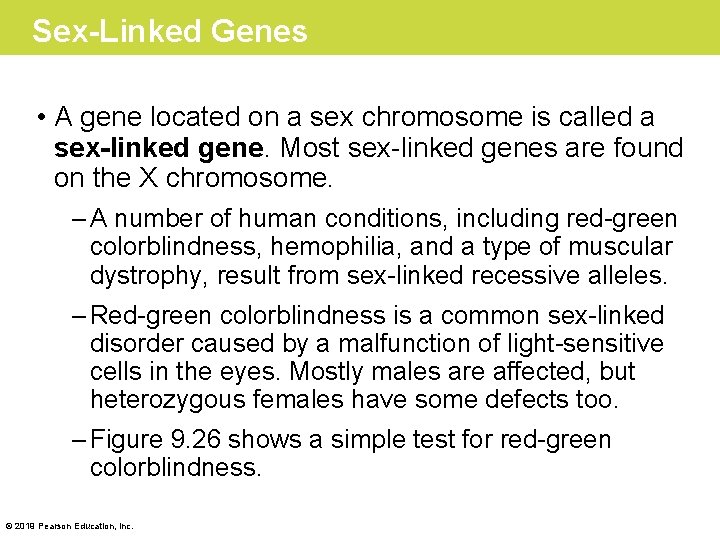
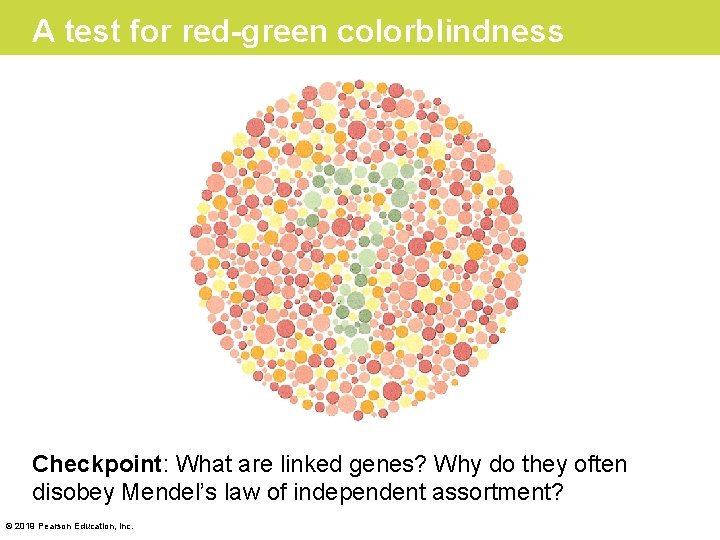
Sex-Linked Genes • A gene located on a sex chromosome is called a sex-linked gene. Most sex-linked genes are found on the X chromosome. – A number of human conditions, including red-green colorblindness, hemophilia, and a type of muscular dystrophy, result from sex-linked recessive alleles. – Red-green colorblindness is a common sex-linked disorder caused by a malfunction of light-sensitive cells in the eyes. Mostly males are affected, but heterozygous females have some defects too. – Figure 9. 26 shows a simple test for red-green colorblindness. © 2019 Pearson Education, Inc.
A test for red-green colorblindness Checkpoint: What are linked genes? Why do they often disobey Mendel’s law of independent assortment? © 2019 Pearson Education, Inc.
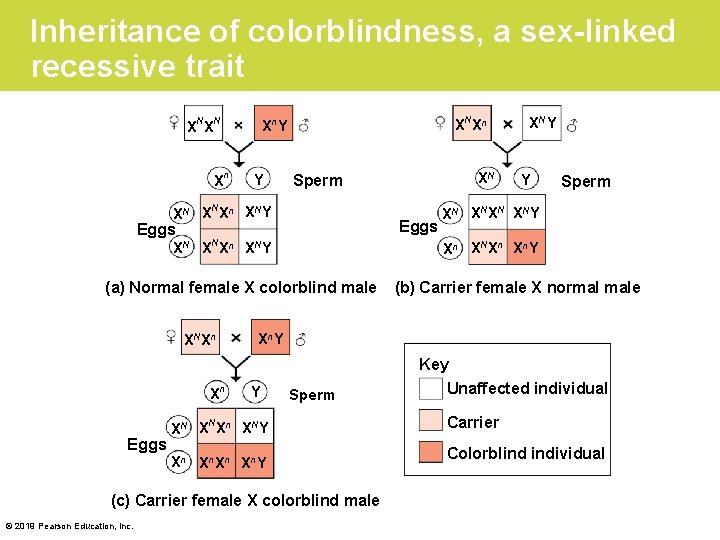
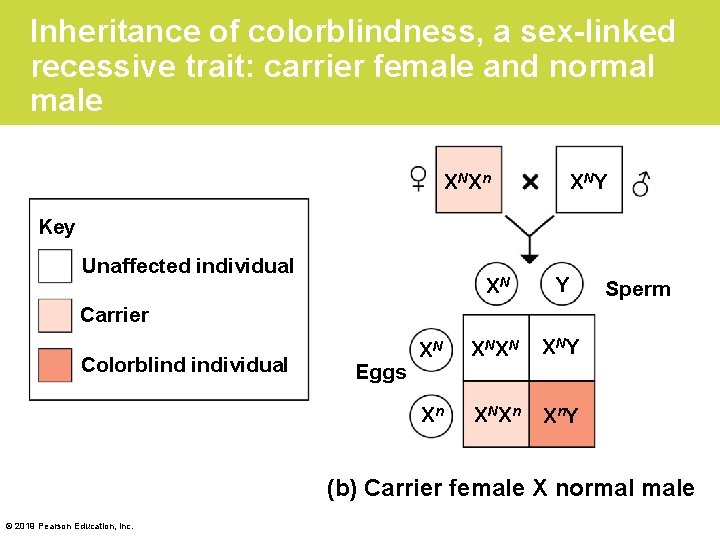
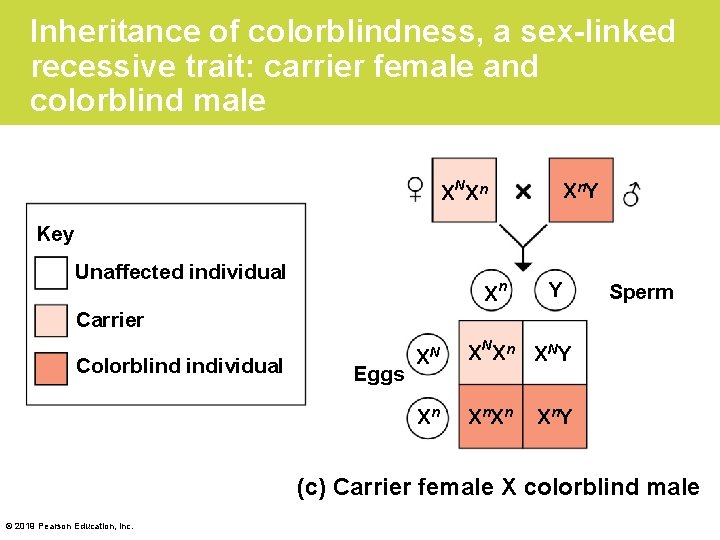
Sex-Linked Genes (Cont. ) • Because they are located on the sex chromosomes, sex-linked genes exhibit unusual inheritance patterns. – Figure 9. 27 a illustrates what happens when a colorblind male has offspring with a homozygous female with normal color vision. – Figure 9. 27 b illustrates what happens if a female carrier mates with a male with normal color vision. – Because the colorblindness allele is recessive, a female will be colorblind only if she receives that allele on both X chromosomes (Figure 9. 27 c). © 2019 Pearson Education, Inc.
Inheritance of colorblindness, a sex-linked recessive trait XNXN Xn XNXn Xn. Y Y N XN X Xn XNY Eggs XN XNXn XNY Y Sperm XN XNY Xn XNXn Xn. Y (a) Normal female X colorblind male XNXn XN Sperm XNY (b) Carrier female X normal male Xn. Y Key Xn Eggs Y Sperm N XN X Xn XNY Xn Xn. Y (c) Carrier female X colorblind male © 2019 Pearson Education, Inc. Unaffected individual Carrier Colorblind individual
Inheritance of colorblindness, a sex-linked recessive trait: carrier female and normal male X NX n X NY Key Unaffected individual XN Y XN X NX N X NY Xn X NX n X n. Y Sperm Carrier Colorblind individual Eggs (b) Carrier female X normal male © 2019 Pearson Education, Inc.
Inheritance of colorblindness, a sex-linked recessive trait: carrier female and colorblind male X NX n X n. Y Key Unaffected individual Xn Y Sperm Carrier Colorblind individual Eggs XN X NX n X NY Xn X n. Y (c) Carrier female X colorblind male © 2019 Pearson Education, Inc.
Sex-Linked Genes (Cont. ) • Hemophilia is a sex-linked recessive trait with a long, well-documented history. – Hemophiliacs bleed excessively when injured because they have inherited an abnormal allele for a factor involved in blood clotting. – The most seriously affected individuals may bleed to death after relatively minor bruises or cuts. – The former practice of strengthening international alliances by marriage effectively spreads hemophilia through the royal families of several nations. © 2019 Pearson Education, Inc.