
Chapter 9 Layout Strategies 8 1 Outline u
- Slides: 34
Chapter 9 : Layout Strategies 8 -1
Outline u The Strategic Importance of Layout Decisions u Types of Layout u Office Layout u Retail Layout u Warehousing and Storage Layouts u Fixed-Position Layout 8 -2
Outline – Continued u Process-Oriented Layout u Work Cells u Requirements of Work Cells u Staffing and Balancing Work Cells u The Focused Work Center and the Focused Factory u Repetitive and Product-Oriented Layout u Assembly-Line Balancing 8 -3
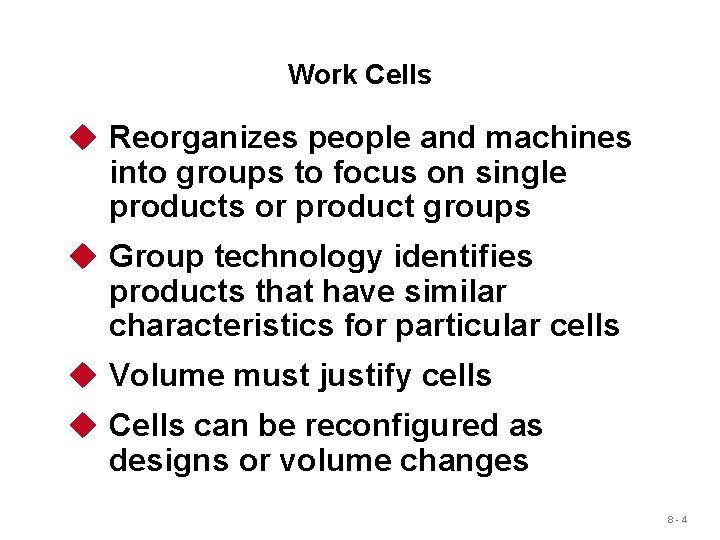
Work Cells u Reorganizes people and machines into groups to focus on single products or product groups u Group technology identifies products that have similar characteristics for particular cells u Volume must justify cells u Cells can be reconfigured as designs or volume changes 8 -4
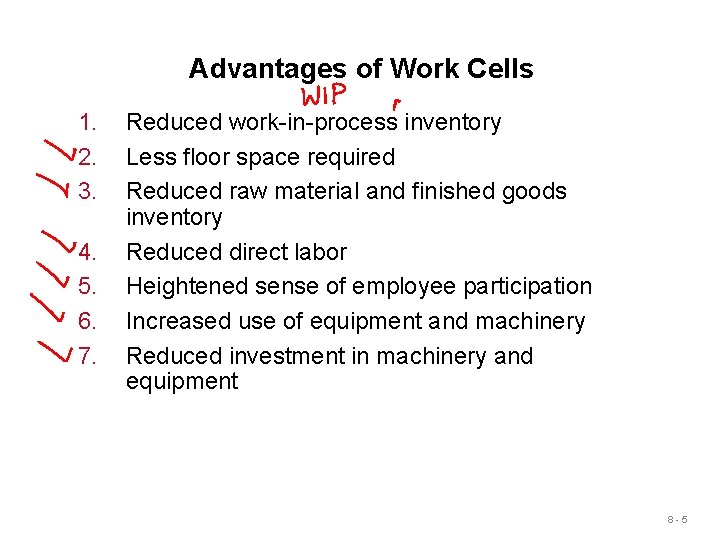
Advantages of Work Cells 1. 2. 3. 4. 5. 6. 7. Reduced work-in-process inventory Less floor space required Reduced raw material and finished goods inventory Reduced direct labor Heightened sense of employee participation Increased use of equipment and machinery Reduced investment in machinery and equipment 8 -5
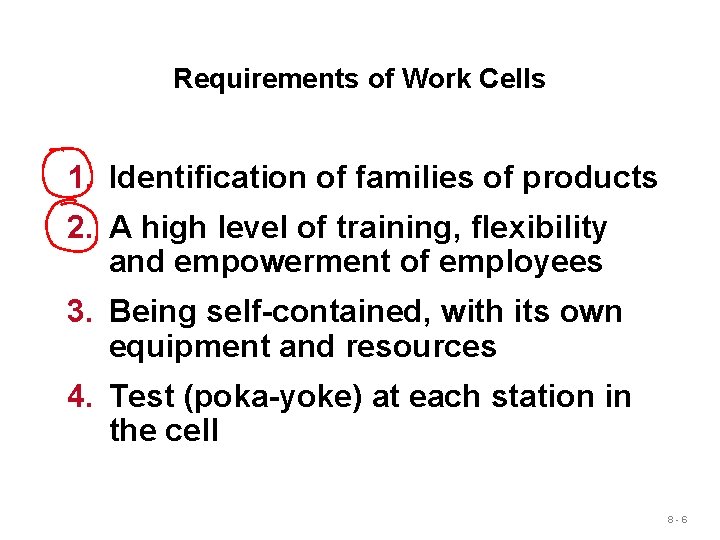
Requirements of Work Cells 1. Identification of families of products 2. A high level of training, flexibility and empowerment of employees 3. Being self-contained, with its own equipment and resources 4. Test (poka-yoke) at each station in the cell 8 -6
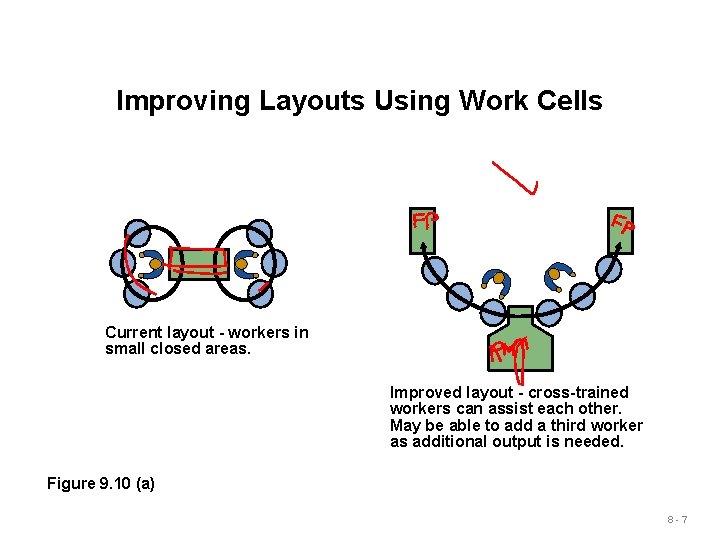
Improving Layouts Using Work Cells Current layout - workers in small closed areas. Improved layout - cross-trained workers can assist each other. May be able to add a third worker as additional output is needed. Figure 9. 10 (a) 8 -7
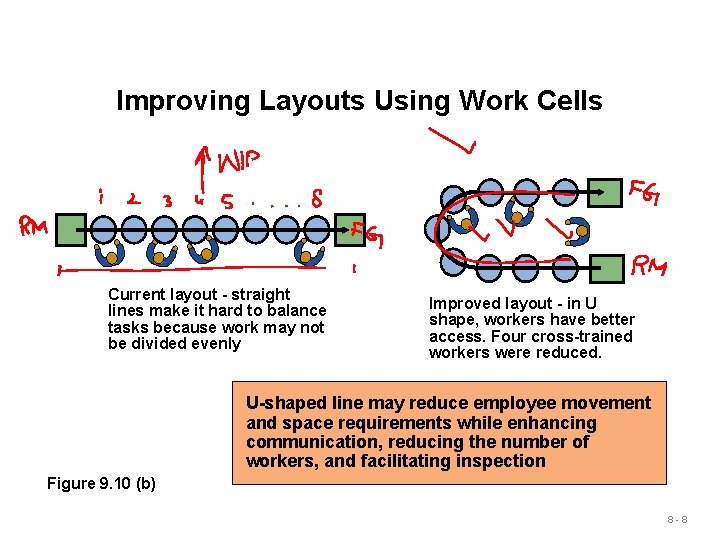
Improving Layouts Using Work Cells Current layout - straight lines make it hard to balance tasks because work may not be divided evenly Improved layout - in U shape, workers have better access. Four cross-trained workers were reduced. U-shaped line may reduce employee movement and space requirements while enhancing communication, reducing the number of workers, and facilitating inspection Figure 9. 10 (b) 8 -8
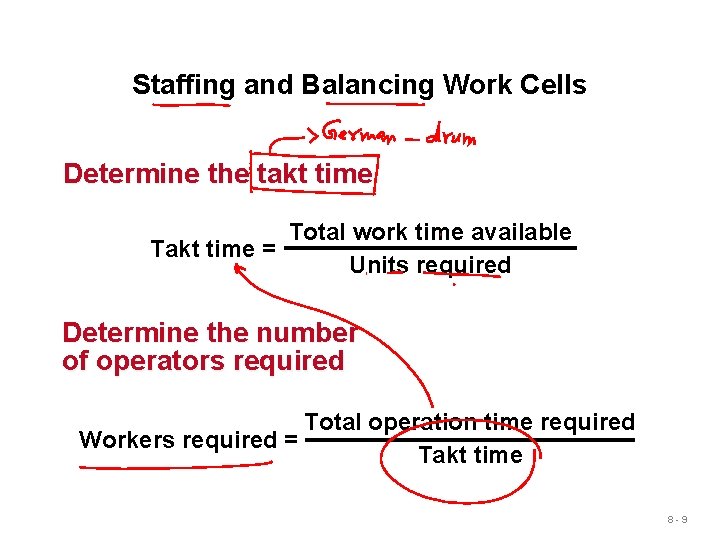
Staffing and Balancing Work Cells Determine the takt time Total work time available Takt time = Units required Determine the number of operators required Total operation time required Workers required = Takt time 8 -9
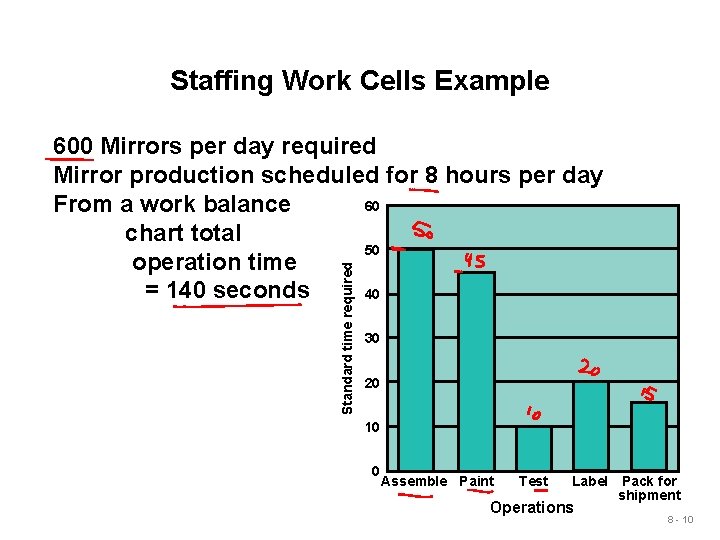
Staffing Work Cells Example Standard time required 600 Mirrors per day required Mirror production scheduled for 8 hours per day 60 From a work balance chart total 50 operation time = 140 seconds 40 30 20 10 0 Assemble Paint Test Label Pack for shipment Operations 8 - 10
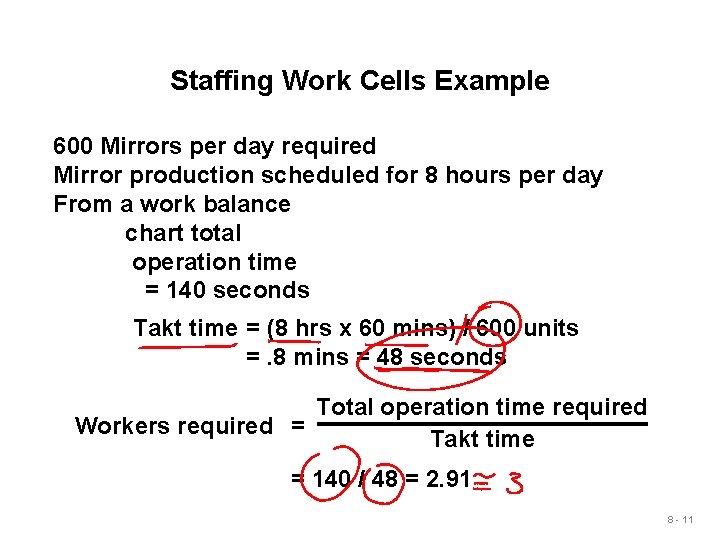
Staffing Work Cells Example 600 Mirrors per day required Mirror production scheduled for 8 hours per day From a work balance chart total operation time = 140 seconds Takt time = (8 hrs x 60 mins) / 600 units =. 8 mins = 48 seconds Total operation time required Workers required = Takt time = 140 / 48 = 2. 91 8 - 11
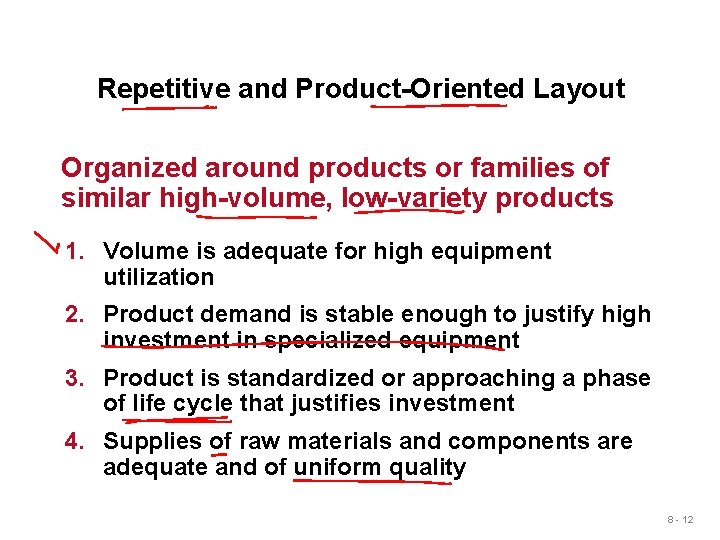
Repetitive and Product-Oriented Layout Organized around products or families of similar high-volume, low-variety products 1. Volume is adequate for high equipment utilization 2. Product demand is stable enough to justify high investment in specialized equipment 3. Product is standardized or approaching a phase of life cycle that justifies investment 4. Supplies of raw materials and components are adequate and of uniform quality 8 - 12
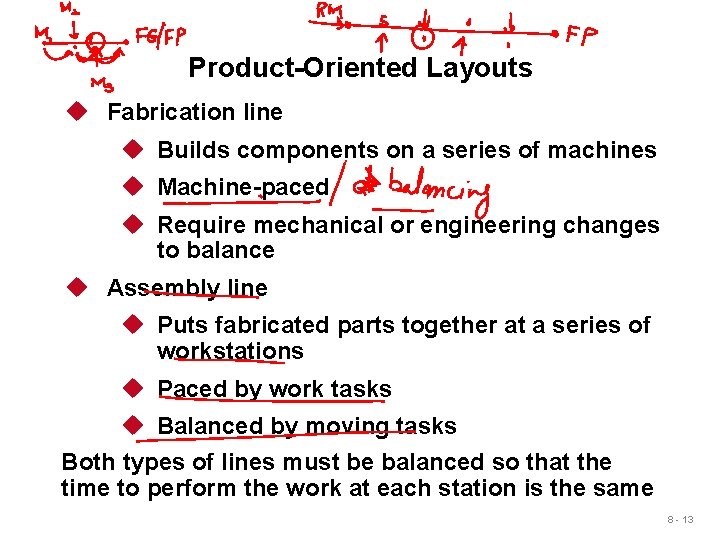
Product-Oriented Layouts u Fabrication line u Builds components on a series of machines u Machine-paced u Require mechanical or engineering changes to balance u Assembly line u Puts fabricated parts together at a series of workstations u Paced by work tasks u Balanced by moving tasks Both types of lines must be balanced so that the time to perform the work at each station is the same 8 - 13
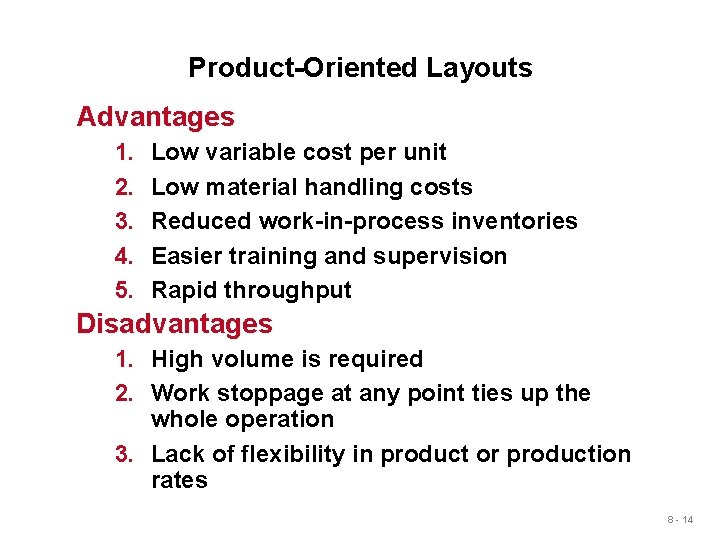
Product-Oriented Layouts Advantages 1. 2. 3. 4. 5. Low variable cost per unit Low material handling costs Reduced work-in-process inventories Easier training and supervision Rapid throughput Disadvantages 1. High volume is required 2. Work stoppage at any point ties up the whole operation 3. Lack of flexibility in product or production rates 8 - 14
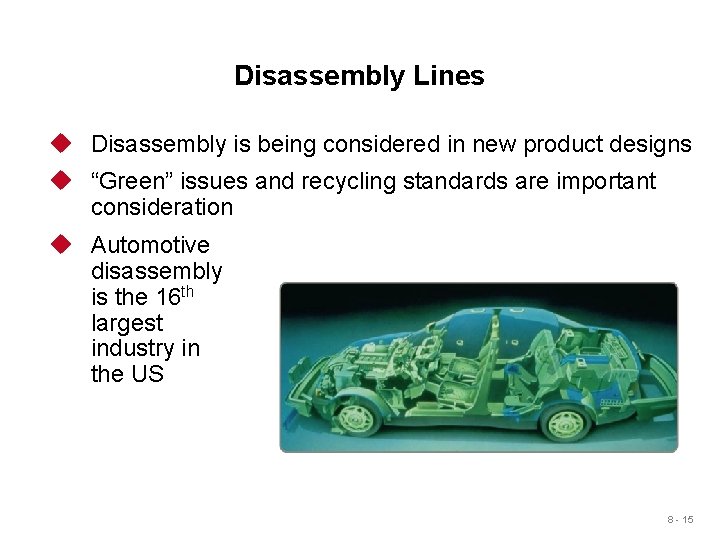
Disassembly Lines u Disassembly is being considered in new product designs u “Green” issues and recycling standards are important consideration u Automotive disassembly is the 16 th largest industry in the US 8 - 15
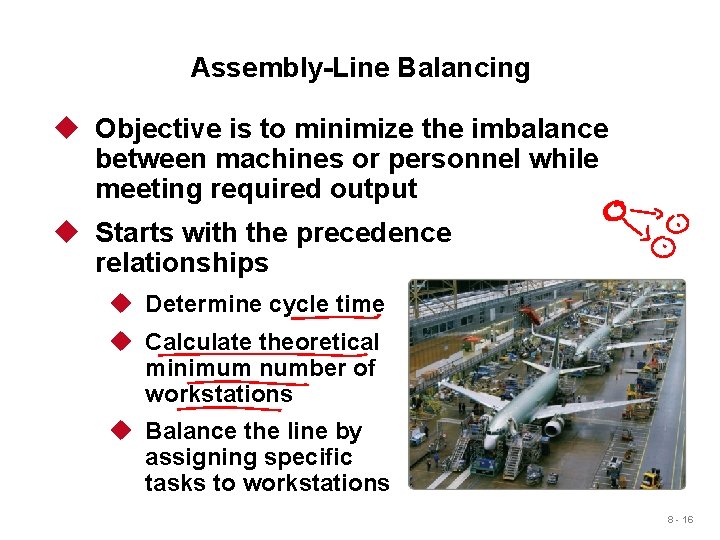
Assembly-Line Balancing u Objective is to minimize the imbalance between machines or personnel while meeting required output u Starts with the precedence relationships u Determine cycle time u Calculate theoretical minimum number of workstations u Balance the line by assigning specific tasks to workstations 8 - 16
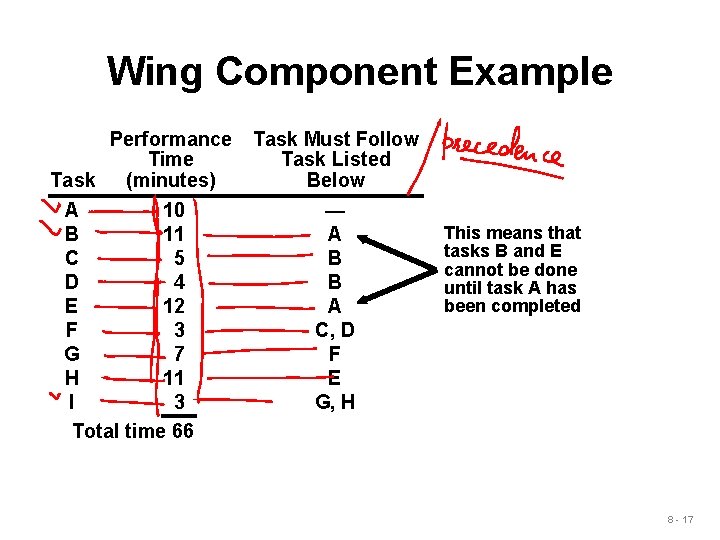
Wing Component Example Performance Time Task (minutes) A 10 B 11 C 5 D 4 E 12 F 3 G 7 H 11 I 3 Total time 66 Task Must Follow Task Listed Below — A B B A C, D F E G, H This means that tasks B and E cannot be done until task A has been completed 8 - 17
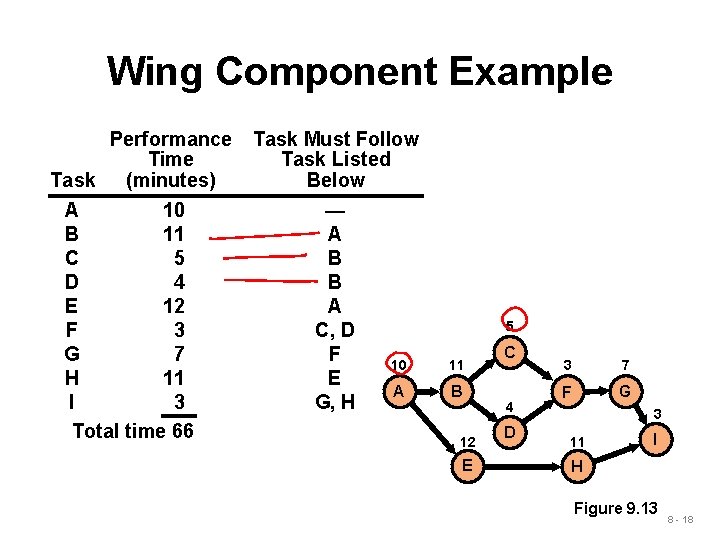
Wing Component Example Performance Time Task (minutes) A 10 B 11 C 5 D 4 E 12 F 3 G 7 H 11 I 3 Total time 66 Task Must Follow Task Listed Below — A B B A C, D F E G, H 5 10 11 A B 12 E C 4 D 3 7 F G 3 11 I H Figure 9. 13 8 - 18
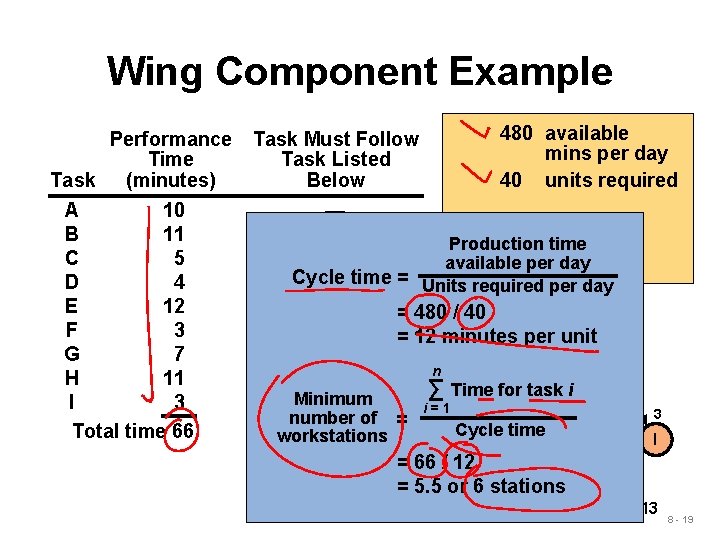
Wing Component Example Performance Time Task (minutes) A 10 B 11 C 5 D 4 E 12 F 3 G 7 H 11 I 3 Total time 66 480 available mins per day 40 units required Task Must Follow Task Listed Below — A Production time B available per day Cycle B time = Units required per day A = 480 / 40 5 C, D = 12 minutes per unit C F 10 11 3 7 n E for task. Fi A ∑ Time B G Minimum G, H 4 i=1 number of = workstations Cycle Dtime 12 11 3 I = 66 / 12 E H = 5. 5 or 6 stations Figure 9. 13 8 - 19
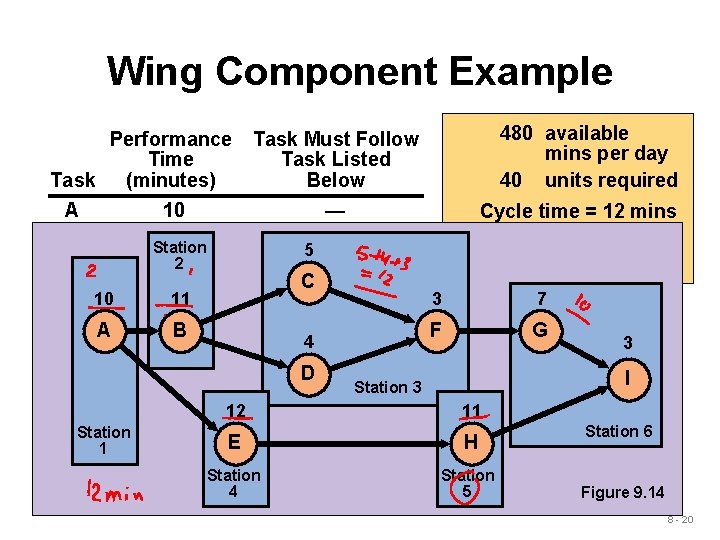
Wing Component Example Performance Time Task (minutes) 480 available mins per day 40 units required Task Must Follow Task Listed Below A 10 B 11 Station C 52 D 4 11 E 10 12 B F A 3 G 7 H 11 I 3 12 Stationtime 66 Total E 1 Station 4 — Cycle time = 12 mins A Minimum 5 B = 5. 5 or 6 workstations C B 3 7 A G C, D F 4 3 F D E Station 3 I Station 3 G, H 11 H Station 5 Station 6 6 Station Figure 9. 14 8 - 20
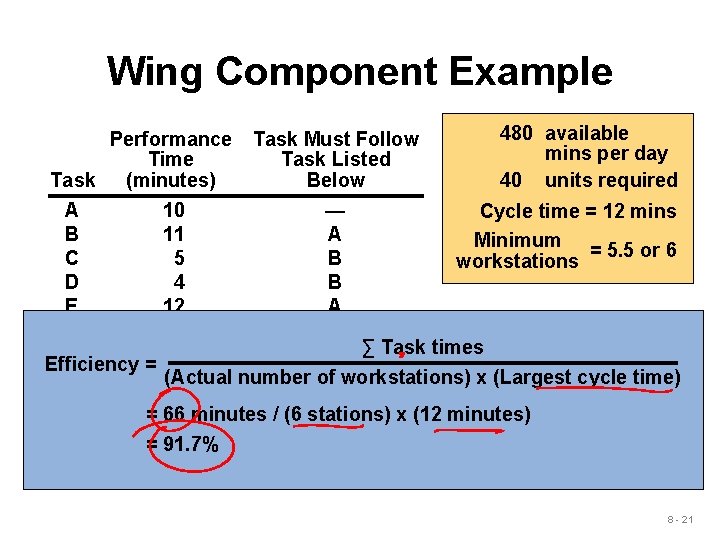
Wing Component Example Performance Time Task (minutes) Task Must Follow Task Listed Below 480 available mins per day 40 units required A 10 — Cycle time = 12 mins B 11 A Minimum = 5. 5 or 6 C 5 B workstations D 4 B E 12 A F 3 C, D ∑ Task times G 7 F Efficiency = (Actual number of. Eworkstations) x (Largest cycle time) H 11 I 3 G, H = 66 minutes / (6 stations) x (12 minutes) Total time 66 = 91. 7% 8 - 21
Summary u The Strategic Importance of Layout Decisions u Types of Layout u Office Layout u Retail Layout u Warehousing and Storage Layouts u Fixed-Position Layout 8 - 22
Summary – Continued u Process-Oriented Layout u Work Cells u Requirements of Work Cells u Staffing and Balancing Work Cells u The Focused Work Center and the Focused Factory u Repetitive and Product-Oriented Layout u Assembly-Line Balancing 8 - 23
Chapter 12: Inventory Management 8 - 24
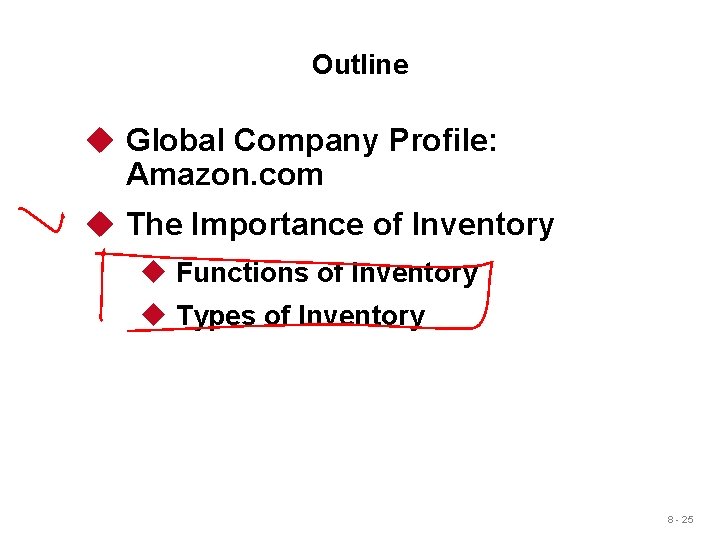
Outline u Global Company Profile: Amazon. com u The Importance of Inventory u Functions of Inventory u Types of Inventory 8 - 25
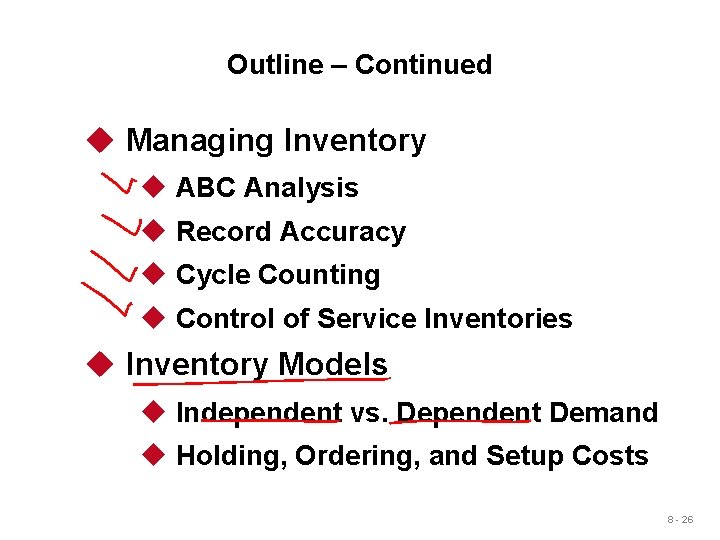
Outline – Continued u Managing Inventory u ABC Analysis u Record Accuracy u Cycle Counting u Control of Service Inventories u Inventory Models u Independent vs. Dependent Demand u Holding, Ordering, and Setup Costs 8 - 26
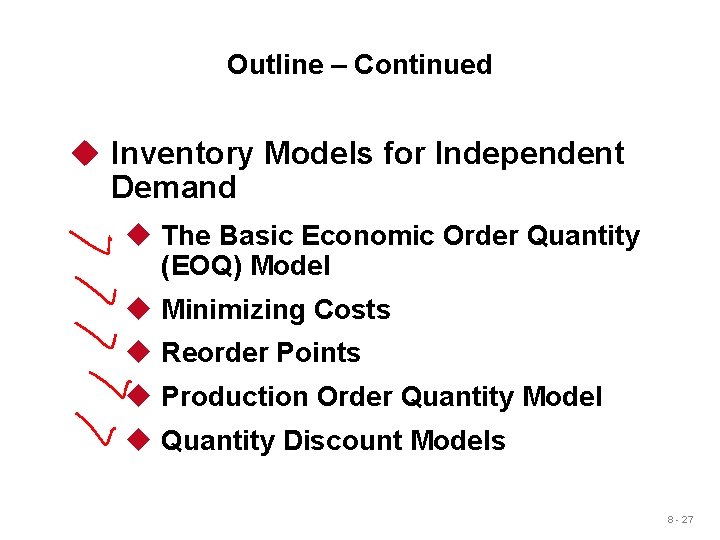
Outline – Continued u Inventory Models for Independent Demand u The Basic Economic Order Quantity (EOQ) Model u Minimizing Costs u Reorder Points u Production Order Quantity Model u Quantity Discount Models 8 - 27
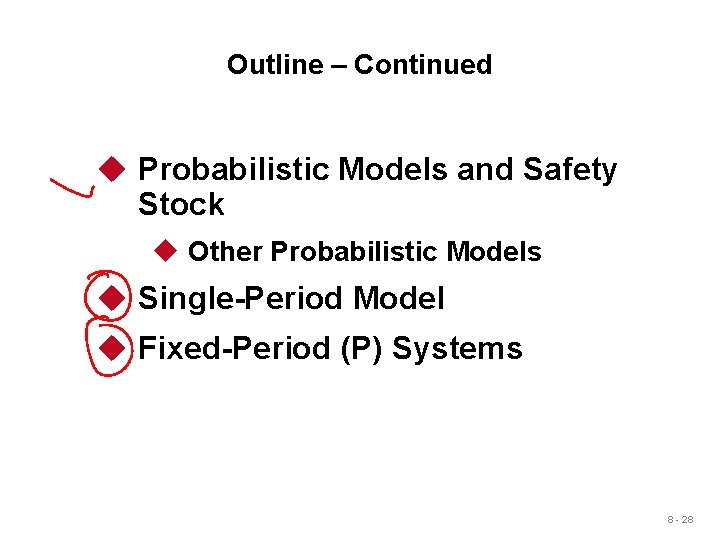
Outline – Continued u Probabilistic Models and Safety Stock u Other Probabilistic Models u Single-Period Model u Fixed-Period (P) Systems 8 - 28
Inventory Management The objective of inventory management is to strike a balance between inventory investment and customer service 8 - 29
Importance of Inventory u One of the most expensive assets of many companies representing as much as 50% of total invested capital u Operations managers must balance inventory investment and customer service 8 - 30
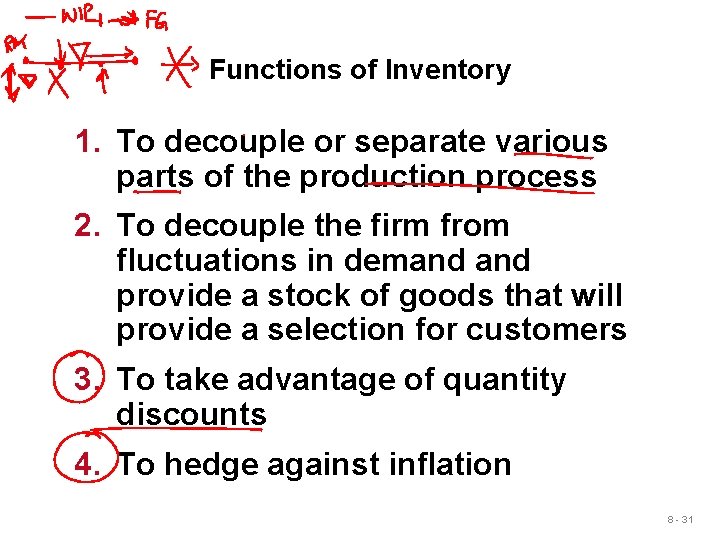
Functions of Inventory 1. To decouple or separate various parts of the production process 2. To decouple the firm from fluctuations in demand provide a stock of goods that will provide a selection for customers 3. To take advantage of quantity discounts 4. To hedge against inflation 8 - 31
Types of Inventory u Raw material u Purchased but not processed u Work-in-process u Undergone some change but not completed u Maintenance/repair/operating (MRO) u Necessary to keep machinery and processes productive u Finished goods u Completed product awaiting shipment 8 - 32
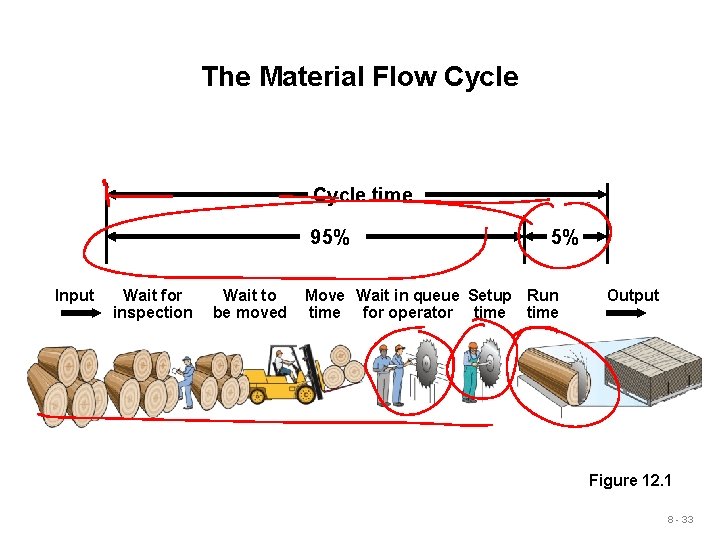
The Material Flow Cycle time 95% Input Wait for inspection Wait to be moved 5% Move Wait in queue Setup Run time for operator time Output Figure 12. 1 8 - 33
Managing Inventory 1. How inventory items can be classified 2. How accurate inventory records can be maintained 8 - 34