
Chapter 9 Launching a New Republic 1789 1800

Chapter 9 Launching a New Republic : (1789 – 1800)

� The first presidential election was held in 1789, George Washington won by unanimous vote, John Adams, runner-up was his vice president � Washington headed to New York, to be inaugurated – formally sworn in, as president � Washington knew that his every action would set a precedent – an example that becomes standard practice Washington’s Presidency:
� First people argued over what to call Washington, “His Excellency” like a king, finally “Mr. President” was decided � The Constitution made many matter to be decided by Congress, for example: it made the Supreme Court, but left Congress to decide on the details � The Federal Judiciary Act – gave the Supreme Court 6 members: a chief justice, and 5 associate judges � Washington appointed John Jay the first chief justice � Washington’s cabinet: state, war treasury, justice, and postal service needed filled � State – Thomas Jefferson, War – Henry Knox, Treasury – Alexander Hamilton, Attorney General – Edmund Randolph, the postal member was not in the cabinet until 1829 Decision to be Made:
�After the war the states had borrowed millions from France, Spain, and the Netherlands, beside private citizens, and soldiers pay �By 1789, the total was $52 million �In 1790, Hamilton proposed a plan to Congress to improve the nations finances 1. Paying off all war debts 2. Raising government revenue 3. Creating a national bank • To raise revenue he favored tariffs – taxes on imported goods • Tariffs do 2 things: increase government revenue and encouraged growth of national business • The nations capitol was relocated to Virginia on the Potomac River in compromise with the south to support Hamilton’s plan The Nation’s Finances:
� Hamilton’s idea of creating a national bank brought forth discussion, those who had a “strict” interpretation of the Constitution and those who had a loose one, because the Constitution didn’t mention a national bank � Hamilton used the “elastic clause” of the Constitution, which gives Congress the authority to do whatever is “necessary and proper” � In 1791 the Bank of the United States was established � Hamilton and Thomas Jefferson had opposing view on the bank, and gave the foundation for the American political factions that followed Hamilton’s Opponents:
� Washington always supported a strong central government, and under his presidency it revealed its strength when dealing with a number of threating situations � The country need peace to prosper, but trouble in the Trans. Appalachian West, land between the Appalachian Mountains and the Mississippi River grew. � Native Americans were the strongest resistance in the Northwest Territory, land bordered by the Ohio River to the south and Canada to the north, because Spain, Britain, Native Americans, and the U. S. all claimed it Challenges to the New Government:
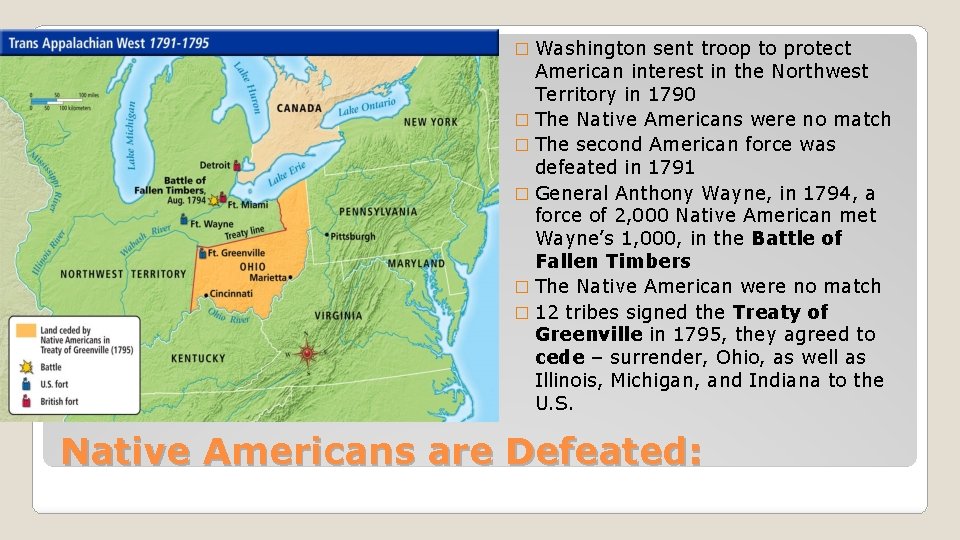
Washington sent troop to protect American interest in the Northwest Territory in 1790 � The Native Americans were no match � The second American force was defeated in 1791 � General Anthony Wayne, in 1794, a force of 2, 000 Native American met Wayne’s 1, 000, in the Battle of Fallen Timbers � The Native American were no match � 12 tribes signed the Treaty of Greenville in 1795, they agreed to cede – surrender, Ohio, as well as Illinois, Michigan, and Indiana to the U. S. � Native Americans are Defeated:
� Hamilton had pushed a tax through Congress to be levied on whiskey, which backcountry farmers grew corn, non-profitable, but whiskey was worth more � In 1794, the Whiskey Rebellion in western Pennsylvania started, farmers burned the local tax collectors home, and threatened to attack Pittsburgh � General Henry Lee, with Hamilton at his side, led 13, 000 soldiers into Pennsylvania, and the rebels fled � The troops rounded up about 20 leaders of the rebellion � The government had shown its power and willingness to enforce the laws Trouble in the Backcountry:
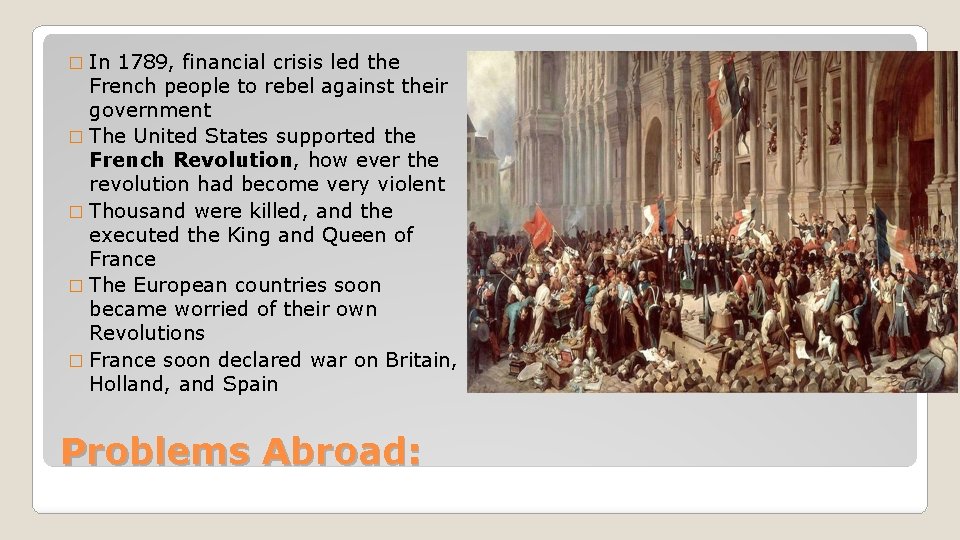
� In 1789, financial crisis led the French people to rebel against their government � The United States supported the French Revolution, how ever the revolution had become very violent � Thousand were killed, and the executed the King and Queen of France � The European countries soon became worried of their own Revolutions � France soon declared war on Britain, Holland, and Spain Problems Abroad:
The United States was caught in the middle of the war, France supported the Americans in their Revolution, and Britain and the United States were trade partners � In 1793, Washington declared the United States neutral – not taking sides � Jefferson wanting support for France, and tired of Washington’s support for Hamilton’s ideas resigned as secretary of state in 1793 � British ships were seizing cargo ships of America in the West Indies carrying good from France � John Jay went to Britain to discuss this matter, and to get the British to leave the northwest frontier � Jay’s Treaty – the British agreed to pay for damages to U. S. vessels, and they agreed to leave the Ohio Valley by 1796 � Thomas Pinckney helped reduce tensions with Spain with Pinckney’s Treaty – stating: 1. Americans had the right to travel freely on the Mississippi River 2. U. S. good could be stored in New Orleans free of custom duties 3. Spain accepted the 31 st parallel as the northern boundary of Florida and the United State’s southern boarder � French and Britain at War:
� With the news of Washington not running for president again, it left the nation divided over how it should be run � Washington had 2 terms in office, and return to Mount Vernon in Virginia � Washington’s parting words in foreign policy – relations with the governments of other countries, were “steer clear of permanent alliances with any portion of the foreign world” � The first political parties – a group of people that tries to promote its ideas and influence government, the Democratic-Republican party, started by Jefferson and Madison, and the Federalist party, started by Hamilton and his friends � Federalists – were supporters of the ratification of the Constitution Federalists in Charge:
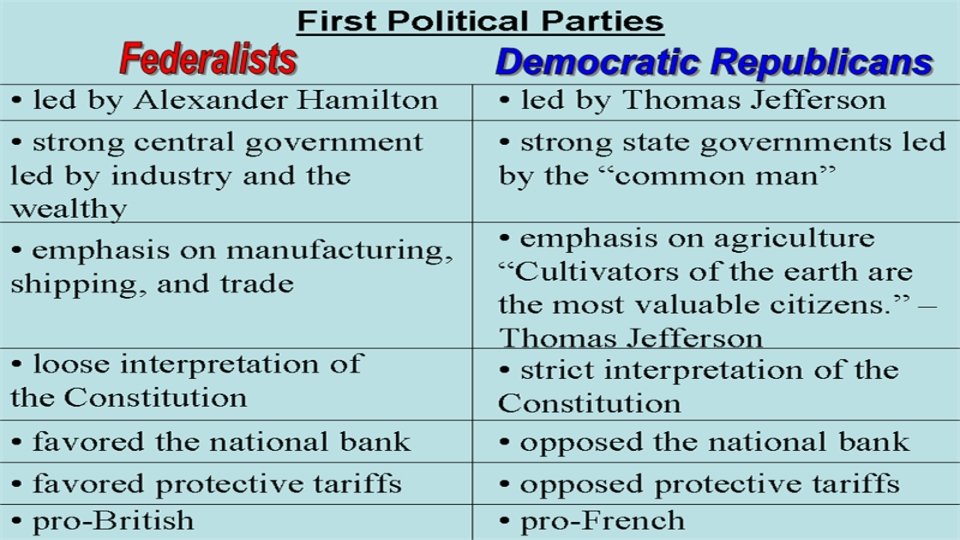
� In 1796, the United States had its first elections with political parties, John Adams for the Federalists, and Thomas Jefferson for the Democratic-Republicans � The electoral college, Adams received 71 votes and Jefferson 68, the Constitution set up that who ever was runner-up would be vice-president � Tensions between France and the United States grew as they began seizing and looting United States ships � President Adams sent, Charles Pinckney, Elbridge Gerry, and John Marshall to France to resolve the problem, they were ignored for weeks, then 3 French agents X, Y, and Z, came to them and said the minister would talk with them � XYZ Affair – that talks would only occur if the Americans would loan $10 million and to bribe the minister $250, 000, the Americans refuse � Congress was outraged and canceled its treaties with France, and allowed U. S. ships to seize French vessels John Adams’s Administration:
� Many Democratic-Republicans resented Adams for his decision � The Federalist Congress, passed the Alien and Sedition Acts with France – which targeted aliens – immigrants who were not yet citizens yet � One act increased the waiting period for citizenship from 5 year to 14, gave the president the power to deport and arrest suspicious aliens during wartime, and another outlawed sedition – stirring up rebellions against the government � Jefferson and Adams looked for ways to fight the acts, and founded a theory called states’ rights – that states have certain rights that the federal government could not overrule � States’ rights set a precedent for future conflict between the states and the national government � The Kentucky Resolution came up with nullification – that the states could nullify, or cancel, any act of Congress it considered unconstitutional � Kentucky and Virginia Resolutions – warned the dangers of the Alien and Sedition Acts posed by the government of checks and balances that were guaranteed by the Constitution The Alien and Sedition Acts:
� With tensions high in the United States, Adams reopened talks with France, and signed the Convention of 1800, agreeing to stop all navel attacks � In 1800, Adams was the first president to govern from the nations new capitol in Washington D. C. � Adams also lost the election of 1800 to Jefferson Peace with France:
- Slides: 15