
Chapter 9 Introduction TRANSFORMATIONS 9 1 Translations Mrs


- Slides: 7
Chapter 9 Introduction TRANSFORMATIONS 9 -1 Translations Mrs. Taormina Geometry C
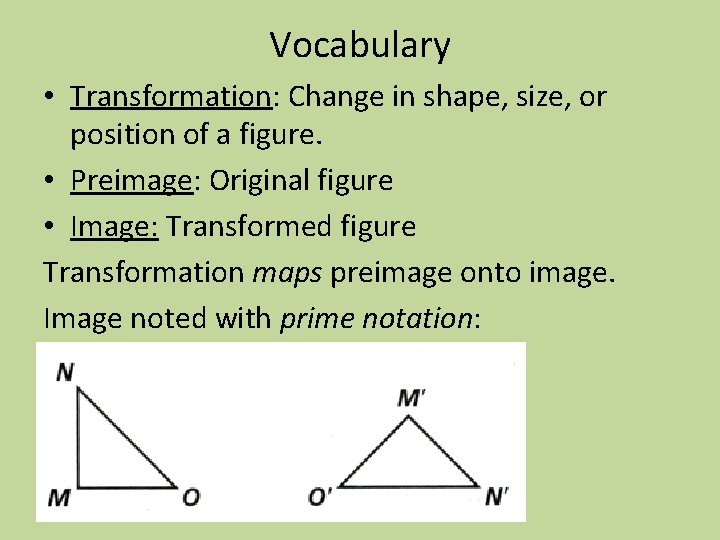
Vocabulary • Transformation: Change in shape, size, or position of a figure. • Preimage: Original figure • Image: Transformed figure Transformation maps preimage onto image. Image noted with prime notation:
Types of Transformations • Reflections (flip) • Rotations (turn) • Dilations (stretch or shrink) • Translations (slide)
Vocabulary Continued… Isometry: Transformation where preimage and image are congruent. (a. k. a: Rigid motion) Orientation: direction figure is named alphabetically (clockwise or counterclockwise) ∆GHI has clockwise orientation. ∆KLM has counterclockwise orientation.
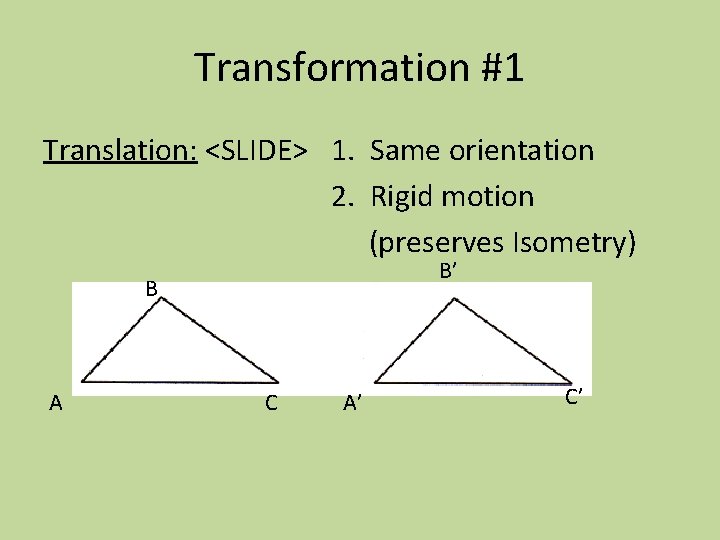
Transformation #1 Translation: <SLIDE> 1. Same orientation 2. Rigid motion (preserves Isometry) B’ B A C A’ C’
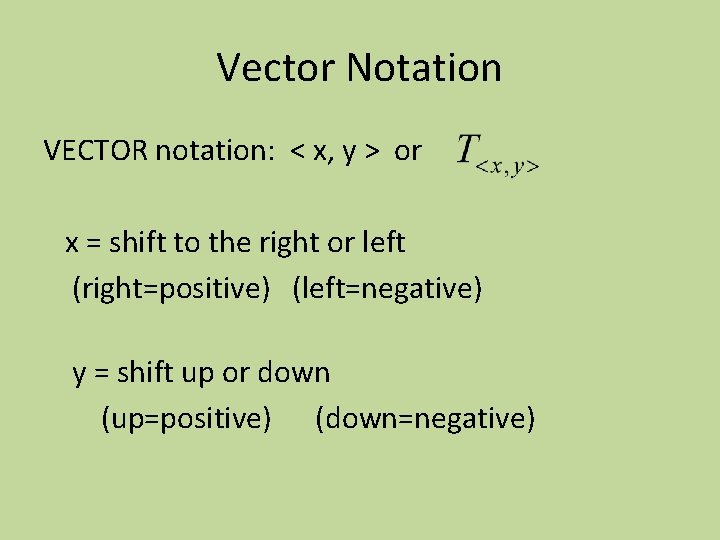
Vector Notation VECTOR notation: < x, y > or x = shift to the right or left (right=positive) (left=negative) y = shift up or down (up=positive) (down=negative)
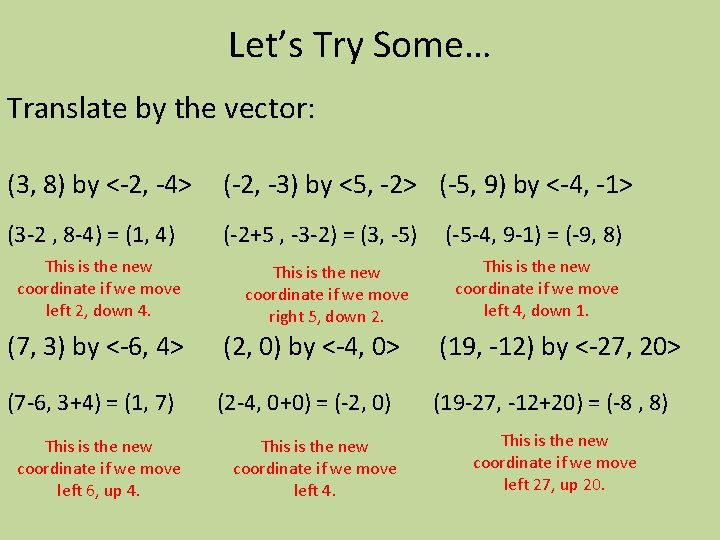
Let’s Try Some… Translate by the vector: (3, 8) by <-2, -4> (-2, -3) by <5, -2> (-5, 9) by <-4, -1> (3 -2 , 8 -4) = (1, 4) (-2+5 , -3 -2) = (3, -5) This is the new coordinate if we move left 2, down 4. This is the new coordinate if we move right 5, down 2. (-5 -4, 9 -1) = (-9, 8) This is the new coordinate if we move left 4, down 1. (7, 3) by <-6, 4> (2, 0) by <-4, 0> (19, -12) by <-27, 20> (7 -6, 3+4) = (1, 7) (2 -4, 0+0) = (-2, 0) (19 -27, -12+20) = (-8 , 8) This is the new coordinate if we move left 6, up 4. This is the new coordinate if we move left 27, up 20.