
Chapter 9 Introduction to a Standard Cost System





- Slides: 42
Chapter 9 Introduction to a Standard Cost System
Learning Objectives 1. Why are standard cost systems used? 2. How are standards for material and labor set? 3. How are material, labor, and overhead variances calculated? C 9
Continuing. . . Learning Objectives 4. How can variances be used for control and performance evaluation purposes? 5. How do organizational evolution and desired level of attainability affect standard setting? C 9
Continuing. . . Learning Objectives 6. How are standard setting and standard usage changing in modern business? 7. What journal entries are needed in a standard cost system? (Appendix) C 9
Standards and Standard Costs The estimated cost to manufacture a single unit of product or to perform a single service is the standard cost.
Material Standards In developing material standards, the specific direct material components used to manufacture the product or to perform the service must be identified and listed. Three things must be known about the materials: – What inputs are needed? – What must be the quality of those inputs? – What quantities of inputs of the specified quality are needed?
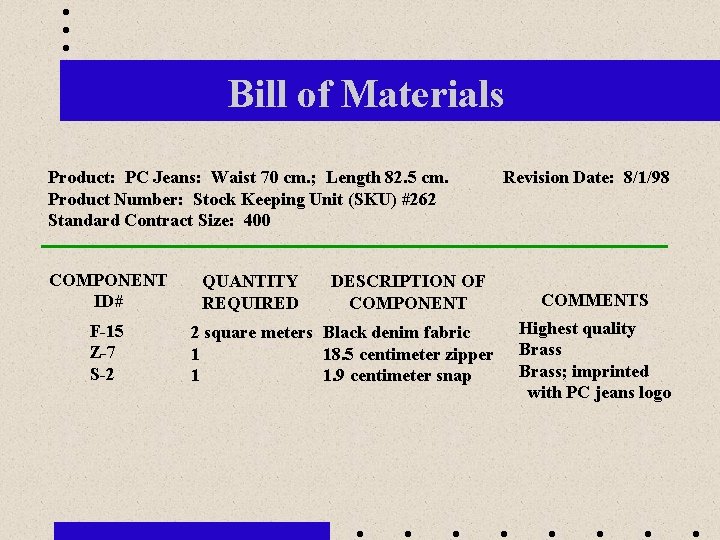
Bill of Materials Product: PC Jeans: Waist 70 cm. ; Length 82. 5 cm. Product Number: Stock Keeping Unit (SKU) #262 Standard Contract Size: 400 COMPONENT ID# F-15 Z-7 S-2 QUANTITY REQUIRED DESCRIPTION OF COMPONENT 2 square meters Black denim fabric 1 18. 5 centimeter zipper 1 1. 9 centimeter snap Revision Date: 8/1/98 COMMENTS Highest quality Brass; imprinted with PC jeans logo
Labor Standards • • Identify each worker operation Setup Disregard all unnecessary movements Convert each operation to time – Time and motion studies – Industrial engineering studies – Historical data • Operations flow document • Labor rates – Wages and fringe benefits
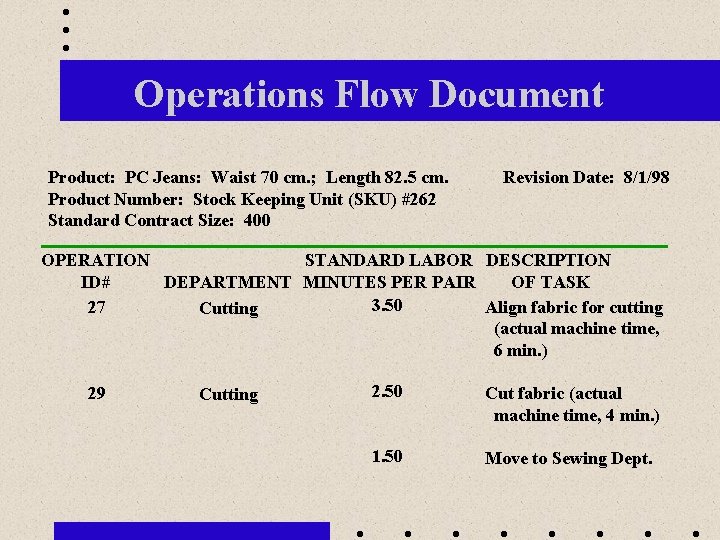
Operations Flow Document Product: PC Jeans: Waist 70 cm. ; Length 82. 5 cm. Product Number: Stock Keeping Unit (SKU) #262 Standard Contract Size: 400 Revision Date: 8/1/98 OPERATION STANDARD LABOR DESCRIPTION ID# DEPARTMENT MINUTES PER PAIR OF TASK 3. 50 27 Align fabric for cutting Cutting (actual machine time, 6 min. ) 29 Cutting 2. 50 Cut fabric (actual machine time, 4 min. ) 1. 50 Move to Sewing Dept.
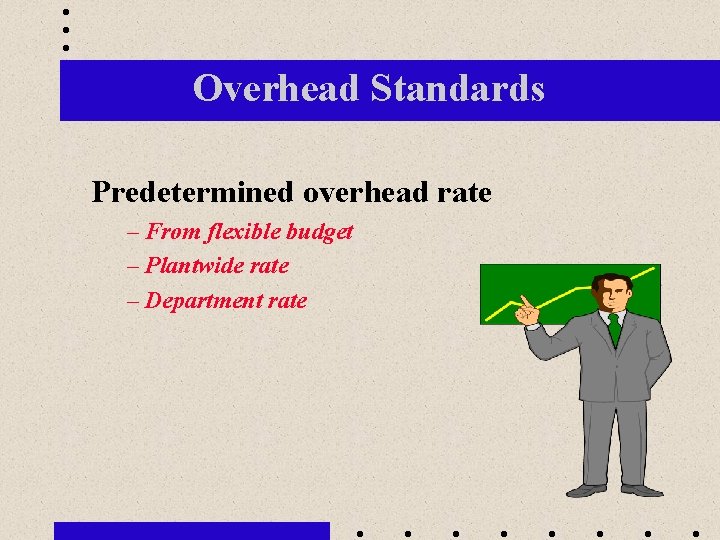
Overhead Standards Predetermined overhead rate – From flexible budget – Plantwide rate – Department rate
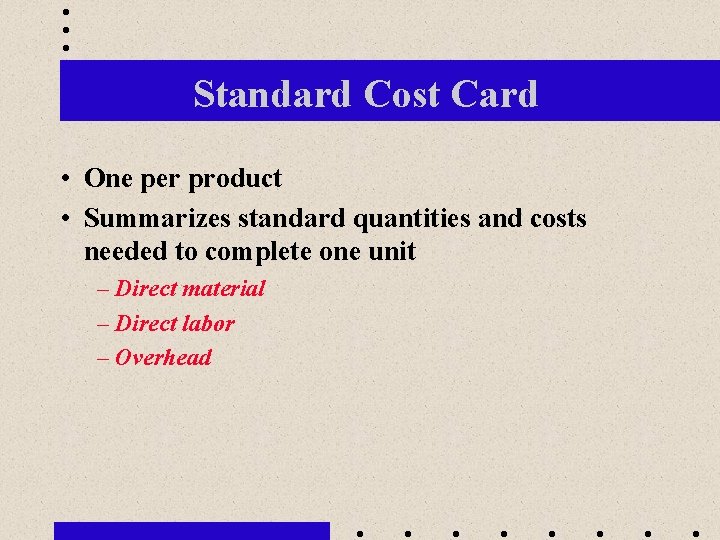
Standard Cost Card • One per product • Summarizes standard quantities and costs needed to complete one unit – Direct material – Direct labor – Overhead
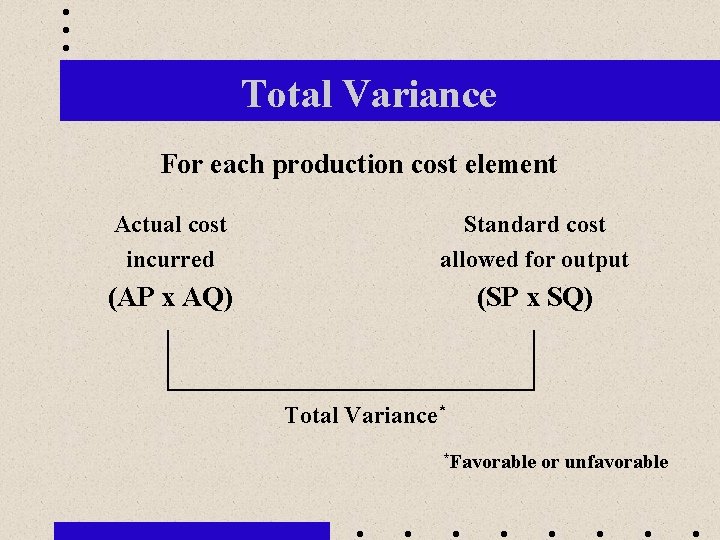
Total Variance For each production cost element Actual cost incurred Standard cost allowed for output (AP x AQ) (SP x SQ) Total Variance* *Favorable or unfavorable
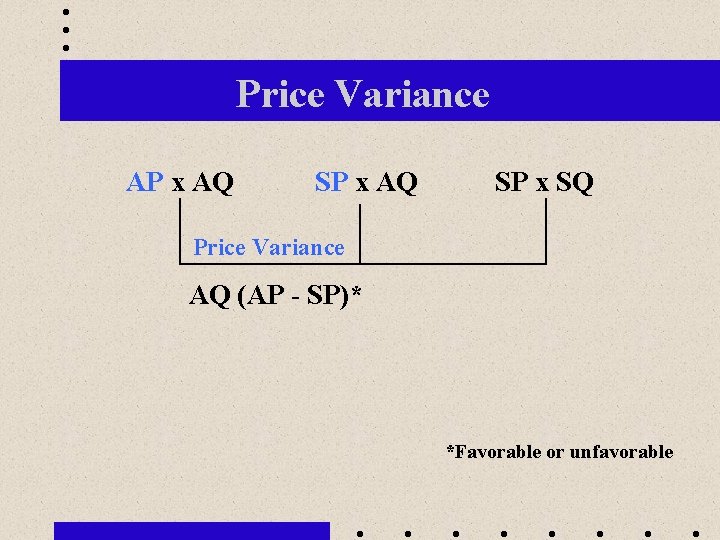
Price Variance AP x AQ SP x SQ Price Variance AQ (AP - SP)* *Favorable or unfavorable
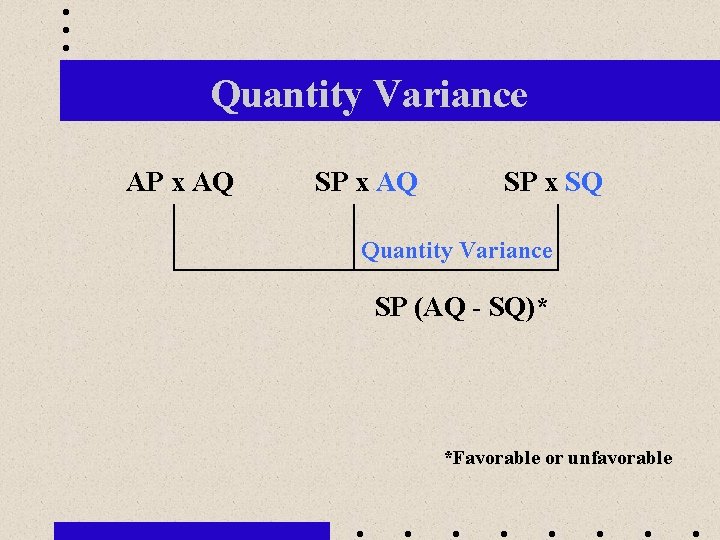
Quantity Variance AP x AQ SP x SQ Quantity Variance SP (AQ - SQ)* *Favorable or unfavorable
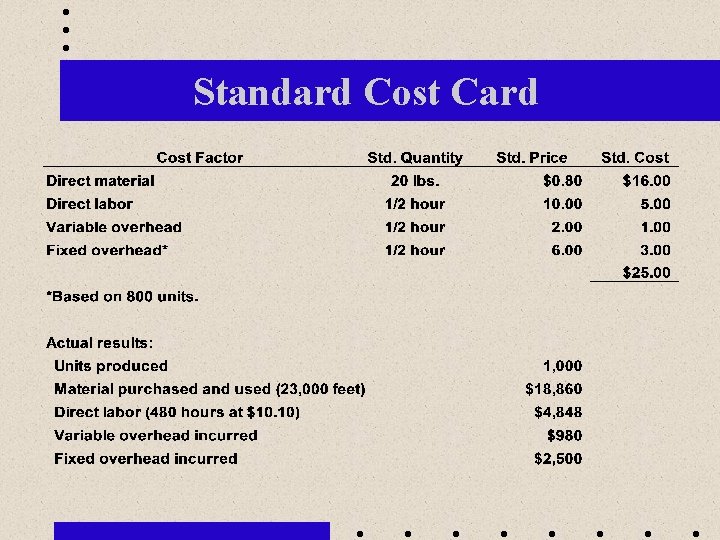
Standard Cost Card
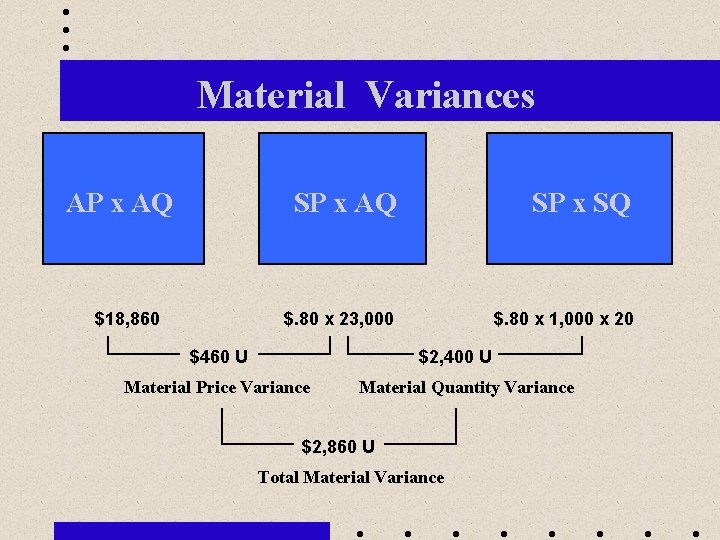
Material Variances AP x AQ $18, 860 SP x AQ SP x SQ $. 80 x 23, 000 $. 80 x 1, 000 x 20 $460 U $2, 400 U Material Price Variance Material Quantity Variance $2, 860 U Total Material Variance
Labor Variances AP x AQ SP x AQ $10. 10 x 480 $10. 00 x 480 SP x SQ $10. 00 x 1, 000 x 1/2 $200 F $48 U Labor Rate Variance Labor Efficiency Variance $152 F Total Labor Variance
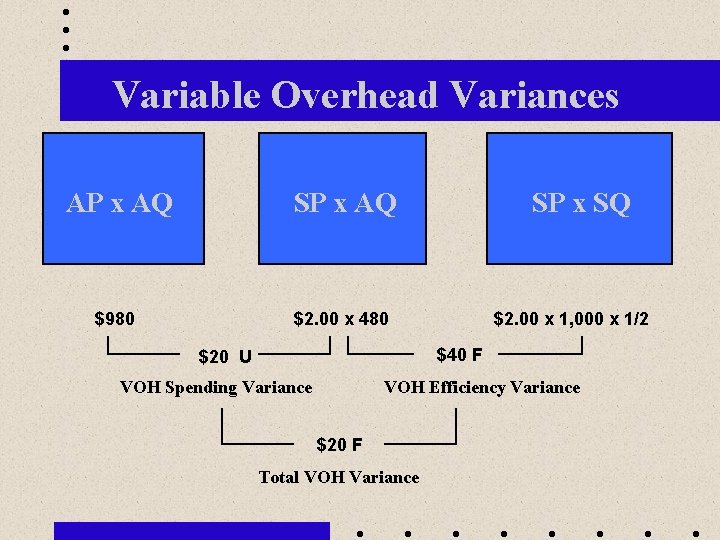
Variable Overhead Variances AP x AQ SP x AQ $980 $2. 00 x 480 SP x SQ $2. 00 x 1, 000 x 1/2 $40 F $20 U VOH Spending Variance VOH Efficiency Variance $20 F Total VOH Variance
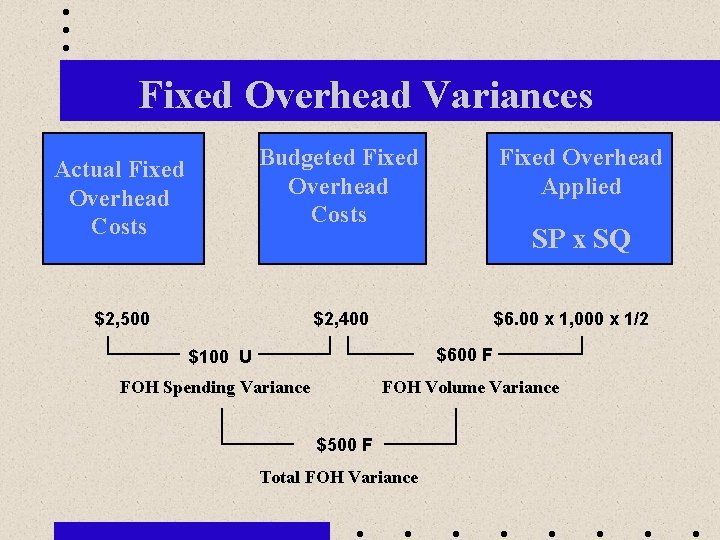
Fixed Overhead Variances Budgeted Fixed Overhead Costs Actual Fixed Overhead Costs $2, 500 Fixed Overhead Applied SP x SQ $2, 400 $6. 00 x 1, 000 x 1/2 $600 F $100 U FOH Spending Variance FOH Volume Variance $500 F Total FOH Variance
Variance Analysis Focuses on the variances Variance analysis is the process of categorizing the nature of the differences between standard and actual costs and seeking the reasons for those differences
Control Over Material Price PURCHASING AGENT
Control Over Material Quantity and Labor Costs PRODUCTION SUPERVISOR SCHEDULE
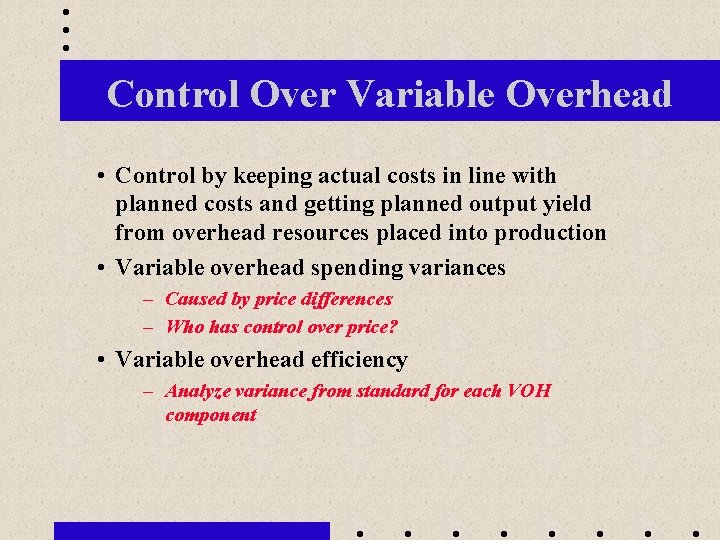
Control Over Variable Overhead • Control by keeping actual costs in line with planned costs and getting planned output yield from overhead resources placed into production • Variable overhead spending variances – Caused by price differences – Who has control over price? • Variable overhead efficiency – Analyze variance from standard for each VOH component
Control Over Fixed Overhead • Managers may have limited ability to control in short run – Control occurs at time of commitment rather than time of activity • Fixed overhead spending variance – Control takes place on a transaction-by-transaction basis – Need to review individual cost variances • Fixed overhead volume variance – Direct function of capacity level chosen for the computation of standard FOH rate – Managers have least control
Establishing Standards • Appropriateness – Basis on which standards are developed – How long standards are expected to last • Attainability – Expected standards – Practical standards – Theoretical standards
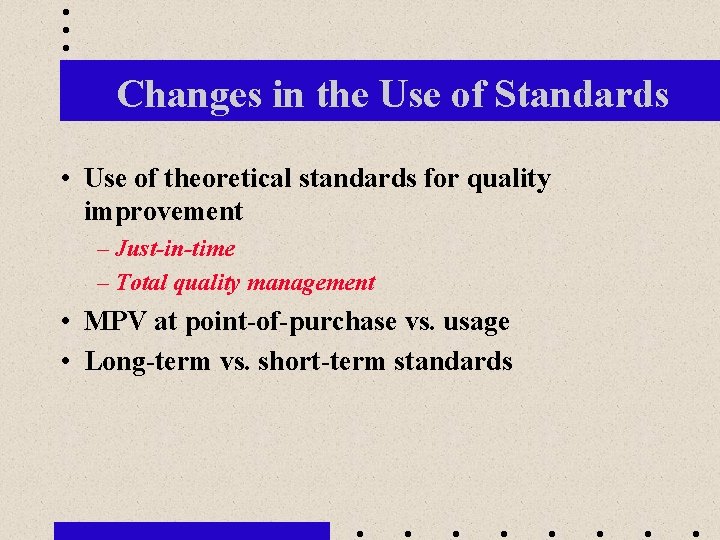
Changes in the Use of Standards • Use of theoretical standards for quality improvement – Just-in-time – Total quality management • MPV at point-of-purchase vs. usage • Long-term vs. short-term standards
Standard Cost System Journal Entries • Each variance is recorded in an account • Favorable variance – Credited – Represents cost reductions • Unfavorable variance – Debited – Represents excess costs • Inventories show standard costs
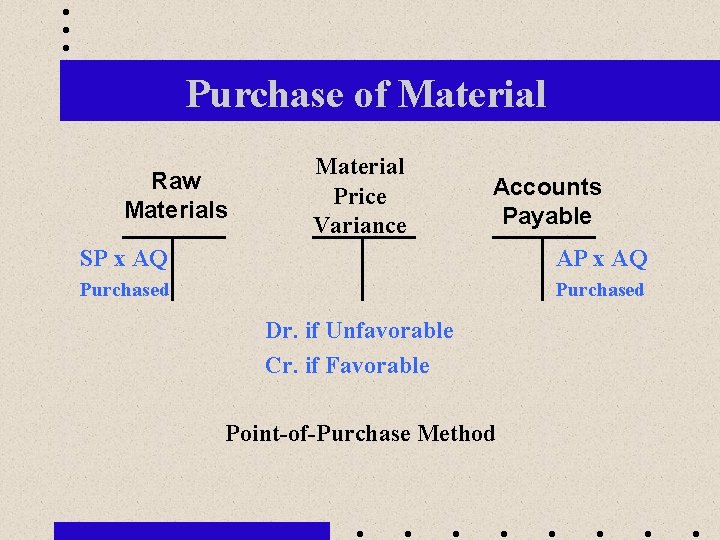
Purchase of Material Raw Materials Material Price Variance Accounts Payable SP x AQ AP x AQ Purchased Dr. if Unfavorable Cr. if Favorable Point-of-Purchase Method
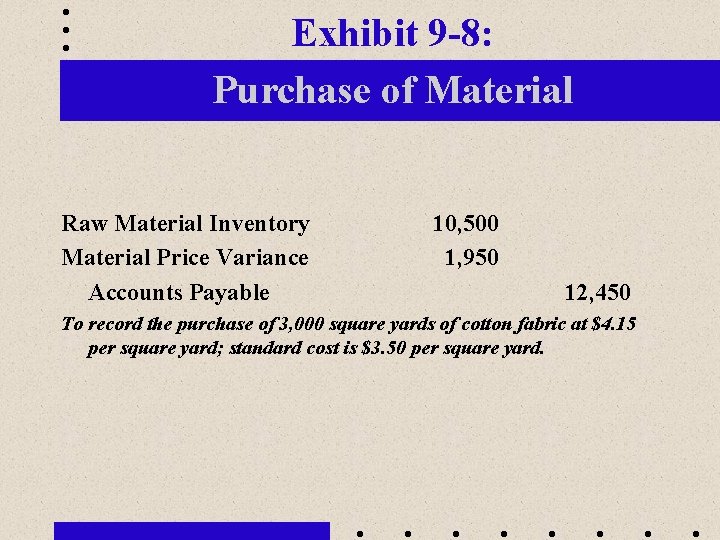
Exhibit 9 -8: Purchase of Material Raw Material Inventory Material Price Variance Accounts Payable 10, 500 1, 950 12, 450 To record the purchase of 3, 000 square yards of cotton fabric at $4. 15 per square yard; standard cost is $3. 50 per square yard.
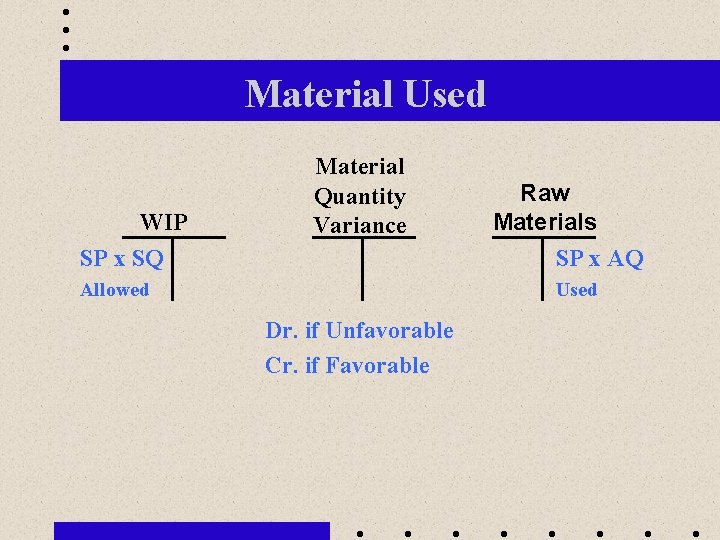
Material Used WIP SP x SQ Material Quantity Variance Raw Materials SP x AQ Allowed Used Dr. if Unfavorable Cr. if Favorable
Material Used WIP Inventory Material Quantity Variance Raw Material Inventory 9, 240 315 9, 555 To record the issuance and usage of 2, 730 square yards of cotton fabric for 2, 200 shirts; standard usage is 4. 20 yards.
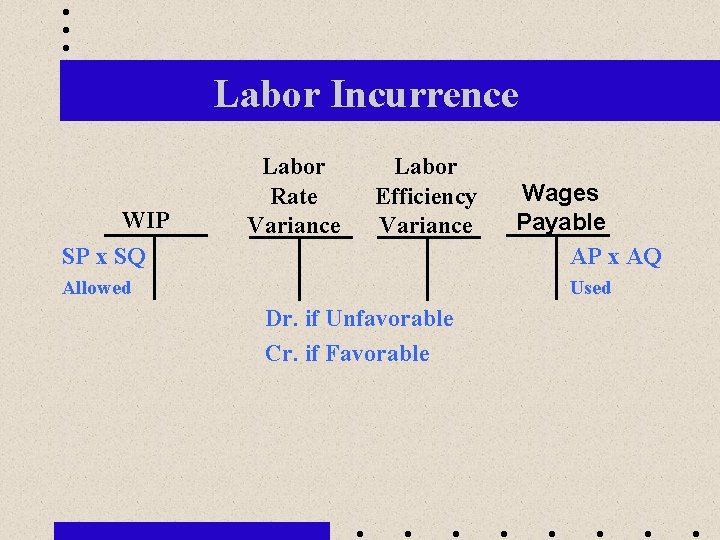
Labor Incurrence WIP SP x SQ Labor Rate Variance Labor Efficiency Variance Allowed Wages Payable AP x AQ Used Dr. if Unfavorable Cr. if Favorable
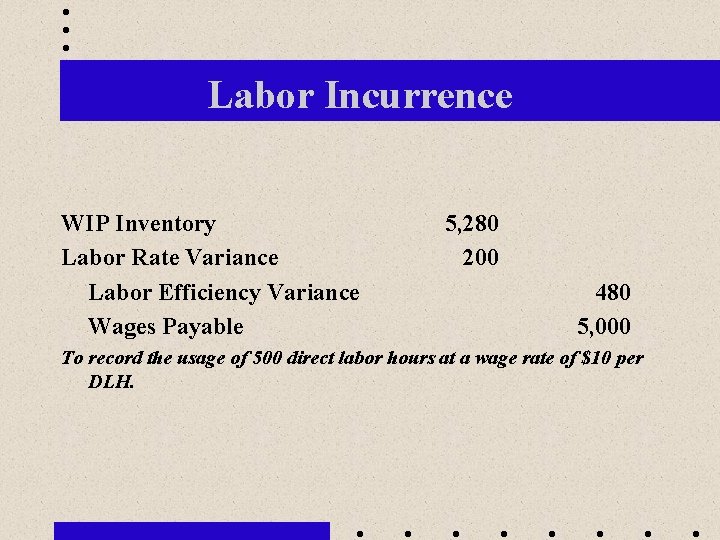
Labor Incurrence WIP Inventory Labor Rate Variance Labor Efficiency Variance Wages Payable 5, 280 200 480 5, 000 To record the usage of 500 direct labor hours at a wage rate of $10 per DLH.
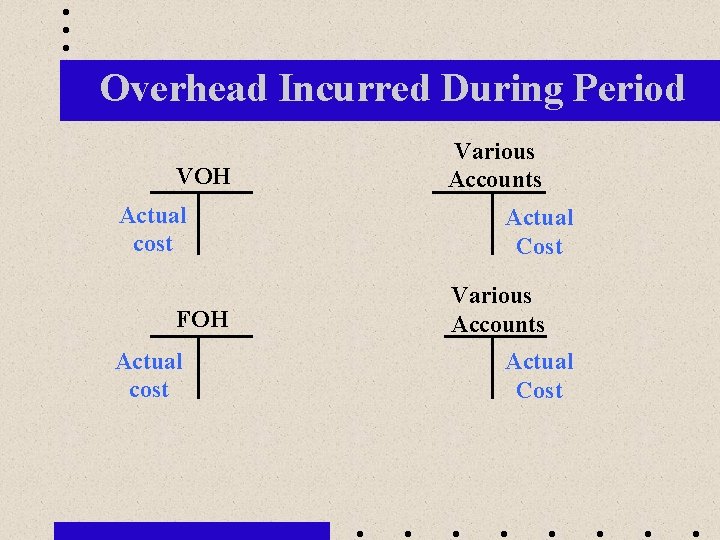
Overhead Incurred During Period VOH Actual cost FOH Actual cost Various Accounts Actual Cost
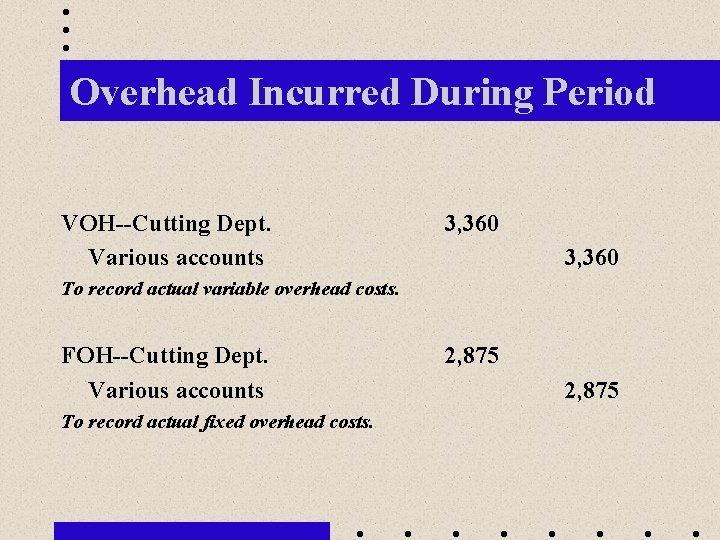
Overhead Incurred During Period VOH--Cutting Dept. Various accounts 3, 360 To record actual variable overhead costs. FOH--Cutting Dept. Various accounts To record actual fixed overhead costs. 2, 875
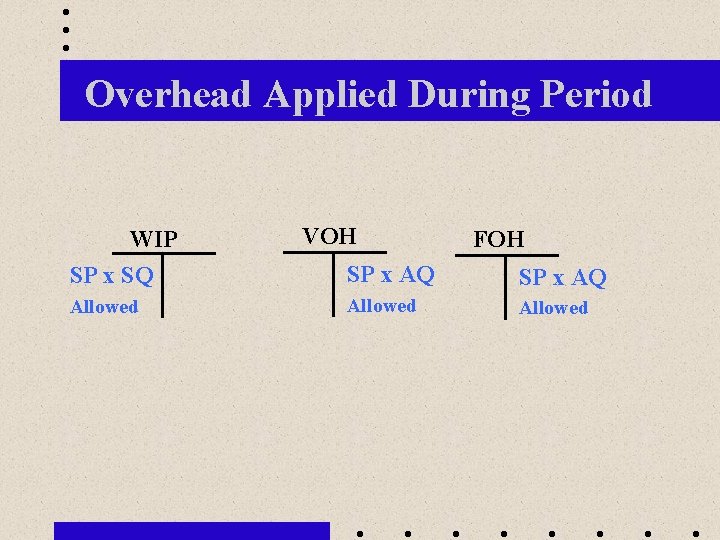
Overhead Applied During Period WIP SP x SQ Allowed VOH FOH SP x AQ Allowed
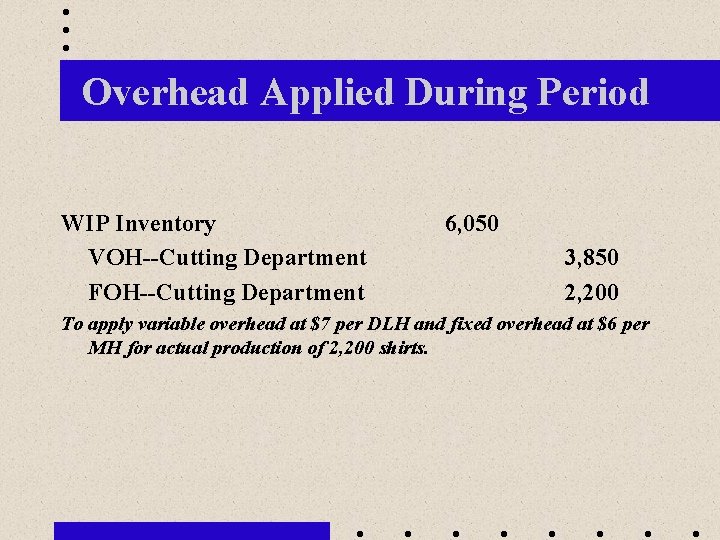
Overhead Applied During Period WIP Inventory VOH--Cutting Department FOH--Cutting Department 6, 050 3, 850 2, 200 To apply variable overhead at $7 per DLH and fixed overhead at $6 per MH for actual production of 2, 200 shirts.
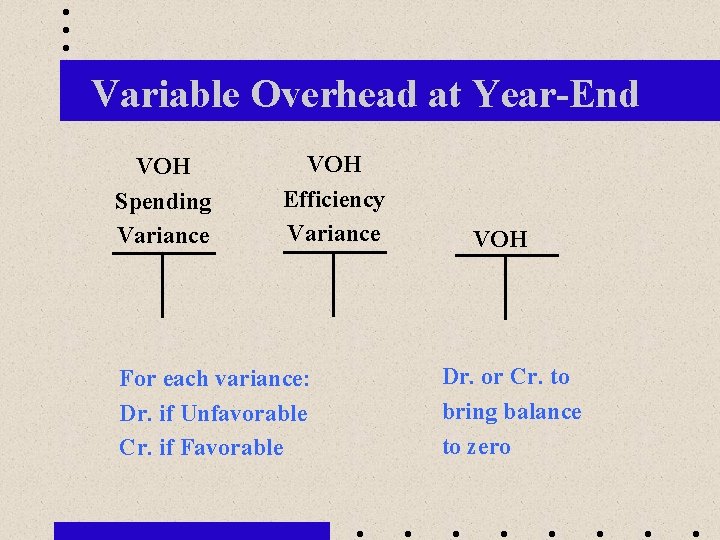
Variable Overhead at Year-End VOH Spending Variance VOH Efficiency Variance For each variance: Dr. if Unfavorable Cr. if Favorable VOH Dr. or Cr. to bring balance to zero
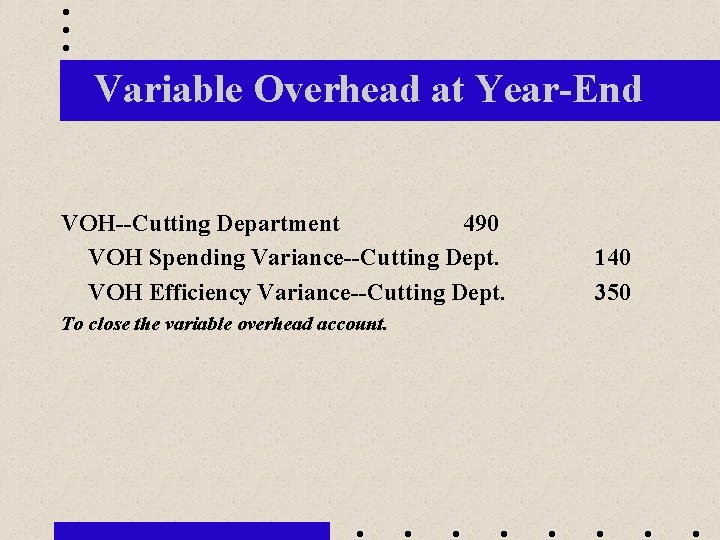
Variable Overhead at Year-End VOH--Cutting Department 490 VOH Spending Variance--Cutting Dept. VOH Efficiency Variance--Cutting Dept. To close the variable overhead account. 140 350
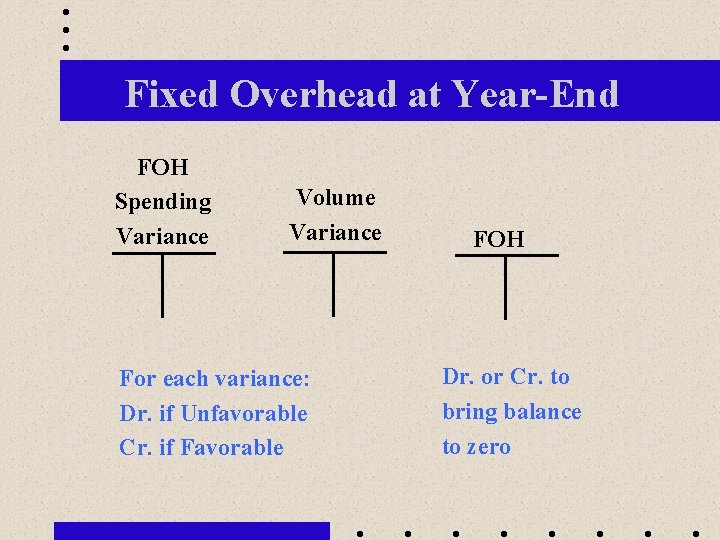
Fixed Overhead at Year-End FOH Spending Variance Volume Variance For each variance: Dr. if Unfavorable Cr. if Favorable FOH Dr. or Cr. to bring balance to zero
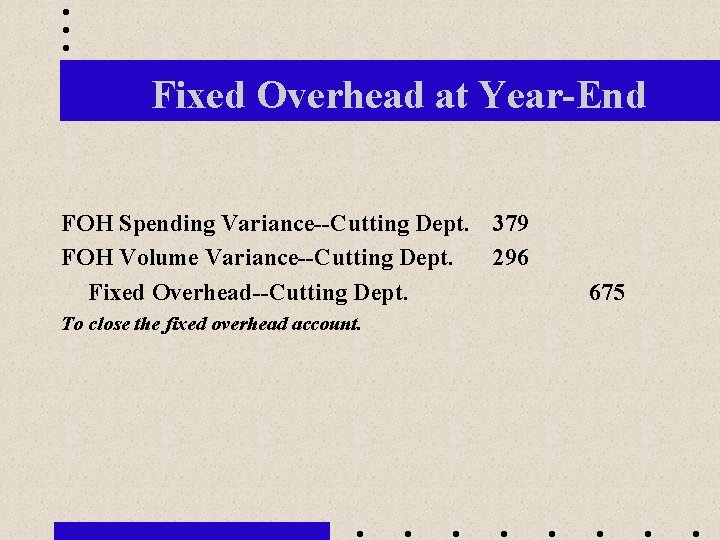
Fixed Overhead at Year-End FOH Spending Variance--Cutting Dept. 379 FOH Volume Variance--Cutting Dept. 296 Fixed Overhead--Cutting Dept. To close the fixed overhead account. 675
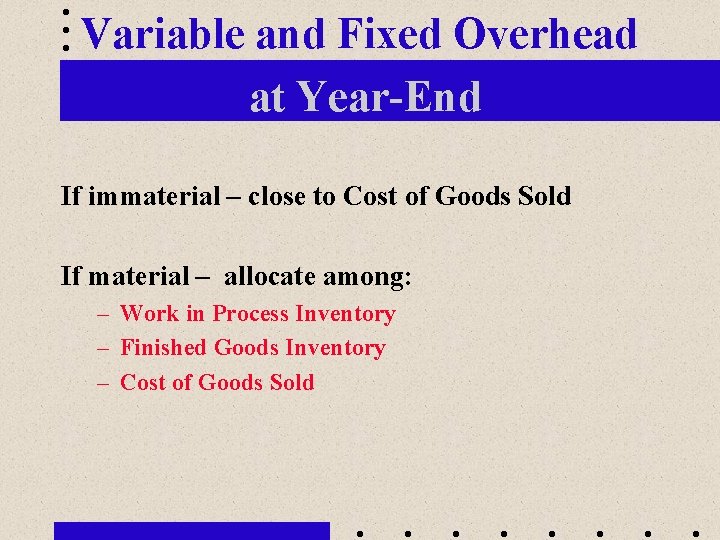
Variable and Fixed Overhead at Year-End If immaterial – close to Cost of Goods Sold If material – allocate among: – Work in Process Inventory – Finished Goods Inventory – Cost of Goods Sold