
Chapter 9 INTERLANGAUGE Q Explain interlanguage p 243


- Slides: 17
Chapter 9 INTERLANGAUGE
Q: Explain “interlanguage” (p. 243)
Q: Explain 4 stages of learner language development (p. 245)
Q: Why is it important to study “learners’ errors”? (p. 249)
Q: Explain the differences between “mistakes” and “errors” (p. 249)
Q: What are the sources of learners’ errors? (p. 250)
Q: Explain kinds of errors (p. 251 -252)
Q: What is “L 1 transfer/ cross-linguistic influence”? Any examples? (p. 254 -257)
Q: Explain universals and markedness features of language (p. 259)
Q: Discuss examples of intralingual transfer/overgeneralizaion (p. 260)
Q: Discuss examples of communication strategies (p. 262)
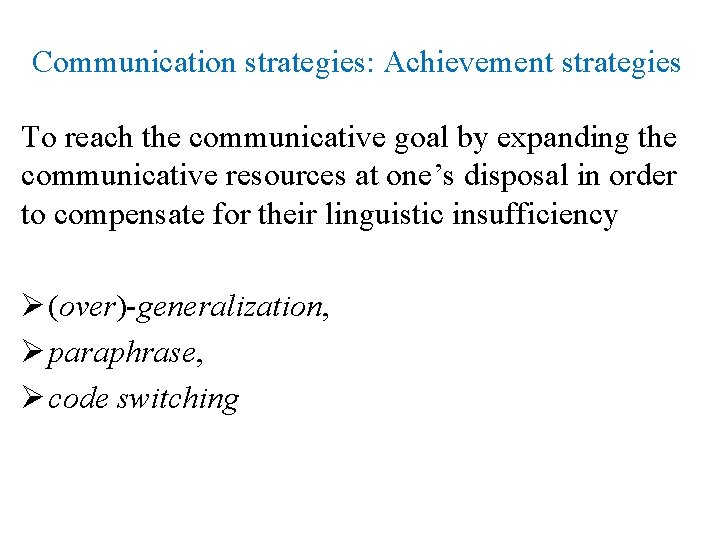
Communication strategies: Achievement strategies To reach the communicative goal by expanding the communicative resources at one’s disposal in order to compensate for their linguistic insufficiency Ø (over)-generalization, Ø paraphrase, Ø code switching
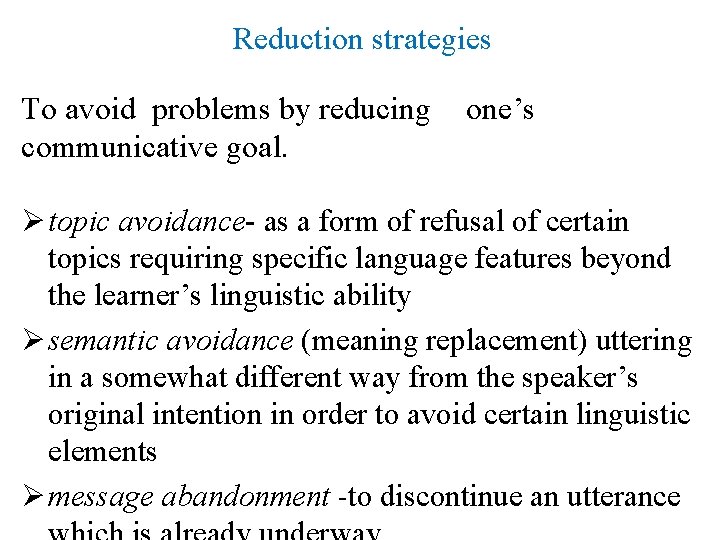
Reduction strategies To avoid problems by reducing communicative goal. one’s Ø topic avoidance- as a form of refusal of certain topics requiring specific language features beyond the learner’s linguistic ability Ø semantic avoidance (meaning replacement) uttering in a somewhat different way from the speaker’s original intention in order to avoid certain linguistic elements Ø message abandonment -to discontinue an utterance
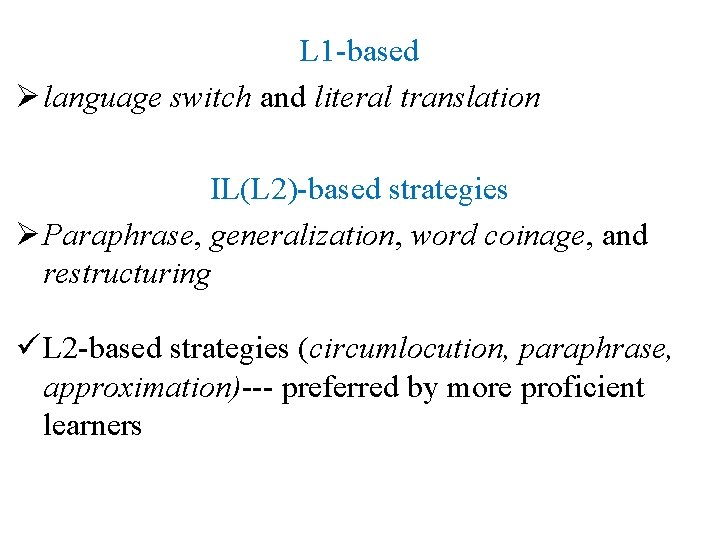
L 1 -based Ø language switch and literal translation IL(L 2)-based strategies Ø Paraphrase, generalization, word coinage, and restructuring ü L 2 -based strategies (circumlocution, paraphrase, approximation)--- preferred by more proficient learners
Q: Explain “fossilization” (p. 264) Q: How do items become fossilized? Q: What should we do as teachers?
Q: ü Explain the weak version and the strong version of “Form-Focused Instruction” (p. 271) ü Is FFI beneficial? How can we make this more effective? (p. 274)
Q: ü Explain different ways of feedback (p. 272) ü Which type of feedback is more effective?